Tropo Performance

Archive for the ‘weapons’ Category

Secretary of the Army Visits the Army’s Center of Excellence for Guns and Ammunition

Sunday, December 14th, 2025

PICATINNY ARSENAL, NJ — Secretary of the Army Dan Driscoll, Senior Official Performing the Duties of the Deputy Under Secretary of the Army David Fitzgerald, and U.S. Representative Thomas Kean Jr. visited Picatinny Arsenal on November 6 to see first-hand the innovative work being by the Joint Program Executive Office for Armaments and Ammunition (JPEO A&A), U.S. Army Combat Capabilities Development Command (DEVCOM) Armaments Center, and Office of the Project Manager Soldier Lethality as they strengthen the Arsenal of Freedom by increasing industrial capacity and bringing advanced technologies and improved lethality to the Warfighter. The visit was Driscoll’s first to Picatinny, which is designated as the Department of War’s Joint Center of Excellence for Guns and Ammunition.

The visit began with a hands-on demonstration of the lethality of the 6.8mm ammunition for the M7 Next Gen Squad Weapon. The rounds will be produced at the Lake City Army Ammunition Plant outside St. Louis in an interim capacity until completion of a new, state-of-the-art facility that is currently under construction. Sig Sauer is also producing the new rounds as a second source in Jacksonville, Arkansas. DEVCOM and JPEO engineers explained to Secretary Driscoll the various 6.8mm technical innovations and the new ammunition’s performance specs as compared to currently fielded 5.56mm and 7.62mm capabilities.

Developed collaboratively by the JPEO A&A, the DEVCOM Armaments Center, the Army Research Laboratory, the 6.8mm family of ammunition is specifically engineered to maximize the performance of the M7 Rifle and the M250 Automatic Rifle. When fired through these Next Generation Squad Weapons, 6.8mm rounds deliver increased range, improved accuracy, and enhanced lethality, ensuring Soldiers maintain overmatch on the battlefield.


Driscoll attended a working lunch where Maj. Gen. John T. Reim, Joint Program Executive Officer for Armaments & Ammunition and Picatinny’s Commanding General, and other senior leaders highlighted the diverse capabilities and critical missions of the major commands and tenant organizations at the installation, underscoring Picatinny’s enduring role in supporting joint force operations and sustaining combat power.

“I have had the privilege of doing nine ribbon-cutting ceremonies here in the past two years,” Reim said. “We are bringing new capabilities online. We are replacing legacy production methods and working closely with industry partners to develop modular, flexible production capabilities that can support a surge while maintaining efficiencies during downtimes.”

The visit continued with a bang as Driscoll witnessed a live fire exercise featuring the Purpose Built Attritable System (PBAS) and a TRV-150 drone dropping smoke and a M69 training grenade onto a target simulating a small group of enemy soldiers with a vehicle. This showed off one of DEVCOM’s latest innovations, the Picatinny Common Lethality Integration Kit or Picatinny CLIK, which defines the physical interface (mechanical attachment), electrical interface (power, network, messaging) and safety critical architecture between the ground station control and an unmanned aerial system (UAS) with lethal payloads, eliminating unique integration methods and costly acquisition conditions created by “vendor lock.”

“This ensures a rigorous, yet flexible, process for evaluating, qualifying, procuring, and ultimately fielding safe and effective weaponized UAS payloads to the joint force,” said acting Executive Director of the Armaments Center’s Weapons and Software Engineering Center, Bhavanjot Singh. “When we solicit industry for a capability, we will be providing Picatinny CLIK technical data so industry can focus on providing lethal capabilities without worrying nearly as much about integration.”

Following the live fire demonstration, Driscoll was shown more of the unique capabilities developed at Picatinny Arsenal by the DEVCOM Armaments Center and the Project Manager offices under JPEO A&A covering lethal UAS, counter-UAS munitions, advanced artillery, and next-gen energetics.

One highlighted counter-UAS capability was the airburst proximity fuze technology that was initially fielded in 30mm XM1211 High Explosive Proximity (HEP) for M-LIDS, providing the first medium caliber counter-UAS capability to theater. Leveraging the capability, the proximity fuze technology was scaled down to a 25mm form factor for the XM1228 Bradley Aerial Defeat Ground Enhanced Round (BADGER). BADGER provides organic C-UAS capabilities to the M2 Bradley Infantry Fighting Vehicle with no additional vehicle or weapon modification required.

“BADGER is a great example of how the Army’s acquisition enterprise is moving toward quicker returns by leveraging new ways of doing business, quickly innovating at the round, and leveraging existing weapons platforms to enhance the lethality of our Warfighters,” said Reim.

Another counter-UAS capability developed at Picatinny Arsenal and presented to Driscoll was the next generation Common Remotely Operated Weapon Station (CROWS). The implementation of a C-UAS capability for platforms with current or future CROWS allows for leveraging of existing 30mm and 40mm weapon systems and proximity-fuze ammunition, providing a low-cost kinetic C-UAS solution across multiple platforms.

Artillery innovations as part of the Army’s Long Range Prevision Fires line of effort are another critical capability area at Picatinny that was presented to Driscoll.

The M982 Excalibur is a 155mm Global Positioning System (GPS) guided precision cannon artillery munition compatible with 39-caliber, 52-caliber and 58-caliber artillery systems with reach distances of up to 40 kilometers, 50 kilometers and 70 kilometers, respectively. Excalibur was co-developed by Raytheon and BAE Systems Bofors and is currently in production to deliver projectiles to the US Army. The projectile is being evaluated for system upgrades to improve performance in GPS-jammed environments leveraging lessons learned and telemetry data from Ukraine.

The Extended Range Artillery Projectile (ERAP), also known as the XM1155 program, is a cutting-edge system of systems designed to deliver unprecedented lethality and range overmatch for 155mm artillery weapon systems. With ranges exceeding more than double those of legacy artillery cannons, the ERAP will be compatible with both current and future Army mobile howitzer systems. The ERAP program is being executed through the innovative Middle Tier of Acquisition pathway, which leverages both traditional and non-traditional suppliers. This approach fosters competition among industry partners and accelerates the prototyping of mature technologies, ensuring that hardware is delivered to Soldiers faster and more effectively.

The Modular Artillery for Combat Effectiveness (MACE) program was discussed, which is an effort to focus on making conventional artillery more manufacturable and modular. Enhanced manufacturability will reduce dependency on niche, government only production processes and leverage commercial production capabilities and capacity.

Following the tours and demonstrations, Driscoll presented coins to the various organizations.

The Secretary of the Army’s visit to Picatinny underscored the installation’s vital role in sustaining the force and arming the Army of the future. As the Army continues to modernize and adapt to evolving global demands, the various commands at Picatinny Arsenal remain a pillar of readiness – delivering the capabilities, expertise, and innovation that ensures our Warfighters and allies are equipped to succeed in any environment.

By Michael Chambers

Registration Now Open for 2026 US Army Small Arms Championships

Friday, December 12th, 2025

Registration for the 2026 U.S. Army Small Arms Championships is now open. The week-long, live-fire training event tests Soldiers’ skills in rifle, pistol and multigun courses of fire. There are also opportunities for Excellence in Competition points to be earned in both rifle and pistol.

This event is only open to Active Army, Army Reseves, US Army or Air National Guard, Military Academy, College ROTC Cadets and OCS Candidates.  Civilians and military personnel from other services are prohibited from participating in any event.

Register here before slots fill up.

Rheinmetall Awarded Contract for Trailblazer on the UK Multiple Launch Rocket System A2

Thursday, December 11th, 2025

Rheinmetall UK have been awarded a contract by the NATO Support & Procurement Agency (NSPA) to provide Trailblazer Driver Vision and Local Situation Awareness System to the UK Ministry of Defence’s M270 A2 Multiple Launch Rocket System (MLRS) platform upgrade. The initial contract will see prototypes delivered in early 2026, with the main production starting later that year. The total contract value is in the mid-single-digit million euro range. The M270 A2 MLRS will be the 17th military platform to use the Trailblazer, which was developed and manufactured in the UK. There are currently seven user countries.  

The upgrade programme for the M270 A2 MLRS tasks Rheinmetall UK to design and deliver enhanced Vehicle Vision capability against specific platform requirements. 

As a mature, software-defined and SIL(safety integrity level) 2-certified system, Trailblazer is already installed in the Boxer Mechanised Infantry Vehicle, the Challenger 3 main battle tank and the Warrior infantry fighting vehicle. This offers advantages through the standardisation of the entire British combat vehicle fleet. 

This programme will see the UK’s M270 A2 MLRS issued with the most modern and capable vehicle vision technology designed to aid vehicle manoeuvre in complex environments 24/7 for both driver and commander.  The programme responsibility includes driver vision sensors, remote side and rear vision sensors, delivery of installation kits including hardened cabling, switches and protective covers. 

Trailblazer improves crew effectiveness by extending the vehicle field of view beyond the daylight spectrum. With enhanced day light, thermal and fusion vision, Trailblazer offers significant crew advantage in adverse weather, obscured and low-light conditions. Featuring very low-latency, the systems aid terrain navigation, obstacle avoidance, safe route selection and enhanced threat detection.  Compliance with SIL-2, (N)GVA and DEF STAN 00-82 video distribution means Trailblazer is safe to operate and easy to integrate.

USSOCOM Cancels LMG-A Effort, For Now

Wednesday, December 10th, 2025

USSOCOM has updated the call for white papers issued in March of this year for their Lightweight Machine Gun – Assault effort with the following statement:

PEO-SW PM SOF Lethality has adjusted the LMG-A Prototyping Project.  SOF AT&L-KR will no longer be moving forward with the prototyping effort.  Instead, the Navy Crane Contracting office will restart the effort.  That said, expect something to be announced by that office in the very near future. 

This Other Transactional Agreement procurement effort was intended to seek out a life cycle replacement for the MK48 Light Machine Gun (LMG) chambered in 7.62 NATO, with the future intent to adopt other calibers such as 6.5mm Creedmoor, but not limited to, as a multi-caliber / intermediate caliber machine gun.

The system was envisioned to include a lightweight, belt fed, fully and semi-automatic weapon system, including a primary barrel, spare barrel, buttstock, receiver, sound/signature suppressor, operator manual, cleaning kit, operator tool kit, maintainer tool kit, spare parts kit, training munition kit, bipod, backup iron sights, and a Transportation Security Administration (TSA) approved locking hard carrying case

SIG SAUER P320 Will Serve as the Swiss Armed Forces Official Sidearm

Tuesday, December 9th, 2025

NEWINGTON, N.H., (December 8, 2025) – SIG SAUER is proud to announce the P320 was selected by the Swiss Armed Forces to serve as their new standard issued sidearm. The selection is a critical component of the Swiss Armed Forces New Generation Project, demonstrating Switzerland’s commitment to soldier focused modernization.

The Armasuisse competitive selection process required extensive technical testing and field trials centered on user feedback with a comprehensive focus on safe, reliable operation.  SIG SAUER is truly honored by Armasuisse’s selection and validation that the P320 meets the stringent quality and precision demands of the Swiss Armed Forces.

Armasuisse’s highly competitive process sought a pistol with modern ergonomics, modularity, and the ability to reliably meet a 30-year service life and operational support demands.  The P320 is one of the most adaptable pistols on the market; it is customizable to meet the ergonomic preferences of a variety of soldiers and accepts a wide range of compatible enhancements and accessories.  The P320’s precision and reliability make the platform extremely well suited for the dynamic and unique needs of the Swiss Armed Forces and their traditional citizen-soldiers.    

The P320 consistently meets and exceeds the stringent expectations of armed forces around the world, including the militaries of the United States, Australia, Denmark and Canada.  We are proud of SIG SAUER AG for this incredible achievement and honored for the opportunity to expand our manufacturing footprint in Switzerland and meet the incredible demands of the Swiss Armed Forces.

To learn more about SIG SAUER, please visit sigsauer.com.

Saab Receives Order for Mobile Air Defence from Lithuania

Tuesday, December 9th, 2025

Saab has received a third order for the Mobile Short Range Air Defence (MSHORAD) system from the Lithuanian Defence Materiel Agency. The order value is approximately SEK 1.4 billion with deliveries 2026-2030.

Saab will deliver a third battery of the MSHORAD to the Lithuanian Armed Forces. The system will be integrated by Saab into the JLTV 4×4 vehicles manufactured by Oshkosh.

“We are proud to continue contributing to keeping the Lithuanian skies safe. Our mobile air defence system can withstand even the most advanced countermeasures, giving the user the capability to plan for the expected and to successfully react to the unexpected,” says Görgen Johansson, head of Saab’s business area Dynamics.

MSHORAD is Saab’s vehicle-integrated mobile air defence solution, which acts as a protective shield for moving units. It consists of mobile radar and firing units based on the RBS 70 NG short-range air defense missile and the Giraffe 1X radar, all connected with a command-and-control system (GBAD C2) and datalink by a communication solution between the units. It offers quick and effective detection, identification and engagement of aerial threats.

Swiss Army Selects SIG P320 as New Sidearm

Monday, December 8th, 2025

Replacing their SIG P220 Pistol in service for 50 years, the Swiss Army has selected the SIG P320.

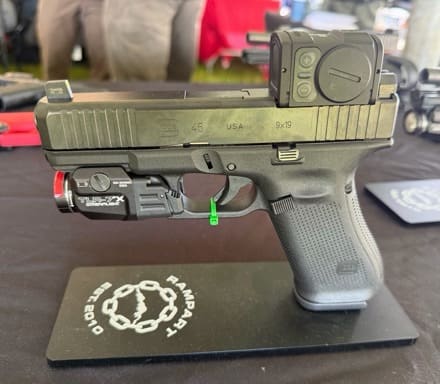
According to the Federal Armaments Office Armasuisse candidate firearms from Glock (G45 Gen 5), Heckler & Koch (SFP9) and SIG SAUER’s P320 were subjected to “intensive and comprehensive technical testing, a troop trial and the examination of logistical aspects.”

The Army plans to purchase 140,000 pistols and the initial order of 50,000 has been placed.

Below is a translated statement from SIG SAUER Switzerland:

SIG SAUER Delighted to Win Pistol Procurement Contract

Neuhausen am Rheinfall, December 4, 2025

SIG SAUER AG is extremely pleased with armasuisse’s decision to select the P320 pistol as the new service pistol of the Swiss Army. This contract is a strong commitment to Swiss industry and an important milestone for our site in Neuhausen am Rheinfall.

With SIG SAUER’s network of several hundred suppliers in all regions of the country, all relevant components of the new pistol can be manufactured and serviced entirely in Switzerland.

This strong Swiss presence and correspondingly high, sustainable added value guarantees quality, security of supply, and rapid production availability.

Pasquale Caputi, CEO of SIG SAUER AG, commented: “We are proud and grateful for the trust that armasuisse has placed in us. The decision strengthens Switzerland as an industrial location and motivates our entire team in Neuhausen am Rheinfall.” We will work with the utmost precision and full commitment to reliably meet the army’s requirements and deliver a highly reliable, safe product to the troops.

The new Swiss pistol combines modern technology, high durability, and precise handling – and stands for Swissness, quality, and a long industrial tradition at the Rhine Falls.

The technical and ergonomic adjustments required following troop trials will be fully implemented.

The entire team in Neuhausen is looking forward to implementing this important project and to the expanded collaboration with armasuisse and the Swiss Army.

Initial Gen 6 Glock Details Dropped

Monday, December 8th, 2025

After a reported five years of development, Glock Inc. has released an initial overview of the Gen 6 series of pistols.

Initial offers are all 9mm models: the Glock 17, Glock 19, and Glock 45.

New Glock Gen6 disassembled

The announcement, captioned ENGINEERED FOR YOU, was published across the range of Glock’s social media channels, with a fairly simple message:


Introducing the 6th Generation of GLOCK pistols. Gen6 is engineered for you.

The Gen6 line brings you purpose-driven ergonomics with a refined optic ready system. The models included are the G17 Gen6, G19 Gen6, and G45 Gen6, chambered in 9mm.


Few details were officially available, though an expected formal release this week (if not today) should rectify that.

We do know a few things about the new Gen6, including the following features:


  1. An updated palm swell intended to contour the pistol to the natural curvature of the hand. We’ve seen several reports that Glock went so far as to measure the majority of their employees’ hands as part of the design process, though nothing (yet) on how those measurements were quantified and utilized by the engineers.
  2. A new grip texture: RTF6, which combines elements of previous textures (RTF2 and RTF4) to create the “…perfect blend of performance and comfort.”
  3. An enlarged beavertail. This obviously encourages a higher master grip and protects from slide bite.
  4. A ridge or “fence” around the slide stop lever, or as Glock puts it, a “Slide Stop Lever Enlarged Border.” This is meant to mitigate or prevent unintended activation.
  5. A “thumb rest.” This is for all intents and purposes a “gas pedal” type feature, which allows better control of the weapon during recoil (and is a favorite among competitive shooters).
  6. Deeper, more overt slide serrations. These are angled deeper intot he slide to make the surface engagement more tactile for slide manipulation.
  7. Undercut trigger guard. This is something people have been asking about for years. It may well eliminate “Glock Knuckle,” which might seem like a minor thing but is – at least for Glock shooters who routinely put a lot of rounds downrange – anything but.
  8. A flat-faced trigger, with the obligatory Safe Action System.
  9. An RDS-mounting system that provides for what Glock describes as “direct mounting” to the slide. Each pistol will ship with three polymer optic plates that together provide fitment for most common optics and act as what’s been described as a “shock absorber.” As a result of the new optic system, MOS Glock models are no more.


Additionally, we know the following:

  • They are returning to a single recoil spring design.
  • This is not a modular design in the context of a serialized fire control part of some kind.
  • They have not changed their stock sights. While this will be a point of contention for many, others will note the increasingly ubiquitous use of pistol optics as a defense, not to mention the tendency of so many shooters to replace the stock sights of any pistol with a style they prefer…though this may be rebutted in turn by acknowledging that better stock sights might reduce the demand for replacements in the first place. This will be argued about a lot, whether the pistol’s other features prove to be an improvement or not.
  • The cost of the Gen6 will purportedly be the same as that of the Gen 5.
  • Though other models will be released, the G47 will not be one of them. That’s because the G47 is not the G17 is the G47 (and so on).
  • The magwell is flared for faster reloads.
  • The accessory rail remains unchanged.
  • Available optic footprints include Trijicon RMR, Leupold DPP, and C-More.
  • Internals are not completely identical to the V series of handguns, but they’re close.
  • The Gen6 is not believed to be backwards compatible with its predecessors, though that might not be the case with the magazines (or at least those of the Gen 5).
  • A large number of extant holsters will take the Gen6, but not all of them.


The gun ships with an assortment of accessories, including three magazines, a cleaning set, two backstraps that can be used to more closely fit the weapon to your hand, and three optic plates.

In short, most of the changes made to the Gen6 overall design appear to be predicated on solving common complaints about previous versions. They will definitely reduce the amount of DIY work and workbench modification so commonly seen in the past. The new guns have some expected features as well as a few unexpected features, none of which will be sufficient to prevent a vast outpouring of dissatisfaction from the internet-cognoscenti who are all too eager to share their knowledge and opinion.

As is usual, unfortunately, with any new gun.)

Note: this sort of “drive-by commenting” should not be conflated with the measured, intelligent delivery of questions, observations, or concerns).

Anyway, we’ll know soon enough (43 days and counting down as of this writing) whether the gun deserves hype or derision or something in between.

Glock seems happy with the new gun, arguably more so than in generations past, though that’s obviously difficult to determine from outside the walls of their facility in Smyrna.

We’re advised by Larry Vickers that the following missive was sent out by Glock to their workforce:

According to Larry Vickers, the following missive was sent out by Glock to their workforce:


Dear Glock Employees,

GLOCK is proud to announce the 6th Generation of GLOCK pistols. The Gen6 line of products delivers enhanced ergonomics for increased usability and comfort with a unique optic ready system. The models included are the G17 Gen6, G19 Gen6, and G45 Gen6, chambered in 9mm Luger.

The 6th Generation of GLOCK pistols are engineered for you. Each detail is meticulously calculated with the user in mind, delivering enhancements that feel intuitive. The Gen6 line brings you purpose-driven ergonomics with a refined optic ready system.

“For nearly four decades, the pursuit of perfection has guided GLOCK in focusing on what truly matters: safety, reliability, and our commitment to our customers. The Gen6 pistol line continues that commitment. We’re not chasing trends. We’re moving forward thoughtfully, with the same uncompromising standards that define every GLOCK product.“ – Carlos Guevara, GLOCK Inc., CEO.


The new pistols should be commercially available on January 20, 2026 – which is, no doubt not coincidentally, the first day of the 2026 NSSF SHOT Show. 

You can learn more on this subdomain of the Glock website, in this Glock Gen 6 rundown, or in one or more of several videos that are coming out on YouTube.

You might check back here occasionally over the next few days, as we hope for a more in-depth formal release to be available soon.