“If you know the enemy and know yourself, you need not fear the result of a hundred battles. If you know yourself but not the enemy, for every victory gained you will also suffer a defeat. If you know neither the enemy nor yourself, you will succumb in every battle.”
? Sun Tzu, The Art of War
I have used the first sentence of this famous Sun Tzu axiom before. The entire quote provides a more complete framework for a professional soldier to consider. In terms of knowing the enemy, Sun Tzu advocated that a General [leader] focus a great deal of effort on gaining superior intelligence while denying the enemy similar information. That is sound advice for any military leader. However, I am not going to talk about that aspect of the art of war today. Instead, I want to talk about the arguably even more critical “knowing yourself” element of the equation. In many ways, it is the harder of the two to master. Harder, because it first requires a leader to develop and – over time – hone his or her self-awareness and self-reflective skills.
Certainly, throughout a career, a wise leader will routinely seek the perspective and advice of others about his or her performance – formal and informal. That aspect of professional development is also very important. Still, I consider that a follow-on step in the process and will leave it for another time as well. The best start point, in my professional opinion, should always be a brutally honest self-assessment. A thorough and candid appraisal of personal strengths, weaknesses, skills, and idiosyncrasies that must be, likewise, continuously updated as a leader gains better self-perception. I will share some of my personal experiences as examples to illustrate. I admit up front that I was rarely as self-aware as I am now in hindsight. I wish I had known in the beginning what I know now. Unfortunately, that is not how it worked for me; but, perhaps, this article will inspire others to seek to know themselves better – and sooner – than I did. Keep in mind, that regardless of source, an assessment is of little value until it is internally “operationalized” to reinforce the positives and address any negatives.
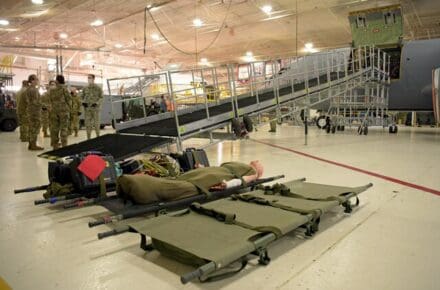
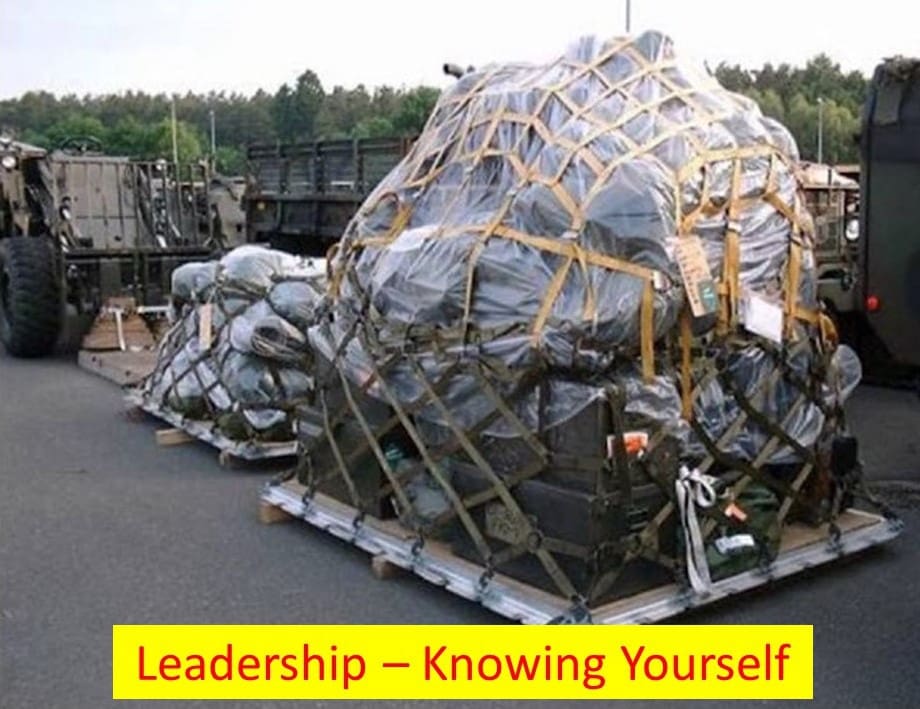
When I started my journey, I was not completely clueless. I knew early on that I wanted to be good at my job and was ready and willing to work at it. I took advantage of every training opportunity available to me and taught myself as well by intently studying the relevant manuals. At this point, the reader is probably starting to wonder what this has to do with the generic picture of the 463L Pallets above? It is simple. I really like building pallets. I always have. I built my first in Germany in the winter of 1975. Our Infantry Company was rotating to Berlin for MOUT training and I was part of the detail tasked to build and load our accompanying pallets on C130s. It impressed me that a loose pile of footlockers, duffel bags, and other gear could be so quickly organized into a symmetrical air-worthy load. As a Pathfinder, I received formal training on how to build pallets correctly and also taught classes on the subject to other units in the Division. Later, at Fort Lewis and then Schofield Barracks, I ran details building pallets for battalion-sized deployments. Belatedly, at Fort Bragg, I eventually received more training on all things air-movement by completing a Load Planners Course.
No matter how senior I got, if I saw a pallet that needed building, I jumped on it – literally. I did not care to just supervise on the sideline. I enjoyed the constructive process of manhandling hard and soft items like tuff boxes and kit bags, etc., and eventually getting that final stable cube configuration. It was fun for me and, frankly, I never gave it much thought beyond that. That changed in the late fall of 1997. I was nearing the end of my command of Alpha Company, 1st Battalion, 3rd SFG. We were getting ready to come back to Fort Bragg from a desert training iteration in an austere satellite facility of Fort Bliss. We had a half dozen empty pallets pre-positioned and were going to build the loads the next day. My Company SGM came to me that evening to confirm that all the teams were ready to go in the morning. He looked at me a little sheepishly and said that the Team Sergeants had asked him to do one thing. That was “keep Major Baldwin at least 50 meters away from the pallets.”
That caught me by surprise. I was not mad about it. We had been together for almost 18 months and they knew me well. I understood that they were just giving me some good-natured ribbing about one of my obvious eccentricities and they expected me to take it with good humor. It was kind of funny. So, the next day, I watched the pallets being built through a window from inside a building. I was missing the fun! That actually bothered me more than I thought it would. It made me think. Why did I like building those pallets so much? I did not find an immediate answer. With my follow-on tour at Leavenworth and then the schoolhouse at Camp Mackall, I did not even see a pallet again until after 9/11. During GWOT I did get to build a few more pallets from time to time. I still liked it, and by then I had done enough introspection to know why.
I got satisfaction from the process of solving what was essentially a life-size puzzle. Taking the individual pieces and fitting them together into a new coherent form. I eventually realized that building the pallets was something of a mental exercise that actually made me a better leader. After all, a lot of leadership involves building plans and making decisions – solving puzzles – without knowing exactly what the final end product will look like. So, in this case, my pallet quirk was indicative of a beneficial positive attribute that served me well over the years. Of course, it was still a little weird. Over time, I also became acutely aware of some of my other personality traits like impatience and temper that were two-edged swords. I came to understand that as long as I kept them under control and channeled that energy towards positive goals, they helped drive me forward and were useful. In that sense, they served me well. Yet, there was always the danger of a counter-productive emotional explosion that I learned to constantly guard against. I was successful more often than not, but it was a perpetual struggle.
I had a few more epiphanies during other assignments. In 1978-80, I was stationed at Fort Lewis, Washington. It was the time of the infamous post-Vietnam “Hollow Army” – for those that can remember that far back. The 9th Infantry Division at Lewis was the lowest priority of the 18 divisions in the Army at the time. That meant that we had only a fraction of the soldiers and leaders we were authorized on paper. The practical result was that the Rifle Company I was assigned to had only two officers. A First Lieutenant who was the Company Commander, and a 2nd Lieutenant who was the XO. We had only one SFC and he was the First Sergeant. The Weapons Platoon (TOWs and 81mm Mortars) and two of the Rifle Platoons were led by Staff Sergeants. I was a Sergeant, E-5, with just two years in grade when I got there; yet, I was the most senior and experienced sergeant in the company. Therefore, for almost a year, I led the 2nd Platoon. The platoon had one other sergeant and a corporal and, including us NCOs, a grand total of 18-20 men present for duty during my entire tour.
Despite the challenges, that job was a wonderful leadership laboratory for me and an invaluable professional development experience. I learned more about myself and leadership in general during those months than in any other assignment. I was proud of that platoon. We got pretty good at doing more with less. At one point, we were practicing for a company raid on a small MOUT facility. We spent two days on the site practicing various techniques. On the third day, the company issued the raid order. In it, my platoon was tasked to establish a blocking position on the road intersection a couple of hundred meters away from the site. I was livid. I went to the Company Commander and asked for a mission change. I wanted us to be part of the assault element – not on the sideline.
I pointed out that my guys had performed at least as well as the other platoons during the train up. In fact, I thought we had done better. My CO agreed. Then he explained that he had made his decision based on three factors. First, the site only had 6 buildings and was too small for all three platoons to realistically maneuver simultaneously and the intersection needed to be blocked in any case. Second, he had observed that my platoon had done well and he figured that the other two platoons needed the additional training more than we did. Third, just as would be true on a real-world raid, he needed to be on the objective. Therefore, he had to have confidence that the leader responsible for the blocking position would be able to handle any likely contingencies without additional guidance. He said, “that is why I picked you.” I was still not entirely happy, but I could not argue with his logic.
That situation gave me a lot to think about. It was not the first time I recognized that I always had the compulsion to be in the middle of any action. My CO had me pegged. I wanted my team to take the hardest missions that mattered the most. I liked making the tough decisions, appreciated maximum autonomy, and was comfortable with ambiguity. In other words, I was invariably motivated to move to the sound of the proverbial guns – with or without orders. That realization not only gave me insight into what kind of leader I was, it also told me where my career needed to go. That eventually meant seeking a commission and later Special Forces duty. It turned out that I was a pretty good fit for that kind of organization and those specific leadership challenges.
One more. This is a Ranger School story. When I was in Florida, I had a minor dental issue with a filling and they took me to the Eglin AFB dental clinic. No Ranger Cadre stayed with me so I was under no supervision. There were soda and candy machines in the waiting area but any food item that was not issued to us was expressly off-limits. I never approached the machines. More importantly, although I was tired and the whole process took about 3 ½ boring hours, I never slept. My teammates were already out in the swamp patrolling and my only mission was to get myself fixed and rejoin them as quickly as possible. I took my duty to my team seriously. Readers of some of my other articles have probably noted that I am not afraid to dodge, bend, or even break, rules if I think it is vital to achieving mission success. Not all rules are created equal.
However, I do NOT believe in cheating on tests. In formal training venues like Ranger School, the standards are established specifically to test soldiers. If I could not meet those standards honestly – with my integrity intact – I would always know that my Tab was tainted and not entirely legitimate. Even if no one else ever found out. Sneaking a nap or a candy bar would have been entirely self-serving and was not going to help me get a passing grade on a patrol or ultimately to graduation. I also had confidence in myself. I knew I did not need to cheat to meet the demands of the school. And I sure as hell was not going to risk getting dropped over a candy bar! I never shared this story with anyone at the time. There was no need. Maintaining my discipline when nobody was looking was just a small victory for me to appreciate. Given that I was an experienced leader by that time, it would have been out of character for me to do anything less. As a side note, I did get a chance to shower and put on a clean uniform before they took me to the clinic – that was pretty nice.
Those are just a handful of the thousands of data points I collected during my career that gave me the unblinking and penetrating look at myself that I needed to evolve. It was certainly not all flattering. Be prepared for that. Solving the puzzle of who you are – and who you are not – is a continuous job for any leader. It does not happen overnight. Think of the 463L now as a metaphor. The enduring task is to fit all your traits – the good and the problematic – onto one metaphysical pallet in order to put the puzzle together and fully know yourself. Ultimately, building a solid professional structure that will improve with age, travel well, and successfully endure all the trials of leadership. Every good leader has to learn how to thrive and not just survive with whatever talents and liabilities that they are blessed or cursed with. In short, a leader is going to be more successful if he or she gets and keeps their own personal shit reasonable tight first!
Finally, always remember that leaders are just one part of an organization. It is not necessary or possible to do everything on your own. Learn to rely on the rest of the team. Cultivate some mentors and coaches for yourself. Be ready and available to provide the same service for your soldiers. Build your team. Develop your subordinates as you improve yourself. Even as relatively senior leaders, we rarely have the option to choose all of our teammates; but I suggest taking advantage of any opportunities that might present themselves to pick as many as you can. Try hard to get people who are smarter and better than you. For best results, strive to team up with people that complement your strengths and/or compensate for your weaknesses. Make sure at least a couple are honest brokers that will tell you when you are wrong. Usually, your senior NCO is that kind of trusted interlocutor. An Executive Officer, 2IC, or Deputy should be another. Take any personal or professional setbacks in stride. I do not know any successful leader who traveled a perfectly straight line to where they wanted to be. Good luck on your journey!
De Oppresso Liber!
LTC Terry Baldwin, US Army (Ret) served on active duty from 1975-2011 in various Infantry and Special Forces assignments. SSD is blessed to have him as both reader and contributor.