GORE-TEX Professional

American Rheinmetall Systems Joins American Rheinmetall as a Unified Business Entity

July 9th, 2025

American Rheinmetall Systems (ARS) is pleased to announce that it will now operate under the unified name American Rheinmetall, aligning with the company’s broader strategy to streamline operations, enhance collaboration, and deliver greater value to its customers across the defense industry.

This move strengthens American Rheinmetall’s position as a leading U.S. defense partner by integrating the exceptional capabilities of the Biddeford, Maine team into the broader American Rheinmetall enterprise. The change does not impact current contracts, programs, or services secured by American Rheinmetall Systems. Existing customers will continue to receive the same world-class support as part of a more connected, large scale, and capable organization.

“American Rheinmetall Systems has long been a cornerstone of Rheinmetall’s U.S. operations proudly operating in Maine where we are committed to remaining and growing,” said Matt Warnick, CEO of American Rheinmetall. “ARS has a deep legacy of innovation and expertise that will continue to thrive while new opportunities for synergy and growth will arise for the Biddeford facility as part of the larger American Rheinmetall enterprise.”

With decades of experience in electronic mission systems and components, the Biddeford team supports next-generation modernization priorities for the U.S. Armed Forces. As a leader in the development and production of crew-served and vehicle-based EO/IR systems, remote weapon station components, airburst ammunition programing units, and counter-UAS solutions, among other technologies, the company adds tremendous value to American Rheinmetall’s growing portfolio.

“Bringing ARS into the core of American Rheinmetall reinforces our commitment to delivering solutions for combat readiness as a prime OEM and Tier 1 supplier focused on Army modernization and American Manufacturing,” added Jason Atkinson, President of American Rheinmetall.

This natural transition marks an exciting step forward in American Rheinmetall’s continued growth, adding scale, capabilities, and synergy that drives new opportunities across the enterprise.

www.rheinmetall-us.com

Darley Welcomes Jim Johnson to Fire Advisory Board

July 9th, 2025

ITASCA, IL – July 9, 2025Darley, a leading provider of defense, fire, and emergency services equipment, is pleased to announce the appointment of Jim Johnson to its Fire Advisory Board. Jim Johnson brings a wealth of industry experience and expertise in serving the fire industry.

Jim Johnson served as President of Pierce Manufacturing from 2010 to 2023. He also served as an Executive Vice President of Oshkosh Corporation and President of Oshkosh’s Fire & Emergency business segment with responsibility for the Frontline, Maximetal and Oshkosh Airport Products brands in addition to Pierce. Most recently, Jim served as the President of the company’s Vocational business segment with the added responsibility for Oshkosh’s refuse vehicles, airport ground support equipment, utility, and concrete truck brands in addition to his Fire & Emergency responsibilities before retiring in 2024. Jim started his career in Indianapolis as an attorney practicing commercial litigation.

“We are truly honored and proud to have Jim Johnson join our Fire Advisory Board,” said Paul Darley, CEO of Darley. “We have been business associates and close friends for almost 20 years. He is a strategic visionary with an eye toward innovation and people. Under his leadership, Pierce grew to be the largest company in the fire industry. Jim’s combination of operational experience, legal mindset, executive presence, sound ethical corporate governance, and industry experience make him an invaluable board member.”

Robotican Announces Delivery of Dozens of ROOSTER Hybrid Drone Systems to European Special Forces

July 9th, 2025

Combat-proven ROOSTER system recently secured official NATO registration, reinforcing its operational credibility and alignment with allied defense standards.

Omer, Israel – 8 July 2025 – Robotican, a leading Israeli pioneer in the development of autonomous robotic and drone technologies, proudly announces the successful delivery of dozens of ROOSTER hybrid drone systems to European special operations forces, intervention units, and infantry teams.

These deliveries represent a significant operational milestone for Robotican’s flagship system. Building on this momentum, the ROOSTER has recently secured official NATO registration, reinforcing its status as a trusted solution that meets the requirements and standards of NATO military forces.

The ROOSTER is a compact, hybrid tactical drone that merges aerial agility with robotic ground mobility, making it uniquely suited for indoor, subterranean, and GPS-denied environments. Its ability to rapidly shift between flying and rolling allows for energy-efficient operation in complex and confined spaces. The integrated protective cage enables a unique robotic rolling capability, allowing the ROOSTER to maneuver across challenging terrains and access confined areas that are inaccessible to conventional drones. The system is capable of extended missions, with a typical 90 minutes of overall active operation and up to 5 hours in standby mode. It features robust MESH communication that enables up to three ROOSTER units to work together as a team—even in environments with no external communication. The Rooster is equipped with a built-in day/night IR sensitivity camera and visible/IR illuminators.



Designed for flexibility, the ROOSTER supports a range of swappable sensor payloads, including thermal imager, oxygen and radiation detectors. These capabilities make it ideal for a wide range of missions, including tactical reconnaissance, urban search & rescue, hazardous materials response and industrial safety inspections. Lightweight, rugged, and operable by a single user, the system can be deployed quickly from a tactical backpack, offering forces immediate situational awareness with minimal exposure.

“The ROOSTER was developed as a strategic response to the growing need for precise intelligence in challenging environments where access is limited and situational awareness is critical” said Hagai Balshai, CEO of Robotican. “By enabling forces to gather critical data before operational breach, it significantly reduces risk and enhances mission planning. Its adoption by the Israeli Ministry of Defense and Home Front Command, alongside elite European & US

Special Operation Forcess, reflects its field-proven value. NATO registration further positions the ROOSTER as a trusted asset for allied operations in the modern battlespace.”

Sons of Liberty Gun Works Announces Major Growth in 2025: New Hires, Dealer Expansion, Law Enforcement Milestones, and the Launch of the MK1

July 9th, 2025

San Antonio, TX – July 8, 2025 – Sons of Liberty Gun Works (SOLGW), maker of the World’s Finest Fighting Rifles, is proud to announce several key developments from Q2 2025 that mark a period of unprecedented growth and expansion across military, law enforcement, and commercial markets.

To support the company’s continued upward trajectory, SOLGW has made two strategic hires: Sean Murphy has joined as Vice President of Sales and Marketing, bringing a decade and a half of industry experience in sales, marketing, training and business development roles. Scott Petersen also joins the team at Director of Special Projects, having recently retired from the prestigious U.S. Army Marksmanship Unit, and has been working on a range of initiatives from increasing production capacity to pushing the edge of performance on new product development projects.

The company has also seen ever growing presence with law enforcement agencies, with over 60 new agencies adopting SOLGW rifles in the first half of 2025 alone. Among the major successes is the delivery of more than 375 EXO3 rifles for patrol use with a major southeastern US agency, representing one of the largest single-agency deployments in the company’s history.

As demand for Sons of Liberty rifles grows, so too does the reach of our Platinum Dealer Network. In June, we proudly welcomed several elite retailers to the fold, including:

Real Street Tactical (FL)

Midwest Shooting Centers (7-locations across Midwest)

Ray’s Sporting Goods (TX)

Texas Gun Experience (TX)

XCal Shooting Sports (VA)

Shark Coast Tactical (FL)

…and more to be announced.

These partners represent the best in service, training, and community presence—and reflect the same standards of excellence SOLGW demands in our products.

Adding to this momentum is the launch of the MK1 Rifle, SOLGW’s next generation fighting rifle platform, engineered for unmatched reliability and shooting performance, with a multitude of refinements that make the MK1 a premiere option for both professional and civilian applications.

“We’re scaling without compromise,” said Nate Horvath, CEO of Sons of Liberty Gun Works. “Everything we do—from dealer partnerships to law enforcement support to military programs—is driven by a commitment to mission-first performance. Our growth is a direct result of that focus, and we’re proud to be earning the trust of professionals across the country.”

“This is a pivotal moment for Sons of Liberty,” said Mike Mihalski, founder and Chief Product Officer. “We’ve always said we build rifles for people who rely on them when it matters most. That mission is resonating across agencies, units, and responsible citizens alike. We’re grateful—and we’re just getting started.”

For more information on SOLGW products, dealers, or law enforcement programs, visit solgw.com.

Streamlight Introduces ProTac HP-X USB and ProTac HP-X

July 9th, 2025

Illuminate the Distance with Tactical Lights Delivering 105,000 Candela, Long-Range Beam Distance, and Multi-Fuel Options

EAGLEVILLE, PA, July 8, 2025 – Streamlight®, Inc., a leading provider of high-performance lighting, launched the ProTac® HP-X USB and ProTac® HP-X, powerful handheld flashlights designed to deliver high candela, a focused beam and long-distance illumination in a tactical-sized body.

Both models deliver 800 lumens, 105,000 candela, and a beam distance of 648 meters. These lights offer pure candela performance, built for search, precision, and perimeter control, making them ideal for a variety of applications where throw and brightness are critical. 

“The new ProTac HP-X series delivers the high intensity beams and versatility that professionals such as those in law enforcement, search and rescue, security, and industrial operations depend on,” said Michael F. Dineen, Streamlight President. “Whether powered by USB rechargeable or disposable batteries, these lights provide robust, long-distance illumination with the durability and features our users have come to expect.”

The ProTac HP-X USB includes a Streamlight SL-B26®-protected Li-Ion USB rechargeable battery pack, featuring an integrated USB-C charge port for on-the-go charging. This USB model provides up to 31 hours of run time and recharges in five hours.

The ProTac HP-X includes two CR123A lithium batteries, offering flexibility for users who prefer or require disposable power sources, and delivers up to 24 hours of run time.

The series includes a multi-function tactical tail cap switch for momentary or constant-on operation and TEN-TAP® programming, allowing users to select from three different programs: high/strobe/low, high only, or low/medium/high. Additional features include an anti-roll face cap and unbreakable pocket clip and holster.

Built from 6000 series machined aircraft aluminum with a Type II MIL-Spec anodized finish, the lights are impact-resistant to two meters, and IP68-rated for dust-tight and waterproof operation to two meters.

The ProTac HP-X USB weighs 5.9 oz with SL-B26 battery, and the ProTac HP-X weighs 5.4 oz with two CR123A batteries.

The ProTac HP-X USB and ProTac HP-X have MSRPs of $198.21 and $178.39, respectively. Available in black, both come with Streamlight’s Limited Lifetime Warranty.  

streamlight.com

The Condition One Nightcap from Badger Ordnance

July 9th, 2025

In a low/no-light environment, the ability to check your elevation turret settings ranges from difficult to impossible. What options are available to you? Pull out a flashlight and destroy your natural night vision, or even worse, introduce unwanted illumination to your firing position? Maybe you have head-borne night vision. Are they adjusted to read the fine markings on your turret, if they even have the resolution required? More than likely, you’re working with clip-on thermals or night vision units and you’re not wearing head-borne night vision when behind a precision rifle. Whether on a deployment, or hunting varmints on the back 40, the ability to know the condition of your optic inputs is one that shouldn’t be overlooked.

After multiple conversations with an entity within the US Army, we created a simple, low-cost, and durable product that neither requires batteries nor risks over-illumination. Made from a high tensile nylon with a reentrant groove designed to seat a Cyalume 1.5” mini type A ChemLight, the C1 Nightcap slides onto a 35mm or 34mm standard C1 ring cap (C1 MAX variants to come) and can be both easily and quickly removed for storage by lifting the side tabs… all while weighing only 0.2 ounces. We provide each C1 Nightcap with 3 mini ChemLights and have additional units for sale. Military customers may note the NSN of these ChemLights for alternative procurement methods.

Sometimes a simple solution works best, and while this is by no means a “revolutionary game-changer” it is available for those users who may benefit. Anyone interested in purchasing the C1 Nightcap can visit www.badgerordnance.com and search for P/N 700-50 – The Condition One Nightcap.

US Army Seeks Suppliers for up to 10,000 Low-Cost Drones per Month

July 9th, 2025

Last week, Army Contracting Command, on behalf of Program Executive Office (PEO), Aviation, released a Sources Sought notice entitled, “Uncrewed Aircraft Systems (UAS) for the United States Army.” It complements an earlier RFI which was issued in April for Purpose Built Attritable Systems (PBAS).

This is great news. While the acquisition system has been slow to adapt to this requirement, Brigade and Division commanders are creating the capability out of hide, using Soldiers who have off-duty experience with drones, paired with 3D printing. Unfortunately, none of it is effectively resourced in manpower, training, or O&M funding. An acquisition of this magnitude will get the Army on its way to learning how to use this capability and incorporate it across the entire formation. Soldiers will adapt quickly and soon be able to employ FPV drones along with other systems to enhance ISR, precision targeting, EW, and low-cost mass effects via swarms.

This new Sources Sought focuses more on cost without the constraints of performance, payloads, and other requirements in the previous announcement. The goal of this Sources Sought is to deliver low-cost UAS solutions into Army formations rapidly and reduce “gold plating.” The Army understands UAS production capacity must expand across the industrial base.

As I mentioned when the PBAS RFI was released, I refer to attritable drones as the “155 shell of the future.” The reason I use that comparison is that a 155mm shell is about $3000. The Army is looking to pay up to $2000 for each of the proposed PBAS but I think that’s a bit low. The availability of these systems, built with US sourced parts (or reliable allied country), is a national imperative.

From the Sources Sought Notice:

“The Army requires low-cost unmanned aerial systems for immediate fielding with up to 10,000 air vehicles within 12 months. The ability to deliver systems at or below our threshold cost is the primary weighted measure.  The system performance characteristics will distinguish systems meeting this core requirement.  The production capability as well as the ability for Soldiers to modify and repair are additional distinguishing characteristics. The intent for modifications is to ensure Soldiers are able to add simple payloads (such as 30mm mortars, grenades, or other lethal payloads) and non-lethal capabilities based on mission needs without vendor involvement in the field. These systems may also be utilized as targets during Counter Unmanned Aircraft Systems (C-UAS) training and other training exercises. Likewise, Soldier repair is needed to allow units to fully understand their equipment and stay in the fight while waiting for additional systems / spare components.”

The number of 10,000 per month is also significant as it is the low end of the number of attritable drones Ukraine claims it expends each month in operations against Russia. This number can surge to 30,000 per month or even higher. The question is, how can the US Army consume that many drones per month during peacetime? Well, for one, 10,000 is the surge capacity and they don’t pan to get there immediately, although I think the requirement will be far beyond just 10,000 per month of we end up in Large Scale Combat Operations. While FPV drones aren’t as capable as exquisite precision guided systems, they are a fraction of the cost and can be produced in a fraction of the time. Ukraine enjoys federated production of drones in workshops and cellars as much as in factories and produces hundreds each night. Second, the Army will use these drones for Counter Unmanned Aerial System training. So far, there hasn’t been much opportunity to go after live systems. This is an opportunity for the Army (and others in DoD) to conduct some simultaneous live training for both offensive and defensive UAS capabilities.

Accessing to the request, potential vendors of PBAS must be able to deliver the following:

  • Unit cost for air vehicle less than $2,000.00.
  • Additional dependent equipment to include ground control station/controller, communications equipment, goggles, batteries, and charging station for one to many controllers to UAS. Cost for these items will be fairly considered during response evaluation.
  • Production capability to deliver an initial quantity of systems by 30 September 2025 with the ability to quickly ramp production and deliver larger quantities up to 10,000 air vehicles within 12 months.
  • The ability for our Soldiers to modify, within reason, the system with a variety of third-party payloads, armaments, and munitions without vendor involvement
  • The ability for our Soldiers to repair the system without vendor involvement
  • Furthermore, systems must be 2020 NDAA Sec 848, 2023 NDAA Sec 817 and American Security Drone Act of 2023 (2024 NDAA, PL 118-31, DIV A, Title XVIII, Subtitle B, SEC. 1821) compliant or demonstrate a path to compliance.

    Most important about this action? Funding is available to achieve this capacity expansion. Lack of capital has held many manufacturers back.

    The Army is seeking white papers which are due by 1600 hours CST 18 July 2025.

    Visit for sam.gov full details.

    I am concerned that there still isn’t a PBAS Interface Control Document which would help both DoD and industry create Modular Open System Architecture drones which become plug and play for the integration of end effectors, comms, guidance, and motors. This would alleviate the concern over which components will work with which drones as everything would work together. Executing this scale of acquisition before establishing these standards is putting the cart before the horse.

    Despite my concern, I am very excited about this action and look forward to the Army executing and obtaining an attritable FPV drone capability at the smallest units and all across the formation.

    Eric Graves

    Founder

    SSD

    Army Scales Down Military Working Equid Program for Warfighting Priorities

    July 9th, 2025

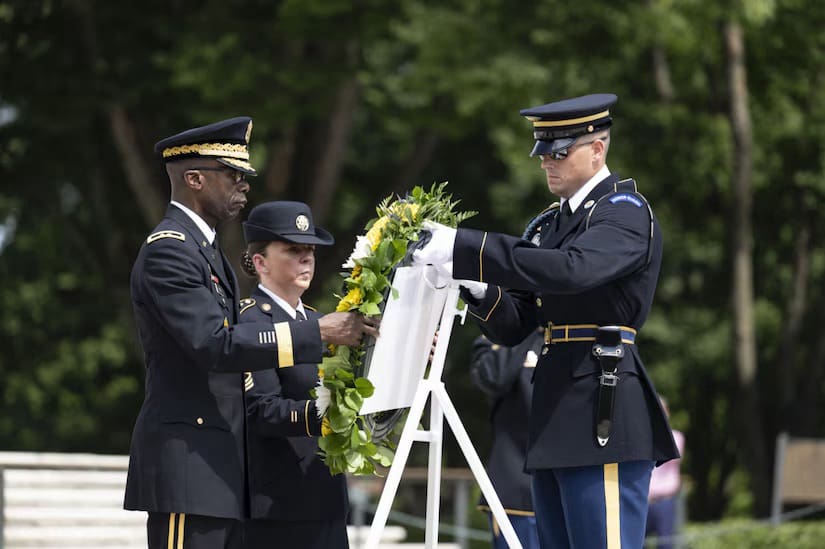
    WASHINGTON – The U.S. Army is streamlining its Military Working Equid program to align more resources with warfighting capability and readiness. MWEs include horses, mules, and donkeys owned by the Department of Defense and housed on Army installations.

    Starting in July 2025, the Army will sunset ownership, operation and materiel support of MWE programs at Fort Irwin, California; Fort Huachuca, Arizona; Fort Riley, Kansas; Fort Sill, Oklahoma; and Fort Hood, Texas. However, MWE programs will continue with The Old Guard caisson units at the Military District of Washington and Joint Base San Antonio, Texas.

    Concentrating the MWE program with The Old Guard will allow the Army to achieve significant cost savings while retaining the program for national ceremonial duties.

    The Army is committed to ensuring a smooth transfer to appropriate owners and will continue to maintain the highest standards of care for the MWEs that remain in its formations. This initiative will save the Army $2 million annually and will allow the funds and Soldiers dedicated to MWE programs to be redirected to readiness and warfighting priorities.

    Installation commanders will have one year to transfer, facilitate adoption, or donate the MWEs to vetted owners according to federal law. The Army Surgeon General’s MWE Task Force, comprised of equine veterinarian experts, will provide oversight to ensure the MWEs go to appropriate owners.

    By Office of the Assistant Secretary of the Army (Manpower & Reserve Affairs)