MOLLE/PALS compatibility allows users to mount pouches and accessories across plate carriers, chest rigs, battle belts, packs, and other load carriage platforms without being locked into a single brand or proprietary system.
That compatibility matters because most military units, law enforcement agencies, and individual users are not building complete loadouts from scratch. They are improving equipment that has already been purchased, fielded, configured, and trained with.
A new pouch may be lighter or more capable, but those improvements mean little if the pouch does not work with the equipment already in use. The best upgrades improve a proven system rather than forcing the user to replace it.
Blue Force Gear® has spent years developing lighter load carriage equipment while maintaining compatibility with the MOLLE/PALS standard. Technologies including Helium Whisper®, MOLLEminus®, and ULTRACOMP® reduce unnecessary material and weight without requiring users to abandon their existing platforms.
What Is the Difference Between MOLLE and PALS?
MOLLE stands for Modular Lightweight Load-carrying Equipment. It refers to the broader load carriage system used to carry and organize mission-essential equipment.
PALS stands for Pouch Attachment Ladder System. It is the grid of horizontal attachment points found on plate carriers, chest rigs, belts, packs, and other tactical equipment. MOLLE-compatible pouches attach to this grid by weaving their attachment straps through the pouch and the platform.
The terms MOLLE and PALS are often used interchangeably, but they do not mean exactly the same thing. PALS is the attachment grid. MOLLE is the larger load carriage system that uses it.
The distinction is less important than the practical result: a properly designed MOLLE-compatible pouch should attach securely to a correctly constructed PALS platform, even when the pouch and platform come from different manufacturers. This open compatibility is one of the primary reasons the system remains widely used across professional load carriage equipment.
Why Does MOLLE/PALS Compatibility Matter?
MOLLE/PALS compatibility gives users the ability to configure and improve their equipment without replacing the entire load carriage system.
A military unit may already have hundreds or thousands of issued plate carriers, belts, chest rigs, and packs in service. A law enforcement agency may have established equipment requirements, training procedures, and standardized pouch placement. An individual user may have spent years refining a loadout around a specific mission or job.
Moving to a proprietary attachment system can create additional costs, training requirements, logistical challenges, and equipment limitations. A compatible solution allows the organization or user to upgrade individual components while keeping the rest of the system in place.
That provides several practical advantages:
• Pouches can move between compatible carriers, belts, chest rigs, and packs.
• Users can upgrade individual components as requirements change.
• Organizations can modernize equipment in phases.
• Familiar pouch placement and established procedures can remain intact.
• Existing equipment investments do not have to be abandoned.
• Users can select equipment based on capability rather than ecosystem restrictions.
Compatibility does not prevent innovation. It makes useful innovation easier to adopt.
How Blue Force Gear® Improved the MOLLE/PALS Standard
Traditional MOLLE construction typically relies on multiple layers of fabric and sewn webbing. That approach provides a proven attachment surface, but the added layers, stitching, hardware, and individual components also create weight and bulk.
Blue Force Gear approached the problem differently. Instead of replacing MOLLE/PALS with a closed attachment system, BFG® developed materials and construction methods that reduce unnecessary weight while remaining compatible with existing equipment.
The foundation of that approach is ULTRACOMP, BFG’s high-performance laminate. ULTRACOMP combines structural stability, abrasion resistance, and strength in a lightweight material that resists stretching and water absorption. It allows BFG to replace heavier assemblies made from multiple layers of nylon, fabric, and webbing with a more efficient construction.
That material technology supports two complementary BFG systems: Helium Whisper and MOLLEminus.
What Is Helium Whisper®?
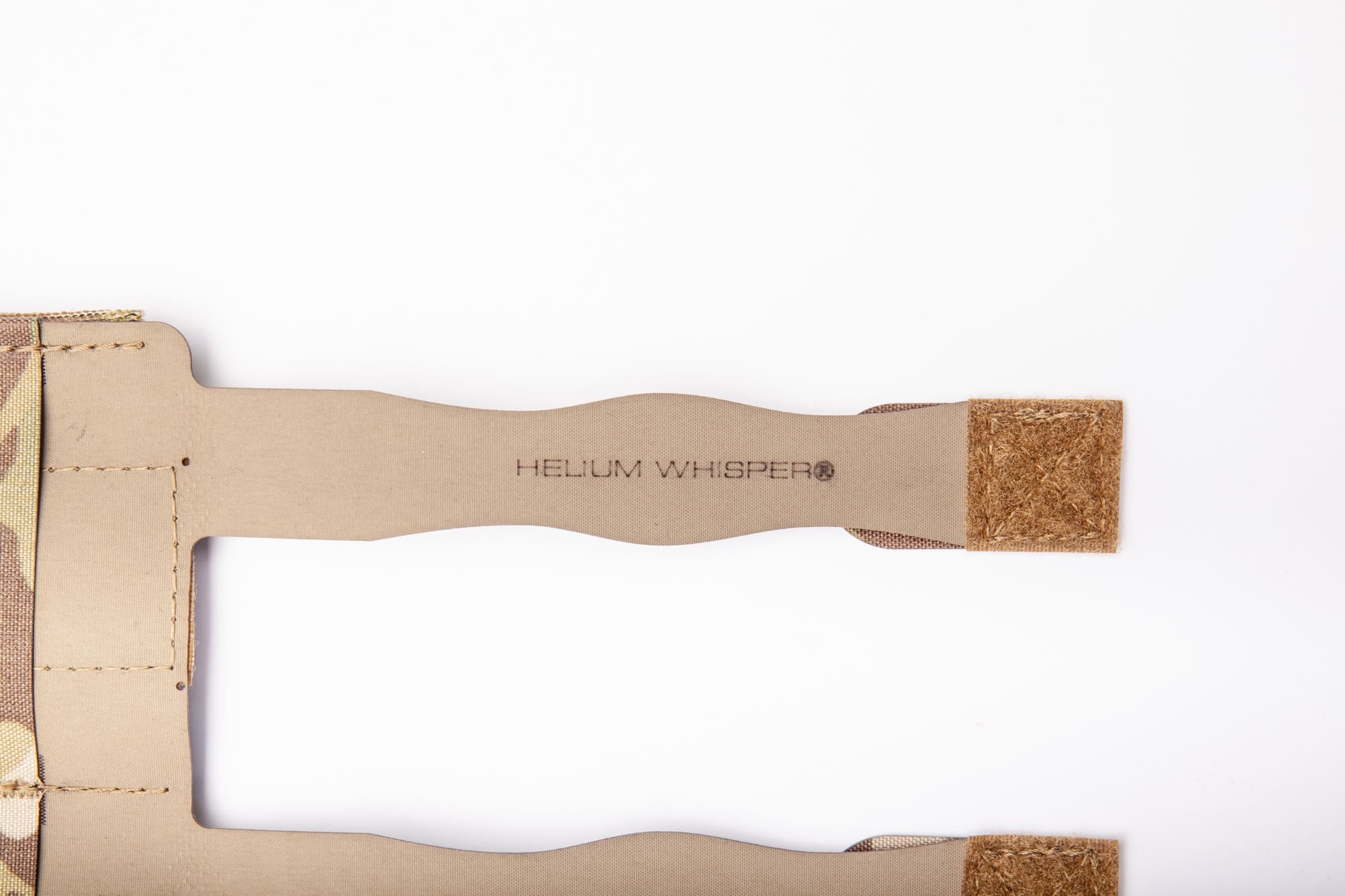
Helium Whisper is Blue Force Gear’s patented MOLLE pouch attachment system.
Traditional pouch backers can require numerous layers, straps, stiffeners, snaps, and pieces of sewn webbing. Helium Whisper replaces that construction with a laser-cut ULTRACOMP backer that uses fewer parts while remaining fully compatible with MOLLE/PALS platforms.
The Helium Whisper system reduced a legacy pouch back panel from 27 individual parts to six and reduced the listed back-panel weight from 83.3 grams to 44.2 grams. No additional proprietary platform is required to mount a Helium Whisper pouch to a compatible carrier, belt, vest, or pack.
For the user, the benefit is straightforward: the pouch mounts where a traditional MOLLE pouch would mount, but the attachment system carries less unnecessary material.
Helium Whisper can be found across BFG’s magazine pouches, medical pouches, utility pouches, and other load carriage products.
What Is MOLLEminus®?
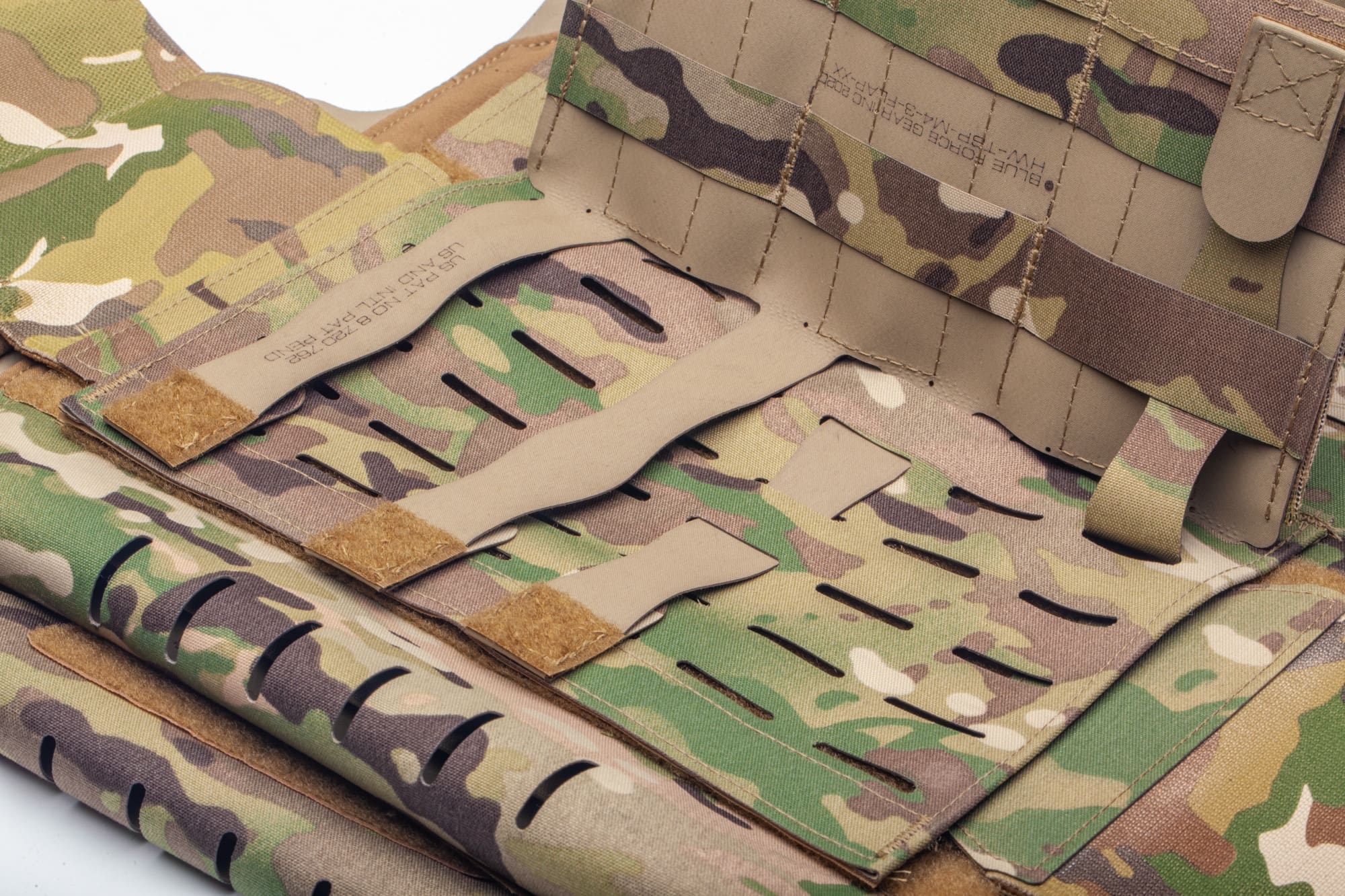
MOLLEminus applies the same weight-reduction philosophy to the platform itself.
Rather than sewing rows of webbing onto a fabric base, MOLLE attachment points are laser cut directly into a single layer of ULTRACOMP. This removes layers of material while maintaining compatibility with Helium Whisper and traditional MOLLE attachment systems.
MOLLEminus is used across BFG plate carriers, chest rigs, belts, and other load carriage platforms. It gives users a lightweight attachment surface without restricting them to MOLLEminus-specific pouches.
A MOLLEminus platform can accept Helium Whisper pouches, traditional MOLLE pouches, and other properly designed MOLLE-compatible equipment. The user gains the weight and bulk reduction of a modern platform without giving up access to the existing MOLLE/PALS ecosystem.
Can Helium Whisper® Pouches Fit Traditional MOLLE Platforms?
Yes. Helium Whisper pouches are designed to mount to standard MOLLE/PALS platforms, including compatible plate carriers, chest rigs, tactical belts, packs, and vests.
A user does not need a MOLLEminus platform to use a Helium Whisper pouch. The pouch can be added to existing equipment as an individual upgrade.
The reverse is also true. MOLLEminus platforms remain compatible with traditional MOLLE pouches. Users can keep current pouches, add new ones over time, or combine attachment types based on their requirements.
This interchangeability prevents the upgrade from becoming an all-or-nothing decision.
How Do You Know Whether a MOLLE Pouch Will Fit?
Before adding a pouch, verify that the platform has enough available rows and columns for the pouch’s attachment footprint. The pouch width, platform dimensions, and attachment method should all be considered.
A properly designed MOLLE-compatible pouch should attach to a compatible PALS platform when enough mounting space is available. Attachment straps should be woven through both the pouch and the platform to create a secure connection.
Users should also consider whether the pouch location interferes with other equipment, movement, accessibility, armor, vehicle seating, or mission requirements.
How Compatibility Supports Incremental Modernization
Replacing an entire load carriage system at once is not always practical. Equipment may be tied to existing contracts, fielding schedules, approved product lists, training requirements, or unit procedures.
MOLLE/PALS compatibility gives organizations a more realistic path forward. Heavier legacy components can be replaced as budgets, equipment life cycles, and mission requirements allow.
An organization could begin with frequently used components such as magazine pouches, medical kits, or general-purpose pouches. Those products can integrate with equipment already in service. Additional components can be upgraded later without making the original improvement obsolete.
Individual users gain the same flexibility. A lighter magazine pouch, medical kit, or general-purpose pouch can be added without rebuilding the entire loadout.
The user keeps the carrier, belt, or chest rig that already works while reducing weight where it makes the most sense.
Compatibility Preserves Equipment Placement
Compatibility also helps preserve consistent equipment placement.
Users develop familiarity with the location of magazines, medical equipment, communication tools, and other mission-essential items. Equipment placement is often reinforced through repetition, organizational requirements, and training.
Moving to a completely different attachment system can require more than replacing hardware. It may change how equipment is positioned, accessed, and managed.
A compatible pouch allows the user to reduce weight or improve capability while keeping critical equipment in a familiar location. The pouch changes. The established setup does not have to.
Lightweight Gear Should Work With What You Already Have
Modern equipment should reduce the burden on the user, not create a new one.
That is why MOLLE/PALS compatibility remains important. It gives military units, law enforcement agencies, and individual users the freedom to select better components without committing to a closed system or replacing equipment that continues to perform.
Blue Force Gear developed ULTRACOMP, Helium Whisper, and MOLLEminus to make proven load carriage systems lighter and more efficient while preserving the compatibility professional users depend on.
The goal is not to replace everything. It is to remove unnecessary weight from the equipment already trusted to do the job.
Frequently Asked Questions
What Does MOLLE Stand For?
MOLLE stands for Modular Lightweight Load-carrying Equipment. It is the broader modular load carriage system commonly used with PALS attachment grids.
What Does PALS Stand For?
PALS stands for Pouch Attachment Ladder System. It is the attachment grid used to mount compatible pouches and accessories to tactical platforms.
Are MOLLE and PALS the Same Thing?
No. PALS is the attachment grid, while MOLLE is the broader equipment system that uses it. The terms are often used interchangeably when discussing tactical pouches and platforms.
Will MOLLE Pouches Fit a MOLLE-Compatible Plate Carrier?
Yes, provided the carrier has a properly constructed PALS field with enough rows and columns for the pouch’s attachment footprint. Users should verify the available mounting space, pouch dimensions, and attachment method before purchasing.
Are Helium Whisper® Pouches MOLLE Compatible?
Yes. Helium Whisper pouches are designed to mount to compatible MOLLE/PALS carriers, belts, chest rigs, vests, and packs without requiring an additional proprietary platform.
Can Traditional MOLLE Pouches Attach to MOLLEminus®?
Yes. MOLLEminus is compatible with Helium Whisper and traditional MOLLE attachment systems.
Do I Need to Replace My Carrier to Use a Helium Whisper®Pouch?
No. A Helium Whisper pouch can be mounted to an existing compatible MOLLE/PALS platform, allowing individual pouches to be upgraded without replacing the carrier.