“We call it the Swiss Army Shoe.”
I thought it was getting a little intense in here so I thought I’d break the tension.


“We call it the Swiss Army Shoe.”
I thought it was getting a little intense in here so I thought I’d break the tension.
The Special Ops Uniform from SpecOpsShop is a US made uniform available in a variety of colorways. In particular, they feature Hyde Definition’s PenCott family of camouflage patterns.

They offer a certain degree of customization and sizes Small – XLarge, regular and long lengths.
Now, THAT’S a stove. The Stove in a Can uses fuel cells (Includes 4 fuel cells for 4-5 hours of cooking time) to rapidly heat any cooking surface. For example, it generates enough heat to boil water in 5 minutes. The fuel cells are a stable and waterproof fuel source that can be stored indefinitely. They can be extinguished and reignited for later use.
As the free world commemorates the one year anniversary of your accomplishment, I pass along my sincerest thanks for a job well done.
BRAVO ZULU
SSD Sends
Leveraging lessons learned on the Ghostex program with ADS, Hyperstealth Biotechnology Corporation has unveiled Deceptex. Leveraging, a print-on-demand camouflage service they manufacture camouflage as needed rather than stockpiling it. With over 100 distinct patterns already loaded on the site, they’ve already got our attention.
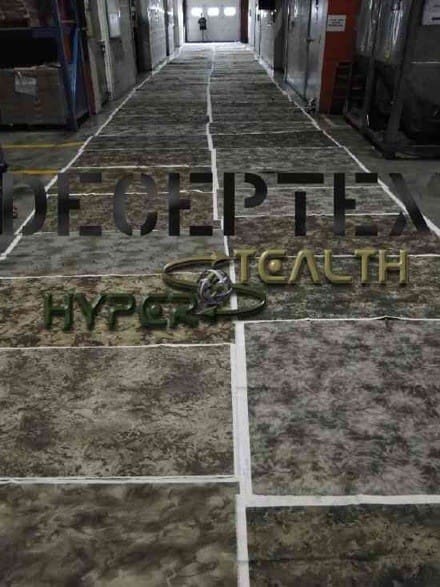
The concept of operations is simple. Hyperstealth will use their two large format digital inkjet textile printers to print fabric for any Deceptex pattern and this will be manufactured into uniforms.
So what makes this different than Ghostex? For one thing, availability. Ghostex was limited to Government clients whereas Deceptex is available to the general public. Additionally, Ghostex features NIR treatments and Deceptex will be limited to visual spectrum camouflage only.
Deceptex will be available for orders beginning Summer 2012.
To learn more visit www.hyperstealth.com/deceptex
Arc’teryx LEAF colorist Kavan Cronin discusses the theory and reasons behind the new Urban Wolf color technology.

This is an artist’s rendering of a new bump helmet from Team Wendy to be unveiled later this month at the Special Operations Forces Industry Conference in Tampa, Florida. Team Wendy actually started as a company to make sport helmets and then began to apply their materials know-how to padding systems for military helmets. Ultimately, they developed the Zorbium Action Pad system that is the only authorized shock absorbing padding system for US Army helmets. Since then, they’ve developed a couple of new helmet liner systems such as EPIC and have combined this latest liner technology with a bump shell designed specifically for tactical applications.
Under this year’s Small Business Innovative Research topics from the Defense Threat Reduction Agency, there’s a rather interesting topic. According to the call for ideas, the object of Topic DTRA122-010, Intelligent Clothing for Rapid Response to Aid Wounded Soldiers is to “Develop uniforms with integrated sensors built into the fabric allowing for measurement of overall health, detection of bullet location, detection of exposure to CBRNE (Chemical Biological Radiological Nuclear and Explosive) agents, and communication capabilities to provide location via GPS coordinates as well as critical health assessment information to medical personnel regarding the wounded soldier.”
The point of the SBIR is to get the Soldier’s clothing to constantly assess the health of the Soldier and alert him (and headquarters) of any maladies, including exposure to CBRNE threats.
“With Intelligent Clothing, the location of a bullet can be determined with appropriately-embedded sensors within the clothing’s fibers that can estimate the depth of penetration and the effected surrounding organs. Additionally, if the person was in an environment where a CBRNE weapon had been stored, manufactured, or used, the Intelligent Clothing could identify the agents via specific biomarkers detected within the blood, saliva, sweat, urine, or could distinguish damage at the cellular, tissue, and/or organ levels post exposure. For example, individuals exposed to a commonly used explosives compound, 2,4,6-Trinitrotoluene (TNT), have been shown to have hemoglobin adducts within their blood and form the urine metabolites of TNT, 4-amino-2,6-dinitrotoluene (4ADNT) and 2-amino-4,6-dinitrotoluene (2ADNT), all of which can be utilized as biomarkers for TNT. In addition, radiation biomarkers include alterations in serum enzyme levels post exposure to ionizing radiation, such as modifications in serum amylase and diamine oxidase concentration levels, which are presently being considered as potential biodosimeters within the medical community. These biomarkers could then be linked to the appropriate array of sensors within the Intelligent Clothing material to detect CBRNE targets, and this information could then be transmitted immediately to emergency responders via communications devices weaved directly into the fabric. This aids in triage and preparation of first responders to be able to handle emergency situations in a critically timely and efficient manner. The collected remotely data would provide commanders venue battlefield awareness as to type of weapons, numbers of casualties and location of engagements.
DTRA requires an assessment of the suitability of various biosensors, communications options and means of integrating these with the appropriate clothing materials and also considering relevant characteristics of the Intelligent Clothing (i.e. – size, thickness, weight, robustness, power requirements, lifetime, as well as sensor sensitivity and selectivity) and the added burdens for the individual troop to manage.”
The investigation will consist of three phases –
“PHASE I: Identify appropriate types of the fabrics, sensors, and related components that are currently available and may be useful for intelligent clothing systems. This phase would also include the selection of biomarkers specific to each agent along with corresponding sensor, and a proof of concept demonstrating operability of components within the military uniform.
PHASE II: Design of selected sensor interfaces and conduct a demonstration of a uniform containing a sensor and communications network.
PHASE III DUAL USE APPLICATIONS: Other applications currently being researched include heart/muscle monitoring for athletes, vitals measurements for babies, and blood sugar levels for Type I and Type II diabetics. Dual Use may be possible for occupations involving hazardous work conditions, mobile diagnostic of life style (as in mobile heart monitors). Furthermore, identification of potential commercial partners and/or commercialization markets in which Intelligent Clothing technology could be transitioned to as an end-user or for further optimization/development. ”
If you’ve been cooking up something that might meet DoD’s needs visit www.acq.osd.mil to get the lowdown on how to submit your white paper.