Phantom Lights

US Army Tests Cutting Edge Parachute System

March 3rd, 2023

YUMA PROVING GROUND, Ariz. — In a combat theater, ground troops in the most isolated areas depend on airlifts for resupply. In the worst conditions, time can be a matter of life or death.

U.S. Army Yuma Proving Ground is home to all manner of parachute testing, with spacious and instrumented ranges large enough to accommodate even the world’s largest cargo parachutes.

YPG has long been on the cutting edge of developmental and operational testing of new airdrop capabilities, including the Rapid Rigging De-Rigging Airdrop System, or RRDAS, which promises to get Soldiers out of a drop zone and into the fight with the equipment they need faster than ever.

Conventional cargo payloads are typically cushioned with a honeycomb-like cardboard material between the vehicle or other heavy item and the steel palette that carries it from an aircraft to the ground. Even with good cargo parachutes and a perfect landing, multiple layers of the honeycomb will collapse upon impact with the ground. RRDAS, however, dramatically reduces the amount of honeycomb necessary to dissipate the force of impact with 10 reusable airbag modules. The self-inflating airbags can be utilized as low as 750 feet above ground level and carry loads from between 5,000 and 22,000 pounds.


“When it flies through the air, ambient air pressurizes all of the fabric-based airbags,” said Maj. Matthew Rohe, Assistant Product Manager for Cargo Aerial Delivery at the U.S. Army Program Executive Office Combat Support and Combat Service Support. “When it hits the ground, the airbag modules cushion the payload, so we don’t need as much honeycomb as in the current design.”

The reduced use of honeycomb should lower rigging time by 25%, but testers are particularly excited about reducing de-rigging time by 40%, which gets Soldiers out of harm’s way faster.

“The end state is that it will reduce the de-rigging time by about two and a half hours primarily through the reduction of the use of honeycomb so Soldiers on the drop zone won’t have to use axes, shovels and picks,” said David Emond, operations manager for Product Manager Force Sustainment Systems. “Currently, once the vehicle crushes the honeycomb Soldiers have to cut out all the honeycomb around the vehicle’s tires to be able to drive it off.”

The system also boasts features to ensure an airdropped vehicle will land upright.

“The system has deployable outriggers on it,” said Rohe. “If it is a high center of gravity load with a chance of tipping over when it hits the ground, these outriggers kick out and will stop it from flipping over.”

Though developmental testing of RRDAS is scheduled to end later this year and full fielding of the system to troops is expected in Fiscal Year 2025, intermittent testing at YPG based on feedback from operational testing at Fort Bragg, North Carolina should continue for two years after that.

“We will be able to increase the load of the payload and the length of the platform so we can drop heavier and longer items,” said Rohe. “We’ll be testing on and off at Yuma for several years to come.”

YPG is the Army’s primary personnel and cargo parachute tester, with decades of institutional knowledge in both rigging and evaluating these complex airdrop systems, as well as coordinating multiple sorties safely. The post’s nearly 2,000 square miles of restricted airspace and favorable weather make it an ideal location for air drop testing.

“We always use YPG because of the test assets available,” said Emond. “It is safer and cheaper to conduct developmental testing here: it is the most reliable and dependable place to get the aircraft that we need to fly test missions.”

By Mark Schauer

GA-ASI Establishes New Collaboration Agreement with Leidos in Australia

March 2nd, 2023

Represents a Continuation of Business Relationship With Cobham Australia

SAN DIEGO – 01 March 2023 – General Atomics Aeronautical Systems, Inc. (GA-ASI) and Leidos have agreed to continue the successful business relationship previously held between GA-ASI and Cobham Australia. With Leidos’ acquisition of the Cobham Special Mission business in October 2022, Leidos has now assumed the role of GA-ASI’s primary Australian industry collaborator for defence and security business.

The arrangement will support discussions relating to a Defence Armed Remotely Piloted Aircraft System, and the Australian Border Force future crewed/uncrewed aircraft system under the Civil Maritime Capability Program.

Discussions are also underway between Leidos and GA-ASI for cooperation on further defence projects in Australia and opportunities in the U.S.

“GA-ASI is delighted to establish a collaboration agreement with Leidos that continues the successful business relationship previously held with Cobham since 2006,” said Ken Loving, GA-ASI regional vice president for Indo-Pacific. “The broader and deeper capabilities that Leidos brings to the relationship, including its impressive capability within Australia, combined with GA-ASI’s substantial global experience in remotely piloted and autonomous aircraft systems, will provide an impressive capability for Australia’s future defence and security needs.”

Leidos Australia Chief Executive Paul Chase said, “We are delighted to continue and build upon the terrific partnership that Cobham Special Mission has developed with GA-ASI over the past 17 years. When we acquired Special Mission last year, we recognised the huge potential for both advancing current capabilities and services and pursuing new opportunities in Australia and globally. General Atomics has excellent technology and by collaborating with them, our complementary capabilities and experience will combine to provide world-class solutions for current and future customers.”

U.S. Army Selects AeroVironment JUMP 20 Medium Unmanned Aircraft System to Enter Future Tactical Unmanned Aircraft System (FTUAS) Program Increment 2

March 2nd, 2023

• AeroVironment is the only company to secure an award for all FTUAS program increments, including FTUAS Increments 0,1 and now 2

• Increment 2 is the final phase of the U.S. Army’s FTUAS program competition to select a replacement for the RQ-7B Shadow UAS

The JUMP 20 is shown conducting flight tests and maneuvers on February 25-26, 2021, at Fort Benning, Georgia during the Future Tactical Unmanned Aircraft System (FTUAS) Rodeo. (Photo: Courtesy asset of the U.S. Department of Defense attributed to Mr. Luke J. Allen). The appearance of U.S. DoD visual information does not imply or constitute DoD endorsement.

ARLINGTON, Va., March 1, 2023 – AeroVironment, Inc. (NASDAQ: AVAV), a global leader in intelligent, multi-domain robotic systems, today announced it was selected by the United States Army on Feb. 28, 2023, to move forward in the Future Tactical Unmanned Aircraft System (FTUAS) program.

AeroVironment’s JUMP 20 will compete with several other vendors in the FTUAS Increment 2 multi-phased effort which will allow the Army to select the best system for its needs. Ultimately, FTUAS Increment 2 aircraft will be fielded to Brigade Combat Teams (BCTs) throughout the Army, replacing the long-serving RQ-7B Shadow UAS.

During the early stages of what would become the U.S. Army’s FTUAS program, AeroVironment’s JUMP 20 demonstrated superior competitive performance and was awarded the FTUAS Increment 1 contract to develop a prototype system to field to one Brigade Combat Team (BCT). Its success throughout the demonstrations led to AeroVironment’s contract award for FTUAS Increment 0, in which the U.S. Army fielded the JUMP 20 into an additional Army BCT within the United States Army Europe. AeroVironment is the only company awarded the FTUAS contract for all three program increments.

“The AeroVironment JUMP 20 is the most mature and capable solution in its class,” said Gorik Hossepian, AeroVironment’s vice president and product line general manager for medium unmanned aircraft systems. “We will continue to work closely with the U.S. Army to ensure we meet their performance needs both today for an all-environment aircraft system and in the future as requirements evolve to meet changing battlefield demands.” 

Airborne Innovation Lab Presents Additive Manufacturing Course

March 2nd, 2023

Last week, the AIL hosted a Basic Additive Manufacturing Course. This 40 hour course taught the basic concepts of Additive Manufacturing and how to efficiently implement it within the DoD.

Students came from various units across Fort Bragg including Division, 18th Fires, 3SFG, and 2SFAB. Students completed the course with a capstone project Highlighted here was a handcuff skeleton key which van be hidden in a boot lace.

AIL offers a variety of courses that can be found on our website:

www.army.mil/82ndairborne#org-airborne-innovation-lab

Explosive Hazard Recognition Cards

March 2nd, 2023

My friend Grzegorz gave me a pack of playing cards today that were created to help keep people alive in Ukraine.

Intended to educate about different types of munitions, each card features a photo with size and weight ?data and a QR code to learn more about the item.

For example, here it the card for the PFM-1 with the QR code going here.

To learn more, visit fenix-insight.online.

Enforce Tac 23 – Benchmade Claymore

March 2nd, 2023

Designed as a replacement for the long serving AFO, the Claymore is lighter, thinner, and faster opening.

Also an automatic opener, they’ve improved the blade steel to CPM-D2 and moved the pocket clip for deep carry. Additionally, Benchmade moved the safety and enlarged it to make it easier to manipulate.

If all that wasn’t enough, it’s also cheaper than the AFO.

The Claymore has been issued NSN 1095-01-796-1907.

Enforce Tac 23 – Adept Armor

March 2nd, 2023

Adept Armor is a US company that specializes in ballistic armor innovation like their NovaSteel Ballistic Buckler.

They took the opportunity of Enforce Tac to preview their latest product, a hard armor plate that replaces the ceramic strike face with treated glass. The result is both weight and cost savings. We should have some definitive ballistic performance and weight data soon.

Enforce Tac 23 – FROG.PRO U.LOK

March 2nd, 2023

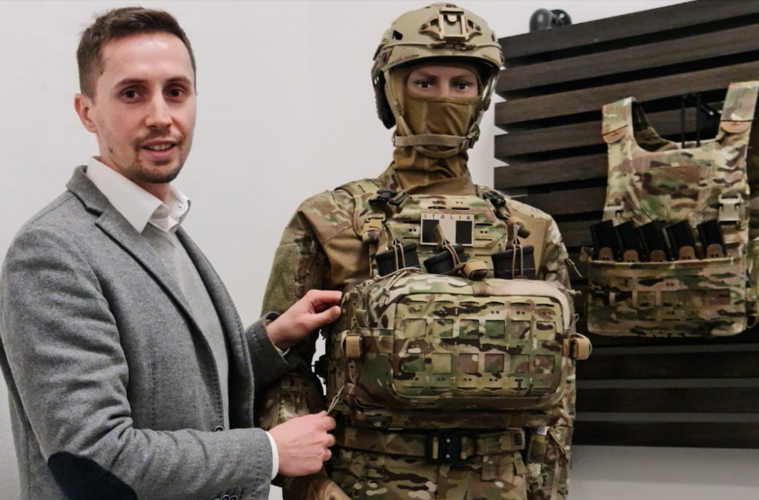
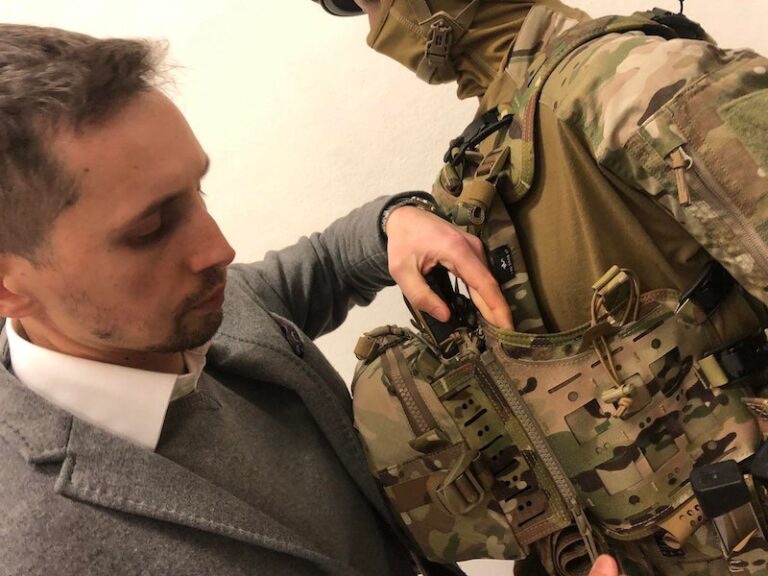
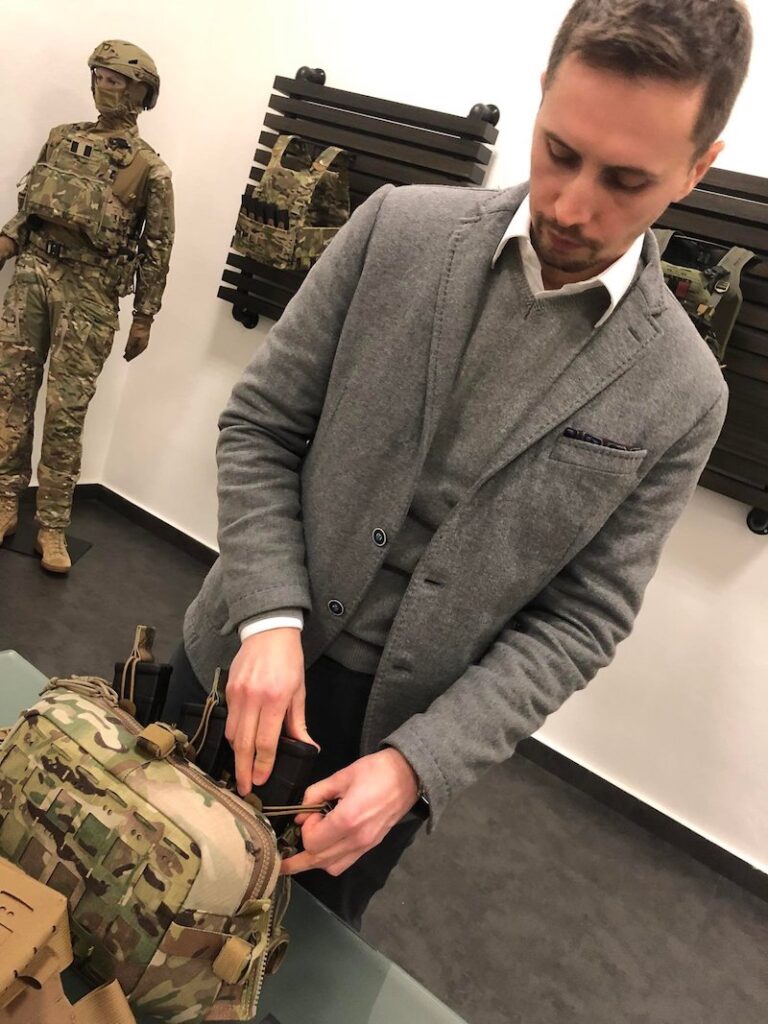
The new hotness from Italy’s FROG.PRO is their patented U.LOK attachment system which utilizes magnetic studs to secure a pouch or panel to a platform.

This modular magnetic attachment system allows you to quickly attach and detach panels and pouches.

Detachment is as simple of pulling one handle and the magnets snap everything into alignment.