Once again, our friends at Tactical Distributors are sponsoring our Black Friday/Cyber Monday master list. To see it, updated regularly with the latest sales info, click here.

Once again, our friends at Tactical Distributors are sponsoring our Black Friday/Cyber Monday master list. To see it, updated regularly with the latest sales info, click here.

AUSTIN, Texas — As the U.S. Army transforms itself to ensure the all-service force can deter and, if necessary, win any future conflicts, it is engaged with allies and partners to develop new capabilities and foster leap-ahead warfighting advantages.
U.S. Army Futures Command plays a pivotal role in this effort by engaging regularly and meaningfully with partner nations, embracing a collective approach to warfare that aligns with the demands of multidomain operations to deliver speed, convergence and overmatch on the modern battlefield.
The command’s International Programs Team, part of the G-3/5/7 directorate, is spearheading AFC efforts to prepare for tomorrow’s joint and combined warfighting challenges in an adept and highly integrated manner, as exemplified by ongoing multinational experimentation being conducted through Project Convergence.
“The reality is, as we look to the future of warfare, we don’t do anything without our international partners,” said Newman Yang, AFC International Programs Team lead. “Whether it be Iraq, counterterrorism, Afghanistan, you name it — our operations are executed with our combined allies and partners; we don’t do it unilaterally.”
Yang joined AFC as a Department of the Army civilian after 30 years of active-duty service, in a career that included 20 years as an Army foreign area officer in locations such as Brunei, China, Hong Kong, Malaysia and Singapore. Due to increasing demand signal for greater engagement with AFC, the command recently expanded the International Programs Team to include personnel with diverse backgrounds in domestic and international Army experience, along with Department of Defense and Congressional engagement knowledge and foreign policy expertise.
Together, the team members help explain AFC’s Army transformation mission, structure and programs to international partners, many of whom have expressed an eagerness to stay abreast of new technologies and to engage in collaborative research and development efforts.
In the fall of 2021, for example, the International Programs Team assisted in the design and execution of a two-day modernization forum hosted by U.S. Army Europe and Africa; the forum, which took place in Germany and included the participation of 13 European allies and partners, offered an in-depth exploration of future opportunities, challenges and concerns related to transformation efforts.
The team also regularly supports engagement visits to AFC headquarters in Austin, recently welcoming senior military leaders from Europe, the Middle East and Asia to discuss shared future force plans and objectives.
Understanding what U.S. military equipment and warfighting systems will look like in the future enables allied and partner nations to make informed decisions about their own transformation requirements, Yang explained, and lays the foundation for future interoperability between allied country militaries.
The diligent work of the International Programs Team contributed to the multinational presence at this year’s Project Convergence event, Project Convergence 22, which brings together U.S., U.K. and Australian service members at U.S. military installations to explore the parameters and possibilities of future warfighting scenarios.
“U.K. and Australia have been full planning participants,” Yang said, noting the countries have incorporated their own service branches in the experiment in a realistic way. “This is a huge commitment on their part.”
Canada, France, Israel, Japan, Korea and New Zealand are also attending the experiment as observers, with the understanding that future iterations of Project Convergence may expand to include additional allied and partner nation participation.
The Project Convergence campaign of learning, experimentation and demonstration is accelerating the U.S military’s ability to transform rapidly and efficiently by identifying common preparedness gaps and assessing who might be best suited to address them across the various services and allied nations.
Yang described the mutually beneficial process as “part of that partnership fabric, where we can mutually develop technologies while also conserving resources to avoid duplication of effort where possible.”
“If we have proper agreements and policies in place, then we can work on sharing those technologies to ensure we persistently modernize our forces and equipment together to deter and defeat potential future adversaries.”
By Maureena Thompson, Army Futures Command
Tickets for the Great American Outdoor Show go on sale on Black Friday, November 25.

Hosted by the NRA, the show runs February 4-12, 2023 at the Pennsylvania Farm Show Complex in Harrisburg, PA.
During the nine-day event you can experience:
– 1,000+ exhibitors showing the latest guns and gear
– 400+ outfitters so you can book the hunt of a lifetime
– 200+ FREE daily seminars and demos
– A jam-packed schedule filled with daily special events
– Tons of family-friendly activities including the Eddie Eagle Kid’s Zone
– A rockin’ Saturday night concert
– Free admission to the DockDogs competition
– Your chance to win a firearm at the Wall of Guns Raffle
www.greatamericanoutdoorshow.org
One of the biggest codebreaking achieved by Naval intelligence during WWII was on April 14, 1943, they learned that Adm. Isokoru Yamamoto was preparing a visit to the upper Solomon Islands to inspect Japanese bases. Commander in Chief Pacific Fleet Adm. Chester W. Nimitz immediately relayed the details to Secretary of the Navy Frank Knox, who informed President Franklin D. Roosevelt. According to reports, the president’s response was “Get Yamamoto.” Whether or not the president actually said those terms, the order was given to assassinate the mastermind of the Pearl Harbor attack.

Ironically, the object of American vengeance had repeatedly put his life on the line by speaking out against US wars. He saw how poor industrial Japan was in comparison to the United States and the United Kingdom because of his postings in America and England.
When asked how he thought a war between Japan and America would go, Yamamoto replied that he would “run wild for six months or a year, but after that I have absolutely no confidence.”

“It is a mistake to consider Americans as luxury-loving and weak,” Yamamoto said in a meeting with classmates from his hometown of Nagaoka on Sept. 18, 1941. Remember the American industry is much more mature than ours, and they have unlimited oil supplies, unlike us. Japan would never be able to defeat the United States. As a result, we should refrain from fighting the US.”
When his government decided to go to war, Yamamoto put his personal feelings aside and pledged to do everything in his power to win.
Yamamoto was playing chess with a member of his team, Capt. Yasuji Watanabe, when they learned over the radio about the assault on Pearl Harbor and Japan’s subsequent declaration of war. “That’s too bad, Watanabe,” he said. Tell the Emperor that the navy did not intend it this way from the start if I die before you.”

Operation Vengeance is a vengeance-seeking operation.
Adm. Yamamoto was killed when the Betty bomber was shot down over Bougainville on April 18, 1943.
Following that came an incredible run of Japanese victories. The Imperial Japanese Fleet was then defeated at Midway, nearly six months to the day after Pearl Harbor. Yamamoto saw the writing on the wall when the arduous Guadalcanal war ended in early 1943. “I sense that my life must be completed in the next hundred days,” he wrote in a letter to a friend in Marchs. He left for the south to oversee the next phase of the operation.

Operation I-Go was a joint Japanese navy-army aerial counter-offensive launched on April 1, 1943, to halt American advances in the Solomon Islands and New Guinea. Yamamoto, now based in Rabaul, decided on April 13 that he wanted to inspect Japanese bases in the upper Solomons. Yamamoto halted the offensive on April 16, pending the completion of his inspection, after acknowledging without question exaggerated pilot reports of ship sinking’s and aircraft shootdowns.
Eighteen P-38s were chosen and fitted with special drop tanks (sixteen for the assault, two spares). While the others targeted the fighter escorts, a “killer” flight of four fighters led by Capt. Thomas G. Lanphier, Jr. would target the two Betty bombers containing Yamamoto and his staff.

Nimitz had to time his window of opportunity to intercept Yamamoto perfectly. Fortunately for him, his opponent was known for being punctual. Yamamoto’s path was outside the control of naval fighters, but it was within the range of Army Air Force P-38Gs that had recently been deployed to Guadalcanal.
Maj. John Mitchell USAAF, commander of Squadron 339, found himself assisting Vice Adm. Marc Mitscher and other senior commanders in preparing the assault on April 17. The intercept will take place over Bougainville Island. A 1,000-mile round trip was planned, with a 600-mile roundabout approach from the south. Eighteen P-38s were chosen and fitted with special drop tanks (sixteen for the assault, two spares). While the others targeted the fighter escorts, a “killer” flight of four fighters led by Capt. Thomas G. Lanphier, Jr. would target the two Betty bombers containing Yamamoto and his staff.

Operation Vengeance is a vengeance-seeking operation.
Any of the pilots who flew Adm. Yamamoto’s assassination flight, Operation Vengeance. From left to right: William Smith, Doug Canning, Besby F. Holmes, Rex Barber (historians believe he was the pilot who shot down Yamamoto), John William Mitchell, Louis Kittel, and Gordon Whittiker. Roger Ames, Lawrence Graebner, Julius Jacobsen; Eldon Stratton, Albert Long, and Everett Anglin; and unknown, crouching from left to right. Image from the National Archives
The P-38s of Operation Vengeance took off at 7:25 a.m. on April 18, the first anniversary of the Doolittle Raid. They arrived at the intercept point at 9:34 a.m. and saw their objective exactly on time.
While the other planes assaulted the other escorts, Lanphier and 1st Lt. Rex T. Barber of the killer flight split up to target the Bettys and immediate escorts. One P-38 and its pilot, 1st Lt. Raymond K. Hine, were killed when both bombers were shot down.

“That son of a bitch will not be dictating any peace terms in the White House,” Lanphier radioed shortly before noon, as the returning P-38s prepared to land at Henderson Field. Yamamoto was no longer alive. Lanphier’s comment was a misinterpretation of Yamamoto’s words, as he broke radio silence to say. Yamamoto was implying that a military victory over America could not be achieved by winning a single war, or even a series of battles.
The Navy Cross was awarded to any pilot who took part in the assault. The question of who shot down Yamamoto’s plane sparked a debate, with both Lanphier and Barber claiming responsibility. Barber was later identified as the perpetrator by historians.
You may recognize Pepper and her handler Justin Melnick from the hit CBS series “SEAL Team”. Pepper is raising funds for working K9s via Military Working Dog Team Support Association, Inc an all-volunteer 501(c)3 charity.

Here’s Pepper’s pitch….”If you donate $18 to MWDTSA, you will be purchasing the ‘Magnum Black Stars and Stripes’ rope toy from USA-K9 by SodaPup pictured on the right. It’s made from extra sturdy rubber so teeth like mine can’t bite through it. As an added bonus, from November 1 through December 15, 2022, USA-K9 by SodaPup will match your tax-deductible donation with TWO additional toys. That’s right, you’re purchasing three toys for the price of one. Thank you!”
Once the fundraising drive is over, MWDTSA will send the toys to working dogs.
Donate here.
MALMSTROM AIR FORCE BASE, Mont. (AFNS) —
For most, the days and hours leading up to their basic military training departure are filled with excitement and anticipation for what’s to come in the next four to six years. For others, the feelings are tainted with fear and anxiety.
For Connor Crawn, the day before he shipped off to boot camp was one of the worst in his life.
The 18-year-old graduated high school only six months earlier as the class of 2020, eager to enlist in the U.S. Air Force but curious about whether he could keep his hair long in accordance with his Kanien’kehà:ka faith.
When Crawn decided to speak to a recruiter his dark, neatly braided hair draped straight down the length of his spine.
For the Kanien’kehà:ka, Crawn explained, keeping the hair long reflects spiritual strength, protection and resilience. Certain styles, like braids, signify even greater strength.
His recruiter took the steps necessary to request a religious accommodation and Crawn went through military entrance processing successfully, but his BMT departure date continued to get pushed as he waited for an answer about his hair.
“I was at the point where I couldn’t wait any longer,” Crawn described of the hurry-up-and-wait process. “I had to get out of my situation.”
Crawn agreed to cut his hair if it meant getting an earlier departure date. He kept his hair long until the last minute, hoping approval would arrive at the last-minute to spare him from the trauma of severing his symbolic strength. He waited, fruitlessly, until the day before he left for BMT.
“My dad and I cut our braids together,” Crawn began, eyes saddening. “I wish I never had to go through that. I felt like a part of me died when I lost my braid.”
Now officially branded as an Airman, the next chapter in Crawn’s life began: BMT and technical training simply became two obstacles to overcome before the fight for accommodation resumed.
In July of 2021, Crawn was stationed at the 341st Missile Wing as part of the security forces group. Before he was even assigned a flight, his priority was visiting the base chapel to begin the request process all over again.
Capt. Trevor Wilson, one of the chaplains on duty at the time of Crawn’s visit, cemented himself as an ally and quickly went to work figuring out the requirements of a process that, just one month earlier, had been introduced to the Department of the Air Force.
The duo spent hours together during that first meeting, poring over instructions, regulations and guidelines for a reality Crawn hoped would soon come to fruition.
My dad and I cut our braids together. I wish I never had to go through that. I felt like a part of me died when I lost my braid.
Airman 1st Class Connor Crawn
According to the process for religious accommodation, as lined out in the DAF Instruction 52-201, the timeline from request to approval was supposed to take no longer than 60 days. Considering the overwhelming number of religious requests being vetted at that time due to COVID-19 pandemic, though, goalposts had to be moved and Crawn’s request would not be approved until October of 2022.
“I knew it was going to take longer than expected,” Crawn explained. “But as the time dragged on, my hope started to waver a little bit. After a year passed, people used to joke that it would be the end of my contract before I heard anything—and honestly, that’s what I was beginning to expect.”
Though the timeline dragged on like a heavy-burdened traveler, Crawn’s case was carefully corralled through coordination by Wilson.
“I know how hard his leadership and the wing worked to get his package up,” Wilson shared. “I had to ensure his request would not get lost or overlooked in the bulk of all that [COVID-19] paperwork. I regularly followed up and tracked his request, because part of my role as the chaplain is to be an advocate.”
Nearly halfway into his contract is when Crawn finally received the good news that he could grow his hair out in accordance with his faith. For him, this was not just a personal win, but a Department of the Air Force-wide win for all his native brothers.
With the approved accommodation, Crawn was authorized to abide by female standards in DAFI 36-2903, Dress and Personal Appearance.


“It was incredible,” he chuckled. “I mean, I thought I was dreaming for the next few days. I kept thinking I would wake up and learn it wasn’t real.”
Crawn’s excitement did not end with reception of the news; immediately after learning about the approved accommodation, the first thing he did was call his family to share. Then, he decided to share with the world.
“My first thought after calling my family was, ‘I gotta let other native men know that it’s possible,’” Crawn eagerly said, grin widening to meet the corners of his eyes. “I could not find a single person who received a religious accommodation like mine as I was going through the process, so I wanted to put the information out there. It wasn’t until I made a TikTok video about it that I began to hear from other people.”
Crawn’s video went viral, sparking an important conversation for U.S. military members and those interested in joining. His statement served as a spark of hope for a demographic who, previously, was uncertain that their organization would be true to their word.
Through DAFI 52-201, Religious Freedom in the Department of the Air Force, the DAF maintains an environment in which members can realize their highest potential. For Crawn, this environment was established when he felt that the leadership around him was willing to fight for something he cared about deeply.
Our Airmen chose us once; the environment we create must encourage them to choose us again.”
Col. Barry Little
Wilson, spearhead for Crawn’s request, felt pride knowing other Airmen would be encouraged to use their voice to be a beacon of change.
“Crawn chose to speak up, to ask for something he believed in, to place trust in the process, and it worked,” Wilson enthused. “The Air Force cannot help if Airmen’s needs are not communicated, and if you share your concerns and requests professionally, you can often get the results you need.”
Col. Barry Little, 341st MW commander, praised Crawn’s dedication as an example of the direction that the total force needs to continue moving toward.
“There has never been a time where what our Airmen do for this country has been so important,” Little said. “Creating an environment of dignity and respect is critical to winning the strategic competition for talent. Our Airmen chose us once; the environment we create must encourage them to choose us again.”
Little’s message, targeted to leaders, is partnered by Crawn’s sentiments to fellow Airmen looking for motivation in times where they may feel defeated by bureaucracy.
“I think it’s all about the person and how much they fight from the start,” he encouraged. “I think that [attitude] really shows your leadership and the people around you how dedicated you are. I never gave up; I never shut up about it to anyone who asked.”
Two years into his career, Airman 1st Class Connor Crawn has some time before needing to decide which direction he prefers the next chapters of his life to go in. Currently, he serves as a convoy team leader with the 341st Missile Security Operations Squadron, and with a recent win in his back pocket, he is optimistic about a future in uniform.
“I might as well stay in, now that I’m able to grow my hair,” Crawn chuckled. “I’m definitely considering it. It’s incredible being able to express my heritage in uniform.”
For more information on diversity and inclusion efforts across the DAF, please visit here.
Story by SSgt Elora J. McCutcheon, 341st Missile Wing Public Affairs

Some photos by A1C May A. Bowers

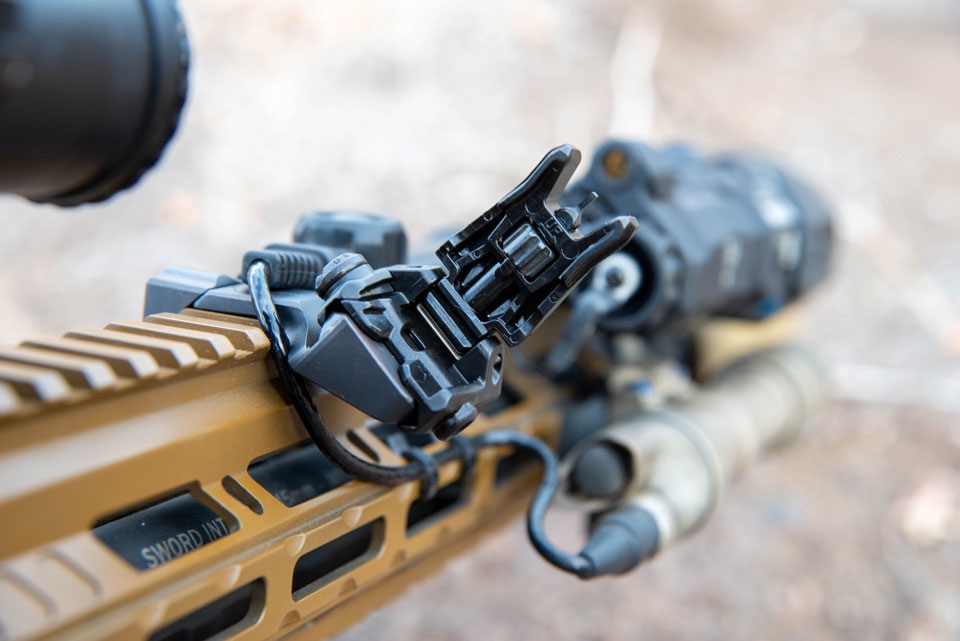
“After using their optic mounts, I approached Scalarworks about making a set of fixed iron sights; what they came up with has exceeded my expectations. I’m now running Scalarworks iron sights and Aimpoint Micro mounts on my BCM carbine in all of my training classes. Scalarworks Leap Mounts and Peak Sights are the current state of the art.”

– Larry Vickers –

Created at the request of Larry Vickers, the Peak/01 Iron Sights are designed around a 15″ sight radius found on modern carbines and feature manually adjustable elevation (front) and windage (rear) with a refined 0.5MOA/click, which matches most Red Dot sights.

scalarworks.com/shop/iron-sights/peak-01
During a conversation with Eric at Soldier Systems, he had a great idea about giving some background as to how some of our products were originally designed. Sharing the Sea Story about the background, whilst sipping fine scotch. We will start this series off with how we started 215 GearTM . We go back to 2007, I was 10 years into my military service. My wife was working for Reebok, managing a team of field representatives. This was until Reebok merged with a larger company, with many programs being streamlined prior to the merger. This resulted in the decision for her to either relocate to the corporate office, or stay in Virginia without a job. I was always a gear guy, never being satisfied with what we were issued. For those in at that time frame, most of us were taking the standard field uniform and relocating pockets and adding Velcro. This was all prior to Crye Precision doing what is now the standard for a field uniform. I knew how to sew, but using industrial sewing machines and bartackers was foreign to me. Luckily I had a friend that went to Riggers school and had access to the paraloft. There, we were able to modify our gear. This knowledge would come into play later.
Faced with what to do with the current situation, I had the idea to start a company around making items that were not currently out there for the war fighter. If you were a startup in 2007, we hit a financial low. Banks were unwilling to make loans, the whole thing was a mess. 215 was started in a spare room over the garage, with one sewing machine. We still have that machine to this day, a constant reminder of the humble beginnings we had. We decided early on to do USA manufacturing, which was important to us. In my spare time, I would design, prototype and iterate products. I then turned to a contract sewing manufacturer to produce our first products. At the time, they had 4 major locations, down from a high of 12. With no loans available, we used personal credit cards to purchase raw materials for the products. Maxing credit cards and paying them, maxing and paying them. I’d like to take the opportunity to say, do not do this as a strategy. Obviously that was a huge gamble. After doing this for some time our bank finally gave us a line of credit to move forward with bigger purchases.

We quickly outgrew the spare room and garage, moving to our first industrial warehouse. We stayed there until 2011. Our manufacturing partner was continuing to downsize and it was now harder to quickly iterate our product line. By his time, it was time to decide the greater 215 destiny. We decide to go all in, moving into two large units in another industrial park. We purchased our own equipment and began hiring to move all production in-house. Funny enough, the week we got the keys and began moving, Hurricane Irene hit Virginia Beach. Additionally, I was in a cast from hip to ankle from knee reconstructive surgery. There is nothing like mopping up standing water in your new building. I invested heavily in laser cutting and computer controlled pattern sewing equipment. Knowing as a small company, anything we can do to stay productive and repeatable is key. We stayed there until 2015, when we purchased our own building and land. This would allow us to grow and expand the business, as we see fit. Fast forward to now, I retired mid 2021, 28 years of service. The recent focus has been on bringing metal CNC fabrication and Cerakote spraying into the mix. One of the best things about my military time was always learning new things and overcoming big challenges. There is something awe inspiring about taking a block of metal and murdering it violently with large machinery. I like to think of it as art therapy for the gunfighter.
215 has always been a family owned and operated business. None of this would be possible without my wife. Obviously someone had to run the company while I was training and deployed. We truly are humbled by the support and patronage of the people and units over the years. We have always prided ourselves with providing out of the box, timely solutions for the people doing the job. Our growth has only been because of the people reading this now.
– Jim V
Founder, 215 Gear