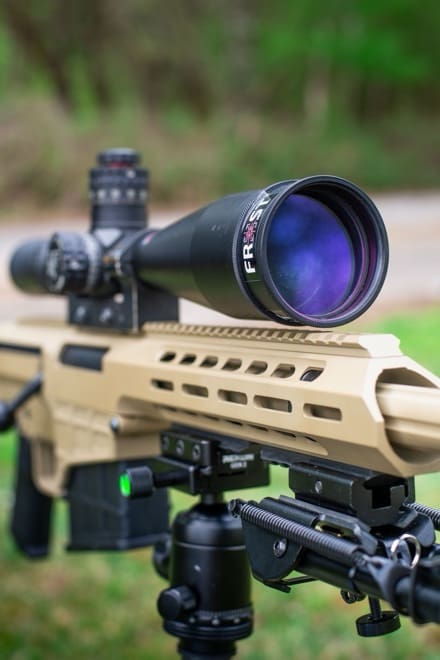
As the Army enhances Soldier lethality, Joint Program Executive Office for Armaments and Ammunition’s (JPEO A&A) Product Manager (PdM) Small Caliber Ammunition is developing the XM1224 Hybrid-Anti Materiel Round (HAMR) precision cartridge for the MK22 Precision Sniper Rifle.
No matter the operational environment, snipers continue to maintain relevancy and technologies to sense and see farther demand persistent investment in precision sniper ammunition. Traditionally, this has meant equipping snipers with multiple weapon systems and ammunition types, which increased load. The XM1224 HAMR will deliver improved accuracy and performance when compared to the existing M1162 round and addresses the anticipated capability gap when the Army divests of the legacy M107 weapon system.
The XM1224 program streamlines ammunition choices, reduces combat load and is an evolutionary increase in precision ammunition that will outpace the threat.
TRANSFORMING IN CONTACT REQUIRES AGILE THINKING
Driven by a commitment to providing warfighters with the best tools to win decisively, PdM Small Caliber Ammunition adopted a fast, unconventional approach to rapidly deliver capability by combining the capability of government scientists and engineers with the speed and efficiency of commercial partners—developing the lethal projectile and high-pressure cartridge case in parallel with continuous integration touch points. This is accomplished in partnership with contracting professionals who leveraged acquisition authorities, which enabled speed and agility.

The XM1224 logo developed by the team at DEVCOM-AC. (Photo courtesy of JPEO A&A)
FILLING THE VOID
The XM1224 HAMR program is a significant advancement in precision ammunition. No commercially available .338 caliber projectile could provide the terminal performance needed to replace the legacy anti-materiel M107 sniper rifle with its larger and heavier .50 caliber ammunition.
Recognizing the importance of precision for sniper systems, The U.S. Army Combat Capabilities Development Command Armaments Center (DEVCOM AC) prioritized ballistics during the initial design phase. A comprehensive modeling and prototyping effort evaluated numerous projectile shapes to identify the most aerodynamically efficient solution. Prototypes underwent rigorous testing, utilizing advanced radar to precisely measure aerodynamic performance. This data-driven approach ensured the solution was optimized for both precision and the incorporation of advanced anti-materiel technologies.
To deliver the required terminal performance across a wide range of targets at extended ranges, PdM Small Caliber partnered with DEVCOM AC to leverage Picatinny Arsenal’s fully integrated, in-house design and fabrication capabilities. The infrastructure and cutting-edge equipment enabled rapid build-test-build cycles to rapidly meet requirements. The XM1224 HAMR projectile stands as a testament of the synergies between JPEO A&A and DEVCOM AC at the Army’s Center of Excellence for Guns and Ammunition.
A MISS IS A MESSAGE
The XM1224 HAMR fundamentally redefines long-range precision. PdM Small Caliber and DEVCOM AC have moved beyond incremental improvements, signaling a fundamental shift in the program. The XM1224 delivers a 20% increase in accuracy over currently fielded precision ammunition, but the real breakthrough comes with a stunning 75% increase in accuracy compared to the legacy .50 caliber precision ammunition for the M107. The new HAMR round provides warfighters with an overmatching capability against emerging threats, ensuring they maintain a critical edge and operational superiority in any environment; this technology is designed to dominate the battlefield.
ACCELERATING INNOVATION: DEPARTMENT OF WAR AND INDUSTRY PARTNERSHIP
The team partnered with industry through a Department of Defense Ordnance Technology Consortium, Other Transaction Authority, contract for maturation and further refinement of key cartridge component technologies with a focus on cost-reduction and producibility. Leveraging the innovative capabilities and expertise of private sector partners, we are not only accelerating the development of advanced technologies but also ensuring that these solutions are economically viable and scalable for military applications. This partnership exemplifies the Department of War’s commitment to engaging with industry leaders in pursuit of modernization and enhanced operational readiness. This strategic alignment profoundly enhances our military’s operational effectiveness, ensuring we are fully prepared to address any challenges that may emerge on the battlefield.
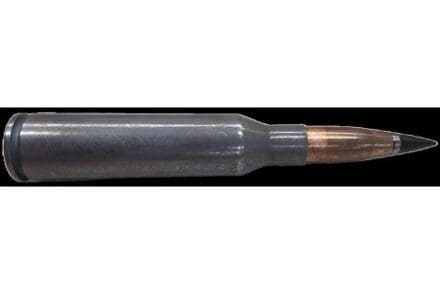
The XM1224 cartridge. (Photo courtesy of JPEO A&A)
ARSENAL TO INDUSTRY: SCALING FOR SUCCESS
As the program proceeds through the Engineering and Manufacturing Development phase, the PdM Small Caliber and DEVCOM AC team at Picatinny Arsenal will leverage in-house capabilities to produce and complete acceptance testing. Following Milestone C, full-rate production will be competed. This transition is expected to ensure a seamless handover of production and the preservation of critical expertise, ultimately maintaining a continuously ready force equipped to pace evolving threats.
CONCLUSION
The XM1224 HAMR program illustrates how blending government innovation with commercial execution, planning a phased transition and emphasizing continuous knowledge sharing, we can deliver capabilities to the field faster and more effectively model with significant implications for the future of defense acquisition and modernizing the Army to be the most lethal force against the evolving threat. The XM1224 HAMR isn’t just about getting ammunition into the field, it’s about equipping Soldiers with the capability they need to fight and win decisively.
For more information, go to the PdM Small Caliber Ammunition webpage at jpeoaa.army.mil/Project-Offices/PM-MAS/Teams/PdM-Small-Caliber.
MAJ. CALVIN W. TAYLOR III, an armor and signal officer, serves as the assistant product manager for Small Caliber Ammunition within Project Manager Maneuver Ammunition Systems and is the project lead for the XM1224 HAMR. He holds an M.S.in systems engineering from the Naval Post Graduate School and a B.B.A. in business management from Austin Peay State University. He has been in the acquisition workforce for three years and is Certified Contracting Professional.
TYLER ROTUNNO, Ph.D., serves as the armaments project officer and lead engineer for the Precision Family of Ammunition, including the XM1224 HAMR program, at Picatinny Arsenal, New Jersey. He holds a Ph.D. and an M.S., both in armament engineering, from the U.S. Army’s Armament Graduate School and a B.S. in biomedical engineering with a specialization in biomechanics from the New Jersey Institute of Technology. He brings 10 years of engineering experience to the Department of War, including six years focused on sniper weapon systems and four years on precision ammunition development.