Danner Boots - Built in the USA

Archive for November, 2026

Raider Green Joins the Mystery Ranch Military Lineup

Monday, November 16th, 2026

Some colors just belong on a ruck.

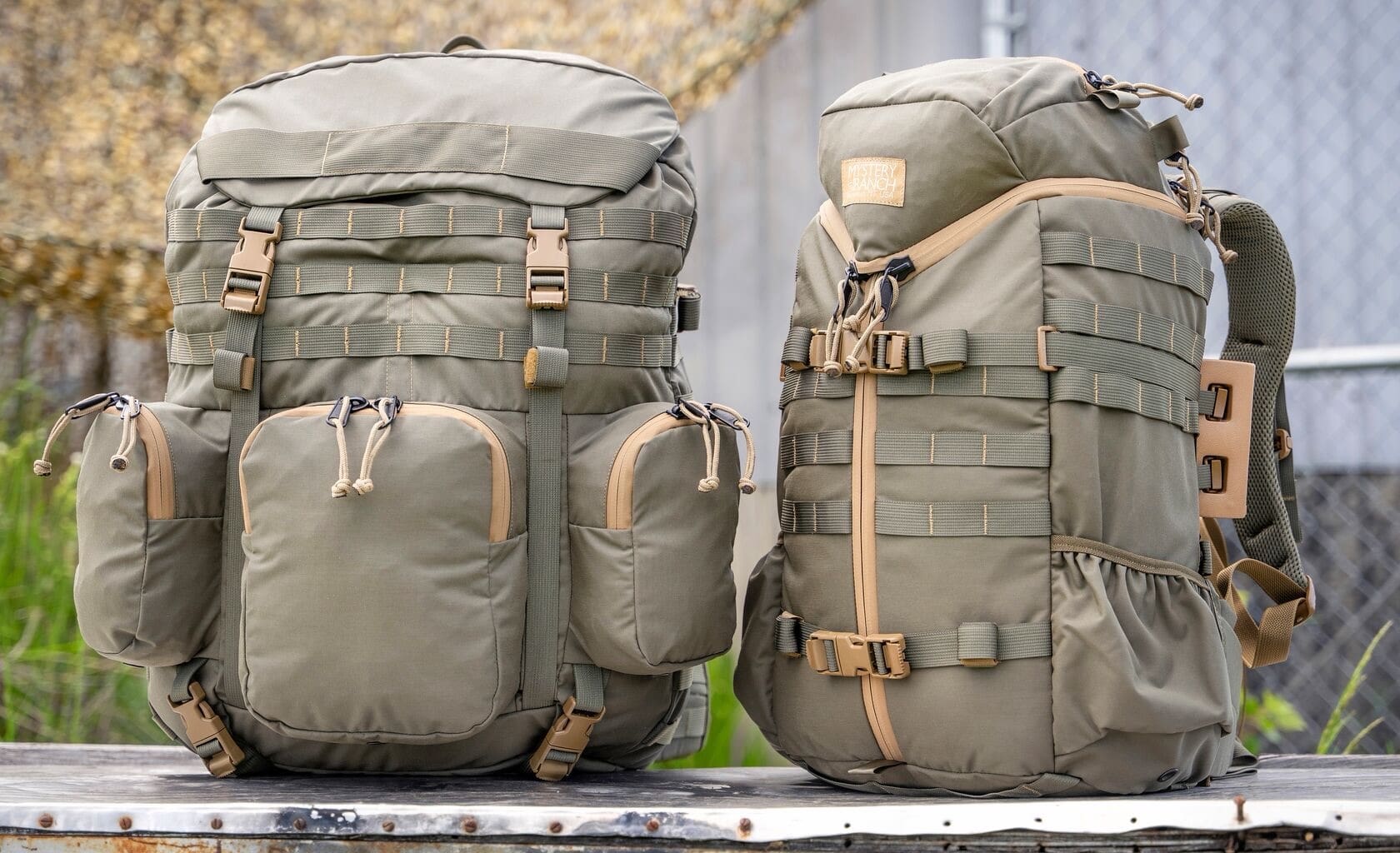
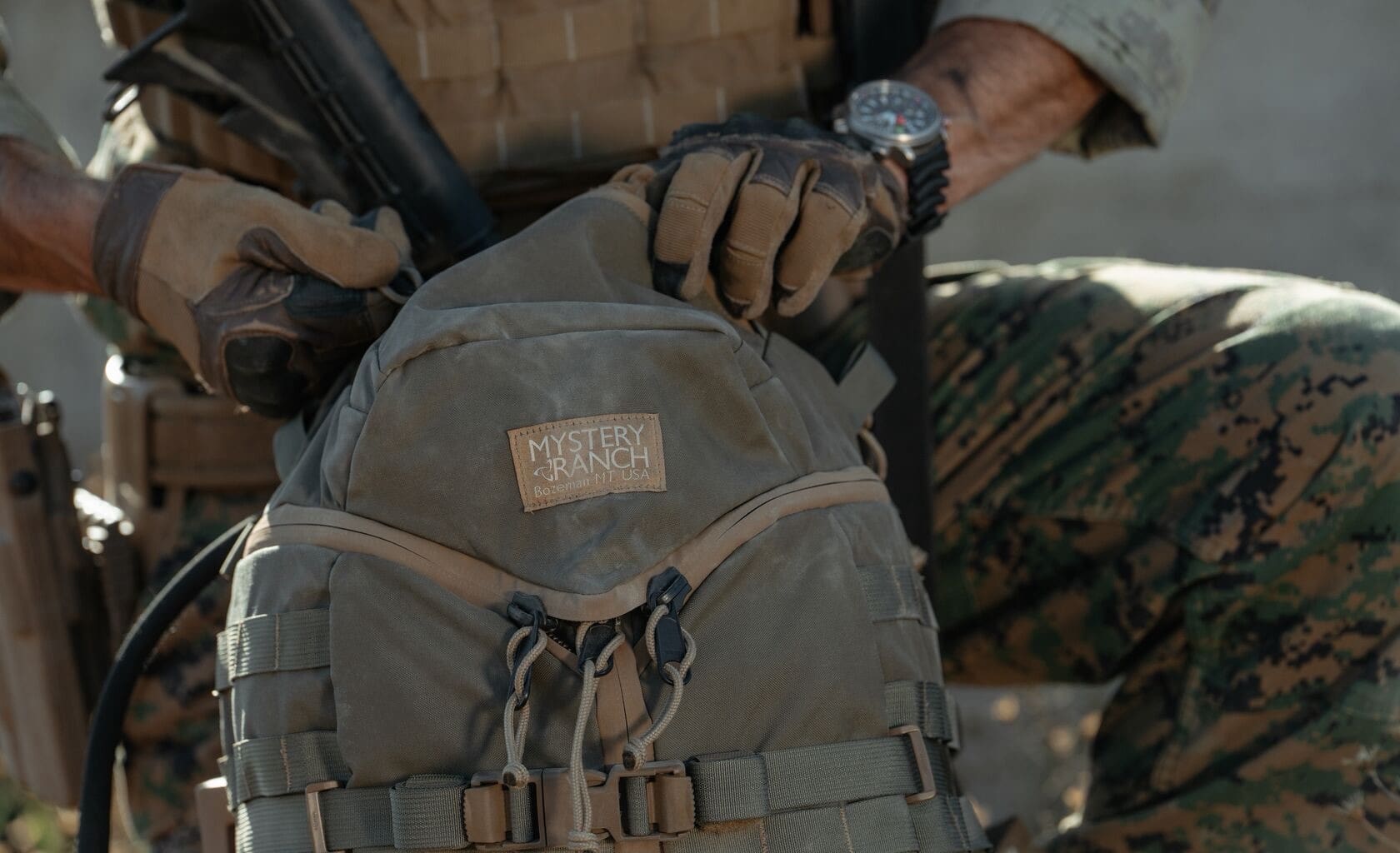
MYSTERY RANCH has added Raider Green to two established military platforms: the MOUNTAIN RUCK and 3-DAY ASSAULT.

Green has a long history across military equipment and load carriage, and Raider Green brings that familiar field-driven aesthetic to these two packs built for very different mission requirements.

On the MOUNTAIN RUCK, the new color feels particularly at home. The pack takes cues from the classic medium ALICE ruck while incorporating MYSTERY RANCH load-carriage via the NICE Frame, as well as intentional design updates. Raider Green reinforces that connection to traditional military equipment while giving the platform the quality and durability which are the trademark of a MYSTERY RANCH pack.

The 3-DAY ASSAULT brings Raider Green to another longstanding MYSTERY RANCH military platform. Built around the 3-ZIP design, it provides rapid access to the main compartment, purposeful organization, and a proven approach to carrying mission-essential gear.

Two very different packs. One new color offering rooted squarely in the military environment they were built to serve.

Raider Green is now available on the MOUNTAIN RUCK and 3 DAY ASSAULT at mysteryranch.com.

US Air Force Force Design 2026: Designing the Air Force for the Future Fight

Monday, November 16th, 2026

ARLINGTON, Va. (AFNS) —  

The Air Force announced its Force Design 2026 establishing a common direction for how the Total Air Force will prepare to generate and employ combat power in future conflict – particularly against increasingly capable adversaries operating in highly contested environments.

“Our Force Design is about the capabilities we will field that are necessary to fight and win in the future,” said Air Force Chief of Staff Gen. Ken Wilsbach.

The Force Design builds on the foundation established by One Force Design 2024, more sharply articulating the need for change, and the capabilities the Air Force needs to overcome the operational challenges of future high-end conflict where technology is at the center of that change.

Advances in sensing, networking, super intelligence, autonomy, unmanned systems, long-range weapons, electronic warfare and other technologies are changing the speed, scale and complexity of warfare. These advances are also changing how airpower must be generated and employed.

“We must evolve if we want to remain the world’s best Air Force,” said Lt. Gen. Chris Niemi, deputy chief of staff for Force Modernization and Chief Modernization Officer. “New technologies are enabling fantastic capabilities that were unimaginable just a few years ago, but those same technologies threaten some of the ways we have historically generated airpower.”

The future Air Force is focused on generating sustained combat power under pressure, using a combination of human judgment, autonomous capabilities and interconnected systems to create resilient options across contested environments.

That requires looking beyond individual platforms and toward the systems that connect them. Aircraft, sensors, weapons, command and control, information and other capabilities must increasingly work together to generate effects, even when portions of the force are degraded or disrupted.

“The Force Design presents a fundamental shift in how the Air Force approaches future challenges in the Joint environment,” Wilsbach said. “It will help Airmen understand how we plan to deliver combat power in the years to come.”

Secretary of the Air Force Public Affairs

T.REX ARMS Launches a Global Map Server for Creating Feature-Rich Military-Style Maps

Sunday, November 15th, 2026

CENTERVILLE, Tenn – (Nov. 13, 2026) T.REX ARMS announced their Map Server, capable of exporting PDFs of military-style maps at various scales and robust landmark feature sets, for printing and exporting to ATAK and Garmin devices.

As mobile phone apps have taken over navigation, paper maps have gotten scarcer and the information on them has gotten sparser, especially for civilian applications. However, SAR, emergency response, and even recreational activities like orienteering depend on detailed paper maps with the military-style features that are usually missing from USGS and recreational prints.

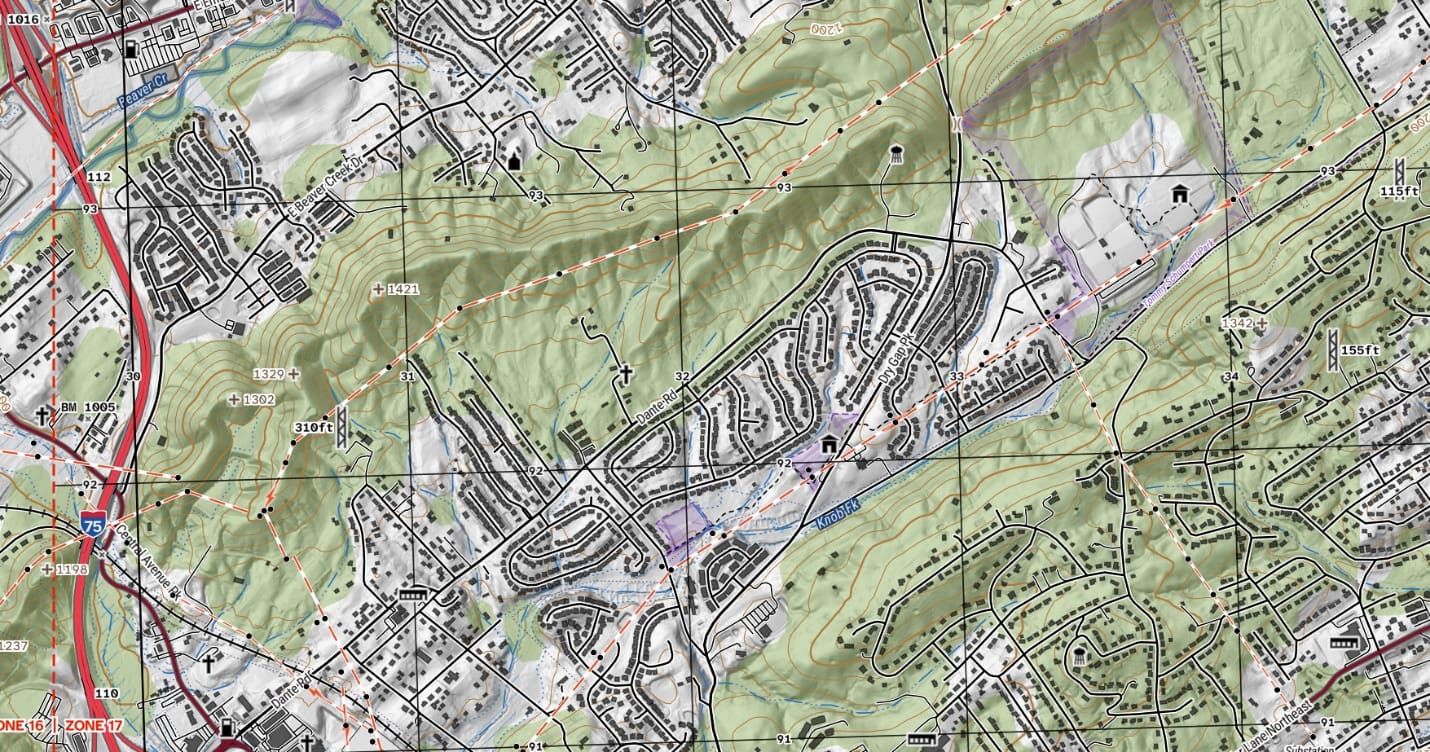
To solve this, T.REX ARMS launched an online map server that can export printable PDFs of military-style maps. Maps can be printed at 1:50k, 1:25k, 1:24k, 1:48k, and 1:15k scales with MGRS grids and notation as well as UTM and lat-long coordinates.

All continents include roads and highways with exit numbers, rail lines, power lines, pipelines, runways, buildings with usage icons, differentiated deciduous and evergreen tree cover, river flow indicators, trails, and extra hilltop elevation points. North American maps get extra details, such as a high-resolution LIDAR hill-shade layer showing the earth surface, FEMA floodplains, intermittent streams, detailed tower data, ham radio repeaters, NOAA marine maps and soundings, and other important landmarks.

The export tool allows fine-grained control of all elements so that maps can be easily customized. In addition to PDFs, theserver can also export MBtiles for use in ATAK, and KMZ files for use on Garmin handhelds, with all the same features and elements as the printable PDFs.

TREX ARMS has compiled all their map data from public domain and open-source repositories so that redistribution of these files is possible without complex licensing agreements and subscription fees. In future, the tiles powering this map server will be made available for offline mapping tools and other resiliency projects.

About T.REX ARMS: We design and manufacture premium holsters, belts, targets, and other defense-of-life equipment, all engineered for real-world performance. Innovation, durability, and user feedback drive a brand made in America by Americans, backed by a lifetime warranty and the best customer service, for all who carry in defense of life.

Streamlight Continues 16-Year Commitment to the Breast Cancer Research Foundation

Sunday, November 15th, 2026

The company maintains its support for breast cancer research and awareness through its Lights for a Cause program

EAGLEVILLE, PA, November 12, 2026 – Streamlight®, Inc., a leading provider of high-performance lighting, announced a $20,000 donation to the Breast Cancer Research Foundation®(BCRF), continuing its long-standing commitment to advancing breast cancer research and awareness. The contribution marks Streamlight’s 16th consecutive year supporting BCRF through its Lights for a Cause program, which directs proceeds from specially marked pink flashlight models toward critical research efforts.

BCRF, the world’s largest private funder of breast cancer research, has committed $75 million to lifesaving research for the 2026–2027 year, supporting more than 280 scientists across 18 countries. According to BCRF, a woman is diagnosed with breast cancer somewhere in the world every 14 seconds. Thanks to advances in research and treatment, the five-year relative survival rate for women with invasive breast cancer has reached 91%.

Streamlight’s 2026 donation was supported through sales of its pink flashlight models, including the Nano Light® II keychain light and the Wedge® XT everyday carry light. For each light sold, Streamlight contributed $1.00 and $3.00, respectively, to BCRF.

“Our partnership with the Breast Cancer Research Foundation reflects a commitment that has remained important to Streamlight for 16 years,” said Michael F. Dineen, Streamlight President. “Through our Lights for a Cause program, we’re proud to provide our customers a meaningful way to contribute to vital research, recognize those affected by breast cancer, and contribute to continued progress in the fight against this disease.”

Since introducing its first pink flashlight models in 2008, Streamlight has remained dedicated to supporting BCRF’s mission to prevent and cure breast cancer.

To learn more about Streamlight’s Lights for a Cause, visit www.streamlight.com.

Bodi.Me Research on Inclusive Body Type Grading

Saturday, November 14th, 2026

Recent blog post as seen on Bodi.Me

At 3DBODY.TECH 2026 in Lugano, Switzerland, Bodi.Me’s Lara Mazzoni, CEO, and Clementine Baldo, Calibration & Technical Fit Manager, presented insights from a two-year research study of curvy and plus-size populations across the USA, UK and EU countries. Their presentation on 21 October, “The Myth of the Proportional Curve: Data, Perception, and the Realities of Inclusive Grading,” examined the gap between real body proportions and the assumptions used to develop extended garment sizes.

Our research highlights a persistent gap in the garment industry’s knowledge and use of body data for curvy and plus-size wearers. When product development overlooks real body proportions, garments can fit poorly, restrict movement and cause discomfort. In workwear and protective clothing, poor fit can also create safety risks. Our message was clear: real body data must inform garment development, size recommendations and supply-chain decisions.

Real body data provides the evidence needed to develop garments around the people who will wear them. Research reveals how proportions vary across sizes, where garments need additional room and which grading assumptions require revision. These insights help technical teams make informed decisions about pattern blocks, garment ease and size ranges, then validate them through wearer testing. For Bodi.Me, the value of research extends through the supply chain: understanding bodies more accurately supports better size recommendations, manufacturing quantities and stock allocation.

What is Plus-Size Grading?

Plus-size grading is the development of garment patterns across an extended size range, adjusting dimensions and proportions to accommodate the intended wearers. Effective grading considers where additional room is needed, how the garment sits on the body and whether it preserves its intended fit.

A pattern may fit its original sample model beautifully. That alone does not establish that every size developed from it will work equally well.

Fixed grading increments can be useful within a validated range. The difficulty arises when manufacturers extend those rules beyond the body shapes and sizes on which they have tested them.

Plus size and curvy describe different fit needs

Plus size generally describes a size category. Curvy describes proportions, often a greater difference between waist and hip measurements. Brands use both terms differently, so neither replaces a clear description of the body shapes a garment is designed to accommodate.

A plus-size range must account for people with fuller abdomens, straighter waists, fuller hips, and other combinations. A curvy cut may suit some of those wearers while leaving others poorly served.

This is why inclusive size development needs to examine the relationship between measurements, rather than treating everyone within a size label as the same shape.

The same size label can describe very different measurements

Our cross-brand size-chart comparison makes the limits of labels clear. In the research presented in Lugano, Tom Tailor’s 2XL starts at a chest measurement of 100.5 cm, while Universal Standard’s starts at 146 cm. That is a difference of 45.5 cm, approximately 46 cm, at the point where the brands move from XL to 2XL.

Where Grading Can Lose Touch with the Body

Our Lugano presentation examined the connection between body proportions, grading and the room a garment provides. Several areas deserve particular attention:
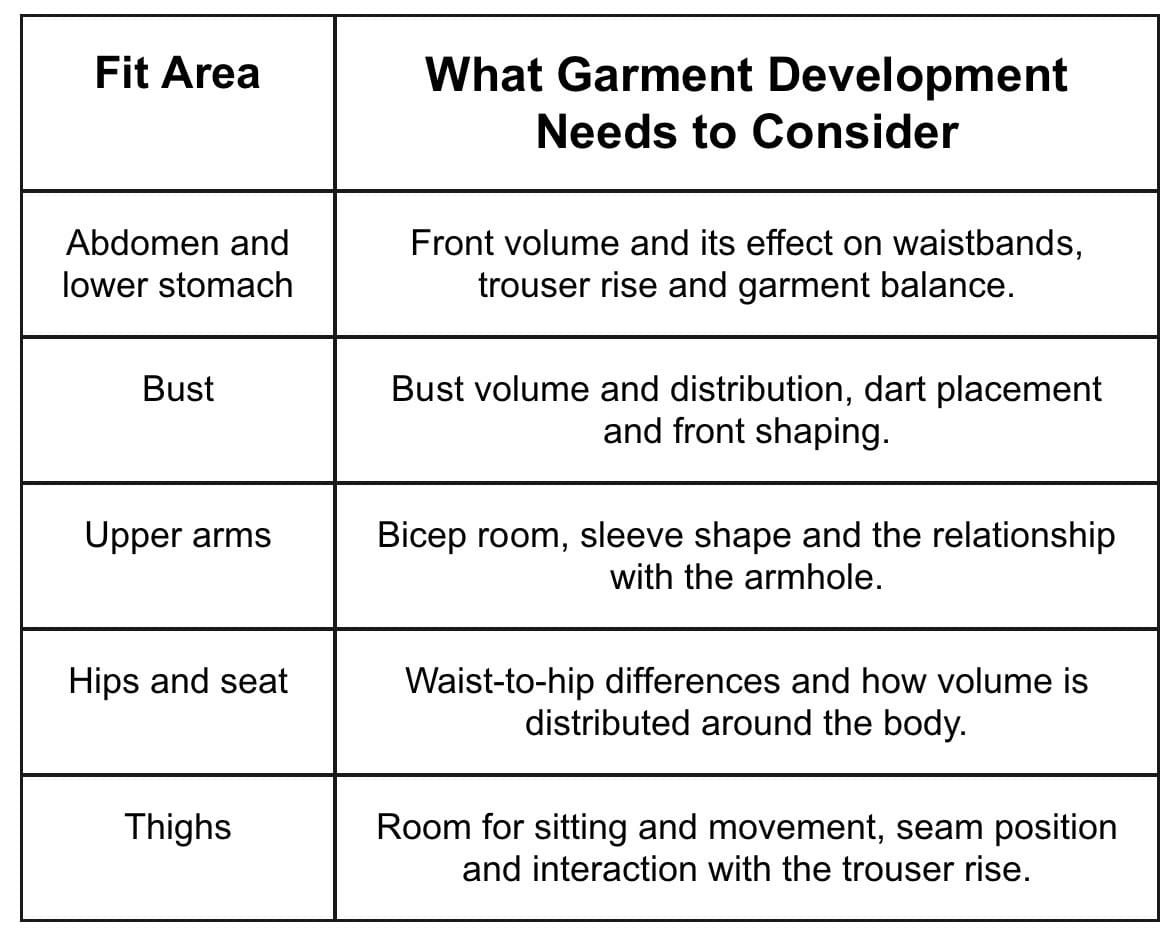
These relationships vary between people. Two wearers with similar hip measurements can need different shaping at the waist or seat. Increasing the overall garment size may relieve pressure at one point while creating excess fabric elsewhere.

Independent research supports closer attention to shape. A University of Oregon study presented at 3DBODY.TECH 2020 found that an established body-shape classification method needed modification to better accommodate plus-size women, including fuller abdomens.

Read the University of Oregon research abstract.

What the grading comparisons reveal

Bodi.Me’s Lugano case study compares how measurement increments and calculated garment ease change across sizes. It also explores a proposed grading approach informed by body data.

Comparing three dress grading approaches
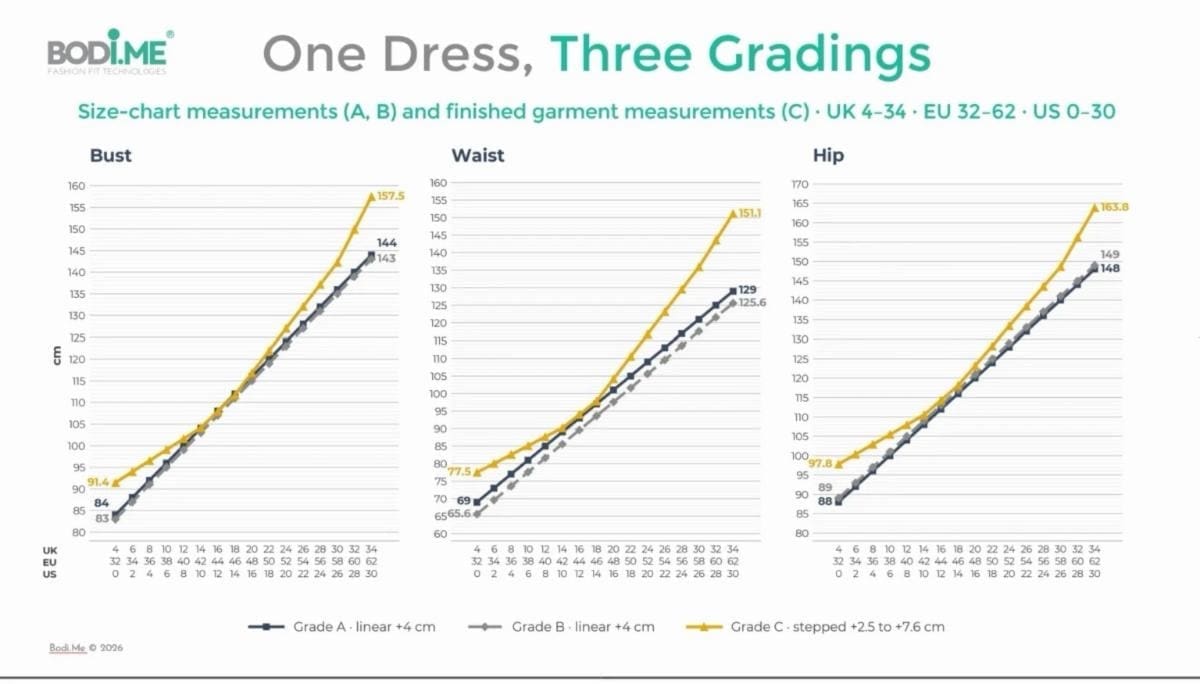
Figure: The comparison shows how measurement increments differ across a size range. A and B are body-size charts; C contains finished garment measurements, including ease. The absolute measurements therefore represent different things. Source: Bodi.Me, 3DBODY.TECH 2026, Lugano.

Read the Full Blog

Canadian Company Announces Next-Generation Electric Snow Bikes for Utility and Defense

Saturday, November 14th, 2026

FOR IMMEDIATE RELEASE

Stealthy and snow-ready: Canadian company announces next-generation electric snow bikes for utility and defense

An electric snow bike designed for weekend thrills and playing in powder is about to report for duty. ENVO Drive Systems aims to release new heavy-duty MoonBike models around fall 2028. 

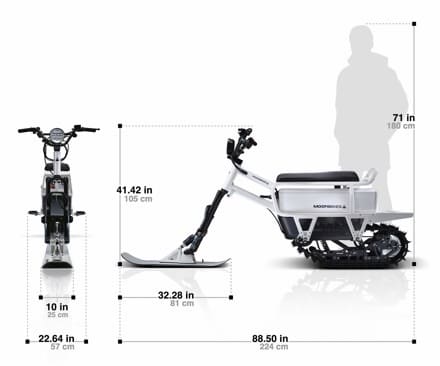
BURNABY, BC — November 10, 2026 — It sounds like something from a spy thriller: a silent snow bike built to slip quietly across the snowy backcountry. But it’s real, and it’s being developed in Canada. Burnaby-based ENVO Drive Systems is developing a heavier-duty version of its popular MoonBike, aimed at professional crews, harsh-weather operations and defence customers.

Like its ultralight counterpart, the utility version will feature zero tailpipe emissions, low-noise operation and a low heat signature. But it’s built bigger and tougher, with a larger seat and sled, double the motor power and attachments to handle a wider range of professional work.

The current version isn’t going anywhere and will remain a light, agile and fun battery-powered rig for snow transport and recreation.

MoonBikes are already popular with resorts. Since the product launched, 1,200 units have been deployed in 45 parks across more than 25 countries. This includes Avoriaz ski resort in France, where the lift operator runs a fleet of six MoonBikes for resort operations and lift maintenance.

The next-generation MoonBike aims to broaden this reach, from light maintenance and resort operations to demanding professional work in harsh winter environments, as well as defence applications such as patrol and transport in remote, cold-weather terrain.

“Teams who work in the snow need tools that are tough, clean and quiet. That’s exactly where MoonBikes are headed,” says Ali Kazemkhani, CEO and founder of ENVO Drive Systems.

Aerospace pedigree: MoonBikes’ founder is a former aircraft engineer

In some ways, this is a natural evolution. MoonBikes founder and mechanical engineer Nicolas Muron spent six years at Dassault Aviation working in aircraft structural engineering before creating MoonBikes.

While MoonBikes was acquired by Burnaby-based ENVO Drive Systems in 2025, Muron remains at the helm of engineering and design, collaborating with ENVO’s engineering team.

“MoonBikes introduced an entirely new way to experience winter with the world’s first ultralight electric snowbike, combining innovative engineering, efficient propulsion and the sheer fun of riding,” says Muron. “The next challenge is to deliver more capability and broaden its uses without losing what made the original work: lightness, simplicity and agility.”

Feedback from professional MoonBikes customers has been enthusiastic so far, with strong interest in the new utility models.

Building on ENVO’s modular technology

The design of the new utility MoonBike will get a boost from technology ENVO has been developing for its new UPT, a modular light electric vehicle that lets buyers configure 18+ different vehicle types on a shared platform.

MoonBike will have access to upgraded batteries, interfaces, controllers and selected components drawn from ENVO’s modular mobility ecosystem.

“By joining ENVO’s production philosophy, MoonBikes can evolve into a more adaptable, feature-rich and lower-cost platform by leveraging mass-produced, configurable components across products,” says ENVO’s Kazemkhani. “Combining MoonBike technology with the UPT platform can also open a path toward future utilitarian snow-mobility applications, including multi-track and specialty electric snow vehicles.”

Logistics and customer support for the next-generation MoonBikes will run through ENVO’s established operations in Vancouver, Los Angeles and Poland.

About ENVO Drive Systems

ENVO Drive Systems helps people and communities move better through practical, efficient and right-sized electric mobility. Its engineering approach combines modularity, configurable designs and shared components to develop purpose-built vehicles for different needs. Based in Burnaby, British Columbia, ENVO’s growing lineup includes e-bikes, Veemo, UPT, MoonBike, SnowBike and SnowKart.

US Army Air Defenders Assess Drone Interceptor

Saturday, November 14th, 2026

USTKA, Poland — In early November 2026, the U.S. Army Europe and Africa’s theater divisional air defense battalion conducted an internal assessment of the FD-1 Interceptor’s counter-uncrewed aerial systems capabilities at the Ustka Training Area, Poland.

Spearheaded by its Tactics, Integration and Employment Battery, 5th Battalion, 4th Air Defense Artillery Regiment, 52d Air Defense Artillery Brigade, the unit conducted Operation Audacious Fury to establish cost-effective, lower-tier kinetic magazine depth against group 1–3 and massed UAS threats.

“There are a lot of systems that we can use to get after defeating the massed UAS threats while staying on the right side of the cost-curve, so we don’t expend our exquisite munitions ineffectively,” said Lt. Col. John Verwiel, the 5-4 ADAR battalion commander.

As such, TIE Battery is not only determining which systems to assess but also solving the problem of how to employ a given system across the force. That means they are the ones developing the associated tactics, techniques and procedures required to teach any novice Soldier how to fly a first-person view drone, such as the FD-1.

“We came out here to develop the [tactics, techniques and procedures] and our training tabling certification system to get an operator with no knowledge or skills in flying an FPV drone to become a skilled operator,” said Staff Sgt. Felix Aguilar, a platoon sergeant with TIE Battery.

Verwiel agrees and wants to share this capability with other units so they can cost-effectively prosecute massed drone threats in the future.

“What I want to do is standardize the training for it, standardize the engagement process, and then get it out to the force at scale to defeat that mass problem,” Verwiel continued.

Aguilar said he has seen his Soldiers’ knowledge and experience broaden in ways previously unimagined.

“None of my Soldiers thought they would be flying drones when they enlisted as an air and missile defense crewmember … [and] now they’ve certified on the SGT Stout and are flying drones into the Baltic Sea,” said Aguilar.

Throughout this exercise, TIE Battery demonstrated its ability to integrate new capabilities that enable the brigade, as the theater air and missile defense integrator, to dominate the decision-making process at the pace of relevancy.

This will be important not only for TIE Battery or 5-4 ADAR, but as this training progression continues, the Soldiers of TIE Battery will be the trained trainers who will then pass that knowledge, training and certification to other units under the umbrella of USAEUR-AF.

By CPT Zemas Andargachew

Marconi Technologies Awarded Contract to Deliver Critical Communications for Patriot Air and Missile Defense System

Friday, November 13th, 2026

Extends four decades of support to Patriot

MONTRÉAL — NOV 2, 2026 — Marconi Technologies has been awarded two contracts totaling $5 million by Raytheon, an RTX business, to deliver Orion radios for the Patriot® air and missile defense system, continuing nearly four decades of uninterrupted support. 

With hundreds of Orion radios fielded across U.S. and allied Patriot batteries, Marconi’s communications technology is embedded in the backbone of allied air defense. These proven systems have earned their place through sustained performance in the most demanding operational environments on earth.

Orion radios deliver the low-latency, high-capacity data links required by air defense. The X500’s seamless backwards compatibility with existing waveforms, combined with a modern IP backbone, ensures Patriot batteries remain operationally current without disruptive rip-and-replace cycles.

“At terminal phase, the engagement window is measured in milliseconds, and Orion is the communications layer that ensures sensor data reaches fire operators at the speed the kill chain demands,” said Brian Karney, director of program management at Marconi. “That level of performance, sustained across hundreds of Patriot batteries for close to 40 years, is what operators depend on.”

The Orion X500 sustains a field reliability rate above 99% and an on-time delivery record that reflects the operational discipline Marconi brings to every program. Built to military standards for rugged, contested environments, Orion drives down total lifecycle costs while maintaining performance and the edge needed by warfighters in any environment. It serves as the critical data exchange layer connecting fire systems to command-and-control nodes, enabling integrated fire control across layered missile defense architectures that also include Terminal High Altitude Area Defense (THAAD).