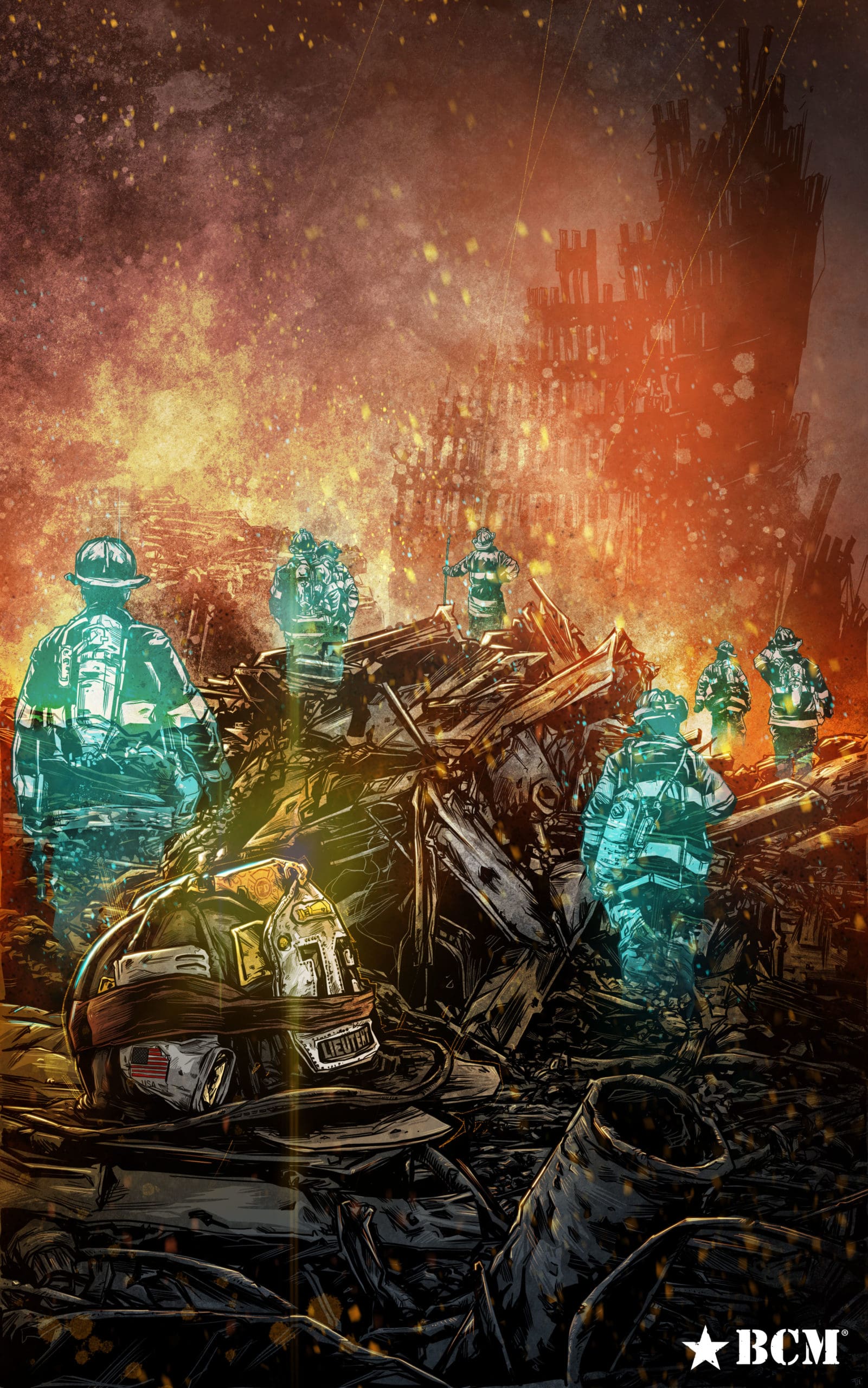
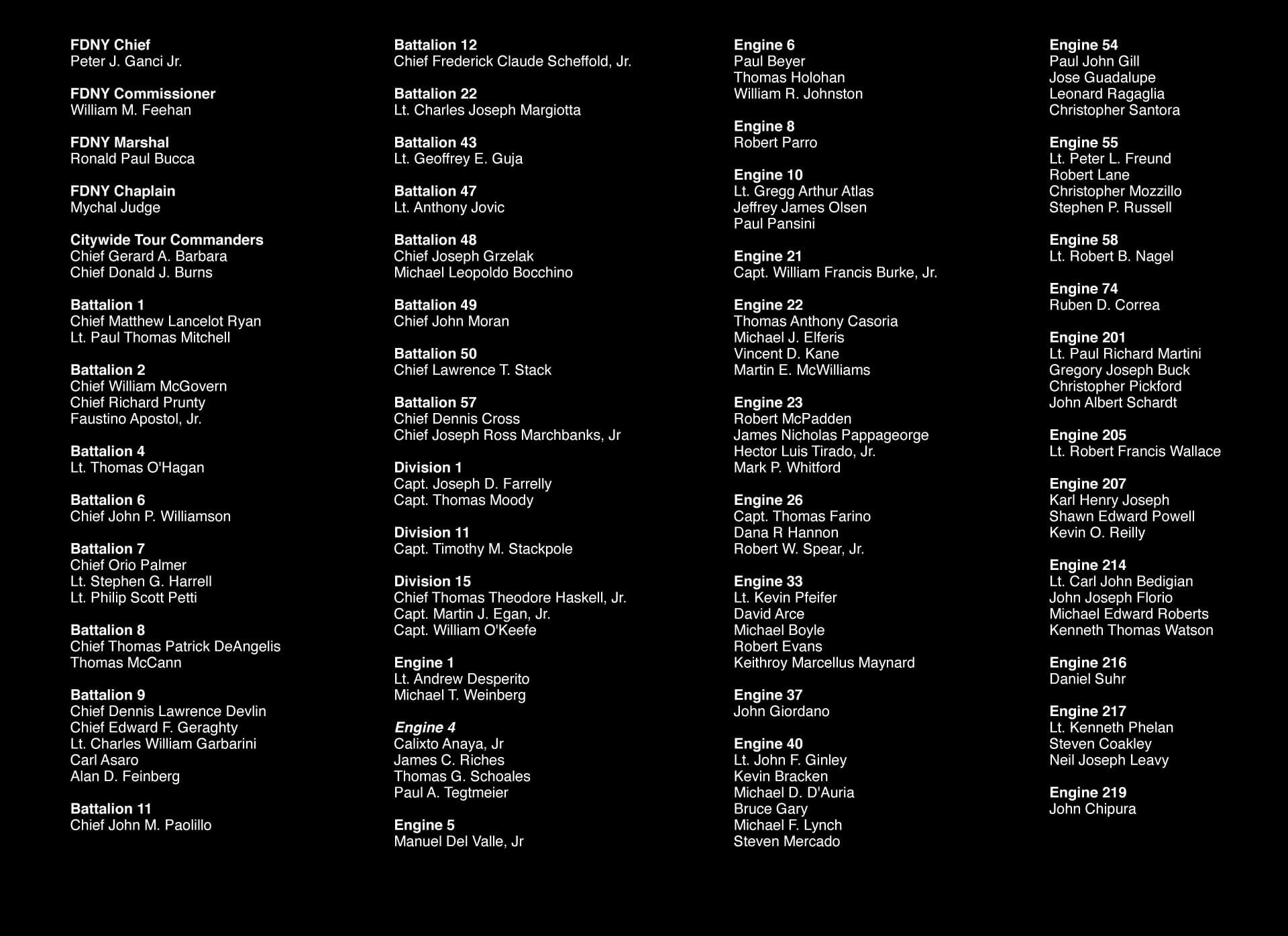
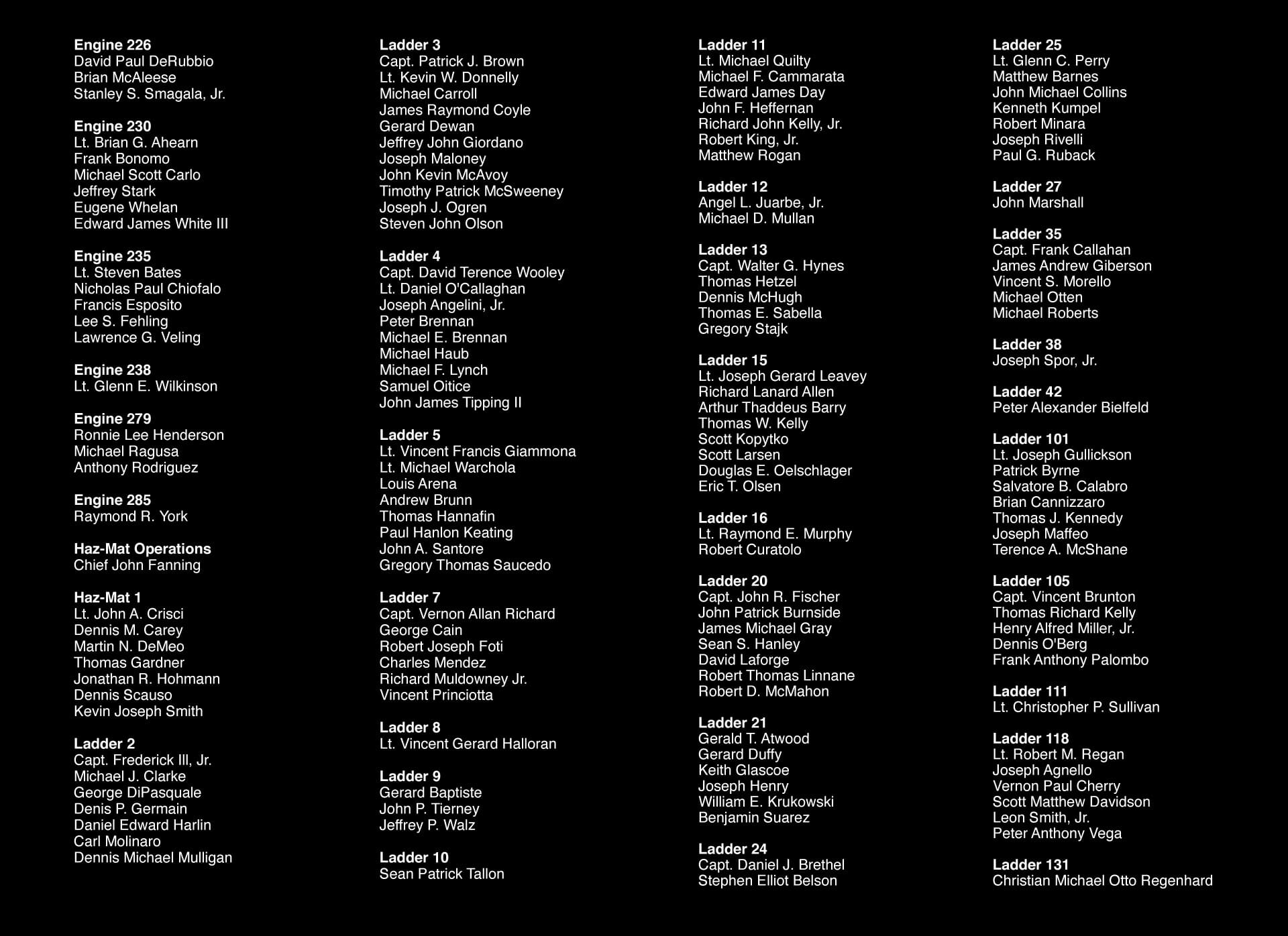
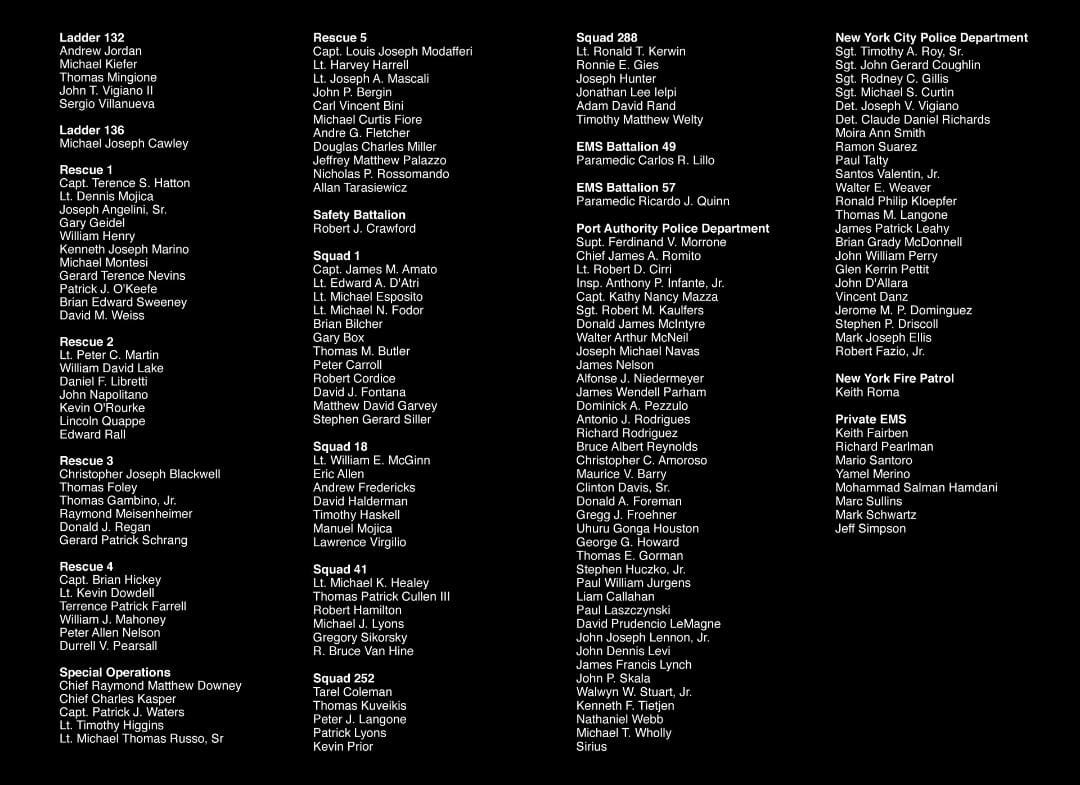
September 11, 2001. 402 first responders give their lives in the effort to save the over 3,000 innocent people trapped in tower one and tower two. Nineteen years later, BCM honors their selflessness and remembers the weight of their loss.


September 11, 2001. 402 first responders give their lives in the effort to save the over 3,000 innocent people trapped in tower one and tower two. Nineteen years later, BCM honors their selflessness and remembers the weight of their loss.
Sorry for the longer than usual time in between articles guys. I had a death in my immediate family this past month I have spent a lot of time over the last month working through those issues and trying to work in the Covid world. In any case I hope you all are staying healthy and as upbeat as possible during these challenging times. 2020 has sure been one for the books (so far). Hang tough, it will pass. Looking forward, people who have followed my articles here on SSD and/or have read my book, know that I am a big believer in the mental aspect of heath and fitness. IMO it’s actually more important that sets/reps, eating, etc., when trying to get and stay in top condition. The body always follows the mind in the success, or failure of anything. With that aspect I have come to learn (the hard way), that there is another part of all this that is very important and all too often overlooked. That is understanding who is fundamentally responsible for your health? That would be you and if you don’t take charge of it, it could lead to some bad outcomes, or at the least prevent you from achieving your goals.

Now on the surface this may seem obvious, but it isn’t that obvious to everyone and in my own case it really wasn’t until recently. In some past SSD articles I have shared a little of my own battle with TBI, not a lot as I don’t come on here to complain about my own (reactively minor) health issues, but to share my experience and information that I think could help people with their weight loss and fitness goals. Plus, I know fellow services members with much worse battle field injuries and chronic service related conditions than mine. I learned many years ago, when you start to feel sorry for yourself, look to your left or right and you’ll see someone who has it worse. So suck it up buttercup.
However in the spirit of trying to help others through my own experience I will share a little more today. For some background info, a little over a year ago I started having these weird headaches. They weren’t really what you would call a headache, but more of a dizzy, lightheaded thing. Out of nowhere, they would sneak upon me, when I was teaching a class, trying to do some computer work, driving, or even just watching TV? My balance was affected sometimes too. It would just happen and there was never an apparent cause? At first I thought it was an ear problem, as I’ve been prone to ear infections, especially as I travel a lot and when I climb above 10,000 ft, which I had been doing a fair amount of. So after trying my usual denial and just gut it out for a few weeks method, it only got worse, so I went to see a doctor.
As I’m retired military I have Tri-Care and go the hospital here on base. Which over the last 10 years has been fine. The fact was it was just like I was still on active duty as I would go and see what ever Navy doctor (or Corpsman) was on duty that day. No problem. Yearly physicals, flu shots, tests, blood work, etc., it was all good. So I go to the doctor this time and take a bunch of tests and the young female Navy Doc tells me that she can’t find anything wrong with me? But this thing was just getting worse, I felt like I was severely hung over 24/7. The only time I actually felt good was when I sweating, like during PT or climbing. However, as soon as I would stop and settle down, it would come back. So she set me up with a Neurologist.
So to make a (very) long story short with this part, I go and had a whole series of MRI’s, soft tissue, with contrast, etc. etc and I go to a ENT. Again nothing, but after a lot of discussion with the Neurologist and his review of tests and my service medical records he tells me that he is 99% sure I have some level of TBI. Ok, I get it, that figures, now what? He says medication is the answer. Now at age 60 I have never been on any long term prescription medication, for anything. So he prescribes me something and I go get it. My wife (who is a nurse) looks at it and tells me that it’s an anti-depressant, something commonly prescribed for PTSD? I call the doctor and he tells me that’s true, but it has been known to help people with TBI and he also thinks I may have some underlying PTSD. Huh? Really? However, as I have always trusted doctors without question, I start taking this stuff as directed.
Right away this shit makes me nuts. I couldn’t sleep with crazy nightmares and it had me ready to cut my own F’ing head off as my TBI symptoms actually got worse. The doctor tells me to just hang in there as it takes awhile to get into your system, call him back in two weeks. After after two weeks and I’m about ready to go active shooter he decides that it’s not right for me and he prescribes something else. My wife looks at this new stuff and tells me that this is high blood pressure medicine? Huh? I don’t have high blood pressure, never have? So like before I call the doc and he says, Yes, it’s for high blood pressure, but it has been known to help people with TBI. Now my blind trust in doctors is starting to fade, but there’s still enough to do what he tells me.
This new medication isn’t as bad as the first, I stopped having zombie nightmares and homicidal thoughts, but it really wasn’t helping the original problem either. After a few weeks I call the doctor and he wants me to try another, different drug? This is where I decide just throwing drugs against the wall (my wall) to see what sticks isn’t going to work, not for me. Thanks, but no thanks. I stop taking the drugs (and actually feel a little better) and my wife sets me up with a civilian doctor, which I’m seeing in a few weeks. In the meantime, I started doing my own research on TBI, PTSD and the medications that are associated with with their treatment. There is a metric F ton of information out there and much of it is written by people who suffer with these problems. The point is that now that I have taken charge of my issue by educating myself about it, as i’m in a much better position to decide on how I want to try and fix it, (if possible). Does that mean I will not listen to doctors and do just what I think is best? No, of course not. What it means is I’m better informed about the potential consequences of different treatments and medications before I buy into it. It helped me look my situation in a better more informed way and will help me discuss this better with a doctor going forward. I was too trusting and frankly lazy about this and it bit me in the ass.
It’s the same thing with something like losing weight and getting your health and fitness on line, you need to take charge of your own situation. Do some research and cut through all the slick marketing and media hype that promotes new workout routines, equipment, supplements and diet plans. Keep in mind that the bottom line is the #1 purpose of any of these products is to make money. If they actually help people is secondary. Now before you say anything, I don’t give a shit if I ever sell another book, the little money I have made from book sales wouldn’t add up to minimum wage when you add up the hours I’ve invested in. It’s always been more about talking to others about a subject I love than making money. The fact is I actually wrote my book at the urging of other Marines that followed my program and advice and it helped get people in better shape for their career. Yes, I’ve sold a lot of books. Way more than I ever thought I would and certainly a lot more than my publisher thought I would. LOL However, I think it’s only sold so well over time is because the advice is sound, honest and timeless. It doesn’t not work because some time has gone by or it’s some new high tech break through. It just works, that’s all.
But forget my book and any other book and take charge of your own health and fitness by doing your own research and figure out for yourself what makes sense for you. The fact is only you know what’s best and will work for you.
Till next month: “Be Safe Always, Be Good when you Can”.
Semper Fi
MGunz
Every person that exercises and tries to eat right has their own set of fitness and health goals. These are unique and personal to each person, with no two being exactly alike. Most are basic stuff like: achieving/maintaining a healthy body weight, improving performance for a sport/occupation, adding some muscle/strength. Under those very general objectives it can get as specific and detailed as your own ambition and imagination can take you. However, there is one common goal of everyone’s fitness program whether they actually say it or not. That is having an abundance of energy, both physical and mental energy, which are completely interrelated.
When you really think about it, energy has driven the human experience. We needed a lot of energy to survive, to hunt, to explore new lands, to build amazing structures and form nations. The fact is tired, exhausted people did not build our country, win our wars or develop the greatest economy in history. Our people did this with incredible physical energy and mental drive. Now in today’s modern world it’s not usually as dramatic a need that our forefathers had to contend with, as technology has made many parts of life much easier. But to be successful in just about anything you want to do, you still need a lot of energy. I know as a trainer that one of the things you often hear from people trying to get in better condition is that they’re tired, worn out. That at the end of the school or work day they have very little energy left to do anything but collapse, let alone exercise. I found this is even a common issue with younger people who have sedentary jobs. Needless to say, it’s hard to convince exhausted people that giving up some sleep to get up early and exercise will actually provide them with more energy, not less. But in most cases it does work exactly that way.
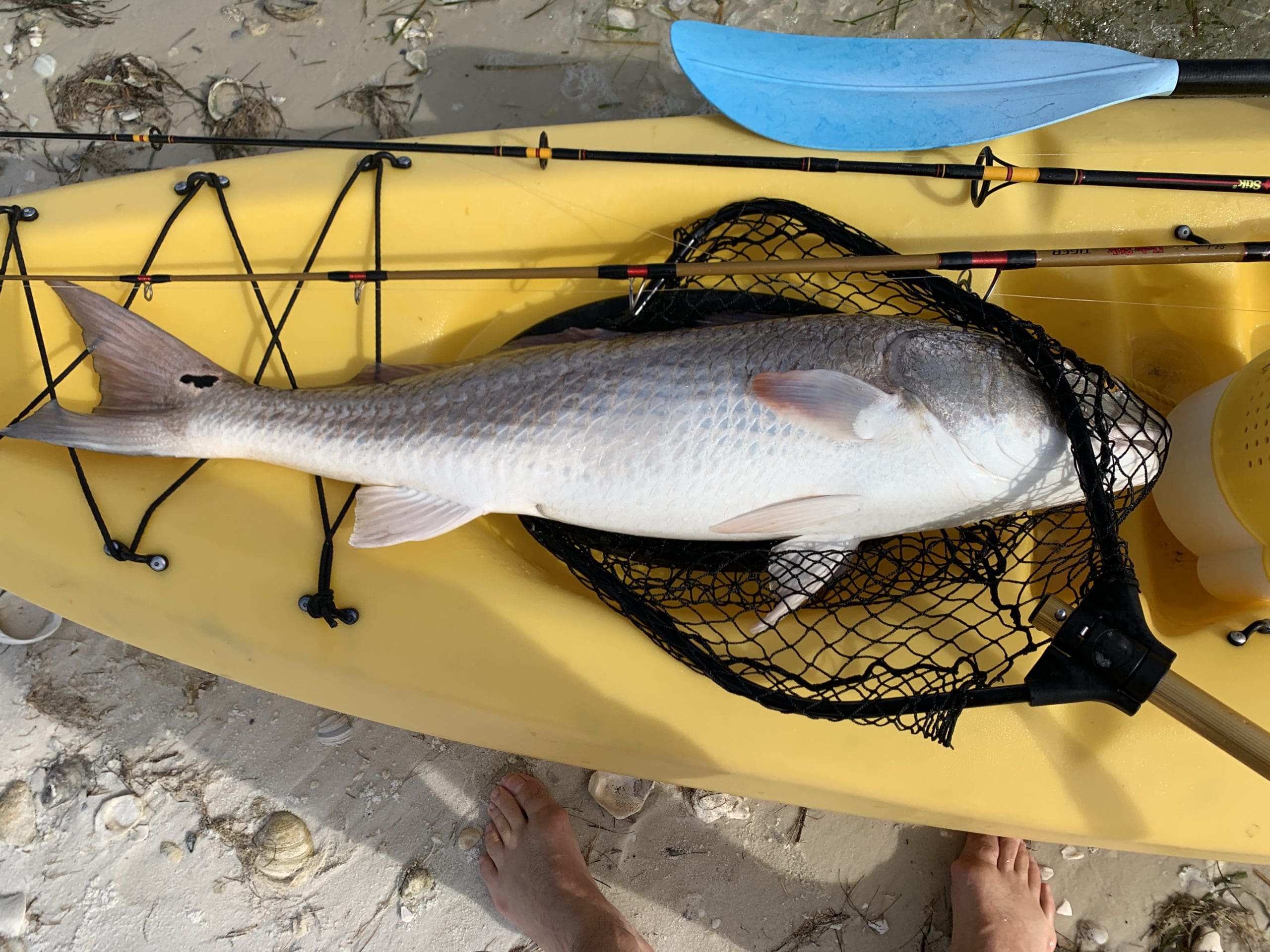
It’s been my experience that increasing activity (the right way), will provide you with more overall energy than a little more sleep, or sitting around will. It tends to build on itself in which the more you do, the more energy you have. It kind of works like interia. However, of course, this theory has a tipping point, where you do too much and the physics takes over and it goes the other way. But I think people can do a lot more than they would think. As a simple example the other day I got up at my normal time, my alarm is set for 0430, but 99% of the time I wake up before it goes off. Within 30 minutes, I’m up, drinking coffee and listening to the news as I put myself through a pretty intense workout in my garage for an hour. By 0730, I was finished, showered, had breakfast and headed in to work. From 0800 – 1400 I taught classes, attended a staff meeting (the most tiring part of my day) and had lunch. At 1400 I took my class of International students for an hour of PT. Standard military PT nothing crazy. After PT I finished the work day with prepping for the next day’s classes and answering emails, etc. Around 1600 I was driving home and noticed that the ocean was calm, with low boat traffic. Arriving home I quickly changed, loaded my kayak and fishing gear onto my truck and was on the water within an hour. Two hours of paddling and fishing yielded me one keeper (a nice slot Redfish, note the picture).
I got home around 1900, cleaned my gear and fish, which I grilled for our dinner. A hot shower and a cold beer had me ready for the rack around 2100. Was I tired? You bet and I slept like a baby with the intent that it would start again around 0430 tomorrow. That was last Tuesday and pretty much a standard day for me. No, I don’t always go fishing and for sure don’t always catch fish when I do. However, I almost always PT early and do something else physically active in the afternoon, a bike ride, climbing on my bouldering wall, some home maintenance, something. The one thing I very rarely do, is park my ass in a chair and stare at the TV or computer. That would exhaust me. People who follow me on IG or FB often say where do you get the energy to do all that crap? Well, habit for one, I’ve been doing a version of this routine all my life. But I do and more importantly don’t do certain things that greatly help me maintain a high level of usable energy. IMO, outside the assumption that you are following a good workout routine and are eating a decent diet, these are the five most basic and effective things that anyone can do to increase their energy levels.
1) Keep your body weight down. This should be obvious, if you’ve overweight (even a little), your body has to work harder to move that weight around, using energy that you could put to better use. If you’re really overweight, it will drain your energy reserves pretty quickly. Not just your muscles, but your organs will be stressed trying to move that extra weight you around. 10lbs doesn’t seem like a lot, but try just carrying a 10lb dumbbell plate around all day, it would become a pain in the ass quick.
2) Don’t eat large meals. Meaning a lot at one sitting. Now, there is no doubt that eating right; The right foods in the right amounts by itself is a huge part of the fitness puzzle, but for now let’s just assume you are eating pretty well. The point is that digestion, especially when processing a large meal, requires a lot of energy. Again, this is a pretty obvious thing, think about how you feel after you’ve had your typical Thanksgiving sized meal, you’re ready for a nap. You are much better off eating smaller meals and if you need more fuel add some nutritious snacks in between. Especially at night as having too big a meal at the end of the day can seriously tap out whatever you had left in your tank.
3) Get better sleep. This is a big one and for many people a very hard one, myself included. The world of today is a 24/7 affair and we all tend to overload our brains with the non-stop input of smart phones, social media, the internet, etc. etc. This all can make sleeping, getting to sleep and then sleeping soundly very difficult, if not almost impossible. I have this issue myself, always have. There is a lot of information out there that can help you with this. Though I know it’s a popular solution, I would try to avoid prescription sleep aids. This can be a complicated problem and you’ll have to do some research to figure out what works for you, but you can’t maintain high energy levels without good sleep.
4) Don’t smoke and don’t drink too much: When I was in the field, on guard duty or drinking with my buddies I smoked way more than my share of cigarettes. I luckily never developed the 24/7 habit and gave them up completely about 15 years ago. The nicotine will give you a quick boost, but in the end, you’ll pay a heavy price, not only in your energy levels, but your overall health. The years of research in this area is beyond dispute. The same goes for drinking too much, a few drinks can be a good thing. Getting slam drunk a few times a week has only one outcome. This can sneak up on you. Many years ago, I was on a two-month det in Thailand. I got in the habit of drinking Johnny Walker Black, as it was tax and duty free at the base package store for $5 a bottle! I drank a bottle just about every night for about a month, before I started to realize maybe I was developing an issue. Needless to say, I was pretty tired all the time too, but being young and in Thailand brings its own energy.
5) Manage/reduce your stress: Easier said than done, I get that. But stress is a huge energy killer. Sweating the load over work, family and social issues will tire you out more than running a marathon. Exercise is a big way to help burn some of this off, but that often isn’t enough, not for me. I find that spending some time doing something relatively mindless works even better. Bike riding, kayaking, fishing and just walking my nutcase cattle dog can go a long way for me. Find something without a bar to jump over, a little hobby. I know many high-octane people who have little hobby’s that they seem to live for, not because it makes them any money, or other tangible benefit, but just for the peace of mind and simple joy it brings them. Grown men that collect comic books, fly model airplanes and I even know a retired Marine Officer that makes appearances as an Elvis impersonator? (He’s actually pretty good too). The point is you can’t work, PT or travel 24/7. I enjoy them all, but I know they all can get old and wear you out. They say that you should think about what you used to like to do when you were 10 and try a version of that again. When I was ten, I lived on a sting ray bike, played sports and ran around the woods like a little wild animal. So it’s no surprise that hiking, bike riding and playing sports are things I still love to do. Don’t disregard the benefits of a simple hobby, it will recharge your battery.
Having more energy has many benefits, too many to list. But maybe the best one is that after the day’s battles are fought. After you’ve done all the things you have to do, you have some steam left over to do something you want to do, things you like to do. At some point you need to pay yourself, life is too short. Protect yourself and hang tough as we all work through this rough patch. We’ll talk again soon, till then:
“Be Safe Always, Be Good When You Can”
Semper Fi
MGunz
PHOTO FILE: PHANTOMLEAF WASP II Z4 im Feldtest
The ideal environment, the camouflage suit sits great and fully camouflaged, he storms the building.
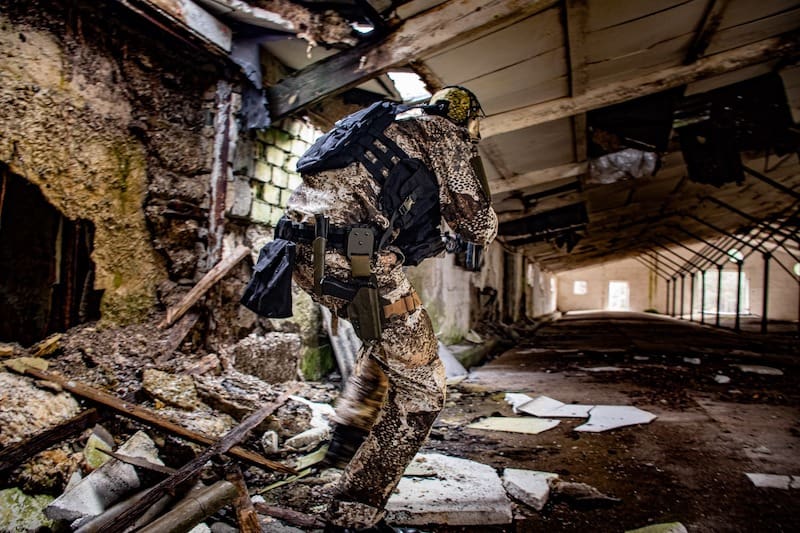
Does it really work that way? With good patterns, yes, sure. But it’s not just a matter of patterns. Each camouflage only works well in the right background. And we wanted to figure out the limits of this one for you: PHANTOMLEAF WASP II Z4 is presented as an originally urban pattern. We wanted to know how it works where and what are ist limitations to give you ideas to use it wisely: Good camouflage products work best with a skilled operator.
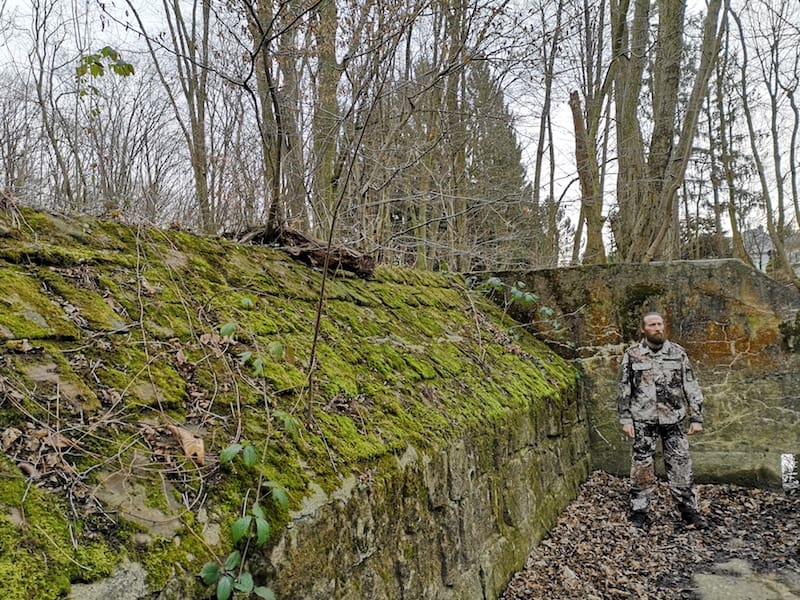
The uniform is from Leo Leo Köhler and we presented it HERE in the SPARTANAT review. It is autumn, we are outdoors. And Z4 doesn’t come too bad even at this location.
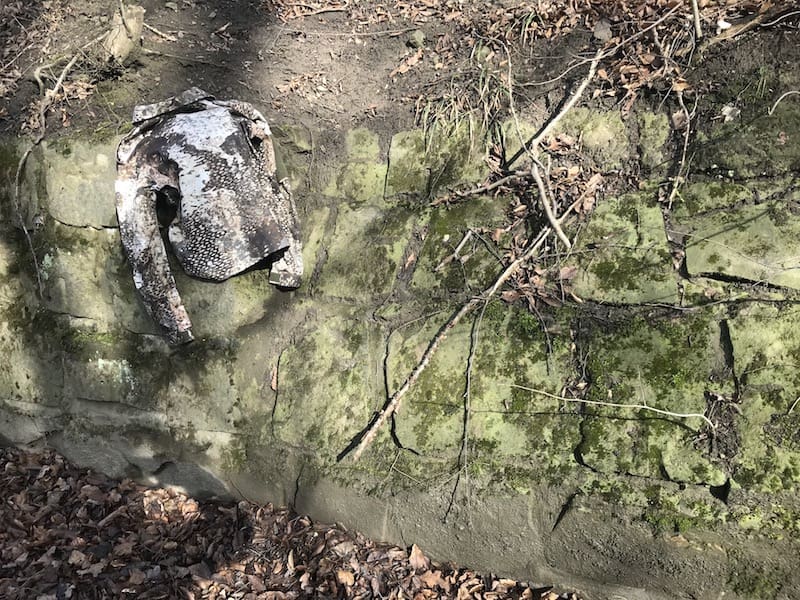
Where the pattern reaches its limits, which is why we do not want to export it to spring, is green. The moss alone kicks it out.

Who likes to compare. We photographed the green Z3A from PHANTOMLEAF at a different time of the year in the same place and in the same position: we could hardly be found. HERE is the field test with the green WASP II Z3A from PAHANTOMLEAF.
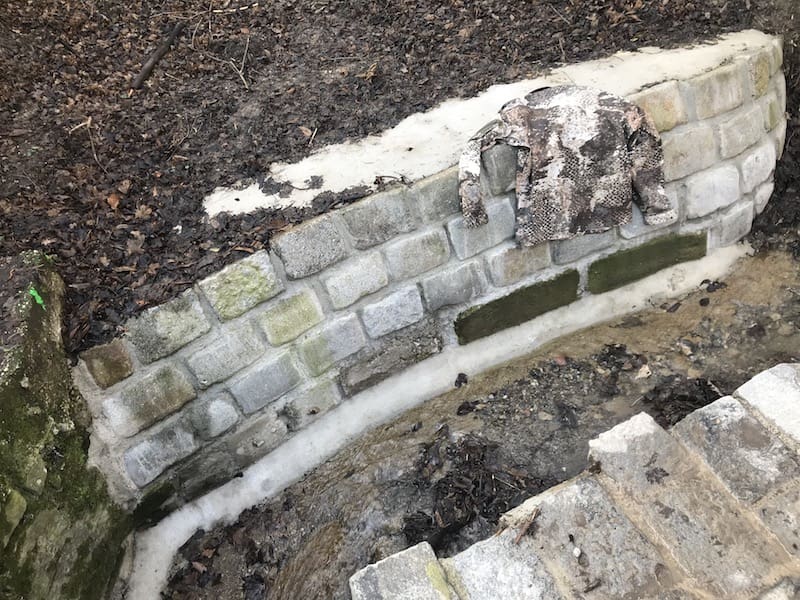
This pattern by PHANTOMLEAF likes what is stone and has shades.
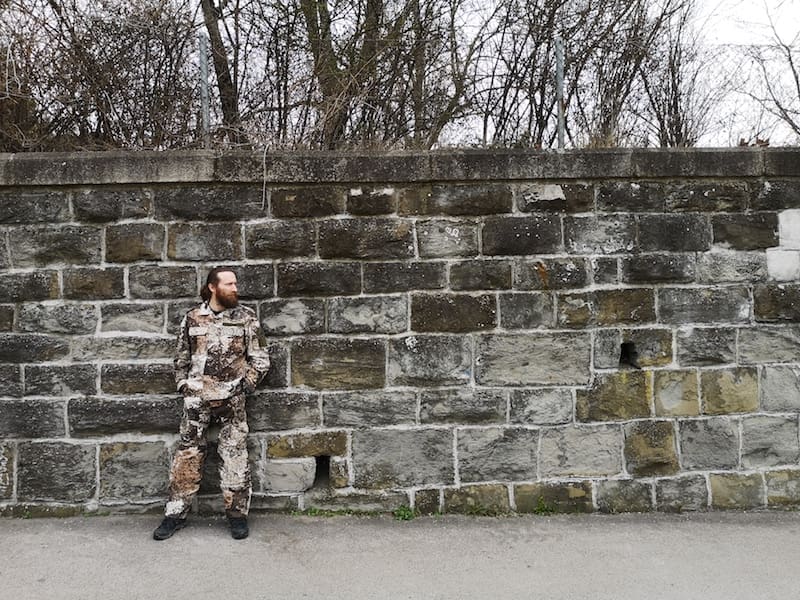
This wall was not built after Z4 was built. Nevertheless, the pattern fits in fine.
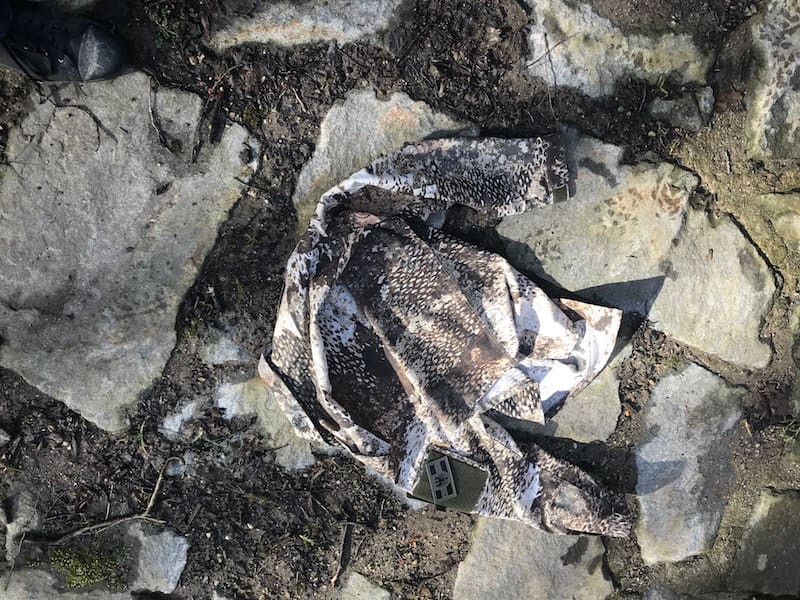
Broken stones, soil in between, all of these come very well in line with the strongly structured patterns in gray and brown tones.
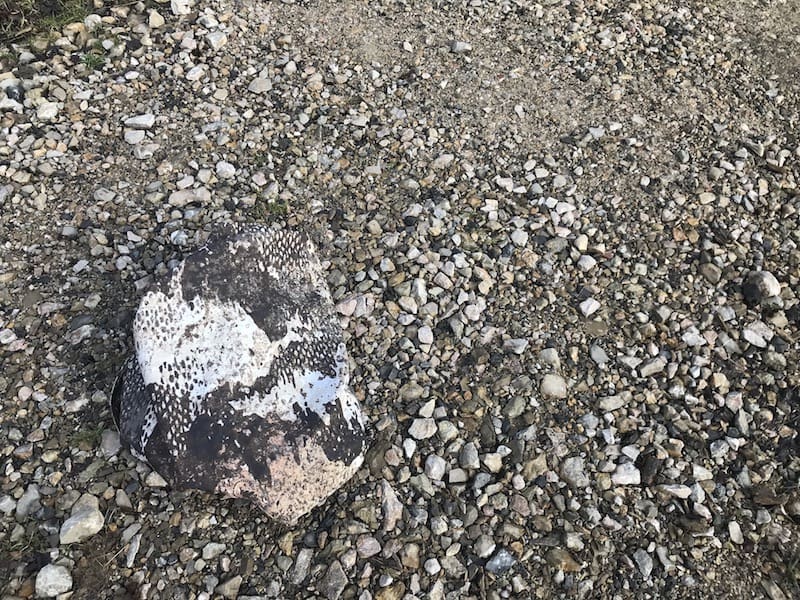
Gravel substrates are also ideal for using PHANTOMLEAF Z4. The strong structure fits here too.
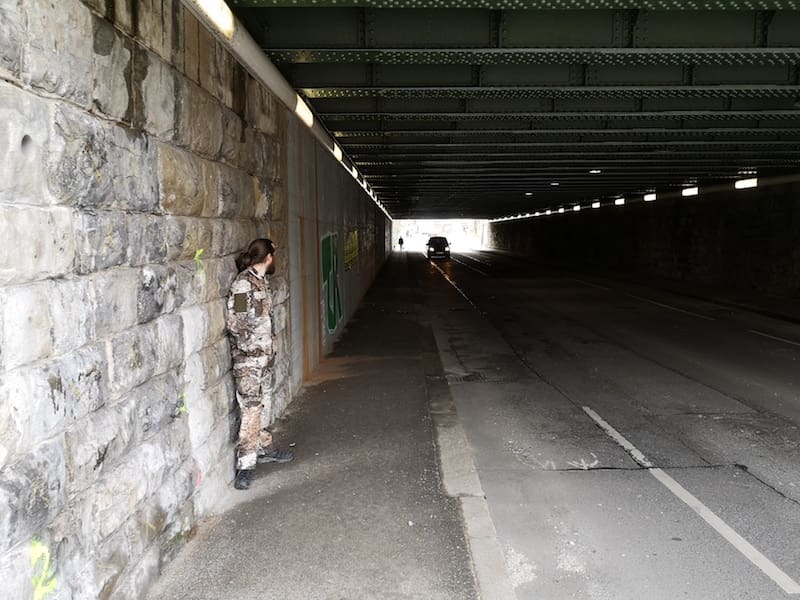
The stone wall in the tunnel underneath literally “soaks up” the pattern.
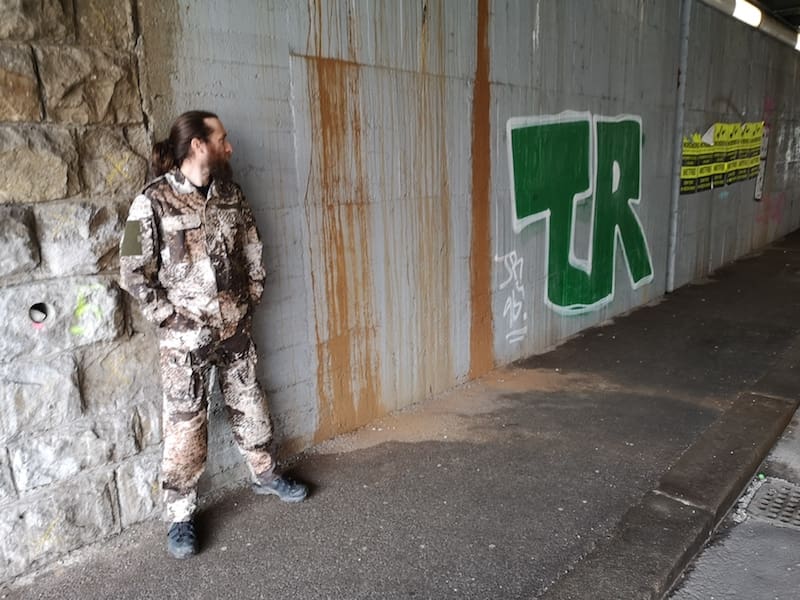
The topic is more difficult with smooth concrete.
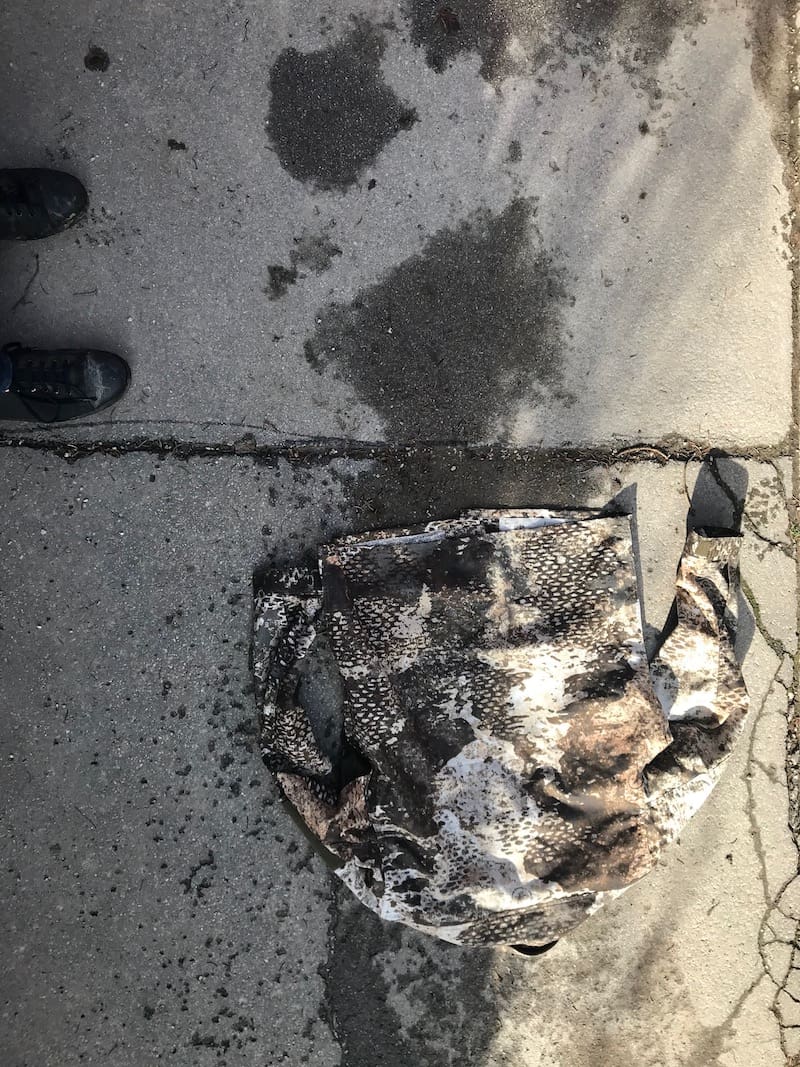
But as soon as there are any structures – it is wet on the ground, plus broken lines – this pattern from PHANTOMLEAF is immediately at home again.
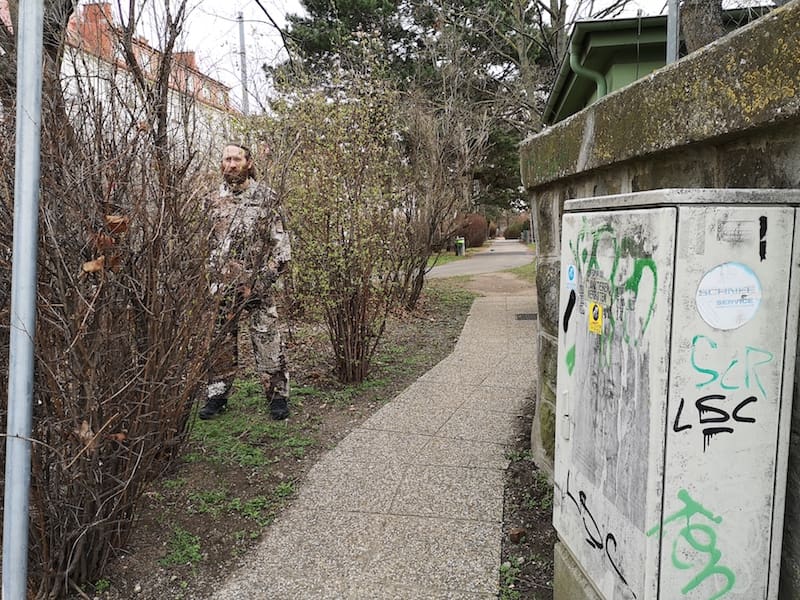
You don’t always have to be in the foreground. Tree branches from a bush, urban environment. Good camouflage.
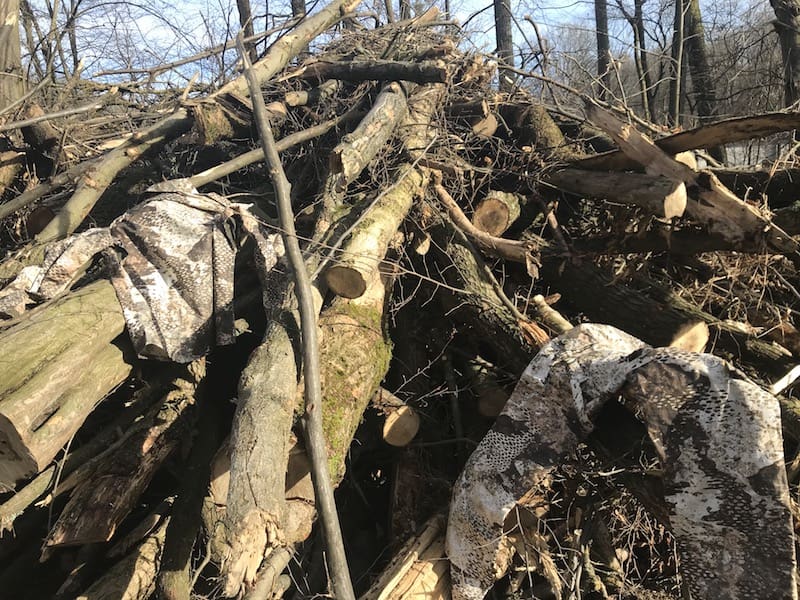
Let’s go out into nature with the pattern. Stack of wood, all wildly mixed up and many colors. We could hide well with Z4.
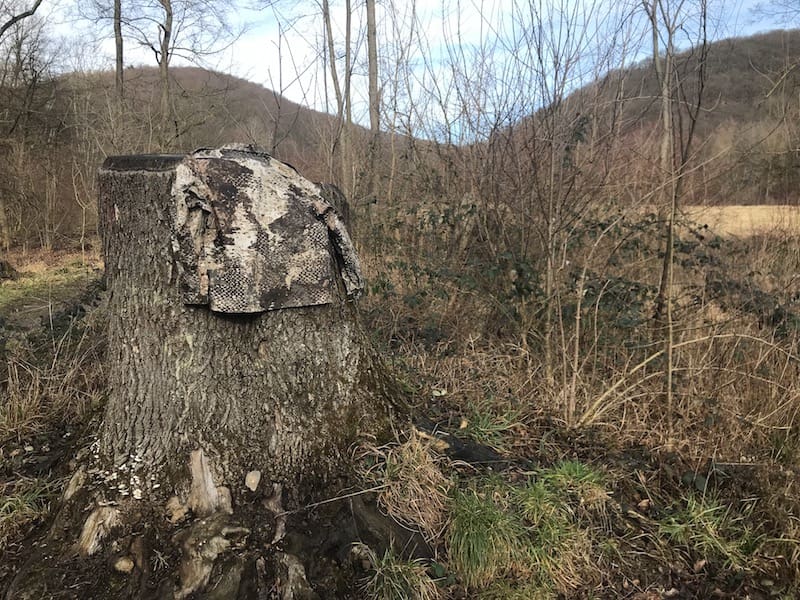
The tree trunk is the example where Z4 surprised us the most. It fits in perfectly despite it originally being intended for urban use.
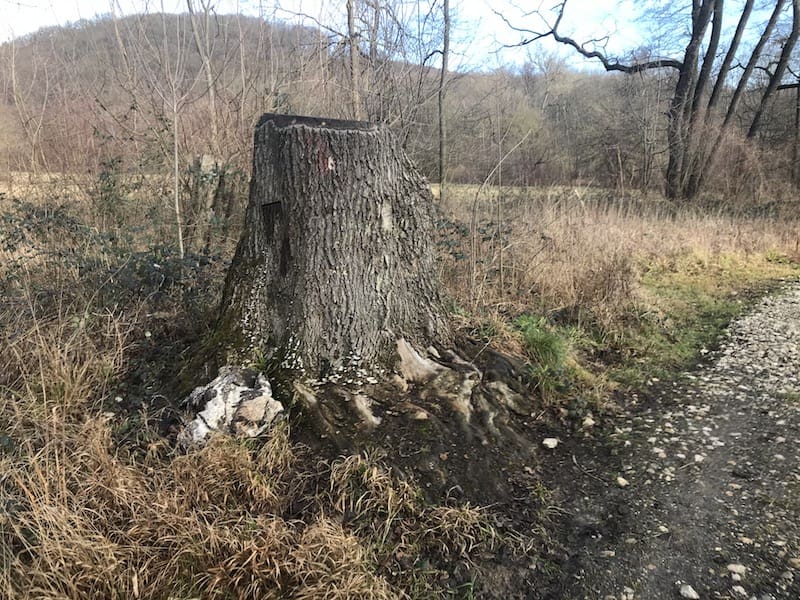
It even disappears …
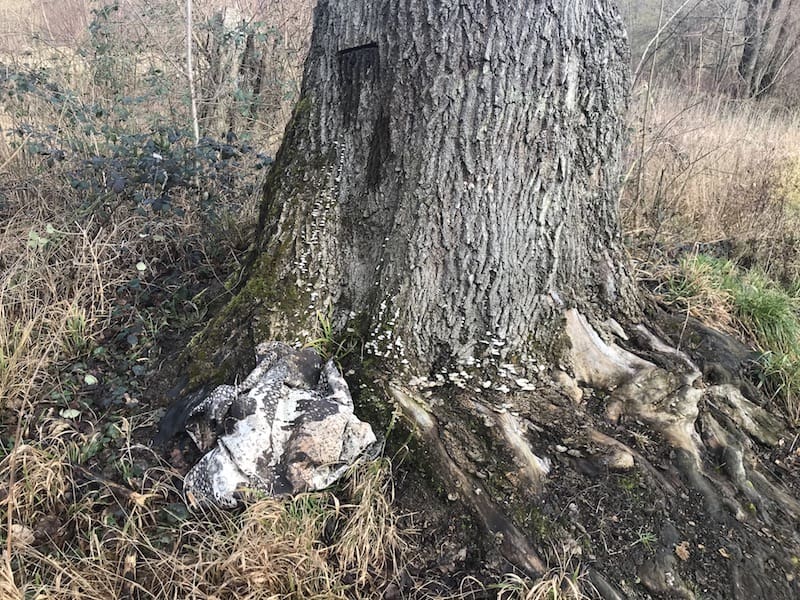
… because it is now placed at the foot of the tree and matches the light gray wood structure.
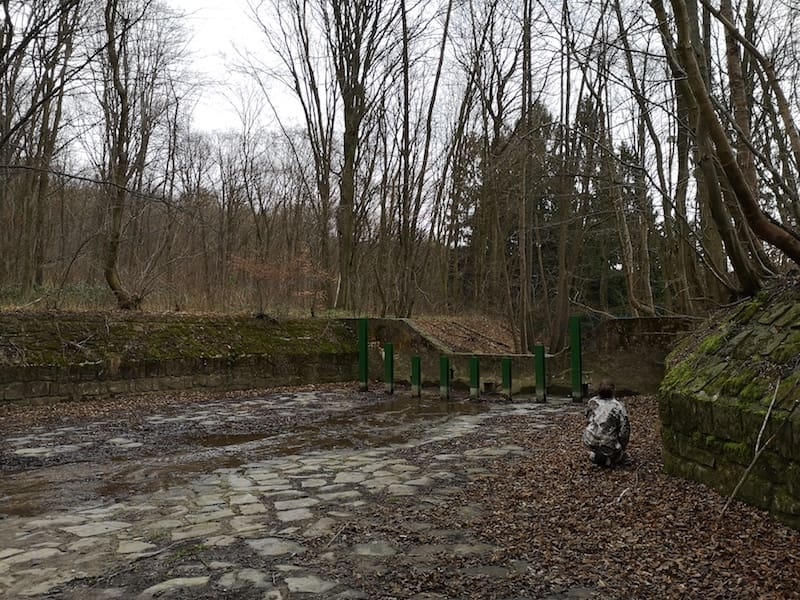
Autumn forest, lots of brown tones …

where the background becomes “monocolor”, the pattern does not feel comfortable. Here it suddenly looks pale because the leaves are so lively.
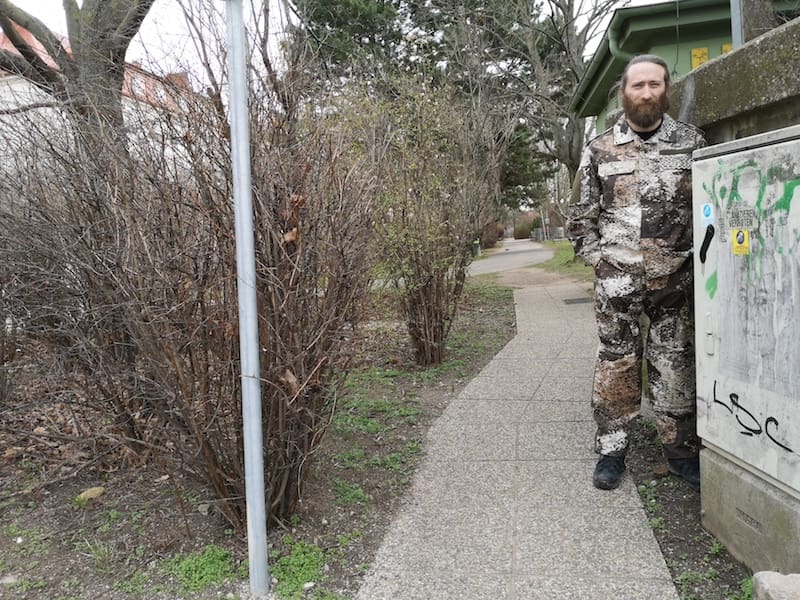
Urban without cover looks fine, because PHANTOMLEAF fits in well here.
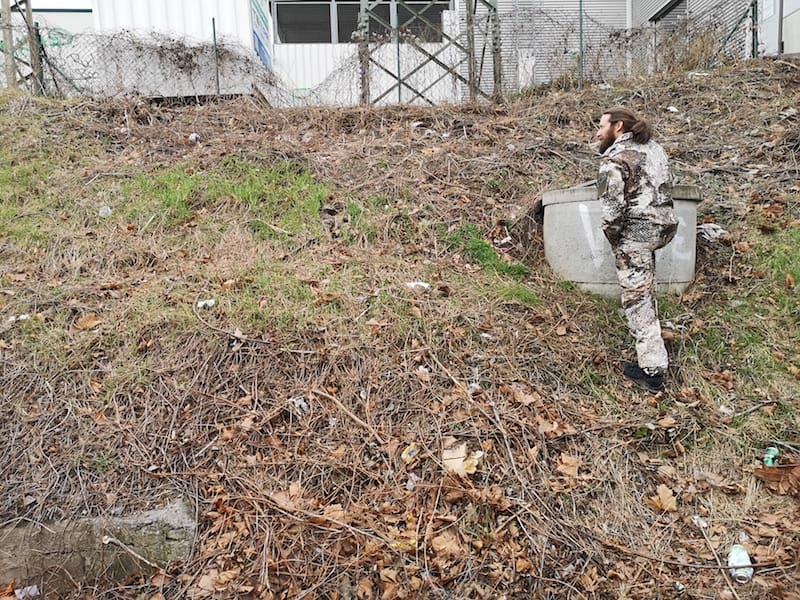
Even if it sometimes appears bright, it “adopts” the surroundings well.
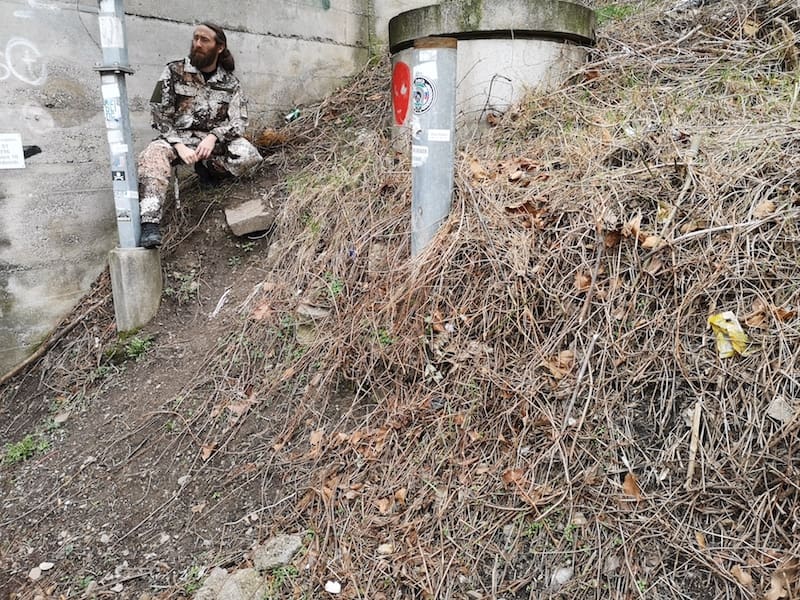
Taking cover in a gray-brown environment, Z4 likes that.
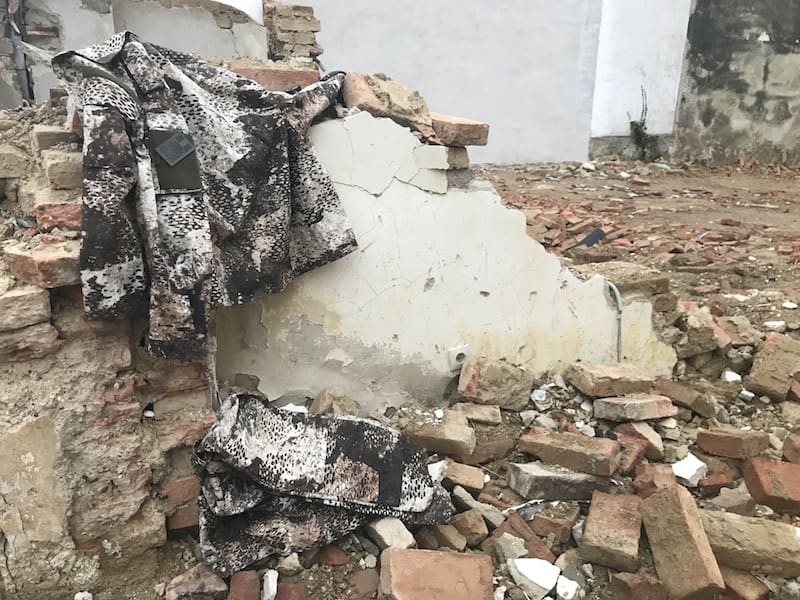
Where there is fighting, a lot is broken, which gives more cover. Here is a disappeared old building as a test site for the PHANTOMLEAF field test.

Plaster, brick, earth – the camouflage pattern disappears.
That is the main area the pattern is intended for.

If the surface becomes too dark, the pattern is again noticeable. On the other side: In real combat situation the suit will be covered in dust and will be wet and will become more adopted tot he surroundings by this. Just to mention: To make a suit more dark to adopt in the field is much easier to lighten it up.
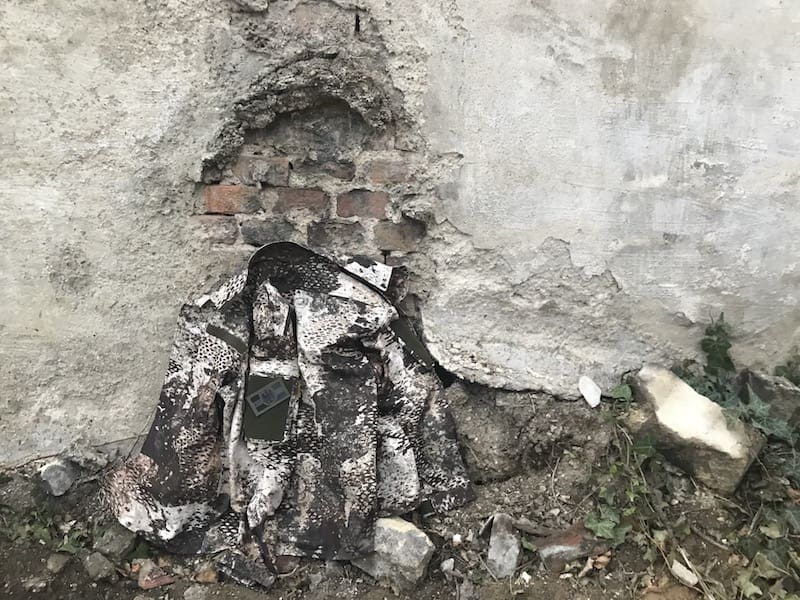
Old house wall: put on the camouflage suit, sit down, nobody will recognize you.

Then someone left his jacket hanging and ran away. Must be cold: Z4 and winter is a hot topic. Especially where there is no closed snow cover.

Now a search picture: Find Z4! A little tip: in the front left. That is very impressive for an “urban pattern”.
CONCLUSION: At first glance an extreme camouflage pattern, which turns out to be very versatile if you pay attention to the surroundings. In addition to the urban environment and autumn forest areas, the pattern also plays a great role in a landscape with some snow and rock.
More pictures of the various PHANTOMLEAF patterns in the field can be found on Instagram at PHANTOMLEAFOFFICIAL.
HERE we interviewed the creators of PHANTOMLEAF.
The field blouse and combat trousers in PHANTOMLEAF by Leo Köhler are available from RECON COMPANY. The command field blouse costs 89.95, the combat trousers 109.95. The matching cap is available at 14.95.
PHANTOMLEAF on the Internet: www.phantomleaf.de
LEO KÖHLER on the Internet: www.leokoehler.com
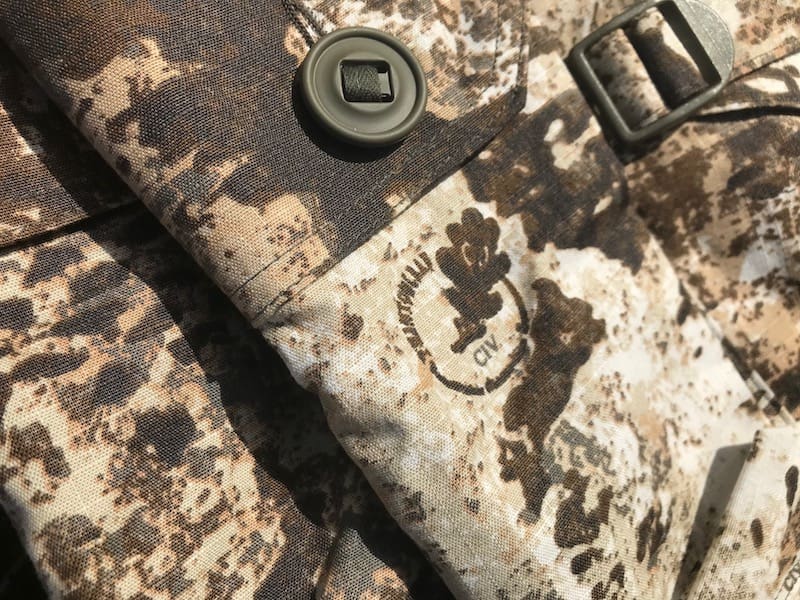
The small leaf is the PHANTOMLEAF logo.
As a PT instructor and fitness author, one question I’ve been asked many times is: What do I think is the most important factor in staying in shape and maintaining a healthy body
weight? Diet? Workout routine? Attitude? Lifestyle? The fact is that achieving and maintaining a high level of health and fitness has several different components that all need to come together for long term success. However, when asked to name the most important factor I always give the same answer: Consistency. Consistency specifically in this case means the ability to follow a fundamentally sound (but not necessarily perfect), exercise routine and eating plan. To follow it not for a few months, a summer, a deployment, etc. but for life.
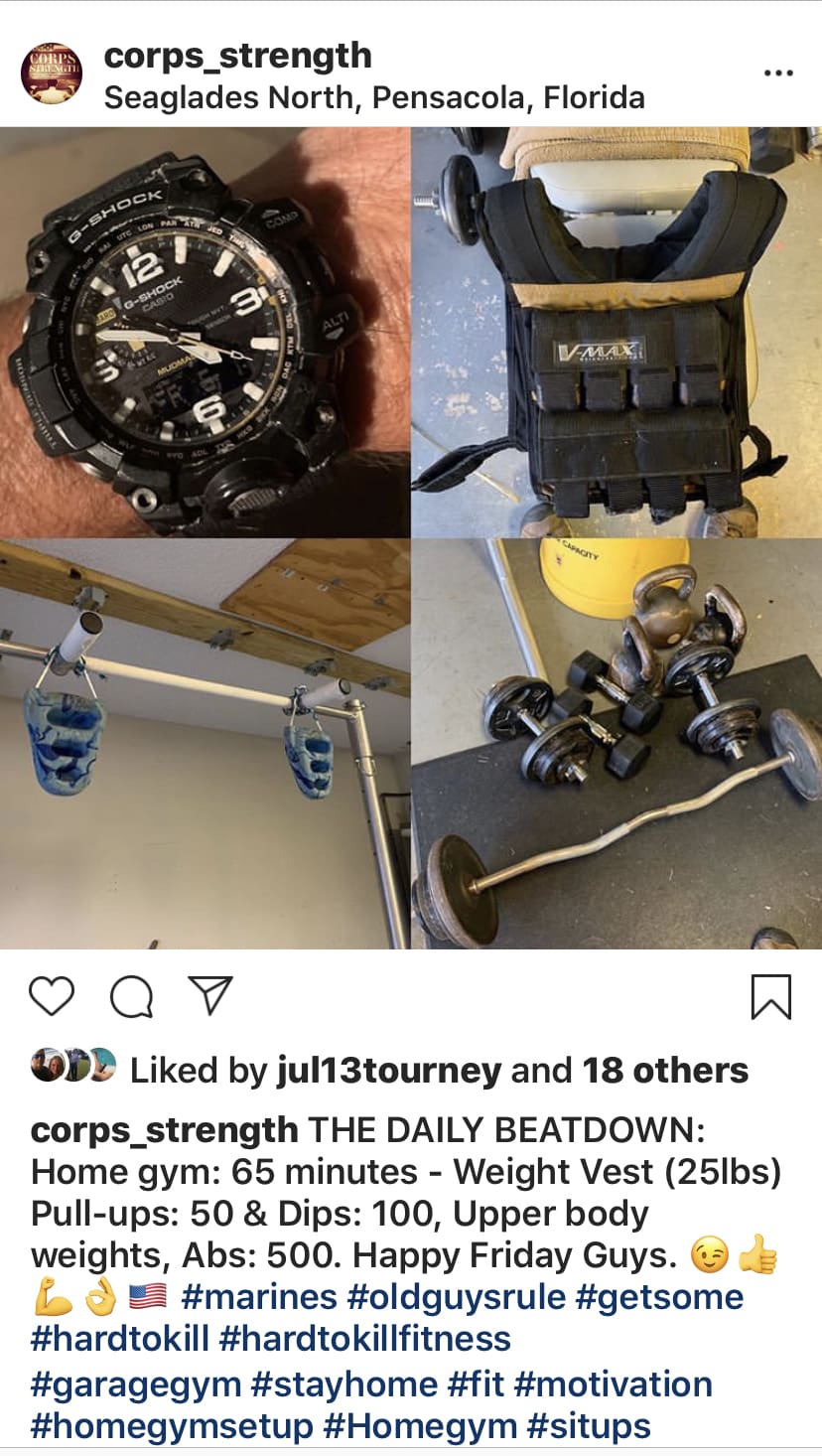
People who follow me on Instagram, know that I post my workouts: THE DAILY BEATDOWN”. It’s like a training log for me (helps keep me honest) and I also hope it provides some motivation to those who follow me. Based on the feedback I get, it does. The fact is I follow others on IG for the same motivation. Some are fitness professionals, military people, gifted athletes and other various mutants that are doing things physically I couldn’t do on my best day, but my favorites are just everyday people who work hard at staying fit. Their true life stories and efforts always give me inspiration to work toward my own goals and I’ve learned a lot from their practical experience. With all that, the main point I try to get across with the picture of my G-Shock showing the time I roll out for PT is that just about every day, day in and day out, rain or shine, home or when on the road, working or off, cold weather or hot; I put in the work. I punch that PT time clock and I have for over 40 years now. I’m convinced that my blue-collar, enlisted Marine approach to this has been the biggest key to my long-term success. I’m also convinced that just getting up and getting it done can overcome a lot of other less than perfect aspects of any program.
Now am I saying that you need to get up at 0430 almost every day and PT like I do? I could say that, as it has worked great for me and it might for you too. But for most people, it probably wouldn’t work, not long term anyhow. The point is that when I help people on their fitness plan and achieving their goals, it’s about finding out what works for them, not me. However, whenever you figure out what routine works best for you, the most important point is that you actually do it and do it on a regular basis. Regular in my opinion means daily. My simple rule on work out frequency is that I plan to PT for 1 hour, first thing in the morning, every day. I’m not foolish about it though, as I will take a day off when I need to, but I do my level best not to go two days in a row without some PT. On average this comes to a day off, every 4-5 days. With this mindset must also come with the understanding that to do this type of every day routine, you must widely vary the intensity and variety of your training to keep your mind and body from burning out. There are some (many) programs that preach the opposite mindset. Meaning that you should take a lot of time off for recovery and then when you do train, train at a very high intensity. In my experience that is a sure recipe for injury and burnout. Both of which lead to long periods of doing nothing. BTW, doing nothing is the easiest habit to develop and one of the hardest to break.
So how do you maintain the long-term motivation to workout and eat right (most of the time), almost every day? Well, it helps to have a high pain tolerance and somewhat OCD personality like myself. But for everyone there are positive and healthy ways to ingrain the long-term exercise and eating right habit. First, you have to figure out how to make this part of your life, not your life. Contrary to popular belief, as much as I like to PT, my life doesn’t revolve around it, it’s just part of my life, like sleeping, eating or dropping a deuce. Just a natural part of my day, not something I consider forced, or a hill I have to climb over to get to my life. The fact is great health and fitness allows me to do the things I like to do: climb mountains, hike, kayak, rock climb, mountain bike, play many different sports and do it all at pretty intense level. Not by any means what you would call a professional level, but at a level that allows me very few limits as far as participation goes. What I mean by that is while I may not be able to speed climb Mt. Rainier, I did successfully climb it without requiring an extreme effort, or suffering any injuries. I also had to do very little specialized training to prepare. My normal everyday routine was really all I needed. Plus, even at age 59 (and being the oldest member of our climbing team by 15 years) I was able to enjoy it. Make no mistake, it wasn’t easy, but not by any means a real physical struggle.
Just as getting good sleep supports your ability to work, play and stay healthy. You should think of PT the same way. Nobody would consider just not sleeping? Well, you’d say that’s not your choice as if you try to go without sleep you’ll just collapse at some point. True, and it’s just as true that if you go without regular exercise and good food your health will eventually collapse also. It will take longer and may be less dramatic, but have no doubt, your health will collapse. On the way to that collapse you will slowly be able to do less and less, and feel more and more like shit. Hey we all get old, sick and die, that’s life. You’re born and at some point, you die. Same for all of us. However, the different is what happens between the two, which can be vary greatly by our own efforts and habits.
The keys to developing the fitness habit, is really the same with embedding any good habit. First you have ease into it with small but consistent changes. Then over time slowly ramp up to the level that will get you to your goals while remaining sustainable. This is maybe the most common mistake that people make in this area. They try to do too much, too fast. It overwhelms their body, life style and mental state and they quickly fall back to nothing. You have to figure out your goal first and then from there design a solid (and simple) plan to get there. The plan needs to consider many different things in addition to your end goal, to include the time you’re giving yourself to get there. This is very important. Goals, both long and short term need a time line. I learned a long time ago the only real difference between a goal and a dream is a time limit. I want to earn a college degree in 4 years is a goal. I want to get a degree someday is just a dream, a fantasy. Your goals need a time limit if you’re serious about achieving them. However, if you aren’t that serious and are happy with just dreaming about great health, fitness and getting your weight right, have at it. That’s easy to do, but remember it’s just a dream, not real and not ever likely to become real. It’s just the way this stuff works.
Of course the mechanics of how to structure your workouts and eating are very important also. The surprising thing though is that this part really isn’t that complicated, certainly not as much as people make it. There is more good information out there on eating right and working out than you could ever need, like my book for example. But, it will take some trial and error to get it tailored for you, but that is the same in any endeavor like: running a business, a military unit or sports team. As they say about combat: The best plans can quickly become useless and have to be adjusted as you go, but prior planning is indispensable. Start with a simple basic plan and adjust as you go. Having no plan and just trying to wing it will fail. Again it’s just the way this stuff works.
The bottom line is getting and staying in shape requires goal setting, some planning, a little experimenting and above all else consistent long-term effort. However, it’s not rocket science and certainly doesn’t require nowhere near the time and effort as the most important things in life do: like earning a living, getting an education, or keeping a family together. However, I will contend that every minute invested in a sound fitness program will pay you back many times over in your health, your mental state and in your life overall. In fact it’s one of the best time investments any person could make to improve their life. I know this not only from my own life, but from witnessing this in an untold number of others. So do yourself a favor and invest a little time and effort in yourself every day, you’re worth it.
I hope everyone is staying safe and we are all over the hump on this pandemic and we can all get back to work and our lives soon. Till next month:
“Be Safe Always, Be Good when you Can”.
Semper Fi
MGunz
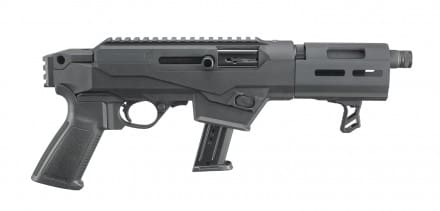
A couple of years back, Ruger released the PC (Pistol Caliber) Carbine, an evolution of a concept initially realized with the discontinued Ruger Police Carbine. Featuring a takedown receiver, ~16″ barrel, and 9x19mm chambering, The PC Carbine was designed to allow shooters to utilize a common caliber and magazines between their sidearm and long gun, lowering a shooter’s logistical burden while providing an improvement in controllability, accuracy, and effective range as required. Lending to the functionality of the PC Carbine is its interchangeable magwells, since it comes out of the box compatible with Ruger’s Security 9 magazines, but can be quickly converted using an included magwell to feed from ubiquitous Glock pattern 9mm magazines instead; a Ruger American compatible magwell was also made available for purchase.
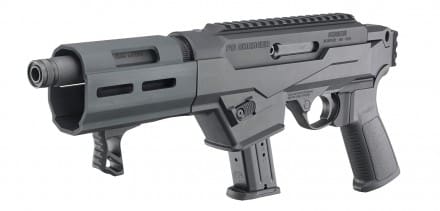
The warm reception and popularity of the PC Carbine led Ruger to expand the product line with various models, including some with a modular, more ‘tactical/modern’ chassis, and others chambered for .40 S&W. However, earlier this week Ruger revealed the most unique addition to the PC line yet, with the introduction of the PC Charger. Like Ruger’s .22 Charger to the 10/22, the PC Charger is a pistol variant of the PC Carbine that utilizes the same receiver – you can think of it as a PDW to the PC Carbine’s, well, carbine:
– 16.5″ overall length vs the PCC’s 34.37″
– 6.5″ barrel length vs the PCC’s 16.12″
– 5 lbs vs the PCC’s 7 lbs
Simply put, it’s a lighter, more compact weapon compared to the PCC while retaining parts commonality and many of the same features, such as the 12 o’clock Picatinny optics rail, reversible charging handle and magazine catch, threaded barrel, and exchangeable magazine well.
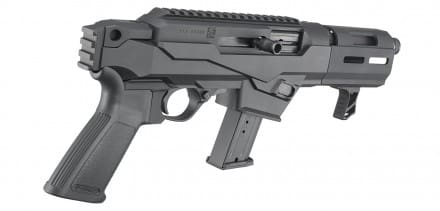
What’s unique to the PC Charger, at least compared to the standard PC Carbine, is the features of its polymer chassis. It includes rearward QD cups for installing QD-compatible slings, the ability to install any AR-compatible pistol grips, and the integrated rear 7075-T6 Picatinny rail, for attaching a rail-mounted brace or stock mount. Rounding out the PC Charger is an M-LOK compatible forend which allows for the attachment of M-LOK accessories or rails at the 3, 6, and 9 o’clock positions.
www.ruger.com/products/pcCharger/models
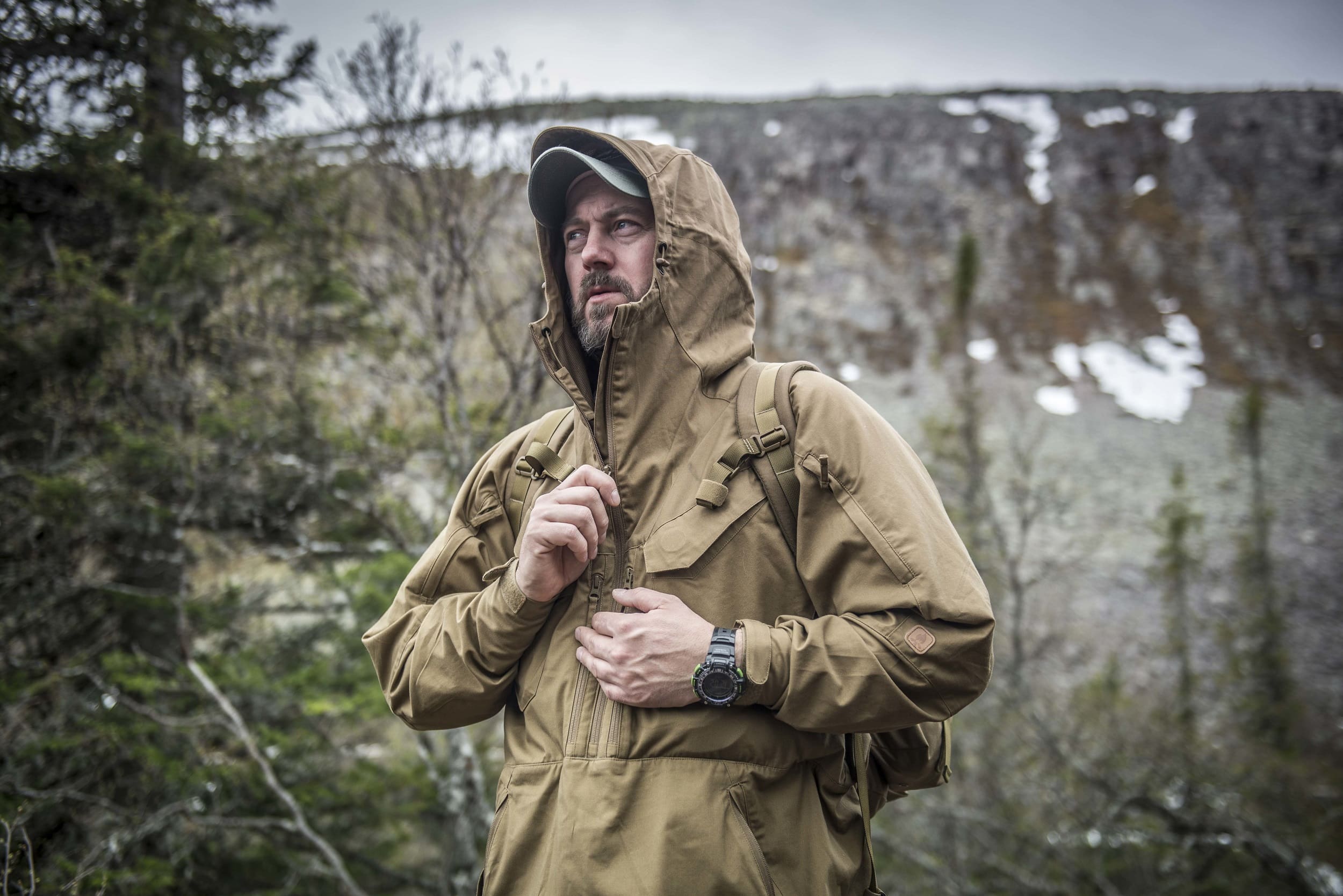
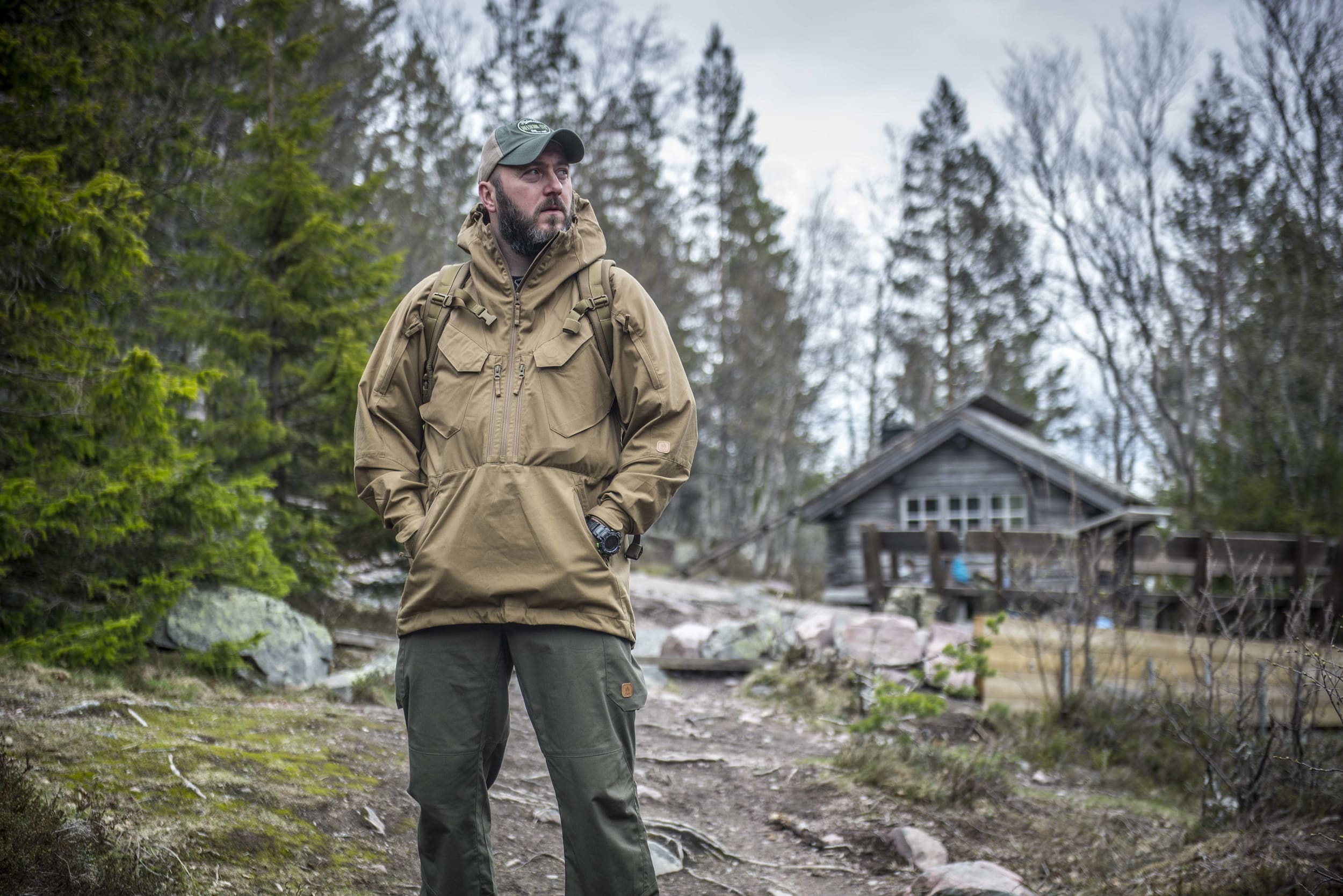
Helikon-Tex PILGRIM Anorak Jacket® is designed for demanding outdoor activities in dynamically changing weather. Based on the zipped “kangaroo” construction proven for decades, it has been clearly refined to meet the expectations of modern travelers, while still hitting the aesthetics of the “old guard”.

Numerous pockets will allow for convenient placement of equipment, while their characteristic arrangement will make them constantly available, even when working in a sitting or kneeling position. Elongated construction of the jacket protects the body regardless of the equipment we carry.
By lowering the “kangaroo” pocket, they were able to extend the front zipper of the jacket, which allows the user to better ventilate his body during strenuous approaches or work
Main features:
1) Fire sparks resistant
2) Dries faster than cotton
3) Can be impregnated with wax
4) Tapes inside the pocket for attaching equipment
5) Hood is adjustable in 3 planes
Find out more: (link) www.helikon-tex.com/en_eur/ku-pgm-dc-pilgrim-anorak-jacket
Helikon-Tex PILGRIM PANTS® are highly durable and lightweight pants made of DuraCanvas® fabric.
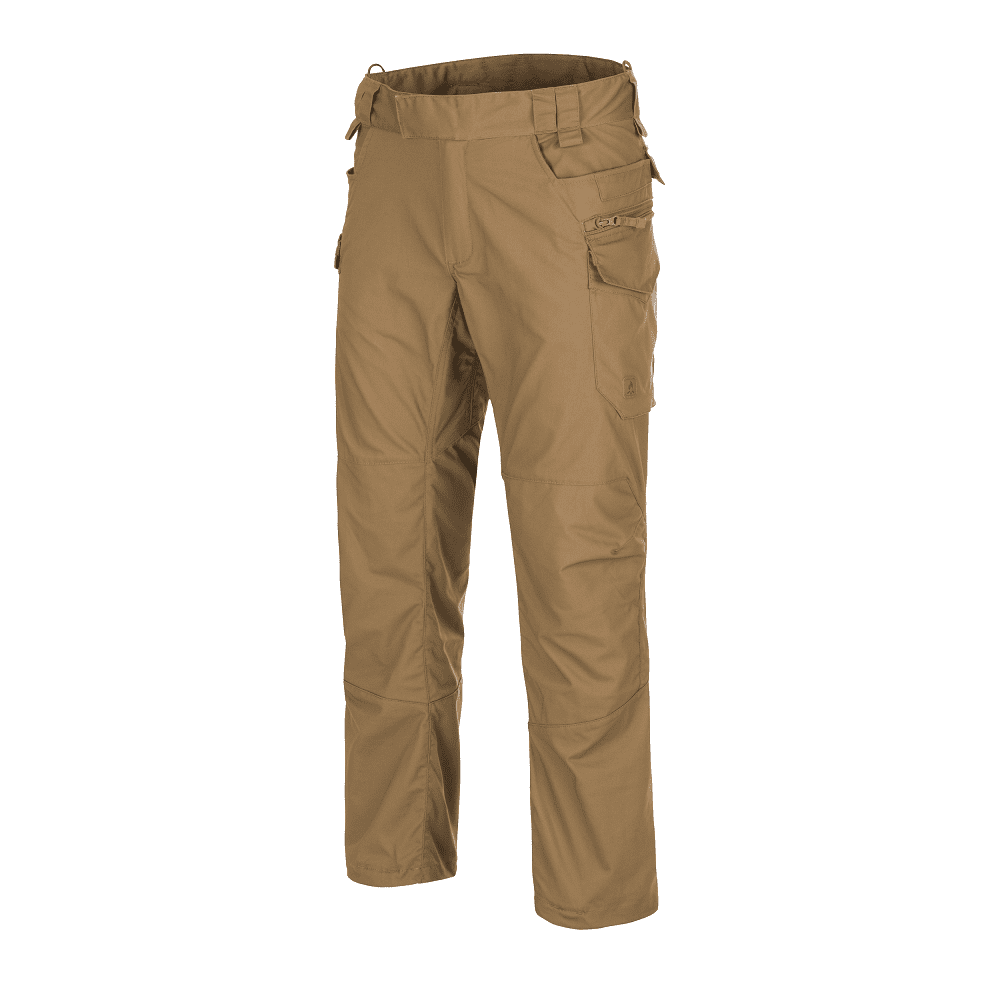
The pants have slightly risen back to protect your kidneys against cold. Additionally, this part is padded with thin foam to provide even more comfort during use. The pants have eight pockets in total. Large, buttoned cargo pockets on thighs have internal mesh panels to provide additional ventilation when pockets are open. Classic hip pockets have reinforcements on edges to protect them from being damaged quickly by knife clips. Between cargo and hip pockets there are smaller zippered pockets. On the back, there are small buttoned pockets with reinforced edges.
Waist and leg cuffs are adjustable. The pants have minimalistic loops for suspenders. Wide belt loops will fit up to 50 mm belts, while additional loops on the front allow dummy cording. Additional visual feature are the Helikon-Tex® branded buttons. To provide better protection against small rain, the fabric can be impregnated with a special wax.
Main features:
1) Extended back midriff to protect kidneys
2) Buttoned pockets for a folding knife, multitool etc.
3) Reinforce knees, compatible with Low Profile Protective Pads
4) Two classic hip pockets with reinforced edges
5) Adjustable hook&loop belt
Find out more: www.helikon-tex.com/en_eur/sp-pgm-dc-pilgrim-anorak-jacket
Navigating the changing currents of government contracting
>McRae Footwear learned quickly how to deliver goods to the world’s largest customer: the U.S. federal government.
In 1969, Victor Karam, a self-described “Yankee who loves the south,” transplanted from his native New England to join McRae Industries in an executive role. A cultured Bostonian of Lebanese descent, Victor had a master’s degree in journalism but ended up in an entirely different field: women’s shoes.

An enduring leader at McRae Industries:
Victor Karam in the ‘70s and today
During the Vietnam War, Victor was drafted into the Army and stationed at Ft. Bragg, NC. He met his future wife during that time, and they decided they wanted to live near her folks. A head hunter connected Victor with Branson McRae, founder and CEO of McRae Industries in Mount Gilead. Branson offered Victor a position as a vice president. “Branson always said he liked to hire Yankees because none of the southerners understood production,” Victor laughs.
“Salary negotiations were interesting. Branson asked me my annual salary target. I told him I expected to match my current salary, which at that time was $15,000. ‘That won’t work,’ Branson said. ‘It’ll never be approved by the board, because I only make $12,000.’”
Despite the dip in pay, Victor was intrigued by Branson’s company and accepted the job. He thought he would move on after a year or two, but ended up staying for more than 45 years, eventually becoming president of McRae Footwear. He continues to serve on the board of directors.
Becoming a preferred contractor
Along with its knowledge of the government’s preferred mode of boot construction – vulcanized, direct molded sole — McRae had two other distinct advantages as a contractor. With fewer than 500 employees, the company qualified as a small business. And it qualified also as having a manufacturing plant in a “labor surplus,” or high unemployment, area. The Department of Defense “set aside” contracts for small businesses, and being labor surplus gave the company a price advantage over large businesses.

Home grown: By law, in making purchases, the federal government gives preference to domestically produced and manufactured products.
To supplement its U.S. government contracts, McRae made combat boots for other nations. For 25 years, the company has been a supplier of military footwear for the government of Israel. Over the years, McRae has also provided boots for military forces in Canada, Brunei, Great Britain, and Saudi Arabia.
“The federal government has consistently praised us for our high-quality products.”
– Victor Karam, director, McRae Industries
Following government specs
“At the time, the design of McRae’s military boots was dictated by the government,” Victor says. “We didn’t have a lot of input. We didn’t have a shoe manufacturers association. The government gave us the patterns and told us how to make the boots. Requirements were so rigid that a slight defect could cause the military to reject an entire production lot of boots.”

Talking though the specs: Being a government contractor required frequent trips to the Defense Personnel Support Center in Philadelphia.
“Branson made it clear that every government specification was to be met. ‘The longer you work here with me, whether you agree or disagree with the specs, you follow them,’ he said. ‘If you see something that needs to be changed, go through the proper channels to get it changed. If you can’t, don’t change it.’’
Specifications were – and still are – exacting and relentless, from cure time for rubber to the boot’s ability to withstand pressure. Government protocols are strictly enforced with McRae workers. Government inspectors frequently walked the floors of the McRae factory. “I don’t know that any of the inspectors that came through had shoe knowledge,” Victor says. “We had to teach them.”
If Branson felt a spec were wrong, however, he was not afraid to question it – through established government protocols. That involved meeting with federal representatives in Philadelphia to clarify requirements or, in one instance, challenge a boot recall.
Victor tells the story of an inspector sent in from Charlotte, NC. “This inspector tested and rejected a production lot of boots where a wrinkle was detected. But the regulations specified boots should be rejected if a horizontal wrinkle were found when tested between both thumbs. The wrinkle detected in this lot was vertical. We showed the quality controller in Philadelphia, and we won our case.”
Looking to the future
Today, about 90 percent of McRae’s military boot business is tied to government contracts. The company also makes commercial versions of its boots.
“Staying flexible and expecting the unexpected is all part of succeeding as a government contractor,” Victor says. “Demand may fluctuate, but our purpose never waivers: To help our troops fulfill their missions though durable and reliable footwear.”

Adding on: As boot orders from the U.S. government accelerated, McRae over time added on a second 100,000-square-foot facility in Troy, NC. This facility houses the company’s direct-attach injection-mold equipment for manufacturing current-spec military boots, along with lasting, finishing, warehousing, and shipping functions.