by
Dr. Earl W. Burress, Jr. (Ph.D.)
(Major, USAF, Retired)
Configuration of the Son Tay GAU-5A/A Replica
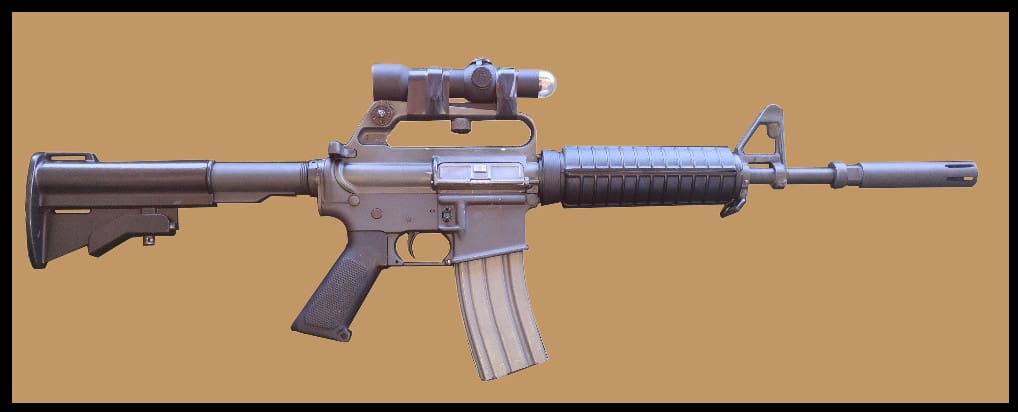
The Son Tay GAU-5A/A replica weapon was assembled with the help of Mr. Eric Fordon of Las Vegas, Nevada, on a semi-auto early ’90s Colt 6520 “large hole” lower receiver finished in a factory Colt Gray Type III anodize. The upper receiver was a lightly worn Colt M-16A1 “slick side” upper with C and M forge markings. The forge markings, according to information available on www.M4carbine.net, indicate that the upper was produced for Colt by the Martin Marietta Forge. The barrel was adapted from a 16 inch Colt pencil barrel with a 1/7 twist. The barrel was “cut” and “pinned with a non-NFA flash hider” by ADCO Firearms in Sylvania, Ohio, to comply with the 16 inch NFA SBR restriction while maintaining look and handling characteristics of an original GAU-5A/A. This approach was selected because a period correct Colt 1/12 twist barrel was not available during rifle construction. Additionally, use of a 1/7 twist barrel made it possible to use the same ammunition for the comparison (by eliminating the need to use different ammunition for a different barrel twist). The weapon was equipped with a slanted delta ring, six-hole handguard, and Colt aluminum stock on a two position buffer tube. The trigger was a mil-spec semi-automatic trigger manufactured by Colt during the late ’80s or early ’90s. Mr. Matt Babb, AR-15 Subject Matter Expert (and owner of Bentwood Gunsmithing in Henderson, Nevada) fired the weapon and deemed the trigger’s characteristics to be representative of mil-spec triggers produced during the 1970s. The ’90s era Colt “black” buffer was replaced with an H buffer when the rifle suffered from periodic failures to feed during test firing after assembly.
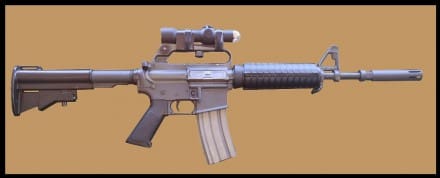
The Son Tay GAU-5A/A replica was constructed using a ’90s era Colt 6520 lower, fitted with a two position buffer tube, aluminum stock, and a 16 MOA Singlepoint OEG scope (Photo Courtesy of Author).
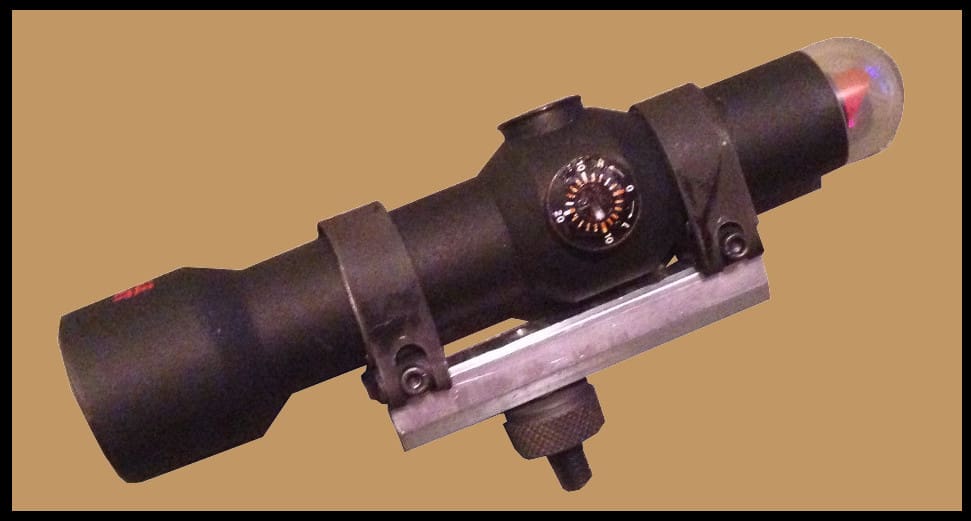
The scope used for the live-fire comparison was a Singlepoint 16 MOA with clear dome and a red fiber optic tube. It did not have a functional “green inverted post”, which limited the test to an environment with a medium level of ambient lighting. It is believed that Normark produced several models of Singlepoint, to include a scope with a 16 MOA aiming dot for rifles and a 42 MOA aiming dot for shotguns. A unit with a 12 MOA aiming dot was discussed on the M-16 Retro Forum “Single Point Sight” thread on AR15.com and does not appear to be as common a model as the 16 MOA version. Singlepoint scopes were produced with red and green fiber optics, clear and opaque domes, and semi-circular and cone shaped domes. It is believed that at least some of the Son Tay GAU-5 Carbines were equipped with scopes with red fiber optics contained under clear domes.
The replica mount was reverse engineered by Mr. David Velleux, manufactured out of aluminum by Mr. John Brace, and finished by Mr. Matt Babb. Mr. Babb added the final touches to the mount by machining the longitudinal slot necessary to view the iron sights and blackening the mounting bar with Brownells Aluma-Hyde II. The replica mount showed some of the instability reported in the Operation IVORY COAST AAR and failed to maintain a zero as well as modern mil-spec scope mounts. The overall weight of the rifle (without a magazine and ammunition) was approximately six pounds and eleven ounces. The rifle had an overall length of 34 inches (with the stock fully extended). Author’s Note: Less than half a dozen authentic Singlepoint mounts of this type are known to exist in the United States.
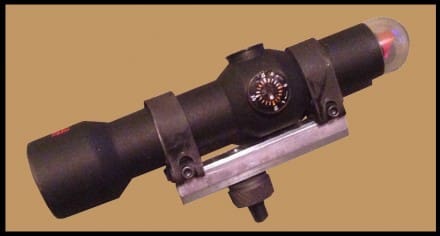
The aluminum replica Singlepoint OEG mount, designed by Mr. David Velleux and manufactured by Mr. John Brace, is shown before final machining and finishing by Mr. Matt Babb. Less than half a dozen of the original plastic mounts are known to currently exist in the hands of museums and collectors. The adjustment knob cover has been removed to reveal an adjustment slot, which is curved to accept the edge of a dime sized coin (Photo Courtesy of Author).
Throughout assembly, Captain Augustine Kim (ARNG) served as the technical advisor for the project. Captain Kim provided input throughout the process, served as a source for hard to find components, and provided final approval of the completed weapon configurations. After assembly, the weapon was test fired and sighted in using Wolf Gold 55 Grain FMJ ammunition. Wolf Gold was selected because of its availability, cost, and mid-range powder load. During test firing, the Wolf Gold rounds consistently ejected at the three o’clock position. The M4A1 CQBR was assembled by the same team of experts using a combination of Colt and Daniel Defense components.
Configuration of the Replica M4A1 CQBR
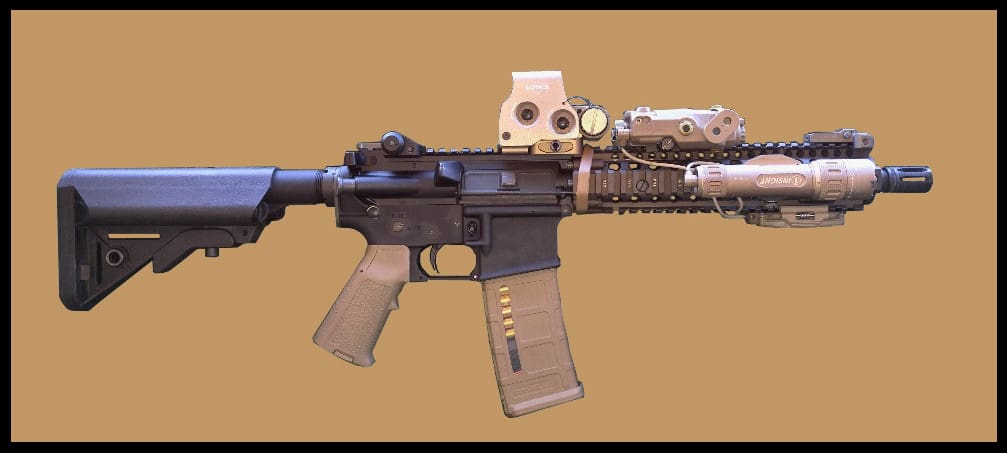
The unsuppressed M4A1 CQBR replica represents the rifle configuration in use by many American SOF units. It was assembled using a modern Colt full fence lower with a four position buffer tube and an LMT Generation 2 (large swivel) SOPMOD Stock. The weapon was equipped with a Geissele SSA semi-automatic trigger, standing in for the Geissele SSF trigger in use in many USSOCOM M4A1s. The lower was fitted with a Magpul MIAD grip and CQD Rear Sling Mount (which continues to be employed by some SOF end-users). The Daniel Defense 10.3 inch upper kit was fitted with a Knight’s Armament Company (KAC) M4QD Compensator, KAC M4 Front Flip-Up Sight, and KAC 300m rear sight. The rifle was equipped with an EOTech EXPS-3.0 holosight (SU-231A/PEQ) with a 1 MOA aiming dot, a civilian ATPIAL-C (AN/PEQ-15), and an Insight VBL III WMX-200 Weapon Light (MX-12393/PVS). The weapon light and laser were fitted with the Insight RMT-400-A6 Dual Button Remote. The charging handle was equipped with an extended tactical latch, bringing the weight of the weapon to approximately 7 pounds 14 ounces. The M4A1 CQBR replicas overall length was 30.5 inches with the stock fully extended. Author’s Note: The LMT SOPMOD stock battery tubes were inadvertently removed during the live fire comparison, but were installed when the unit was weighed and photographed.
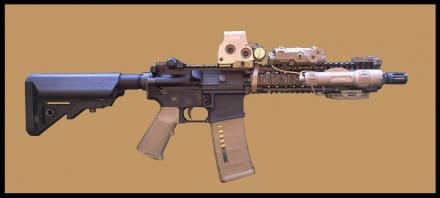
The M4A1 CQBR replica is built on a modern Colt lower with a Daniel Defense 10.3 inch upper. It is equipped with an EOTech EXPS-3.0 1 MOA optic, a four position buffer tube, an LMT SOPMOD stock, and a Geissele SSA semi-automatic trigger. The tan silicone band at the base of the rail system is in place as part of a heat and wear test not associated with this live fire comparison. This weapon represents a contemporary configuration in use by some American Special Operations Forces (Photo Courtesy of Author).
This GAU-5A/A Carbine replica, which represented the state of the art for the AR-15 when employed in 1970, will be compared with the replica M4A1 CQBR, replicating the weapons currently in use by many American SOF units. The purpose of the comparison is not to prove that the M4A1 is superior to the GAU-5A/A or vice versa. Instead, the M4A1 CQBR was selected because it is a weapon in widespread use that can be used as an effective baseline to illustrate the similarities and differences between the two weapons configurations.
Live Fire Comparison
The comparative course of fire was limited to 10 rounds from each weapon to prevent the shooter from adapting to the system and overshadowing to their first impressions of each weapon’s handling characteristics. The weapons were zeroed to a 100 yard zero (using a vertical offset) with Wolf Gold ammunition. The course of fire was conducted against human sized paper targets on an indoor range at 15 yards. Shooters engaged their targets as rapidly as comfortably possible. Thus, split times and total engagement times were not recorded. Shooters were given an opportunity to manipulate the weapons and warm up using the M4A1 CQBR (if desired) for approximately five minutes before conducting the comparative course of fire. Five participants test fired the rifles in an indoor range, under medium lighting, on two different occasions. One shooter had limited experience shooting the AR-15, one shooter had moderate experience with the AR-15, and three shooters had a high level of experience with the AR-15. The feedback, presented below, was similar from all five shooters.
Participants noted the weight difference between the weapons, but did not consider the M4A1 CQBR to be significantly less manageable than the GAU-5A/A. One participant discussed the “nose heavy” feel of the CQBR (which would be significantly magnified if the rifle had been fitted with a suppressor) but did not indicate that this negatively impacted the shooter’s ability to manipulate the weapon. Author’s Note: The differences in handling characteristics may have been more noticeable while maneuvering in a shoot house environment.
The M4A1 CQBR was deemed to be more desirable from a “human factors” standpoint. Ergonomic lessons of over four decades have result in several notable improvements. The four position buffer tube and sloped cheek rest allowed the shooters to establish a more desirable cheek weld in an effort to achieve a more consistent eye index. The GAU-5A/A’s combination of two position stock and vertically offset scope forced the shooter to fire from a position with their head raised, which negatively impacted their cheek weld. It was impossible to use the “nose-to-charging handle” technique when using the Singlepoint sight. Furthermore, it was dangerous to use the “nose-to-charging handle” technique when using the iron sights, because of the risk of the rifle recoil driving the sharp edge of the Singlepoint sight into the shooters forehead. The grips were similar ergonomically, although the handguards were notably dissimilar. The aluminum Daniel Defense handguard had a rougher texture (because of the machined rails) and was longer than the Colt six-hole handguard (which allowed the shooter to fully extend their arm and employ a “C-Clamp” grip technique). The GAU-5A/A did not allow full arm extension, but provided a smooth plastic handguard of varying diameters based upon the shooter’s hand position.
The shooters commented on the stiffness of the GAU-5A/A trigger when compared to the Geissele SSA trigger. The GAU-5A/A trigger was heavier, although within mil-spec, and was more difficult to fire than the M4A1 CQBR’s Geissele trigger. The Colt trigger was described as “clunky” and took more concentration while shooting, because of the weight range allowable by the mil-spec versus the Geissele trigger (which is engineered to consistently actuate at a lower weight of trigger pull). Despite the heaviness of the mil-spec Colt trigger, the shooters indicated that it would be possible to adapt to the GAU-5A/A trigger pull with practice.
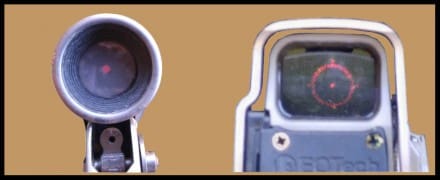
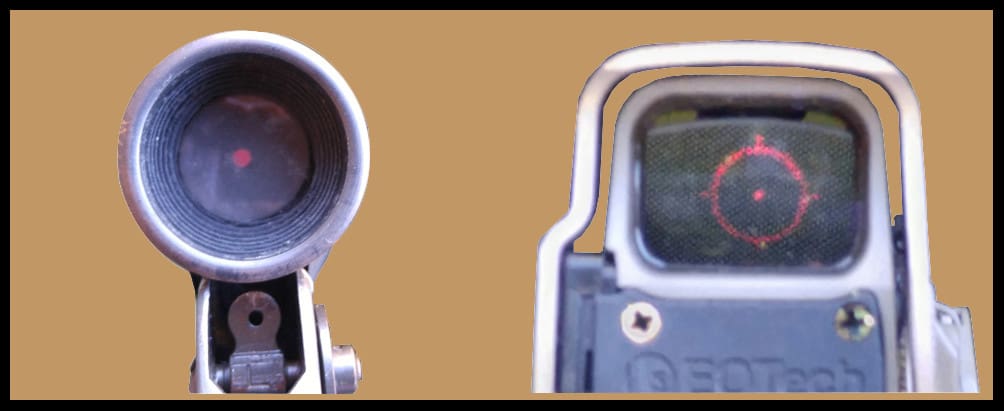
This image shows the size difference between the 16 MOA aiming dot found in the Singlepoint Occluded Eye Gunsight (left) and the 1 MOA aiming dot found in the EOTech holosight (right). Both optics could be considered state of the art within their respective eras and are shown in a comparable scale. The image highlights the position of the GAU-5A/A carry handle mounted field sights, which (according to the Operation IVORY COAST AAR) would have been the shooter’s first choice if engaging targets under daylight conditions. It should be noted that the target cannot be viewed through the Singlepoint sight due to the “black back plate” and that the dark obscuration on the EOTech is necessary to highlight the reticle (Photo Courtesy of Author).
The shooters found the Singlepoint to be less accurate than the EOTech (due to the 16 MOA of the Singlepoint aiming dot when compared to the 1 MOA EOTech aiming dot). They also found the Singlepoint target acquisition time to be slightly longer than the EOTech, but still effective (due to some of the limitations associated with human binocular vision). Shooters discussed “losing the dot” while focusing on the target, which occurs as the image of the aiming dot floats across the shooter’s optical blind spot (which lies at the point where the optic nerve intersects with the retina at the back of the eye).10 The Operation IVORY COAST AAR recommended the assaulters overcome this phenomena by shooting rapidly. Momentarily deflecting focus, blinking, or momentarily pausing were also effective ways to cause the aiming dot to reappear.11 It should be noted that shooters may “lose the dot” when employing modern Aimpoint and EOTech optics as well, but the intensity of the dot in these optics may make this phenomena less noticeable.
Ultimately, all rounds fired were “good hits” against the 15 yard targets. The EOTech had slightly better engagement times and provided a picture of the target with fewer incident of the shooter “losing of the dot”. The EOTech also had a more precise aiming dot which was surrounded by a graduated circular reticle. This, when combined with the Geissele trigger pull, made the groups shot with the M4A1 CQBR approximately 40 percent smaller than the groups shot using the GAU-5A/A. Although many will not be surprised to learn that the M4A1 CQBR was faster and more accurate, the performance of the GAU-5A/A and Singlepoint combination was rated as effective under test conditions, even by modern standards.
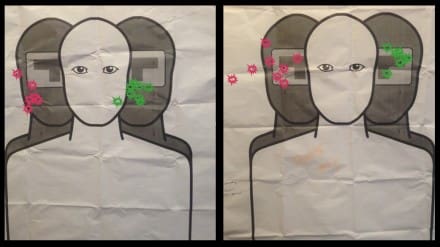
The two photos are indicative of the results achieved by nearly every shooter who fired a test profile. The test profile consisted of ten rounds of Wolf Gold .223 Rem 55 GR ammunition per weapon. The hits on the left (marked in red) were achieved using the GAU-5A/A replica and the hits on the right (marked in green) were achieved using the M4A1 CQBR replica. After throwing out the “outlier” (the round on target that landed farthest from the group) the results showed that the M4A1 CQB replica had a group approximately 40% smaller than the GAU-5A/A. The round count was limited for ease of analysis and to ensure that the results were an accurate measure of the shooter’s first impression. The test profiles were conducted indoors, under medium lighting, at the Green Valley Range in Henderson, Nevada (Photo Courtesy of Author).
The feedback from the live-fire participants showed how “modern” the 45 year old configuration felt and how the system’s “quirks” were not irreconcilable. The Singlepoint scope functioned well, did not require a power source when operated in a medium light environment, and provided a presentation very similar to that found in modern “red dot” optics. The Son Tay GAU-5 Carbine was clearly a harbinger of future military carbines, to include the M4A1 CQBR. The Son Tay GAU-5 Carbines also incorporated features common in modern weapons to include an adjustable stock and shortened barrel. In summary, this comparison has shown that the Son Tay Raiders’ GAU-5 Carbine is echoed in the modern military carbine and continues to be an effective weapon configuration in its own right.
Historical Impact of the Son Tay Raid
Although the Son Tay raiders failed to repatriate American POWs, the mission did have a positive strategic impact on the Vietnam War and had a lasting effect on the American SOF community. Historians state that the raid put the Democratic Republic “on notice” by demonstrating that the United States had the ability and will to strike in support of American POWs. As a result of the raid, many of the POWs were consolidated and some have stated that their treatment improved.12 The raid also proved that American SOF could plan and successfully execute a complex mission into a denied area in nearly total secrecy. Innovations employed during the Son Tay Raid included ground breaking aerial tactics (the inter-fly of dissimilar aircraft in the night low-level environment without Night Vision Goggles), agile equipment acquisition (off the shelf purchases of SOF equipment to include the Singlepoint OEG scope, Colt 30 round M-16 magazines, and commercially available chainsaws), and joint mission execution similar to that found in modern SOF operations (to include the integration of multi-service assets during planning, mission rehearsal, and mission execution).13
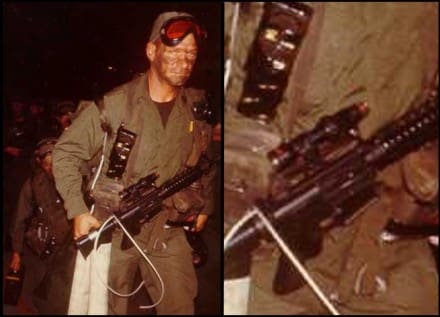
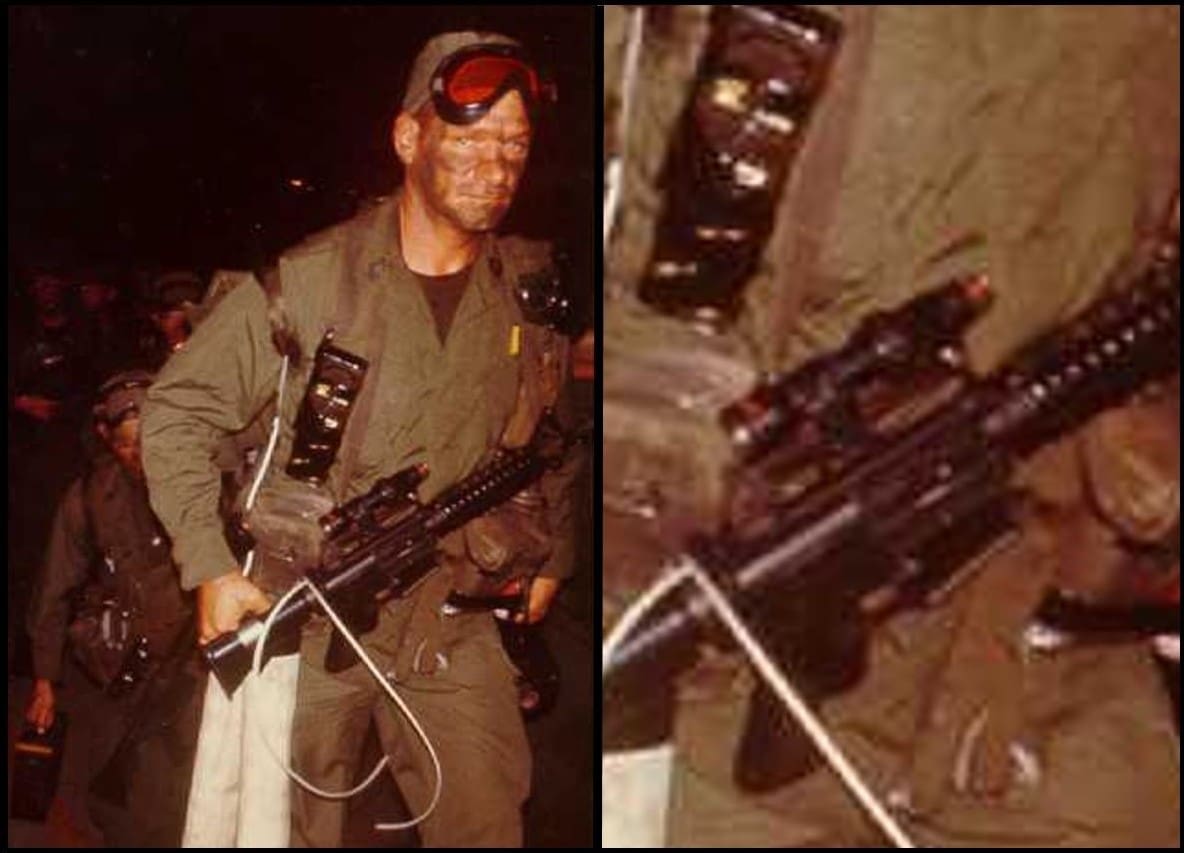
This pre-mission photo shows Master Sergeant Billy K. Moore (US Army, Blue Boy Assault Group, Headquarters Element) carrying a GAU-5A/A equipped with a Singlepoint scope, a miner’s light on the left strap of his load bearing equipment, and red Polaroid M1944 Wind/Dust goggles (which were intended to preserve the shooter’s night vision). The scope appears to be the Singlepoint clear dome version with a red fiber optic tip (Courtesy USAF).
Admiral William McRaven (USN, Retired) summarized the long term impact of the mission in the following except from Spec Ops: Case Studies in Special Operations Warfare: Theory and Practice when he stated, “Brigadier General Manor stated in his report on the Son Tay raid that ‘it should be noted that we were successful not only in what was done, but what could have been done if necessary.’ The raid on Son Tay is the best modern-day example of a successful special operation and should be textbook material for future missions.” This passage highlights the historical impact of the mission and demonstrates how it sets the benchmark for SOF missions of today.14
Special Thanks
Special thanks to Mr. Matt Babb (former USA Artillery), Mr. John Brace, Mrs. Kelsey Burress, Major Jim Collins (USAF, Retired), Mr. Robert Corcoran (former USAF C-130 Pilot), Mr. David Velleux, Gunnery Sergeant Erick Findley (USMC, Retired), Mr. Eric Fordon (former US Navy Diver), Mrs. Judy Fordon, Colonel John Gargus (USAF, Retired), Captain Augustine Kim (ARNG), Sergeant Travis Pierce (former USMC Infantry & current Team Leader for the Liberty County Texas SWAT Team), Lieutenant Colonel Joe Rawlings (USA), Mr. Caleb Rawlings, Mr. Richard Reuter, Captain John Thomas (USAF, Retired), TSgt Andrew Tijerina (USAF, Retired), and Colonel Scott Walker (USAF, Retired) for their assistance as evaluation participants, fabricators, or as members of the peer review team.
About the Author
Dr. Earl W. Burress, Jr. (Major, USAF, Retired) holds a Doctorate in Business Administration (with specializations in Homeland Security and Aviation Operations) from Northcentral University. While on active duty, Dr. Burress served as a Minuteman III Missile Combat Crew Member and a C-130 Pilot. Dr. Burress completed six combat deployments and logged over 1,000 hours of combat flying while conducting tactical airlift and special operations support missions throughout Afghanistan and Iraq. Additionally, Dr. Burress developed an Irregular Warfare Training Program for the 34th Combat Training Squadron while supporting the Joint Readiness Training Center as the Senior Air Force Observer/Controller for Airlift Operations. Dr. Burress completed his Air Force career in military Test & Evaluation. Dr. Burress is the owner of Tactical Applications Group, LLC and holds two US patents on components for direct action and sniper rifles.
Footnotes
1. Spec Ops: Case Studies in Special Operations Warfare: Theory and Practice (William H. McRaven), Ballantine Books, 1995
2 & 3. Retro Black Rifle, http://pullig.dyndns.org/retroblackrifle/index2.html
4. The Son Tay Raid: American POWs in Vietnam Were Not Forgotten (John Gargus), Texas A&M University Press, 2006
5. The Raid (Benjamin F. Schemmer), Harper & Row, 1976
6. Principles of How to Use Singlepoint (Normark Corporation)
7. Spec Ops: Case Studies in Special Operations Warfare: Theory and Practice (William H. McRaven), Ballantine Books, 1995
8 & 9. Commander JCS Joint Contingency Task Group Report on the Son Tay Prisoner of War Rescue Operation, Part 2 (Unclassified, Sanitized),
www.benning.army.mil
10. Introduction to Aviation Physiology (Federal Aviation Administration),
www.faa.gov
11. Commander JCS Joint Contingency Task Group Report on the Son Tay Prisoner of War Rescue Operation, Part 2 (Unclassified, Sanitized),
www.benning.army.mil
12. The Raid (Benjamin F. Schemmer), Harper & Row, 1976
13. Commander JCS Joint Contingency Task Group Report on the Son Tay Prisoner of War Rescue Operation, Part 2 (Unclassified, Sanitized),
www.benning.army.mil
14. Spec Ops: Case Studies in Special Operations Warfare: Theory and Practice (William H. McRaven), Ballantine Books, 1995
© Copyright 2015 by Dr. Earl W. Burress, Jr. & reprinted with permission by Soldier Systems.