DAVIS-MONTHAN AIR FORCE BASE, Ariz. —
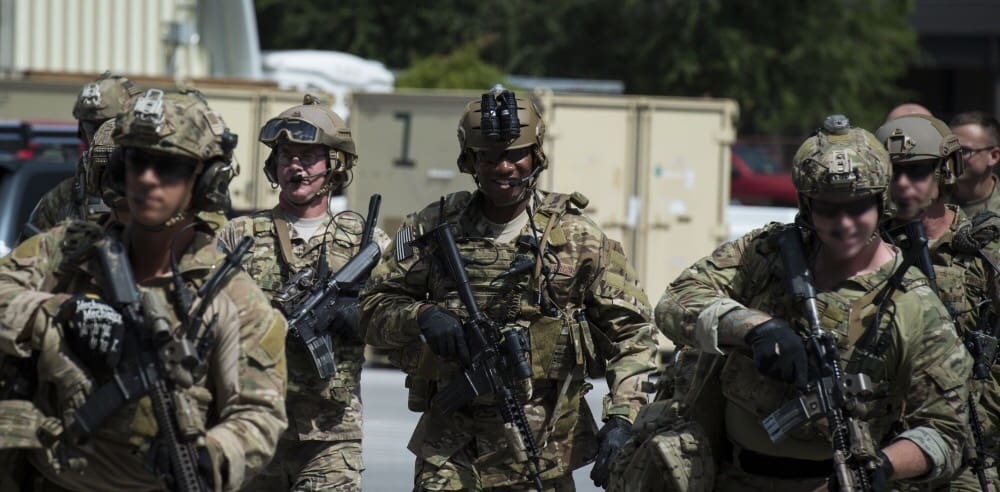
Your transport aircraft has just crashed in a remote and hostile environment. You and only a handful of other troops have survived the crash. As you survey the surroundings, you notice a crowd of local inhabitants running toward the wreckage screaming wildly, with brows furrowed and fists clenched. The level of fear inside you begins to skyrocket. You’re now scanning the crowd for its weakest links, trying to formulate a progressive strategy with the little time you have before they make contact. Which combative system are you most confident to employ in order to save your own life?
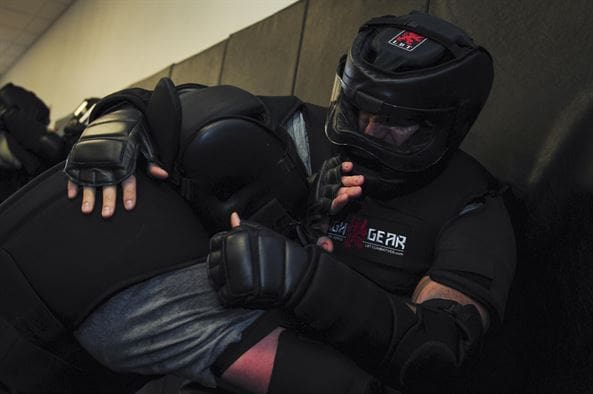
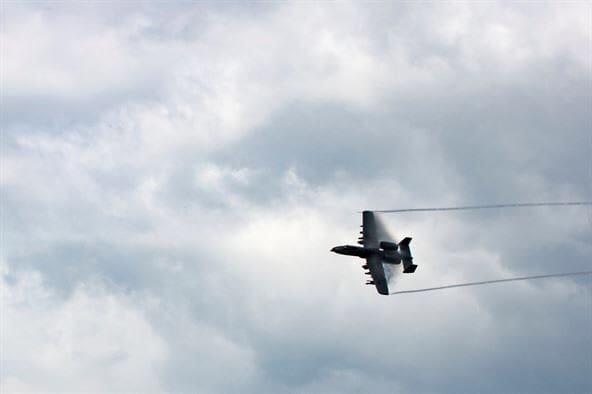
(USAF photo by Senior Airman Chris Drzazgowski)
Self-defense is a major component of support provided by Survival, Evasion, Resistance and Escape specialists to troops who have a high risk of isolation in theater, such as downed-pilots and operators.
Late last month, SERE specialists across the 23d Wing, along with Pararescuemen from the 68th Formal Training Unit convened at Davis-Monthan Air Force Base, Ariz., to attend a one-week personal defense course led by a special guest.
“The intent of this week’s instruction was to give these Air Force SERE specialists the qualifications required to teach the SPEAR System as subject matter experts,” said Tony Blauer, founder of Blauer Tactical Systems Inc., and SPEAR coach. “We augmented the system and customized it with specific capture avoidance and SERE-type nuances — specific scenarios you wouldn’t see in a regular fight.”
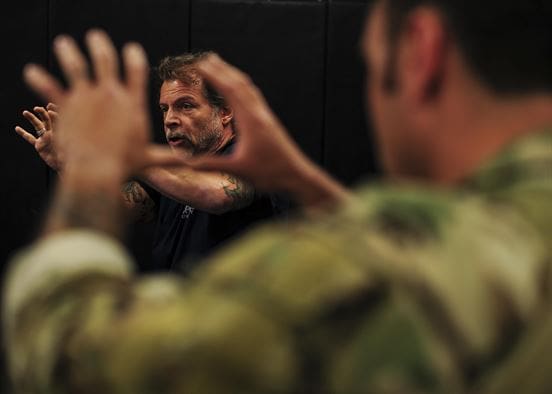
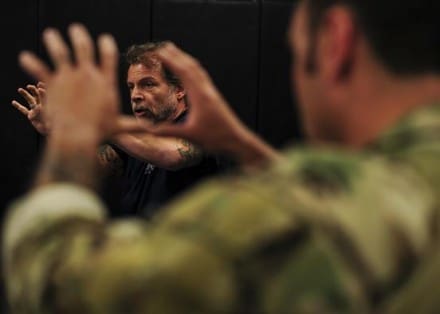
Tony Blauer, founder of Blauer Tactical Systems Inc., and SPEAR coach, instructed SERE specialists and other Guardian Angel counterparts in order to qualify them to teach the SPEAR System to personnel across the Air Force. (U.S. Air Force photo by Senior Airman Chris Drzazgowski)
The Spontaneous Protection Enabling Accelerated Response System takes advantage of the human body’s startle/flinch mechanism to convert an aggressor’s attack into a tactical counter measure, according to Blauer.
“We weaponize the flinch,” Blauer said. “By combing the old brain’s most important function, to survive, with the new brain’s intelligence, to think and decide, we have reawakened a non-perishable personal defense system that can make every human being safer.”
To implement a strong foundation of Blauer’s system into future SERE training, a collaborative effort was necessary among the SERE specialists to maintain and distribute a uniform understanding of SPEAR.
“In the 23d Wing, we’ve got Nellis, D-M and Moody,” said Tech. Sgt. Nick, SERE specialist. “All the C-130 and HH-60 guys, and all the PJs within the 23d Wing — we all see the same people, so we’re all getting together to share the same information across the wing.”
Currently, Modern Army and Special Operations Combatives Programs are administered by SERE specialists.
“There are so many different combative programs in the military already,” Sergeant Nick said. “I did a lot of research and looked at what we were already teaching. In order to make this continuation training, I needed a system out there that builds upon what we already have. I saw his system and it directly translated into what we teach.”
The practical application and versatility of the SPEAR System has gained much popularity among police, first-responders, and the military. Blauer has spent three decades researching real violence and has reverse-engineered a system of close quarters entirely based on how fear and danger can afflict tactical performance.
“We teach them how people move,” Blauer said. “Everything from the extreme close quarter is built on a premise determining that the bad guy controls the fight, the location, the level of violence and the duration of the fight, so I need to figure out how to beat him. This is a new paradigm in strategic thinking. It’s brain-based and allows the defender to be much more responsive.”
When the specialists weren’t executing drills on the mats, they were engaged in analytical classroom discussions.
“Those real fights are completely different challenges, emotionally and psychologically, the duress is different, and then the movement patterns of the attacks are different,” Blauer said. “What we do is we use body cam, helmet cam, dashboard video and closed circuit TV to study how real violence looks and moves. As valuable as martial arts are, the real fight is different. Our approach is to study the enemy and move from there.”
Upon the training’s conclusion, SERE specialists and other Guardian Angel counterparts are now able to tailor a specific program for their customers across the Air Force.
“The most important lesson from this week is the realization that we’re all human weapon systems,” Blauer said. “Everybody knows how to fight, they just don’t know they know how to fight. Realize you don’t need a martial art belt, you don’t need a level, you don’t need to win tournaments, you need to have the ‘I don’t want to die, I’m gonna fight’ mentality.”
Just before Blauer departed Davis-Monthan AFB, the course attendees presented him with a gift signifying their gratitude for a week of exclusive and in-depth instruction.
“I really appreciated Tony Blauer coming out here himself,” Sergeant Nick said. “He’s the CEO of his company and he could have sent another trainer to come out here and train us — but the level of instruction, professionalism and customer service he provided was phenomenal — I consider Tony a friend now.”
Senior Airman Chris Drzazgowski, 355th Fighter Wing Public Affairs