FirstSpear TV

Archive for the ‘Armor’ Category

UPC4 Plate Carrier Adapter System Available Now

Friday, September 27th, 2019

Modular, Adaptive, Quick Release Pack to PC Attachment

EEB960AE-2C77-4D60-A2EA-D19507C7AD79

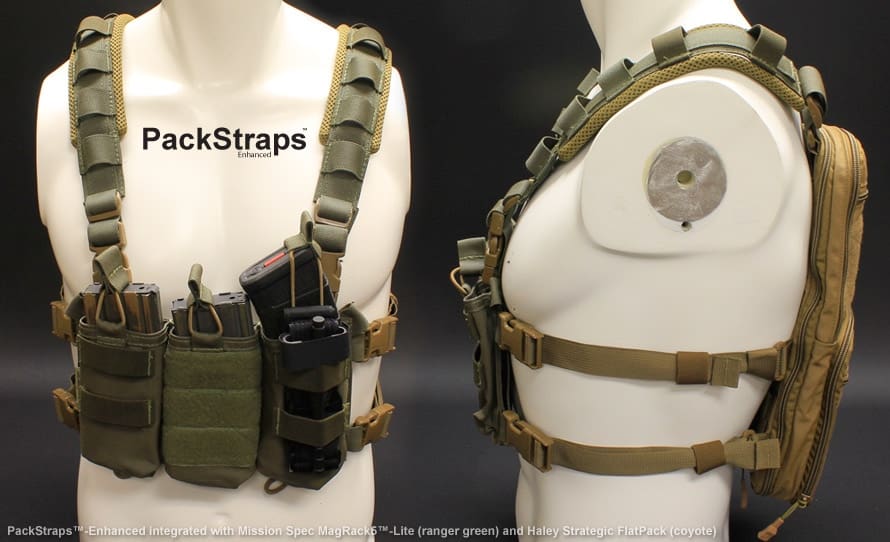
Due to user requests for a universal, quick detach/reattach pack to plate carrier solution, the UPC4 Plate Carrier Adapter System is available for any PALS equipped pack or PC.

September 24, 2019 (Birmingham, AL) — Emergent Rescue Systems, LLC today announced the release of its newest innovation, the UPC4 Plate Carrier Adapter System. The UPC4 was developed initially for HRE Pack attachment to the most common industry PCs.

The end result, however, is a modular system which adapts to any PALS/MOLLE equipped surface. Additionally, its adjustable quick release points allow fast detachment and simple reattachment.

The UPC4 is a full solution system with modular components.

Shoulder Quick Release Straps

Shoulder Quick Release Straps provide multiple quick release points across the shoulder and plate carrier front.

Its shoulder QR points can adjust to any position along the PC shoulder straps.

Shoulder Quick Release Covers

Shoulder Quick Release Covers provide a simple protective solution to securing cross-shoulder items. With a trifold design and QR pull tabs, removal and reattachment is simple.

Side Quick Release Strap

Side Quick Release Straps provide QR attachment points along the cummerbund that include strap tension adjustment at the ITW QASM buckles. For rear pack attachment, G-Hooks provide a low profile connection that is secure enough for harsh environments, yet detachable without a tool.

Vertical Adapter Locks

Vertical Adapter Locks convert horizontal to vertical PALS rows with a dual row adapter lock that remains in place under heavy load tension. VALs are designed as an adapter and stabilizer, eliminating QASM adapter twisting from single PALS row attachment.

Made in the USA. Berry Amendment compliant. Exclusive production by Zulu Nylon Gear.

Visit UPC4 Plate Carrier Attachment System for more info.

Aspetto Wins Coveted $9.9M IDIQ Contract from DHS CBP

Friday, September 20th, 2019

September 18, 2019 – Fredericksburg, VA

Aspetto, Inc., a leading manufacturer of armor and nylon solutions, is awarded a single Indefinite Delivery, Indefinite Quantity (IDIQ) five-year contract for Ballistic Plate Carrier System’s. The Department of Homeland Security (DHS), U.S. Customs and Border Protection (CBP) posted a requirement for a Ballistic Plate Carrier System to be used for training and law enforcement operations. The effort is integral to providing effective Use of Force equipment to officers and agents within CBP. The contract was open competition with no set-asides and encouraged the contractors to develop a solution that increased user efficiency and comfort. Aspetto offered their patented KWIQ Clip that provides the end user swift donning and doffing as well as robust load-bearing capabilities.

The company is honored to support the brave Border Patrol Agents who are working tirelessly to ensure our national security.

For more information, please visit www.Aspetto.com

A Federally Recognized 8(a) Entity GSA Contract # GS-07F-146GA

Contact:
Walter Clarke
VP Government Sales
540.547.8487
Email: walter.clarke@aspettoinc.com GSA Contract # GS-07F-146GA

MDM 19 – Arbor Arms x Aqualung Buoyancy Compensator Shooter Kit Combination

Tuesday, September 17th, 2019

Arbor Arms is working with Aqualung to offer a low cost retrofit kit for armor carriers so that they can be used in conjunction with Aqualung Buoyancy Compensators. In this case, we see the Calypso.

The cummerbund is elastic so it will allow a buoyancy compensator or horse collar to still inflate yet keep your gear nice and snug.

Additionally, the Aqualung weight belt is worn with ditchable weights fore and aft to keep them out of the way of holsters and magazine carriers.

arborarmsusa.com

Army Research Looks at Pearls for Clues on Enhancing Lightweight Armor for Soldiers

Tuesday, September 17th, 2019

RESEARCH TRIANGLE PARK, N.C. — Round, smooth and iridescent, pearls are among the world’s most exquisite jewels; now, these gems are inspiring a U.S. Army research project to improve military armor.

By mimicking the outer coating of pearls (nacre, or as it’s more commonly known, mother of pearl), researchers at University at Buffalo, funded by the Army Research Office (ARO), created a lightweight plastic that is 14 times stronger and eight times lighter (less dense) than steel and ideal for absorbing the impact of bullets and other projectiles.


Photo Credit: Shutterstock

ARO is an element of the U.S. Army Combat Capabilities Development Command’s Army Research Laboratory.

The research findings are published in the journal ACS Applied Polymer Materials, and its earlier publication in J. Phys. Chem. Lett.

“The material is stiff, strong and tough,” said Dr. Shenqiang Ren, professor in the Department of Mechanical and Aerospace Engineering, a member of University of Buffalo’s RENEW Institute, and the paper’s lead author. “It could be applicable to vests, helmets and other types of body armor, as well as protective armor for ships, helicopters and other vehicles.”


Photo Credit: Courtesy University at Buffalo

The bulk of the material is a souped-up version of polyethylene (the most common plastic) called ultrahigh molecular weight polyethylene, or UHMWPE, which is used to make products like artificial hips and guitar picks.

When designing the UHMWPE, the researchers studied mother of pearl, which mollusks create by arranging a form of calcium carbonate into a structure that resembles interlocking bricks. Like mother of pearl, the researchers designed the material to have an extremely tough outer shell with a more flexible inner backing that’s capable of deforming and absorbing projectiles.

“Professor Ren’s work designing UHMWPE to dramatically improve impact strength may lead to new generations of lightweight armor that provide both protection and mobility for Soldiers,” said Dr. Evan Runnerstrom, program manager, materials design, ARO. “In contrast to steel or ceramic armor, UHMWPE could also be easier to cast or mold into complex shapes, providing versatile protection for Soldiers, vehicles, and other Army assets.”

This is what’s known as soft armor, in which soft yet tightly woven materials create what is essentially a very strong net capable of stopping bullets. KEVLAR is a well-known example.

The material the research team developed also has high thermal conductivity. This ability to rapidly dissipate heat further helps it to absorb the energy of bullets and other projectiles.

The team further experimented with the UHMWPE by adding silica nanoparticles, finding that tiny bits of the chemical could enhance the material’s properties and potentially create stronger armor.

“This work demonstrates that the right materials design approaches have the potential to make big impacts for Army technologies,” Runnerstrom said.

By U.S. Army CCDC Army Research Laboratory Public Affairs

C2R-FAST – Low Profile Discrete Carrier

Sunday, September 15th, 2019

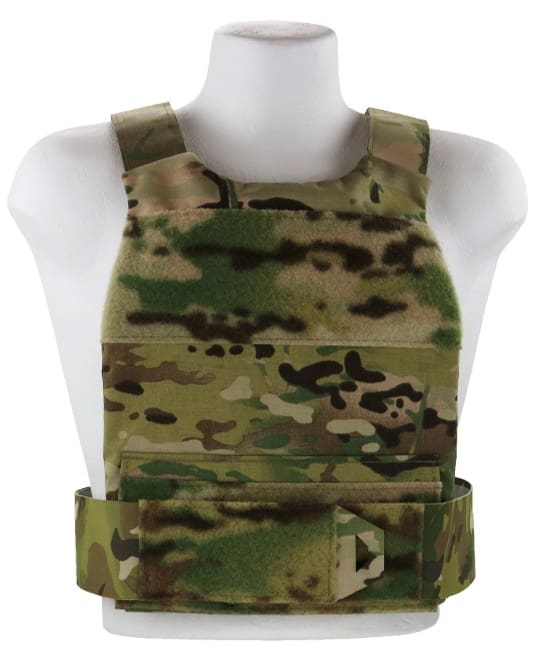
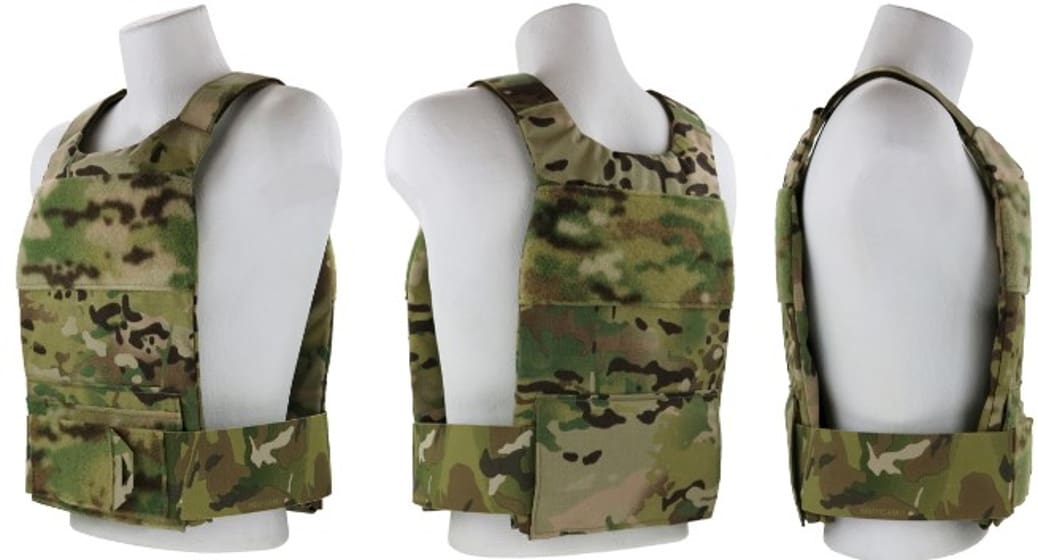
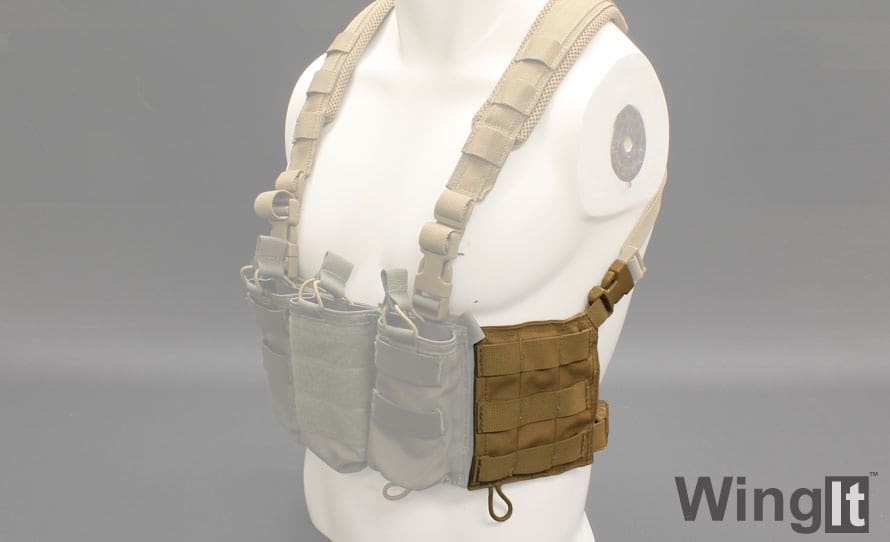
C2R-FAST showed their new Low Profile Discrete Carrier at DSEI. The They tell us they have had Prototypes our for awhile now, but this is the final production ready system. They plan to also offer accessories such as the drop pouch seen on the Grey version at the bottom of the photo. Available in a range of colors.

This is a photo they shared to Instagram which shows better shoulder strap detail.

www.c2rfast.com/c2rfast/Home

DSEI 19 – Saratoga Fragment Protective Armour-Up for Light EOD/CBRN

Friday, September 13th, 2019

Germany’s Bluecher Saratoga is well known for their CBRN suits but they have also developed ballistic under garments.

Based on this work, they’ve created a lightweight vest and apron for EOD use when a full bombsuit isn’t warranted and frag is the primary concern such as dispersion devices. The ensemble weighs less than 6 kg and meets STANAG 2920 (1.1 g FSP) with V50 velocities up to 450 m/s.

DSEI 19 – TYR Tactical PICO DS-X

Tuesday, September 10th, 2019

TYR Tactical gave us a sneak peek of the new PICO DS-X. Weighing in at less than two pounds, it can be configured with any of TYR’s cummerbunds, including a new cummerbund with the National Molding Tactik buckle. There are multiple new lightweight accessories as well. Coming October.

Canadian Army – Uniform, Camouflage and Equipment Modernization Process Marches On

Wednesday, September 4th, 2019

Lieutenant-Colonel Raymond Corby speaks to 3rd Battalion, The Royal Canadian Regiment, about the Soldier Clothing and Equipment Modernization Trial at Garrison Petawawa on September 4, 2019. Photo By: Private Robert Kingerski PA01-2019-0286

Ottawa, Ontario — Some 600 soldiers at 4th Canadian Division Support Base (4 CDSB) Petawawa will soon be standing out as they help the Canadian Armed Forces test a new Canadian Disruption Pattern (CADPAT) to help select a replacement camouflage for the current iconic woodland and arid CADPAT patterns.

The original distinctive CADPAT, revolutionary for its time, was initially developed in 1997. It is most closely associated with the Canadian Army but it is also worn by Navy and Air Force personnel when they work within Army lines.

Canadian Special Operations Forces personnel wear another pattern, MultiCam, which is not being replaced.

Since CADPAT was issued, there have been a number of advances made in camouflage research, specifically protection from detection by infra-red and other night vision systems.

Starting at the end of September 2019, 3rd Battalion, The Royal Canadian Regiment will begin wearing coats and trousers, shell fragmentation protective body armor, bush caps, helmet covers and rank patches in the “Prototype J” mid-spectrum pattern.

This new four-colour pattern falls in the middle of the camouflage spectrum, not overly emphasizing brown or green tones.

A member of 3rd Battalion, The Royal Canadian Regiment, asks a question to Lieutenant-Colonel Raymond Corby about the Soldier Clothing and Equipment Modernization Trial at Garrison Petawawa on September 4, 2019. Photo By: Able Seaman Elizabeth Ross PA02-2019-0286-007

While there have been over a dozen patterns tested, this is the first pattern to be taken out of a lab and tested using real soldiers, who are undergoing rigorous training for overseas operations. There will likely be adjustments made to the pattern resulting from this trial.

The trial will last until July 2020. During this time, the Human Factors Support Cell from the Soldier Systems Directorate within Director General Land Equipment Program Management will seek user feedback about the “Prototype J” pattern by conducting large-scale questionnaires.

The team will also conduct data collection, focus groups, and 3D body scanning to define how the current operational uniform and personal equipment can be improved.

This study will also include seeking out soldiers of smaller stature, including but not exclusively women, to ensure that the next generation of clothing and equipment fit the widest variety of soldiers possible.

A member of 3rd Battalion, The Royal Canadian Regiment, inspects the prototype uniform from the Soldier Clothing and Equipment Modernization Trial at Garrison Petawawa on September 4, 2019. Photo By: Able Seaman Elizabeth Ross PA02-2019-0286-012

The Soldier Operational Clothing and Equipment Modernization (SOCEM) project, led by the Canadian Army Director of Land Requirements, in cooperation with Assistant Deputy Minister (Materiel) and Defence Research and Development Canada, has been working for over two years on harnessing technological advances to improve the functionality of Canadian Armed Forces operational uniforms and equipment.

The goal is operational clothing and equipment that protect and fit better while lightening the load carried by soldiers.

Transitioning to a single pattern from the current temperate woodland (green), and arid (tan) will also create efficiencies in terms of logistics.

With the final decision expected no later than 2022 and a full roll out 2027, the interim years will see mixed uniforms and equipment as items in the new pattern are gradually acquired and put into service.

By Eric De Lafontaine, Manager – Soldier Operational Clothing and Equipment Modernization, Directorate of Soldier Systems Program Management