Celebrate 20 years of the TLR-1

Archive for the ‘Army’ Category

Army Futures Command Announces ‘Software Factory’ in Austin

Monday, July 20th, 2020

AUSTIN, Texas – U.S. Army Futures Command announced the establishment of the first Soldier-led Software Factory today.

The Austin-based Software Factory is a first-of-its-kind concept for the Army that will leverage a train-with-industry pipeline to empower Soldiers and Civilians to scope and solve problems with modern software practices.

This new capability will allow units to act faster and mitigate unforeseen risk inherent in multi-domain operations. It will teach Soldiers and Civilians how to solve Army problems with cloud technology and modern software, and to better prepare Soldiers for disconnected warfare in 2028 and beyond.

“The capability to develop software at the lowest tactical levels will help us provide better software products,” said Gen. John M. Murray, commanding general of Army Futures Command. “We anticipate long-term cost savings and expect the Software Factory to help us maintain a competitive advantage across Army modernization efforts.”

This new software factory complements the Army’s digital talent initiative based at Carnegie Mellon University in Pittsburgh, Penn. Army professionals will attend data science and engineering graduate programs, and 12 Soldiers will attend a boot-camp-style fellowship for cloud technicians to help solve Army problems through agile and secure software development processes.

“All of these efforts will develop and sustain the digital talent the Army needs for the future,” Murray said. “The CMU-trained engineers will build the data environment the Army needs. The technicians will maintain that environment. And the Software Factory will develop the skills to operate in that environment.”

By Army Futures Command

US Army Researchers Pursue Tactical Edge in Electronic Warfare

Thursday, July 16th, 2020

ABERDEEN PROVING GROUND, Md. — In the age of technology, the Army’s ability to dominate the electromagnetic spectrum can significantly influence the outcome of future conflicts on the battlefield.

The U.S. Army Combat Capabilities Development Command’s Army Research Laboratory designated several research programs as essential for future Soldier capabilities. Of these major flagship programs, the Foundational Research for Electronic Warfare in Multi-Domain Operations, or FREEDOM, Essential Research Program recognizes the value of electronic warfare competencies as a necessary requirement for success in large-scale combat and multi-domain operations.

During World War II, jamming missions conducted by Allied forces successfully disrupted German command and control systems and navigation capabilities. When adversaries used radio-controlled improvised explosive devices to attack ground forces in Afghanistan and Iraq, the U.S. Army defended its Soldiers with newly developed tools that jammed radio-activated triggers.

“The overall goal of the program is to drive a revolutionary change in the way that the Army uses electronic warfare from a single exquisite platform to a distributed, disaggregated and heterogeneous set of offensive and defensive capabilities,” said Dr. Matthew Higgins, FREEDOM program manager. “We are looking to demonstrate research prototypes that prevent the adversary’s ability to actively or passively find, classify and geo-locate U.S. forces.”

According to Higgins, Army researchers in the program examine a wide spectrum of complex issues, such as the need to optimize secure communication among allied forces and the development of techniques to evaluate the effectiveness of electronic attack techniques.

Researchers in the FREEDOM program also plan to unify electronic warfare with cyber technology, which typically remains separated in operations, research and system development.

The program aims to provide both basic and applied research to enable tactical dominance in an Army initiative called cyber electromagnetic activities, or CEMA. These efforts include the elimination of adversary threat capabilities, the surveillance of electromagnetic and cyberspace environments and the enhancement of mobility within the battlefield and cyberspace.

“Adversaries are contesting all domains, the electromagnetic spectrum, and the information environment,” Higgins said. “Future challenges require integrating electronic warfare and cyber technologies and activities as well as a shift for electronic warfare to a more surgical offensive posture against more advanced adversarial systems.”

In general, the FREEDOM Essential Research Program focuses on three core research areas:

·      Adaptive/Cognitive: Developing the ability to effectively outpace adversary decision and technical options

·      Distributed/Coordinated: Achieving spatially and temporally diverse responsiveness to dense and complex threat environments

·      Preemptive/Proactive: Preventing or disrupting the adversary’s ability to find, fix, track, target and engage our forces

“In the long term, we are looking at multi-function RF capabilities from distributed platforms with research focused on adaptive filters, wide-band amplifiers and adaptive manufacturing-enabled antenna technology,” Higgins said. “The Soldier will have freedom to maneuver on the battlefield and to dynamically access the congested and contested electromagnetic spectrum.”

In order to achieve this goal, researchers leveraged the work from various collaborative research alliances, such as the Cyber CRA, the Internet of Battlefield Things CRA and the Distributed and Collaborative Intelligent Systems and Technology CRA.

The team also established partnerships with other government organizations, such as the Defense Advanced Research Projects Agency and the Air Force Research Laboratory, as well as with several universities, including the University of Notre Dame, Northeastern University and the University of Wisconsin-Madison.

Higgins explained that all these efforts serve to provide Soldiers with technologies that push the Army closer toward electromagnetic spectrum dominance. This research will ultimately help protect Soldiers from electronic warfare attacks by adversaries and create windows of opportunity for multi-domain operations.

“Electronic warfare is increasingly vital to Army preparations to defeat any potential threat,” Higgins said. “The Army’s focus on large-scale combat operations highlights the need for a robust ground electronic warfare force to support multi-domain operations and enable the Army to fight and win in a complex world.”

Higgins speaks about his research in the CCDC Army Research Laboratory’s What We Learned Today podcast, published July 9, 2020.

By U.S. Army CCDC Army Research Laboratory Public Affairs

Fort Knox First Post to Issue Army’s New World War II-style Dress Uniforms

Wednesday, July 15th, 2020

FORT KNOX, Ky. — A line formed inside the Fort Knox Military Clothing Sales store July 8 as several recruiting students anticipated being the first to be issued the Army’s newest uniform — the Army Green Service Uniform.

Considered a nostalgic nod to the greatest generation — who fought in World War II — the green and beige uniform has caused strong reactions in civilians and Soldiers alike.

“This is kind of cool, especially for these students, because they’re going to be the face of the Army when they go out there,” said Sgt. 1st Class Wesley Wills, career recruiter and Army Recruiter Course instructor. “To put them in the new uniform makes sense to me because they’re going to be engaging the public. It’s going to be good for the Army.”

In Week 4 of the six-week recruiter course, the 70 Soldiers attending were divided into two groups so Army & Air Force Exchange Service personnel could effectively issue all pieces of the uniform set. The set issued to the recruiters includes a service coat, two pairs of pants, a long-sleeve and short-sleeve shirt each, a pair of shoes, socks, tie, belt, gloves and the distinctive cap.

“This uniform goes back to our historical identity,” said Wills. “When I was out recruiting and wore the Army Service Uniform, a lot of times I was asked if I was in the Air Force. Whereas, I believe these are a little truer to who we are.”

Already a recruiter in Fort Smith, Arkansas, Sgt. Rochelle Walsingham said she was excited to be part of the class that gets the uniform. She noted some differences from other uniforms.

“It’s a little heavier than the other ones. The jacket’s a lot heavier and more durable than other jackets are,” she said. “But the AGSUs are more form-fitting for the females. That was a big problem for the ASU for the females. These actually fit more to your form, and we were told you are able to take them out more or bring them in more, so it helps a lot.”

She said when her unit found out she would be one of the first to get issued the new uniforms, they wanted her to take some pictures.

“They’re very jealous,” said Walsingham. “They said, ‘What?!? You already get yours?’ I said, ‘Yeah, and I don’t have to pay for it.’”

Uniforms will go on sale to other Soldiers who want to buy them beginning July 10. Drill sergeants are expected to be the next group to receive the uniforms, and new recruits are expected to be issued the uniforms in the fall. AAFES officials say other installations will begin receiving them shortly afterward.

Emmanuel Belt, the Fort Knox Military Clothing Sales store manager, said they found out in April that Fort Knox would become the first to receive the uniforms. Excitement at the installation has been building since.

“I’m really surprised at how much enthusiasm there is with this uniform,” said Belt. “I thought people wouldn’t want to spend any more money on uniforms, but they all really want this uniform. And it looks great, too.”

By Eric Pilgrim

New Army Funded Solar Material Could Clean Drinking Water

Tuesday, July 14th, 2020

RESEARCH TRIANGLE PARK, N.C. (July 13, 2020) – Providing clean water to Soldiers in the field and citizens around the world is essential, and yet one of the world’s greatest challenges. Now a new super-wicking and super-light-absorbing aluminum material developed with Army funding could change that.

With funding from the Army Research Office, an element of the U.S. Army Combat Capabilities Development Command’s Army Research Laboratory, researchers at the University of Rochester have developed a new aluminum panel that more efficiently concentrates solar energy to evaporate and purify contaminated water.

“The Army and its warfighters run on water, so there is particular interest in basic materials research that could lead to advanced technologies for generating drinking water,” said Dr. Evan Runnerstrom, program manager at ARO. “The combined super-wicking and light-absorbing properties of these aluminum surfaces may enable passive or low-power water purification to better sustain the warfighter in the field.”

The researchers developed a laser processing technology that turns regular aluminum pitch black, making it highly absorptive, as well as super-wicking (it wicks water uphill against gravity). They then applied this super absorptive and super-wicking aluminum for this solar water purification.

The technology featured in Nature Sustainability, uses a burst of femtosecond (ultrashort) laser pulses to etch the surface of a normal sheet of aluminum. When the aluminum panel is dipped in water at an angle facing the sun, it draws a thin film of water upwards over the metal’s surface. At the same time, the blackened surface retains nearly 100-percent of the energy it absorbs from the sun to quickly heat the water. Finally, the wicking surface structures change the inter-molecular bonds of the water, increasing the efficiency of the evaporation process even further.

“These three things together enable the technology to operate better than an ideal device at 100 percent efficiency,” said Professor Chunlei Guo, professor of optics at University of Rochester. “This is a simple, durable, inexpensive way to address the global water crisis, especially in developing nations.”

Experiments by the lab show that the method reduces the presence of all common contaminants, such as detergent, dyes, urine, heavy metals and glycerin, to safe levels for drinking.

The technology could also be useful in developed countries for relieving water shortages in drought-stricken areas, and for water desalinization projects, Guo said.

Using sunlight to boil has long been recognized as a way to eliminate microbial pathogens and reduce deaths from diarrheal infections, but boiling water does not eliminate heavy metals and other contaminants.

Solar-based water purification; however, can greatly reduce these contaminants because nearly all the impurities are left behind when the evaporating water becomes gaseous and then condenses and gets collected.

The most common method of solar-based water evaporation is volume heating, in which a large volume of water is heated but only the top layer can evaporate. This is obviously inefficient, Guo said, because only a small fraction of the heating energy gets used.

A more efficient approach, called interfacial heating, places floating, multi-layered absorbing and wicking materials on top of the water, so that only water near the surface needs to be heated. But the available materials all have to float horizontally on top of the water and cannot face the sun directly. Furthermore, the available wicking materials become quickly clogged with contaminants left behind after evaporation, requiring frequent replacement of the materials.

The aluminum panel the researchers developed avoids these difficulties by pulling a thin layer of water out of the reservoir and directly onto the solar absorber surface for heating and evaporation.

“Moreover, because we use an open-grooved surface, it is very easy to clean by simply spraying it,” Guo said. “The biggest advantage is that the angle of the panels can be continuously adjusted to directly face the sun as it rises and then moves across the sky before setting – maximizing energy absorption.”

The Army and Guo are exploring transition opportunities to further develop this technology within DOD laboratories and private industry.

In addition to the Army, this research received funding from the Bill and Melinda Gates Foundation and the National Science Foundation.

By U.S. Army CCDC Army Research Laboratory Public Affairs

Photos courtesy of University of Rochester.

Army procedure goes digital for recovering lost, damaged property

Friday, July 10th, 2020

WASHINGTON – The procedure to recover lost or damaged property went digital on an Army-wide basis Monday, thanks to a Minnesota National Guard innovation to improve its property stewardship.

“We are moving from a 1977 Pontiac to a 2020 Ford,” said Col. Joe Ricker, Army G-4’s Deputy Director for Enterprise Systems. “It is certainly a big change.”

The change means all Soldiers can now initiate Financial Liability Investigation of Property Loss procedures electronically. The process, called eFLIPL, is similar to using online tax software programs through which users answer questions and forms are completed in the background.

The Army has billions of dollars of assets in inventories, and ensuring accountability and maintenance of it is not only important, but also a challenge. All Soldiers sign for individual equipment, but they don’t always realize just how expensive it is until it is lost or damaged.

The Army uses the investigations to determine if the proximate cause for the loss is based on negligence or willful misconduct, and if assessing financial liability is appropriate, explained Sgt. 1st Class Bobby Johnson, senior logistics Staff NCO in the G-4’s Property Accountability Division.

Johnson said the process includes several layers of review, can take months, and involves many people. “With the electronic system, it will reduce the burden on commanders,” he said. “They will be able to have better oversight. There will be uniformity among all commands. The process will be easier to audit. It will help anyone at any level initiate a FLIPL, and it will let us spot trends to see if policies need to be changed.”

Going digital also has several benefits in a COVID-19 environment, as everything will be paperless, and the system will be in a secure cloud. In fact, the pandemic helped speed the process of getting the digital version in place.

eFLIPL also is a great example of the Secretary of the Army’s initiative to employ technology to reform the way the Army works. Army Secretary Ryan McCarthy said last October at the Association of the U.S. Army’s annual conference, “The intent is to move the Army from industrial-age processes to the information age of leveraging data as a strategic asset and utilizing private sector technology.”

Ricker said “eFLIPL drives at the secretary’s intent. It is using Microsoft’s Azure Cloud for FLIPL data availability and making data accessible in a multitude of systems to include Army Vantage.”

Army Vantage, which has been a great help in the COVID-19 response, enables the Army to see itself by providing a common integrated data platform for visualizing current and future states of the Army. The FLIPL team will establish a Vantage Data Connector order to automatically populate the Vantage Commanders’ Dashboard. This will allow commanders the opportunity to review the units’ eFLIPL actions while reviewing readiness and other important items.

Like many great inventions eFLIPL started out as a simple idea by one Soldier – Maj. Chris Larson – who wanted to streamline a manual process. He had a team from the Minnesota Guard help him build the automated system and implement it. The team included Master Sgt. Keith Toenies, Jason Spillum and Master Sgt. Jeremy Fish.

Their results were immediate. They found it cut administrative errors and inconsistent packets, and reduced the time it took to process the FLIPL.

The system received such good reviews that the entire Army National Guard implemented it in October 2018. It has had a positive impact on how lost, damaged or destroyed property is assessed.

According to Chief Warrant Officer 5 Eric Crow, the Army G-4’s Division Chief for Property Accountability and Policy, the benefits of eFLIPL also spread to the Army Reserve, where 75 percent of its commanders have been trained to use it.

“Everyone has been anticipating the release for some time,” he said, “and a lot of active component Soldiers have reached out to their guard and reserve counterparts to help them train on how to use the system.”

This past year, Army G-4 conducted pilot programs with Soldiers from III Corps units at Fort Hood, Fort Carson, Fort Riley and Fort Bliss; the 101st Airborne Division, Fort Campbell; and the United States Army Special Operations Command, Fort Bragg. Based on their feedback, system managers improved the eFLIPL system so the process can be done seamlessly and without errors.

So far more than 20,000 people have registered to use eFLIPL. Over the course of the next few months, there will be video training for Soldiers, especially for commanders, judge advocates and financial liability officers. All Army organizations need to be on the system by October 1.

“In an era when more things are becoming digital, so too are eFLIPLs,” Johnson said. “Today is a great day for property accountability reform.”

– Army G-4

AeroVironment Receives $21 Million Initial Contract Option for Raven Radio Frequency Modifications Under Previously Awarded US Army Contract with Potential $55 Million Total Value

Thursday, July 9th, 2020

• Contract option for Army Small Unmanned Aircraft Systems (SUAS) Flight Control Systems (FCS) domain includes avionics and data link upgrades to modify radio frequency

• Raven tactical unmanned aircraft system is designed for rapid deployment, delivering real-time tactical situational awareness to warfighters

U.S. Army Soldier hand-launches Raven tactical unmanned aircraft system during a platoon live fire exercise at Fort Campbell, KY. (U.S. Army Photo by Capt. Justin Wright)

SIMI VALLEY, Calif., July 8, 2020 – AeroVironment, Inc. (NASDAQ: AVAV), a global leader in Unmanned Aircraft Systems (UAS), today announced the United States Army exercised the first of three options under the sole source Flight Control Systems (FCS) domain of the Army’s multi-year small UAS contract on April 28, 2020. The value of the initial contract option is $21,058,643 and includes avionics and data link upgrade packages to modify radio frequencies employed by the Army’s existing fleet of Raven® tactical UAS, the largest fleet of Raven systems in the world. Delivery will take place over a two-year period.

The Army exercised the option under the FCS domain awarded to AeroVironment by the Army in June 2019. FCS is one of six domains comprising the Army’s existing five-year Indefinite Delivery, Indefinite Quantity (IDIQ) SUAS contract, and has a potential value of up to $55 million.

“AeroVironment is committed to providing continuous support to the Army’s ongoing, multi-year programs of record for tactical UAS, such as the Raven, with quick and efficient field upgrades to help operators around the world perform their missions more effectively,” said Rick Pedigo, Vice President, Business Development and Sales for AeroVironment.

AeroVironment’s Raven system is designed for rapid deployment and high mobility for operations requiring low-altitude intelligence, surveillance and reconnaissance. With a wingspan of 4.5 feet and weighing just 4.2 pounds (1.9 kilograms), the hand-launched Raven provides situational awareness, day or night, with an operational range of 6.2 miles (10 kilometers). The Raven’s Mantis i23 EO/IR gimbaled payload delivers real-time video or infrared imagery to ground control and remote viewing stations.

AeroVironment’s family of tactical UAS comprises the majority of all unmanned aircraft in the U.S. Department of Defense (DoD) inventory, and its rapidly growing international customer base of 50 allied governments. To learn more, visit www.avinc.com.

US Army Releases Photos of Latest Next Generation Squad Weapons and Fire Control Prototypes

Tuesday, July 7th, 2020

PEO Soldier’s Program Manager Next Generation Squad Weapons has released photos of the latest versions of the three candidate systems for Rifle and Automatic Rifle as well as the two proposed Fire Control Systems.

NGSW

Three industry teams were selected to provide Next Generation Rifle and Automatic Rifle systems to the US Army which will eventually replace the M4 Carbine and M249 Squad Automatic Weapon in the Army’s and potentially other the services’ close combat forces.

These new weapons fire a 6.8mm cartridge unlike anything else in our or other nations’ inventories. It performs in a similar fashion to the commercial 270 Win Short Mag round and will provide our troops with overmatch of threat small arms.

The teams include Textron System, General Dynamics-OTS and SIG SAUER. Each vendor brings a unique perspective to satisfying the Army’s requirement which includes not only weapons but also ammunition which weigh-in at 20% lower than current ammo.

For instance, Textron proposes a Case, Telescoped ammunition and weapons with an entirely new operation system to accommodate their cartridge design. Meanwhile, GD proposes a polymer cased ammo and bullpup weapons. SIG seems to take the low risk approach with weapons most Soldiers will be able to pick up and put right into operation along with a hybrid cased ammo which combines steel and brass in the cartridge case to lighten the load.

NGSW-FC

Designed specifically to pair with NSGW’s novel caliber, the two Fire Control System prototypes are provided by Vortex and L3 teamed with Leupold.

Specifically, NGSW-FC is intended to increase the Soldier’s ability to rapidly engage man sized targets out to 600m or greater while maintaining the ability to conduct Close Quarters Battle. This objective is achieved by leveraging technologies to calculate and display a disturbed reticle to the User.

Despite the COVID-19 pandemic, the program office continues to forge ahead on this priority effort with ongoing technical testing at Aberdeen Proving Ground and Soldier Touch Points at Fort Drum, through the end of August. The Army hopes to make a source selection decision by FY 2022.

US Army Selects Countermeasures Against Drones

Tuesday, July 7th, 2020

WASHINGTON – The Army is leading a joint effort to align its counter-drone systems into a streamlined command and control architecture, officials said, enabling more “plug and play” technology on an increasingly joint battlefield.

All types of drone-zappers were assessed and evaluated on multiple criteria, said Maj. Gen. Sean A. Gainey, director of the Joint Counter-Small Unmanned Aircraft Systems office, or JCO, but the most prominent question remained: “Will it plug and play with emerging industry technologies?”

The Defense Department is bringing “an enterprise approach to a critical capability area, and providing the tools [needed] to enable U.S. forces to adapt when facing UAS threats,” Gainey said. “Our goal is to align existing and future technology solutions to operational needs while applying resources more efficiently.”

In November, the Army was tapped to be the executive agent for the Counter-Small Unmanned Aircraft System, or C-sUAS, office to counter hostile drone systems. By January, when Gainey took command, the 60-person team started identifying and prioritizing joint gaps in readily-available systems.

By using a “system of systems approach,” Gainey said, the C-sUAS office initially gauged 40 systems needed to primarily detect, access, and engage with enemy drones. That initial list whittled down to seven defense systems, and one streamlined command and control, or C2, system. The official list was released Thursday.

However, currently fielded anti-drone systems not listed won’t be immediately scrapped. They will stay in use until they can be replaced with something from the approved list, Gainey said. “This method won’t just determine the selection of current systems today, but also future investments based on criteria such as effectiveness, usability, and integration.”

The phased selection process for the chosen systems was measured on an array of criteria that focused on a system’s ability to detect, track, and defeat threats along with their overall usability, sustainment, ease of integration, and relationship toward enduring solutions, Gainey said. The most important, however, was how the system operated on a C2 battlefield.

Armed with that criteria, the C-sUAS office worked with the Rapid Capabilities and Critical Technologies Office and put together a board represented by all the services, including the United States Special Operations Command.

The joint team came together and figured out which systems would be here for good, he said. Their final selections splintered into three target areas, including fixed and semi-fixed systems, mobile mounted systems, and handheld dismounted systems for troops on foot.

“Each service has each been assigned to sponsor one of those systems,” Gainey said. “So as we move this forward as a joint approach, we’ll coordinate the future upgrades of these systems and the contracting of these systems across the Joint Force.”

One of the fixed or semi-fixed systems chosen was FS-LIDS, which is a fixed site – low, slow, small unmanned aircraft system integrated defeat system. The FS-LIDS system is an Army-led “system of systems” approach, Gainey said, which means it’s not a standalone electronic system, but rather a kinetic capabilities system with multiple hardware and software parts that are interoperable.

As the Army takes responsibility to further develop the FS-LIDS system, the Navy opted to refine another fixed technology — CORIAN, a counter-remote control model aircraft integrated air defense network. Both systems are used to disrupt drone signals, and they are interoperable with each other.

The last fixed system chosen was the Air Force’s NINJA system, or Negation of Improvised Non-state Joint Aerial threats. Like the others, NINJA zaps radiofrequency communications between a UAS and its operator, and is interoperable with its counterparts.

Each of the three fixed or semi-fixed systems kinetically fuse, Gainey said, adding, “that’s what we found during this assessment. A ‘system of systems’ approach gives the best opportunity to defeat the threat as opposed to a single-system employed technology.”

When it comes to mounted systems, the LMADIS, or light-mobile air defense integrated system, was the single, go-to pick. The LMADIS is a portable jammer system, sponsored by the Marine Corps, and is capable of breaking up communications between drones and their operators from a mounted vehicle.

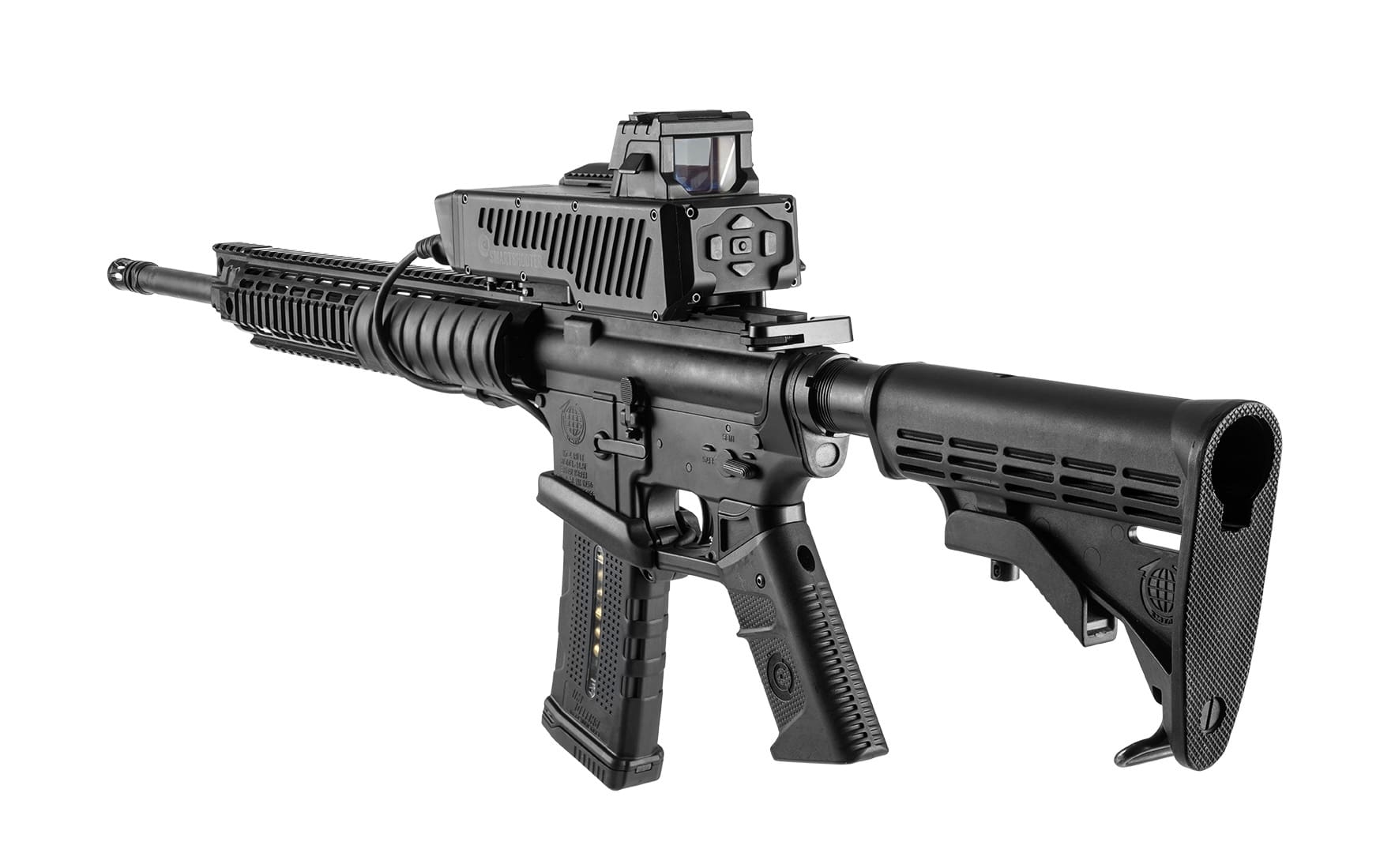
Only one of three mobile devices are currently sponsored, however all three are available for service use, Gainey said. SOCOM will sponsor the Bal Chatri, but the Drone Buster and Smart Shooter devices will not be sponsored. Each handheld device can be used while patrolling an area.

The guiding principle behind every selection is interoperability, Gainey said. “The command and control technology brings it all together. This initiative will bring an enterprise approach to a critical capability area and provide the tools warfighters [need] to better adapt to changing threats.”

The success of their choices relies on the service’s ability to embrace the command and control standards, or C2, Gainey said. “This will allow the plug-in-play of emerging technology from industry into our architecture.”

Regarding C2, the Army has FAAD-C2, Forward Area Air Defense Command and Control, along with its interoperable systems: the ADSI, the Air Defense System Integrator, and the MEDUSA C2, or Multi-Environmental Domain Unmanned Systems Application Command and Control. However, the MEDUSA C2 is still in the works to be interoperable with the FAAD-C2.

All that said, there is no interim timeline, Gainey said, despite the interim selections. As the C-sUAS office continues to work with industry, test new devices, and bring on emerging technologies to the DOD, “Our strategy is to continually improve the current capability we have, while testing and looking at the new technology to bring it on, not through this sort of slow, methodical way.”

Moving forward, the objective is clear: continually improving the systems with joint solutions. C-sUAS is working on a capability development document, or CDD, to lay out a blueprint for those emerging technologies. The first draft, slated for a fall release, will also open the door for industry to compete as the military moves forward, Gainey said.

Although unpublished, the initial draft of the CDD focuses on the interim capabilities identified in the assessment, and how it bridges the strategy of current system-to-objective joint solutions.

“We will continue to work with industry to bring these systems to full maturity or replacement with follow-on enduring solutions,” Gainey said. “Future research, testing and investment decisions on capability modernization will consider not only the most up-to-date existing technologies but, more importantly, those new and emerging technologies currently in development.”

By Thomas Brading, Army News Service