The 101st Airborne Division (Air Assault) has been a leader in Army innovation for decades, and the Spec. 4 Peter M. Guenette EagleWerx Applied Tactical Innovation Center promises to play a major role in future warfighter transformation.
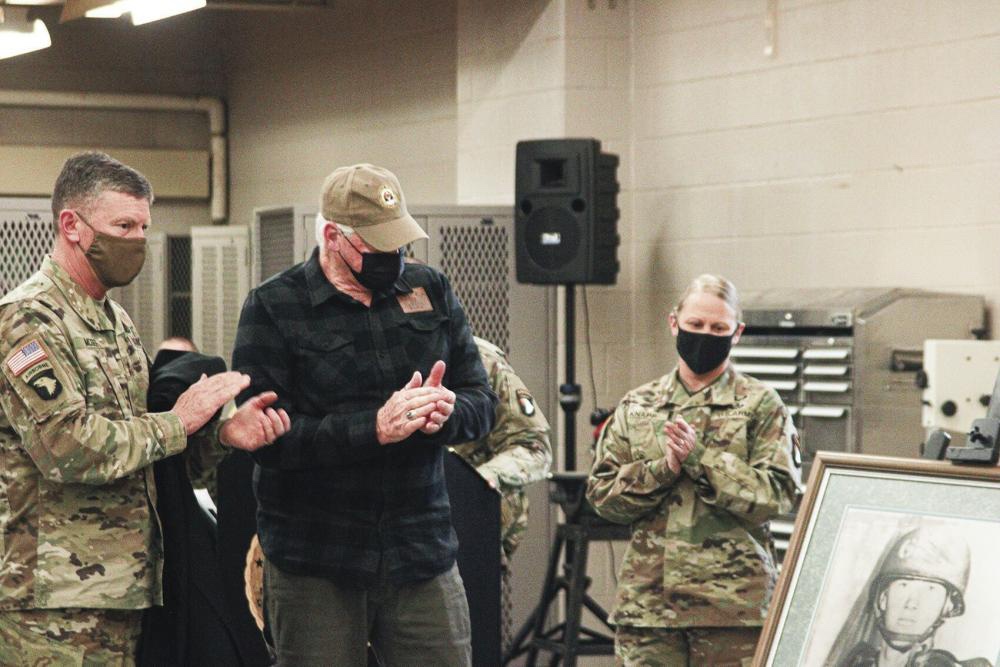
Soldiers, Families and community members toured the facility firsthand Dec. 7 during a ribbon cutting and dedication ceremony at 89 Screaming Eagle Blvd., where they learned about EagleWerx’s capabilities and bottom-up approach to innovation.
“We all know that transformation starts with the people who are executing, and the Soldiers are the ones closest to the problem,” said Capt. Lauren Hansen-Armendariz, deputy innovation officer, 101st Abn. Div. “They understand it the best, and that’s exactly why EagleWerx exists – to be able to give Soldiers what they need so they can make improvements.”
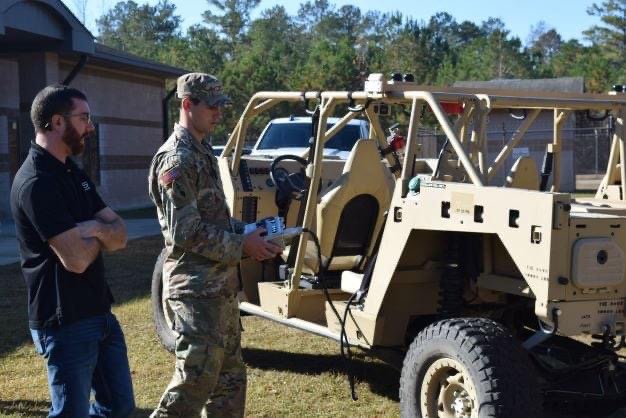
EagleWerx gives Soldiers direct access to a wide range of capabilities including entry-level artificial intelligence, robotics equipment, 3D printing, engineering support and educational workshops to solve problems. Its employees can also connect Soldiers with collaborative partners such as Vanderbilt University, Middle Tennessee State University and U.S. Army Combat Capabilities Development Command, or CCDC.
Major General JP McGee, commanding general, 101st Airborne Division (Air Assault) and Fort Campbell, said EagleWerx is an important step forward for the installation because it empowers Soldiers to adapt and excel in future conflicts.
“Innovation is not about a technology,” McGee said. “It is about a spirit within our Soldiers and leaders, and it needs to be established and fostered before a crisis, before we are at war. A site like this named after one of our heroes, Peter Guenette, represents our tangible investment into establishing innovation as an enduring part of the culture of the 101st.”
Guenette served with 506th Infantry Regiment, 101st Airborne Division (Airmobile), during the Vietnam War and received a posthumous Medal of Honor citation for his efforts on the battlefield. During a firefight in the Quan Tan Uyen Province May 18, 1968, he smothered the blast from a hand grenade with his body to protect his fellow Soldiers, saving at least three others at the cost of his own life.
The installation later dedicated the Guenette Arts and Crafts Center to his memory in 1975, and the building retained his name after it was re-established into EagleWerx.
“It evolved into something pretty awesome,” said Michael Guenette, Spec. 4 Guenette’s brother. “It was awesome before as an arts and crafts center, and as the war in the Middle East started it was good for helping Soldiers who had PTSD work on projects. And now this is a great evolution. My brother was a science guy, he really was, so I think it’s a great thing. Keeping his name on the building is important, and this base honors heroes like Peter.”
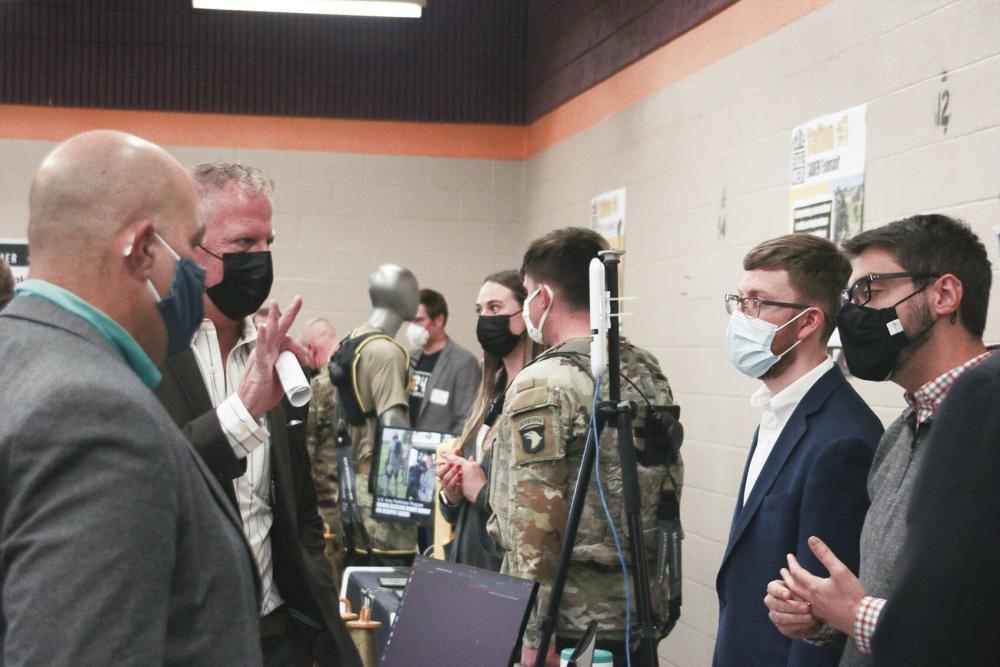
Guenette was among several guests at the facility’s ribbon cutting and dedication given a guided tour, where Soldiers from across the installation highlighted partnerships and projects being developed through EagleWerx.
Chief Warrant Officer 3 Ron Billingslea, 101st Division Sustainment Brigade, said EagleWerx will allow the unit to push its additive and subtractive manufacturing capabilities to the next level.
“Additive manufacturing, in layman’s terms, is the ability to create parts, one-off pieces or test molds so we can test or figure out a problem and create a solution without having to expend a lot of materiel,” Billingslea said. “Right now, we’re looking at problems that we’re tracking across the board, like long lead times on parts for vehicles that are down or one-off pieces that will get everyday use from Soldiers.”
The Lifeliners use 3D printing capabilities and computer aided design, or CAD, files to produce those parts that can be used to repair broken equipment on the battlefield quickly instead of waiting for third parties to deliver materiel. CAD files for specific parts can also be uploaded into a database and shared across the Army, Marine Corps, Navy and Air Force.
“We’re going to partner up with EagleWerx to be able to build products we can prototype here,” Billingslea said. “When we send a CAD file back to the forward line of troops, they can run that program to make sure it’s optimal to what we need in the field. In doing that, we build a network and create a partnership with EagleWerx as a hub for forces across the U.S. platform.”
In addition, Billingslea is planning to facilitate classes at EagleWerx to teach Soldiers and local students the basics of CAD, additive and subtractive manufacturing. Soldiers can use that instruction to gain a better understanding on how those capabilities can help them, while students can position themselves for success in the military or a trade.
Educational programming is a major component of EagleWerx, and the facility has already hosted a number of classes since its soft opening in August.
“I took part in a design thinking workshop on suicide prevention,” said Spc. Seth Johnson, 1st Battalion, 327th Infantry Regiment, 1st Brigade Combat Team, 101st Abn. Div. “The solution we came up with is currently in the process of being implemented in the division, and it’s sort of like an Eagle Day 2.0 where one day out of every month you do cohesion building exercises among your squad. We reiterated the importance of that, how it affects people and how they feel about it when it’s done regularly.”
Approximately 30 Soldiers from across the installation participated in the workshop and formed two teams to pursue different solutions. Johnson said he appreciates the chance to get involved and looks forward to seeing what future workshops can develop.
“It makes you feel like you have an impact on the Army and the ability to solve problems that affect people at your level,” he said. “I think EagleWerx is going to produce great things and given the opportunity I’d be happy to come back and work on more projects.”
Other classes hosted at EagleWerx are made possible through support from community and Army partners. Bull Holland, Advancing Concepts Office Operations, CCDC Army Research Laboratory, recently led three teams of Soldiers through the H4X Lean Acquisition Innovation Course, a five-week graduate-level course, using EagleWerx as a venue.
“What we’ve done for these Soldiers is put together a class that teaches the same lean innovation methods that we teach in American Psychological Association [APA] schools and other graduate programs around the country,” Holland said, adding he has taught the same course at North Carolina State University. “Instead of us trying to find the right place to engage Soldiers in each different brigade, EagleWerx centralizes Soldiers from across the division into one spot and gives people like myself a place to plug in.”
Soldiers who completed the course at EagleWerx used entrepreneurial skills to develop requirements for new “see through wall” capabilities, electromagnetic sensors and air assault planning based on problem statements provided to each group.
“Our problem statement was that as technology progresses, our electronic footprint keeps increasing through emissions of energy and it’s something potential adversaries could exploit and use against us,” said Staff Sgt. Patrick Frisbie, electronic warfare noncommissioned officer in charge, 1st BCT. “That’s something that we want to develop tactics, techniques and procedures to mitigate.”
As an electronic warfare NCOIC, Frisbie is familiar with that problem and has practical experience with looking for electromagnetic signals to trace enemies. He and his classmates used that experience to identify cost-effective technologies the division could eventually use to reduce energy emissions down to the company level.
“Soldiers all have their own particular insights and they know the problems they face the best,” he said. “This gives them a space to come down if they have an idea. Even if it’s a simple modification to a piece of equipment that already exists, they have professionals here that can put them in touch and make things happen.”
Ultimately, EagleWerx is intended to help Soldiers find the resources to solve problems at any scale and build a culture of innovation across the division.
“Innovation does not start with me,” McGee said. “It is not a top-down driven endeavor; it starts with our people closest to the challenge – our Soldiers who are at the tip of the spear. Our vision is that all Screaming Eagle Soldiers are empowered to inform, accelerate and integrate innovative solutions and models in order to prepare the 101st for the future fight.”
Story by Ethan Steinquest
Fort Campbell Public Affairs Office