TYR Tactical

Archive for the ‘Army’ Category

This Is My Squad: Forging Leadership Skills Through the Squad Leader Development Course

Tuesday, January 12th, 2021

“This Is My Squad,” an initiative of Sgt. Maj. of the Army Michael A. Grinston, aims to build more cohesive units across the Army and empower noncommissioned officers with the leadership skills to anticipate issues and address them early on. The Army Resilience Directorate’s contribution to TIMS is the Squad Leader Development Course, which aims to advance this initiative by giving squad leaders the opportunity to critically reflect on their leadership style and learn to employ evidence-based leadership skills. Leaders who understand their leadership philosophy, know their Soldiers, and live the Army Values can forge cohesive Army units that are strong and resilient in the face of any challenge.

SLDC facilitators will guide squad leaders to craft their personal leadership philosophy focusing on the areas of commitment, trust, and developing others. A personal leadership philosophy can increase leader consistency and effectiveness. It provides a plan for value-based action, which can be particularly helpful in challenging moments or at tough decision points. A personal leadership philosophy, particularly when shared with others, can improve relationships. It allows others to understand a leader’s values, priorities, approach to decision-making, and expectations. During this two-day course, squad leaders discuss doctrine from Army Doctrine Publication 6-22 and research from the field of human performance, organizational psychology, and positive psychology to highlight the impact and importance of squad-level leadership behaviors. During the course, Soldiers discuss effective leader behaviors in different components of leadership to include character, motivation, trust, and developing others. The intent of the course is to motivate students to identify, adopt, and internalize leadership behaviors outlined in doctrine and supported by research. R2 Performance Experts delivered SLDC as a pilot from Dec. 1-2 to 24 squad leaders that make up Grinston’s TIMS Leadership Panel. On Dec. 3, the TLP provided feedback to R2’s Curriculum Development Team on the course content and design so organizers can make improvements before making the course available to all squad leaders.

ARD requested that the Walter Reed Army Institute of Research conduct a longitudinal evaluation of SLDC to determine the effectiveness of the training in improving squad leader knowledge, attitudes, and behaviors that foster unit trust and exemplify ethical leadership. In partnership with R2 Performance Experts at Fort Riley, Kansas, it is anticipated that SLDC will be delivered to squad leaders with the 1st Infantry Division in March 2021. Half of the participating squad leaders will be randomized to receive SLDC training as part of the evaluation. The other half will be assigned to a wait-list control group to receive training following the completion of the evaluation. Soldiers receiving SLDC will complete surveys before training, following training, and at follow-ups scheduled over two months after the training. Surveys are designed to assess Soldier’s pre-training knowledge, attitudes, and behaviors and offer Soldiers the opportunity to provide feedback regarding the training.

By Piers Kowalski, Laura Kirschner, Ian Gutierrez, and Susannah Knust, Ph.D., Army Resilience Directorate

‘When Failure Thrives – Institutions And The Evolution Of Postwar Airborne Forces’

Saturday, January 9th, 2021

Published in 2015, ‘When Failure Thrives – Institutions And The Evolution Of Postwar Airborne Forces‘ was the first imprint from Army Press.

Author Marc R Devore examines the post-1945 evolution of airborne forces the US, UK and USSR have ever accomplished their objectives at an acceptable cost.

Go ahead and read it, the arguments are always the same either way, but it’s worth knowing what gets put in from of decision makers.

Thanks to Mud!

Stryker Brigades Targeted for the Army’s Integrated Tactical Network

Saturday, January 9th, 2021

ABERDEEN PROVING GROUND (APG), Md. (January 5, 2020) – Following the successful integration of its new more flexible and expeditionary network capability into dismounted units, the Army is now focused on delivering the same capabilities to Stryker brigade combat teams.

To produce uniform equipment packages for these Integrated Tactical Network (ITN) components across multiple Stryker variants, the Army has been conducting a Capability Set (CS) 21 ITN Stryker characterization effort with the 2nd Cavalry Regiment (2/CR), since April 2020. The effort will support the iterative modification of integrated ITN component designs into these vehicle platforms.

On the current timeline, the characterization will conclude in fiscal year (FY) 2022, making 2/CR the first Stryker unit equipped partially with CS21 ITN.

The Army first fielded CS21 ITN to the 1st Infantry Brigade Combat Team, 82nd Airborne Division in October 2020, with the next ITN fielding set for the 173rd Airborne Division this month.

“We are excited to move to this next phase of CS21, which will enhance mounted, on-the-move and at-the-quick-halt ITN capabilities,” said Lt. Col. Brandon Baer, product manager for Helicopter and Multi Mission Radios (HAMMR), assigned to the Program Executive Office for Command, Control, Communications-Tactical (PEO C3T).

The ITN approach injects new commercial components and network transport capabilities into the Army’s tactical network environment to provide maneuver brigades and below with smaller, lighter, faster and more flexible communications systems. Adding mounted ITN capabilities allows commanders to maintain battalion-wide terrestrial voice and data network and enables Soldiers to operate over the Secure But Unclassified (SBU) enclave while transitioning between dismounted and mounted operations.

“SBU continues to be the game-changing capability enabled by the ITN,” Baer said. “It allows data to be categorized according to its classification, which will be just as critical for our mounted units because data at battalion and below is often perishable and unclassified.”

To execute the CS21 ITN Stryker characterization, personnel from the HAMMR team are collaborating with engineers and technicians from the U.S. Army Combat Capabilities Development Command (DEVCOM) at the C5ISR Center Prototype Integration Facility (PIF), at APG. With Strykers at hand in the integration bay, the team will identify the most effective use of the limited space inside the vehicles, and then design and build the streamlined hardware required to integrate the ITN kits into the vehicles.
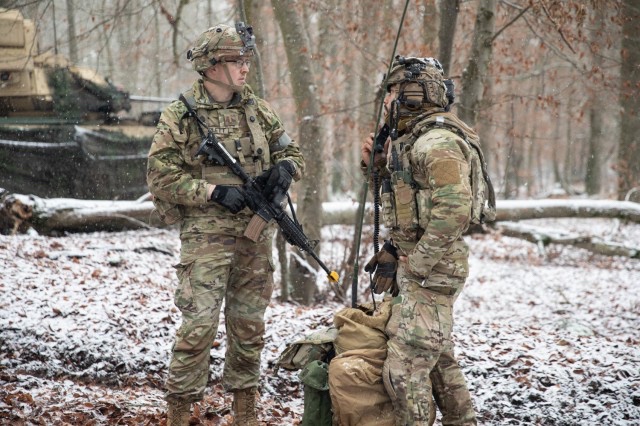
To ensure realistic operational requirements the PIF Team is directly collaborating with 2/CR, currently via video conferences due to COVID-19 travel restrictions.

“We have been conducting user juries remotely, which allowed the 2/CR Soldiers to show us their vehicle space restrictions, and in turn allows us to show them how much space our proposed designs will claim,” said Jim Leary, C5ISR PIF project engineer.

The 2/CR conducts missions using multiple commander and infantry carrier Stryker variants, with infantry carrier configurations most prevalent.

“Each vehicle within the 2/CR may require something unique to perform its mission, but our goal is to design a one-kit-fits-all variant approach,” Leary said.

The characterization led to the production of two unique ITN equipment kits. Kit one will be populated in almost every Stryker variant and features the mobile broadband kit for 4G LTE network capabilities, 2nd Generation Manpack radio, a mounted two-channel leader radio and a unique power distribution box, Leary said.

Kit two, slated for only the Command Vehicle Stryker variant, includes a Tactical Server Infrastructure computer, a Silvus radio, a Tactical Radio Integration Kit box, tactical cross domain solution and a power distribution unit, Leary said.

“Both kits will include various mounts, cabling, hardware and installation instructions, and will be adaptable to integrate into other 2CR tactical vehicles such as High Mobility Multipurpose Wheeled Vehicles, medium tactical vehicles (MTVs) and the MTV replacement, the Joint Light Tactical Vehicle, if available,” he said.

The most recent video conference user jury with the 2CR featured the team’s final proposed component designs and recommendations on where to place them in the vehicles’ available space, Leary said.

“Our last review was mostly favorable,” Leary said. “Next we will send PIF-produced 3D models of the kits to the 2/CR so that they can confirm the space we’re claiming is accurate or provide an alternate location for unique vehicle configurations.”

Following a verification and validation effort to systematically assess each component’s performance, and provided COVID travel restrictions are lifted, PM TR and PIF personnel will travel to the 2/CR in Germany to integrate CS21 ITN into Strykers from May through August.  The entire characterization effort will culminate with a squadron-level exercise in September 2021, which will lead to the formal evaluation of the next capability set, CS23, in FY 2022.

“Our goal is always to build a design that repeats itself over and over again as opposed to making a unique design for every vehicle,” Leary said. “In doing so we save money, reduce the logistics footprint across multiple vehicle types, but most importantly, we make it as easy as possible for integration efforts across the entire force.”

By Kathryn Bailey, PEO C3T Public Affairs

New Reserve Parachute Testing Seeks to Eliminate Potential Premature Activations

Friday, January 8th, 2021

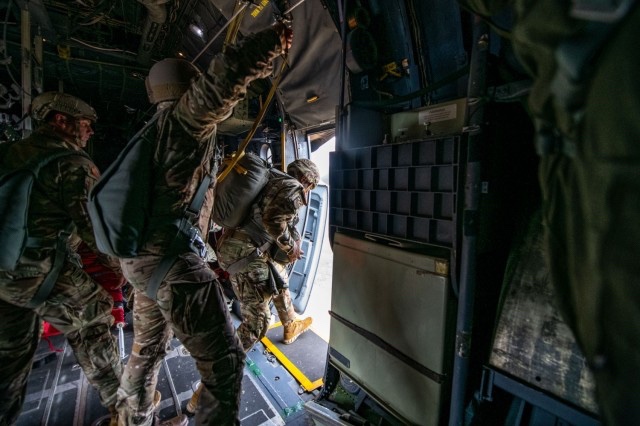
FORT BRAGG, North Carolina — Certified parachute test jumpers here finished 23 risk reduction jumps with the T-11R Single Pin Troop reserve parachute, making sure it works as it should during equipment test jumps.

The Airborne and Special Operations Test Directorate (ABNSOTD) tested the chute from both rotary winged and fixed winged high performance aircraft to eliminate the potential for premature reserve activations.

Any necessary changes were made to address the previous version’s premature activation thought to be caused by wind blast, according to Lt. Col. Derek Johnson Chief, Test Division at ABNSOTD.

“Testing promotes and delivers a safe, and more durable piece of equipment to the Warfighter,” said Johnson. “Soldiers relish in participating in day-to day testing. It ignites their enthusiasm to rig and load a piece of equipment which will ultimately serve our future Soldiers during combat missions.”

After the risk reduction jumps, ABNSOTD conducted 53 operational static line jumps during daylight hours to be fully certified by the Natick Soldier Research, Development, and Engineering Command located at Natick, Massachusetts.

While employing a host of risk reduction measures to ensure potential test items are safe and effective from the intended user’s standpoint, test events with the T-11R kicked off with new equipment training.

Parachute Riggers participated in New Equipment Training to learn the assembly of the chutes new components and closing of the pack tray.

“There is a huge increase in the amount of information that is provided to Soldiers who are given the opportunity to practice what they are learning in the form of hands-on training,” said Mrs. Shonda Strother, editor with ABNSOTD.

Testing new airborne equipment enables Soldiers the opportunity to provide feedback to the Army concerning current Soldiers needs in the field, according to Staff Sgt. Robert Whan, 2nd Battalion, 508th Parachute Infantry Regiment’s Battalion Air NCO.

All airdrop test iterations were airdropped with Soldiers in full combat equipment as if they were jumping into a combat operation.

“The T-11R Single Pin reserve parachutes were then inspected for any damage in order to make sure they can hold up to the high demands of the airborne mission,” said Sgt. 1st Class Katherine Greene, ABNSOTD’s T-11R test noncommissioned in charge.

The new T-11R Single Pin pack tray is manufactured from the same materiel as the current issue item. The current T-11R version has a square shaped look while the redesign has a rectangle shape.

The re-designed pack tray includes a change where the reserve ripcord handle is now a single pin pull, and a change in the geometry of the reserve handle eliminates the risk of windblast.

A plastic viewing window also assists the jumpmaster when inspecting the curve pin during jumpmaster personnel inspection. The reserve handle remains a textile type.

Story by Mr. William Slaven, Airborne & Special Operations Test Directorate, U.S. Army Operational Test Command

Some of photos by Jim Finney, Airborne & Special Operations Test Directorate, U.S. Army Operational Test Command

Ten Weeks in Thailand: 1st SFG(A) Green Beret is First US Soldier to Complete Royal Thai Army’s Ranger School

Thursday, January 7th, 2021

Wearing Royal Thai Army (RTA) fatigues and black leather boots, a U.S. Army Green Beret wades waist deep through a swamp carrying a heavy rucksack and an old-fashioned Mannlicher M1888 bolt-action rifle. With soaked feet and pain spreading through tired muscles, there are still miles left to trudge.




The night prior, he slept an hour because of a successful patrol in the swamps. On nights where the patrols are unsatisfactory, he’s lucky for a half hour of uninterrupted sleep in the quagmire. Twenty-two hours out of the day are devoted to patrolling.

The other 72 days of the RTA Ranger School are just as relentless. Earning the Royal Thai Army Ranger Badge is a grueling effort, but high attrition rates are unusual for the course. The candidates rely on one another to push each other through to the end, whether it means carrying another’s rucksack for five weeks due to a broken ankle or a quick nudge to awaken a tired teammate. From Oct. 17 to Dec. 29, 2020, a Green Beret with 1st Special Forces Group (Airborne) attended the RTA’s Ranger School in the Kingdom of Thailand and earned the Thai Ranger Badge along with recognition as the course’s distinguished graduate.

Furthermore, he became the first U.S. servicemember to attend in more than 40 years, and the first to graduate the course in its modern form. Life changing is what Ranger School is, the Green Beret said. You can’t write or call your family back home; here, your family are your brothers and instructors.

The Green Beret was recognized as a valued teammate whom instructors came to rely on. As the course progressed, instructors placed him in key positions to facilitate the successful completion of missions within his platoon.

“It’s a lifetime bond here,” he said. “I will always remember these guys and I will always keep in contact with them. It’s like brother-to-brother mentorship.”

Ranger School consists of different phases: mountain, forest, swamp, maritime and urban combat. In each phase, a candidate is assessed on the positions of squad or platoon leader, medic, pace man and map, and compass man.

“As a Green Beret, we’re supposed to be masters of the basics,” the Green Beret said. “This course took me back to the basics. For instance, navigating off one map per platoon…In an [Operational Detachment Alpha], you have eight maps plus GPS.”

To pass RTA Ranger School, you must compose operations orders and lead squad or platoon-sized elements on missions. All interactions between teammates and instructors are in Thai.

“You have to be fluent in this language,” he said. “The instructors don’t speak English and there are no translators here.”

As well as being fluent in Thai, the Green Beret is U.S. Army Ranger qualified and drew a contrast between U.S. and RTA Ranger Schools. In U.S. Army Ranger School, a severe enough injury would result in a medical drop from the course, he said. At Thai Ranger School, instructors encourage Ranger Buddies to help one another by shouldering the weight of an injured soldier.

The course was comprised of students from U.S. Army Special Forces, Royal Thai Army, Royal Thai Police, Royal King’s Guards, and the Royal Thai Special Mission Unit. Of the 198 who started the course, 187 graduated.

According to the award write up given by the RTA, the Green Beret’s conduct demonstrates the value the U.S. Army places on equal partnership in support of the U.S.-Thai alliance. His performance set the example for future U.S. Army attendees to the RTA’s Ranger School.

“It’s not so much what he gives to my formation, but what he gives to our entire force at-large in that he is a tactical and cultural diplomat for our country and Army,” said the Soldier’s Company Commander from 1st SFG (A). “The skills that he comes back with and the relationships he forged while there will better prepare both countries to operate with each other for our mutual defense.”

Story by SGT Anthony Bryant, 1st Special Forces Group (Airborne)

DC Guard to Wear Black ID Vests for Inauguration

Wednesday, January 6th, 2021

District of Columbia National Guardsmen will wear a black identification only vest during the activation for demonstrations in Washington D.C., June 5 to 7, 2021.

The black identification vest is not body armor nor a tactical vest. It is the traditional uniform worn by the D.C. National Guard members in multiple domestic operations including Presidential Inaugurations, the COVID-19 pandemic response, the 4th of July celebration and the “Anniversary March on Washington” in the last year.

More than 300 Guardsmen are supporting the District of Columbia from Jan. 5 to 7, 2021, at the request of Mayor Muriel Bowser and Dr. Christopher Rodriguez, Director of the D.C. Homeland Security and Emergency Management Agency, on behalf of the D.C. Metropolitan Police Department and D.C. Fire and Emergency Services.

The request for support was approved by the Secretary of the Army, the Hon. Ryan D. McCarthy.

By Capt. Tinashe Machona | D.C. National Guard

Powerful Example: IVAS Program Uses Middle Tier and Other Transaction Authorities

Sunday, January 3rd, 2021

The Integrated Visual Augmentation System (IVAS) program office employed critical thinking and innovative practices in the strategy, planning and execution of IVAS–an acquisition program designed to give our Soldiers, Marines and Special Operators a decisive advantage in close-combat capability. The program team leveraged the Adaptive Acquisition Framework, Middle Tier of Acquisition Pathway/Rapid Prototyping Path as highlighted in DoDI 5000.80, as well as Other Transaction Authorities to contract with Microsoft and other traditional and non-traditional vendors. Additionally, they involved Soldiers in the design and test process (“Soldier-Centered Design”), collaborated with key stakeholders and industry as one team (the “right team”), and effectively identified, managed and drove down risk as development and testing progressed.

Click here to watch the video.

IVAS is a low-profile, ruggedized Heads-Up Display (HUD) with a body borne computer pack, Conformal Wearable Battery (CWB), squad radio, and integrated thermal and low light sensors that provides the Close Combat Force a single platform to fight, rehearse, and train. The IVAS suite of capabilities leverages tactical mixed reality to enable planning, networked information sharing via Tactical Cloud Package (TCP) and Cloud Services, and an augmented reality Synthetic Training Environment (STE) and Squad immersive Virtual Trainer (SiVT) that enables the Warfighter to fight ‘25 bloodless battles’ before engaging the enemy. IVAS integrates next generation situational awareness tools and high-resolution simulations to deliver a single platform that improves Soldier sensing, decision making, target acquisition, and target engagement. These capabilities will provide the increased lethality, mobility, and situational awareness necessary to achieve overmatch against our current and future adversaries.

Team IVAS is on target to begin production in March 2021, with first unit equipped in September 2021, accelerating the development process by more than four years compared to traditional acquisition processes.

Written by Tony Romano, DAU

Army Researchers Acquire Two New Supercomputers

Friday, January 1st, 2021

ADELPHI, Md. — Army researchers are upgrading their computing capabilities with the acquisition of two new supercomputers.

The U.S. Army Combat Capabilities Development Command, now known as DEVCOM, Army Research Laboratory is home to the Department of Defense Supercomputing Resource Center, where computer scientists are welcoming the bi-annual technology refresh as part of the DOD High Performance Computing Modernization Program.

The two supercomputers, named Jean and Kay, recognize the remarkable achievements and enduring legacies of Jean Jennings Bartik and Kathleen “Kay” McNulty Mauchly, key contributors and computing pioneers as part of the original team of programmers of the Electronic Numerical Integrator and Computer, or ENIAC, the world’s first general purpose computer.

These systems will join the Betty system in the center’s production high-performance computing infrastructure. The Betty system is named in honor of Frances Elizabeth “Betty” (Snyder) Holberton, another key member of the original ENIAC programmer’s team.

The two systems are both Liqid Computing platforms containing 48 core Intel XEON (Cascade Lake Advanced Performance) processors integrated with the largest solid state file systems the DOD has deployed to date.

The systems are expected to enter production service in the mid-fiscal 2021 timeframe, and will join the center’s Centennial and Hellfire systems towards establishing a cumulative computational capability of 23.3petaflops.

“Jean and Kay will allow ARL to support many of DOD’s most significant modernization challenges to include digital engineering and other emerging workloads,” said ARL DSRC Director Matt Goss. “By adding specialized technology to augment traditional high performance computing with data analytics, these machines will serve as a spring board on which DOD scientists can make game changing discoveries.”

According to ARL computer scientist Bob Sheroke, these systems significantly enhance the program’s ability to support the DOD’s most demanding data-intensive computational challenges, and include emerging technologies and tools for artificial intelligence, data analytics and machine learning.

The systems include embedded capabilities to support persistent services in additional to traditional batch-oriented processing.

“The DOD High Performance Computing Modernization Program, established in 1992, has invested over $1.2 billion at the ARL DSRC, which has maintained the center’s posture as one of the program’s primary HPC centers and one of the top supercomputer sites in the national supercomputing infrastructure,” Sheroke said.

Visit www.arl.hpc.mil to learn more about center’s computational capabilities and support services.

By U.S. Army DEVCOM Army Research Laboratory Public Affairs