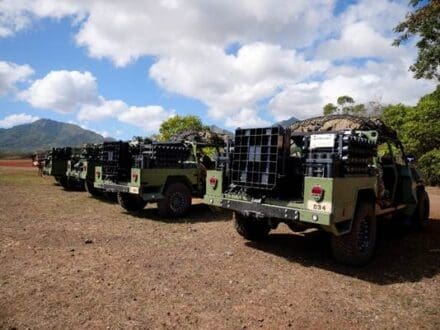
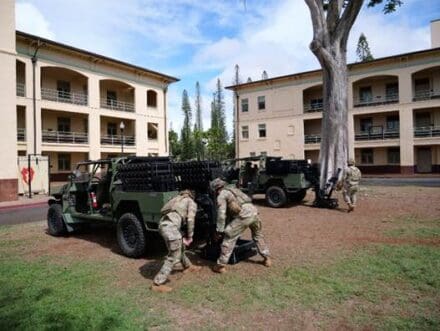
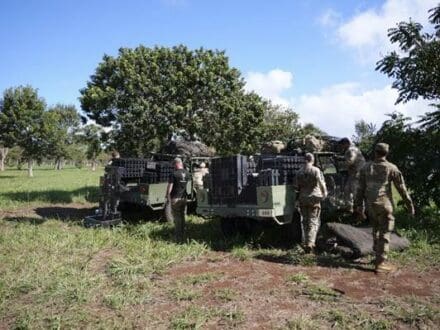
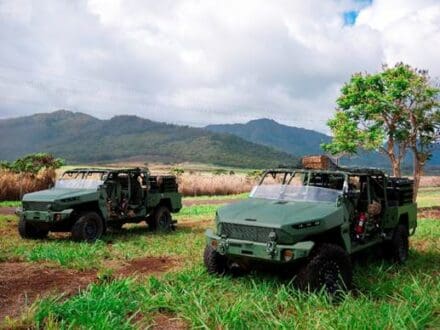
Wilcox Ind RAID Xe

Archive for the ‘Army’ Category

US Army Publishes ATP 3-01.81, Counter-Unmanned Aircraft System (C-UAS) Operations

Friday, May 30th, 2025

The US Army has just published ATP 3-01.81, Counter-Unmanned Aircraft System (C-UAS) Operations (MAY25).

Army Techniques Publication (ATP) 3-01.81 Counter-Unmanned Aircraft System (C-UAS) Operations provides operational considerations for defending against unmanned air threats for multi-domain operations.

This ATP offers planning and integration guidance for counter-unmanned aircraft system (C-UAS) platforms in a layered defense, along with both active and passive defense techniques for countering the unmanned aircraft system (UAS) threat in various areas of operations. This ATP also provides guidance on how to plan for, and incorporate, C-UAS Soldier tasks into unit training events.

The principal audience for ATP 3-01.81 is brigade and below commanders and staff, junior leaders, platoons, and individual squads who employ combined arms planning techniques within their operations (refer to ATP 3-01.8). Leaders in all organizations can benefit from C-UAS techniques prescribed in this publication.

Trainers and educators will also use this publication to support the development and introduction of combined arms for air defense into existing curricula. Other services and joint organizations may use this manual to gain insight into Army air and missile defense (AMD) operations for C-UAS.

Download your copy at armypubs.army.mil/epubs/DR_pubs/DR_a/ARN43877-ATP_3-01.81-000-WEB-1.

Warfighters Put Emerging Technologies to the Test at Fort Leonard Wood

Thursday, May 29th, 2025

FORT LEONARD WOOD, Mo. — The Army Futures Command Maneuver Support Battle Lab is winding down this year’s Maneuver Support and Protection Integration eXperiments and Army Application Lab assessments, in which warfighters conducted simulated battlefield experiments with 14 emerging technologies from May 5 to 16, 2025, at locations across Fort Leonard Wood.

“Protection, though largely attributed to the Maneuver Support Center of Excellence, is everyone’s responsibility,” said Kyle Henry, MSBL Experimentation Branch chief and one of the key organizers of the event.

According to Henry, MSPIX puts the latest tools in the hands of Soldiers while also giving capability developers and the science community credible and validated operational experiment venues for their conceptual and materiel development.

“Engineers and scientists can get lost behind their computer screens and become narrow sighted within the confines of their labs. Their ideas of how something might benefit a Soldier in real world applications are often biased and skewed,” Henry said. “Bringing their capabilities — often their life’s work — out into the field with the Soldiers who may become the end-user provides a reality check for all involved.”

MSPIX participants include both government labs and private industry.

“The vast majority of technology providers are not under contract with the government and pay-to-play, meaning they bring their technology and support to us at no cost. Through coordination with Army Test and Evaluation Command and MSCoE, we can put these capabilities into the hands of Soldiers, something that is mutually beneficial, at a relatively low cost to the taxpayer,” Henry explained.

AAL’s assessments focused on robotic breaching and terrain shaping operations, while MSPIX tested several unmanned and autonomous technologies.

About 50 U.S. Army Forces Command Soldiers from Fort Leonard Wood; Fort Cavazos, Texas; Joint Base Lewis-McChord, Washington; Fort Bragg, North Carolina; Fort Carson, Colorado; and Vicenza, Italy, took part in the assessments.

Some of the experiments had Soldiers controlling unmanned drones, vehicles and boats traversing air, land and water.

Sgt. Mariano Negron, a 12C, or bridge crewmember, with the 74th Multi-Role Bridge Company at Fort Cavazos, spent much of May 13 at Training Area 250’s lake using a system that allowed him to control a bridge erection boat, commonly called a BEB, from a handheld controller.

He said he regularly uses BEBs to build bridges, but not with a remote control.

“I am used to using handheld controllers to play games and it is similar to that. I picked it up easily. It’s like driving a remote-controlled car,” Negron said.

The system can be fitted to existing vessels already in the Army’s inventory to facilitate remote control or autonomous operation.

“We could use this to build bridges without having Soldiers enter the water,” Negron said. “If we needed to remain covered but also needed to bridge a gap to transport troops or cargo we could with this technology.”

Negron said it felt good to be able to provide guidance to the system’s creators.

“We operate these boats all the time. We know how to make these boats do what we need them to do to complete our mission. I have been able to give them feedback that I hope will improve this technology if we get it someday in the future,” Negron said.

Capt. Adam Robinson, an experimentation officer with the Maneuver Support Capability Development Integration Directorate of AFC at Fort Leonard Wood, supervised the testing of seven technologies at Training Area 401.

“We are running platoon style lanes to test the remote breaching and terrain shaping capabilities of these technologies,” Robinson said. “We are giving a platoon leader, a platoon sergeant and a section of combat engineers a mission to complete with these new technologies and watching how they use the technology to execute.”

Robinson said he was impressed by watching how the Soldiers operated a robotically controlled utility terrain vehicle.

“The way it can move and track is pretty impressive,” Robinson said. “The engineers are using them to shape terrain, but as a MP, I would use it for surveillance or resupply. It has a variety of applications.”

Other technologies assessed the capabilities of autonomous track loaders for dig, dump and fill operations; autonomous biological critical area disinfection; a mobile sensing system designed to detect the movement of targets and provide visual imaging; equipment delivering a broad-spectrum electromagnetic pulse during breaching operations; and bioreporters created to detect nerve agents for standoff chemical threat detection.

By Melissa Buckley, Fort Leonard Wood Public Affairs Office

Hegseth Announces Pay Raise for Army Paratroopers

Saturday, May 24th, 2025

FORT BRAGG, N.C. — Defense Secretary Pete Hegseth announced a pay raise for Army paratroopers today during remarks to current and former members of the 82nd Airborne Division at Fort Bragg, North Carolina.

Hegseth made the announcement during the 82nd’s All American Week, a four-day event that brings past and present paratroopers together to celebrate their service through competitions and camaraderie.

“I’ve got a bit of an announcement today that might be of interest to this community,” Hegseth said to the formation of Soldiers.

“For the first time in [decades], here [as] the secretary of defense, through the secretary of the Army, we are increasing jump pay,” Hegseth said, eliciting an enthusiastic response from the crowd.

Hazardous duty incentive pay — commonly referred to as “jump pay” — is set to increase from $150 per month to $200 for rank-and-file paratroopers.

Additionally, Hegseth added, jumpmasters — the senior paratroopers responsible for training and teaching the techniques for jumping from aircraft — will receive an additional $150 per month on top of the $150 in HDIP they already earn.

“Here’s to our paratroopers, our jumpmasters, who do the difficult things in difficult places that most Americans can never imagine,” Hegseth said following the announcement.

He emphasized that service members remain central to decision-making at the Pentagon.

“I want you to know [that] inside the corridors of the Pentagon, you are on our minds — with the decisions we make in budgets, in planning, in deployments, in orders [and] in reorganizations,” he said.” We have you and your families in mind.”

Hegseth then spoke about rebuilding the military and reestablishing deterrence — two of his top three priorities, along with restoring the warrior ethos, as outlined in his Jan. 25, 2025, message to the force.

“President [Donald J.] Trump is committed to historic investments inside our formations,” Hegseth said. “Our promise to you is that when the 82nd Airborne is deployed — if we have to call 911 for America’s response force — you will be equipped better than any other fighting force in the world.”

He added that under the current administration, the 82nd Airborne will always maintain a superior advantage in battle.

“That’s my promise to you,” he said.

On deterrence, Hegseth said the department is focused on restoring “peace through strength.”

“When I look out at this formation, the eyes of the men and women and these flags, I see the eyes of deterrence; I see the eyes of American strength; I see the eyes that will deter the wars that we don’t want to fight,” he said. “Those who long for peace must prepare for war.”

Hegseth closed his remarks by expressing gratitude to the division’s troops, veterans and their families in attendance.

“Like those who came before you, you keep showing the world the stuff you’re made of,” Hegseth said.

“Because we know you are ready for the important work that lies ahead.”

– Matthew Olay, DOD News

Unique Army Unit Shares Lessons Learned on How Army Can Become More Mobile, Lethal

Thursday, May 22nd, 2025

WASHINGTON — The Army’s 3rd Brigade Combat Team, 10th Mountain Division, shared insights gained from its nine-month European rotational deployment as the Army’s only Transformation in Contact 1.0 unit in an active theater during a media roundtable May 5, 2025, at the Pentagon.

The brigade is one of three brigades with an initiative to integrate technological advancements into equipment and force structure.

Unique to the Soldiers’ experience was that they were the first Army brigade to “transform in contact” while forward deployed. Transforming in Contact, or TiC, is how the Army is adapting its organization and delivering new technologies into the hands of Soldiers so they can experiment, innovate and be ready to fight on a modern battlefield. It accelerates fielding of necessary capabilities and leverages commercial off-the-shelf products to get new capabilities to the force fast.

Col. Josh Glonek, commander of the 3rd Brigade Combat Team, 10th Mountain Division, said when their deployment began nine months ago along NATO’s eastern flank from the Baltics to the Black Sea region, the Army asked them to do two things: become more mobile and more lethal.

Lessons learned

The unique brigade applied lessons learned from the war in Ukraine to advance Army efforts in unmanned aerial systems employment, electronic warfare, ground mobility, deception, command and control, survivability and more.

The brigade operated in challenging terrain in complex environments, during winter conditions, Glonek said during Combined Resolve 25-01 at the Joint Multinational Readiness Center in Germany.

“The difficult terrain and weather tested equipment and Soldiers, leading to crucial adjustments in tactics,” he said. “The European weather — cloud cover, fog, icing — presented significant challenges to drone operations. We need to develop technologies and tactics that can operate effectively in these conditions.”

Although the terrain and weather were difficult, he said the Soldiers proved their resiliency.

“Our Soldiers are proving that they can adapt and overcome, even in the most demanding environments,” Glonek said.

The colonel said the unique brigade also successfully fielded new equipment across five NATO countries.

“The 3/10 has been at the forefront of integrating cutting-edge technologies like advanced drones (Skydio, Vector, Darkhive), new vehicles such as Infantry Squad Vehicles, or ISVs, and networked communication systems. This isn’t just about having new gear. It’s about how we’re using it to enhance our capabilities.”

Glonek said the integration of Infantry Squad Vehicles, unmanned systems — including lethal drones — and redesigned Strike Companies has increased the brigade’s ability to maneuver quickly, find the enemy, and deliver decisive firepower. He said ISVs and Soldier Mounted Equipment Transports significantly improved the light infantry’s mobility, reducing their reliance on traditional support units.

Ninety percent of the brigade-initiated fire missions were observed by the UAS, significantly increasing accuracy and reducing risk to Soldiers, he said. The integration of Strike Companies, equipped with scouts, mortars and unmanned systems proved effective in finding, fixing and locating enemy forces.

“Through this, we’ve learned the importance of maintaining dedicated reconnaissance,” Glonek said.

Lethality, readiness

Glonek said the brigade combat team is modernizing their equipment and their approach to warfare to increase their lethality and readiness, so they can answer the call anywhere at any time.

“The 3/10 was specifically designed to rapidly integrate new technologies and adapt our organizational structures,” he said. “We’re now delivering those lessons learned — practical, actionable insights — to the entire Army.”

He said they incorporated discoveries from their European rotation to test and improve their C2 configuration, invest in innovations, and implement emerging technology with brigades to make them more lethal in multi-domain operations.

“The lessons learned by the 3/10 are shaping the future of the Army,” Glonek said. “We are prioritizing electronic warfare, investing in drone capabilities, and ensuring our Soldiers are equipped with the skills and technology they need to win on the modern battlefield.”

Transformation, interoperability

The brigade fielded lightweight alternatives and introduced drones, unmanned aerial systems equipment, electronic warfare and mobile infantry vehicles to adapt to the changing modern warfare environment.

It integrated multiple TiC systems and capabilities across the European theater. By emphasizing these TiC capabilities, integrating NATO Allied Forces and partner nations, Patriot Soldiers validated the Army’s ability to command and control U.S. and NATO ground forces in a large-scale combat operational environment, Glonek said.

The brigade integrated multiple TiC systems and capabilities across the European theater. They operated in a real-world environment, 90 miles from Ukraine, and in an exercise that involved nearly 4,000 participants from multiple nations.

“This provided invaluable insights unavailable in training exercises,” he said. “We worked side-by-side with our NATO allies, sharing technology and learning from their experiences. It reinforced the importance of interoperability and collective defense.”

As a TiC unit, the Soldiers were prioritized to receive the newest warfighting capabilities, including more than 150 unmanned aerial systems and upgraded communications equipment.

– Shannon Collins, Army News Service

Project Manager Soldier Lethality Announces Type Classification Approval for Next Generation Squad Weapons (NGSW)

Wednesday, May 21st, 2025

PICATINNY ARSENAL, NJ – Project Manager Soldier Lethality (PM SL) announced today the official Type Classification – Standard (TC-STD) of the U.S. Army’s M7 Rifle and M250 Automatic Rifle, signifying a major program milestone.

Following a full and open competition, including technical testing and Soldier touch points, a 10-year production contract was awarded to SIG SAUER in April 2022 to produce the M7 Rifle and M250 Automatic Rifle.

The M7 Rifle and M250 Automatic Rifle are currently being fielded across the Close Combat Force (CCB) to replace the M4A1 Carbine and M249 Squad Automatic Weapon (SAW) respectively. The Type Classification confirms the system meets the Army’s stringent standards for operational performance, safety, and sustainment.

“This milestone reflects our commitment to delivering cutting-edge capabilities that give our Soldiers the tactical advantage and lethality required on the battlefield,” said Col. Jason Bohannon, Project Manager Soldier Lethality. “We remain focused on equipping our force with the most reliable and effective tools to ensure mission success.”

PM SL continues to lead the way in modernizing the Army’s combat effectiveness and lethality through innovative, Soldier-focused solutions.

– PEO Soldier

RIA-JMTC Leads the Charge in 3D-Printed Drone Production, Uniting the Organic Industrial Base for Future Warfare

Wednesday, May 21st, 2025

ROCK ISLAND ARSENAL, Ill. – As the conflict in Ukraine has demonstrated, the battlefield of the future will be defined by the innovative and widespread use of unmanned aerial systems, and the ability to rapidly produce and deploy these systems at scale will be crucial to maintaining a tactical advantage in future conflicts.

“The U.S. Army recognizes the changing dynamics of warfare and is fully committed to staying ahead of the curve,” said Col. David Guida, commander of Rock Island Arsenal-Joint Manufacturing and Technology Center. “We are investing heavily in our Organic Industrial Base, harnessing its agility and innovation to develop and field advanced capabilities like these 3D-printed drones. At RIA-JMTC, our unique blend of cutting-edge technology and skilled artisans is leading the charge in this critical effort to shape the future of warfare.”

Through initiatives like Transforming in Contact, the Army is fielding new technologies and transforming how it develops, tests and integrates those technologies onto the battlefield. TiC prioritizes addressing immediate needs by enabling “in-contact experimentation”—putting cutting-edge technology directly into the hands of Soldiers and empowering them to innovate and adapt in real-world scenarios. This approach fosters a culture of calculated risk-taking and rapid Soldier feedback, ensuring that solutions are not only technologically advanced but also practical and effective on the modern battlefield. By focusing on near-term solutions and integrating emerging technologies, TiC enables Army units to rapidly test organizational changes and stay ahead of our adversaries, ensuring they are ready to fight and win in an increasingly complex and challenging operational environment. RIA-JMTC is partnering with multiple units in the field and the Combat Training Centers to share and provide technical data and lessons learned to help all improve.

This flexible and adaptive process is illustrated by the development of 3D-printed drones. RIA-JMTC is actively preparing to build the capacity for large-scale production of 3D-printed drones, working in close collaboration with other key OIB facilities, such as Tobyhanna Army Depot. This collaborative approach, harnessing the unique strengths and expertise of various OIB sites, is key to the Army’s strategy for rapidly developing and fielding advanced UAS capabilities. This directly supports TiC’s goal to accelerate the innovation and experimentation of new systems at scale to preserve our technological edge.

“This project is a testament to the enduring spirit of American ingenuity and the Army’s unwavering commitment to staying ahead of the technological curve,” said Guida. “Our team at RIA-JMTC is dedicated to producing high-quality, on-time readiness solutions for the Warfighter, constantly pushing the boundaries of what’s possible in support of those on the front lines. This 3D printed drone initiative embodies that commitment, showcasing our ability to rapidly adapt and deliver cutting-edge solutions that will directly impact the future of warfare.”

The initiative was sparked by a collaborative proof-of-concept project with the 101st Airborne Division (Air Assault), which highlighted the potential of 3D printing for rapidly prototyping and producing customized tactical drones tailored to specific mission needs. This initial project served as a valuable learning experience, demonstrating the viability of RIA-JMTC’s 3D-printed drone production capabilities and revealing the power of collaboration within the OIB.

“The history of the 101st Airborne Division is a testament to the courage, ingenuity and unwavering spirit of the American Soldier,” said Maj. Gen. Brett Sylvia, commanding general of the 101st Airborne Division (Air Assault). “These 3D printed drones are the latest of many exciting emerging technologies we are implementing under our continuous and iterative TiC. They are the beginning of a user-driven, division-enabled force multiplier that will empower our Screaming Eagles to write the next chapter in the evolution of vertical envelopment.”

Building on these initial successes, RIA-JMTC produced smaller drones from the 2nd Calvery Regiment with less pieces to again showcase its rapid production capabilities. The factory is now focused on preparing for full-scale production to meet the Army’s broader and rapidly expanding UAS needs. The factory is actively researching and evaluating various drone designs to ensure they are prepared when the Army provides the requirements. This research involves close collaboration with other experts within the OIB’s research and development community to identify designs that offer the optimal balance of capability, adaptability and cost-effectiveness.

“The OIB must support current unit readiness across the force, maintain the ability to surge and modernize and retool to sustain the next generation of equipment,” asserted Greg Lupton, RIA-JMTC deputy commander. “This project, demonstrating how Arsenals like RIA-JMTC directly respond to urgent Warfighter needs, highlights this critical role. By manufacturing and fabricating vital components and systems, Arsenals ensure our Soldiers have the utmost confidence in their equipment and are prepared to face any challenge on the battlefield.”

This collaborative approach is exemplified by RIA-JMTC’s partnership with Tobyhanna Army Depot, the Army’s Center of Industrial and Technical Excellence for Command, Control, Communications, Computers, Intelligence, Surveillance, and Reconnaissance (C4ISR) and Electronics, Avionics, and Missile Guidance and Control, and the Air Force Technology Repair Center for Tactical Missiles, Rigid Wall Shelters and Portable Buildings. Tobyhanna brings unparalleled expertise to the project, and their artisans will install the sophisticated electronics, sensors and mission-critical internal systems that will bring the drones to life, leveraging their deep experience in C5ISR, avionics and missile guidance systems.

“This partnership with RIA-JMTC leverages Tobyhanna’s core strengths as the Department of Defense’s leading provider of C5ISR readiness for the joint Warfighter,” said Col. James L. Crocker, Tobyhanna’s commander. “Our skilled workforce and state-of-the-art facilities are prepared to equip 3D printed drones with the advanced technological capabilities they need to provide a decisive edge on the battlefield.”

In addition to this ongoing research and development effort, RIA-JMTC is working to compile Technical Data Packages from the Army, which will help define the specific types and quantities of drones required to meet the demands of the future battlefield. This TDP will provide the critical specifications and requirements that will guide the final stages of production planning and ensure that the drones produced by RIA-JMTC are precisely tailored to meet the needs of the Warfighter.

“This project is about investing in the future of the Army and ensuring that our Soldiers have the tools they need to succeed in any mission, on any battlefield,” said Guida. “We are not just building drones; we are building the future of Army readiness.”

RIA-JMTC, in close coordination with Tobyhanna and other key OIB partners, is working to be fully prepared to rapidly produce and deliver these critical assets to the Warfighter. This agile and collaborative approach ensures that the Army can rapidly adapt to evolving threats and maintain its technological edge on the dynamic battlefields of the future.

“This is about more than just drones,” Lupton added. “This is about the Army’s commitment to leveraging the full potential of the OIB to maintain its technological edge in an era of rapidly evolving threats. The partnerships we are forging today will be essential to ensuring our nation’s security for decades to come.”

By Kendall Swank

U.S. Army Designates Type Classification Milestone for the NGSW Lethality Program

Tuesday, May 20th, 2025

NGSW Type Classified

NEWINGTON, N.H., (May 20, 2025) – SIG SAUER, industry leading manufacturer of elite military weapon systems, is proud to congratulate the U.S. Army on the milestone of officially designating Type Classification – Standard (TC-STD) to the SIG SAUER Next Generation Squad Weapon (NGSW) M7 rifle and M250 (belt fed) automatic rifle — cornerstone systems of the U.S. Army’s modernization program and overmatch efforts. The M7 is the M4 carbine replacement, and the M250 replaces the M249 Squad Automatic Weapon; the systems bring superior range and lethality over legacy systems, providing a greater threat to enemy forces through superior overmatch.

The Type Classification affirms the M7 and M250 meet stringent performance, safety, and reliability standards for widespread military use. This designation ensures seamless integration into the U.S. Army’s inventory, streamlining procurement, training, and maintenance across units and asserting the materiel fully satisfies U.S. Army operational needs.  This milestone marks the transition of these advanced firearms from developmental to standardized status, signifying readiness for widespread fielding. 

“This approval underscores the U.S. Army’s commitment to equipping our soldiers with next generation lethality to maintain tactical superiority and enhance mission success” states Steve Rose, Executive Vice President, Defense Strategies Group.  “The M7 and M250 represent a transformative leap in combat capability.”

The NGSW Program, initiated in 2017, aims to revolutionize small arms capabilities for the U.S. Army. Following a 27-month prototype phase, extensive testing culminated in the selection of SIG SAUER’s XM7 and XM250 in April 2022.

US Army Opens Recruiting for Robotics Warrant Officer MOS

Monday, May 19th, 2025

Last fall, I mentioned a that US Army Special Operations Command was adapting to the evolving face of warfare by creating a new Military Occupational Specialty. In true SOF fashion, they attacked the problem asymmetrically by adapting a career management field they had control over and using authorities to recruit talent into the warrant officer force. Now, it’s open for applications. If you are into emerging warfighting capabilities, this is the job for you. I’m jealous something like this wasn’t available when I was in.

MOS 390A Robotics Technician

The result is MOS 390A Robotics Technician, intended to enable and provide robotic and autonomous system solutions to tactical problems across all warfighting functions and domains during competition, crisis, and combat operations.  The 390A will be assigned to tactical formations at brigade/group-level and above.  This new MOS will be the subject matter expert for planning robotics and autonomous systems operations, integrating those operations into broader plans, engineering and fabricating robotic and autonomous system solutions to tactical problems, managing attritable systems and their kinetic and sensor payloads, and delivering those capabilities and effects in support of Soldiers at the tactical edge.

Eligibility:

a.  The MOS is open to all enlisted, officer, and warrant officer that are currently serving in Special Operations Forces Units. As there is no requirement for SFQC graduation, I hope to see some enablers applying.


i.  Enlisted: Open to all MOS and grades/ranks.

ii.  Warrant Officer: Applicants must be a graduate of the Warrant Officer Candidate School and a Warrant Officer Basic Course.  Must be a Chief Warrant Officer Two (CW2) with a minimum of one-year time in grade or Chief Warrant Officer Three (CW3) with no more than one-year time in grade.

iii.  Officer: Applicants open to all branches. Officers must be branch qualified.

b.  Must meet Army physical fitness and Army Height / Weight standards.

c.  Must possess a Secret clearance.

d.  Have no derogatory information in their OMPF, a referred NCOER or OER, or pending adverse action.

e.  Must be able to complete a 3-year tour following graduation from WOBC.

Packet Submission Deadline is Friday, 1 August 2025 

For full information, visit recruiting.army.mil/In-Service-Opportunities/US-Army-Warrant-Officer-Recruiting/Do-I-Qualify/WO-MOS-Feeder-List/39A-Robotics-Technician