TYR Tactical

Archive for the ‘Army’ Category

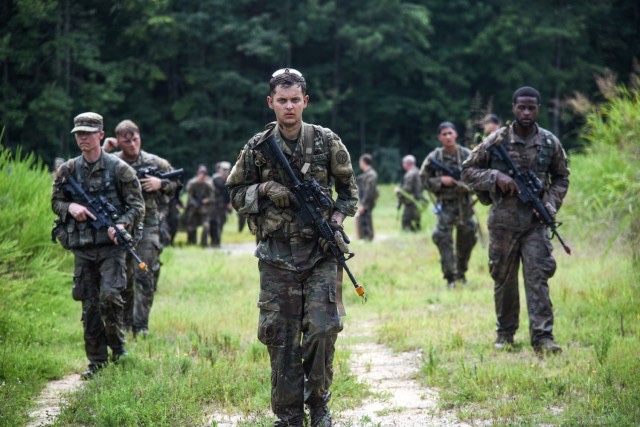
US Special Forces Partner with Bosnian SIPA for Joint Combined Exchange Training

Tuesday, July 4th, 2023

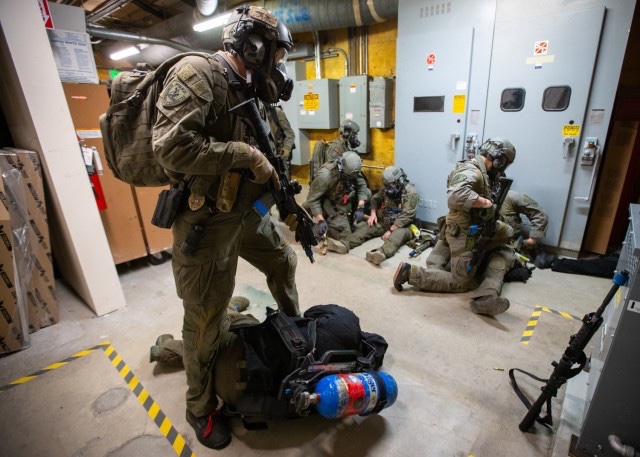
SARAJEVO, Bosnia-Herzegovina — Forty miles southwest of Sarajevo, enemies are holed up in an underground government facility built inside a mountain during the Cold War to protect a former Yugoslav president against nuclear attack.

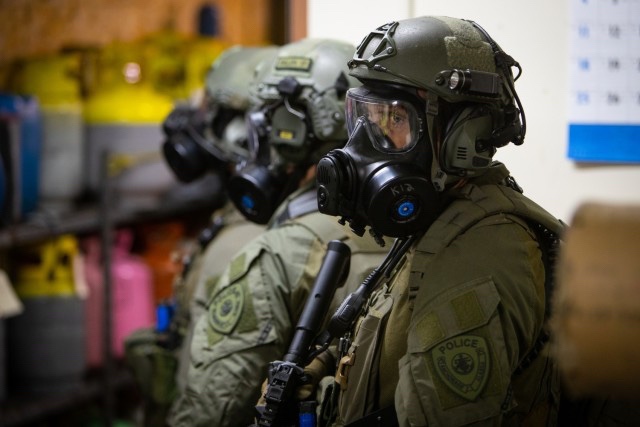
From a Sarajevo compound, U.S. Army Green Berets assigned to the Critical Threats Advisory Company, or CTAC, take off to raid the 70,000-square-foot protective bunker alongside Bosnia-Herzegovina State Investigation and Protection Agency, known as SIPA, officials May 8, 2023.

Three nondescript houses disguise each entrance to the facility. Through the houses and inside the labyrinthine structure, intermittent volleys of gunfire with the enemy reverberate through tunnel corridors. Room by room, the combined force of assaulters systematically clear the protective bunker.

This raid was the culmination exercise of a six-week-long joint combined exchange training focused on close-quarters battle and small unit tactics.

“It was a time-sensitive target, so the planning cycle was condensed,” said the troop leader assigned to CTAC, 10th Special Forces Group (Airborne) — a highly lethal force capable of collaborating with elite special operations forces elements worldwide. “The bunker has small hallways and small rooms … I wanted to raid the bunker to see how the team would react; to see how I would command and control.”

The 100-room structure was selected as a target to test the force’s methods due to its complexity and extensive size.

Providing solutions for the most sensitive problems and succeeding is paramount, said the special support unit executive officer, a SIPA official with over thirty years of police experience. The mission’s challenging location, time constraints and finite resources presented a nightmare scenario that compelled partners to combine efforts, overcome adversity and get results.

The mission succeeded, shortfalls and gaps were identified, and both sides provided recommendations for future reference, said the special support unit executive officer. Experience and lessons learned from the CTAC are valuable resources that will align the special support unit in solving complex problems.

“I do truly believe that the systems were tested that day,” said the CTAC troop leader. “We definitely learned lessons working with a new partner force which is key in refining troop standards. It’s the Green Beret way.”

By SSG Anthony Bryant

The Horse Cav Rides On

Monday, July 3rd, 2023

FORT CAVAZOS, Texas — First Team Troopers have been preserving the traditions of the U.S. Cavalry, performing drills and ceremonies at events locally near Fort Cavazos, or overseas in partner nations for over 50 years.

In 1972 the 1st Cavalry Division Horse Cavalry Detachment was activated. Since then, it has demonstrated its proficiency from the local change of commands to being a part of the Army-Airforce Football game. Capt. Michael Gates, an experienced rider who previously commanded the 11th Armored Cavalry Regiment “Blackhorse” Horse Detachment, recently assumed command of the 1st Cavalry Division detachment.

“They’re putting me through the same training program that all the new Troopers go through,” Michael said. “I want to see how everything works out here because learning how things are done at the 1st Cavalry Division is very important to me.”

When not performing in parades across the pond in the U.K. or exhibiting at local rodeos, the detachment hosts a weekly demonstration every Thursday. Mounted drills from the U.S. Army’s 1883 Manual of Cavalry Tactics are presented to newly arrived Troopers, their families, and others from the local Texas community.

“We came out to see Fort Cavazos and the 1st Cavalry Divisions demonstration,” said Angel Callan, the site director for the Florence Independent School District’s ACE program. “Many of these students don’t get to experience anything like this; we’re trying to expose them to different colleges and careers.”

Detachment Troopers perform other historical duties besides mounted drills, such as creating riding saddles in their leather shop, building and maintaining their Model 1878 supply wagon, and training and caring for their horses and mules.

“I had no prior knowledge of horsemanship or how to do any leather work,” said Spc. Isaac Hernandez, a detachment Trooper, drives the supply wagon and helps make the unit’s leather items. “As soon as the opportunity to join, I jumped on it. This is a great experience to teach me how to ride horses and get me in tune with a different side of the Army.”

The Horse Cavalry Detachment staff is always ready to give a tour so families can visit and see the animals. Troopers are invited to visit the detachment and try out for a position with the First Team’s Horse Cavalry.

“Come give it a shot; you don’t know you’ll love it until you’re out here,” said Gates. “I had zero experience before I joined the Blackhorse team; I fell in love with it head over heels. I just bought my horse, and I will get involved with the cavalry and horsemanship in my free time.”

By SGT Alex Romey

New Mechanized Infantry Combat Vehicle Prototype Contract Awarded to Two Vendors

Thursday, June 29th, 2023

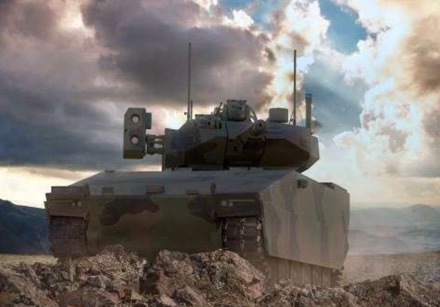
WASHINGTON — The Army’s Optionally Manned Fighting Vehicle program, now redesignated as the XM30 Mechanized Infantry Combat Vehicle, announced June 26 that a contract for prototypes will be awarded to two vendors: General Dynamics Land Systems Inc. and American Rheinmetall Vehicles LLC.

The two vendors will prepare prototypes of a vehicle to replace the M-2 Bradley Infantry Fighting Vehicle, which is a tracked vehicle designed for reconnaissance and provides protection, transportation and small-arms firepower for squad elements. The total award value for both contracts is approximately $1.6 billion.

“The XM30 will replace the Bradley fighting vehicle, bringing new transformational capabilities to the fight; these will include improvements to lethality, Soldier-vehicle survivability, and upgrade ability beyond the physical and economic limits of the Bradley,” said Honorable Douglas R. Bush, assistant secretary of the Army, Acquisition, Logistics and Technology. “The modular open system architecture that the XM30 will allow new building technology to be added to the vehicle as that technology matures, ensuring an overwhelming advantage in any potential adversary competition.”

The OMFV program is part of the Army’s modernization strategy. The Next Generation Combat Vehicle program aims at updating several vehicles and weapons platforms used in the Army today.

Part of advancing and modernizing the Army is seeking out the best designs through competitive contracts.

“Competition remain a vital aspect of the XM30,” Bush said “The program opened the door for industry partners that are not traditional U.S. combat vehicle prime contractors, which allows for increased competition and innovation. This reduced the Army’s risk and increased our likelihood of success while balancing investments across the entire Army modernization enterprise.”

The Bradley first started being used in 1981 and is an infantry fighting vehicle used to transport infantry on the battlefield as well as provide support to dismounted troops. It has been updated over the years but has reached its technological limits.

“In recent years, peer and near-peer competitors of the United States have significantly increased their combat vehicle capabilities. The character of warfare has changed, and our potential adversaries are bringing increased value to the battlefield,” said Brig. Gen. Geoffrey Norman, director of the next generation combat vehicles.

Concerns over the impact to the effectiveness of an outdated vehicle during full-spectrum military operations was what gave rise to the decision to modernize the Bradley.

“The best way to respond is to ensure that our formations are equipped with infantry fighting vehicles, which can bring greater survivability, powerful lethality at standoff range and improved maneuver capabilities to the battlefield,” Norman said.

Even though the XM30 hasn’t yet been designed, several key features have been outlined for the vendors to include in their prototype: two Soldiers to operate and carry capacity for six more, a 50mm cannon and a remote turret, as well as anti-tank guided missiles. Weapons systems on the XM30 will be designed to use the latest in sensor and fire control systems.

The XM30 will also be designed with sustainability and mobility in mind as it will feature a hybrid electric powertrain, which will reduce power consumption, Norman said.

“The occupants will benefit from innovative force protection systems that include integrated active protection systems, kitted armor and innovative signature management capabilities from the very beginning,” Norman said. “All of these advances are being designed with modern digital engineering in a modular, open systems approach that will allow for rapid integration of the latest hardware and software in the future.”

“The XM30 meets the Army’s requirements for a transformational increase in warfighting capability, not simply another incremental improvement over the Bradley fighting vehicle,” Norman said.

A modernization effort is planned to replace the M-113 Armored Personnel Carrier and M-1 Abrams Tank, as well as development of a light tank for infantry brigade combat teams. There are also plans for three versions of robotic combat vehicles.

By SFC Michael Reinsch, Army News Service

Watervliet Forging Ahead with Key Modernization Projects

Monday, June 26th, 2023

WATERVLIET ARSENAL, N.Y. — Leadership at America’s cannon and mortar factory announced plans to replace the arsenal’s rotary forge and paint booth in the coming years as part of a massive 15-year modernization effort.

The new forge and paint booth will increase capacity and quality, and support the trend toward developing longer, more capable artillery and cannons.

“These two modernization projects really capture what we are doing at Watervliet Arsenal. This is the front end and back end of cannon production,” said Col. Alain Fisher, Watervliet Arsenal commander. “We are using new technology in our facilities from the moment raw material enters until the final product is loaded and transported to its ultimate destination: America’s Soldiers, Marines and Airmen.”

To say cannon manufacturing is a specialized skill is an understatement; among the specific processes Watervliet Arsenal uses, none is more iconic than the massive rotary forge. Since it was first installed in 1976, Watervliet’s forge has produced thousands of barrels for every long-range direct and indirect-fire cannon system for the U.S. military and its allied nations. Watervliet currently produces cannons for the M109 Paladin self-propelled howitzer, M1 Abrams tank, M77 lightweight howitzer and AC-130 gunship for the U.S. Air Force.

The idea of replacing aging machines is nothing new at Watervliet; however, the scale and importance of the forge have made the thought of its eventual removal a challenge. All that changed with a renewed interest in long-range precision fires by the U.S. Army and an increase in production since 2019. The answer was simple: To continue fulfilling mission requirements and new capabilities, the rotary forge would need to be replaced.

The project addresses facility and garrison infrastructure upgrades and improvements at Watervliet Arsenal to support a new rotary forge. WVA is evaluating and designing infrastructure support for secondary equipment and processes that support forge operations, including power, HVAC, controls, structural and architectural upgrades, security, telecommunications, process flow, hazardous material testing, fire suppression and alarms, construction phasing and logistics support, equipment laydown area evaluation and other support.

Equally important is the finish coating that all cannon and artillery undergo at Watervliet Arsenal — after all, paint protects the underlying steel from harsh weather conditions, improving the lifespan of a cannon. Watervliet leaders are planning a new modern automated paint booth to support longer cannon and increase quality.

The new paint booth is not only more technologically advanced, but it is also larger, to accommodate longer cannons and allow more cannons to be painted at a time.

The new paint booth includes automation, an upgraded oven, robotic tooling, programmable controls and automatic ambient and climate controls. Supporting this new technology are multiple utility and infrastructure improvements, including HVAC, electrical, fire suppression, gas connections, compressed air, and structural and building repairs. Once complete, WVA will have the capability to paint the larger and heavier components needed to support Army signature modernization projects.

The current paint booth requires protective equipment worn by painters who spray cannons and components by hand. While a skilled painter is effective at this job, automation improves consistency and reduces exposure risks to painters.

“Anytime we can use engineering controls and practices to not only improve our processes and quality but also reduce risks to our employees, it is a win-win,” said Matthew Church, Watervliet Safety and Environmental Division chief. “Removing the human from direct contact with the process allows us to protect the employee’s health without having to replace them with a robot.”

Construction of the new paint booth will begin in fiscal year 2024.

Watervliet Arsenal is an Army-owned and operated manufacturing facility and is the oldest continuously active arsenal in the United States, having begun operations during the War of 1812. Today the arsenal is relied upon by U.S. and allied militaries to produce the highest-tech, highest-powered and most advanced cannons, howitzers and mortar systems.

By Matthew Day

Two US Army Soldiers Win Bronze Medals at Shotgun Skeet Nationals

Thursday, June 22nd, 2023

Spc. Samantha Simonton and Staff Sgt. Hayden Stewart both earned Bronze Medals at the USA Shooting 2023 National Skeet Championships in Hillsdale, Michigan May 17 -22.


SPC Samantha Simonton, a marksmanship instructor/competitive shooter with the U.S. Army Marksmanship Unit Shotgun Team.

The competition pitted the Soldiers from the U.S. Army Marksmanship Unit Shotgun Team against more than 60 top skeet athletes from around the United States, including Olympic medalists.


SSG Hayden Stewart, a marksmanship instructor/competitive shooter with the U.S. Army Marksmanship Unit Shotgun Team.

The Championships required each competitor to shoot 10 qualification rounds of 25 targets before the top six were selected to move forward into a Final.

Simonton, a Gainesville, Georgia native, fired off four perfect rounds of 25 and four near-perfect rounds of 24, ending with a total of 241 hits, which was just one hit less than Austen Smith and Dania Vizzi, the Gold and Silver Medalist, respectively.

Stewart, a Columbia, Tennessee native, impressively completed seven of his 10 qualification rounds perfectly, and the remaining three rounds were very strong, missing only one target per round. The Soldier’s near-perfect total score of 247 hits was unfortunately not enough to win the Gold Medal though since many other competitors were shooting near perfect too, said Stewart.

“That match was brutal. I’ve never seen scores that high in the United States before.”

Stress is typically high at National Championships, but this year there was even more pressure since the competition also served as Olympic Trials (Part 1) for the Paris 2024 Games. Not only that, the scores also determined the teams for the upcoming World Championships, World Cup Italy and Pan American Games. Knowing this, Stewart said he really needed to rely on his training in both shooting and resiliency.

“During my rounds, I was telling myself to trust my training and give every shot 100 percent. The three targets I missed, I knew what I had done wrong and made minor adjustments to hit it next time.”

The adjustments worked and Stewart claimed the Bronze Medal behind civilians Connor Prince and Vincent Hancock, who won the Silver and Gold Medals respectively. With only one point separating the top six athletes, a few shoot-offs were required to determine the medals. During all this intense competition, Stewart said all he could do was focus on his shot process.

“I honestly didn’t know what the scores were until the last round. I was focusing on what I needed to do to hit my next target.”


SPC Samantha Simonton, a marksmanship instructor/competitive shooter with the U.S. Army Marksmanship Unit Shotgun Team.

That focus allowed Stewart to qualify for the U.S. National Skeet Team along with fellow USAMU teammates: Simonton and Staff Sergeants Dustan Taylor, Christian Elliott and Mark Staffen.

The National Championship scores were combined with the 2023 Tucson Selection scores to select both the World Championship and World Cup Italy Teams. Taylor, Elliott and Simonton earned spots on these teams.


SSG Dustan Taylor, a marksmanship instructor/competitive shooter with the U.S. Army Marksmanship Unit Shotgun Team.

Taylor’s score, in combination with past performances, qualified him for the Pan American Skeet Team as well.

Getting five of our six Soldiers on the National Skeet Team was something to be proud of, said Sgt. 1st Class Jeffrery Holguin, the USAMU Shotgun Team Chief who is a 2008 Olympian.

“Staff Sgt. Stewart’s 247 and Staff Sgt. Staffen’s 246 are HUGE scores in Olympic Skeet, especially considering the first two days of the competition were cold, wet and windy.”


The International Shooting Sports Federation Italy World Cup is in Lonato July 8 -17. The ISSF World Championships is in Baku, Azerbaijan August 14 – September 1.

The Pan American Games are in Santiago, Chile October 20 – November 5.

By LTC Michelle Lunato

Army Rolls Out New Army Body Composition Program

Tuesday, June 20th, 2023

WASHINGTON — The Army rolled out its new Army Body Composition Program Monday that outlines a more accurate way to assess Soldiers’ body fat.

At a recent event, Sgt. Maj. Christopher P. Stevens, Army G-1 personnel sergeant major, and Holly McClung, lead researcher for the body composition study at the Army Research Institute of Environmental Medicine, talked about the roll out of the new program in detail.

“For years, we have been committed to reducing body fat across the force. It’s one of the driving factors in supporting the holistic health and fitness program, as well as one of the reasons to request a study on the Army Body Composition Program,” said Sgt. Maj. of the Army Michael A. Grinston in a prepared statement. “As we got feedback from the study, we found there were ways to modernize the ABCP and better uphold the standards established in the regulations. As we implement these policies, performance on the [Army Combat Fitness Test] will increase while body fat decreases at a scale never before seen in our Army.”

The new changes, which also apply to Army National Guard and Army Reserve, replace the older method of measurement with a one-site tape test that is one measurement across the belly button. The previous test had two measurements across the belly and the neck.

“This new tape test requires taping only at one site, and the use of a corresponding calculation model for all Soldiers,” Stevens said. “[The] height and weight screening table remains the first line of assessment so no change to that.”

“From the clinical application in the medical world, a waist circumference, abdominal around your belly button, is linked to long-term health outcomes,” McClung said. “Not only are we looking at the performance of the Soldier today, but the long-term health of the Soldier in years to come within the Army.”

As far as those who are unable to pass, the Army has methods in place that assist Soldiers with a path to a healthier lifestyle and, hopefully, will bring them up to standard.

“We want to help them, we want to put them on a health promotion track, work with some dietitians and some trainers and bring them up to standard,” McClung said. “It’s making sure that we’re helping our Soldiers today, as well as in the long run.”

With the older method, it was found that some Soldiers were passing when they should have failed, and some would fail when they should have passed, McClung said.

“That’s why as a team, the policy working group came up with the three different methods, so that we could pull out those top performers that maybe were failing,” McClung said.

Like the previous test, Soldiers who fail the height and weight will need to take the new standards test. Soldiers who fail the first taping method can use the previous taping method as confirmation until June 12, 2024, as the new method is phased in. After failing those tests, the Soldier will be flagged, which can negatively impact their career.

If the Soldier fails both of those versions of the tape test, they can request, if reasonably available, supplemental assessment with the Dual X-ray Absorptiometry, InBody 770 or Bod Pod. These three devices are an advanced way to measure body fat composition.

“What’s going to stay in place when it comes to profession in the Army Body Composition Program is weight loss,” Stevens said.

These changes were made based on extensive research. The Army-wide study, which the ABCP is based on, was completed earlier this year, and evaluated the effectiveness of the new test on more than 2,600 Soldiers.

“We were hearing a lot from Soldiers in listening sessions and other forums who were concerned with the ACFT,” McClung said. “One of the main outcomes of this study was the first time that the Army has actually linked physical performance to body composition.”

The Army will continue to use the data from the study to make modifications to the program if necessary.

“This new policy will increase the readiness of the force by giving every Soldier a more accurate assessment of their health and fitness,” Stevens said. “The overall focus of the program is to have an effective and accurate assessment of the holistic health and fitness of the force, while at the same time providing Soldiers with the resources they need to improve and preserve individual and unit readiness.”

By SFC Michael Reinsch, Army News Service

Leonardo DRS Awarded $94 Million Contract for Advanced Infrared Weapon Sights for Army Snipers

Friday, June 16th, 2023

ARLINGTON, Va.–Jun. 8, 2023– Leonardo DRS, Inc. (NASDAQ: DRS) announced today that it has received a new contract to produce its next-generation infrared weapon sights for U.S. Army infantry snipers. The firm-fixed-price contract from the Army’s Contracting Command is valued at more than $94 million over five years.

Under the contract, Leonardo DRS will produce the advanced system known as the Family of Weapon Sights – Sniper, Improved Night / Day Observation Device Block III. The advanced infrared weapon sight is designed for sniper or reconnaissance operators that require extended range target detection and identification, observation of environmental indicators, and a capability to track bullet trajectory.

“We are proud to provide this technology to ensure soldiers have the most advanced systems available,” said Jerry Hathaway, senior vice president and general manager of the Leonardo DRS Electro-Optical Infrared Systems business. “We have a long history of supplying the Army with advanced electro-optic and infrared technologies, and this award highlights our customer trust in our market-leading Family of Weapon Sights.”



At the core of the technology is decades of Leonardo DRS experience in the micro-cooled infrared weapon systems field. The Family of Weapon Sights-Sniper employs a passive, micro-cooled, mid-wave infrared technology designed to provide the user with large-format imagery to maximize the effectiveness of the mission.

Underground Soldiers: Army Trains for Operations Below Surface

Thursday, June 15th, 2023

HONOLULU — Beneath the streets of the densely-populated Korean peninsula, U.S. Soldiers donned in heavy gear, traverse South Korea’s dim, underground tunnels.

To better face the daunting challenge of combat in large cities, Soldiers of the 2nd Infantry Division, 8th Army, have taken a step further: learning to move underground in the East Asian nation.

Eighth Army commander Lt. Gen. Bill Burleson said that Soldiers will need to learn how to operate below the surface to avoid sensors and monitoring devices on the ground level.

“When you look at the ability to move underground, in some ways the tunnels are completely unseen by other sensors,” Burleson said during the annual Land Forces Pacific Symposium May 17. “We’ve got to be able to do that and fight in terrain. And in cities, some of that involves tactics and techniques. There’s a leader development aspect to that. There’s a [communications] aspect to that.”

Four known underground tunnels exist in the 150-mile demilitarized zone between North and South Korea in the peninsula’s center.

U.S. Soldiers from the 2nd ID and the Republic of Korea have built subterranean training facilities to prepare for conflict in cities. The partner nations engaged Exercise Warrior Shield in March 2023 to strengthen US and ROK collaboration across all domains while improving tactics and procedures. The combined forces also conducted air assault and ground forces operations.

During Warrior Shield, Soldiers from 2nd Brigade, 2nd Infantry Division simulated breaching the entrances of underground buildings.

“They have actually acquired some material solutions to operate underground better without constraints,” Burleson said. “That will allow them to operate in underground facilities … and we know there’s facilities under North Korea that we’ve got to be prepared for should conflict come.”

The headquarters of 8th Army at Camp Humphreys, South Korea sits 40 miles outside of Seoul, a city of 10 million, where the most efficient form of travel lies underground in the city’s subway systems. To prepare for possible conflict, Burleson said Soldiers must become proficient in subterranean operations through training.

“Without degradation, they’d be able to evacuate casualties [and] be able to see, sense and communicate effectively,” he said.

Army Training and Doctrine Command adopted urban warfare training into its training centers, as the Army shifts from anti-insurgency operations to large-scale ground combat. “Increased urbanization is unavoidable,” Burleson said. “Conflict in urban areas is unavoidable. Although warfare has evolved, we’ve just got to accept the fact that there’s more to be done if we want to be prepared.”

Burleson said the shift to urban combat has become more apparent during the Ukraine-Russian conflict where the enemy combatants have fought in city settings. He added that the Army and U.S. forces must develop capabilities across multiple domains including communications functioning effectively in a cyber and electronic space.

“My question is, are we ready for the strategic shock of fighting in a mega city?” Burleson said. “We’ve [said] for a long time, avoid fighting in cities … The avoidance idea may no longer be possible.”

Burleson added that in cities, U.S. Soldiers will have to learn to operate in tight spaces and battle with precision weapons while considering the danger of using weapons near a civilian population. Retired Army Maj. Gen. Laura Yeager, former commander of the National Guard’s 40th Infantry Division, added that U.S. forces must adapt to the unique conditions of combat in large cities.

“You might have to use fires but you’re going to want to understand what those weapons’ systems’ effects are on the urban environment,” she said. “They may not have the effect that you expect.”

She said that in urban environments, aircraft such as helicopters will be more vulnerable to small arms fire as well as have limited places to land. She added that military leaders must make other considerations, such as enlisting the help of law enforcement and civic agencies.

Burleson said that the commitment to planning for combat in urban zones requires collaboration and interoperability achieved through exercises like Warrior Shield.

If forces do not prepare themselves, U.S. Soldiers and their allies may risk repeating history such as during the Battle of Osan on July 5, 1950. A North Korean Army had already captured Seoul from the South Korean military. Poorly-equipped and unprepared U.S. forces suffered heavy casualties during the fight.

“We’ve got to have willing commitment to prepare and be ready,” Burleson said. “Otherwise, we’re going find ourselves where we were on the fifth of July, 1950. We must be ready.”

By Joe Lacdan, Army News Service