GORE-TEX Professional

Archive for the ‘Army’ Category

11th ACR’s Mastery of Maneuver Warfare Informs Future Prototype Development

Friday, December 9th, 2022

FORT IRWIN, Calif. — The 11th Armored Cavalry Regiment frequently functions as an opposing force, providing a realistic training environment for service members participating in exercises at Fort Irwin’s expansive National Training Center.


Last month, however, select Soldiers from the regiment had the opportunity to serve in a different and very unique role — that of a future warfighter.

Equipped with prototype wearables, next-generation drones and specialized knowledge of maneuver warfare, the Soldiers lent their time and insights to support Project Convergence 22, an experiment designed by the Army to illuminate the benefits and challenges new technologies could bring to tomorrow’s battlefields.

“It’s cool that we’re shaping the future of the Army,” said Sgt. Austin Gazaway.

Gazaway saw value in conducting future force experimentation alongside major allies — an effort he viewed as helping to “open up transparency” about emerging capabilities and warfighting systems.

Sgt. Calvin Robinson also enjoyed taking part in operational scenarios created specifically to field-test new technologies.

“I feel like the PC22 event went really well,” he said. “It was a good opportunity to see what the Army is possibly deciding to give future Soldiers.”

Gazaway, Robinson and other 11th ACR Soldiers, many of whom had not previously participated in dedicated Army innovation efforts, spent seven days in early November assessing the effectiveness of equipment such as the Enhanced Night Vision Goggle – Binocular, or ENVG-B; the Integrated Visual Augmentation System, or IVAS; and the ExoBoot.

“Going from old to new, to high-powered technology, it’s pretty nice,” said Spc. Ian Campbell.

Campbell felt the ENVG-B’s dual scopes performed better than a more traditional single scope night vision goggle.

“I thought it was really helpful to keep track of my team and to see where my guys are,” he said. “I think overall it improved our team’s lethality.”

For many of the Soldiers, using the still-in-development technology took some getting used to. Several experiment participants noted that the IVAS and ExoBoot still had “some kinks” to work through, but that they looked forward to seeing how the Army would incorporate their feedback into future iterations of the apparatuses.

“The fact that they gave us a chance to actually use some of the products is a really good thing, I feel like,” Robinson said.

Robinson added that the 11th ACR’s familiarity with the terrain at the National Training Center, which encompasses more than 1,000 square miles, helped ensure the technology received a rigorous and authentic evaluation.

Following completion of the experiment, the overall consensus among 11th ACR Soldiers interviewed was that the Army’s new approaches to enhancing Soldier Lethality were promising.

“I feel like it will make a lot of stuff easier,” Gazaway said.

He additionally reflected on how Soldiers in the past likely thought certain equipment that the Army uses today was “weird” or awkward when first introduced, but that adjustments to new operating tools and methods are a natural and necessary aspect of change.

“The future just keeps moving forward.”

Campbell agreed.

“At some point, it will just become the new normal.”

By Maureena Thompson, Army Futures Command

Textron Systems Wins $162 Million Close Terrain Shaping Obstacle Increment 1 Contract

Thursday, December 8th, 2022

Award Supports Modernization of U.S. Army’s Terrain Shaping Capabilities

WILMINGTON, MA/December 5, 2022 – Textron Systems Corporation, a Textron Inc. (NYSE: TXT) company, announced today that it received a five-year contract valued at $162 million from the U.S. Army Contracting Command – New Jersey, in connection with the U.S. Army Project Manager Close Combat Systems, to develop a remote command and control capable, anti-vehicle precision munition system that supports the Army’s terrain shaping operations modernization program.

Textron Systems will design an advanced anti-vehicle, soldier-in-the-loop munition system to support the Close Terrain Shaping Obstacle (CTSO) Increment 1 Common Anti-Vehicle Munition Based Top Attack System. CTSO Increment 1 fulfills a U.S. Army directive to replace obsolete munitions with next-generation technology that enables soldiers to effectively conduct terrain-shaping operations against peer threats. CTSO Increment 1 is the first of three increments of increased capabilities in the U.S. Army’s plans to modernize terrain shaping operations.

“We are committed to supporting the soldier by giving them technology that increases their combat advantage, and by keeping the soldier in the loop we give them even more control,” said Henry Finneral, Senior Vice President, Weapon Systems. “This munition will increase tactical protection for our troops who are facing increasingly sophisticated enemies. For the adversaries and the types of conflicts we see emerging, this will represent a true next-generation anti-vehicle weapon.”

The munition developed for Increment 1 will have stand-off and top attack capabilities designed to support complex terrain shaping operations by denying enemy armored vehicles freedom to maneuver. The system will be rapidly emplaced and highly portable, and will be designed to be employed alone, in multiples or in tandem with other terrain shaping systems.

Over a five-year period of performance, Textron Systems will develop the CTSO Increment 1 design, conduct contractor qualification testing and deliver hardware in support of government qualification testing. Capabilities will include increased effectiveness over legacy systems, mission planning tools, a remote-control station that enables constant soldier-in-the-loop control, and the ability to turn the munition on-and-off on command. CTSO Increment 1 allows an operator to control multiple systems and have improved sensing and reporting capabilities. The munition may be rapidly emplaced, is recoverable, and is non-persistent.

www.textronsystems.com

Editor’s Note: These US Army images depict their operating concept for a Top Attack Munition as well as the hand emplaced XM204 munition manufactured by Textron.

Army Accepts Delivery of First Prototype Mid-Range Capability Battery

Thursday, December 8th, 2022

Middle River, MD. – The US Army accepted delivery of the first prototype Mid-Range Capability (MRC) battery. The MRC provides a land-based, ground-launched system with a range between the Army’s Precision Strike Missile and the Long-Range Hypersonic Weapon.

Building from existing US Navy missile and launcher systems, the MRC provides a fires capability that has not existed in the US Army since the implementation of the Intermediate Nuclear Forces (INF) treaty in 1987. Answering the call to the Army’s No. 1 modernization priority, Long-Range Precision Fires, the MRC can defeat a variety of mid-range targets.

“The MRC rapidly progressed from a blank piece of paper in July 2020, to the Soldiers’ hands in just over two years. The RCCTO team, as well as our joint service and industry partners, delivered this hardware so Soldiers can begin training as quickly as possible,” said Lt. Gen. Robert Rasch, Director of the Army Rapid Capabilities and Critical Technologies Office (RCCTO).

Initial hardware delivery occurred with ongoing support planned through December 2022 in preparation for training to begin after the holidays. The delivery includes a complete MRC ground equipment and reload capability, which comprises a battery operations center, four launchers, prime movers, and modified trailers.

The MRC achieves operational capability in fiscal year 2023 upon completion of system testing, training, and delivery of the missiles. Delivering the ground hardware first allows the Soldiers to train on the equipment, create doctrine for the system, and develop tactics, techniques, and procedures.

The MRC Project Office works closely with the Soldiers and Sailors who benefit from this system via embedded Soldier-Sailor Centered Design Events. These events provided critical user feedback throughout the design process and ensured Soldiers and Sailors were at the center of this effort.

In executing the mid-range fires system and testing, the Army continues to work in close coordination with its joint service and agency partners.

By Venetia Gonzales

Editor’s note: These DoD image depict the anticipated MRO capability using the RIM-174 Standard Extended Range Active Missile (ERAM), or Standard Missile 6 (SM-6) currently in service with the US Navy.

US Army Selects Textron’s Bell V-280 Valor as Future Long-Range Assault Aircraft

Tuesday, December 6th, 2022

Textron’s Bell V-280 Valor tilt-rotor has been selected by the US Army as its Future Long-Range Assault Aircraft to eventually replace the Blackhawk fleet of helicopters.

Due to the tilt-rotor design the V-280 can fly at up to 280 knots with a combat range of up to 800 nm. It also carries more troops and cargo, with up to 14 troops and a max takeoff weight of over 30,000 lbs compared to 9 passengers and 22,000 lbs for the UH-60M.

The initial contract award is for $232 million but could be worth as much as $70 billion.

There will be an initial 19 month period of additional development and testing with a goal of fielding beginning in 2030.

The Army plans to initially buy 750 to 1,000 FLRAA examples and operate a mix of Blackhawks and Valors for decades. For those shocked by the decision to continue to use the Blackhawk, please remember that the Air Force has just begun to phase out it’s UH-1 Hueys that began service in the 1960s and the Marines have just completed an upgrade with their UH-1Y Venom.

Security Force Assistance Primer

Saturday, December 3rd, 2022

Since 2018, the Army has fielded six purpose-built security force assistance brigades (SFABs) to advise or train with vetted foreign security forces so Army brigade combat teams could focus their training and readiness to participate in large-scale combat operations.

Most of the security force assistance (SFA) planners and practitioners interviewed for this SFA primer publication agree that the authorities to conduct SFA are inconsistent with current SFA activities conducted in several countries around the world.

A general lack of understanding on how these activities are funded has led to inefficient SFAB use. This primer explores current SFA literature to determine if the doctrine is accurate, understandable, and consistent with other doctrine or if further doctrine revisions are required.

The intent of this primer is to review how the Army provides trained and ready SFA capabilities for combatant commands’ (CCMDs’) security cooperation (SC) programs and related activities coordinated through their theater armies.

The principal audience for this primer is theater army SC planners, division and brigade leaders and staffs, and Soldiers assigned or attached as advisors to brigades that execute SFA missions or echelons above brigade accomplishing the same missions.

Read Full Document:

23-02 (703)_Security Force Assistance Primer (Nov 22) (Public).pdf [PDF – 2.3 MB]

Visit Our Website:

www.army.mil/CALL

CALL Restricted Site

call2.army.mil

By Center for Army Lessons Learned

US Army Completes Fielding of Short Range Reconnaissance System

Friday, December 2nd, 2022

REDSTONE ARSENAL, Ala. — The Soldier Unmanned Aircraft Systems (UAS) Product Office successfully completed fielding of the RQ-28A, Short Range Reconnaissance (SRR) system to the 3rd Battalion, 75th Ranger Regiment at Fort Benning, GA, in early November.

The Skydio RQ-28A is the Army’s first program of record quadcopter. It is a new and disruptive organic capability that is fielded to the platoon echelon in the form of a portable rucksack Vertical Take Off and Lift, small, unmanned aircraft. It provides Warfighters with enhanced situational awareness and a standoff capability in urban and complex terrain, enabling accurate reconnaissance and surveillance of targets of interest. It can be used to conduct surveillance during routine combat operations.

During the new equipment fielding and new equipment training, UAS project office leaders, along with crucial personnel from the SUAS offices, traveled to Fort Benning to participate in the final day of training with the Soldiers and engage critical stakeholders.

“It’s very intuitive with great obstacle avoidance, additionally the thermal is better than expected.” Said Staff Sgt. Adam McDevitt the UAS section platoon sergeant. “I can’t wait to use this on full mission profiles to see what it can really do.”

“The SRR RQ-28A capability will provide game-changing technology to Army platoons, enhancing both Soldier lethality and survivability” said Carson L. Wakefield, product lead for Soldier Unmanned Aircraft Systems. “It is a new capability for the Army, and I am so proud of my team for delivering an innovative solution in just under three years from prototype to delivery.”

The quadcopter system weighs less than five pounds, can be carried and stowed in a transport case and is rucksack portable. It has vertical take-off and landing, hover, perch and stare capabilities. The system is hand launched and capable of being recovered within confined areas.

The Soldier UAS Product Office is scheduled to field 480 systems across the Army in 2023 with a total of 1,083 delivered during low-rate initial production systems through the second quarter of F25.

The RQ-28A is the first tranche of the SRR program and delivers a much-needed capability to Soldiers. Tranche 2 will include a prototyping effort and will include threshold requirements and multiple performance objectives.

By David Hylton

War Hero Recounts Lives Saved in Afghanistan

Wednesday, November 30th, 2022

FORT LEAVENWORTH, Kan. — Sitting inside one of the many buildings around Fort Leavenworth that belong to the Mission Command Training Program, is Sgt. Maj. Antonio Gonzalez. He an ardent believer in the Army values and by all definition, a war hero. His actions in Afghanistan in 2007 would result in the Silver Star, the third-highest award for valor in the U.S. Army.

Gonzalez grew up in Boyel Heights in East Los Angeles, an area known for drug and gang wars and also high unemployment.

“Despite what was happening where I grew up, I met some outstanding friends at Bishop Mora Salesian High School,” said Gonzalez. “I graduated in 1987 and to this day, I still keep in touch with them. That’s the loyalty we have within that bond.”

Sports were also an escape for him.

“I grew up loving the Raiders, Dodgers, Magic Johnson and the [Showtime-era] Lakers, Kirk Gibson hitting that home run in the World Series, all of that,” he said.

His passion and skill in sports eventually led him to a football scholarship at Kansas State University playing for Bill Snyder, who won more than 200 games in his college football coaching career.

After his playing days ended and he earned his college degree in 1994, Gonzalez walked into an Army recruiter’s office in 1996, following through on his desire since childhood to serve in the military.

“The recruiter was a little surprised when I walked in,” said Gonzalez. “I was like ‘you don’t have to give me a whole speech, you don’t have to sell me on anything, I want to be an infantryman, where do I sign?’ I wanted to serve my country. I wanted to be out there in the woods, shooting guns and all that good stuff that comes with being an infantryman in the Army.”

Gonzalez said he came into the recruiter’s office so abruptly they asked if he was running from the police.

“I had grown up in a community where a lot of folks joined the military and it was something I had always wanted to do, I just wanted to get my education first,” said Gonzalez.

In 1996, Gonzalez arrived at Fort Campbell, Kentucky, his first duty station. Six years later he went to try out for Special Forces, eventually joined the 7th Special Forces Group out of Fort Bragg, North Carolina. Now a member of the Green Berets, Gonzalez trained, advised and assisted numerous times in South and Central America.

Like many in the combat arms and special forces community, there were multiple deployments to Afghanistan during two decades of war. The events of June 11, 2007, remain clear in Gonzalez’s head like it just happened.

At the time, Gonzalez was part of the Special Forces Operational Detachment Alpha 732. He and the others were ambushed by Taliban fighters following a routine patrol in the Uruzgan Province. Throughout the fight, he exposed himself to Taliban snipers and machine gunners three times, eventually saving the lives of four Afghan security forces that had been trapped. Gonzalez almost died in the process.

“A sniper bullet just whispered right by my head,” he said. “I could have kissed it, that’s how close it was. But if I had to do it again, I would. That’s just the type of person I am. Loyalty is one of the Army values. You have that in sports as well, the whole team concept. You don’t want to be the reason why the other team scored a touchdown and you lost the game. In war or combat, you don’t want to be the reason why your teammates are shot or killed.”

The Special Forces motto is “De Oppreso Liber” which translates from Latin as “to free the oppressed.”

“That’s truly what I felt we were doing over there,” said Gonzalez. “They were being oppressed by the Taliban and all these enemy folks and you just know innocent people are being killed when they were just trying to live their lives. In the states, you see kids running around and you see the kids in Afghanistan, they can’t even be kids because they’re being oppressed. It makes you appreciate it more when you come back to the states, so you hug your kids a little tighter and a little longer and you tell them you love them.”

Gonzalez had another brush with death in 2013 when he received news that his son, serving in the Army himself as a combat medic specialist, has been injured in combat and almost died in Afghanistan.

“I literally could not move when I received that call, “said Gonzalez. “I was paralyzed and scared for my son but thank God he eventually recovered.”

As he approaches 30 years in uniform, there is another event in his career that continues to shape him to this day. One he must hold back tears when talking about.

“There was a guy, Travis, who was on my team, just a good person and his parents are beautiful human beings, and Travis was killed in Afghanistan by an improvised explosive device on a deployment before the one I received the Silver Star for,” he said. “When I made the rank of master sergeant and then I was a team sergeant, I told myself that if you’re on my team, no one is going to die on my watch. When we came back from Afghanistan, the wives thanked me for bringing their husbands home.”

Gonzalez added that Travis Hunsberger was an “18E,” a Special Forces Communications Sergeant on ODA 732, and he is the real hero.

“He sacrificed it all,” said Gonzalez. “Some gave some, but he gave all. He is the hero along with all of our fallen heroes. I’m no hero compared to them.”

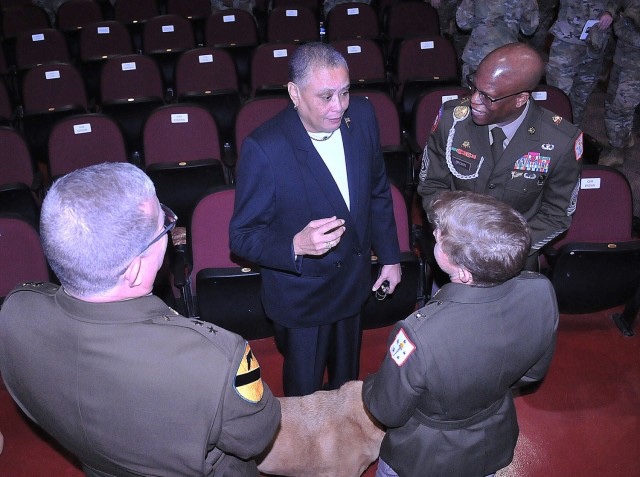
Gonzalez’s two-decade-plus military career has gone full circle as he finished out his undergraduate degree serving an internship at the United States Penitentiary, Leavenworth. These days, Gonzalez is the operations sergeant major for Mission Command Training Program. He oversees administrative requirements for Soldiers in the unit, not a combat role but still making sure Soldiers and their families are taken care of.

“I met a lot of great people in this business and if I was to change any of it, I would never have met those great people because the good people that I have met outweigh the bad.”

He credits his parents and his wife Alyson for supporting him through the highs and lows.

“I have to thank my parents for sacrificing everything for us and raising us with love and discipline,” said Gonzalez. “They encouraged us to always strive to do better and give it 100% every time. Always respect others and especially your elders. I’m the oldest of four boys and we all are doing well because of our parents.”

“My wife Alyson has been my bedrock and support pillar. She is a school counselor at Edgerton Elementary and I guess she tends to give me some counseling from time to time. We both graduated from Kansas State and love being alumni and continuing to support the school.”

Gonzalez was honored before a September 2022 football game at the university. He was awarded the Medal of Military Excellence and a President Emeritus Myers coin. The university’s president, Dr. Richard Linton, presented the awards to Gonzalez to recognize his Army career.

“I’ve been most proud of what Tony has done since leaving Kansas State University and getting invested in the service, and it just goes along with his nature and wanting to do what is right and provide guidance for his fellow teammates and his country,” said coach Snyder in an interview before the game.

By Russell Toof, Fort Leavenworth

Old Ironsides!

Monday, November 28th, 2022

The uniforms for the Army vs. Navy game have been unveiled and are inspired by the 1st Armored Division and the 80th anniversary of Operation Torch.

#GoArmyBeatNavy

Photos by Army West Point Athletics