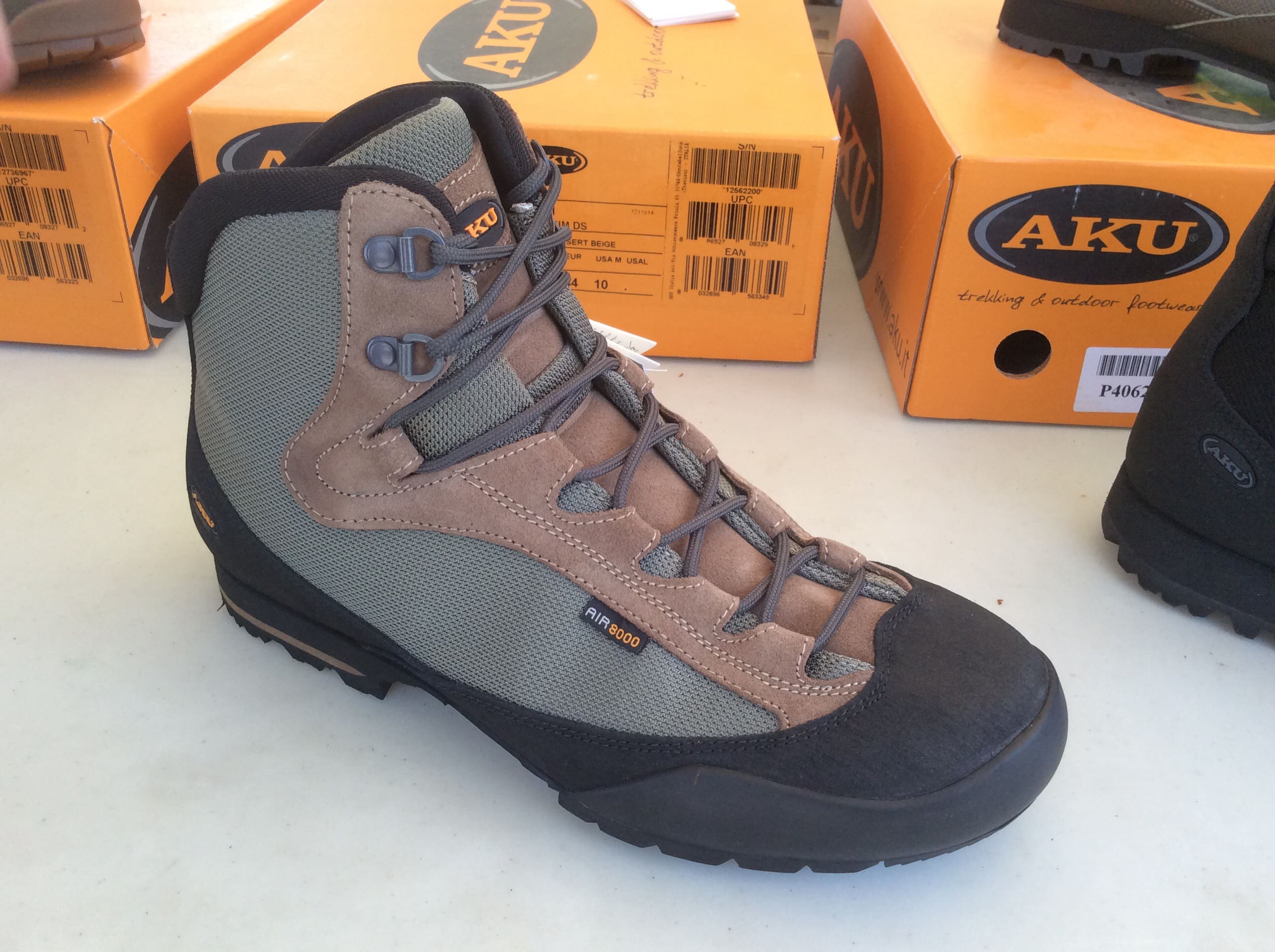
The Aku NS564 Bosco has been a great militarized trekking shoe for the last decade. Unfortunately, supply here in North America has been difficult. Today I met up with the North American distributor. In addition to Rampart International in Canada, they are available in the U.S. Through Procurement Specialists.
Above, is the NS564 Spider. It’s a slight modification to the classic model (which is still available), adding a rubber rand along the edge of the toe in order to counter wear. The NS564 family has a tighter toe box than Aku’s Pilgrim models which were introduced a couple of years ago. This is because of their use as an approach or urban climbing boot.
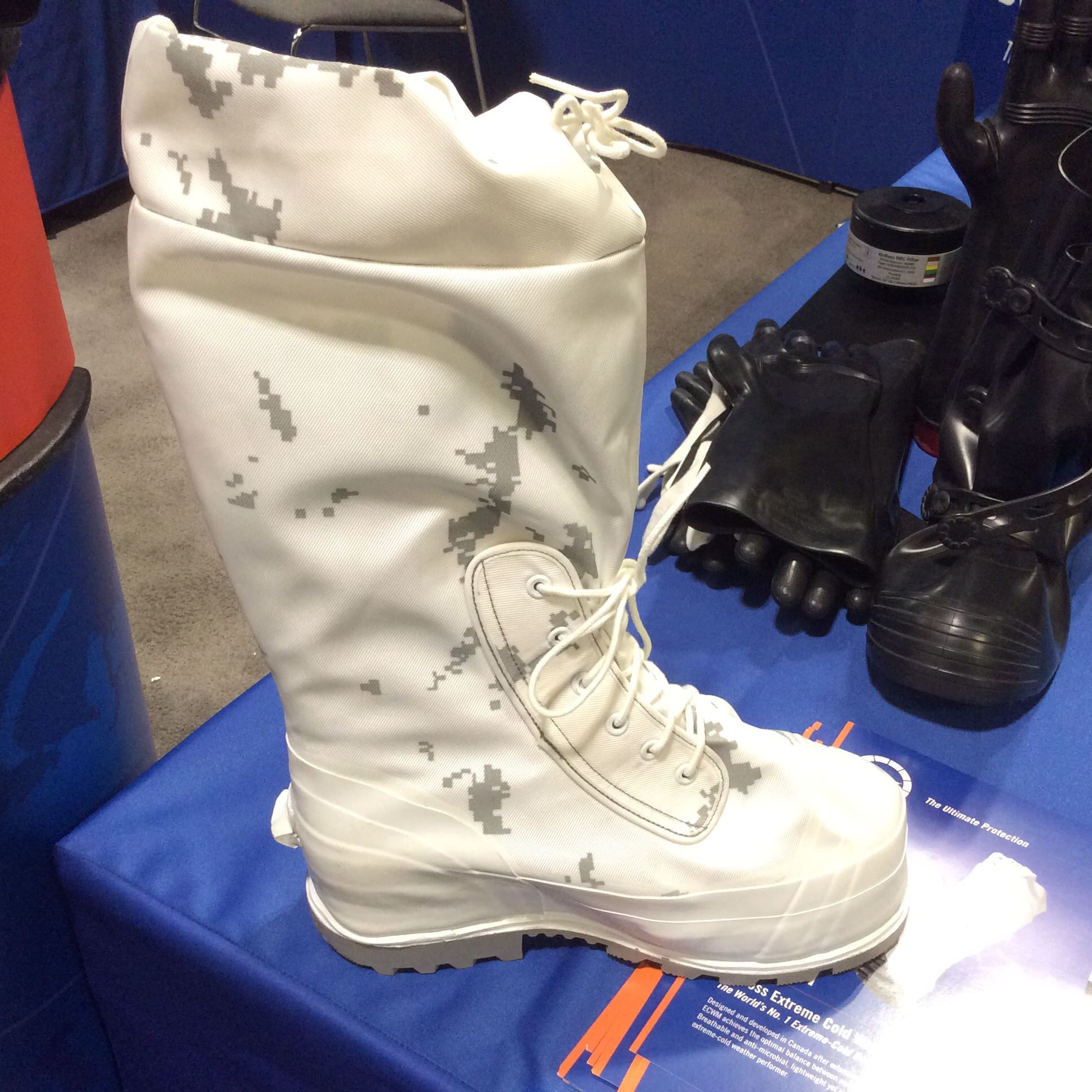
The current U.S. Issue Vapor Barrier Boot is very labor intensive to produce and can currently only be made by a single factory in Canada. It so happens that the firm that can produce the VB boot, AirBoss Defense, also makes the Candian Forces Extreme Cold Weather Mukluk. This Mukluk protects the feet to the same temperature as the VB Boot (0 to -55 Deg C) is lighter weight, features a removable liner and insoles and is also taller.
The U.S. Army Natick Soldier Research Development and Engineering Center, in support of Product Manager Soldier Clothing and Individual Equipment issued a Sources Sought Notice last week seeking informtion on ventilating insoles for combat boots. The goal of this effort is to identify offerors with capabilities to provide/design/develop boot insoles for use by the combat Soldier in various different terrain and conditions, to include tropical jungle environments.
Specifically, the insoles must:
1) Be constructed of materials that do not absorb water;
2) Be designed to allow water and sweat to drain away from the foot while walking;
3) Be highly breathable, to allow for air to circulate under the foot when worn;
4) Be durable enough to last for six months of combat use in jungle environments where high humidity and repeated submersion in water are expected;
5) Must not cause pressure points, discomfort, or irritation during walking/running on uneven, rugged terrain throughout the useful life of the item;
6) Be rigid enough to resist moving or bunching under the foot;
7) Be able to not interfere with normal walking/running or reduce Soldier performance in movement through varied terrain;
8) Be resistant to degradation due to fungus and bacteria;
9) Be able to provide shock attenuation;
10) Do not require a break-in period; and
11) Must meet all requirements of Berry compliant manufacturing.
Well no kidding. It only took them a year after they released an RFI for jungle boots that it finally dawns on them that they might need ventilating insoles. PEO Soldier has at its disposal the entire technical and historical holdings of the Natick Research, Development and Engineering Center but it seems as if no one wants to find out how a requirement was satisfied in the past. It’s been done before. Hit the books to find out how.
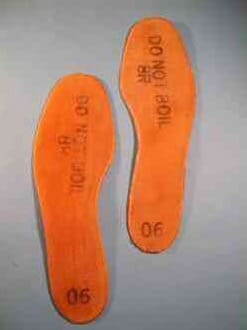
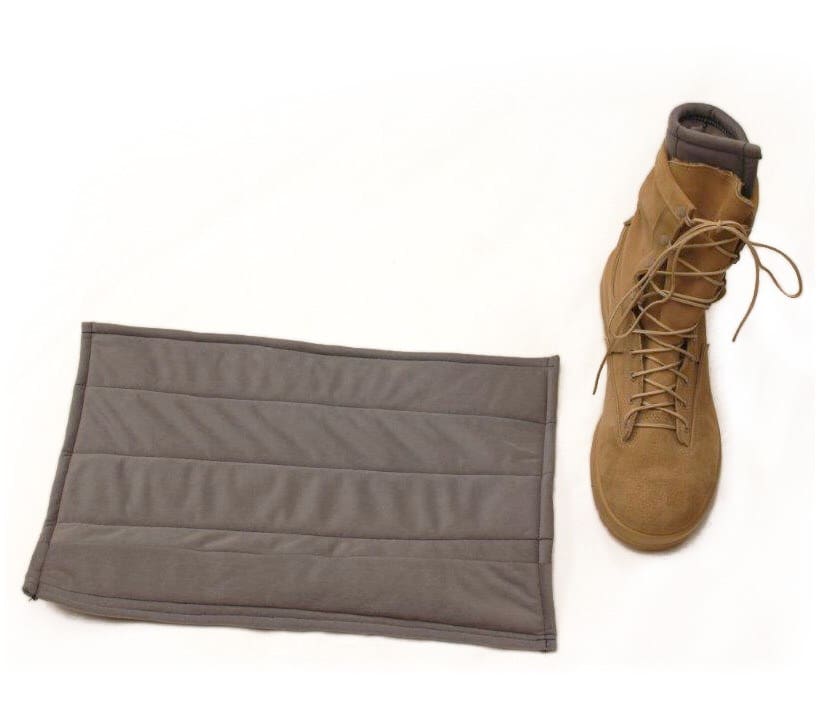
For those of you unfamiliar with the Saran Insole issued with the Boot, Hot Weather, it looked just like what you see above. It was designed to keep your foot up off of the floor of the boot and allow some air to circulate in hopes of staving off trench foot.
When you think of Wiggy’s, you generally think of sleeping bags. But, that’s not all Jerry Wigutow does. His latest product is an inexpensive shoe drier.
While it can be used to dry almost anything, this “Shoe Drier” utilizes a viscose rayon fiber batting core to absorb moisture from your boots or other items in a similar fashion to stuffing your wet shoes with newspaper. Wiggy claims there is no known shelf life for this item and that it can be used indefinitely including field use so long as you dry it out each day. It can also be thrown in a standard dryer.
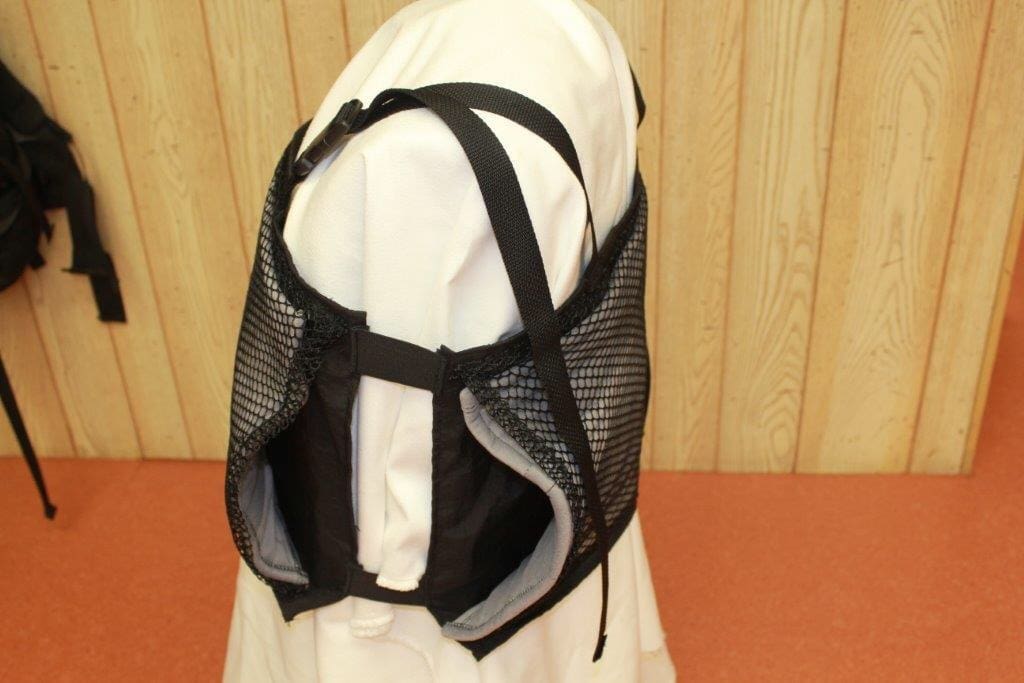
For use in extremely wet or cold environments, Wiggy’s also offers a vest which can be worn below overgarments. You place the Shoe Drier in the vest in order to dry it with body heat.
Tacprogear is now the Military and tactical distributor for LALO Footwear. The full release can be read below:
LALO Footwear becomes the official footwear of Tacprogear.
Boynton Beach, Fla. (March 2015) – Tacprogear, a leading manufacturer of tactical equipment used by professionals around the globe, is pleased to announce that it has become the military and tactical distributor for LALO Footwear. Additionally, LALO has become the official footwear of Tacprogear.
“We are very excited about becoming the exclusive distributor for LALO Footwear to the military and tactical markets,” remarked TPG CEO Dan Lounsbury. “Our company missions and beliefs are very similar so this was a natural fit. Top tier materials designed with invaluable feedback from Elite Operators creates a top notch product that we are proud to offer through our website.”

LALO makes uncommon gear for the common man and woman, making the most technologically advanced products for the military and beyond. LALO Footwear is Navy SEAL field tested and approved. Their creations come from the minds of current and former special warfare operatives, as well as a team of award-winning designers and developers that have been creating innovative footwear for some of the world’s most popular brands for over 30 years.

“We are very pleased to partner with TPG to distribute LALO products via their sales channels, servicing their customer base. Together with TPG we can focus on delivering world class products and impeccable customer service to the market,” commented LALO CEO Jay Taylor.
TPG carries the following LALO Footwear styles on its website:
– Bloodbird (available in Black Ops, Desert, Jungle)
– Grinder (available in Black Ops, Desert, Jungle, Night Vision)
– Zodiac Recon (available in Black Ops, Desert, Night Vision)
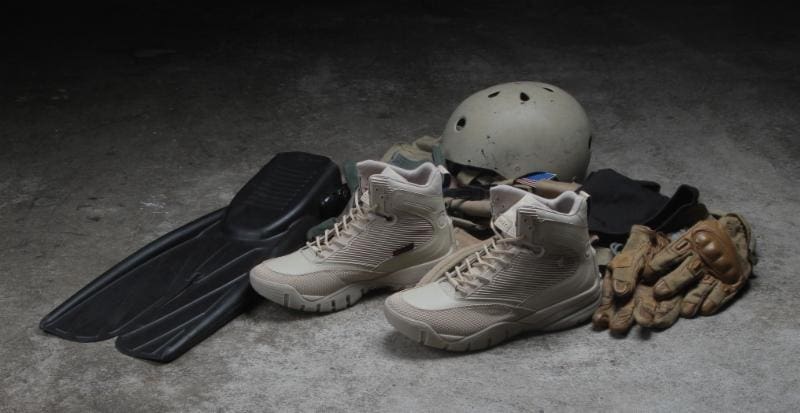
– Shadow Intruder Tactical Boot (available in Desert Tan and Black Ops)
– Shadow Amphibian Tactical Boot (available in Desert Tan and Black Ops)
MSRP ranges from $117 to $315. The full selection can be found on TPG’s website.

Word on the street is that the Army has postponed the Uniform Quality Control Program for boots planned for this Spring. The program has raised numerous questions from industry regarding how it would be implemented which resulted in hesitation in manufacturing Coyote Brown boots for the upcoming transition to the Operational Camouflage Pattern this Summer.

Had it gone on as planned, there would have been few footwear options available along with the new version of the ACU because no one wanted to be stuck with a warehouse full of uncertified boots. While issue boots are being procured through the Defense Logistics Agency, footwear manufacturers were waiting to begin making commercial options until after UQCP had completed its process. As it is, the delays caused by UQCP will most assuredly result in boot shortages during the initial transition as boot builders remain skeptical.
What’s more, it’s “caveat emptor” since there’s no guarantee the Coyote colored boots you purchase will eventually receive UQCP certification, nor that you’ll be allowed to wear them. Even though a boot model might earn UQCP certification, it’s still up to the chain of command whether it can be worn. The best bet is to look for boots that are AR 670-1 compliant and hope that your CoC will allow you to wear them.
The delay is currently estimated to be six to eight months but they plan to take it back up once the transition to OCP is under way.
Last June, SSD flew to Chamonix, France to cover the unveiling of the Arc’teryx footwear line. Unlike anything we’ve seen before, the line consists of two basic types (Acrux = Low cut and Bora = Mid cut) made into eight shoe models with five for men and three for women. Now, they are available for order.
The key to the technology is ‘Arc’teryx Adaptive Fit’ (pronounced A squared): the combination of a stretchable liner and single-piece, seamless laminated outer shell that are manufactured separately but worn together for improved comfort, climate management and durability. In several models, these liners are removable. The upper is no slouch either. The construction contains no leather and is made up of a laminate consisting of:
• a non-woven DWR-treated microfiber for smooth internal surface
• a textile woven with PU coated Nylon yarn for air flow and abrasion resistance
• 0,2 mm TPU film build integral upper support
• 0,35 mm high abrasion TPU film reinforcement on more exposed areas
Once again, I want to remind everyone that these are not a LEAF product but rather a commercial Arc’teryx offering. Having said that, many LEAF customers are going to want these, particularly as they are available in generally subdued colors. However, these are NOT garrison boots and are very much boots meant for the trail and field.
Initially, the low top Acrux models were referred to as Alpha, so if you read my earlier stories, keep that in mind. The Mid height Bora continues to retain the same name. The Bora² Mid GTX Hiking Boot is available in Black with removable Cajun-colored stretch GORE-TEX liner although the insulated liner isn’t out yet. In addition to the removable boot liner, it also incorporates a Vibram sole made from the new Megagrip compound. Working in concert with the outsole, three-dimensional rubber components (individually shaped for every size available) protect heel and toe area from rock contact. Finally, an Ortholite-insole rounds up the outer shoe construction.
I’ve been wearing a pair of Acrux FL for several months. My pair is the unlined model, mesh and I find them quite comfortable, with the feeling of an approach shoe, meaning the sole is somewhat stiff. I’ve hiked quite a bit in them with no issues. As you can see, I even wore them without socks. With any show built on a European last, I recommend that you up up 1/2 size. That’s what I did and I have a good fit. Also, when you order these, if you are in the US, they will show you a US size on the product page but when you get into the shopping cart, they will revert back to UK sizing which is 1/2 size smaller than US sizes. Don’t be alarmed.