GORE-TEX Professional

Archive for the ‘C-UAS’ Category

11th Airborne Division Conducts Groundbreaking UAS Experimentation in Alaska

Thursday, November 27th, 2025

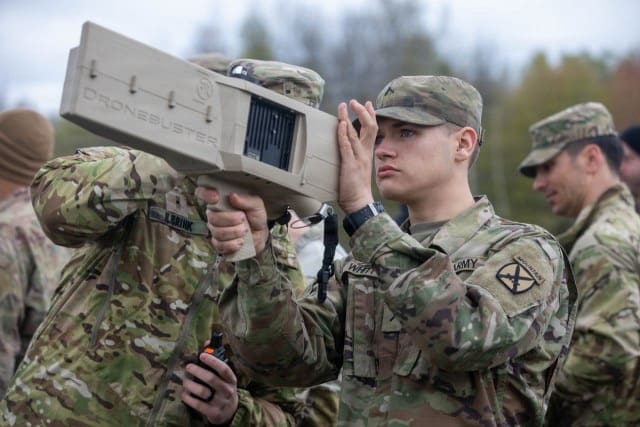
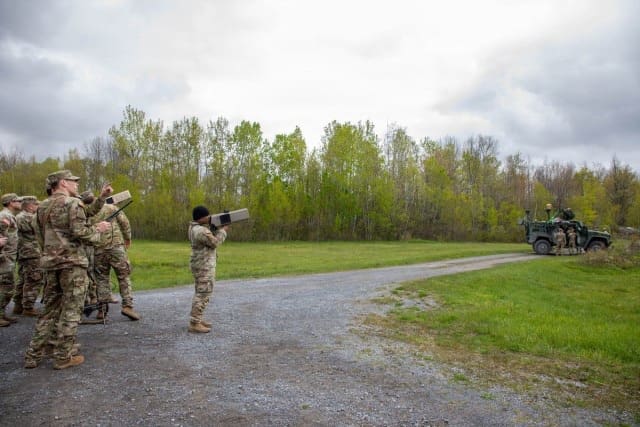
FORT WAINWRIGHT, Alaska – The 11th Airborne Division recently conducted a groundbreaking electromagnetic warfare (EW) and counter-unmanned aerial system (C-UAS) training event at the Joint Pacific Alaskan Range Complex (JPARC) near Fort Greely, Alaska, integrating EW Soldiers from across the DIV alongside UAS and C-UAS vendors to experiment with technologies in Alaska’s arctic environment.

The training event, conducted in partnership with the Defense Innovation Unit (DIU), provided Soldiers with a unique opportunity to integrate EW systems with cutting-edge C-UAS technologies, refine tactics, techniques, and procedures (TTPs), and practice their ability to detect and counter enemy UAS threats in a contested electromagnetic spectrum (EMS).

“This [training] was a rare opportunity for our EW teams to work together and see firsthand how UAS systems operate in extreme cold weather,” said 1st Lieutenant Gunnar Moffitt, an EW Platoon Leader, 2nd Infantry Brigade Combat Team (Airborne), 11th Airborne Division. “We were able to detect Radio Frequency (RF) signatures, locate UAS command-and-control links, and assess how our systems perform in freezing temperatures and deep snow. This type of training is critical for preparing our Soldiers to operate in the invisible battlefield of Large-Scale Combat Operations (LSCO).”

Key highlights focused on detecting and analyzing the electromagnetic spectrum (EMS) signatures of various UAS platforms, including their command-and-control links. Soldiers used their organic EW systems to identify and locate enemy UAS operators and assess the effectiveness of their equipment in Arctic conditions.

“EW has been overlooked for the past 20 years, but the ongoing conflict in Ukraine has shown us how critical it is for LSCO,” said Staff Sgt. Clayton Wall, an EW Platoon Sergeant. “EW plays a huge role in modern warfare, and it’s exciting to be on the cutting edge of this technology. We’re not just training; we’re shaping the future of the Army and ensuring we’re ready to win the next war.”

The JPARC experiences extreme cold weather conditions, with temperatures routinely below freezing and receiving significant snowfall, providing a realistic environment for testing the durability and effectiveness of EW, C-UAS and UAS systems. Soldiers observed impacts to system battery life due to cold temperatures, gaining valuable insight into how these systems perform in Arctic environments.

“This [equipment] gave us the ability to see the invisible battlefield,” said Wall. “By analyzing our systems, we can understand enemy capabilities. This information allows us to advise brigade commanders and gain a tactical advantage in LSCO.”

Soldiers were also able to verify the visibility of UAS signatures within the EMS and assess the effectiveness of their systems in detecting and countering threats. Data collected during the training will inform future improvements to EW and C-UAS capabilities, ensuring the Army remains prepared to contest the air littoral, the airspace between the surface of the Earth and 10,000 feet above ground level.

“Electromagnetic warfare is the future of the Army,” said 1LT Moffitt. “It’s a field where we can have a real impact, and this training showed us how we can use new equipment to shape the battlefield and make a difference in LSCO.”

This event with EW and C-UAS systems is part of a broader experimentation effort by the 11th Airborne Division to address critical capability gaps identified in the Army’s Arctic Strategy, “Regaining Arctic Dominance.” The division’s work in Alaska highlights the importance of EW in modern warfare and the division’s role in ensuring readiness and survivability in extreme environments.

Story by MAJ Ian Roth 

Photo by MAJ David Nix

11th Airborne Division

DroneShield Announces Tom Branstetter as Head of U.S. Operations

Monday, November 24th, 2025

Long-time U.S. leader appointed to guide DroneShield’s next phase of growth and support rising demand across defense, federal, and public safety sectors
Warrenton, Viriginia –  November 20, 2025DroneShield, a global leader in advanced counter-drone technology, today announced that Tom Branstetter has been appointed to lead its U.S. operations, capitalizing on the company’s continued momentum and commitment to strengthening its U.S. footprint. 

Branstetter has served as DroneShield’s Vice President of Sales and Business Development, and co-led DroneShield’s U.S. business alongside former U.S. CEO Matt McCrann for more than six years. Branstetter played a central role in scaling the organization from a small operation to a nationally recognized leader in counter-drone and airspace awareness technologies. His leadership has helped drive the growth of DroneShield’s U.S. customer base across defense, public safety, federal, and critical infrastructure sectors, while advancing the company’s mission to deliver practical, operator-focused solutions to combat emerging drone threats.

Throughout his tenure, Tom has overseen major U.S. programs, supported deployments across government and defense customers, and helped build the strong operational foundation that DroneShield is known for today. As a veteran of the United States Special Operations Community, his deep understanding of the threat landscape, customer requirements, and the practical realities of deploying CUAS technology in the field makes him uniquely positioned to lead the next phase of U.S. expansion. 

Tom’s appointment ensures continuity for customers at a time when demand for CUAS and airspace security capabilities continues to accelerate. He remains focused on strengthening U.S. operations, supporting current and future programs, and delivering the high-quality service and reliability that DroneShield’s customers expect.


“I’m proud of what we’ve built over the past several years and honored to lead the U.S. team into this next chapter,”said Tom Branstetter. “Our mission remains the same: deliver trusted, scalable, and effective counter-drone technologies that protect people, assets, and critical missions.”

DroneShield, recently announced the formation of its U.S. Advisory Board and an expansion of its U.S. research and development capability. The company will continue its planned U.S. growth initiatives, including expanded customer support, enhanced manufacturing capability, and deeper engagement with defense and public safety partners nationwide.

Mountain Horse Solutions Wins the US Army xTechCounter Strike Competition

Monday, November 24th, 2025

Colorado Springs, CO – Nov. 24, 2025Mountain Horse Solutions, in partnership with S3Werx and Argus Industries, is proud to announce that its integrated counter–unmanned aerial system (C-UAS) solutions are a winner in the U.S. Army’s xTechCounter Strike competition, and the team has been awarded $350,000 in prize funding to continue advancing this critical capability. The technology portfolio the team showcased – most of which are combat proven and in operation – centered on ease of use for rapid adoption, advanced sensing and improved lethality for warfighter survivability, commercial technology for cost-effectiveness, right-to-repair capability for simplified sustainability and a modular open systems architecture (MOSA).

Held in Germany last week in front of an international audience of armed forces and media, the U.S. Army’s xTechCounter Strike initiative is helping to accelerate the development of technology and solutions for defeating the rapidly evolving threats posed by small UAS. This year’s competition challenged industry participants to demonstrate adaptive, mission-ready solutions capable of supporting soldiers and joint partners in complex, contested environments.

Mountain Horse Solutions and its partners showcased a responsive, integrated technology suite, drawing from S3Werx’s rapid–deployment platforms and Argus Industries’ advanced sensing and seeker systems. Multiple components were integrated to deliver maximum effectiveness for the warfighter, and this combined approach emphasizes modularity, rapid threat adaptation and operational simplicity for soldiers at the tactical edge.

“With this award, the U.S. Army is recognizing our solutions and investing in our continued collaboration and shared dedication to supporting the warfighter. Our partners at S3Werx and Argus Industries brought exceptional capability and creativity, enabling us to respond rapidly to the Army’s needs and offer meaningful, field-relevant solutions,” said Richard Budniewski, director of UAS/C-UAS Programs at Mountain Horse Solutions. “We are incredibly proud of our team and the remarkable effort that went into achieving this recognition and award from the U.S. Army. What sets this accomplishment apart is not only the innovation behind the technology, but the speed and commitment shown by everyone involved.”

Four key categories underwent soldier training and evaluation over the course of two weeks, and the Mountain Horse Solutions, S3Werx and Argus team submitted across all four capabilities:

1.     Passive UAS Detection: ARGUS Tsukarok – A hand-sized, body-worn detection device detects military-grade UAS at ranges up to 1.5km and integrates with ATAK for precise geolocation.

2.     Offensive/Defensive UAS Operations: S3 WERX FD-1 Interceptor – An FPV/autonomous interceptor drone capable of speeds up to 165mph, configurable for kinetic or non-kinetic engagements against ground or air targets.

3.     UAS Defeat Systems: ARGUS STING (anti-radiation jammer seeker) – A platform-agnostic, bolt-on system that activates when jamming is detected, locks in on the jammer source, and neutralizes it (with kinetic payload equipped). Also, ARGUS MEPF (Modular Explosive Proximity Fuse) System – a modular proximity fuse providing a dual-safe arming solution for UAS-deployed munitions, configurable for both ordnance drop missions and one-way ordnance deployment, providing one fuse for all UAS missions.

4.     Training and Resilience: S3 WERX TTS-27 – Group 1 target drones for training scenarios.

The xTechCounter Strike competition, led by the Office of the Assistant Secretary of the Army for Acquisition, Logistics and Technology, or ASA (ALT), challenged industry and academia to deliver cutting-edge solutions that enhance soldier protection, survivability and operational advantage. The Global Tactical Edge Acquisition Directorate (G-TEAD), stood up by the office, also participated and judged the competition. More than 200 companies applied to this year’s challenge, 15 finalists were invited to compete in the culminating event in Germany and just four teams were ultimately recognized as winners and awarded prize money to continue development.

A G-TEAD Marketplace has also been established as a flexible acquisition vehicle and innovation platform designed to accelerate delivery of operationally ready equipment and software, and Mountain Horse Solutions is among the first to be accepted on this unique platform serving the US Army and allied nations.

To learn more about the xTechCounter Strike competition, visit xtech.army.mil/competition/xtechcounterstrike.

Origin Robotics Selected by Belgian Ministry of Defense to Supply BLAZE Drone Interceptors

Wednesday, November 19th, 2025

RIGA, Latvia (18 November 2025)Origin Robotics announced today that the Belgian Ministry of Defense has selected its AI-powered BLAZE interceptor as part of a newly approved 50 million euro national counter-drone package aimed at strengthening Belgium’s ability to detect, track and neutralize hostile unmanned aerial systems. The procurement follows several weeks of escalating drone incursions over airports, military facilities and critical infrastructure.

Belgium’s decision comes amid significant pressure to reinforce its airspace security. The country has struggled to respond to repeated air traffic interruptions due to insufficient counter-drone capacity. In recent weeks Belgium had to call in support from Germany and the United Kingdom to compensate for the shortfall. The new short-term package is intended to restore immediate operational resilience while the Ministry of Defense prepares a longer-term investment plan. In addition, Defence Minister Theo Francken has announced a 500 million euro comprehensive anti-drone program for sustained capability development.

Agris Kipurs, CEO and co-founder of Origin Robotics, said, “This decision reaffirms Origin Robotics as a leading company in the field of advanced autonomous defense systems. In essence, this is a major statement of confidence. Belgium is facing an immediate security problem and has chosen BLAZE as the solution. We are proud to support a NATO ally with a system built for exactly this type of threat environment and we remain committed to delivering reliable, cost-effective and rapidly deployable capabilities.”

Launched in May 2025, BLAZE is an autonomous interceptor designed to neutralize fast-moving aerial threats, including loitering munitions and hostile drones. It combines radar-based detection, AI-powered computer vision and operator-approved autonomy to deliver precise, rapid and scalable defensive capability. The system is man-portable, deployable in minutes and capable of high-intensity operational cycles. BLAZE delivers intercepts through airburst fragmentation and includes robust safety features such as operator-controlled wave-off commands for return or self-neutralization.

The Belgian procurement reinforces the growing adoption of Origin Robotics technologies across Europe. Following the battlefield-proven deployment of Origin’s BEAK system with the Latvian and Ukrainian Armed Forces, as well as recognition through national and EU defense programs, Origin continues to expand its role as a trusted supplier of autonomous aerial defense solutions.

Echodyne and Poland’s Military Institute of Armored and Automotive Technology Collaborate on Integrating Counter-Drone Radar into Unmanned Ground Vehicles

Monday, November 17th, 2025

The respected R&D center collaborates with Echodyne as modernizing ground capabilities becomes increasingly important for national defense

Kirkland, WA, November 13, 2025Echodyne, the radar platform company, today announces a collaboration with Poland’s Military Institute of Armored and Automotive Technology (WITPiS), a leading research and development center in the field of land vehicle technology. Through this collaboration, the teams will work to assess, integrate, and find potential uses for Echodyne’s counter-unmanned aerial system (C-UAS) radars in Unmanned Ground Vehicles (UGVs) developed by WITPiS and its industrial partners.

Echodyne will be working closely with its long-time partner and distributor in Poland, Linc Polska, to test, demonstrate, and present the capabilities of C-UAS radar technology with WITPiS’ UGVs. The three entities will work hand-in-hand to identify both civil and military applications for the radar-enabled UGVs in the region.

“The Military Institute of Armored and Automotive Technology brings critical expertise to our collaboration to deliver best-in-class ground-based systems for detection and situational awareness,” said Eben Frankenberg, CEO of Echodyne. “As Allied militaries increasingly put the spotlight on modernizing their land force capabilities, Echodyne looks forward to continuing to demonstrate how our MESA radars provide the highest performance for on-the-move threat detection, and integration into larger counter-UAS and defense systems.”


Echodyne’s 4D metamaterials electronically scanned array (MESA) radars are perfectly suited to provide the reliable precision tracking capabilities required for fixed, portable, and on-the-move C-UAS missions. Rooted in the belief that data fidelity makes all the difference to C-UAS mission success, Echodyne radars consistently generate a high-fidelity view of the airspace, detecting and tracking UAS intruders with pinpoint accuracy.


“Echodyne’s been a long-time partner of ours and we know exactly what their consistent, reliable radar technology is capable of,” said Harald Dingemans, CEO at Linc Polska. “We look forward to showcasing different ways the radar technology can support the modernization of land capabilities with WITPiS UGVs.”

Digital Force Technologies Selects Echodyne Radar for Seraphim Counter-UAS Family of Systems

Wednesday, November 12th, 2025

MESA® radars tapped by Seraphim C-UAS autonomous sensor and effector solutions for exceptional data fidelity, OTM capabilities

Kirkland, WA, November 11, 2025 – Echodyne, the radar platform company, is pleased to announce that its radars have been selected by Digital Force Technologies (DFT) as the primary radars across its Seraphim C-UAS family of systems. DFT combines extensive defense expertise and cutting-edge technology to deliver unparalleled solutions that meet the evolving needs of the warfighter from concept to battlefield application. The Seraphim C-UAS is a modular, expandable family of autonomous solutions for detection, assessment, tracking, deterrence and defeat of UAS threats.

The end customer solutions range from expeditionary systems to fixed-site, in-garrison protection and maintain an agile, rapid-deployment approach. DFT was selected as part of the TERAPIN project to deliver an ultra-endurance autonomous mobile sensor/effector platform with robust edge processing for the expeditionary warfighter operating in austere, remote locations. Echodyne’s portfolio of market-leading radars, including EchoShield® and EchoGuard®, are now integrated components, adding high fidelity detection, classification, and precision tracking data across the Seraphim C-UAS family of systems.

TERAPIN is part of a United States Marine Corps program to provide persistent, all-domain sensing and surveillance support, tactical early warning, multi-domain intrusion-detection, and forward edge processing/computing of an AI/ML- based computer vision capability. These capabilities are being deployed by the Fleet Marine Force (FMF), at the Marine Littoral Regiment (MLR), down to any sized Marine element, to support the Naval Expeditionary Force (NEF) in the conduct of Sea Denial and Sea Control operations, and to enable force protection for Expeditionary Advanced Bases (EABs), forward fixed sites, and installations.

“Echodyne shares Digital Force Technologies’ commitment to delivering adaptable solutions that advance mission success and enhance warfighter safety, awareness, and capabilities,” said Justin MacLaurin, CEO of Digital Force Technologies. “The demand for autonomous systems that accurately sense their environment, identify threats, and inform and protect the warfighter is evolving quickly, and Seraphim C-UAS is proving that cutting-edge, autonomous solutions are available today.”

Echodyne’s patented MESA architecture creates ultra-low SWaP, high performance radar systems that deliver extraordinarily accurate situational awareness data. A solid-state, zero sustainment architecture makes MESA radars ideal for missions in water, coastal, land, and air domains and complements rapid adaptability to fixed, portable, temporary, or on-the-move (OTM) requirements. 

“Echodyne is thrilled to be acknowledged by Digital Force Technologies as having the ideal radars for their Seraphim C-UAS solutions,” said Eben Frankenberg, CEO of Echodyne. “Counter-UAS is critical to every force and mission, and this selection demonstrates again that cutting-edge Defense solutions are turning to Echodyne radar for market-leading accuracy, precision, and reliability.”

DroneShield Names US Advisory Board

Monday, November 10th, 2025
  • DroneShield brings together leading U.S. military and national security experts to support continued expansion across U.S. and allied markets 
  • The Advisory Board strengthens strategic engagement with government and industry partners 

Sydney, Australia – Warrenton, Viriginia – 7 November, 2025– DroneShield, a global leader in advanced counter-drone technology, is pleased to announce the establishment of its U.S. Advisory Board, comprising senior military and national security leaders with extensive operational and industry expertise.&

The Advisory Board will support DroneShield’s expanding U.S. operations, providing strategic guidance on growth, policy engagement, and technology adoption within military, intelligence, and critical infrastructure sectors.

General Mark D. Kelly (Ret.), U.S. Air Force 

General Kelly completed a 38-year career in the United States Air Force, most recently serving as Commander, Air Combat Command, Joint Base Langley-Eustis, Virginia, where he led and prepared combat-ready air, space, cyber, and intelligence forces for global operations. His distinguished career includes previous roles as Deputy Chief of Staff for Operations, Headquarters U.S. Air Force at the Pentagon, and as Commander of both 9th and 12th Air Forces. A graduate of the U.S. Air Force Fighter Weapons School and the National War College, General Kelly is a command pilot with over 6,000 flight hours, including 800 combat hours in fighter aircraft.

Brigadier General Gwyn Armfield (Ret.), U.S. Air Force

Brigadier General Armfield recently completed nearly three decades of service in the U.S. Air Force. He is the founder of RGA Consulting Group, advising clients in leadership, risk management, and technology development. His military career included roles as Vice Director for Strategy and Plans at U.S. Central Command and Deputy Commanding General for U.S. and Coalition Special Operations Forces in Afghanistan. A former National Security Fellow at Harvard University’s Kennedy School of Government, he was also Chief of Strategy for U.S. European Command and recipient of the Air Force’s Lance Sijan Leadership Award for his actions in Afghanistan.

Lt. Jay Humphlett (Ret.), U.S. Navy  

A business transformation and military industry leader, Jay Humphlett has driven high-impact strategic capture initiatives at Raytheon and Dataminr. A former U.S. Navy F-14 Tomcat Radar Intercept Officer and TOPGUN graduate, he has held senior executive roles across venture capital, military, and intelligence-driven technology sectors. His experience spans a variety of markets and business models to include SaaS, AI, PAI/OSINT, Special Mission Aviation, hardware, systems integration, and services. His career includes leadership positions as President of a special mission aviation firm and CEO of a global health protection company.

Anthony P. Reardon (Ret.), U.S. Air Force 

Anthony Reardon served as Administrative Assistant to the Secretary of the Air Force, Headquarters U.S. Air Force, Arlington, Virginia, as a member of the Senior Executive Service prior to his retirement. As the Air Force’s senior career civilian advisor to the Secretary, he oversaw a $5.6 billion annual portfolio and more than 37,000 personnel, implementing Secretariat policies, goals, and objectives. Earlier in his career, Mr. Reardon held senior roles including Assistant Deputy Chief of Staff for Strategic Plans and Requirements; Director of Policy, Plans, and Strategy for Air Force International Affairs; and Deputy Director of Legislative Liaison. A former active-duty Air Force Weapons Systems Officer, fling the RF-4C and held staff positions across multiple commands, accruing over 1,900 flight hours.

DroneShield continues to expand its U.S. footprint across government and commercial markets, with growing demand for its AI-enabled counter-UAS, electronic warfare, and threat-detection solutions.

“The formation of our U.S. Advisory Board marks another milestone in DroneShield’s growth trajectory. Each member brings unique insight from decades of leadership across military operations, military technology, and national security. Their collective experience will strengthen DroneShield’s ability to support U.S. and allied partners in addressing the evolving drone threat environment,” said Oleg Vornik, CEO, DroneShield. 

DroneShield Expands Airspace Security with ADS-B Integration into its DroneSentry-C2 Software

Friday, October 24th, 2025

Dual-band ADS-B reception enhances airspace safety awareness, supporting mixed-domain operations

Sydney, Australia – 23 October 2025 – DroneShield, a global leader in counter-drone technology, today announced the integration of Automatic Dependent Surveillance–Broadcast (ADS-B) into its ecosystem. The integration fuses traditional aviation surveillance data with counter-drone detection, allowing operators to intuitively differentiate legitimate aircraft from potential drone threats.

ADS-B is a widely adopted air traffic monitoring technology, used globally to broadcast the identity, position, altitude, and velocity of crewed aircraft. By receiving and fusing ADS-B data into DroneSentry-C2, DroneShield’s SaaS-enabled command-and-control platform can now provide operators with a clearer picture of both crewed and uncrewed activity in shared airspace. This reduces the risk of misidentification and enhances operator confidence when making time-critical decisions. The update comes as DroneShield has unveiled its DroneSentry-C2 Enterprise and several updates to its C2 software earlier this month, as part of its regular quarterly software update cycle.

The need for integrated airspace awareness has been underscored in recent years, including high-profile incidents in the United States where unclassified aerial objects near sensitive sites triggered widespread concern. In environments where distinguishing between drones, conventional aircraft, and other aerial phenomena is becoming increasingly critical, DroneShield’s integration of ADS-B with multi-sensor counter-drone detection provides additional clarity and control for users.


Image: DroneSentry-C2 incorporating the ADS-B flight tracking feature

For public safety agencies, emergency services, and critical infrastructure operators, the integration supports further awareness in mixed airspace missions such as disaster response, emergency medical transport, and major event security. For defence and government customers, it reinforces airspace awareness while expanding the operational relevance of counter-drone solutions.

DroneSentry-C2, DroneShield’s rapidly scaling command-and-control platform, is built on DroneShield’s proprietary artificial intelligence, the SensorFusionAI (SFAI) engine, DroneSentry-C2 ingests and cross-references data from radio frequency, radar, optical, and now ADS-B sources, creating a single operational picture that reduces false alarms and increases the range of effective response options available to end users, highlighting DroneSentry-C2’s role as more than a display tool.

“Integrating ADS-B data reflects our vision for a future of comprehensive airspace awareness,” said Angus Bean, Chief Product Officer at DroneShield. “By expanding DroneSentry-C2’s capabilities to include both crewed and uncrewed aviation ADS-B data, we are adding to our customers situational awareness that they need to make faster, safer, and more confident decisions in complex environments.”