Celebrate 20 years of the TLR-1

Archive for the ‘Contracts’ Category

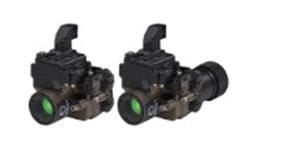
Optics 1 Awarded $45 Mil Contract For Enhanced Clip-on Thermal Imagers and Enhanced Clip-on SWIR Imagers

Monday, October 2nd, 2017

IMG_4547

According to the Department of Defense:

Optics 1 Inc., Bedford, New Hampshire, is being awarded a $45,000,000 firm-fixed-price, indefinite-delivery/indefinite-quantity contract for production of enhanced clip-on thermal imagers and enhanced clip-on short-wave infrared imagers in support of special operations forces. Work will be performed in Bedford, New Hampshire, and is expected to be complete by September 2022. Fiscal 2017 Navy working capital funds (Navy) in the amount of $220,000 will be obligated at time of award and will not expire at the end of the current fiscal year. This contract was competitively procured via the Federal Business Opportunities website, with one offer received. The Naval Surface Warfare Center, Crane Division, Crane, Indiana, is the contracting activity (N00164-17-D-JQ17).

Ft Benning Cancels Reverse Auction For 12,600 PMAGs

Monday, October 2nd, 2017

IMG_4544

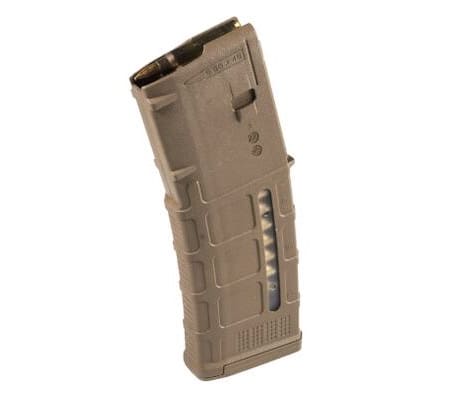
In August US Army Mission and Installation Contracting Command at Fort Benning announced an intent to purchase 12,600 GEN M3 PMAGs from a commercial source via reverse auction.

For this solicitation, MICC End User intends to conduct an online competitive reverse auction to be facilitated by the third-party reverse auction provider, FedBid, Inc. FedBid has developed an online, anonymous, browser based application to conduct the reverse auction. An Offeror may submit a series of pricing bids, which descend in price during the specified period of time for the aforementioned reverse auction.

Reverse auctions sound like a great idea, at least for commodity items like ink pens and toilet paper. Essentially, the government outsources the buy to a third party and they host the reverse auction which sees companies compete with each other to fulfill the contract for less and less money until a winner emerges which will do it for less than anyone else. The thing is, you have to be very careful with this purchasing vehicle. Because the winner will be doing it for pennies on the dollar, there’s lots of incentive to cut corners and give the government exactly what they asked for.

Below is the description of what they intended to buy. Emphasis added is mine, to point out that just a few words give bidders an excuse to substitute the PMAGs with something else entirely, in order to underbid eveyone else.

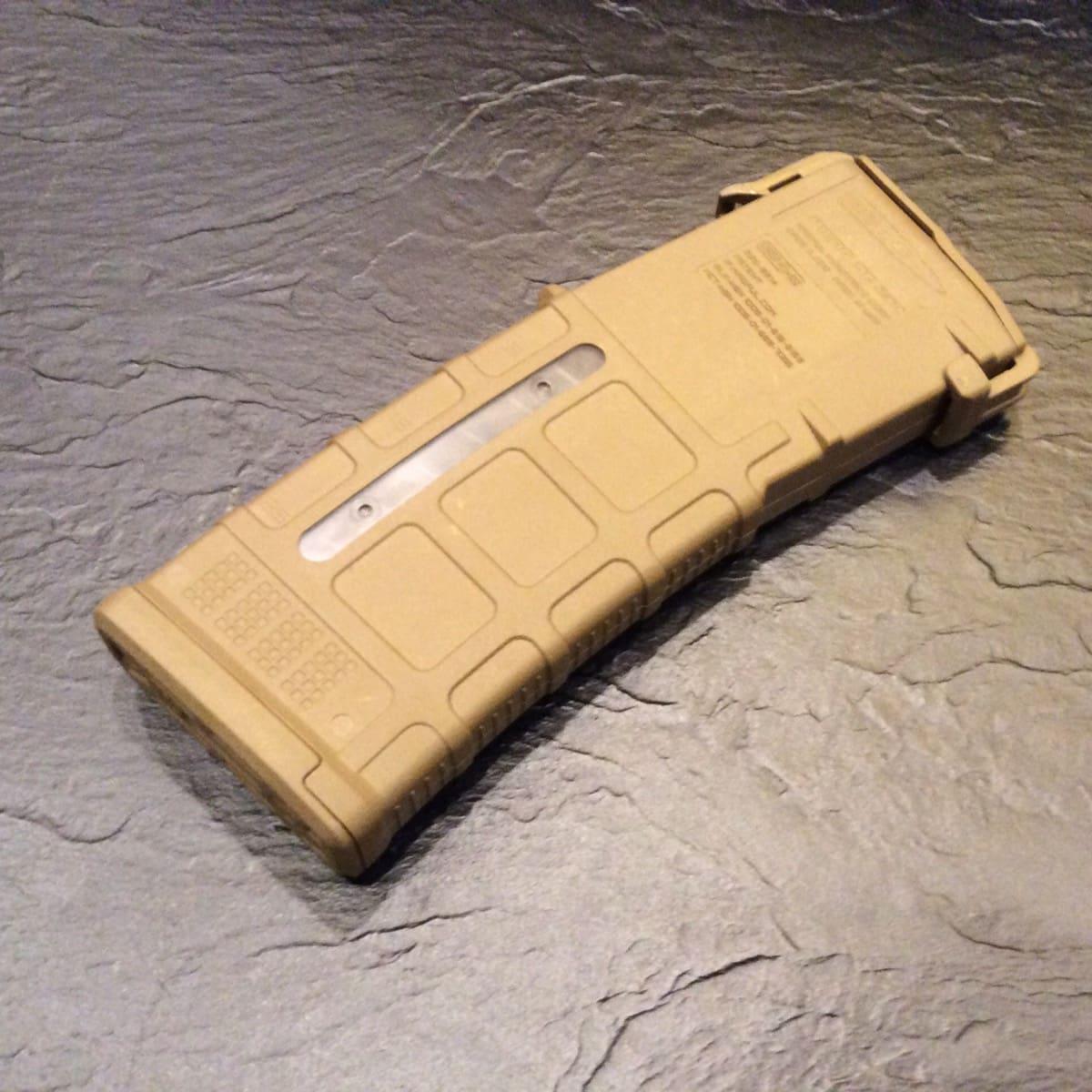
M4 Magazine. Color preference is coyote tan, but gray/black is also considered. Fits 30 rounds of 5.56×45 ammunition. Transparent window on side to see the ammunition level. Strong and durable springs. Light polymer material. Warranty for defective items. Include shipping. PMAG 30 AR/M4 GEN M3 Window or equal., 12600, EA;

If the units at Fort Benning had received an “equivalent” when they expected PMAGs, it wouldn’t have been the first time a reverse auction has failed to deliver what the unit thought they were asking for.

Fortunately, they cancelled this purchase. The Army issued Maintenance Information (MI) Message 17-045, which authorized units to requisition GEN M3 PMAGS under NSN 1005-01-615-5169 (BLACK) and NSN 1005-01-659-7086 (COYOTE TAN) as Additional Authorization List (AAL) items. By ordering through the stock system, they’ll get exactly what they want, and at contract price.

NSWC Crane Awards $10M Contract To SureFire For Muzzle Brakes And Suppressors

Monday, October 2nd, 2017

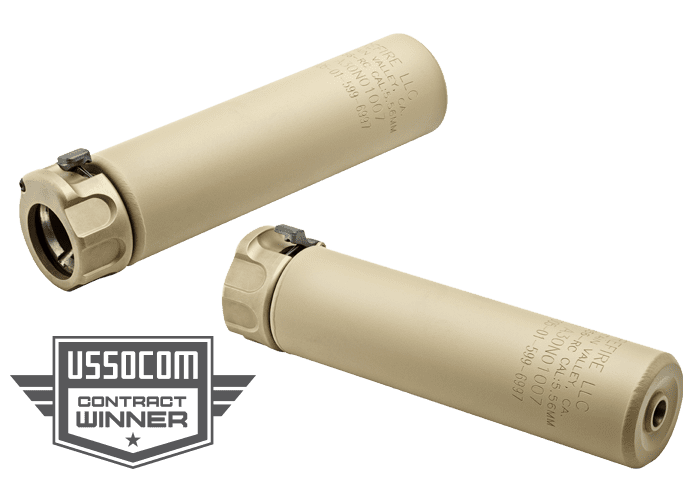
Late last week, Naval Surface Warfare Center Crane posted an award for a $10 million contract to SureFire for “SUPPORT/SUSTAINMENT FOR MUZZLE BRAKES, AND SOUND SUPPRESSORS IN SUPPORT OF THE MK13 MOD 7 SNIPER RIFLE, 10.3 AND 14.5 M4A1 UPPER RECEIVER GROUP (URG)”.

IMG_4543

This allows the units supported by Crane (primarily USSOCOM) to quickly procure additional muzzle brakes and suppressors.

Ballard Subsidiary Protonex’ Squad Power Manager Product Receives Go-Ahead For Full Rate Production By US Army

Monday, September 25th, 2017

VANCOUVER, CANADA and SOUTHBOROUGH, MA, USA – Ballard Power Systems (NASDAQ: BLDP; TSX: BLDP) and the Company’s wholly owned subsidiary – Protonex Technology Corporation (“Protonex”) – today announced that the U.S. Army Program Executive Office Soldier (PEO-Soldier) has received signature approval for its Mobile Soldier Power Program of Record to full rate production status, commonly known as “Milestone C”.

spm-622-in-field_1095x730.jpg

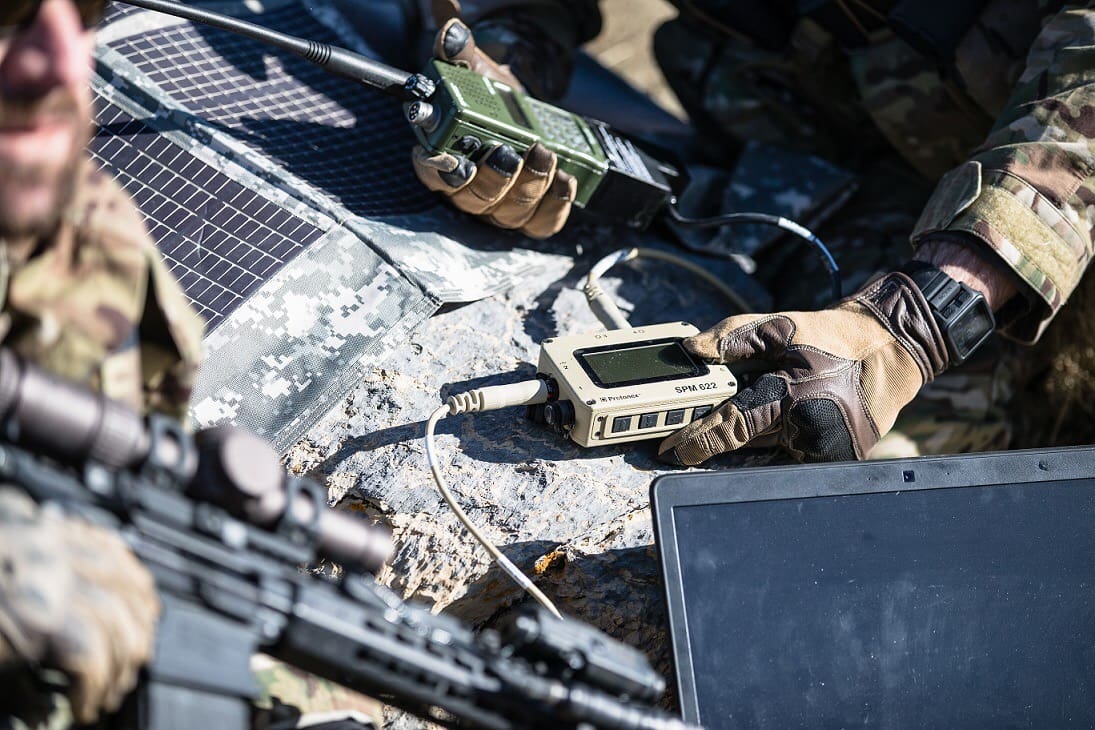
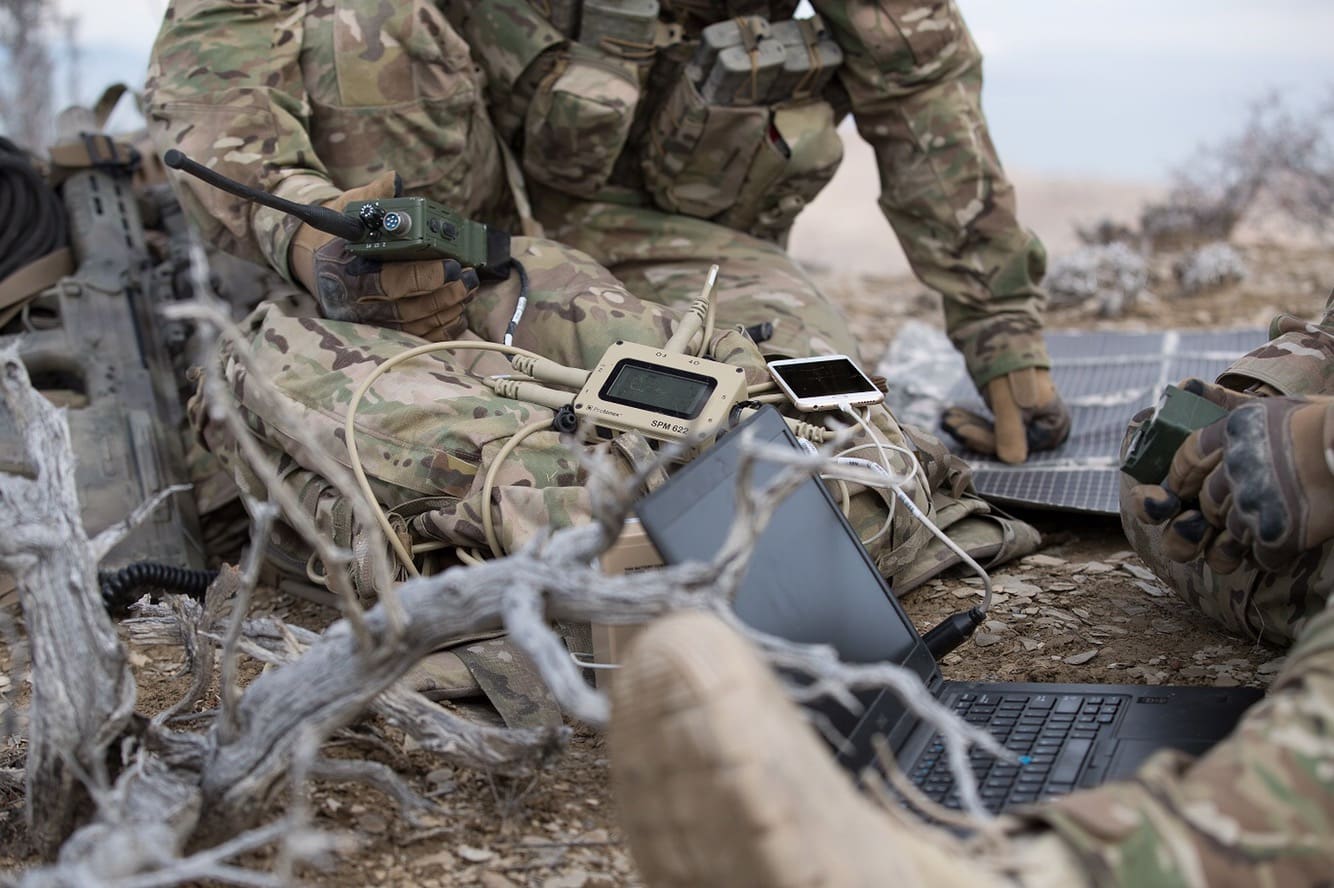
This Program of Record includes a number of new devices focused on improving power and energy management on and around the soldier, including Protonex’ Squad Power Manager Kit (SPM-622), conformal wearable batteries, and man-worn power and data distribution devices, such as Protonex’ Vest Power Manager family.

SPM-622 Squad Power Manager
“With the digitization of the battlefield, the U.S. military identified a capability gap in energy and power management for its increasing array of electronic devices,” said Paul Osenar, President of Protonex. “Our Squad Power Manager is one of the solutions that fill this gap. Lightening the load of warfighters by eliminating many of the batteries, adapters and chargers they carry was a requirement that we identified years ago. We are excited to work with the Army to provide innovative and practical power solutions like our Squad Power Manager. The Milestone C designation now enables the U.S. Army to field the SPM-622 as part of the Mobile Soldier Power Program of Record in significant volume.”

spm-622-sof-kit_av1.jpg

The SPM-622 is a tough, versatile and agile power management device, weighing less than a pound and enabling military forces to manage and prioritize power use for various electronics devices – including portable radios, GPS systems, Medical and EOD equipment, and computers – from any available power source. In addition, the SPM-622’s ability to scavenge from vehicles, other batteries, solar panels and other energy sources allows military units to recharge mission essential batteries when resupply is unavailable or delayed. As a result, the U.S. Department of Defense and Allied militaries have deployed more than 5,500 Protonex SPM Power Manager Kits through the limited production phase of the program.

spm-622-satcomm.jpg

The small, light and intelligent SPM-622 system increases mobility and flexibility of the warfighter. The product fulfills a U.S. Army requirement that has been validated by deployed units engaged in combat operations in austere environments, delivering a number of high-priority benefits to military end-users that include: reliable power for a variety of electronic devices, including equipment for communications, medical, explosive ordinance detection and directed fires; lightened load due to reduced battery burden; reduced logistical strain in remote locations or austere environments as a result of the lower quantity and variety of batteries needed; increased energy independence; and increased operational and mission effectiveness.

The SPM-622 Squad Power Manager was developed by Protonex and is manufactured at production facilities located in Southborough, Massachusetts.

www.PTXnomad.com

UPDATED – CSASS Update

Friday, September 22nd, 2017

Naturally, if word gets out that the Interim Combat Service Rifle effort has stopped midstream, folks are going to wonder about other 7.62mm programs, especially CSASS.

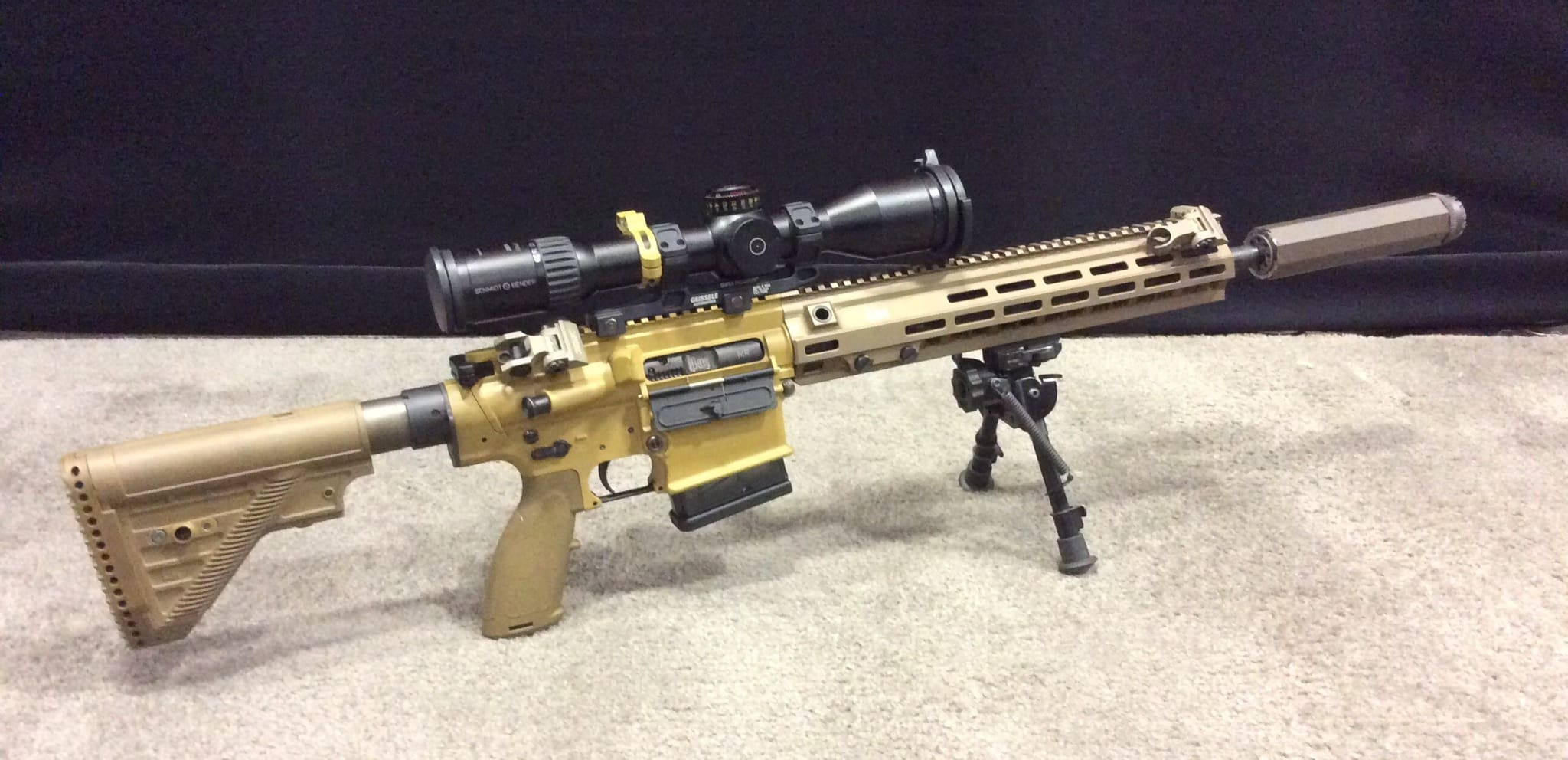
Despite a contract award in early 2016 to H&K for a G28 variant, the US Army has yet to field any M110A1 Compact Semi Auto Sniper Systems. So far, the program has no funding. It’s not dead; it just doesn’t have money to buy anything.

However, a directed requirement for 6069 G28 rifles, which are essentially M110A1s minus the optic, is still rumored to be moving forward, albeit rather slowly. These rifles will be fitted with a different optic and used in the Squad Designated Marksman role. While the Army will not have a widespread capacity to bring 7.62 hate, the DMR guns and existing M110s, built by Knight’s Armament Co, offer a limited capability.

However, CSASS is still alive and well with the US Navy and US Air Force, who are reportedly still on track to field several thousand of the rifle system.

UPDATE
Within an hour of this post being published, The Army Contracting Command published an award on FedBizOpps entitled, “Compact Semi-Automatic Sniper System Engineering Change Proposal”.

The U.S. Army Contracting Command – New Jersey (ACC-NJ), on behalf of the Project Manager Soldier Weapons (PM-SW), awarded a modification to incorporate Engineering Change Proposals to the Compact Semi-Automatic Sniper System.

If I were a betting man, that ECP turns the CSASS into a DMR by eliminating the Optic and Suppressor as well as lengthening the Barrel, which results aggregately in lowering the price and producing the desired variant of the G28 specified in the Directed Requirement. If it includes a full-auto function, ICSR could still happen as an ECPed CSASS and offer the Army the 7.62 H&K G28, it wants.

We will update you as we learn the details of this ECP.

The 7.62mm Intermediate Combat Service Rifle Program Is Dead

Thursday, September 21st, 2017

GEN Milley

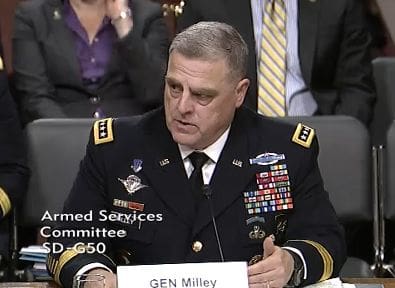
For two weeks now we’ve been told by multiple sources that the US Army’s effort to field a 7.62mm NATO Service Rifle has been placed on hold (that’s how the Army kills a program without actually cancelling it). This, after industry jumped through hoops to provide the Army with samples of a fully automatic rifle, based on US Army Chief of Staff, General Mark MIlley’s testimony on May 25th.  In front of the Senate Armed Services Committee, he stated that the there is a proliferation of inexpensive threat body armor and that they have a 7.62mm projectile to deal with it.

He said, “We recognize the 5.56mm round, there is a type of body armor it doesn’t penetrate. We have it as well. Adversarial states are selling it for $250.” He went on to say, “There’s a need, an operational need. We think we can do it relatively quickly,” and went on to say, “The key is not the rifle, it’s the bullet.” GEN Milley sated that they’ve done some experimentation at Ft Benning and they have a solution. When asked by Sen King if it would require a new rifle, GEN Milley responded, “It might, but probably not.” GEN Milley went on to explain that the “bullet can be chambered in various calibers, it can be modified to 5.56, 7.62.”

The Army’s answer to that was an RFI and then solicitation for a full auto 7.62mm Intermediate Combat Service Rifle which closed just weeks ago. Now, it’s dead on the vine. No word on how the Army will deal with the vendors and the weapons they submitted, or more importantly, the threat it identified before Congress.

There has been an internal struggle within the Army between the leadership and the Acquisition community over this and other directed requirements from the Army Staff at the Pentagon. The CSA and other senior leaders have issued orders to purchase specific capabilities and the Acquisition community has resisted. Another example of this phenomenon is the Directed Requirement for the USSOCOM Plate Carrier and Level IV armor plate from late last year which, despite full testing and fielding by SOCOM, is caught in a bureaucratic cycle of new testing and effort to copy the armor carrier.

However, in this case, the Acquisition community moved relatively quickly, but GEN Milley allegedly had a “squirrel!” moment during a recent visit to Fort Benning, where he was introduced to the Lightweight Small Arms Technology and its associated Telescoping Case technology. LSAT has been a science project since the 1980s. His fixation of this new shiny toy should stall out Army Service Rifle modernization for years, if not decades, giving Picatinny plenty of breathing room to work on their own agenda.

Sources say that the new path forward is to write a new requirement for a Next Generation Carbine, something that has long been a mid-term goal. However, GEN Milley says that he has a threat the Army must deal with in the now. How will the Army mitigate that threat if it doesn’t get the capability he told the SASC and the Army solicited industry to fulfill?

Persistent Systems Awarded $8.9 million Radio Contract for US Army WMD Teams

Tuesday, September 19th, 2017

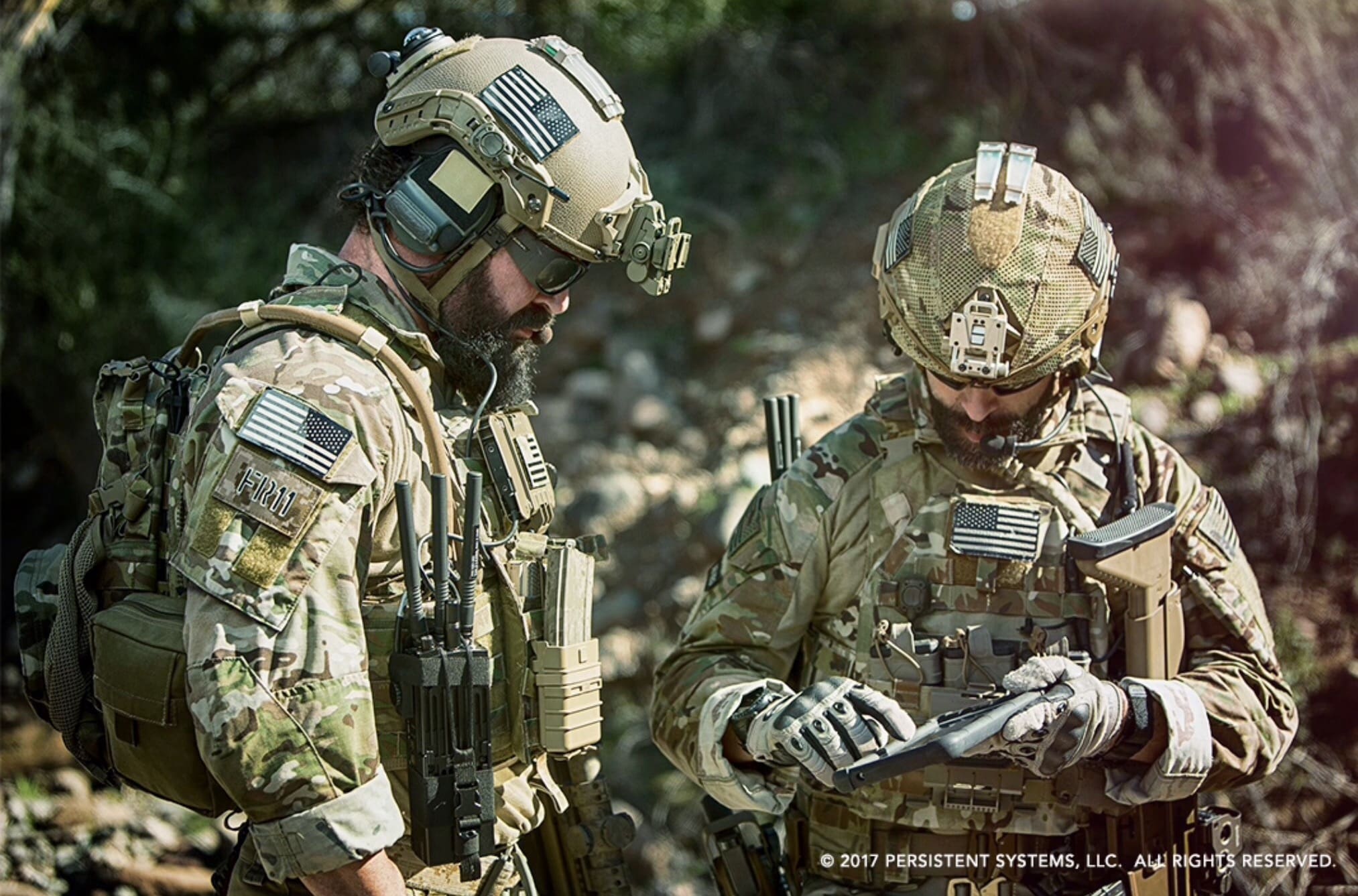
New York, N.Y. — Persistent Systems, LLC (“Persistent”), a leader in Mobile Ad hoc Networking (MANET) Technology and developer of Wave Relay®, announced today that it was awarded an $8.9 million contract award to provide more than 950 MPU5 radios to the U.S. Army National Guard’s Weapons of Mass Destruction Civil Support Teams (WMD-CSTs).

The contract is in support of the U.S. Army’s Unified Command Suite (UCS) Program of Record, which is managed by the Joint Program Executive Office for Chemical Biological Defense (JPEO-CBD). The UCS program aims to provide communications interoperability between military emergency response elements and Federal, State, and Local authorities on the scene of an incident.

IMG_4225

The Unified Command Suite is a self-contained communications vehicle that can either be driven to or be air-lifted via a C130 to an incident location. The MPU5 radios enable a high-speed communication network to be established on-the-fly, which empowers CST personnel to operate across the incident area while remaining connected both to the vehicle and to each other.

“Whether at a campaign rally or along a marathon route, National Guard Civil Support Teams run WMD detection operations to keep Americans safe,” said Louis Sutherland, VP of Business Development for Persistent. “That’s why it is so important that they have a robust wireless network.”

The MANET element of Persistent’s solution creates a vast, self-forming, self-healing radio network that does not require outside infrastructure to work. Should a node drop out of the network, sensor data collected by a Civil Support Team member will simply be routed another way. Using the MPU5 also means cutting down on the number of relay radios needed to push signals over and around obstacles.
IMG_4224

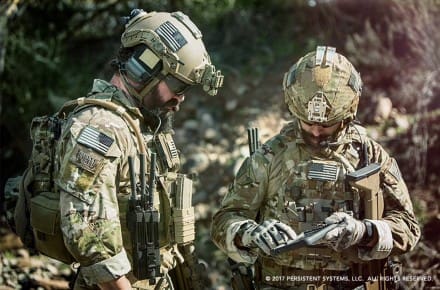
The MPU5 provides push-to-talk audio, video encoding, and an integrated Android™ computing environment that allows the installation of 3rd party applications. It is a 6W 3×3 MIMO radio which provides extremely long range and throughput exceeding 100 Mbps. These capabilities enable National Guard Civil Support Teams to network their sensors and transmit data collected in the field to the UCS vehicle and then on to a national lab for analysis.

“MIMO radios thrive in urban environments, where standard radios have trouble,” Sutherland said. “This enables the CST personnel to extend their network further from the truck and operate effectively in urban, high-population-density environments that are the most likely targets of an attack.”

Persistent has customers in the Army, Air Force, and Department of Homeland Security.

“Some of our most passionate advocates come from the chemical, biological, radiological, nuclear, and explosives detection community,” Sutherland said. “In fact, our MPU5 radio is already embedded in QinetiQ’s Talon unmanned ground robot which is also used by Civil Support Teams.”

Persistent has already begun delivery of its radios and expects to make another delivery of 500 radios to the Unified Command Suite program this month. The radio integration is being performed by NAVAIR in Patuxent River, Maryland.


Why Hasn’t The US Army Adopted Polymer Magazines?

Monday, September 18th, 2017

Despite adoption of polymer magazines by USSOCOM, the Marine Corps, and even the Air Force, the US Army has yet to join them. To make matters worse, the Army has evaluated polymer rifle magazines several times, and seems to have ignored their own results. In fact, the Air Force is said to have based their decision on the last Army test report. Granted, the Army has authorized use of the Magpul GEN M3 PMAG, but unlike the others, they haven’t made it their primary magazine.

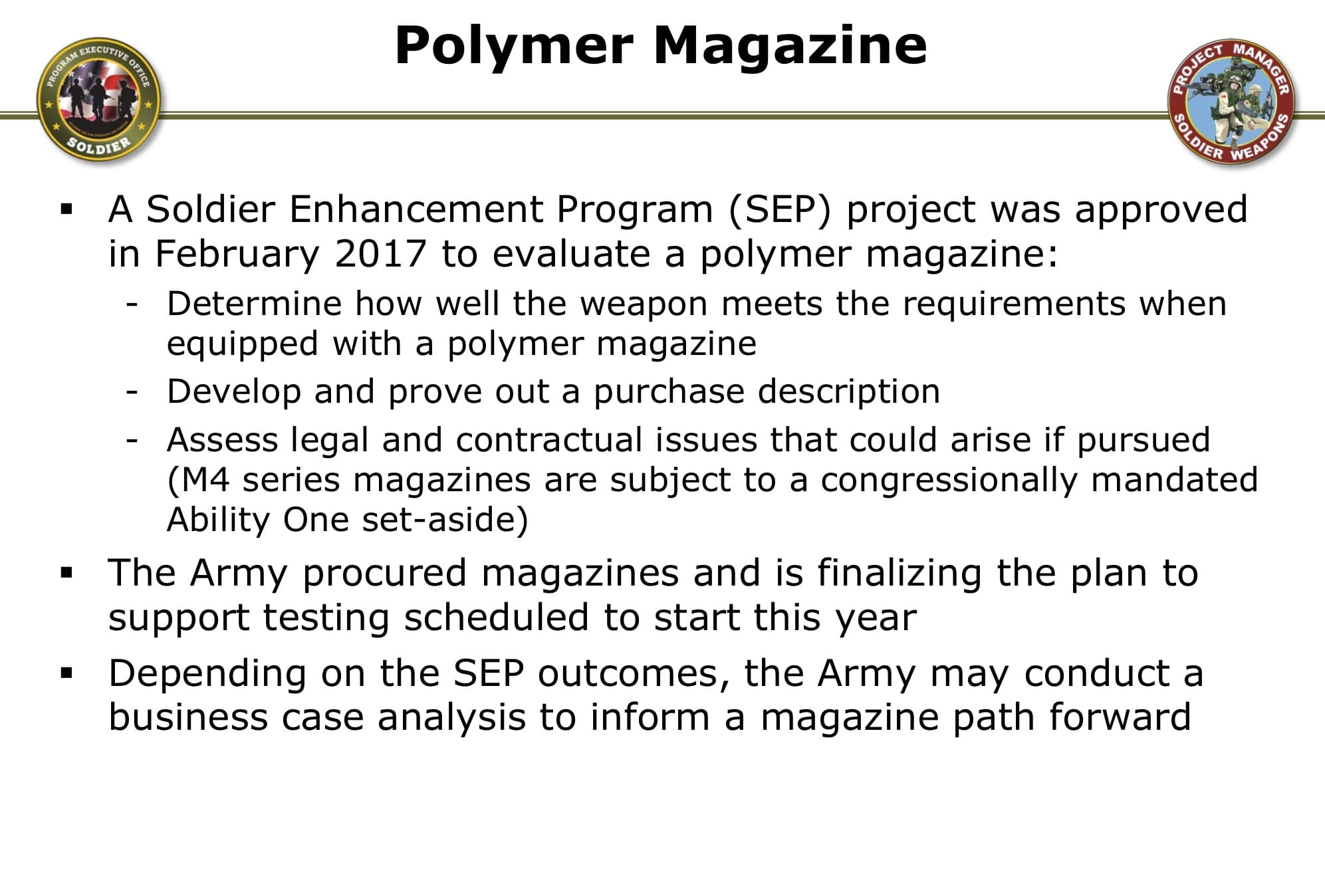
While there’s been lots of online conjecture as to why the Army hasn’t adopted a polymer magazine, the true answer may well lie in this slide from a briefing presented by LTC Steve Power, PM Individal Weapons at PEO Soldier’s PM Small Arms, during NDIA’s 2017 Armament Systems Forum, this past May.

The Army is going to conduct yet another polymer magazine evaluation under the Soldier Enhancement Program. Direct your attention to the sub bullet on the slide below, which states, “Assess legal and contractual issues that could arise of pursued.” Most fail to understand the significance of that statement. Turns out, what’s holding the Army back is something bigger than any of us; procurement set asides.

IMG_4217

To begin to understand why it’s so important, you need to know that AbilityOne has a government-only sales website sponsored by three organizations, National Industries for the Blind, SourceAmerica (formerly NISH), and the US AbilityOne Commission, the operating name for The Committee for Purchase From People Who are Blind or Severely Disabled. They are all involved in providing goods to the US Government, based on the Javits-Wagner-O’Day Act or “JWOD Act” authorized under 41 U.S.C. 8501-8506c. These nonprofit agencies manufacture a variety of commodities throughout the United States, and employ people who are blind or have other severe disabilities. It’s a public/private success story.


Not only is the program Congressionally mandated, the AbilityOne Program employs more than 47,000 Americans. As you can imagine, this gives it a lot of clout. Essentially, once a commodity is provided via a directed source, it always will be. That’s why the legal review was mentioned as a factor, perhaps as important as, if not more than, how well the magazines work.

By now, you’ve said to yourself, “Well the other services have transitioned to the PMAG, why can’t the Army?” The answer lies in the numbers. The Army’s buying power is massive when it comes to small arms amd accessories. It buys more than the other three services combined, and that’s even if you add SOCOM into the equation. For the Army to drop a directed source is a very big deal and they will assuredly face Congressional pressure over such a move.

While it’s certainly frustrating to see the Army move so slowly toward the the wholesale adoption of a polymer magazine, we understand that there’s a bit more to it. That’s why we are publishing this information. You need to understand it as well. The Army needs to get its ducks in a row in order to make the business case for transition. But now that all of the cards are on the table regarding what’s at stake, there’s no excuse to keep kicking the can down the road. While performance must trump set asides, the question is, how much does performance need to improve for the Army to upset the rice bowl?