XC3 Weaponlight

Archive for the ‘Contracts’ Category

USMC Preparing for Full Rate Production of MADIS RWS

Tuesday, July 11th, 2023

MADIS RWS production ongoing in Kongsberg’s world-class facility in Pennsylvania

JOHNSTOWN, Penn. – July 10, 2023 – A critical system in the Marine Corps Ground-Based Air Defense (GBAD) portfolio, the Marine Air Defense Integrated System (MADIS) Remote Weapon Station has reached a pivotal milestone transitioning into full rate production. The remote weapon station is manufactured and managed by Kongsberg in Johnstown, Penn. and is a key component to the larger and holistic system which provides protection from drones and increased lethality against evolving threats.

“The Marine Corps is leaning forward with orders for long-lead items to prioritize the timely production of these systems in support of Force Design 2030,” said William Dixon, MADIS Project Manager, KONGSBERG Protech Systems USA. “As we enter full-rate production for these remote weapon stations, we’re also discussing additional technology we can incorporate into the system to improve and expand their capabilities for the Marines.”
“Kongsberg’s Johnstown facility consistently yields remote weapon station manufacturing excellence, having produced more than 20,000 systems over the last 15 years,” said Eskild Aas, Director US PROTECTOR Programs, Kongsberg. “Delivering the LRIP systems and moving into full-rate production of the MADIS RWS exemplifies our rigorous processes, and is an important milestone for the program office and our team.”

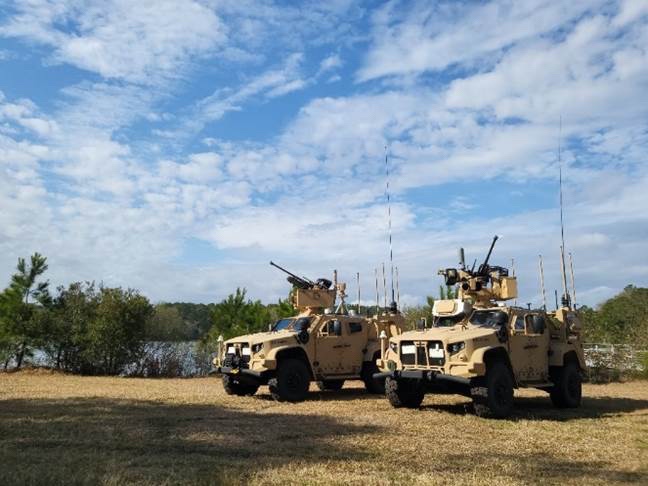
The KONGSBERG RS6 RWS for MADIS RWS includes the XM914E1 30mmx113mm percussion-primed cannon with a co-axial M240C (7.62mm) machine gun, an integration kit for the STINGER Air-To-Air Launcher (ATAL) and provisions for future C-UAS defeat systems. MADIS is part of the U.S. Marine Corps’ plan to upgrade their two active Low Altitude Air Defense (LAAD) battalions. The first 30mm remote weapon system to be qualified on the Joint Light Tactical Vehicle platform (JLTV), MADIS RWS mounts on JLTVs and fights as a complimentary pair, designated as Mk1 and Mk2. The MADIS Mk1 features STINGER missiles, and neutralizes fixed and rotary-wing aircraft. Mk2 fulfills the Counter-Unmanned Aircraft System (C-UAS) mission requirement, while also providing radar and command-and-control for the pair.

The U.S. Marine Corps awarded Kongsberg the five-year, indefinite delivery / indefinite quantity other transaction authority (OTA) production contract in Sept. 2021. It has a ceiling of $94 million and includes a series of Low-Rate Initial Production (LRIP) systems, full-rate production units, spares and training. This production contract award followed a Sept. 2020 OTA contract award from the USMC to KONGSBERG for test articles and activities, which included Design Verification Testing (DVT), after a competitive process.

The KONGSBERG RS6 RWS for MADIS leverages technology and competence drawn from multiple counter-unmanned aircraft systems (C-UAS) and air defense programs. The system leverages commonality with the family of PROTECTOR RWS delivered and fielded with the U.S. Army and Marine Corps.

KONGSBERG is the world’s leading manufacturer of RWS, having delivered over 20,000 units to more than 20 countries worldwide. KONGSBERG is also the sole provider of RWS and remote turrets to the U.S. Army and U.S. Marine Corps. All RWS and remote turrets delivered to U.S. customers are manufactured in the Kongsberg Johnstown, Penn. facility and leverage our extensive American supply base. The company takes great pride in its continued support to, and for the United States, U.S. employees, and U.S. supply base.   
Caracal: Germany and the Netherlands Enter €1.9 billion Framework Contract with Rheinmetall for 3,058 Airmobile Vehicles

Monday, July 10th, 2023

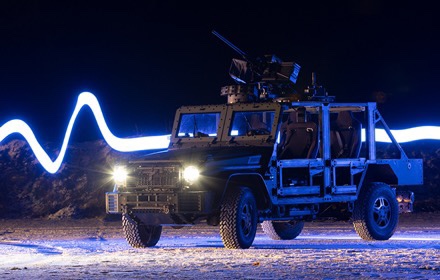
The German and Dutch armed forces have contracted with Rheinmetall to supply up to 3,058 Caracal airmobile platforms. Worth up €1.9 billion, the multiyear framework contract includes up to 2,054 vehicles earmarked for Germany and 1,004 for the Netherlands.  As a first step, a firm order from the framework contract has been placed for 1,508 vehicles worth approximately €870 million, including value added tax. To finance the procurement project, Germany is drawing on the special fund set up last year for reequipping the Bundeswehr. 
The Caracal is the product of a partnership between Rheinmetall, Mercedes-Benz AG and Armoured Car Systems GmbH. Delivery of the first trial models is scheduled to take place as early as the first quarter of 2024, with the start of delivery in series planned for early 2025.  
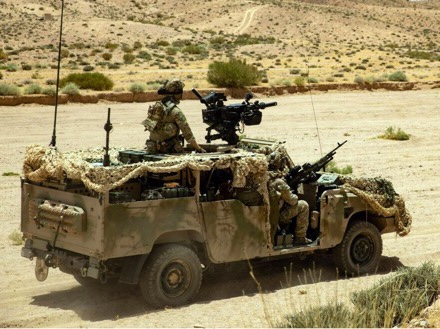
A 4×4 all-wheel-drive vehicle, the Caracal is a mobile platform specially designed to meet the needs of airmobile formations and special operations forces. 

Procurement of the “Deployment System Airmobile Platform” is unfolding against the backdrop of the tense security situation and urgently required new capabilities for national and alliance defence. Owing to the close working relationship between the German and Dutch armed forces and the comparable requirement situation in both countries, the procurement project has been a bilateral one from the outset. 


The tendering process, which began in October 2022, was completed in two fast-paced proposal phases. In the end, Rheinmetall put forward the most economical proposal, with price and technical performance converging to overcome the remaining competitor. 

The Caracal is based on a commercial off-the-shelf chassis of the new G-model 464 series from Mercedes-Benz. In future Rheinmetall will therefore be able to offer users around the world a proven, technically mature platform, providing logistic support throughout the vehicle’s long service life. 

With the Caracal, Rheinmetall’s portfolio of tactical vehicle systems has expanded to embrace the lightweight, less-than-10-ton 4×4 segment, where the Düsseldorf-based tech enterprise sees strong growth potential. 

“Together with our partners Mercedes-Benz AG and Armoured Car Systems GmbH, we’re ready to roll and can advance quickly to full-scale, large-volume series production”, states Dr Björn Bernhard, managing director of Rheinmetall Landsysteme GmbH. “Final assembly of all German and Dutch vehicles will take place at our plant in Ede in the Netherlands and at VDL Special Vehicles B.V. in Eindhoven, our designated partner company. Having two assembly locations will let us quickly scale up production while simultaneously contributing to sustained value added in the Netherlands, our partner country”, notes Dr Bernhard. 

Jankel Celebrates the Delivery of Over 500 Fox Tactical Vehicles

Monday, July 10th, 2023

In July 2023, Jankel, a world-leader in the design, integration, manufacture, and support of high-specification vehicles and protection systems, is celebrating the delivery of over 500 Jankel Fox tactical vehicles, globally. The Jankel Fox product line is a family of tactical vehicles based on modified off-the-shelf Toyota base vehicles; either the Hilux or the 79 series pickup (single and double cab), depending on each customer’s s requirements.

The 500 vehicles have been designed, developed and built by Jankel in the UK where the IP resides, as well as being produced in collaboration with their French partners, Technamm who have built the French variant of the Jankel Fox Long Range Patrol Vehicle (LRPV), named ‘Jankel Fox by Masstech’. The vehicle was procured by the French MoD as part of the VPS2 urgent requirement in 2018. The vehicles are manufactured under license in France by Technamm at their Lambesc facility. In 2015, Jankel was awarded an internationally competed contract to supply 108 Jankel Fox 4×4 Rapid Reaction Vehicles (RRV) to the Belgium Ministry of Defence (BeMoD) for use by their Special Forces. The last of the BeMoD Jankel Fox RRVs rolled off the production line in 2020. Since then, Jankel has received a significant number of orders for Jankel Fox vehicles from undisclosed global customers in different variants, bringing the current total to over 500, supporting UK exports and jobs across a growing team of engineers and skilled technicians. The Jankel Fox vehicle is now in service and supported in: UK; USA; NZ; Romania; France; Belgium; Botswana; Oman; Jordan; South Korea; Brunei; Spain; Italy; Mauritania and Indonesia.

The Jankel Fox family comprises of three main role variants: Tactical Utility Vehicle (TUV); Rapid Reaction Vehicle (RRV) and Long Range Patrol Vehicle (LRPV) available in 4×4 and 6×6 variants. Jankel continue to spirally develop the platform in the UK with configurations and developments to integrate future mission systems across the Jankel Fox family. Jankel has designed and integrated upgrades to the off-the-shelf automotive platform systems including: suspension; drive train; brakes; transmission and power generation. The military integration then includes weapons, communications, ECM, modular armour, seating, tools and stowage. The vehicle is compliant with multiple international defence standards that include reliability, integration, service support, operating environments, towing, tie-downs, aircraft and helicopter transportation. The Jankel Fox has a crew of 2-6 and is used in a variety of roles including: command, reconnaissance, tactical patrol, fire-support, logistics, border patrol and anti-poaching. Jankel has also put in place a comprehensive global support solution that is delivering all aspects of in-service support to the range of customers now operating their Jankel Fox vehicles.

Andrew Jankel, Chairman at Jankel said: “this is an important milestone for Jankel as we see over 500 of our Jankel Fox tactical vehicles having been delivered to over fifteen end user groups. That’s a significant achievement creating UK-held Intellectual Property and enabling Jankel to further grow the team, creating and sustaining skilled engineering jobs. The programmes have demonstrated our flexibility in producing and exporting vehicles globally including through licensed manufacture in-country, to satisfy local build requirements “a model that can be replicated anywhere.” He added: “I think there are three main points to make about the Jankel Fox. 1) it’s an extremely capable and flexible platform that is now battle-proven on multiple operations. 2) our approach of using modified off-the-shelf base vehicles delivers the required capability but at an affordable price. 3) because the Jankel Fox is based on the world-renowned and supremely reliable Toyota chassis’, remote users can tap into a global support network literally, anywhere. At the same time, we’ve developed a comprehensive support solution to complement that.”

DroneShield Announces $9.9 million DoD Contract

Thursday, July 6th, 2023

• Five Eyes DoD awards DroneShield a record $9.9 million contract

• The award follows DroneShield successfully completing a $3.8 million contract with the same customer

• Ongoing significant momentum in the business in a rapidly expanding market


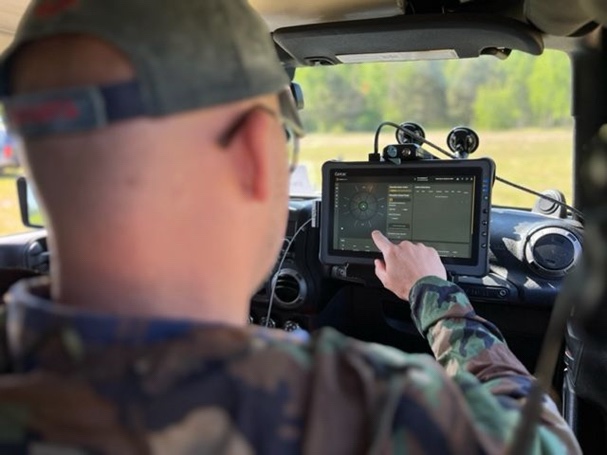
Operator with the tablet console of DroneShield DroneSentry-X vehicle counterdrone system

DroneShield Ltd (ASX:DRO) (DroneShield or the Company) has been awarded a follow-on 2-year R&D contract with a total value of $9.9 million by a Five Eyes Department of Defence (DoD). Approximately $4.5 million is due in the September and December 2023 quarters. Five Eyes refers to the defence/intelligence alliance between the US, Canada, UK, Australia and NZ.

The award follows DroneShield materially completing the $3.8 million contract announced 4 June 2021 with the DoD, with a final milestone payment expected this month.

Oleg Vornik, DroneShield’s CEO, commented, “Follow-on contracts are the ultimate customer measure of our performance.  As an Australian sovereign industrial capability business, DroneShield is proud and pleased to continue undertaking multi-year contracts of increasing size with this customer.” 

“This is the largest long-term contract received by DroneShield to date, significantly larger than the earlier, $3.8 million contract. The 2-year term locks in cash receipts over a period of time. Further larger contracts are anticipated following completion of this phase.”

“In the current uncertain geopolitical environment, there is a significant focus by the Five Eyes Governments to procure from defence industrial capability champions within their network of countries. Having deep engineering and research capability, TRL9 products and a track record of working with Defence, places DroneShield in a favourable position for ongoing work.”

Operational Update

• Following a strong $7 million cash receipts 1Q23 quarter, DroneShield is on track for an all-time record 2Q23 quarter and continuing on a trajectory for another record year for cash receipts in 2023. Further detail will be provided in the next 4C quarterly, due to be released later in July.

• Significant progress on manufacturing, operations and inventory scale-up to support additional anticipated orders for remainder of 2023. DroneShield is currently finalizing the location for a larger industrial site to move its Sydney operations to enable the growth.

• With the $11 million contract announced in December now fully delivered and paid for, DroneShield is progressing the inventory build of the second $11 million order announced in January, expected to be delivered later this year.

• Current order book (committed and binding customer purchase orders) of approximately $29 million, an all-time record.

• Over $200 million qualified opportunities pipeline (in addition to the order book), across approximately 80 projects.

• Ongoing record demand for counterdrone / C-UAS equipment, underscored by the events in Ukraine and increasing defence and security budgets globally. 

• In addition to military and intelligence communities, significant engagement with critical infrastructure plants, airports and other civilian customers.

Saab Receives Order for Carl-Gustaf M4 from Australia

Thursday, July 6th, 2023

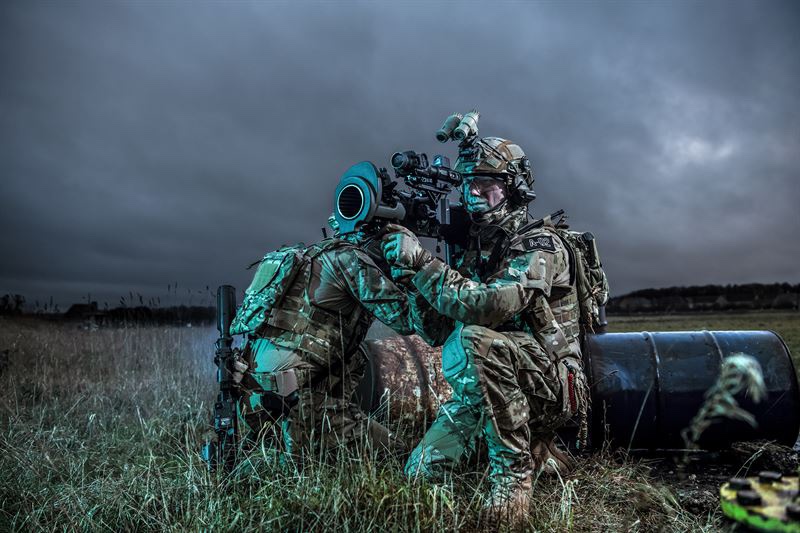
Saab has received an order from the Australian Department of Defence for the supply of additional Carl-Gustaf® M4 weapons. The order value is SEK 400 million with deliveries during 2024-2025.

The Carl-Gustaf M4 weapons will be delivered with Saab’s new Fire Control Device, FCD 558.

“This order continues Saab’s longstanding relationship with the Australian Defence Force. We are proud to deliver modern and user-focused weapon systems that ensures the Australian armed forces’ ability to meet a wide range of challenges on the battlefield,” says Görgen Johansson, head of Saab’s business area Dynamics.

Proven to deliver results on the battlefield, Carl-Gustaf provides the effectiveness soldiers need. The wide range of ammunition types for Carl-Gustaf makes it flexible and able to handle any situation, whether it is to destroy an armoured vehicle or structure, or illuminating the battlefield during night operations.

The Carl-Gustaf system is supplied to more than 40 countries around the world.

Rheinmetall Supplying Ukraine with 14 Leopard 2A4 Tanks – Order Volume in the Triple-Digit Million Euro Range

Thursday, June 29th, 2023

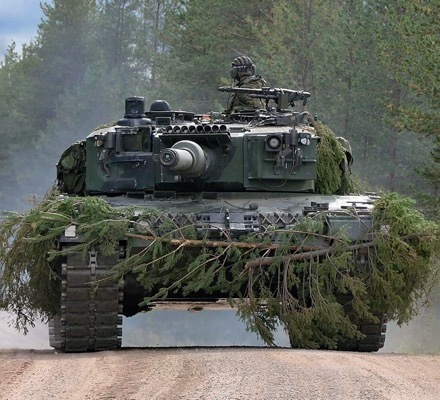
In April 2023 the Dutch and Danish governments announced their intention to jointly acquire Leopard 2 A4 main battle tanks for donation to Ukraine. The Dutch government therefore contracted with Rheinmetall to supply fourteen Leopard 2A4 MBTs, worth a figure in the lower three-digit million-euro range. The Dutch and Danish government are jointly financing the order as part of the international tank coalition to provide effective support for Ukraine.
Officials of the Netherlands, Denmark and Germany and representatives of Rheinmetall recently signed an agreement to this effect. 
The first vehicle is scheduled for delivery in January 2024, with the last due to ship in the course of the year. The vehicles are upgraded Leopard 2A4 tanks acquired by Rheinmetall from the inventories of user nations. 

The transaction underscores Rheinmetall’s role as an important supplier of materiel to the Ukrainian armed forces. It is just the latest in a series of actions taken by the Düsseldorf-based tech enterprise in support of Ukraine’s defensive war effort. In the meantime, Rheinmetall is the embattled country’s sole source of large-volume shipments of new medium- and large-calibre ammunition, including 20mm rounds for the Marder IFV’s automatic cannon and 105mm and 120mm tank ammunition for the main armament of the Ukrainian Army’s Leopard I and Leopard 2 MBTs. A first lot of 35mm ammunition for the Gepard antiaircraft tank will soon be ready for shipment as well. 

Rheinmetall has also been instrumental in supplying the Ukrainian military with substantial numbers of combat vehicles, whether through multilateral “Ringtausch” exchange programmes with partner nations or via direct deliveries. Back in March 2023, for instance, Rheinmetall shipped twenty Marder infantry fighting vehicles to Ukraine at the behest of the German government.  A second lot of twenty of these tried-and-tested vehicles is due to ship this summer. 

By the end of 2023, Rheinmetall will also be supplying Ukraine with 26 brand-new military trucks and two state-of-the-art air defence systems. The support effort also encompasses SurveilSPIRE mobile reconnaissance systems with day- and night-capable cameras and autopiloted mini-drones. The Group is also furnishing Ukraine with a field hospital system consisting of containers and tents as well as a container-based mobile surgical station for initial treatment of trauma cases, both of which will be a vital source of support for the Ukrainian military in the coming months.  

New Mechanized Infantry Combat Vehicle Prototype Contract Awarded to Two Vendors

Thursday, June 29th, 2023

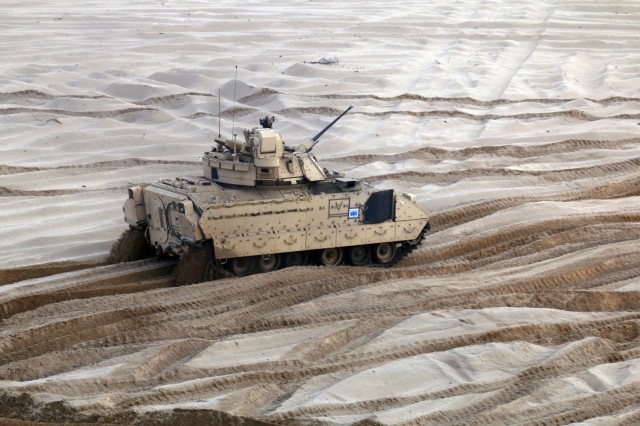
WASHINGTON — The Army’s Optionally Manned Fighting Vehicle program, now redesignated as the XM30 Mechanized Infantry Combat Vehicle, announced June 26 that a contract for prototypes will be awarded to two vendors: General Dynamics Land Systems Inc. and American Rheinmetall Vehicles LLC.

The two vendors will prepare prototypes of a vehicle to replace the M-2 Bradley Infantry Fighting Vehicle, which is a tracked vehicle designed for reconnaissance and provides protection, transportation and small-arms firepower for squad elements. The total award value for both contracts is approximately $1.6 billion.

“The XM30 will replace the Bradley fighting vehicle, bringing new transformational capabilities to the fight; these will include improvements to lethality, Soldier-vehicle survivability, and upgrade ability beyond the physical and economic limits of the Bradley,” said Honorable Douglas R. Bush, assistant secretary of the Army, Acquisition, Logistics and Technology. “The modular open system architecture that the XM30 will allow new building technology to be added to the vehicle as that technology matures, ensuring an overwhelming advantage in any potential adversary competition.”

The OMFV program is part of the Army’s modernization strategy. The Next Generation Combat Vehicle program aims at updating several vehicles and weapons platforms used in the Army today.

Part of advancing and modernizing the Army is seeking out the best designs through competitive contracts.

“Competition remain a vital aspect of the XM30,” Bush said “The program opened the door for industry partners that are not traditional U.S. combat vehicle prime contractors, which allows for increased competition and innovation. This reduced the Army’s risk and increased our likelihood of success while balancing investments across the entire Army modernization enterprise.”

The Bradley first started being used in 1981 and is an infantry fighting vehicle used to transport infantry on the battlefield as well as provide support to dismounted troops. It has been updated over the years but has reached its technological limits.

“In recent years, peer and near-peer competitors of the United States have significantly increased their combat vehicle capabilities. The character of warfare has changed, and our potential adversaries are bringing increased value to the battlefield,” said Brig. Gen. Geoffrey Norman, director of the next generation combat vehicles.

Concerns over the impact to the effectiveness of an outdated vehicle during full-spectrum military operations was what gave rise to the decision to modernize the Bradley.

“The best way to respond is to ensure that our formations are equipped with infantry fighting vehicles, which can bring greater survivability, powerful lethality at standoff range and improved maneuver capabilities to the battlefield,” Norman said.

Even though the XM30 hasn’t yet been designed, several key features have been outlined for the vendors to include in their prototype: two Soldiers to operate and carry capacity for six more, a 50mm cannon and a remote turret, as well as anti-tank guided missiles. Weapons systems on the XM30 will be designed to use the latest in sensor and fire control systems.

The XM30 will also be designed with sustainability and mobility in mind as it will feature a hybrid electric powertrain, which will reduce power consumption, Norman said.

“The occupants will benefit from innovative force protection systems that include integrated active protection systems, kitted armor and innovative signature management capabilities from the very beginning,” Norman said. “All of these advances are being designed with modern digital engineering in a modular, open systems approach that will allow for rapid integration of the latest hardware and software in the future.”

“The XM30 meets the Army’s requirements for a transformational increase in warfighting capability, not simply another incremental improvement over the Bradley fighting vehicle,” Norman said.

A modernization effort is planned to replace the M-113 Armored Personnel Carrier and M-1 Abrams Tank, as well as development of a light tank for infantry brigade combat teams. There are also plans for three versions of robotic combat vehicles.

By SFC Michael Reinsch, Army News Service

MDM 23 – GM Defense Selected for Defense Innovation Unit’s Stable Tactical Expeditionary Electric Power (STEEP) Program

Tuesday, June 27th, 2023

Even before GM Defense was selected to produce the US Army’s Infantry Squad Vehicle they were working on innovative solutions for the US military. Since then, they’ve done quite a bit of work on both electric and hybrid systems.

Their latest project is for the Defense Innovation Unit’s Stable Tactical Expeditionary Electric Power (STEEP) Program on behalf of the Marine Corps which seeks to offer a tactical microgrid and energy management capabilities in austere locations.

Leveraging GM’s Ultium Platform which is used in their electric vehicles, they are building a prototype to provide uninterruptable and sustainable power. GM’s STEEP solution offers intelligent tactical microgrid capabilities that work with hydrogen-powered generators, stationary and mobile battery electric power or existing fuel-powered generators to support efficient power management and distribution.

In a release from GM earlier today, GM Defense president Steve duMont stated, “This contract award demonstrates our ability to leverage advanced commercial technologies and investments from our parent company, GM, to reduce warfighter fuel consumption, and lower acoustic and thermal signatures, while providing efficient energy at the tactical edge. We are proud to win another contract award with DIU, whose mission to accelerate the adoption of commercial technology across the U.S. military aligns with our efforts to transition global defense and government customers to a more electric, autonomous and connected future.”

This is GM Defense’s second win with DIU having previously worked on prototyping a battery system based on GM’s Ultium Platform in support of the Jumpstart for Advanced Battery Standardization (JABS) solicitation.