Aquaterro

Archive for the ‘Guest Post’ Category

See the Dark Wolf Ventures Howler at SHOT Show

Thursday, January 18th, 2024

Satcom/RF Backhaul with Advanced Situational Awareness
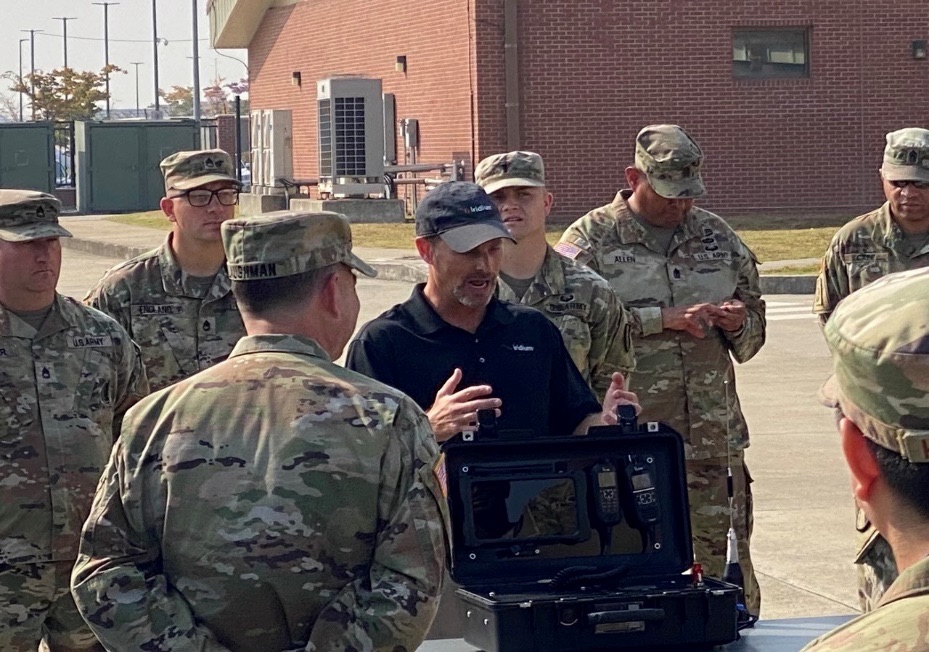
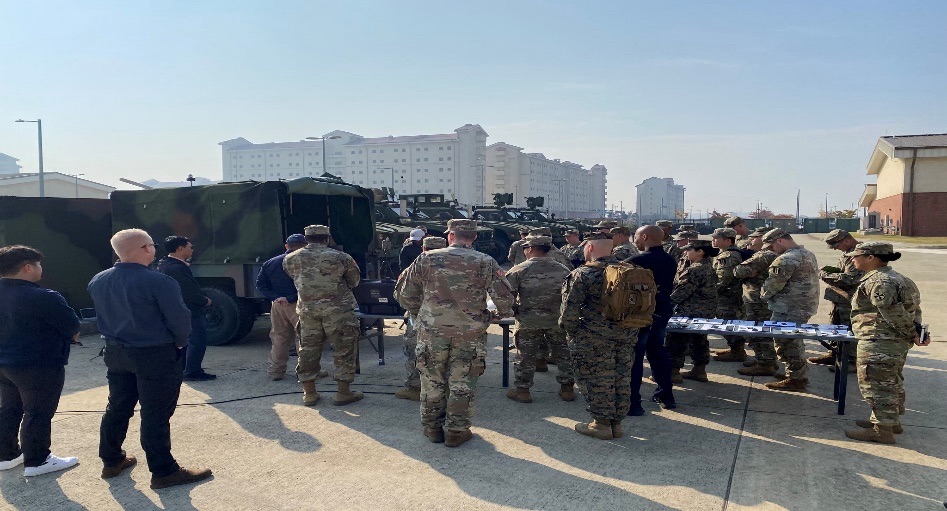
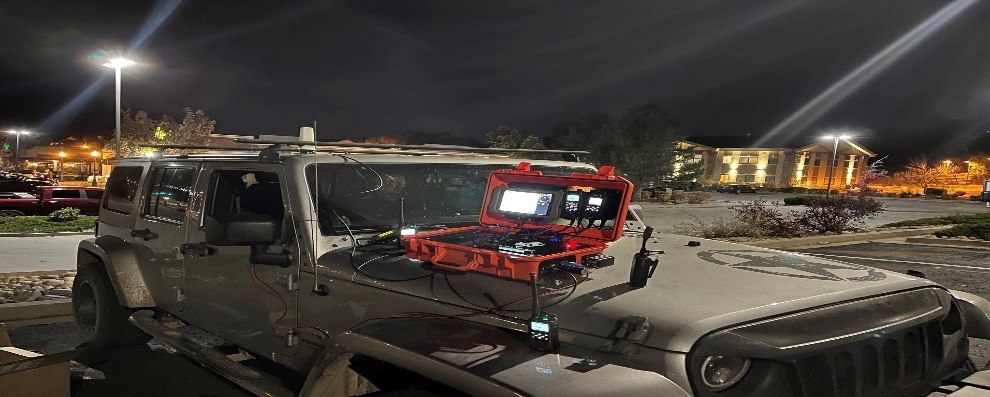
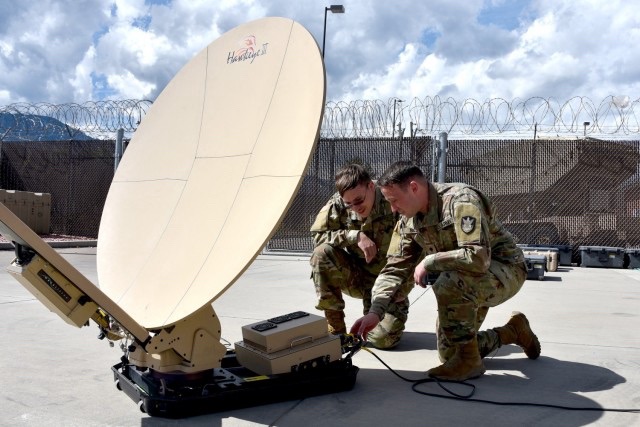
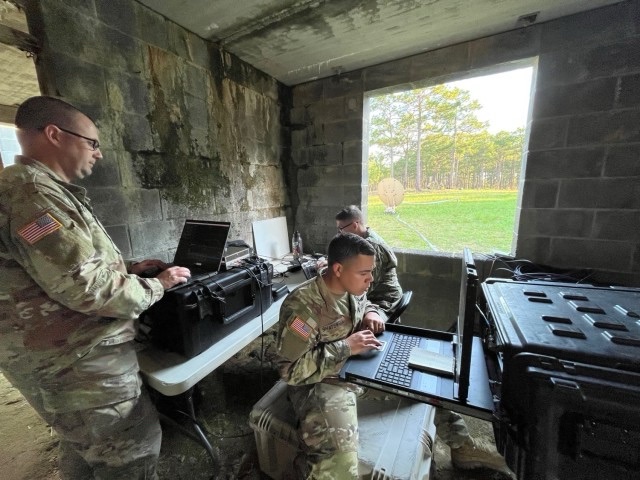
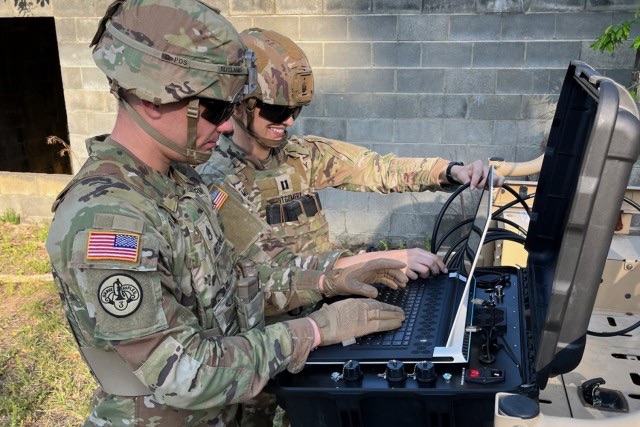
The Dark Wolf Howler is one of many custom communications products!! Whether you are working with P25 or other platforms, the Howler can connect you anywhere in the world using the Iridium LEO constellation, even if you’re on the move! In one current configuration (as shown), ICOM’s F7500 Series P25 radios are backhauled over the ICOM SAT100M Satellite radios for a true BLOS (Beyond Line Of Site) system. In the pics, Jay Chapman and Brandon Newsome from Iridium, Kevin Rutherford from Dark Wolf Ventures, and Glenn Williams from ICOM America conducted a demonstration in which P25 radios at an installation in South Korea are connected over satellite to IDAS radios in Ft. Carson, CO. This P25 to IDAS RF backhaul through the Iridium constellation also allows for real time PLI tracking and messaging through ATAK on a Samsung Tablet.

Schedule a meeting to join us at SHOT Show this year and check out one of our newest releases.

The Howler from Dark Wolf Ventures integrates ATAK on the Tab Active 3 from our partners at Samsung.

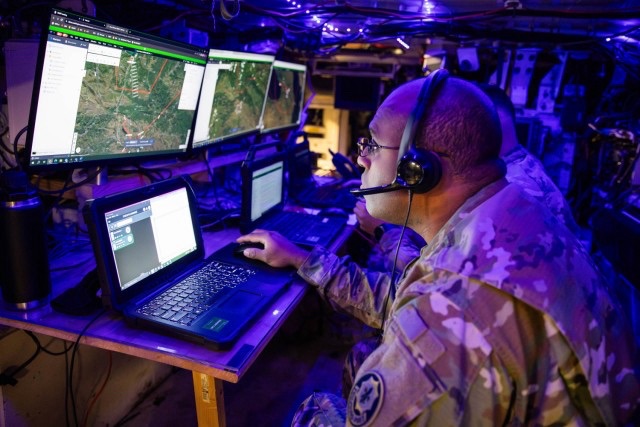
Dark Wolf Ventures’ custom ATAK plug-in provides remote command and control of the connected radios, real time updates of physical location, short messaging, and improved situational awareness.

Jay Chapman and Brandon Newsome from Iridium conducted a demonstration of the P25 Howler in South Korea.

Even while using different digital protocols, the Howler provided seamless situational awareness and consistent communications from around the world.

The Howler in mobile IDAS configuration was connected from Fort Carson, CO to the P25 Howler in South Korea. The mobile configuration goes from storage to fully operational and backhauling over satellite in fewer than five minutes, and can even be used on the go.

darkwolfventures.com/innovations

Army Intelligence Leader: ‘Cultural Shift’ Will Help Service Become Data Centric

Thursday, January 18th, 2024

WASHINGTON — To better acquire and access data on the battlefield, the Army has revamped how it integrates data across warfighting functions, an Army intelligence leader said.

To continue on its maturity path in fiscal year 2024, the Army needs a “cultural shift” to organically transform how the service uses data, said the service’s chief intelligence officer David Pierce.

“While the Army is taking the right steps toward becoming more data-centric, technology is not enough to solve enterprise data challenges,” Pierce said. “Cultural shifts are required to change how the Army views the value of data.”

The branch will take its next steps toward becoming more data centric by moving from a “managed” maturity level to a “proactive” one, Pierce said. This includes bolstering its data literacy programs, improving data management processes, and raising the level of how Army intelligence shares and communicates with data, he added.

To improve the Army’s ability to work with data, Soldiers and civilians of all ranks must become more data literate; improving how they write, understand, analyze, and communicate information.

Introduced in fall 2022, the Army Data Plan established a service-wide framework that adopted a new governance model focused on giving the warfighter advantages through proper data use. The initiative falls in line with the Secretary of the Army Christine E. Wormuth’s pledge for the Army to become more data centric.

Accurate, timely data will enable commanders to make informed battlefield decisions according to the Army’s Data Plan.

The Army changed roles and responsibilities for to become more effective in its data management process, Pierce said. Army units assigned “data champions” to foster a culture of data centricity. Pierce added that Army Intelligence has encouraged innovation by supporting small, successful intelligence communities including one at Fort Eisenhower, Georgia.

There, the 513th Military Intelligence Brigade Pierce said Army Intelligence wanted to learn from the brigade’s successes and adopt and scale their practices across all of Army Intelligence.

Similar to what the 513th created at Fort Eisenhower, Army Intelligence and Security Command, or INSCOM, intelligence data science groups scheduled “hackathons” where intelligence professionals could meet and share ideas while solving real world challenges.

The 513th MIB and the U.S. Military Academy at West Point formed a Data Literacy Task Force to improve the unit’s understanding and use of data. The task force achieved that goal by having intelligence professionals take Data 101, West Point’s data literacy course.

The task force encourages innovative solutions while boosting data literacy and readiness, which in turn helps intelligence brigades in real world missions, said Col. Molly Solsbury, 513th MI Brigade commander. Pierce said data accessibly also plays a significant role in multi domain operations, part of joint, all-domain operations.

“Multi-domain operations is largely informed by what a commander can see, both strategically across the globe and within their battlespace,” Pierce said. “Access to the data … is critical to achieving decision advantage. While the Army still has improvements it needs to make to its sensor capacity, the data we have today still needs to be able to be discovered and delivered to the right platforms and tools of choice.

Pierce said that as the Army’s access to data expands, the service will have more emerging opportunities to find insights that inform commanders’ decisions and create better strategic outcomes. Accessible data will also raise the speed of those decisions.”

“The landscape of data has foundationally changed with globalization and the overwhelming increase of digital information,” Pierce said. “While data has always been critical, the growing scale with which the Army works with data and the breadth of available digital systems and networks that connect them changes how the Army consumes and transforms data into actionable insights and knowledge that commanders can use for decision-making.”

Pierce added that the service’s ability to access and use data directly impacts the Army’s global operations dedicated to addressing worldwide security threats.

By Joe Lacdan, Army News Service

VENDORS WANTED! Exhibit at Canada’s Largest Private Range Day and Expo for Military and Law Enforcement

Wednesday, January 17th, 2024

Rampart is calling for exhibitors to register for Rampart Range Day and Expo 2024 – Canada’s largest private Range Day and Expo for Military, Law Enforcement!  This highly anticipated event gives qualified end-users a one-of-a kind chance for training, networking and hands-on experience with the latest tactical equipment, technology, and firearms.

As a vendor, Rampart Range Day and Expo presents an unbeatable opportunity to showcase your products to over 600 qualified end-users and purchasers in a dynamic, secure environment.  

Registration will fill up fast, so act now to secure your booth!

rampartcorp.com/range-day-vendor-registration


Army Depot Leads Way in Transitioning to Safer Firefighting Foam

Wednesday, January 17th, 2024

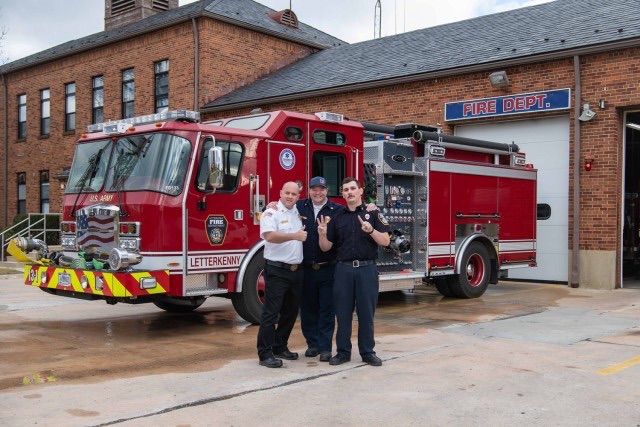
CHAMBERSBURG, Pa. — Letterkenny Army Depot made considerable strides in supporting the Army’s three-pronged approach to address per- and polyfluoroalkyl substances, known as PFAS.

In line with the National Defense Authorization Act for fiscal year 2020, which prohibits the use of fluorinated aqueous film-forming foam, or AFFF, at any military installation after Oct. 1, 2024, LEAD Fire and Emergency Services transitioned all three of their engines to the updated military specifications for land and maritime firefighting agent, fluorine-free foam, known as FFF.

Under the direction of Fire Chief Dave McGlynn and the supervision of Fire Capt. Scott McGonigal, the LEAD Fire and Emergency Services team successfully transitioned Engine 13-1 with a 50-gallon capacity, and Engines 13-2 and 13-3 with 30-gallon capacities each, Dec. 12 – 13, 2023.

“This achievement not only underscores the Army’s commitment to environmental stewardship and public health but also positions Letterkenny Army Depot and its Fire and Emergency Services team as a benchmark in military environmental initiatives,” McGlynn said. “Our success in transitioning to PFAS-free firefighting solutions exemplifies the Army’s role as a leader in sustainable and health-conscious practices.”

As LEAD embarks on supporting the Army’s Organic Industrial Base 15-year Modernization Implementation Plan, environmental and operational initiatives such as the fluorine-free foam transition postures LEAD Fire and Emergency Services to support modernization efforts.

“This transition will ensure that LEAD Fire and Emergency Services is properly equipped to offer safer protection to the depot during the modernization and construction phase,” McGlynn remarked. “In addition, this will help us continue to offer our service to the depot and surrounding community in a safer way.”

Letterkenny’s Fire and Emergency Services department services the entire installation and supports the Franklin County community through mutual aid agreements.

“The fact that this foam is PFAS-free ensures that we can deliver safer foam in our emergency response,” McGlynn stated. “Through Franklin County Fire Chief’s Association meetings, I’ve learned that Franklin County is also in the process of transitioning the foam on apparatuses throughout the county.”

The LEAD Fire and Emergency Services team worked in close coordination with the Directorate of Public Works and the Environmental Division to safely transfer and dispose of the old fluorinated aqueous film-forming foam.

“This transition was successfully accomplished through the mutual partnership and support from the entire Letterkenny team,” McGlynn said. “As in everything, communication is the key to success. This particular effort was a success because of the relationships and good communication between LEAD, Army Materiel Command and Aviation and Missile Command.”
LEAD and the Army are collaborating on a comprehensive assessment of areas where PFAS-containing chemicals were used and stored on-post. The results of this assessment and information gathered from groundwater sampling, performed in cooperation with local residents, will be used to develop an effective strategy to remediate the effects of past discharges.

“Removing all the fluorinated aqueous film-forming foam from Letterkenny ensures that a potential source of PFAS is eliminated,” stated Amy Renshaw, a physical scientist and installation restoration program manager and BRAC environmental coordinator for LEAD. “This transition greatly supports our assessment and helps ensure the success of the PFAS removal efforts.”

Limited sampling conducted during an onsite assessment at Letterkenny in 2021 found that locations related to past fire training with potential releases showed elevated PFOA/PFOS concentrations. The assessment led Letterkenny to seek to test off-post drinking water wells that could potentially be affected due to depot operations.

In July 2022, the U.S. Army conducted testing of 20 drinking water wells on private properties, including two community wells serving multiple residences, near the depot and found zero wells with concentrations that exceed 70 parts per trillion, the Environmental Protection Agency’s former lifetime health advisory level.

In a continued effort to determine potentially affected areas, Letterkenny is preparing to expand the evaluation area later this year. The Army will be contacting owners of properties adjacent to the depot to seek permission to test the quality of drinking water in wells. These tests will help assess if past industrial operations have potentially impacted the wells’ water.

The Army prohibits the use of AFFF for maintenance, testing and training on its installations and only uses AFFF for emergency responses. Now that the transition has occurred, LEAD will no longer utilize AFFF for emergency response.

“Firefighting is already an inherently dangerous job, and we felt it was vitally important to expedite this process once given the opportunity. The hope is to start a trend to get the rest of fire and emergency services to remove and replace theirs sooner than later,” McGlynn shared. “The successful replacement of PFAS-containing AFFF at Letterkenny Army Depot represents a significant stride toward a safer, more environmentally responsible military. It sets a precedent for other installations and services, highlighting the feasibility and urgency of transitioning to PFAS-free alternatives for a healthier and safer future.”

Letterkenny Army Depot is the Army’s premier professional organic maintenance facility that provides overhaul, repair and modifications for tactical missile air defense and space systems, electric power generation equipment and various military vehicles, support systems and protection programs. LEAD is a subordinate of U.S. Army Aviation and Missile Command, and is the Air and Missile Defense and Long Range Precision Fires depot, supporting systems for the Department of Defense, foreign partners and industry. Letterkenny Army Depot was established in 1942 and is a government-owned and -operated industrial installation located in Chambersburg, Pennsylvania.

By Dorie Heyer

MATBOCK Tariser Eclipse 12 Years Later!

Tuesday, January 16th, 2024

Look what MATBOCK found when digging through their videos.

For nearly a decade, the Tarsier Eclipse has been on the market. This was one of the original designs that ultimately didn’t make the cut, a few reasons why it didn’t make the cut.
The material is less protective than the current rubber body, which acts as a shock absorber.
The inability to quickly identify how open or closed the iris is, even with cold weather gloves on.
Less parts that required being screwed together
Operators were inadvertently unlocking or twisting the body off when they adjusted the iris to “fully open” or “fully closed”.
Here is a cool pro-tip they just posted the other day.

If you’re interested in scheduling a meeting with the MATBOCK Team at Shot Show, please email sales@matbock.com

www.matbock.com

Army Asks for Help in Alleviating Burden on Missile Air and Missile Defense Soldiers

Tuesday, January 16th, 2024

WASHINGTON — The Army and the joint force must help reduce the stress of heavily tasked Soldiers in air and missile defense formations, an Army leader told lawmakers on Dec. 7.

The Joint Integrated Air and Missile Defense force has taken increased importance in ongoing combat operations, said Maj. Gen. Sean Gainey, director of the Joint Counter-Unmanned Aircraft Systems Office and director of fires, Office of the Deputy Chief of Staff for Operations, Planning and Training. U.S. Army air and missile defense deployments worldwide have greatly impacted Soldiers and their families, he said.

“We’ve asked a lot of our air and missile defense formations, and in every instance, they have responded to every call,” Gainey said to the House Armed Services Committee’s subcommittee on strategic forces. “The cost has been decreased time [at] home. It’s having a strain on the force. Army leadership recognizes that strain. And the Joint Staff and [Army] leadership has looked at reducing demand.”

Brig Gen. Clair Gill, Joint Staff deputy director for regional operations and force management, said missile-related threats have rapidly expanded and grown in sophistication, maneuverability and lethality, placing more stress on Soldiers and troops in other branches.

Nearly all Soldiers in air defense units have exceeded the Secretary of Defense requirement of remaining home for a minimum of two years following a one-year deployment, Gainey added.

Gainey said that the Army shares the responsibility of integrated missile defense with other services. He said to alleviate the burden placed on Soldiers, the Army has been working closely with sailors assigned to the Navy’s Aegis Ballistic Missile Defense System and troops in the Air Force counter-air operations program. Soldiers have also worked closely towards integration with allied nations during mass exercises.


“This additive capability, and its associated force structure is designed not only to defeat the threat, but to minimize the impact on Soldiers and their families,” said Gainey, who the Senate recently appointed to the rank of lieutenant general and will become commander of the Army Space and Missile Defense Command in Redstone Arsenal, Alabama.

Gainey asked for the help of lawmakers to assure funding for construction of facilities and quality of life initiatives for air and missile defense Soldiers, including those assigned to the defense of Guam.

“Support to the quality of life programs will also be a critical part to continue the improvement in getting after the health of force initiatives,” Gainey said. “The Air and Missile Defense formations are the most deployed formations in the Army. And several times those systems are deployed early into an environment, the quality of life facilities aren’t in place for the Soldiers.”



Soldiers and sailors have been building the defense infrastructure of Guam, a strategic location for U.S. forces in the Pacific that could be pivotal in future conflicts. Soldiers assigned there not only have limited services and facilities but must also contend with geographical challenges such as typhoons.

Gainey said the military and government must act now to lessen the burden on missile defense Soldiers and their families. Families must endure long periods of separation when Soldiers frequently deploy.

“The importance of the work that our air and missile defense Soldiers do each and every day in support of the Army, and the nation cannot be overstated,” Gainey said. “And I want to thank you for your continued support to them and their families. Our Army’s contribution to defeat the wide range of evolving threats continues to improve in both capability and capacity as we build towards the future Army.”

By Joe Lacdan, Army News Service

New Army Space Vision: Actualizing Multidomain Operations

Sunday, January 14th, 2024

WASHINGTON — “The Army Space Vision will ensure our commanders integrate space-based operations into all aspects of our operational planning and execution to prevail on tomorrow’s contested battlefields.” — The Honorable Christine Wormuth, 25th Secretary of the Army.

Army space will reach new heights in 2024. This month, the Secretary of the Army, Chief of Staff of the Army and Sergeant Major of the Army published the Army Space Vision outlining a renewed focus for Army space activities. The new space vision directs the Army to concentrate on: (1) integrating friendly joint, coalition, and commercial space capabilities and (2) interdicting adversary space capabilities to protect friendly forces. These two roles and responsibilities are critical components to multidomain operations, and they enable the Army to effectively shoot, move, communicate, and survive on a 21st-century battlefield. The Army Space Vision focuses the scope of Army space operations to its core interests while acknowledging the Space Force mission to provide mission-critical space capabilities to the Joint Force.

The Army Space Vision is a call to action for commanders and staffs, at every echelon, to better understand how the space domain impacts land operations and how operations on land can impact the space domain. As the Army prepares for large-scale ground combat operations against peer competitors, the Army cannot take friendly space capabilities for granted or discount adversary space capabilities. This reinforces guidance outlined in Army Field Manual 3-0 emphasizing commanders and their staffs require an increased understanding of the space domain and the Army can no longer assume it can operate unobserved. Additionally, commanders cannot assume they will have unconstrained use of space capabilities.



To increase the Army’s collective understanding of the space domain, commanders should seek out Army space professionals within their organization or their higher headquarters. Army space professionals can help units by increasing their knowledge of friendly and adversary space capabilities and, more importantly, how they affect operations on land. The Army must integrate its space professionals into day-to-day operations and more long-term planning efforts at a minimum. They can also spearhead leader professional development sessions that emphasize the integration of friendly space capabilities to enhance all Army warfighting functions and the interdiction of adversary space capabilities to protect friendly forces.

As the Army seeks to integrate joint, coalition, and commercial space capabilities it must prioritize the following space mission areas (1) Positioning, Navigation, and Timing (PNT) (e.g., Global Positioning System), (2) Satellite Communications (SATCOM); (3) Intelligence, Surveillance, and Reconnaissance (ISR); and (4) Missile Warning. These are not the only space mission areas; however, these four space mission areas are the most consequential for the Army to carry out its mission. Additionally, the Army still develops ground user equipment in concert with its joint, coalition, and commercial space capability providers. As the Army uses friendly space capabilities, commanders and staffs need to know the interdependencies and potential vulnerabilities.

When it comes to interdicting adversary space capabilities, Army commanders and staffs must understand space domain threats and how they impact land operations. Rapid advancements in adversary space capabilities pose a significant risk to the Army and land forces particularly. For instance, adversary PNT systems enable long-range precision-guided munitions, SATCOM provides beyond-line-of-sight encrypted communication for command and control, and ISR allows persistent observation and geolocation. To mitigate the threat, Army space professionals can conduct space operations that deny or degrade adversary use of space for hostile purposes. Interdicting adversary space capabilities protects friendly forces and is an essential element in multidomain operations.

The Army Space Vision also differentiates Army space from the other services. Since the Space Force establishment, each service has retained a cadre of space professionals and service-unique space capabilities. All services integrate joint, coalition, and commercial space capabilities, and most services conduct space operations to interdict adversary space capabilities. The common thread among the services is tailoring space professionals and space capabilities to their domain. For the Army, its space professionals directly support ground maneuver commanders on the land domain. The Army specially designs its space capabilities to co-locate and maneuver with ground forces at the forward edge of battle. These service-unique space capabilities are smaller in size, more mobile, produced at a greater scale, and built for combat.

The Army looks forward to actualizing the new vision over the coming months and years. In addition to the Army Space Vision publication, there are other momentous changes taking place too. First, the Army proponent for space and high altitude, the U.S. Army Space and Missile Defense Command, recently had a change of command ceremony as it said farewell to Lt. Gen. Dan Karbler and welcomed Lt. Gen. Sean Gainey. Second, the Army is developing and fielding new capabilities to interdict adversary use of space for hostile purposes. Third, the Army is also contemplating elevating its space operations career field from a functional area to a branch. Regardless of whether the space operations career field becomes a branch, there is consensus that Army space professionals, capabilities, and formations will continue to grow.

As the new vision surmises, the Army’s next fight will occur across multiple domains, and successful operations in and through the space domain will be critical to our success. In other words, space is important to the Army and will become increasingly more important going forward. Army commanders and staffs must know how the space domain affects land operations, and how they can affect the space domain. The interplay among domains is a principal reason the Army adopted multidomain operations as its operating concept. The Army Space Vision allows the Army to actualize multidomain operations with its renewed focus on Army space operations. Army senior leader endorsement of the new vision concurrently recognizes the importance of the space domain and substantiates increased investments in Army space professionals, capabilities, and formations.

By COL Pete Atkinson, HQDA Space Chief

371st Special Operations Combat Training Squadron Increases Reach, Brings Training to Audience

Saturday, January 13th, 2024

AIR FORCE SPECIAL OPERATIONS COMMAND —  

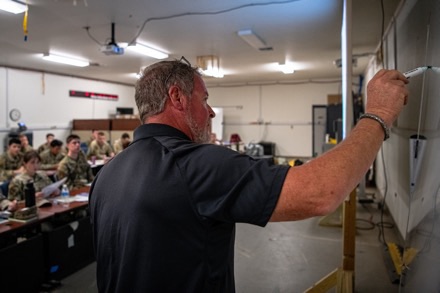
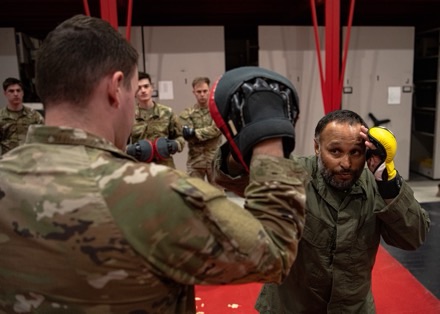
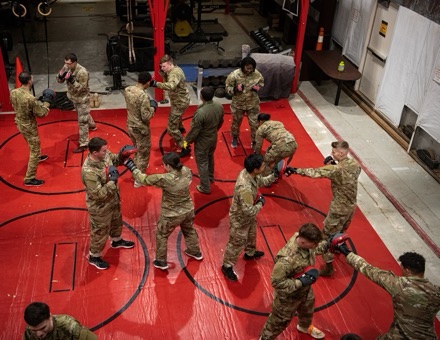
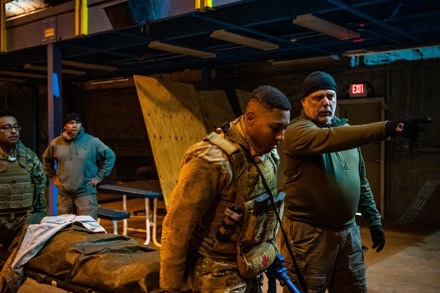
Members of the 371st Special Operations Combat Training Squadron Mobile Training Team (MTT) brought the new Special Operations Task Unit-192 course to a mission sustainment team assigned to Cannon Air Force Base last quarter.

Over the course of a month, 371st SOCTS executed two iterations of SOTU-192, training fifty Air Commandos for deployment. This specialized ground combat training included instruction in land navigation, combatives, practical weapons training, tactical combat casualty care, and active shooter/care under fire scenarios. Additionally, they covered Special Operations Task Group and Joint Task Force awareness in preparation for operations in each echelon’s respective future operating environment.

“The planning for this course, which started in November 2022, provided learning through realistic hands-on training and adaptive scenario-based exercises to reinforce learning,” said Colonel Robert Johnston, Air Commando Development Center-Provisional commander. “The training objectives are designed to sharpen their skills and encourage critical thinking to adapt to operations before the adversary can react.”

The 371st SOCTS, which falls under the ACDC-P, is the formal training unit responsible for conducting Programmed Ground Training of Air Force Special Operations Forces on behalf of all core-SOF and non-core SOF personnel.

The SOTU-192 is one of several formal training courses offered by 371st SOCTS that uses an attribute and scenario-based training model to deliver combat ready airmen who can think and operate in all domains.

“Our goal is to provide the training our Air Commandos need to operate competently and confidently,” said Johnston. “By bringing this training to Cannon, we’re developing empowered leaders with the skills to impose dilemmas for our adversaries and ultimately deliver the lethality needed to win.”

The mission of 371st SOCTS is to enable AFSOC Force Generation development by providing SOTU, Special Operations Task Group, Mission Sustainment Teams, and Theater Air Operations Squadron elements combat ready airmen who can think and operate in the air, land, and human domain. Contact the Air Commando Development Center for more information concerning Education, Training, and Experiential opportunities.

By 1st Lt. Cassandra Saphore

Air Force Special Operations Command Public Affairs