Atrius Development Group

Archive for the ‘Guest Post’ Category

Army Concludes Network Modernization Experiment 2023

Sunday, December 10th, 2023

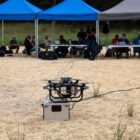
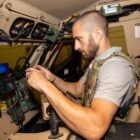
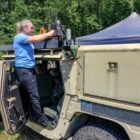
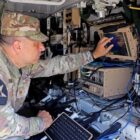
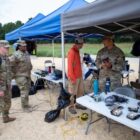
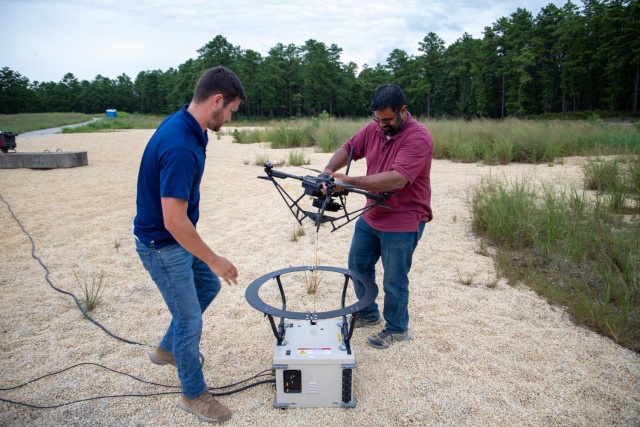
JOINT BASE McGUIRE-DIX-LAKEHURST, N.J. — The Army completed its annual capstone Network Modernization Experiment, or NetModX, after 10 weeks of experimentation spanning 62 technologies.

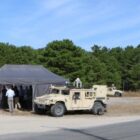
Across three locations in New Jersey and Maryland, the Army’s Command, Control, Communications, Computers, Cyber, Intelligence, Surveillance and Reconnaissance Center and partner organizations experimented with a broad spectrum of network-related capabilities in an operationally realistic, threat-informed environment. The C5ISR Center is an element of the Combat Capabilities Development Command.

Because of the Army network’s vast reach, NetModX 23 encompassed 17 focus areas and five modernization priorities: Future Vertical Lift, Long-Range Precision Fires, Network, Next Generation Combat Vehicle and Soldier Lethality.

“As an enabler for multiple Army technologies, the network and its performance in multiple dimensions becomes critical to overall mission success,” said Joe Saldiveri, NetModX 23 lead strategic planner.

NetModX 23 featured projects leveraging a live, virtual and constructive environment that enables experimentation in a distributed manner. LVC assists the NetModX project management team to provide an all-inclusive service by combining real and simulated capabilities to simulate technologies under experimentation. The LVC environment fills in gaps where real systems are too expensive or too scarce to include.
“The C5ISR Center offers a critical service to the C5ISR community by providing the environments and engineering expertise to experiment and inform complex C5ISR integration decisions. LVC is a tool that enables us to answer more complex questions with greater fidelity and more efficiency. We continue to invest and work with our partners in building out our LVC capabilities — to ensure we are pushing the state-of-the-art boundaries,” said Seth Spoenlein, assistant director for system integration.

As part of NetModX, the C5ISR Center routinely partners with a fellow Army R&D organization, DEVCOM Analysis Center, to create an operationally relevant experimentation environment. This environment is vital to experimentation as it exposes emerging technologies to realistic threats for greater learning.

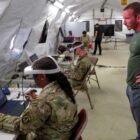
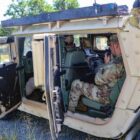
In addition to the work of Army scientists and engineers, the event included Soldier participation from the 75th Innovation Command, 101st Airborne Division and Fires Capabilities Development and Integration Directorate. This allows real-time Soldier feedback on how emergent technologies affect mission threads and performance within those threads.

“Soldier participation in NetModX allows technology developers to gain insights into how Soldiers would interact with the technology in an operational setting, providing valuable lessons across a broad range of technology readiness levels,” said Noah Weston, chief of C5ISR Center’s Strategic Experimentation Office.

New this year was Innovation Week, a two-week extension of NetModX with a focus on sensor-to-shooter experimentation, augmented by LVC capabilities to enhance realism. The intent was to explore high-risk, high-reward experimentation, to push the boundaries of learning by exercising a common sensor-to-shooter mission thread using uncommon technologies and network architectures.

Innovation Week resulted in a series of firsts for the Army network enterprise, providing a basis of knowledge for further exploration, Weston said.

“Leveraging initiatives such as Innovation Week, the Army can discover potential leap-ahead technologies or architectures that are distinct advantages over currently deployed systems. Innovation Week is focused on reducing risk for both our internal science and technology programs and, more importantly, our transition partners. It provided an operationally relevant “safe to fail” environment to conduct systems of systems experimentation,” he said.

By Dan Lafontaine, DEVCOM C5ISR Center Public Affairs

Some photos by James Lee, RJ Regars, and John Tang, DEVCOM C5ISR Center
Fairchild AFB Demonstrates Strategic Deterrence Readiness During Titan Fury 24-1

Saturday, December 9th, 2023

FAIRCHILD AIR FORCE BASE, Wash. (AFNS) —  

Airmen assigned to the 92nd and the 141st Air Refueling Wings conducted exercise Titan Fury 24-1 at Fairchild Air Force Base, Nov. 13-17.

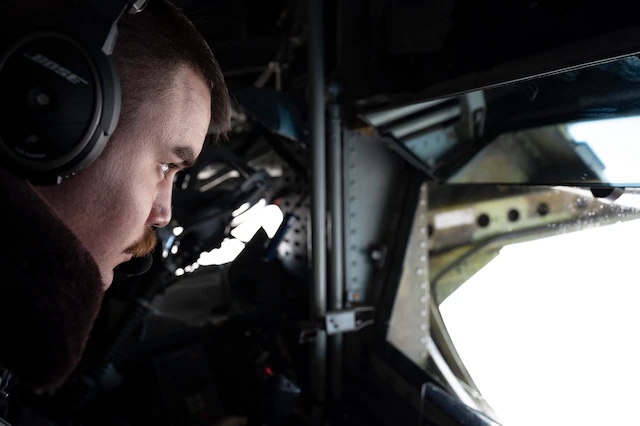
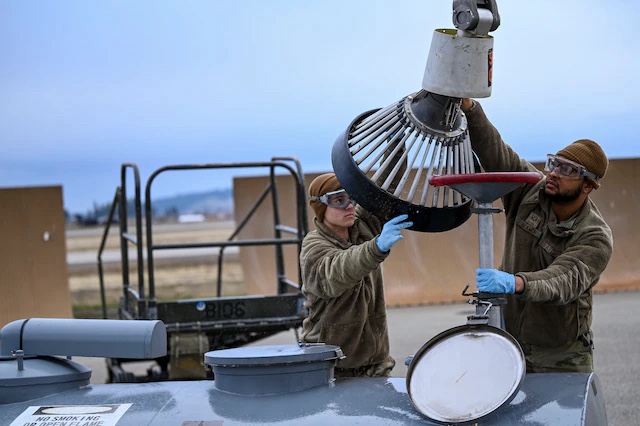
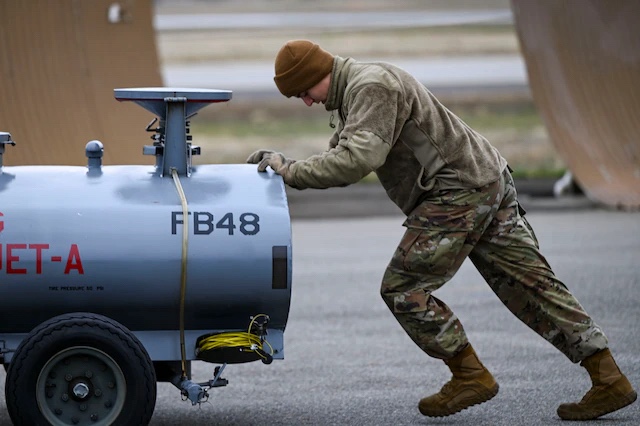
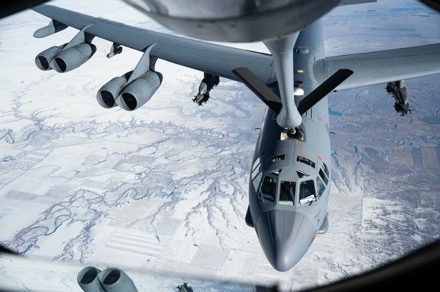
During the exercise, Airmen demonstrated how various support activities contribute to mobilizing KC-135 Stratotankers at a moment’s notice if called upon to support strategic deterrence and other National Defense Strategy priorities.

“It’s critically important that Fairchild Air Force Base conducts exercises like this for one reason only, and that’s deterrence,” said Lt. Col. William Dowd, 97th Air Refueling Squadron commander. “We have to send a clear message to our adversaries and allies alike that Fairchild Air Force Base stands ready to execute this mission. Without making sure our crews are ready and able—regardless of how hard it is and how fast we need them to be—we can’t ensure the delivery of deterrence worldwide.”

For decades, the KC-135 has been the backbone of Air Mobility Command’s air refueling capabilities around the world because of its ability to extend global reach and project U.S. airpower.

Dowd explained how teamwork and collaboration are the keys to Fairchild AFB’s ability to keep this proud tradition going strong.

“The teamwork that goes into executing a mission of this scale really boils down to the relationship between operations and maintenance, then everything else has to come up and build the support pyramid for those two,” he said. “It is a challenging week for everybody, from maintenance and operations to the defenders in security forces who protect the ramp and aircraft and the folks in the Force Support Squadron who are turning out meals for them and bringing food to the crews at the jet.”

Dowd also praised the hard work and long hours of airfield managers, fuel operations, safety, inspector general and the other essential functions of the exercise that enable mission readiness.

“We could tell they were getting tired, but there was a gleam in their eyes, and we knew they were ready to show the world that Fairchild is ready to execute this mission,” he said. “The 92nd ARW, along with our Guard partners, the 141st ARW, conduct these exercises to ensure we are always prepared because there isn’t an aircraft in our fleet that can kick ass without tanker gas.”

In addition to the 92nd ARW active duty and 141st ARW Air National Guard units at Fairchild AFB, TF-24-1 included aircraft and personnel assigned to the 912th Air Refueling Squadron who traveled from March AFB, California, to participate. The 912th ARS is a geographically separated unit of the 92nd ARW.

According to Lt. Col. Roque Zarate, 912th ARS director of operations, participating in the exercise enabled his unit to integrate with 92nd ARW Airmen and build interoperability in a training environment that resembles the manner in which they would operate during a real-world scenario.

“Titan Fury is important, not only for the aircrews and maintenance, but for our controllers as well,” he explained. “They have to practice things that maybe they’re not used to with the crews that are organic to the 92nd. So, for them to actually integrate us into the exercise, being a geographically separated unit, there’s a lot more planning and a lot more nuances. It’s important for everybody to exercise the way we would go to war, or really, to deter our adversaries from attacking us.

“It’s nice just for us to be able to come here and see how our parent wing executes the same [mission],” Zarate added. “We’re taking lots of notes on how we can do things better at March, and we’re also providing notes to Fairchild on what they can do better.”

Master Sgt. Dustin Brockman, a generation superintendent for TF 24-1, highlighted the importance of exercising to build both proficiency and speed.

“[Getting] the aircraft ready quickly is important,” he said. “If it was a real-world situation, we don’t know how fast we would need to act. If we take too long to get ready, then we might not be able to meet the mission requirements. We work quickly yet safely to get the aircraft generated as fast as possible.”

Like many Airmen, this exercise was a first for Capt. John Will, a KC-135 pilot assigned to the 97th Air Refueling Squadron. He said his first Titan Fury experience enabled him to develop at a steady pace in his role as an aircraft commander supporting Fairchild AFB’s mission.

“There’s still a lot of learning to be done,” he said. “I feel like with every step of the process, I’ve been slowly learning this mission and getting better at it. We do other smaller exercises and classes to get us ready for this, so it’s not just everything at once. Seeing it all come together has been really cool.”

This recurring total force exercise is an example of how the 92nd ARW and the 141st ARW at Fairchild AFB are engaged, postured and ready with a credible force to assure, deter and defend in an increasingly complex security environment.

“We ran 24-hour operations for a week, generated 21 aircraft and demonstrated our ability to deploy personnel and conduct our mission from anywhere,” said Col. Chesley Dycus, 92nd ARW commander. “We did this all by combining our efforts with our teammates in the 141st ARW, and the crews and jet here from the 912th ARS. I couldn’t be more proud.”

92nd Air Refueling Wing Public Affairs

FirstSpear Friday Focus – Padded Plate Backer

Friday, December 8th, 2023

The Padded Plate Backer Kit provides comfort by utilizing non-ballistic foam inserts that contour to your body. They are designed to reduce pressure points while maintaining the plate carrier’s shape. Additionally, these foam inserts can be configured multiple ways to fit your specific needs. Whether you need more support in certain areas or a different fit altogether, this kit has you covered.

Not only does this kit offer increased comfort, but it also features channels on the body side for better ventilation and shock absorption. This added feature provides air flow to the carrier, reducing heat buildup and increasing breathability. The shock absorber function works to disperse energy from impact, minimizing the damage to your body.

One of the best aspects of the Padded Plate Backer is its minimal weight and bulk. The foam inserts do not weigh down your carrier and they do not add unnecessary bulk. With a weight of only 13oz, this kit is perfect for those who are always on the go. The lightweight design allows you to move freely and with ease, while the foam inserts provide the necessary support.

Another advantage is ts durability. The non-ballistic foam inserts are made to last, so you can trust them to withstand harsh conditions and heavy use. These inserts are also water-resistant, protecting against moisture buildup which can lead to mold and foul odors.

Visit FirstSpear to find American Made kit and accessories, Built For The X.

Pioneering Communications Demo Starts US Army Exercise

Friday, December 8th, 2023

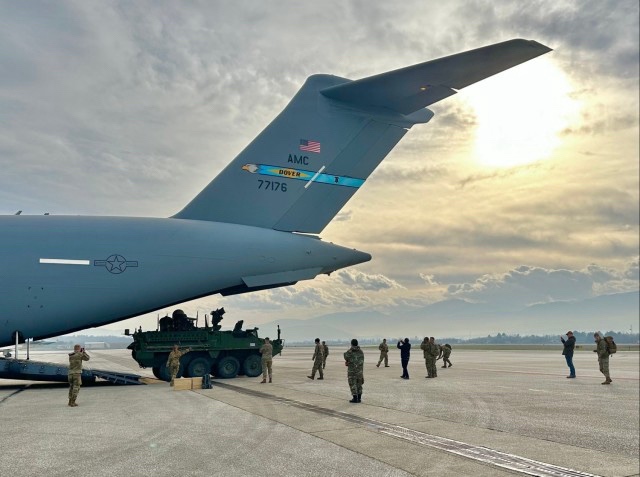
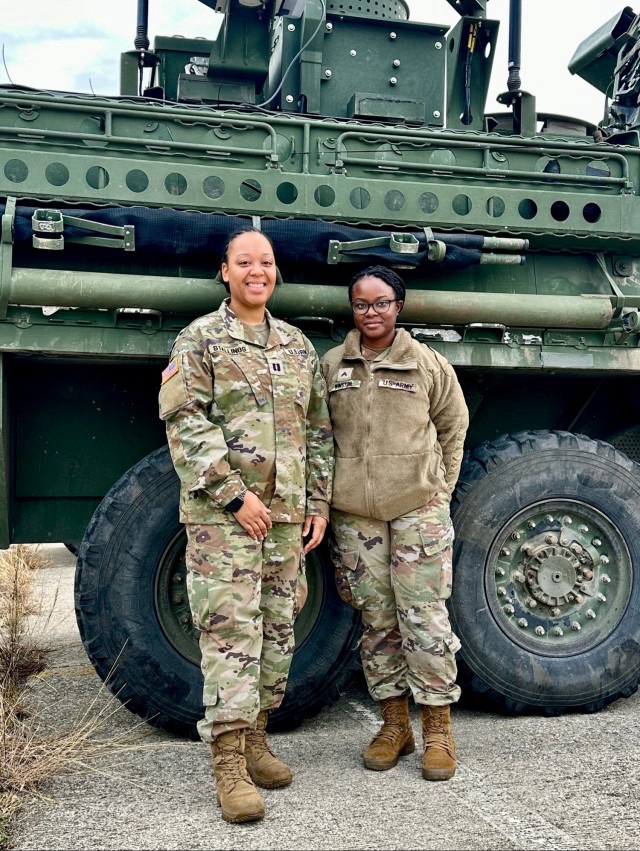
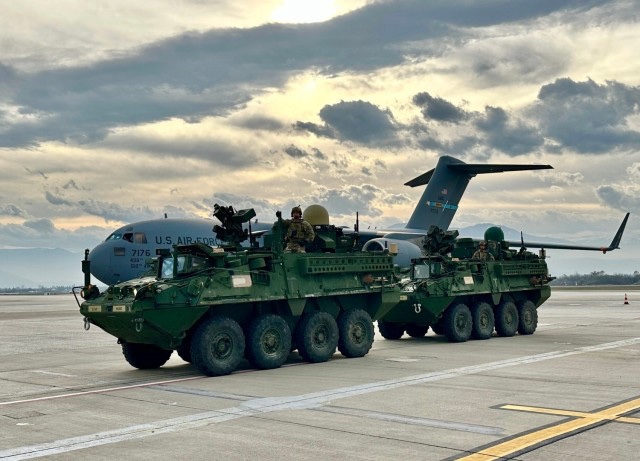
SKOPJE, North Macedonia — Soldiers with the 509th Strategic Signal Battalion, 2nd Theater Signal Brigade were the first in history to facilitate en route mission command outside of the U.S. while in-flight with Stryker vehicles as a tactical command post aboard a military aircraft, which kicked off the U.S. Army Europe and Africa exercise, Brave Partner, Dec. 1 at Skopje International Airport.

Brave Partner is a “short notice action planning exercise” that aims to enhance regional partnerships and increase U.S. force readiness and interoperability in a realistic, multinational training environment, including roughly 180 U.S. Soldiers from the 2nd Cavalry Regiment with support from 30 service members from the Army of the Republic of North Macedonia, Dec. 1-10, 2023 at Skopje International Airport and Krivolak Training Area, North Macedonia.

“I find it exceptionally phenomenal to have the opportunity to field equipment and work with partner units as well as partner nations,” said Capt. Shenelle Stallings, 509th SSB Headquarters and Headquarters Detachment commander. “The cohesion and the trust we’re building with one another — because I’m from the 509th, and we’re providing comms for 2CR, and we’re in North Macedonia — so all those pieces coming together and seeing how these things work makes it all the more worthwhile.”

Stallings said her team is making history by validating en route mission command that’s first-of-its-kind on a strategic network, and they’re setting a foundation and building it from the ground up in their area of operation. They achieved excellent signal speeds that exceeded their expectations with minimal latency. They faced snow and heavy clouds, which had the potential to degrade signal transmissions. She explained that taxiing and takeoff were the most important parts of the test while transitioning between equipment from ground to air, and that was also successful.

“I was on a video chat the entire time, and it was crystal clear,” said Stallings. “We use the Voyager 8 and the KAFMA antenna that allows us to reach back to our strategic network in Italy, and then we’re also able to come here with our Starlink and transition to that seamlessly.”

One of Stallings’ Soldiers, Cpl. Deandra Winston, is an expert on communications equipment and prefers the Voyager 8 transit case to bulkier equipment she’s used in the past. She explained that tactical signal equipment is becoming increasingly innovative and mobile. Being able to connect users without waiting for equipment to be set up on ground is key.

“It will create an ease of understanding between troops that are coming and going and a faster understanding of the mission that needs to be executed,” said Winston. “New technology comes out every day, and it’s best to not be scared to try new tech. Everything takes time, and I understand that, but it’s time to get rid of the old and use the new.”

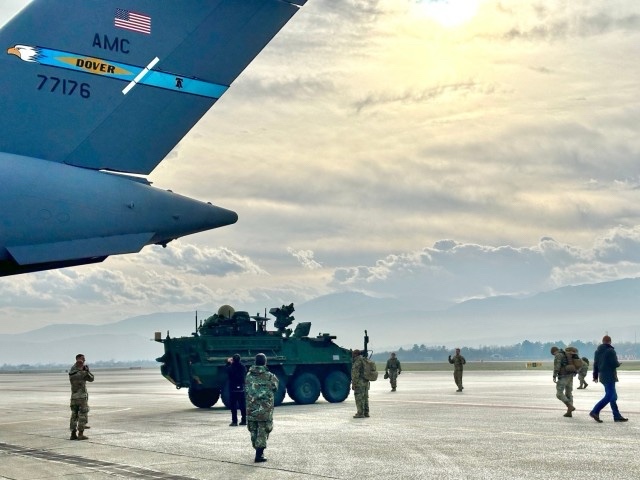
As part of USAREUR-AF’s Tactical Mission Data Platform, 2CR’s Stryker vehicles were a command post aboard a C-17 aircraft, demonstrating innovation and speed in exchanging information between commanders en route in the sky and warfighters on the battlefield.

As this initial event for Brave Partner took place, the charter plane carrying a majority of the 2CR Soldiers was also arriving at Skopje International Airport.

Army of the Republic of North Macedonia Sgt. Maj. Igor Petrovski, airport liaison officer, was on-site and coordinated the C-17’s arrival as well as the charter plane’s arrival that carried most Soldiers who arrived for Brave Partner. He has a wealth of experience facilitating flights for NATO partners, including C-17s, C-130s and charter flights for the U.S.

The Republic of North Macedonia has a partnership with the Vermont National Guard, and Petrovski explained that his country’s military hosts international exercises with NATO countries, including the U.S. Army and especially the Vermont National Guard.

“We are brothers in arms with the Vermont National Guard,” said Petrovski. “The partnership is leveled up year by year.”

Army of the Republic of North Macedonia Lt. Col. Vladimir Cvetkovski, chief of the Host Nation Support Coordination Center, explained that North Macedonia is new to NATO with three years of membership, but they’ve taken many steps to maintain standards, and they are committed to training with the U.S. as well as keeping good relations with all of NATO.

“The U.S. is our strategic partner,” said Cvetkovski. “We have very good support from the U.S.”

A majority of Brave Partner is scheduled to involve live-fire ranges for 2CR Soldiers to train with Stryker armored fighting vehicles. Cvetkovski explained that Krivolak Training Area has the best terrain and facilities for that type of training. He said the training area accommodates a variety of military vehicles, aircraft and munitions.

“We have a very good training area here,” said Cvetkovski. “KTA is in the top 3 of all training areas in all of Europe.”

By Capt. Maria Salcido

Crye Precision Adds Color Options for Female Fit Uniforms

Thursday, December 7th, 2023

Now available, three new color offerings for the G4 Female Fit line.

The G4 Female Fit line tailor the uniforms specifically to a woman’s body, creating unparalleled fit and function. Combined with the feature set of the G4 line, the uniforms are now available in Ranger Green. Khaki, and Black.

www.cryeprecision.com

US Army Hosts Joint Counter-IED Exercise at Premier Pacific Northwest Training Center

Thursday, December 7th, 2023

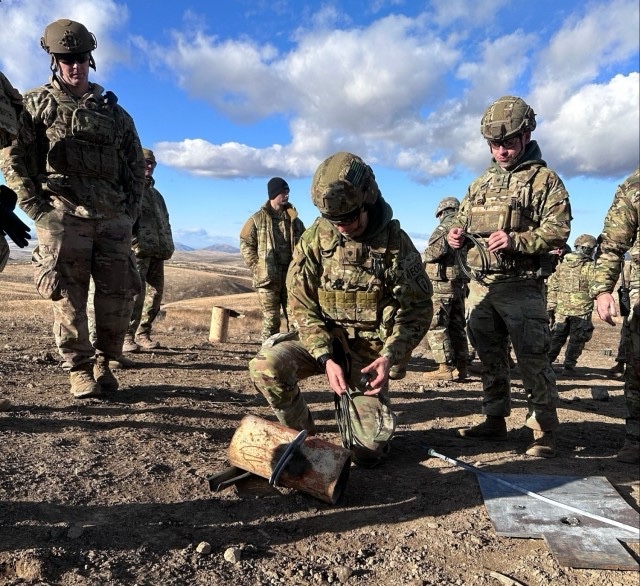
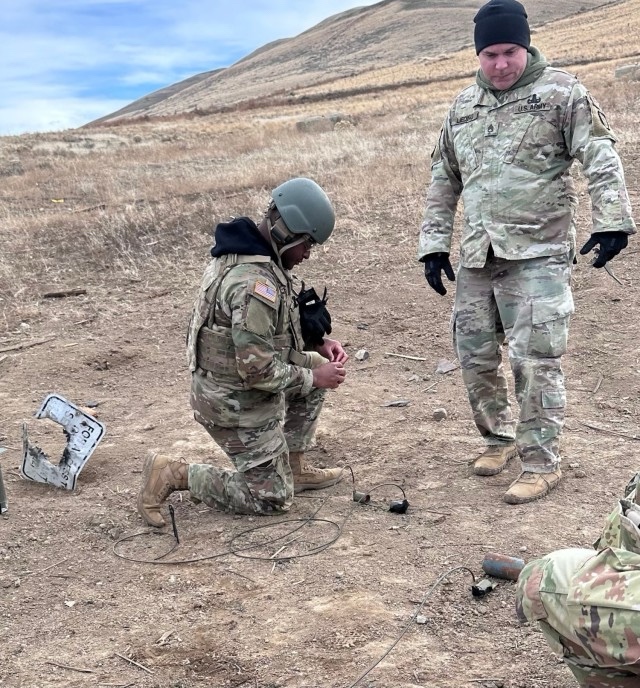
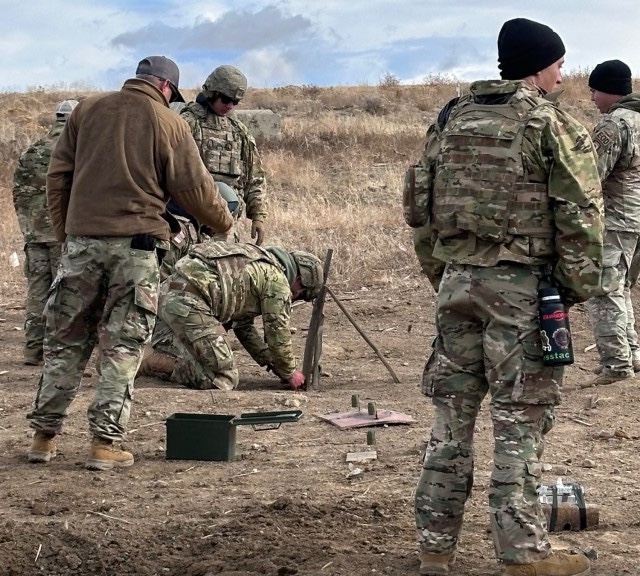
YAKIMA TRAINING CENTER, Wash. — U.S. military explosive ordnance disposal technicians and civilian law enforcement bomb squad personnel trained to combat advanced improvised explosive devices at the premier U.S. Army Pacific Northwest training venue.

The U.S. Army 53rd Ordnance Company (EOD) hosted the joint, multicomponent and interagency training with the Washington National Guard 319th EOD Company, Oregon National Guard 142nd Flight Wing Civil Engineer Squadron, U.S. Air Force 92nd Civilian Engineer Squadron and U.S. Navy EOD Mobile Unit 11 Detachment Northwest on Yakima Training Center.

FBI Special Agent Bomb Technicians and agents from the Bureau of Alcohol, Tobacco, Firearms and Explosives also participated in the training.

The counter-IED training event provided valuable experience using alternative shaped charge and water-based tools in addition to disruption tools.

U.S. Army 1st Lt. Quinton R. Reese, a platoon leader with the 53rd Ordnance Company (EOD), said the joint EOD techs discussed tactics, techniques and procedures with service-specific gear that usually only gets employed during joint advanced IED training.

“This was a great event with a much wider audience showcasing each tool that we as a total EOD force use to defeat an IED,” said Reese. “This training allowed some of our most junior team members the opportunity to see what their tools can actually do when used properly — so the first time they see one in action it’s not on a live device.”

While Army, Navy, Air Force and Marine Corps EOD techs leverage their capabilities for different missions, they also have overlapping capabilities that complement each other. Reese said experiences are also different among EOD team leaders in the same service.

“The role of Army EOD teams varies from mounted patrols through an urban environment to dismounted Special Operations Forces support,” said Reese. “The experiences of one team leader to the next could be vastly different based on the mission sets.”

“By getting the various experiences and viewpoints of both junior and senior EOD technicians from all services and components as well as civilian counterparts, we can help bridge the gap and provide a forum for increasing the tool set both literally and in the problem-solving process for all EOD technicians, regardless of service,” said Reese.

Reese started his uniformed service as an enlisted Army geospatial imagery intelligence analyst before graduating from the U.S. Military Academy at West Point and becoming an EOD officer.

A native of Coeur d’Alene, Idaho, Reese said he was inspired to serve as an EOD officer by a mentor from the 53rd EOD Company, the same company he serves in now.

“His stories of the complex problem solving and the highly technical aspects of the work appealed to me,” said Reese. “As a prior enlisted Soldier, knowing that I would go through the same training as the Soldiers I would lead was a unique opportunity I could not pass up.”

Reese said he has also witnessed the importance of noncommissioned officer leadership during a downed aircraft response on Yakima Training Center.

“Thankfully, the crew walked away from the wreck that night,” said Reese. “Getting to see the difference that we as EOD can make as well as seeing my platoon sergeant effectively take control of a scene as a team leader was awe-inspiring and made me proud to be a part of this highly specialized field.”

The 53rd EOD Company, “Fighting 53rd,” is part of the 3rd EOD Battalion, 71st EOD Group and 20th Chemical, Biological, Radiological, Nuclear, Explosives (CBRNE) Command, the U.S. military’s premier CBRNE formation.

American Soldiers and U.S. Army civilians from the 20th CBRNE Command deploy from 19 bases in 16 states to confront and defeat the world’s most dangerous hazards.

Capt. Logan T. Morris, the commander of the 53rd EOD Company, said the training event gave the joint EOD and civilian bomb squad techs the opportunity to share their knowledge about functions, capabilities and branch-specific explosive tools and techniques.

Originally from Redmond, Oregon, Morris became an EOD officer after being mentored by his ROTC commander at Oregon State University, then Lt. Col. Eric Larsen, who was an EOD officer.

Morris said the Yakima Training Center is the ideal location for large-scale training events. The 327,000-acre training center can accommodate brigade-sized units for maneuver exercises.


The Eastern Washington State training center is more than two and a half hours away from Joint Base Lewis-McChord, Washington.

“Yakima Training Center boasts nearly limitless opportunities for training to scale with the demands of units requirements,” said Morris. “YTC frequently hosts Canadian, Singaporean, Japanese, Korean and other Pacific Theater aligned joint and national training events and it is a bastion for brigade-level and below training with nearly no limitations.”



By Walter T. Ham IV

Department of the Air Force Leaders Emphasize Adapting AI for Warfighting Success

Wednesday, December 6th, 2023

ARLINGTON, Va. (AFNS) —  

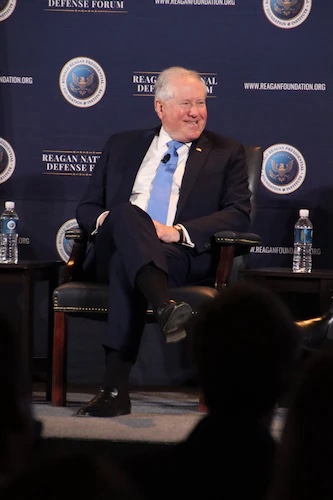
Air Force Secretary Frank Kendall made it clear that the Air Force and Space Force are fully committed — and pushing hard — to develop and deploy artificial intelligence as a key element in meeting security challenges posed by China and other adversaries Dec. 2.

Kendall’s remarks were not new, but by voicing them during a session at the influential Reagan National Defense Forum, he added additional weight to the Department of the Air Force’s efforts to use AI as part of a larger push to modernize.

“I care a lot about civil society and the law of armed conflict,” Kendall said. “Our policies are written around those laws. You don’t enforce laws against machines, you enforce them against people. Our challenge is not to limit what we can do with AI but to find how to hold people accountable for what the AI does. The way we should approach is to figure out how to apply the laws of armed conflict to the applications of AI. Who do we hold responsible for the performance of that AI and what do we require institutions to do before we field these kinds of capabilities and use them operationally.”

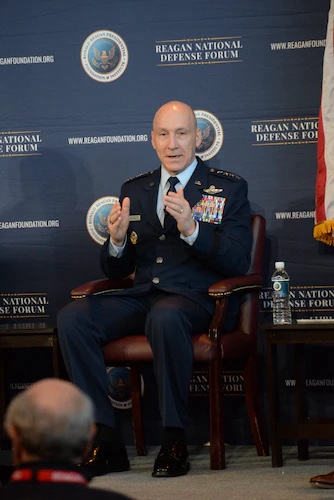
Kendall pointed out that China and other adversaries are aggressively using AI, and while the U.S. maintains an edge, it is shrinking. Kendall’s comments dovetailed with those from Air Force Chief of Staff Gen. David Allvin, who said at a separate session during the conference that the Air Force must modernize to properly meet the security threats of today.

Part of that effort, Allvin said, is diligently working to integrate AI and machine learning into new capabilities that mesh seamlessly with mission needs and proven technologies, while understanding performance tradeoffs.

“I do believe the future is going to be about human-machine teaming,” Allvin said. “Optimizing the performance and being able to operate at speed. That investment in our collaborative combat aircraft program is what is going to get us there.”

Speed and automation of AI systems have vastly shortened decision timelines. That’s why the DoD’s National Defense Strategy focuses on accelerating decision making and the way information is analyzed and shared.

“We are leveraging algorithms and starting with data fusion and being able to gain insights,” Allvin said. “The changing character of war is speed. If we are going to be privileging speed and have massive amounts of data, the ability to have algorithms and the tools that support and let the analysts do what only humans can do which is make that human decision.”

“Our job on the government side more than anything else is to thoroughly understand this technology, have the expertise we need to really get into the details of it and appreciate how it really works,” Kendall said. “To be creative about helping industry find new applications for that technology and developing ways to evaluate it get the confidence we’re going to need to ensure that it can be used ethically and reliably when it is in the hands of our warfighters.”

Replacing obsolete, legacy systems by harnessing emerging information, communications, and AI technologies to provide operational targeting and decision support with the speed, adaptability and resilience needed to fight in a highly contested environment is a priority for DAF and falls under Kendall’s Operation Imperatives.

“The critical parameter on the battlefield is time,” Kendall said. “The AI will be able to do much more complicated things much more accurately and much faster than human beings can. If the human is in the loop, you will lose. You can have human supervision and watch over what the AI is doing, but if you try to intervene you are going to lose. The difference in how long it takes a person to do something and how long it takes the AI to do something is the key difference.”

Rapid AI development requires DAF to be agile and adaptable in its approach, focusing on rapid testing, experimentation and deployment. The Department of Defense continues to maintain a robust regulatory and ethical framework to ensure the responsible use of AI in defense.

Both men stressed the importance of innovation. Allvin said that innovation is a critical element of modernization and is necessary for maintaining readiness.

“War is a human thing and the ability to leverage technology with human innovation is something we can never walk away from as we’re continuing to develop and more sophisticated systems,” Allvin said.

The Reagan National Defense Forum, celebrating “10 Years of Promoting Peace Through Strength,” brings together leaders from across the political spectrum and key stakeholders in the defense community, including members of Congress, current and former presidential administration officials, senior military leadership, industry executives, technology innovators and thought leaders. Their mission is to review and assess policies that strengthen America’s national defense in the context of the global threat environment.

Secretary of the Air Force Public Affairs

FORSCOM Commander’s Forum Outlines the Future of Army Formations

Tuesday, December 5th, 2023

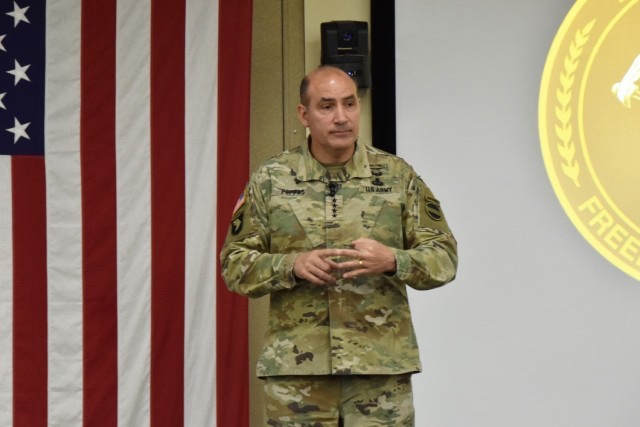
FORT LIBERTY, N.C. — Commanders and command sergeants major from across the U.S. Army Forces Command footprint gathered at Fort Liberty for the FORSCOM Commander’s Forum, Nov. 29-30, 2023. The conference brings together senior leaders from all Forces Command corps and divisions as well as the Army National Guard and Army Reserve for focused training and conversations on leading warfighters on the battlefield.

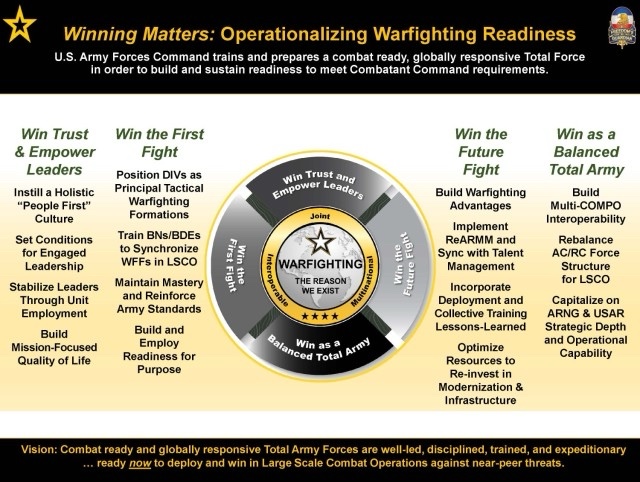
Gen. Andrew Poppas, FORSCOM commanding general, welcomed the group and explained there was much to cover over the two-days. He continued by explaining his “4-Wins:” Win Trust and Empower Leaders; Win the First Fight; Win the Future Fight; and Win as a Balanced Total Army.

“The framework we’ve laid out is the 4-Wins,” said Poppas. “This is the framework in which we move forward. And I will tell you that at every touchpoint within each one of these domains, I feel we’ve made great success. In the way we are building the team, in the way we’ve embraced it … strengthening the relationships we have and engaged leadership.”

He continued by expressing his vision of a warfighting force and professional warriors. Warriors need the mindset of always moving forward; the warrior spirit to hone yourself to be physically and mentally fit; and training methodology focused on building formations to their greatest capability, he said.

“The strength of that formation is that they rely on each other,” Poppas said. “It’s the person to your left that’s carrying the shield that protects you. It’s the strength of the formation that moves forward.”

Poppas explained the number one priority for the Army chief of staff is warfighting and FORSCOM owns warfighting. As he looked around the room, he acknowledged that the leaders sitting there were in the positions they are in due to their strong backgrounds as leaders, warfighters, and Soldiers.

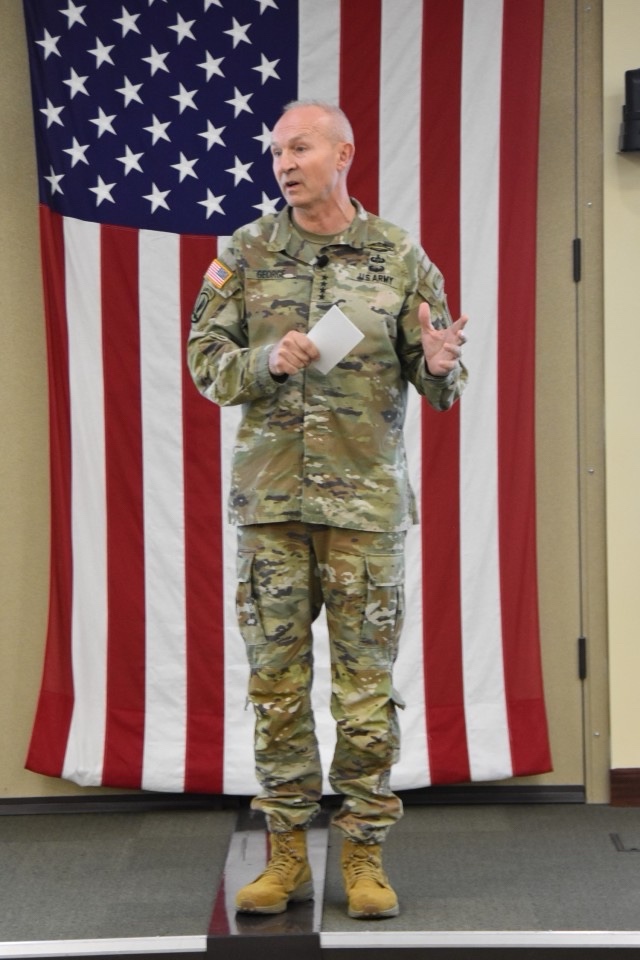
This year, the 41st Chief of Staff of the Army, Gen. Randy George, was the guest speaker for the forum. George has served as the Chief of Staff of the Army since Sept. 21, 2023. He began his discussion by acknowledging that world today is a very complex place. The Middle East, Ukraine, Taiwan and Africa were cited as just a few of today’s global hot spots the U.S. Army has interests. In addition to these topics, George recognized challenges with recruiting efforts, equipment and parts delay and budget stability.

As he continued, George shared with the group the questions he asked to his staff at the Pentagon: what can we stop doing or change; how do we adjust our processes; how can we push down authority and funding; and are we making the right trade-offs?

“I generally don’t talk about 2030 because I don’t think we have that much time,” said George. “2030 is too far down the road. We are going to be a lot different before that, I can guarantee you. We are going to be a lot different in the next four years.”

The Army chief of staff continued the conversations, outlining his some of his priorities — such as warfighting, delivering ready combat formations, adjusting the approach to military construction projects, and production of a new mobile app to help inform Soldiers and families of quality of life programs available to them.

Focusing on continuous transformation, George explained that transformation is more than just purchasing new equipment. Transformation also includes changes to processes, training and how Army formations look.

“I want our leaders to decide what our formations will look like, not a bunch of us sitting inside the [Pentagon],” explained George. “I can certainly do that, I definitely have my own opinions on a lot this, but I want everybody involved in what we’re doing.”

The topic of strengthening the profession was saved until last to emphasize the point. George shared an example from his time as a division commander. Underlining how he and other division commanders would share advice and lessons learned with each other to help increase lethality and warfighting capabilities.

“I remember when I was a captain and pulling the drawer open and Armor Magazine and Infantry Magazine were there, and they were very helpful,” said George. “I’m asking for your help in making sure people are writing about our profession. We should be talking about our profession.”

By Adam Luther