FirstSpear

Archive for the ‘Guest Post’ Category

US Army Holds EW Warfighters Forum

Sunday, February 25th, 2024

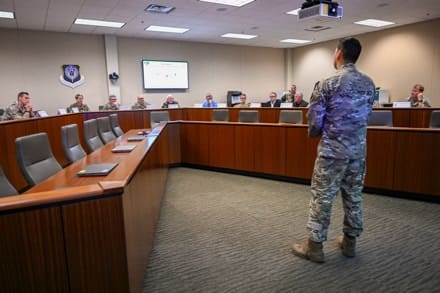
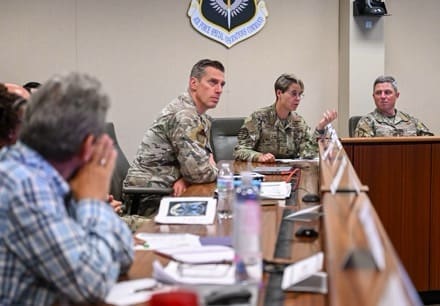
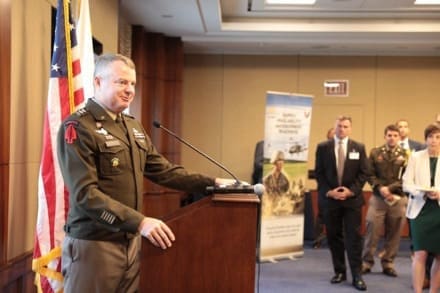
Last week leaders from across the Cyber, Signal and Intelligence communities participated in the EW Warfighters Forum, at NSA-Georgia, located at Ft Eisenhower.

The event focused on changing Army culture and finding novel solutions to technologically evolve our warfighters. Discussions focused on emerging threats, current and future capabilities and fielding requirements for the Army of 2030.

Record-Breaking Army Astronaut Receives Rare Qualification Device

Sunday, February 25th, 2024

WASHINGTON — Secretary of the Army Christine Wormuth awarded Col. Frank Rubio the Army Astronaut Device during a pinning ceremony at the Pentagon today.

Rubio spent 371 days aboard the International Space Station from 2022-2023 breaking the record for the longest spaceflight for an American astronaut.

“Col. Rubio, you are a stellar example of the Army’s core values and what it means to lead a life of service,” Wormuth said. “You inspired audiences around the world as you orbited the Earth for 371 days, and now, back on Earth, you continue to inspire others as you share your experience with the public.”

The Army awards the astronaut device to personnel who complete at least one operational mission in space. With the award, Rubio joins Col. Anne McClain and Col. Andrew Morgan as the only active-duty Soldiers authorized to wear the device.

Army astronauts choose which specialty badge the device is placed on for their uniform. Rubio will wear his on his senior aviator badge.

A former UH-60 Black Hawk pilot, Rubio flew more than 600 combat flight hours during several overseas deployments. He then transitioned to the medical field as a family physician and flight surgeon before being selected as a NASA astronaut in 2017.

He served as a flight engineer for Expeditions 68 and 69, supporting numerous research projects including particle vibration experiments, biological testing and 3D tissue printing while also performing three spacewalks outside of the station.

“What an incredible honor it is to represent the Army,” Rubio said. “And honestly, the biggest honor for me out of this badge is the fact that to me it’s the ultimate team badge. You absolutely cannot get to space on your own. It takes a team of thousands to get you to space.”

Rubio launched into space Sept. 21, 2022 aboard a Russin Soyuz spacecraft alongside cosmonauts Sergey Prokopyev and Dmitri Petelin. The crew’s initial six-month mission was pushed into a year-long stay following a space debris strike that caused their return capsule to lose all its coolant.

The trio logged more than 157 million miles during the mission and circled the globe nearly 6,000 times until finally returning to earth Sept. 27, 2023.

Back home, Rubio plans to continue working with NASA as they further their mission and he hopes to eventually return to space one day.

“There [are] few things where you can say ‘my job represents humanity,’ and that is a powerful thing to be a part of,” he said. “It’s just such an incredible experience to be able to inspire the next generation, contribute to science, technologies that we’re developing that [are] going to help humanity in ways that we probably can’t imagine right now.”

The Army has worked closely with NASA to advance space exploration since the beginning of the U.S. space program, and that partnership has produced 19 Army astronauts.

“These uniquely skilled and extremely qualified people represent the very best and most talented officers and warrant officers from within the Army,” Wormuth said. “As we humans explore further into space, and NASA returns to the moon and sets its sights beyond to Mars, the Army will continue to play an important role in the exploration of space long into the future. And we will build on the research that Col. Rubio did on the International Space Station for 371 record-setting days.”

Story by Christopher Hurd, Army News Service

Photos by SFC Nicole Mejia and Deonte Rowell

Air Force to Re-Introduce Warrant Officer Rank, Other Major Changes

Saturday, February 24th, 2024

AURORA, Colo. (AFNS) —  

To best optimize itself for Great Power Competition, the Air Force plans to, among other things, bring back warrant officers within the cyber and information technology professions, said Air Force Chief of Staff Gen. David W. Allvin during a presentation Feb. 12 at the Air Force Association’s 2024 Warfare Symposium.

That change was among two dozen announced by senior Air Force officials. Each change is specifically designed to prepare the service for strategic power challenges from competitors like China and Russia.

“Both China and Russia are actively developing and fielding more advanced capabilities designed to defeat U.S. power projection,” said Secretary of the Air Force Frank Kendall. “The need for modernization against capable, well-resourced strategic adversaries never stops. But modernization isn’t the only thing we need to do to be competitive. Today we are announcing 24 key decisions we have made to improve both the readiness of the current force and our ability to stay competitive over time, to continuously generate enduring competitiveness.”

Those changes, Kendall said, focus on people, readiness, power projection and capability development and are implemented within the Department of the Air Force, the Air Force and the Space Force.

Spotlight: Science and Tech
Within the Air Force, Allvin explained, the service is looking to better attract and develop cutting-edge talent, specifically within information technology and cyber fields. The service plans to expand technical tracks for officers and create technical tracks for enlisted, and to also reintroduce the rank of warrant officer within the information technology and cyber fields as a way to maintain technical leadership with those skills.

“We know there are people who want to serve. They just want to code for their country. They would like to be network attack people and do that business,” Allvin said. “But everybody needs to see themselves into the future beyond just this assignment or the next. So, developing that warrant officer track for this narrow career field, we anticipate will drive that talent in and help us to keep that talent. There’s something specific about this career field, why it’s attractive and it’s a nice match for a warrant officer program. The pace of change of the cyber world, the coding world, the software world — it is so rapidly advancing, we need those airmen to be on the cutting edge and stay on the cutting edge.”

The Air Force had warrant officers when it was created in 1947, after being split off from the U.S. Army. But the service stopped appointing warrant officers in the late 1950s.

Allvin also discussed changes in the way the Air Force will conduct exercises. The plan is for the service to implement large-scale exercises and mission-focused training which encompasses multiple operations plans to demonstrate and rehearse for complex, large-scale military operations, he said.

“We’re going to reorient ourselves to more large-scale exercises rather than a smaller scale that have been a product of the last two to three decades,” Allvin said. “Large-scale means multiple weapons systems, multiple capabilities, coming together in a combat-simulated environment and showing our ability to execute the mission that’s going to be expected of us in the high-end conflict.”

Exercises in recent years, he said, have already been getting bigger. But those enhancements have been driven at the local level, not from the top down. That will change.

“Our Air Force needs to institutionalize this,” he said. “And we’re going to do that.”

He said the Air Force is looking at fiscal year 2025 for its first large-scale, multi-combatant command exercise targeted at Indo-Pacom.

Chief of Space Operations Gen. Chance Saltzman said a change underway within the Space Force is to enhance readiness by implementing standards that reflect operations under contested conditions rather than those of a benign environment.

“The legacy force that we had, our roots … were built around efficiency, built around a benign environment,” he said. “So, the standards for readiness that we kind of held our forces to was different. It wasn’t built for the domains that we’re facing, a contested domain.”

Now, Saltzman said, the Space Force must rewrite its standards for readiness centered around a contested domain, rather than an uncontested domain.

Spotlight: DoD Space Strategy
That, he said, means in part having the right mix of officers, enlisted personnel and civilians in Space Force units. It also means training must be aimed at more than just procedural competency.

“As soon as you put a red force in the mix, as soon as you put a threat in the mix, it radically changes your training,” he said. “You have to have advanced training, you have to have tactics training, you have to understand how you work together, in-comms, out of comms, with other units, in order to continue to achieve the kinds of effects in a contested domain when an adversary, a capable adversary, is doing everything they can to stop you from being successful.”

Space Force, he said, will build a training infrastructure and a test infrastructure to validate its tactics so operators will know more than just how to operate equipment — but will be successful against an adversary.

Kristyn Jones, who is currently performing the duties of the under secretary of the Air Force, also pointed to changes at Department of the Air Force level. There, she said, among those changes, the department expects to create an Air Force Integrated Capabilities Office to lead capability development and resource prioritization. The office is expected to drive Department of the Air Force modernization investments.

“We’ll be looking at capabilities across our services, not in stovepipes,” she said. “We’re enabling end-to-end creation of effects. This organization will help us to prioritize our investments and will be responsible for working with us to determine the next iteration of operational imperatives.”

By C. Todd Lopez, DOD News

Vertx at EnforceTac 2024

Friday, February 23rd, 2024

Vertx is at EnforceTac 2024 in Nuremberg from February 26-28, 2024, to showcase the newly launched Recon Flex and Recon X uniform collection. Make sure to stop by Booth #679 in Hall 7 to check out their latest gear and apparel.

For more information about Vertx and Vertx Pro, please visit their website.

FirstSpear Friday Focus – Strandhögg v3 Plate Carrier

Friday, February 23rd, 2024

The Strandhögg v3 Plate Carrier maximizes 6/12 technology and rapid closure systems provided by the FirstSpear Tubes fasteners for easy donning and doffing. The front panel has an internal zippered admin pocket along with a 4″x9″ loop field for identifiers. Along the bottom of the front panel is a second loop field for Ragnar style pockets & accessories like the FirstSpear Admin Placard and Fight Panel.

The Instant Access Back Panel allows for easier access to adjust your cummerbund. Both the front and back of the carrier features interior facing channels for foam to add comfort and ventilation. These foam inserts can be removed for a more streamlined carrier. The front and back have the ability to hold both soft armor and plates that are the same size and cut as the carrier.

Visit FirstSpear to find American Made kit and accessories, Built For The X.

919th SOW Makes History, Salutes Legendary Air Force Pioneers

Friday, February 23rd, 2024

DUKE FIELD, Fla. —  

The 919th Special Operations Wing made history Feb. 3, 2024 demonstrating a new capability on the same airfield some of the Air Force’s most revered aviation pioneers trained more than a half century ago.

Throughout the four-day exercise, the unit integrated non-standard aviation, Remotely Piloted Aircraft and Mission Sustainment Team operations to prepare for future contingencies where the famed Doolittle Raiders trained for their daring one-way mission in the offensive against Japan decades ago.

“This exercise demonstrated the 919th’s ability to employ the functionality of an entire unit and establish an operational air base all while maintaining a very small footprint,” said Col. Jason Grandy, 919th SOW commander. “We developed this training to fit AFSOC’s deployment model which is focused on the competition between rising powers. We did it in a manner that also allowed us to validate a proof of concept for a few of our mission sets.”

As part of the exercise, members from the 919th Special Operations Security Forces Squadron and 919th Special Operations Medical Squadron flew aboard a C-146A Wolfhound aircraft to perform a medical evacuation for critically injured servicemembers at a remote overseas location. After the aircraft landed, members applied life-saving medical care on a simulated battlefield before loading the casualties on stretchers for transport on the C-146 back to a higher level medical facility for treatment and care.


“Our security forces members are elite and have some of the best training to protect not only the lives of aircrew but also those on the battlefield,” said Grandy.

Air Commandos from the 2nd Special Operations Squadron used the venue to continue devising strategies to enhance the capabilities of the MQ-9 Reaper. In this case, they integrated the weapons system into the exercise in ways it has not been used before.

“We are transforming for the future in every aspect of our mission,” said Lt. Col. David Payne, 2nd SOS commander. “Not only did our members accomplish the shortest known runway landing for an MQ-9 via Satellite Launch and Recovery to date, we also provided casualty evacuation overwatch, as well as ammo resupply to ground forces.”

The culture of innovation that lives within the squadron was the catalyst behind an initiative to provide an ammo resupply using an MQ-9 travel pod after completing a short field landing on Eglin Aux Field 1 (Wagner Field).

“I think it’s important to point out that in February 1942, Doolittle and his crew trained for the shortest takeoff in B-25 history (400 feet),” said Payne. “Now 82 years later, we are following in his footsteps landing the MQ-9 on the shortest known field on the same airfield. The achievement required technical order waivers which allowed for a 33 percent decrease in runway required for landing.”


Payne noted the aircraft departed the tarmac at Hurlburt Field, Fla., near a facility named The Richard E. Cole building. Cole was the co-pilot for Doolittle on the lead aircraft for the Doolittle Raiders and the last surviving member of the Raiders before passing away in April 2019 at the age of 103.

The 919th Special Operations Mission Support Group was equally impressive proving they can provide the warfighter with operational flexibility for mission sustainment and generation with a very small footprint.

Mission Sustainment Teams are comprised of highly trained personnel to set up a contingency location for a brief period of time. These specialized teams include a variety of support specialists to offer a base operations capability with skill sets in fuels, communications, security forces and civil engineering among others.

“We provided MST elements at multiple forward locations throughout the exercise enabling airlift and overwatch assets to transit and receive the support needed while they were on the ground,” said Col. Olivia Nelson, 919th SOMSG commander. “This is the first time our Airmen have exercise the deployment of multiple elements of an MST, and we learned many valuable lessons in the process. I’m incredibly proud of their efforts.”

Payne commended the support specialists for enabling his unit’s exercise objectives and concluded by promising to continue pushing the envelope for innovative and transformation.

“We’re not done,” said Payne. “We’ll keep leaning forward and doing things only SOF [Special Operations Forces] can do.”

By LtCol James R. Wilson, 919th Special Operations Wing

Symposium Brings New Technology, Ways to Fight to I Corps

Thursday, February 22nd, 2024

JOINT BASE LEWIS-MCCHORD, Wash. — Service members, tech industry professionals and academia gathered together at JBLM’s American Lake Conference Center for the Armed Forces Communications & Electronics Association’s second annual Enabling Distributed C2 Symposium from Jan. 31-Feb. 1, 2024.

“One of the things that we wanted to do is provide a venue and event that would bring together industry, the military and academia to hear the challenges that leadership in the military has that we can help solve,” said Dave Stookey, treasurer of the AFCEA Northwest Chapter. “The Army and Air Force communicate what problems they’re having, especially in the INDOPACOM area, and then industry and academia have a better idea of what they’re asking for and how we can bring solutions. There are companies who have solved some of the same issues that maybe the Army or the Air Force could consider putting into use.”

At the forefront of the conference was a discussion about how technological innovation helps commanders attain better command and control while operating in the Indo-Pacific theater.

“One thing that we’re finding is that as technology improves, commanders want better visibility into what’s happening, better situational awareness and better information,” said Stookey. “Better technology enables the distributed C2 to get the right information to the right people in austere or challenged environments.”

Col. Rett Burroughs, the First Corps chief information operations officer (G6), elaborated on how better technology and data collection enable commanders to make better, informed decisions.

“Commanders have to know the data, they have to understand what they need and what’s missing from their requirements to make an informed decision,” said Burroughs. “Maybe you’re wearing a parachute and you and I are going to jump out of this airplane in 15 hours. We want to get an enemy read because they’re not going to wait till we land to start shooting at us. Technology has the ability to help us get the information that we need to make informed decisions, faster.”

Stookey elaborated on new strides the technology industry is making to control the amount and relevance of information commanders have access to.

“If you’re down range and you want information, you’re trying to pull the whole information search and that’s wrong,” he said. “What industry is doing is refining how you do a search when you’re at the edge. And then you do a query and only pull back what you need.”

Technology enabling greater command and control also helps mitigate the “tyranny of distance,” one of the most significant challenges I Corps faces operating in the Pacific.

“The tyranny of distance is always uppermost in my mind,” said Burroughs. “Because how am I going to get comms all the way to Australia and then to Thailand? We can provide at least a minimum of voice so Lt. Gen. Brunson can talk to the 7th Infantry Division commander who may be in Chitose, Japan. But we’re also working on building a better data infrastructure as well.”

Stookey talked about one of the ways the industry is helping I Corps overcome this obstacle.

“One of the areas industry is doing a lot is taking the cloud across the ocean,” said Stookey. “If you’re connected and you’re in the United States, that works great. But when you’re 6,000 miles away or in a country that doesn’t have the greatest fiber connection, what do you do? What the industry is doing is they’re putting that cloud computing in a box that can be the same size as a roll luggage. You can take it with you and then all you have to transact with the cloud is the minimum amount of data you need.”

With the amount of data commanders have access to and the speed at which they can get it, commanders can make better decisions faster.

“… Commanders need to be able to hear the confidence in a subordinate voice to know that they truly understand the task, mission, purpose, and the intent,” said Burroughs. “And if he can hear that and then free up his commanders to fight, then we’ve achieved success.”

By SGT Keaton Habeck

C5ISR Center Modernizes Army’s Countermine Mission at Sandhills Project

Wednesday, February 21st, 2024

FORT LIBERTY, N.C. — Army researchers are teaming with operational units to define the future of countermine technology while developing solutions for Soldiers.

The Army’s C5ISR Center joined the 20th Engineer Brigade, 18th Airborne Corps and industry partners during the multi-day Sandhills Project experimentation event in December to demonstrate how Army Futures Command’s R&D community is shaping technological capabilities to meet Soldiers’ current and future needs.

C5ISR Center’s civilian engineers and scientists are modernizing the Army’s countermine mission space through investments in Aided Target Recognition, known as AiTR, with an emphasis on increased Soldier survivability. The Center was one of the first to develop and field AiTR during operations in Iraq and Afghanistan, primarily for counter-improvised explosive device applications in combination with ground penetrating radar sensors. Now, the focus turns to the next round of threats. The C5ISR Center is an element of the Combat Capabilities Development Command under AFC.

Mike Donnelly, an electrical engineer in the Center’s Research and Technology Integration Directorate, said the group is developing AiTR algorithms for integration into platforms such as remote and autonomous ground robotics, small unmanned aerial systems and handheld detection systems. Breaching operations must be as fast and precise as possible to maintain momentum and reduce the enemy’s ability to target friendly forces.

“We go to the field to provide live demonstrations with Soldiers and collect data from real targets,” Donnelly said. “This helps us develop a more robust algorithm so that when you give it to the Soldier, you know it’ll work in wide range of environments and conditions. That’s been the fundamental ideology behind our program. Build the best AiTR we can for Soldiers when it comes time to deploy.”

In addition to civilian subject-matter experts, the Army assigns noncommissioned officers to C5ISR Center as enlisted advisers to bridge the gap between lab-based research and operational use.

“Working with Soldiers gives researchers a different perspective because they have on-the-ground experience,” said Master Sgt. Cory Stepp, a combat engineer assigned to C5ISR Center. “As the R&D coordinator for C5ISR Center, I go out and find units, and we take this technology to Soldiers to get a larger amount of feedback. It’s important to involve Soldiers early on so we can help fix some of the problems in the very beginning stages.”

Col. Kenneth Frey is director of the Maneuver Support Capability Development Integration Directorate, which writes requirements for the future capabilities of Army branches that include combat engineers. His team works with DEVCOM Centers and other Army research organizations to understand the current state of the art and where technology is headed to define modernization requirements.

“I aim to modernize the engineer regiment, specifically toward the 2040 future,” Frey said. “What are our threats in 2040? Where do we need to be in 2040 to prepare regiments to operate in that time and space? I leverage the science and technology community to understand the minimums and maximums of technology now and in the future.

“The main obstacle that I see for Soldiers today in this experimentation is they still do this mission in the threat and are physically in the breach. For 2040 or nearer, we want to remove Soldiers from the hazard. Everyone here — S&T, industry, leadership — has come together with their skillsets. It gives a vision of what can be done.”

C5ISR Center electrical engineer Clare Yang said algorithms help to reduce the cognitive burden on Soldiers as they conduct missions as well as improve situational awareness by automatically detecting threats of interest. AiTR does not require a Soldier to continually monitor a sensor feed but merely confirm what the algorithm detects.

“Soldiers can push the ground robotic platform ahead of their units to conduct breach objectives such as cutting wires, moving obstacles and neutralizing explosive hazards while they stay behind,” Yang said.

“With an air platform, Soldiers can elevate their point of view, which allows them to see a farther distance and a wider area. Time is of the essence when it comes to obstacle breaching, and the ability to see as far and wide of an area as possible will help combat engineers gather intel quickly and make speedy decisions. In the coming decades, we’ll see more human-machine integrated platforms.”

Maj. Nick Rinaldi, a project manager at Army Applications Lab, is part of a team focused on working across the service to bring solutions to the front lines.

“There are great programs in place to get us where we need to be in the Army of 2030 and Army of 2040,” Rinaldi said. “In parallel, there are activities happening at an operational unit level across multiple organizations in Army Futures Command and Corps of Engineers. How do we deliver in parallel? How do our Warfighters take advantage of technology as it’s becoming available?”

C5ISR Center participation in experimentation venues such as Sandhills Project and brigade training rotations is instrumental for the Army S&T community to move lab work into the field, according to Marc Titler, a chief engineer in the Center’s RTI Directorate.

“Our engineers and scientists get immediate feedback on the current capabilities that will improve the next iteration of their prototype systems,” Titler said. “SMEs gain a broader appreciation and context of the real-world mission space challenges and problems that helps focus investments and technical investigations.”

By Dan Lafontaine, DEVCOM C5ISR Center Public Affairs