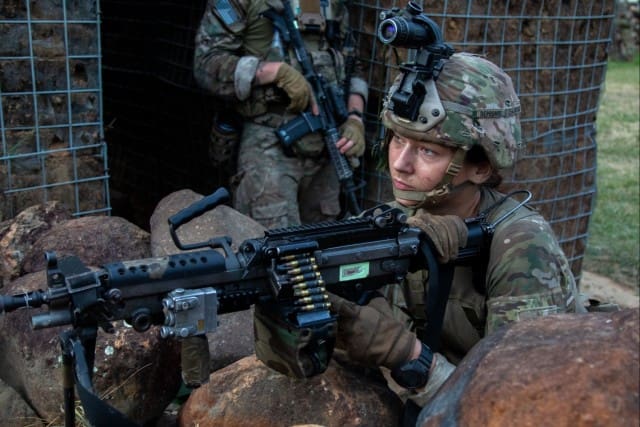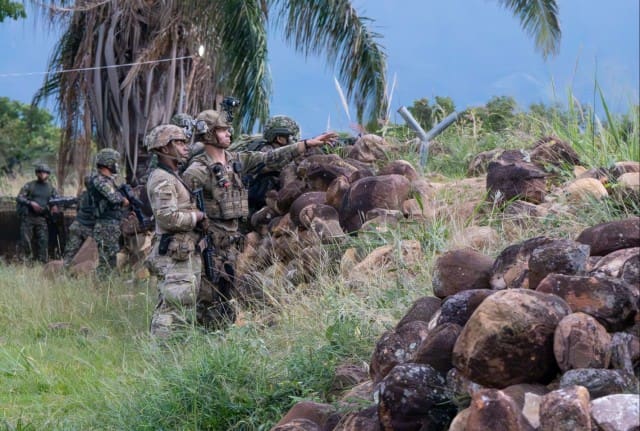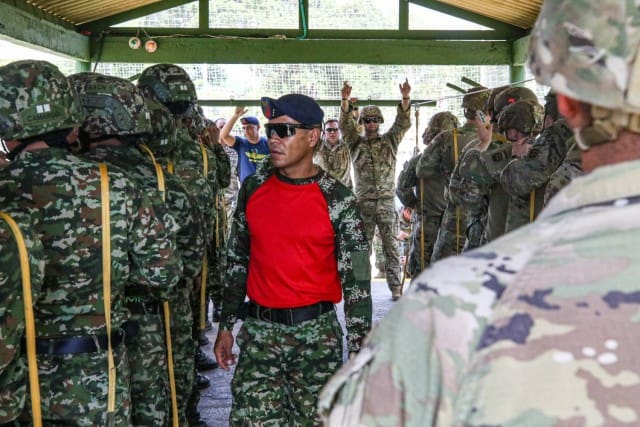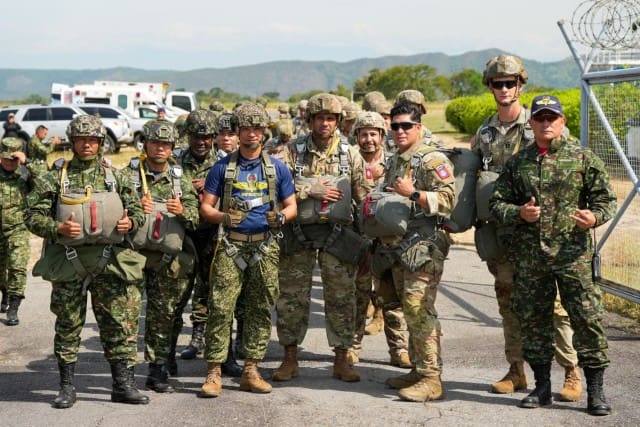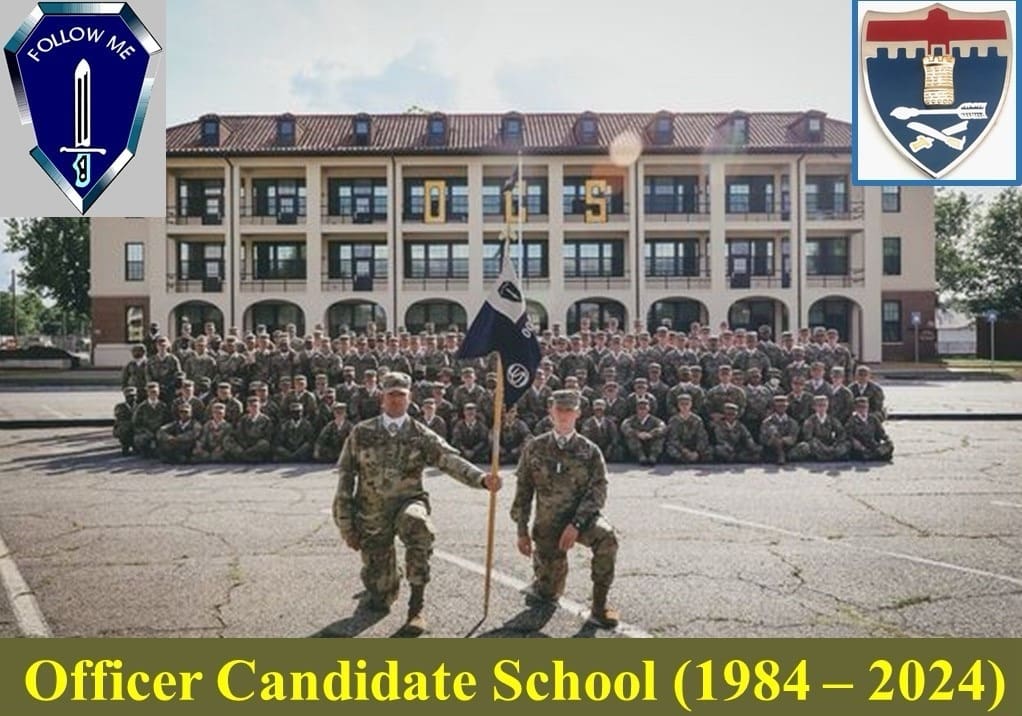
In November of 1984, I joined Class 1-85 at the Officer Candidate School (OCS) at what was then Fort Benning, Georgia. I mentioned that fact in passing in earlier articles. I will share some of my school memories, but only to compare and contrast my experience with those of an OCS Candidate today. To make a valid comparison, I needed to spend some quality time at the school. Fortunately, the leadership of the school, the Fort Moore PAO, and the Maneuver Center of Excellence (MCoE) leadership all agreed to let me do it. The Battalion leadership was particularly enthusiastic about the project. My intent is to produce something that will – hopefully – encourage qualified civilians and soldiers to consider OCS favorably as an option to seek a commission in the U.S. Army. Likewise, I want to encourage serving Officers and NCOs to consider an instructor tour with the school as cadre TACs.
To that end, I just spent four days (29 Jul–1 Aug) embedded with the school and the two student companies currently in session. That included Delta Company which was just starting their fourth week of the course and their first week-long field experience out at the Land Navigation training site. Their training involved day and night evolutions and culminated with testing and – when necessary – retesting. In parallel, I observedCharlie Company just starting their eleventh week (in garrison) of the modern twelve-week program and at the end of their time at the school. From my perspective, the timing of my visit was as near perfect as I could have hoped for. I could engage students and cadre of Delta early in their journey to become officers and see in Charlie examples of the final product.
Up front, I would like to highlight one of the most significant improvements to the OCS program that has happened since I was commissioned. That is the emphasis on the school’s history that is now part of the candidates’ education. When I went through, we got nothing. There were no markers or monumentsat our barracks. No exposure to notable OCS graduates and heroes – including 75 MoH recipients to date. Today, each class tours the National Infantry Museum (NIM) which has a large display dedicated to OCS just inside the front entrance. The school also owns and maintains a good-sized museum dedicated to OCS history and contained in Wigle Hall adjacent to the OCS barracks. Moreover, distributed throughout the unit’s area there are historical displays, plaques, monuments, and memorial paver stones donated by the OCS Alumni Association, other Veterans groups, and previous classes. All of that serves to connect the graduates, across the generations, to their proud heritage.
I do not know why OCS was slow to embrace and celebrate that history. The Alumni Association did not even form until 1986. Frankly, while I am a member now, I was not even aware of it until fairly recently. However, over many years, the Association has worked with school leadership and has been instrumental in making the NIM display happen, enhancing Wigle Hall, and generally in commemorating and preserving our past. I do not have the space to give a full overview of the history of the OCS program. The school has a synopsis on their official site and there is a reasonably accurate Wikipedia page with additionalinformation for those that are interested in more details. Suffice it to say, that the first OCS programs began in 1941 as a response to the pressing needs of the U.S. Army for large numbers of junior officers in WWII. Still, at 83, OCS is the youngest of the commissioning sources for the Army.
The U.S. Army has used many methods over the years to generate officers to fill the ranks. In the early days of the Republic, the Military Academy at West Point was expected to provide all the “career” officers for the Army during peacetime. Direct Commissions, also called “Direct Appointments” would be used in times of war when the Army needed to rapidly expand. One example of a direct commission officer would be Joshua Chamberlain. He was a College Professor before he was commissioned as a Colonel to command the 20th Maine, famous for their gallant stand under Chamberlain’s leadership at Gettysburg. After the war, he left the Army, as was expected, and returned to his college. He was one of the good ones. However, many others having received little training or even vetting by the Army were far less capable of being effective combat leaders. In short, back in the day, the program produced mixed results.
There is also a sub-set of Direct Commissions/Appointments commonly called “Battlefield Commissions” not to be confused with Battlefield Promotions. They are offered (in almost all cases) to NCOs who have displayed meritorious leadership in combat. Often, but not always, those Commissions are directly associated with acts of valor. In WWII, Audie Murphy would be the prime example. He had received several awards for valor as an NCO, was given his battlefield commission from SSG to 2LT, and then for his subsequent heroic actions as a Lieutenant he received the MoH. Robert Howard was a legend in Special Forces. He earned a Battlefield Commission during Vietnam in connection with his own MoH. He was a MSG and was appointed to 1LT. I had the privilege of meeting him several times while I was an NCO and he was still on active duty. The option still exists for future Battlefield Commissions, but the Army has not exercised that option since the end of the war in Vietnam.
The Direct Commission Program today has three courses that transition civilians or enlisted Soldiers with unique skillsets to officers without going through a traditional commissioning track. In other words, this category of officers is hired (commissioned) as specialists rather than generalists. Medical professionals and chaplains have their own Direct Commission courses. OCS operates the tailored branch immaterial course that resides exclusively with Echo Company of the OCS Battalion and occupies space in the same footprint at Fort Moore. The OCS run course primarily supports the JAG corps, as well as experts in civil affairs, engineering, and cyber; however, all branches may – in theory – direct commission officers. The official Army website describes the current status of the program this way. “The National Defense Authorization Act of 2019 (NDAA 2019) gave the military services the authorization to direct commission officers up to the rank of Colonel. With this new [enhanced] authority, the Army has developed commissioning paths for each specific job field. With these, there are different prior experiences required to receive the grade determination.”
Today, we have three primary sources to fill the Army’s needs for Lieutenants. The Military Academy, Reserve Officer Training Corps (ROTC), and OCS. Each has debatable strengths and weaknesses. The Military Academy at West Point is a great program but is very restrictive. The vast majority of the new cadets who join each year are right out of High School. Enlisted soldiers or slightly older civilians do have a narrow window to apply for acceptance but cannot be over 22 years of age when their class starts. West Point also does not accept anyone who is married. Everyone has to go through the entire 4-year program, but as I understand it, there is an option to opt-out at the end of the second year. Academically, the West Point experience produces a traditional 4-year Bachelor’s Degree. The Army owns West Point, it is taxpayer-funded, and it currently produces more than 900 new officers annually – almost all go on Active Duty.
ROTC is a DoD managed program that is not limited to the Army. It was created in 1918 to establish a standing pool of vetted and trained officers “in reserve” that could be Federalized in time of need. Many colleges offer ROTC programs on campus. Traditional “Military Schools” like Vermont’s Norwich, founded in 1819, look a lot like the Military Academy.However, Norwich, The Citadel, VMI, and so on, are fundamentally just private colleges. Only a fraction of their respective Corps of Cadets is ever enrolled in ROTC. Most of their students are just there for the military-like experience as they work toward a college degree. ROTC is offered as well at many non-military colleges around the country. Schools that host ROTC may offer separate tracks for students to seek commissions in the Army, Air Force, or Navy (including the USMC). The programs are not as restrictive as the Military Academy in terms of age or marital status. But, in practice, the majority of ROTC Cadets join the program right out of High School and will be in their early 20s and still unmarried when they graduate and get their college degree and their commission. ROTC produces about 5300 new officers per year – more than twice as many as West Point and OCS combined. Or about 70% of the total requirements for the Army (Active, Guard, Reserve).
As I have described above, the cohorts of cadets that assembleeach year at the Academy, or those other schools offering ROTC, are traditionally and by design largely homogenous in terms of age and life experiences. The Army is very comfortable getting most of its lieutenants at 22-23. And the Army expects that over 70% of Lieutenants, from all of the commissioning sources, will leave service at the end of their initial service obligation. The Army prefers that too because we do not have Captain’s jobs for all of those Lieutenants anyway. That is the way it has always been. Even in the 21st Century, the personnel management mechanisms are still optimized to handle that legacy input/output model. Conversely, by law, regulation, and policy, OCS is allowed to cast a wider net. The average age of an OCS graduate is 28. I was 28 when I was commissioned. Like me, some 30% are married and may even have children when they show up.
Army OCS is certainly similar in function to West Point and ROTC programs. It has the same mission, i.e. to produce competent entry-level officers (Second Lieutenants) to meet the Army’s needs. But it is quite distinct in form. Two categories of candidates come to the school. The first is currently serving soldiers. Junior enlisted can apply and may very well be accepted, but generally it is NCOs, who are already serving in Active Duty or National Guard or Army Reserve units. One of the major differences in today’s program from what I went through is that everyone, from any source, who applies to OCS now must have a college degree. That has been the rule for decades. Back in the 80s, many of us had no degrees but were required and given block time to do “Degree Completion” later. So, I subsequently got my degree as a Captain about 4 years after graduating from OCS. There was also an age limit. No one could apply if they would be 39 on the date of their commissioning. There was a cut-off for time in service as well. No more than 10 years on the date of commissioning. No waivers, hard stop. A few years after my time it was reduced to 6 years. Sometimes service waivers were offered, sometimes not. Today, coincidentally, the policy is back to 10 years in service, with no waivers.
The second category is civilians with college degrees who enlist, go to Basic Training, and then show up to OCS under what is called the College Option. “College Ops” then and now make up the majority of each class. However, even College Opscandidates who enter the program tend to be older and have a little more life experience than their Academy or ROTC counterparts. Some are even prior service coming back in after a break in service. Indeed, OCS graduates generally have a good reputation in the force as being a little more mature and “worldly-wise” than lieutenants from other sources. As I have explained, there is considerable truth to that perception. Still, that is not a result that can be attributed to the training program at OCS, but rather reflects the diversity and caliber of peoplerecruited and accepted into the program.
Another major difference and point of pride for the OCS program is that it is “scalable” by design. That is, unlike the Academy or ROTC, OCS is divorced from any degree-producing mandate and can readily expand or contract to meet the Army’s evolving needs. During Vietnam, OCS produced 7000 lieutenants per year. In my day it was only about 700 per year. During the surge periods of GWOT, the school ramped up to put out some 2000 per year. Now it is back down to around 1100 per year for all three Components (Active, Guard, Reserve). The program is not particularly resource intensive and the only critical “pacing item” is cadre. As long as the school has enough to maintain an acceptable student-to-instructor ratio the program can expeditiously become as big as the Army needs it to be.
I have already mentioned Echo Company. Additionally, there is an HHC. It is the holding company where students who sign in early wait to start their class, recycles wait to try again, and graduates (Lieutenants) wait their turn for Branch specific schools. The other 4 companies, Alpha, Bravo, Charlie, and Delta are dedicated to OCS training. Only two are generally in session at a time, the other two are on cycle break before their next classes. If necessitated by a crisis, even with just their current assigned cadre, the schedule could be tightened so that all 4 companies can be in staggered sessions back-to-back-to-back each producing ~150 new lieutenants in each cycle. The other commissioning sources do not have that flexibility and, because of the way they are structured academically, cannot surge their output rapidly either.
The OCS program has been as long as 22 weeks in WWII. It had dropped to 17 weeks by the Korean War and then generally stabilized at 14 weeks for many years. Where it stood when I came through. It has been at 12 weeks for a long time now. I am convinced that is just right – the Goldilocks solution. 10 weeks would be too short in my opinion and, with the clarity of hindsight, 14 weeks was longer than my class needed. 12 weeks is sufficient time for the program to adequately assess thecandidates’ potential to lead. Since OCS is a leadership school, the components of the Program of Instruction (POI) are actually not that important. The two most critical elements are the students and the cadre. I will start with the students. The course has to provide the environment and the time for each student to soak in Army values and the ethos expected of a professional soldier and an officer. It is truly an exercise in cultural immersion and they need sufficient time to fully marinate in it,so to speak.
I will use a couple of examples from my time to illustrate. In my individual engagements with numerous students, I confirmed that while their experiences were different, the dynamics were indeed still much the same. I came to OCS as a promotable infantry SSG with almost 10 years. My roommate was an MP SSG with 8+ years. Sam and I bonded quickly and were both confused and appalled with the way the course started out. We expected the cadre to be Drill Sergeant-like and directly enforce discipline and standards. They did not. They appointed a student chain of command that would be changed out every week and then were surprisingly hands-off. Student leadership roles included: Company Commander (CO), Executive Officer (XO), First Sergeant (1SG), Platoon Leaders (PL), Platoon Sergeants (PSG), and Squad Leaders (SL).
Sam and I were not picked for leadership roles in the first 4 weeks and we were getting pretty frustrated. While I did not know it at the time, I realize now that letting the students flail around and work it out for themselves was a critical feature of the program and not a bug. Peer leadership is hard. It was hard for the College Ops because they had only briefly seen Army leaders in action in the form of Drill Sergeants. They had no basis for comparison and no real clue how leadership worked.Prior service candidates in general were not much better. They had seen more examples of military leadership techniques but were unsure how those should be applied in a peer leadershipsetting. Especially in the first couple of weeks nobody fully trusted anybody, so advice that came from other students – no matter how experienced – and not directly from the cadre was ignored. In fact, because the student leaders knew in the moment, they were the ones being scrutinized and graded they operated almost entirely from fear of making ANY decision.
The leadership tried to be friends with everyone, and very collegiate in their interactions with their notional subordinates.Rather than lead, they always tried to get consensus on even the smallest decision. Asking the entire class to vote on everything so that they could dodge taking full responsibility – or any responsibility at all – for their calls. Sam and I talked it over and began a campaign of “civil disobedience” since any advice we gave was falling on deaf ears. I think it was towards the end of the third week when our SL, a College Op, stuck his head in the open doorway to our room and said “I need 2 volunteers to sweep and mop the hallway.” Sam and I said in unison “No thanks!” He got confused and walked away for a couple of minutes. When he came back, he said “I really need someone to sweep and mop the hallway.” And we replied “We can see that. Good luck.” Finally, he got mad and said “Terry, you sweep and Sam, you mop.” We said “Roger that!” and got up to get the broom and mop. Now he was mad and confused, so he asked “Why the heck did you make me ask three times?” We replied that we were waiting for him to say it right.
We became so obviously dysfunctional that the cadre took our guidon away early in the fourth week to shame us. I, for one, was ashamed. I was surprised at how much it bothered me. I had never been part of a unit that was not worthy of a guidon. At the end of the fourth week, my TAC asked me if I was ready to be the student company commander for the fifth week. I said, “Yes Sir, I am.” Sam was going to be the PL for our platoon, and my XO was a guy named Neil who was an Aviation Warrant and had come to OCS from an instructor position at the Warrant Officer Academy. He went on to be our Honor Grad and somehow convinced the Army to let him be an Infantry Officer even though he was a rated helicopter pilot. So, the cadre was stacking the deck and almost everyone in the incoming chain was a long service candidate. We huddled the Sunday evening prior to taking charge and talked through how we wanted to do it. Bottom line, we were going to act like a real chain of command in a real unit.
The next morning, we formed for PT and the new chain of command ran out of the ranks and into position replacing the outgoing chain. My TAC was on the steps going into the barracks in front of me along with another TAC from a different platoon. They ordered me to take the company across the street for PT. I saluted, but instead of turning around to relay those orders, I started up the steps. The other TAC made a move to intervene but my TAC waved him off. I addressed the company and told them to fall out and fall in a horseshoe around me. When they did, I gave the only speech I gave to the company that week. It went something like this: “This is a unit, not a democracy. We will not be forming committees, or seeking your consensus, or taking votes before we make decisions. If you are in a leadership position you are expected to lead. If you are not in a leadership position then SHUT UP and Follow! We will give you the same courtesy when it is your turn to lead. That is all.”
Not everybody took that quietly. Several started to voice their views and tried to open a debate about it on the spot. I told them that I had not asked for their opinion and called the company to attention and put them back in formation. We marched off to PT. Later while on a break in the classroom, one of the prior service candidates from another platoon came up to lecture me on how rude and unprofessional I was to tell my peers to “shut up” like that. I said, “Did you bring this up to your chain of command?” “No, I am bringing it directly to you.” He still did not get the point. “OK, so take this to your SL at the next break. For now, sit down and shut up!” He huffed and puffed for a moment but then sat down. We were not very loud, but several students heard the exchange as well as one of the TACs. I did not get many questions brought directly to me after that. The cadre never said out loud that they approved our message or methods, but the next morning they gave us our guidon back. After seeing a fairly good example that week of how a chain of command should work, the student chains of command in the subsequent weeks went much more smoothly.
When I talked to the Delta Company students at the Land Navigation site, the student company chain of command was proud to report to me that they were all prior service candidates. Their cadre had set them up for success in the fourth week just like mine did in the fifth. From my observations, and talking to their cadre, the students seemed to be well on their way to getting their shit together. Their experience played out differently than mine but the methods and the outcomes are still the same. To be clear, while my instincts had been correct in the case I described, I had some big blind spots too. Talking with the cadre, including the Battalion Command Team, they still see the same thing with prior service candidates today. Because of my NCO experience, I had an overinflated ego. I thought the Army was lucky to have me volunteer to be an officer and that OCS had nothing to teach me and it was just a formality. I was sure my orders to 2LT had already been cut when I showed up. I just had to wait patiently for them to be issued.
I was dead wrong! Despite my years in service, there was so much I did not truly comprehend about the duties of an officer. First, that officers – by virtue of a commission – operate withdifferent authorities than NCOs. I knew that but did not understand the implications. NCOs make decisions, but all executive decisions with significant and long-term impact – by law and regulation – have to be made by Officers. Of course, Officers have judicial and non-judicial powers that NCOs do not. At its most stark, in combat, Officers decide when, where, and how soldiers are put in harm’s way. With broader authoritycomes greater obligations and accountability. Officers alone own their command decisions and the consequences of thechoices they make. They are – rightly – held responsible for everything their unit does or fails to do. It is called the “burden of command” for a reason. I had to find that out for myself.
Likewise, I definitely needed to work on checking my ego. Egos that are properly inflated help make us successful leaders. They fuel our drive, determination, and healthy ambition. If underinflated, we will display a lack of confidence and we cannot instill confidence in others if we are unable to find it in ourselves. Overinflated egos result in overconfidence and arrogance and tend to make us the kinds of ineffective and even toxic leaders that soldiers try hard to avoid. To be sure, OCS did not have time to deflate an ego as big as mine. The job did that. Being a real PL, in a real unit, is very humbling. And a little humility goes a long way. I suggested to Charlie Company, specifically, that they learn how to keep their egos in check and properly inflated as soon as possible if they have not already.
Let me talk about the OCS cadre for a minute. As is the case in all schools, the cadre are the unsung heroes who do the heavy lifting to make the program work. I saw the exact same professionalism, dedication, and mission focus in the NCOs that worked for me at Camp Mackall training, testing, and evaluating potential new Green Berets. Likewise, Drill Sergeants on the trail, Ranger Instructors (RIs), and Blackhats at Airborne School make it look easy every day. Some of the cadre at OCS did not know what it was till they got there. Others volunteered but only had a vague understanding of what happens at the school. Hopefully, this article can serve to clear up some of the mystery. While there are frustrations that come with a job like this, I can tell you that the cadre also emphasized to me the great satisfaction they get in producing some of the next generation of Army Officers.
One of the great strengths of the modern program is that there are now NCO TACs paired with the Officer TACs. We only had Officers and it was a glaring weakness in the program back then. Now students can observe how real Officers and NCOs interact in a professional manner to get things done as a team. The TACs also give most of the instruction to the students now. In my day, the TACs owned us in the barracks but delivered us to training committees for instruction. The newer way is much better. After all, real units do almost all of their training with organic subject matter experts. Why shouldn’t OCS? So, if there are any NCOsor Officers out there looking for a professional development opportunity, I suggest you seriously consider OCS. When I talk to Special Forces NCOs inclined to dodge a SWCS assignment they tell me that they want to stay “where the action is” at Group. I get that. But if you are passionate about the future of the force – and we all should be. Then the schoolhouse IS where the action is.
OCS is Branch Immaterial. Any Branch or MOS can apply to be an instructor so there is a healthy cross-section of the Army represented. Former Blackhats, Drill Sergeants, and RIs are here. Going through the course and as TACs. No Special Forces TACs at the moment, but at least one in Charlie is about to be commissioned. Charlie Company had an RI come in from Camp Darby to give interested candidates a briefing on Ranger School. About 18 showed up, including one female as well as a couple of holdover lieutenants from a previous class. I was able to sit in. Ranger School today is 61 days – essentially unchanged from my time. That is about right in my opinion. As I mentioned earlier in relationship to the length of OCS, once a leadership school has assessed and evaluated someone’s potential to lead,then additional repetitions are a waste of time and resources. The only way to learn to lead is to lead. I say again. The only way to learn to lead is to lead. OCS and Ranger School only simulate select aspects of small unit leadership to put candidates under pressure and enable instructors to make informed assessments. At the end of the day, the actual and ultimate “test phase” that matters can only come when that new Lieutenant orRanger gets put in a real leadership slot.
Is every graduate going to be a successful Lieutenant? No, of course not. OCS has produced countless exemplary officers like Dick Winters of Band of Brothers fame and a handful of unsuccessful officers like Rusty Calley of My Lai infamy. Coincidentally, Rusty Calley died in Columbus, Georgia while I was on Fort Moore this time. The two worst officers I ever worked with in my career were OCS graduates. But they werethe exceptions. I can say this, some that looked very promisingduring the course will disappoint and some that struggled with the program will turn out to be outstanding. The majority will do just fine. As I told Charlie Company, the OCS program works, you are ready, and you are good enough for today. Tomorrow the job will require you to be a little better and the next day better still.
The burden of leadership is 24-7, 365. It is not the kind of job you can ever “clock out” from. Professional Officers and NCOs have to internalize that fact. Some candidates asked how I achieved a favorable Work/Life balance. I told them they were thinking about it the wrong way. If you are a professional, then the Army is going to BE your life, not something separate and distinct from it. But it is not the ENTIRETY of your life. As an individual, you have to learn how to balance the often-conflicting demands of being a leader with the other aspects of your life like a spouse, or children. And even while meeting the demands of the day, carve out time for additional education and skills training so that you are ready for the personal and professional dilemmas you can expect to face tomorrow. All while NOT neglecting your physical, psychological, and spiritual health. I never said it was easy, but it can be done.
I love being around what I call “High Performance” people. That is what I saw at OCS. Students and Cadre alike. If you like being around people like that then OCS might be for you. I had a sidebar with the female candidate after the Ranger briefing. I think for a moment, since I was an old guy, that she thought I would try to talk her out of it. Instead, I asked her about her intentions and how she was going to get ready. She had realistic expectations of the challenges and asked me some questions. I gave her some advice. She seemed very focused and determined. Some 143 women have earned the Ranger Tab to date. I am a pretty good judge of character, and I suspect this young woman will add herself to that number in the very near future. She had the right attitude. I cannot say with certainty that she will make it, but I applaud her and anyone else who has the guts to see opportunities rather than obstacles.
Far too many people go through life with timidity and without conviction. Do not be one of those people. If you want to go to OCS, quit procrastinating and commit. Airborne School, Ranger School, the SFQC? COMMITT! Stop talking about it and just do it. I swear to you that none of these schools are as hard or nearly as scary as you are imagining. Yes, they all require you to prepare yourself physically and mentally beforehand. But there is no mystery. These schools have their standards posted on their websites. There is no intention to trick students. The instructors want you to succeed. The schools are there for the sole purpose of producing entry-level graduates out to the force. They only get credit for the number they produce, not the number they drop. Do your preparation properly and then all you have to do is show the work.
Finally, I would like to thank LTC Garvin, and CSM Gilmer, the great Command Team leading the Battalion. Happy Warriors, temperamentally well suited for the all-important jobs they have. The CSM will be going shortly to take the CSM position at an ROTC Brigade level HQ. Thanks to the Staff, the Cadre of Delta and Charlie Companies; and the holdover Lieutenants, waiting for their next class dates, who augment the Staff and the companies during training events like land navigation. Of course, the candidates themselves who were ready and willing to engage with me on any number of subjects. A special thanks to Lieutenant Wu, a holdover waiting his turn to go to Fort Leonard Wood to become an Engineer. He was my trusty Escort and Wingman during the week. In the end, this article required a team effort. I am just a writer, trying to tell their story through the lens of mine.
Charlie Company spent Thursday, my last day, cleaning weapons. They were in racks outside under a covered pavilion staged to be turned into the central weapons pool the next morning. I stayed and talked to those assigned to guard the weapons until midnight. I left only because I had a long drive home the next day. I was a little hoarse from jibber jabbering continuously for four days straight, but confident and comfortable that the OCS program was in good hands and that the “product” was definitely as good, and probably even better, than it was when I went through.
De Oppresso Liber!
LTC Terry Baldwin, US Army (Ret) served on active duty from 1975-2011 in various Infantry and Special Forces assignments. SSD is blessed to have him as both reader and contributor.