SIG SAUER - Never Settle

Archive for the ‘Guest Post’ Category

SCUBAPRO Sunday – Low Volume Masks

Sunday, August 28th, 2022

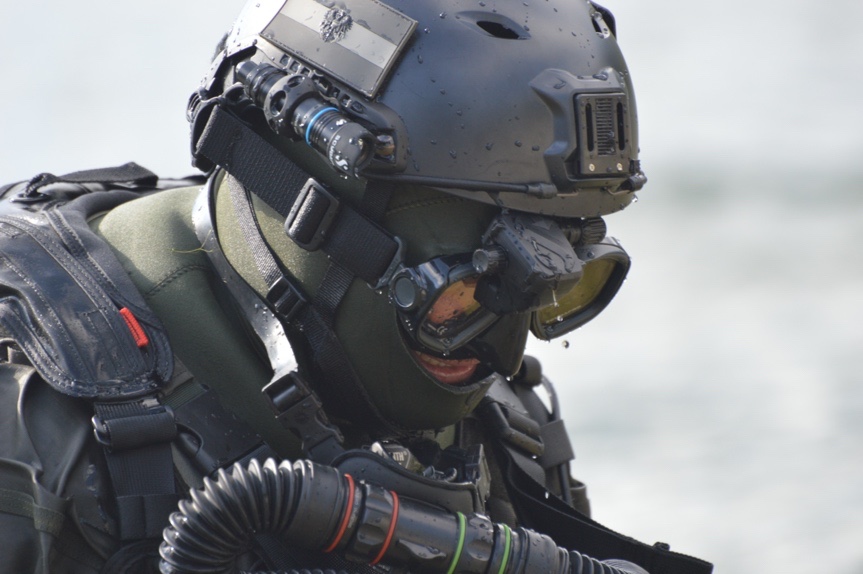
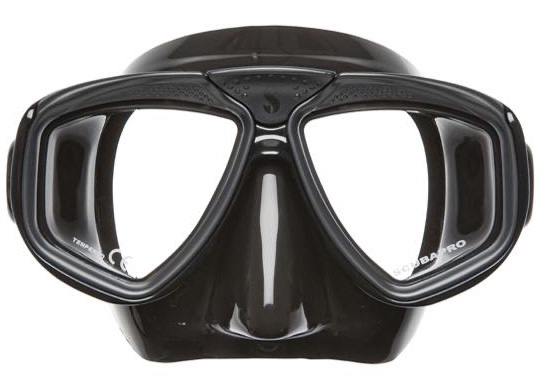
Why is low-volume important to Combat divers? For anyone who needs to preserve their air while diving or wants a straightforward mask to clear, low-volume masks are the perfect option. These benefits are also great for freedivers and spearfishers. Low-volume masks are necessary for apneic (breath-hold) sports because relatively little air is required to equalize them at deep. The main reason is the air inside the mask will condense as pressure rises with depth.

This means there is less air wasted in the mask. There is also less of a chance of a mask squeeze. The mask is closer to the diver’s face, possibly helping you see better; the diver must equalize the air in the mask to make up for the volume lost if they want to avoid this. They accomplish this by slightly exhaling through their nostrils. Since there is less airspace in a low-volume dive mask, the diver doesn’t have to use as much of their precious breath on it.

Apnea masks are less noticeable and more streamlined than conventional masks due to their low-volume construction. They offer good fields of vision despite their size (sometimes even better than large-window masks!) and are lighter, and it is less weight and room needed to carry two.

Many divers hate mask clearing, and a low-volume mask uses less air to clear. When clearing, you are wasting less air and less chance of losing control of their buoyancy. Inverted teardrop-shaped lenses are standard in low-volume masks, allowing you to view down your body without moving your neck. This is a benefit for some divers because it makes it simpler to check their pressure gauge by simply looking down to see your attack board.

Low-volume masks are an excellent option for backups and spares due to their compact, lightweight design. They fit great into an M16 pouch.

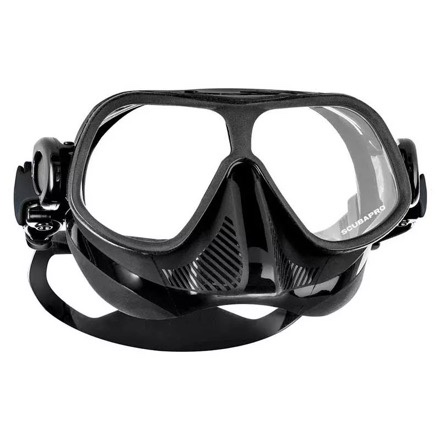
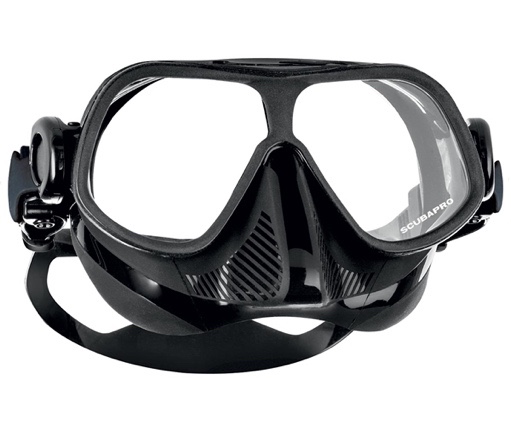
Reducing the size of the glass lenses is one method of creating a low-volume mask. This doesn’t limit your vision as much as you think because the lenses are so close to your face. However, frameless masks are an excellent alternative for anyone who feels uncomfortable or claustrophobic wearing standard low-volume designs. Some apnea masks will say not for diving, those usually have two lenses like the SCUBAPRO Steel Pro Comp, and there is only a piece of rubber between the two. If you dive deep with it, there is a chance that the lens can push in on your face. Therefore they say not for SCUBA diving but for combat diver operations that work well.

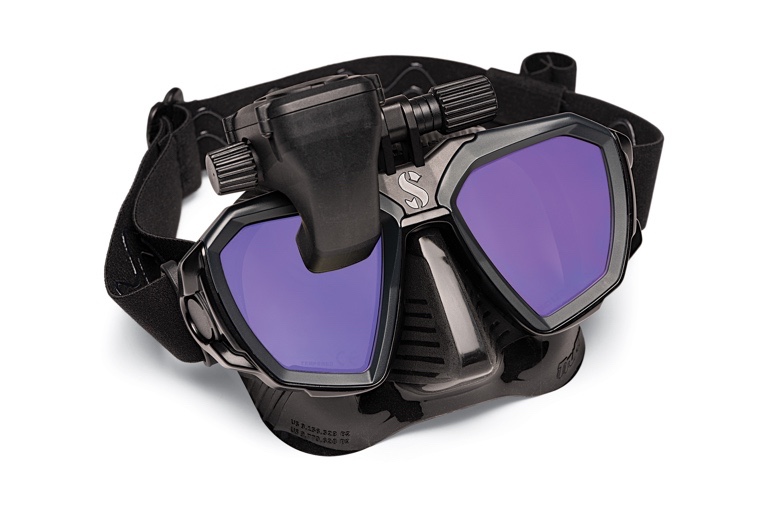
The low profile is also suitable for those who want to wear corrective lenses, which function best when placed near your eyes (much like glasses). The SCUBAPRO Zoom and D-mask are an excellent choice for this. All these masks work with the SCUBAPRO comfort stapes that are great for all divers, especially combat divers, as there is a lot less chance of them breaking, and they also work with the SCUBAPRO Odin helmet mask strap. This allows you to attach these masks to Ops-Core, Team Wendy, and Galvion helmet rails.

Winchester – Folds of Honor

Sunday, August 28th, 2022

Freedom comes with a heavy price. Team Winchester understands this and send their thanks in a special message to our service members, their families and Folds of Honor.

See why Folds of Honor and its mission means so much to us.

Airman’s Innovation Saves Time, Money

Sunday, August 28th, 2022

RAF MILDENHALL, United Kingdom (AFNS) —

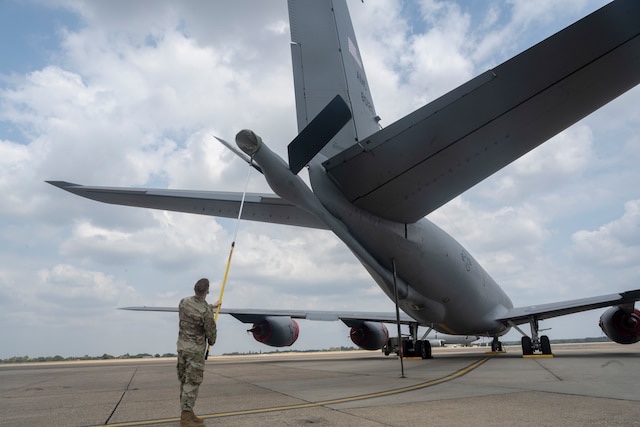
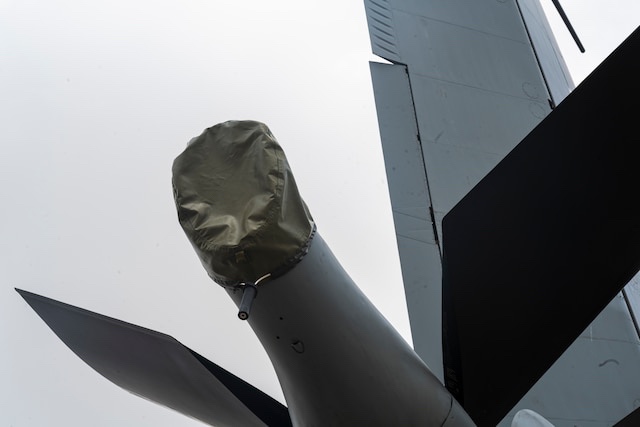
Thousands of hours are spent each year removing and installing a boom cover on a KC-135 Stratotanker aircraft – hours that could be used elsewhere. One 100th Maintenance Squadron Airman has invented a new boom cover tool that has the potential to save the U.S. Air Force 40,000 man-hours and approximately $1 million per year.

“I noticed as soon as I got to Mildenhall that removing and installing the boom cover was tedious and time consuming,” said Airman 1st Class Jacob Helzer, 100th MXS hydraulics maintenance journeyman. “Removing the cover the conventional way involves calling the Aerospace Ground Equipment backshop for an aircraft stand and requires two Airmen and a substantial amount of time.”

The current conventional method hinders daily operations, whereas the innovative solution Helzer created is easier, takes less time and lessens the impact on the flow of operations.

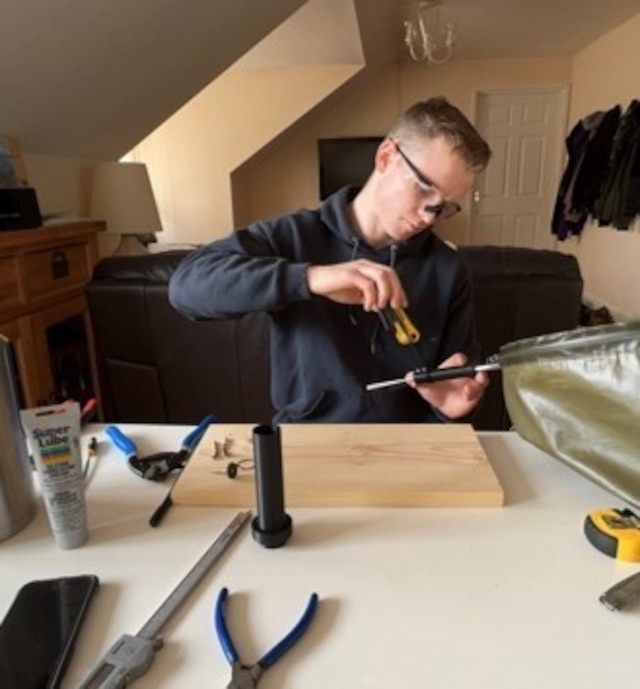
“One of the maintenance crew chiefs reached out because he knew I enjoy 3D printing and design and believed I could come up with a solution for the boom cover,” Helzer said. “I then came up with a prototype for a tool that could make the process much smoother.”

Tech Sgt. Steven Jakubowski said Helzer is always looking for ways to innovate and constantly asking questions to gain further knowledge. 

“He spent a lot of his free time, outside of work, designing the boom cover tool,” Jakubowski said. 

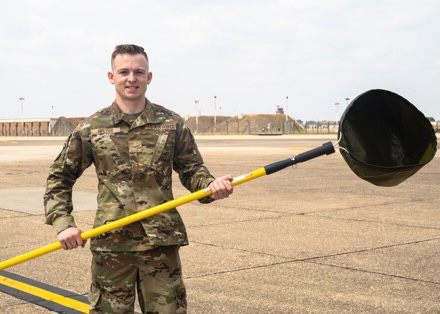
Helzer, using his skill and knowledge with 3D printing, created a prototype called the “Boom Cover Tool.” The tool was manufactured with Helzer’s 3D printer and resembles a butterfly net on the end of a retractable pole with a hoop mechanism that tightens and loosens the net covering on the opposite end. 

“Once I created the prototype, I brought it to my section and tested it out,” Helzer said. “A 30-minute job became a one-minute job with the Boom Cover Tool.” 

The Boom Cover Tool greatly reduces the number of man-hours needed every time a cover needs to be removed or installed on an aircraft and the cover itself better protects the boom pod during adverse weather conditions. 

Each Boom Cover Tool costs roughly $200 to produce. 

“The projected savings were calculated by him and I while submitting for Spark Tank by using the 2021 comptroller document for wages,” Jakubowski said. 

“I did the math and the projected savings for the Air Force if they utilized the Boom Cover Tool for the entirety of the refueling fleet would be approximately $1 million and potentially 40,000 man-hours annually,” Helzer added. 

In order to meet this goal, Helzer has been collaborating with the MXS fabrication flight to produce the test prototypes for each aircraft here. 

“Once we have everything streamlined, we can move into the beta testing phase, which is roughly six months, then move on to scaling up for the entire KC-135 Stratotanker aircraft fleet,” Helzer said. 

Moving forward, Helzer plans on developing a batch of tools for the local KC-135 fleet to prove the design concept. Helzer would then like to contract the fabrication of a final, more durable prototype and share the Boom Cover Tool throughout the entire fleet and modify the design to be adopted for other variations of refueling aircraft. 

“Helzer has been a go-getter from the moment he arrived on station and is always hungry to learn all aspect of his job, and his critical thinking skills are some of the bests I’ve ever seen,” Jakubowski said. 

Helzer has always been motivated to improve himself and the way things are done at his job, and one example of this is the Boom Cover Tool. 

“This is how change starts, by questioning the way we do things and coming up with a solution that will benefit Airmen at all levels,” Helzer said. “I created the Boom Cover Tool to make the lives of my Wingmen easier and inspire Airmen to devise and implement new ideas to help improve even the simplest tasks.” 

By Airman 1st Class Alvaro Villagomez, 100th Air Refueling Wing Public Affairs

Primary Focus – Building a Battle Belt: Beginner’s Guide

Saturday, August 27th, 2022

With your battle belt playing such a fundamental role in your kit, it’s important to get it right. From the choice of pouches and accessories, to placement, to the materials and pattern of the belt itself, your first line of equipment should be carefully crafted to fit your specific needs and use case.
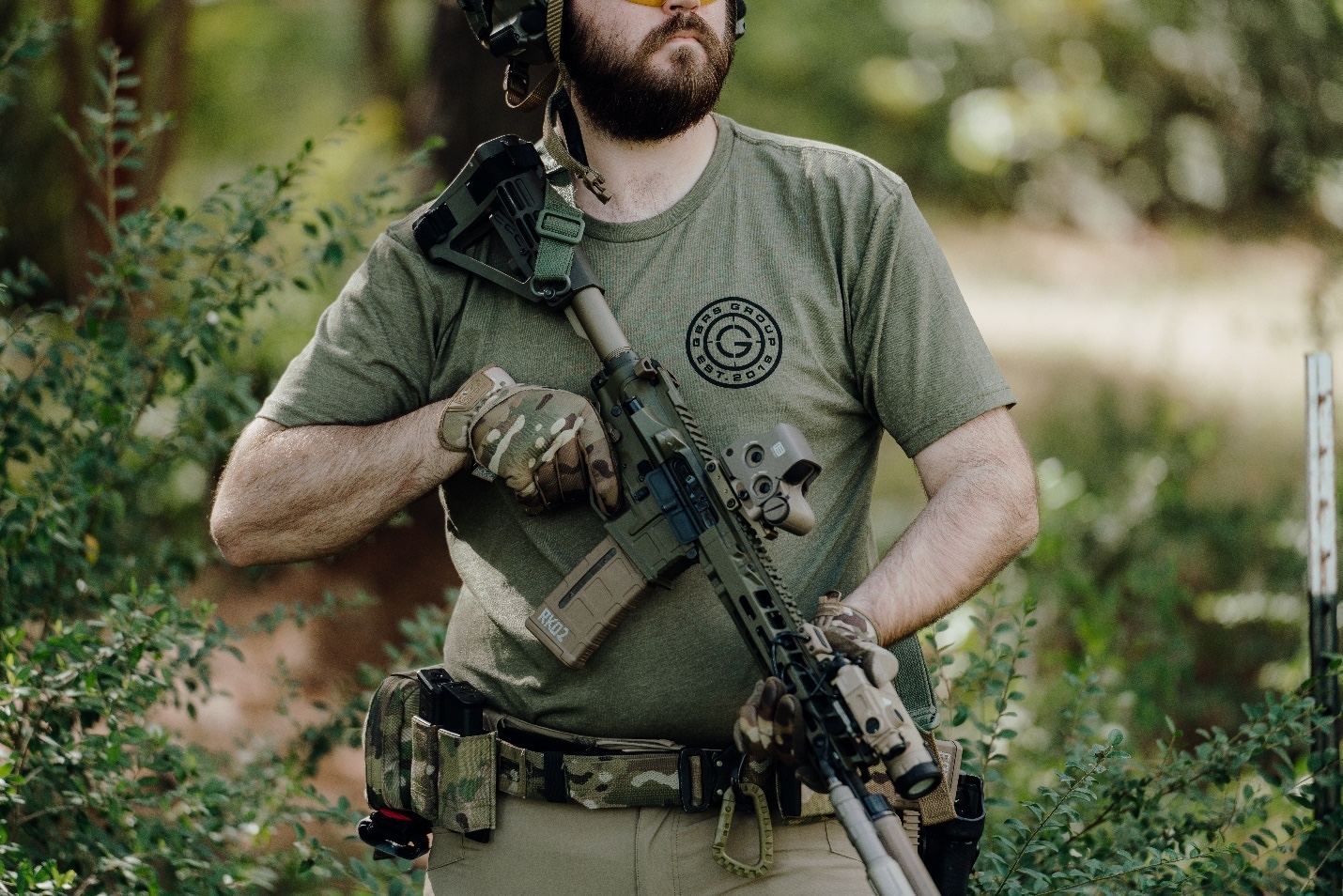
Building a Battle Belt: The Belt Itself

The first decision is which belt to start with. Tactical belts break down into three major categories: Single, Padded, and Double.

Single belts are the simplest and usually the cheapest. They’re basically just a normal belt widened to spread the weight of your sidearm and magazines across a larger area and made from a more durable material, like ballistic Nylon. They’ll often have a reinforced buckle as well. A traditional single belt is a good option for those looking to save a few bucks, especially if you don’t plan on putting much gear on it or wearing it for extended periods of time.

Padded belts take a traditional tactical belt and augment it with a padded sleeve for improved comfort. The sleeve will usually have extensive MOLLE webbing on the outside, offering lots of real estate for mounting pouches, first aid kits, and accessories. These types of belts can be very comfortable, even when worn all day, but since they thread through the padded sleeve rather than your belt loops, they won’t do anything to keep your pants up.

The downside to padded belts is that they take up more space on your torso than single or double belt systems. They also can be more prone to shifting since they’re held in place solely by friction rather than being anchored to your belt loops.

Double belt systems are the current pinnacle of battle belt technology. There’s some variation within this category, but nearly all models use a low-profile inner belt that threads through your belt loops and an outer belt to which you attach your various accessories. The two belts are usually connected to each other with hook and loop fasteners to keep them firmly in place.

The double-belt design provides greater rigidity than a single or padded belt and will resist sagging better under heavy loads. The exterior belt is usually MOLLE-equipped, so like a padded belt, they offer greater space for mounting pouches and holsters. Since your gear is attached via webbing instead of threaded onto your belt, you don’t have to worry about it shifting around while taking the belt on and off.

Which design is best for you will depend heavily on your application.

Building a Battle Belt: Core Accessories

Regardless of which belt you choose, there are a couple of accessories that should be on any tactical belt.

Magazine Pouches

First and foremost is magazine pouches. As the saying goes, nobody ever walked away from a gunfight wishing they had less ammo.

You’ll want at least one spare magazine for each firearm on your person, although more may be appropriate depending on your application and what other load-bearing equipment you’ll be using.

Most people prefer their mags at or behind the point of their hip, but handgun mags can be run forward of the hip as well. In that case, you’ll want to take a look at canted mag pouches to avoid compromising your ability to bend over.

Holster

Depending on your particular use case, a handgun may or may not be necessary for you, but if it is, then you’ll want a proper outside-the-waistband holster on your belt.
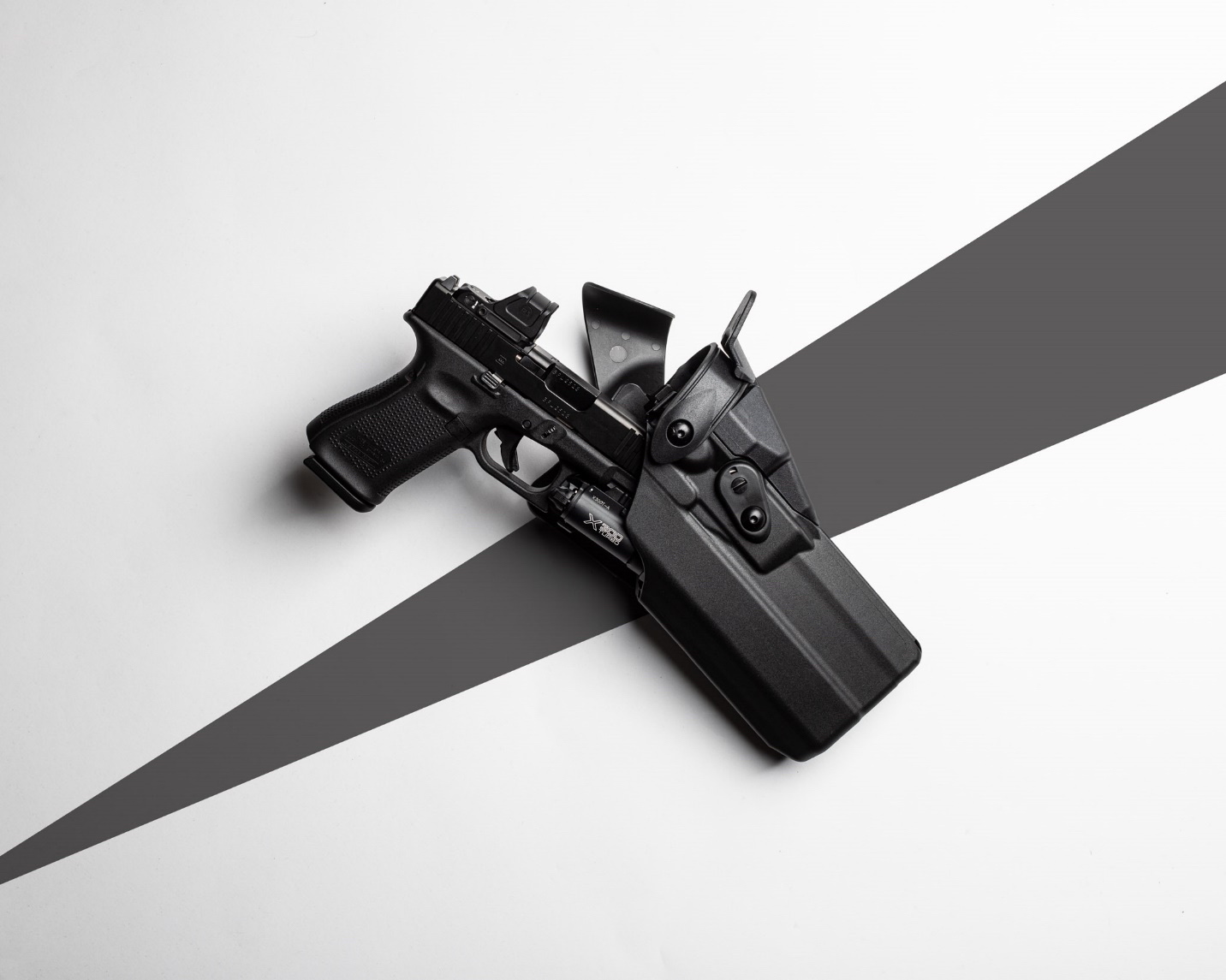
Obviously, a holster is best situated on your strong side. If you use your battle belt in conjunction with any form of body armor or chest rig, you may need a low-ride holster to provide enough clearance for a clean draw.

Regardless of your holster’s ride height, we heavily recommend something with active retention. Active retention such as Safariland’s ALS and SLS technologies or Blackhawk’s T-Series ensures that your gun stays in your holster until you draw it, no matter how much you get banged around.

First Aid

A battle belt is made for gunfighting, and gunfighting has an extremely high risk of injury, even if you prevail.

If used as a standalone platform, a battle belt should have at least a basic Individual First Aid Kit (IFAK) and a properly staged tourniquet. The “properly staged’ part is important; it should be positioned to allow rapid deployment and one-handed use, not still in the plastic wrap.

The best position on your belt for an IFAK is at 6 o’clock. This situates your IFAK directly behind you, making it accessible with either hand. It also takes up real estate in an area that’s not suitable for anything else.

Positioning a hard object on your belt at the small of your back increases the risk of spinal trauma if you fall on it; this is often one of the core criticisms of small-of-back concealed carry for firearms.

An IFAK usually contains enough soft material like gauze to eliminate this risk, meaning it’s probably the only thing on your belt you can safely carry in that position. This frees up other space for a dump pouch or more mags.

Building a Battle Belt: Secondary Gear

This category of gear is less universal, so you may not need all of it; in fact, you might not need any of it if your goal is a truly minimalist setup.

Flashlight

Even if you already have a weapon light, a standalone light is often worthwhile. Being able to illuminate an area without pointing a firearm at it is an important capability, especially for civilians.

As far as proper mounting location, flashlights are pretty versatile. Just make sure you can reach it with your non-dominant hand and that it doesn’t get in the way of more vital gear, like your mags or first aid kit.

If your belt is already pretty full, you can try mounting it horizontally on the front of the belt.

Knife

A quality knife really needs no explanation—you won’t find a more versatile tool. Whether it’s cutting rope or breaking glass, there’s really no substitute for a good, tough knife.

Some users like to keep a small knife for cutting tasks that require precision and a larger one for bigger jobs, but we’re of the opinion that one medium-sized knife is plenty for most people.

Small fixed-blade and folding knives can be mounted just about anywhere on a battle belt, but their most often situated on the dominant side of the belt, forward of the holster.

Larger knives are usually positioned on the dominant side as well, typically behind the holster. However, it’s very important to make sure that the knife and sheath don’t obstruct your draw.

Dump Pouch

They’re not a necessity, but having a dump pouch on your belt can be very convenient. They’re often used as a repository for empty magazines, as it’s much faster to dump them into the wide opening than to stuff them back into a mag pouch.

Beyond that, though, they’re also useful as a general-purpose dumping ground for anything you need to pick up and take with you but can’t fit into your pockets.

Dump pouches are low-priority pieces of gear when it comes to accessibility. You don’t need immediate, unimpeded access to them the way you do your holster or spare mags. For that reason, a dump pouch belongs wherever you have extra space that isn’t being occupied by more critical equipment.

Most users mount their dump pouch toward the rear of their belt, either behind their spare mags on their weak side or behind their holster and knife on their strong side.

Gloves

Many operators choose to wear gloves. Most guns get pretty hot after a couple of mag dumps, so a good pair of gloves can be a real asset in a prolonged confrontation.
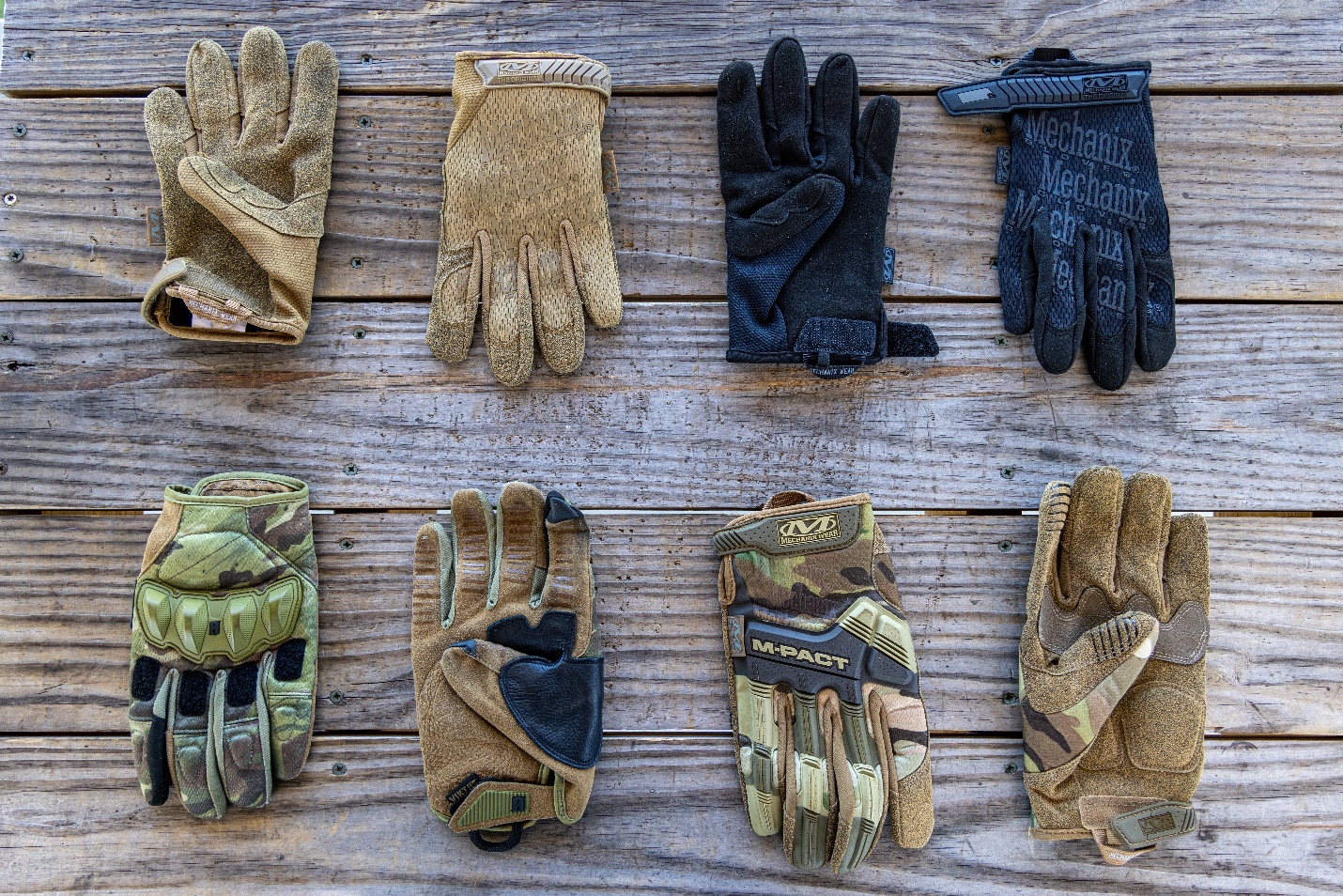
Most tactical gloves come with small loops sewn in at the cuff, making them easy to hang on a carabiner clip. Attaching them to your belt is a simple matter of threading a carabiner through a few loops of MOLLE webbing.

Many users choose to place this clip at the front of the belt, next to the buckle. It means your gloves will dangle in front of you when you’re not wearing them, but they’re lightweight enough that it shouldn’t matter.

Building a Battle Belt: Summary

Configuring a battle belt can entail a lot of trial and error. What works for everyone else may not work for your scenario or your needs.

It’s best to build up your battle belt one step at a time, starting with the essential elements like magazine pouches, medical equipment, and a holster, and train with it enough to figure out what works for you and what doesn’t.

Once you’ve got the essentials covered and the wrinkles ironed out, you can move on to less mission-critical equipment like flashlights and dump pouches.


Unleashed: Grey Wolf Flies with All-Air Force Crew for First Time

Saturday, August 27th, 2022

EGLIN AIR FORCE BASE, Fla. —  

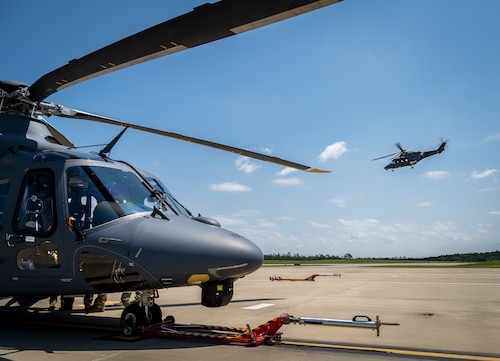
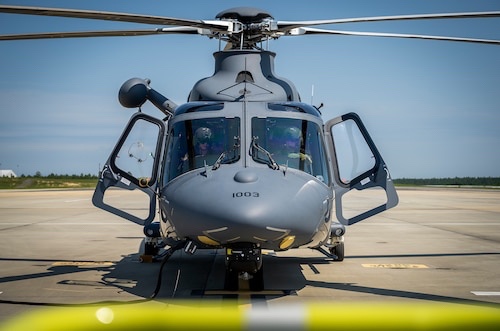
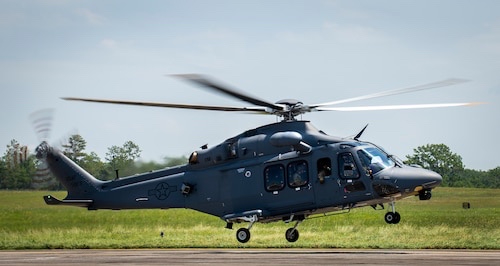
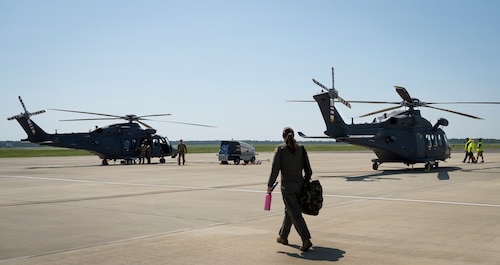
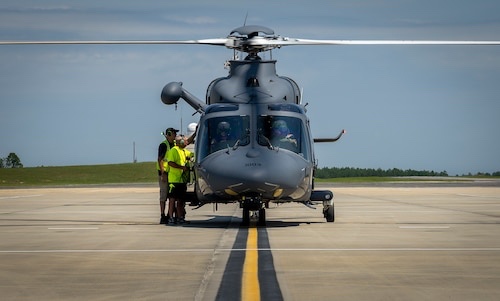
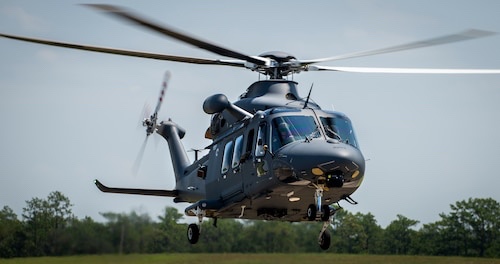
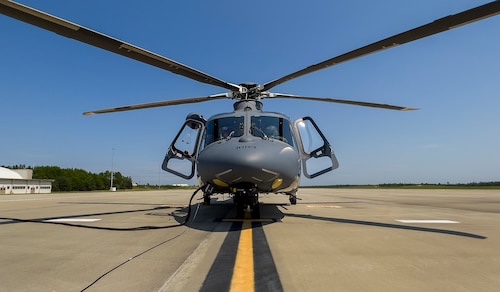
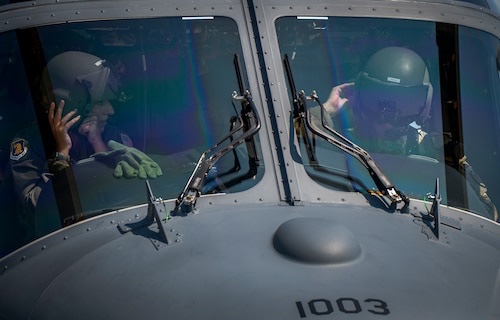
Lt. Col. Mary Clark stepped out to the MH-139A Grey Wolf with confidence.

Confidence gained from taking part in and leading in the developmental efforts of the Air Force’s first acquisitioned helicopter.  Those early labors from concept to reality culminated as she climbed into one of the pilot seats for the MH-139A’s first flight under Air Force ownership here Aug. 17.

“This milestone really represents the beginning of Air Force testing for the Grey Wolf,” said Clark, a former requirements officer with the Grey Wolf program, now at the 96th Operations Group.  “We can now open up those test points for the military and push the envelope more to ensure we’re delivering that operational capability the units need out of the helicopter.”

The Grey Wolf achieved this milestone after earning its military flight release, Aug. 12.  The new status allows Air Force-only aircrew to conduct testing on military capabilities of the MH-139A as the program moves forward.  Prior to the military flight release, military and Boeing contractors shared the flight duties since the aircraft’s arrival here in December 2019.

During that two-and-a-half-year period, the military testing fell to the 413th Flight Test Squadron and the AFGSC Detachment 7, in which Clark was a former commander.  The 413th FLTS is the Air Force’s only rotary-wing developmental test unit.

“We learned a lot over the last two years,” Clark said.  “That experience allowed us to shape our test plans and ultimately save time.  We already know some baseline foundational things we don’t have to re-establish in our own program.”

The aircraft’s first flight under its new call sign, Lycan, meaning werewolf, took place above and around Duke Field, an auxiliary field North of Eglin.  The goal of that flight was to validate processes, checklists, maintenance, emergency procedures and aircrew communication and coordination.

Tech. Sgt. Alexander Graves, an AFGSC Det. 7 special missions aviator, was part of both MH-139 first flights with Boeing in early 2020 and now the all-Air Force flight.  The Airman said he hadn’t reflected on his place in Grey Wolf history as the first enlisted to fly in and instruct on one of the Air Force’s newest aircraft.

“What an honor,” said Graves, a former C-130 loadmaster, who was chosen to be part of the Grey Wolf program.  “I never thought in my career I’d be in a position to do something like this.  It’s so rewarding to finally test the things we’ve been building up and to see that work we put in over the last two years pay off now.”

The goal for the next 15 months of testing on the four MH-139As here will be to validate the safety of the aircraft and define the limits and maneuvers that can be performed.  The developmental testing here will make sure the MH-139A meets AFGSC requirements for operational missions and define baseline operational capabilities upon which to build tactics, techniques, and procedures.

The MH-139A will replace the Air Force fleet of UH-1N aircraft, increasing capabilities in speed, range, endurance, payload, and survivability. The Air Force will acquire up to 80 helicopters, training devices, and associated support equipment. The aircraft will provide vertical airlift and support to four major commands and other operating agencies.

From those humble beginnings in concept to feeling the MH-139A’s wheels leave the pavement, Clark said it was truly a magical moment.

“It’s just extremely satisfying to now own and fly something we worked so hard to get,” she said smiling.  “Today the leash was off and we could finally run with the Grey Wolf.”

By Samuel King Jr.

FirstSpear Friday Focus: FS Donated to HAVA 

Friday, August 26th, 2022

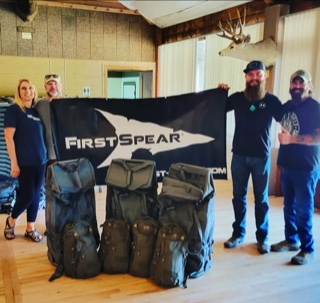
FirstSpear Sponsors Honored American Veterans Afield

FirstSpear is proud to support HAVA – Honored American Veterans Afield. HAVA is hosting 150 veterans 25-27 August, providing range time, meals and camaraderie.

As the number of injured men and women returning from the battlefields of Iraq and Afghanistan grew, members of the firearms industry initiated a non-profit partnership called HAVA to aid disabled soldiers as they transition to their lives back in the United States. The ultimate goal is to increase their confidence and hope for the future by reconnecting with their love of the outdoors and the American traditions of hunting and firearms.


Visit honoredveterans.org to learn more about how the firearms community is supporting disabled veterans.

Visit FirstSpear to find all the gear and apparel for America’s Warfighter.

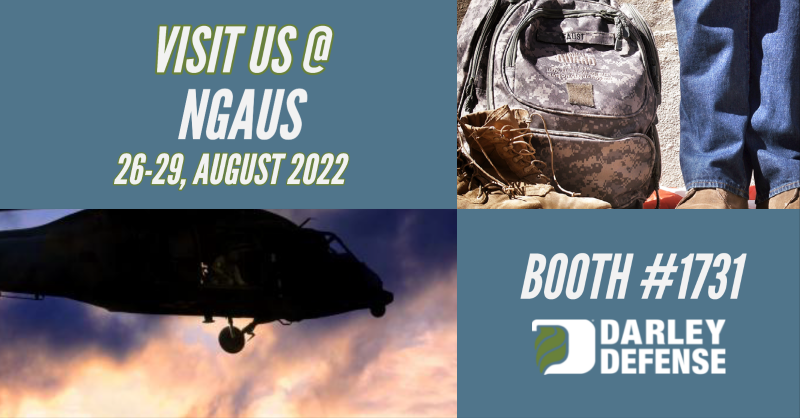
See Darley Defense at NGAUS in Columbus, Ohio

Friday, August 26th, 2022

When you hear Darley Defense, you should be thinking “premier procurement solutions.” Across the Defense industry and throughout Law Enforcement and First Responder communities, Darley is the go-to for equipment, technology, gear, clothing, and more. It’s not about getting the job done. It’s about getting it done right. Darley Defense is primarily military veterans, so they’ve walked-the-walk and know how to translate complicated procurement jargon into a clear and fast solution. Darley Defense is at NGAUS – booth 1731 – and a key sponsor for the Texas and Georgia National Guard hospitality suites. Visit them at booth 1731, find them at an after-exhibit event or visit DarleyDefense.com to turn your needs into solutions.

APNT/Space CFT Concludes High Altitude Experimentation

Thursday, August 25th, 2022

HUNTSVILLE, Ala. – The Assured Positioning, Navigation and Timing/Space (APNT/Space) Cross-Functional Team (CFT) has concluded a 64-day stratospheric flight demonstration utilizing Airbus’s Zephyr 8 ultra-long endurance solar-powered unmanned air system (UAS).

Launched from Yuma Proving Ground (YPG) on June 15, the Zephyr 8 UAS ascended to over 60,000 feet into the stratosphere before executing its flight plan over the southern portion of the United States, into the Gulf of Mexico, and over South America. Once returning to airspace over YPG, the team conducted multiple assessments.

On August 18 around 2100 hours PDT, the prototype aircraft’s flight campaign ended when the Zephyr 8 UAS encountered events that led to its unexpected termination over YPG. These events are under investigation. No injuries or risk to personnel or other aircraft resulted from this incident. Further information will be released following the investigation.

“Our team is working hard to gather and analyze important data following the unexpected termination of this flight,” said Michael Monteleone, Director of the APNT/Space CFT. “Despite this event, the Army and its partners have gleaned invaluable data and increased knowledge on the endurance, efficiency, and station keeping abilities of high-altitude UAS platforms. That knowledge will allow us to continue to advance requirements for reliable, modernized stratospheric capabilities to our Soldiers.”

This flight marked a number of firsts for Zephyr 8, including its departure from U.S. airspace, flight over water, flight in international airspace, data collection and direct downlink while outside of U.S. airspace, the longest continuous duration (7 days) utilizing satellite communications, and the demonstration of resilient satellite command and control from three different locations – Huntsville, AL; Yuma, AZ; and Farnborough, UK.

During this flight, Zephyr 8 more than doubled the previous UAS endurance record, just under 26 days, and flew in excess of 30,000 nautical miles – more than one lap around the Earth. The 1,500 flight hours beat all known unmanned aircraft endurance records, marking significant capability and informing future mission requirements.

This experimentation successfully demonstrated Zephyr’s energy storage capacity, flight endurance, station-keeping and agile positioning abilities.  Given the amount of data that was generated during the 64-day flight and the time required to analyze it, as well as the need to investigate the events that led to the termination, further flight demonstrations have been postponed until 2023.

This 64-day test flight was performed in conjunction with government and industry partners who support experimentation that continues to inform Army requirements.

-Army Futures Command