Aquaterro

Archive for the ‘Guest Post’ Category

Fort Lee Renamed for Buffalo Soldier, Medal of Honor Recipient

Saturday, July 19th, 2025

FORT LEE, Va. — Medal of Honor recipient Pvt. Fitz Lee was honored today during a ceremony renaming the installation after him.

The ceremony, which took place at the U.S. Army Ordnance Training Support Facility, featured the unveiling of new signage displaying “Fort Lee,” which will be installed at all garrison access control points. Additionally, the Sustainment Gate was renamed Lee Gate, and Sustainment Avenue was changed to Lee Avenue.

“Today, we gather not simply to unveil a new name for this installation, but to honor the full arc of service, sacrifice and commitment that has defined it for generations,” said Maj. Gen. Michelle Donahue, commanding general of the Combined Arms Support Command and Fort Lee. “We gather with respect, to celebrate the legacy of all who have served here and to look forward to the future.”

Donahue also acknowledged the installation’s previous namesakes, Lt. Gen. Arthur Gregg and Lt. Col. Charity Adams, praising their pioneering service, leadership and perseverance.

“Their stories will remain vital parts of this installation and our museum collections,” she stated. “We are committed to ensuring their legacies are preserved and honored as they helped shape this post into the center of excellence it is today.”

Lee enlisted in the Army as a private in 1889 and served with the 10th Cavalry, known as “Buffalo Soldiers,” during the Spanish-American War.

“We honor our installation with the legacy of Pvt. Fitz Lee who was a native of Dinwiddie County, a Buffalo Soldier and a Medal of Honor recipient,” said Col. Rich Bendelewski, Fort Lee garrison commander.

Lee earned the Medal of Honor for his exceptional courage during a daring rescue mission in Cuba in June 1898.

“We are proud and excited to be here today honoring our fellow Buffalo Soldier Pvt. Fitz Lee,” said Trooper Nina Amos, National President of the 9th & 10th (Horse) Calvary Association. “Lee was a Soldier who served with honor, integrity, valor and conviction.” Lee was awarded the Medal of Honor during the War with Spain.

As he was boarding transport ships bound for Cuba, Lee, along with 50 other troopers, was chosen for a special assignment behind enemy lines to reinforce and resupply Cuban fighters seeking liberation from Spanish rule, according to the National Park Service’s Charles Young Buffalo Soldiers National Monument website.

On June 30, 1898, Cuban freedom fighters and some American volunteers aboard the U.S.S. Florida attempted an amphibious landing at Tayacoba, Cuba. The landing party immediately engaged with Spanish soldiers from a nearby blockhouse. The Cubans and Americans retreated, leaving behind a group of wounded comrades. After four failed attempts, U.S. commanders decided to try one last time to retrieve the survivors.

Lee and three other Buffalo Soldiers answered the call. They rowed ashore amid intense small arms fire, and upon reaching the shore, located the survivors and brought them safely back to the U.S.S. Florida, the site stated.

“That kind of courage – deliberate, determined and selfless – defines the very best of our Army,” Donahue said. “Pvt. Lee didn’t act for recognition. He acted because it was the right thing to do. Because that’s what Soldiers do.”

Lee was born in June 1866 in Dinwiddie County, Virginia, which is only a few miles from the installation that bears his name.

“A name is never just a name – it’s a reflection of our values, our history and our aspirations,” said Kevin Massengill, Dinwiddie County administrator. “This base has always been more than a neighbor to Dinwiddie; it’s been a family.”

For more than a century, our residents have worn its uniform, worked its gates and supported its mission, he said.

“By bearing the name of our own, Fort Lee now tells a story rooted in this land – one that speaks not only of a history we inherited, but a legacy we choose to honor: a Dinwiddie son,” Massengill said.

Lee’s health declined quickly after the rescue mission. He received his Medal of Honor while he was in the hospital on June 23, 1899, at Fort Bliss, Texas, and was medically discharged from the Army on July 5, 1899.

Lee moved to Leavenworth, Kansas, after discharge to live with fellow retired Buffalo Soldiers. He died at the home of a friend on Sept. 14, 1899, and was buried with full military honors at Fort Leavenworth National Cemetery.

“By bearing his name, this installation deepens its connection to our local heritage and our Army’s enduring values,” Donahue said. “Fitz Lee’s legacy is one of bravery, humility and unwavering commitment – qualities we must all strive to embody.”

“Fort Lee will continue to be a place where Soldiers are forged, leaders are developed, and the strength of our Army is sustained,” Donahue concluded. “Let us carry that responsibility with pride, with humility, and with an unwavering commitment to excellence.”

By Ericka Gillespie and Jefferson Wolfe

FirstSpear Friday Focus – SHERPA in MultiCam Black

Friday, July 18th, 2025

The SHERPA, now offered in MultiCam Black, is a versatile and discreet equipment bag built for hard use and adaptable to a wide range of environments. Designed in collaboration with FirstSpear’s professional users, it delivers performance whether you’re heading to the range, boarding a boat, or responding to a call-out.

Its compact form makes it ideal for day use, with a durable 500D construction and premium hardware that ensures long-lasting reliability. The large main compartment includes removable and reconfigurable interior organizer panels, allowing users to customize storage for mission-specific gear.

Two padded pistol pockets provide secure transport for handguns, while the loop interior is compatible with hook-backed Ragnar pockets and cell tags, adding modular storage flexibility.

A removable padded shoulder strap with rugged HK hooks offers comfortable carry, whether slung across your body or thrown over a shoulder. The Sherpa maintains a low-profile, discreet appearance, helping it blend into civilian settings without drawing unwanted attention. This bag meets the demands of users who don’t compromise on function or form.

Whether you’re carrying firearms, tools, or everyday essentials, the Sherpa is sized and built to handle it all. With its intelligent layout and field-proven design, it’s a trusted companion for professionals and enthusiasts alike. The optional DELUXE SHERPA DIVIDER, sold separately, further enhances internal organization for those with more specialized loadouts. FirstSpear is the premier source for cutting edge-tactical gear for military, law enforcement and those who train. For more information visit First-Spear.com.

Ukraine’s Battlefield Innovations Reshape Global Military Thinking

Friday, July 18th, 2025

WIESBADEN, Germany – Since the onset of full-scale Russian aggression in 2022, Ukraine has adapted swiftly to conditions on the battlefield, turning what was expected to be a quick invasion into a costly quagmire for the Russian armed forces. These operational, institutional, and technological adaptations adaptation were the focus of a panel convened at LANDEURO on July 16 with military leaders, defense industry representatives and Ukrainian officials which examined the evolution of Ukraine’s defense capabilities since the onset of full-scale Russian aggression.

The panel moderated by Dr. John Nagl, professor of warfighting studies at the Army War College, featured Armed Forces Ukraine Maj. Gen. Volodymyr Horbatiuk, Deputy Chief of the General Staff; U.S. Army Lt. Gen. Curtis A. Buzzard, Commanding General, Security Assistance Group – Ukraine; Armed Forces Ukraine Maj. Robert Brovdi, Commander, Unmanned Systems Forces; Maximillian Froch, Head of Strategic Programs International Rheinmetall AG; and Oleksandra Azarkhina, Co-founder, We Build Ukraine.

The transformation of the way Ukraine fights began with the structure of its armed forces, according to the panelists. Lt. Gen. Buzzard described how the country’s military expanded from 20 to over 100 brigades in a very short time. This transformation has required new approaches to training, organization, and leadership, all under intense pressure of an ongoing war.

“Never be satisfied with our efforts to try to learn as much as we can,” said Lt. Gen Buzzard, reminding NATO and U.S. leaders of their responsibility to keep learning from Ukraine’s experiences.

Strong collaboration between government officials, private companies and citizens strengthened Ukraine’s ability to innovate quickly, bypassing slow-moving systems in favor of fast, flexible and more cost-effective solutions driven by people on the ground, panelists said.

Azarkhina described Ukraine’s approach as values-driven and resourceful. She emphasized the role of civic engagement and cooperation and encouraged NATO and partners to align efforts through intelligence sharing, joint procurement, and smarter coordination to stabilize the frontline.

Panelists highlighted the central role of unmanned systems including aerial drones and ground vehicles, in Ukraine’s military operations. This kind of technology is helping Ukraine gather information and carry out missions more safely. Maj. Brovdi, a decorated member of the Ukrainian military and awarded by Volodymyr Zelenskyy as the “Hero of Ukraine,” discussed Ukraine’s developing doctrine for using unmanned systems. He believes this framework will serve as a model for NATO.

Brovdi praised the efforts of fellow countrymen, but said Ukraine is facing three major challenges at this stage in the war. He said Russian forces are being deployed in such large numbers that Ukraine defenses are struggling to keep up; vital infrastructure across Ukraine are continuing to suffer heavy damage from ongoing Russian assaults; and Ukraine’s civilian population is already fully engaged in the war effort, therefore, there is no reserve remaining for more personnel.

Ukraine’s experience during the war is changing how countries around the world think about defense and is influencing programs like the Army Transformation Initiative. Instead of using old systems, Ukraine is finding faster, more flexible ways to respond with new technology and working with all parts of society.

The full video of the panel can be found here.

By Natalie Weaver

Gray Eagle Armed Persistence

Thursday, July 17th, 2025

Source General Atomics;

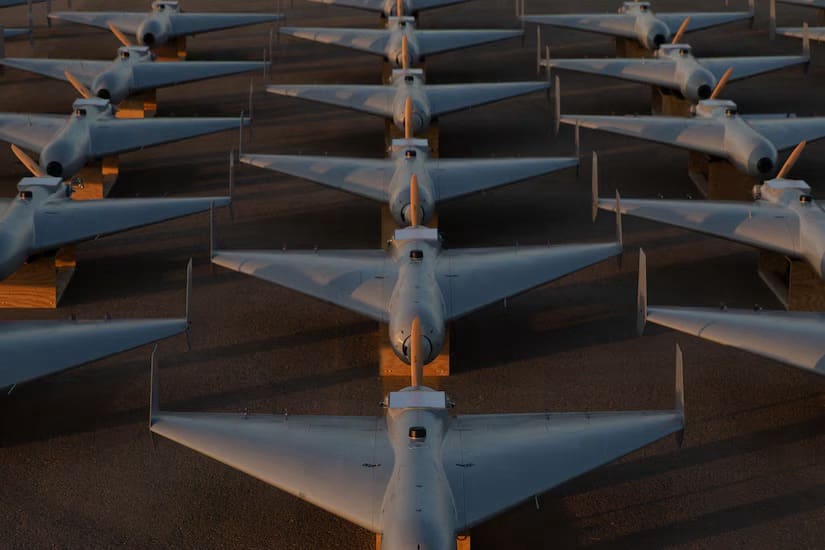
An essential element of the U.S. Army’s Aviation Modernization Plan, GA-ASI’s Gray Eagle Unmanned Aircraft System (UAS) is an innovative and technologically advanced derivative of the combat-proven Predator®. Gray Eagle offers a reliable, affordable, low-risk, and compelling next-generation tactical UAS solution to meet challenging service requirements for persistent Reconnaissance, Surveillance, and Target Acquisition (RSTA) and attack operations.

Gray Eagle has an endurance of 25 hours, speeds up to167 KTAS, can operate up to 29,000 feet, and carries 1,075lb (488 kg) of internal and external payload. The aircraft can carry multiple payloads aloft, including Electro-optical/Infrared (EO/IR) with laser designation, Synthetic Aperture Radar (SAR), communications relay, and four Hellfire missiles.

Compared to the Predator predecessor, Gray Eagle’s Heavy Fuel Engine (HFE) supports the Army’s “single fuel in the battlefield” concept and provides increased horsepower and significantly improved fuel efficiency, utilizing either jet or diesel fuel.

An extremely reliable UAS, Gray Eagle features a fault-tolerant control system and a triple-redundant avionics system architecture, similar to the systems integrated in the battle-proven Predator B. Designed with airworthiness as a primary consideration, Gray Eagle is engineered to meet and exceed manned aircraft reliability standards.

This long-range, long-dwell UAS is dedicated to direct operational control by Army field commanders. Its expansive mission set includes, but is not limited, to wide-area Intelligence Surveillance and Reconnaissance (ISR), convoy protection, Improvised Explosive Device (IED) detection and defeat, close air support, communications relay, and weapons delivery missions.

Gray Eagle features an automatic takeoff and landing system (ATLS) that allows the aircraft to be launched and recovered without any operator interaction. Gray Eagle aircraft have successfully conducted tens of thousands of takeoffs and landings.

Gray Eagle Dugway:

Gray Eagle AV SN# 70125 was one of the first aircraft off the Gray Eagle production line, built specifically to meet the ARMY’s needs. AV 70125 is special to Dugway and the ARMY both, shortly after production, it was designated as a test asset and sent here to Dugway. While here, AV 70125 was a key asset to all 4 ARMY production prove out tests to ensure the Gray Eagles abilities and reliability. AV 70125 has also been an invaluable asset to testing, accomplishing, enhanced safety, reliability, combat effectiveness, and readiness of the fielded ARMY Gray Eagle fleet, supporting our troops in the real-world environments they see every day. Through the course of AV 70125’s 15+ year service life, it has flown over 230 flights, of which all were related to testing and evaluation to continue providing the most cutting-edge technology for the U.S. ARMY.

Most importantly, the Gray Eagle program still remains here at Dugway and continues to prove its value to the ARMY every day. UAS PMO plans on continual testing and technology insertions with the Gray Eagles that reside on Dugway, operated and maintained by General Atomics.

By Rodney Mitani

RESOLUTE SPACE 25: Guardians Ready to Lead Service’s Largest Exercise

Thursday, July 17th, 2025

JOINT BASE PEARL HARBOR-HICKAM, Hawaii (AFNS) —  

More than 700 Guardians around the world are prepared to participate in a U.S. Space Force led large-scale exercise, Resolute Space 2025, which will demonstrate the Space Force’s preparedness for complex, large-scale military operations.

The exercise will be conducted in partnership with joint and international forces and demonstrates the ability to operate in a contested, dynamic environment against high-end threats on short notice. Space superiority is an indispensable prerequisite to the success of the Joint Force. Resolute Space enhances the skills of Guardians to deter and, if necessary, defeat adversary aggression threatening the U.S. and its allies and partners.

“Resolute Space sends a clear message: Guardians are prepared to fight and win in space shoulder to shoulder with our joint and allied partners,” said Chief of Space Operations Gen. Chance Saltzman. “By training at this unprecedented scale, we’re sharpening warfighter instincts, strengthening combat credibility, and proving our commitment to deliver peace through strength in the face of any challenge.”

Resolute Space is integrated with the Air Force’s exercise Resolute Force Pacific, or REFORPAC, which together form the core of the 2025 Department Level Exercise series.

The intent of this Space Force-led exercise is to incorporate, at scale, space-based and space-enabled capabilities to include, but not limited to, space electromagnetic warfare, space domain awareness, orbital warfare, and navigational warfare.

“Resolute Space emphasizes our focus on readiness and training as we incorporate live, synthetic, and virtual space warfighting into an exercise of this magnitude. We’ve leveraged expertise across all functional areas to ensure Guardians internalize the scope and scale of their responsibilities to the joint force and to national security,” said U.S. Space Force Col. Jay Steingold, Resolute Space exercise director. “The expertise and dedication required by the Resolute Space planning team to bring the exercise from conceptualization through planning and into execution is nothing short of remarkable. They have surged in their professional capacities and have been laser-focused on providing Guardians highly relevant and realistic exercise training opportunities.”

Guardians will be operating out of Joint Base Pearl Harbor-Hickam; Peterson and Schriever Space Force Base, and Buckley SFB; and other locations in the U.S. and overseas. This concept of distributed operations provides effective warfighting capabilities to the joint and combined force around the world.

The nation depends on the Space Force to organize, train and equip forces ready and able to conduct space warfighting operations. Resolute Space 2025 provides fundamental training to validate Guardian readiness.

By Resolute Space Public Affairs (Space Training and Readiness Command and Space Operations Command)

X-Pac Tactical Powers Spiritus Systems Mission-Ready Design Innovation

Wednesday, July 16th, 2025

Spiritus Systems is dedicated to designing and manufacturing high-performance equipment that consistently exceeds the expectations of its core users—primarily military and law enforcement professionals. With a focus on challenging industry norms, the brand develops gear with a clearly defined end-use in mind, often anticipating needs beyond the initial objective.

This thoughtful approach stems from a deep understanding of the user community. Spiritus Systems engages directly with individuals from various operational backgrounds to ensure its gear genuinely meets real-world requirements. The design philosophy is rooted in the founders’ military experience, combined with end-user feedback and advanced, U.S.-based manufacturing practices. The result: quality equipment that performs in the most demanding conditions.

We had the opportunity to speak with Spiritus Systems Lead Designer, Matt Hawes, to learn more about what sets Spiritus Systems apart and what’s on the horizon.

Solving Niche Problems for a Broader Market

According to Hawes, what makes Spiritus Systems unique is its ability to solve specific user challenges while maintaining wide applicability. “We’re problem-solvers. We design with a specific issue in mind, but the goal is always to create something that works for more than just one purpose,” said Hawes.

Spiritus Systems creates “omnivorous” pouches and gear that are versatile in both form and function. Whether designed for a specific tool or task, their products often prove useful in a variety of situations, making them a smart investment for users who often purchase gear out-of-pocket.

A Focused User Base

While Spiritus Systems products have broad appeal, their primary audience remains specialized law enforcement units—particularly SWAT teams—as well as military personnel and special operations forces who require elite-level performance gear.

American-Made—Down to the Details

All Spiritus Systems products are manufactured in the United States, and the commitment to domestic sourcing doesn’t stop there. Even when not required by government contracts, Spiritus Systems adheres to Berry Amendment standards, ensuring that materials are also U.S.-sourced whenever possible.

“We’ve even worked with U.S. manufacturers to bring formerly foreign-made materials stateside,” said Hawes. “This includes processes like weaving and dyeing, as well as developing new colorways and custom material options.”

Innovative Use of X-Pac® Fabrics

The adoption of X-Pac® fabrics has been a game changer for Spiritus Systems. Hawes recalls testing samples of X-Pac® VX21, X33, and X50 fabrics during a previous role, experimenting with the material under different stressors and sewing conditions. The X-Pac® fabrics held up exceptionally well, showing minimal distortion—key for robotic sewing systems that lack the adaptability of human sewers.

Not only do X-Pac® fabrics streamline the manufacturing process, but they also offer tangible benefits for end-users. Traditional materials tend to absorb sweat and moisture, but due to its weatherproofing properties, X-Pac® fabrics stay dry, enhancing comfort during long wear times. The fabric is also extremely lightweight and abrasion resistant ensuring long-lasting durability.

New Materials, New Possibilities

Currently, Spiritus Systems leans heavily into X-Pac® X50 fabric for a wide range of products including slings, plate carriers, and pouches. The material’s manufacturing efficiency helps lower labor costs and boost production capacity.

The team is also experimenting with an ultra-light material, X-Pac® Manta. “It’s hilariously light—I laugh when I weigh it,” saidHawes. While still in the exploration phase, X-Pac® Mantapresents exciting opportunities for creating ultra-thin, durable gear without compromising strength.

The Versatile JSTA Pouch

Among Spiritus Systems’ lineup, the JSTA pouch holds a special place for Hawes. Originally designed to carry chem light bundles, its utility extends far beyond that. From carrying competition shooting accessories to spare magazines—or even explosive charges—its adaptability speaks to the design ethos of the company.

On the Horizon

The next major product launch for Spiritus Systems is the LV-120 plate carrier system, which heavily incorporates X-Pac® fabric and reflects a culmination of thoughtful, user-centered design. “We’re in the final stages,” said Hawes. “There’s enough going on in that system to warrant a full hour-long conversation!”

Also in development is the LV-120 suite, along with enhancements to the plate carrier line, signaling exciting growth for Spiritus Systems in the months ahead. You can find more information on Spiritus Systems and its products on its website.

Please visit X-Pac® Tactical for more information on its performance fabrics.

About X-Pac® Tactical

Born from X-Pac® legacy on the world’s most challenging peaks and longest trails, X-Pac® Tactical Fabrics, are lightweight, durable, incredibly strong and 100% waterproof. At the forefront of innovation, these fabrics offer peak performance in the harshest environments. Leveraging a proprietary lamination technology, X-Pac® Tactical Fabrics combine trusted face fabrics and strategic fiber reinforcement; specifically designed for the demanding missions. This unique construction elevates equipment’s functionality and longevity. TRUST ONLY X-PAC® www.x-pactactical.com.

About Dimension-Polyant

Dimension-Polyant is the world’s largest sailcloth producer with decades of experience in highly technical sailing fabrics. Founded in 1966, Dimension-Polyant has consistently set the standard with their high-quality products and precision workmanship. The company is known for reliable customer care, world-class innovation, and conscious efforts to make products that have as little of an impact on the environment as possible. Its production facilities are in Putnam, CT USA and Kempen, Germany. As of 2021, the company is climate neutral. www.dimension-polyant.com. Dimension-Polyant is owned by Sioen Industries, Belgium sioen.com/en

US Army Begins Fielding Improved Ghillie System

Wednesday, July 16th, 2025

The Improved Ghillie System is hitting the field!

Supply Soldiers from the 1st Special Forces Group (Airborne) got a first look at this next-gen base layer-modular system during a recent fielding at Joint Base Lewis-McChord.

Led by Blaise Liess from Tactical Soldier Mobility under PdM SCIE, the team partnered with Salute Uniforms to innovate design and textiles, boosting mobility and concealment for snipers and recon teams while cutting production costs.

The result? An advanced and more accessible concealment system for the Soldiers who need it most!

– Via PEO Soldier

Specialized EOD Fitness Test Will Gauge Critical Task Ability

Tuesday, July 15th, 2025

ARLINGTON, Va. (AFNS) —  

Explosive Ordnance Disposal has been added as the next combat arms career field to require special sex and age neutral fitness standards.

EOD joins other fields with heightened entry level and sustained physical fitness requirements. These requirements acknowledge that sustained endurance is necessary to tackle long hours in physically and mentally-taxing conditions.

The other specialties that utilize occupationally specific physical fitness assessments are in the Special Warfare community. Both communities started developing their fitness standards in 2015.

Starting Aug. 1, EOD Airmen will begin taking the new assessment that will measure their ability to perform tasks necessary to accomplish critical mission objectives. During an adaptation period over the last year, EOD Airmen took an unofficial version of the test. Results after July 31 will be part of an EOD Airman’s official record.

The assessment will include four exercises to assess muscular strength and endurance, anaerobic capacity and cardiorespiratory endurance:

1000-meter row

20-lb. medicine ball toss

Trap bar lift

Gruseter drop-roll-lift-run maneuver

EOD Airmen with a 3E8XX Air Force Specialty Code and EOD-qualified officers assigned to a 32E3H duty position are currently exempt from the Air Force Physical Fitness Assessment and have begun training for the EOD OSPFA.

“Maintaining our strategic advantage is about building a ready force capable of engaging against any threat to the United States across the spectrum of operations from competition through crisis and if deterrence fails, to prevail in conflict,” said Brig. Gen. Brian Hartless, Civil Engineers director. “Our EOD Airmen are crucial to preserving our nation’s security.”

The 1000-meter row measures cardiovascular fitness, which relates to EOD operations such as bombing range explosive hazard removal and bomb suit operations to defeat improvised explosive devices.

The 20-lb. medicine ball toss to the back, side, and log measures fitness related to EOD operations such as robot employment and operations, ladder climbs, and cross-loading or evacuation of casualties.

The trap bar lift requires five repetitions ranging from 150 to 360 lbs. It measures fitness related to EOD operations such as construction of protective works, contingency airfield support operations and bomb suit operations to defeat improvised explosive devices.

The Gruseter is a drop-roll-lift lift-run maneuver with a 30-lb. vest, 50-lb. sandbag, and a 15-meter run for five rounds. This exercise is particularly beneficial for EOD operations, such as small unit tactics and bombing range explosive hazard removal, as it simulates the physical demands of these operations, where personnel may need to quickly and efficiently move heavy equipment in high-stress situations.

Component scores are measured at three levels: initial EOD training, intermediate level training, and graduate level/operational fitness.

For more information, see the OSPFA score charts and videos here and AFMAN 36-2930.

Secretary of the Air Force Public Affairs