GORE-TEX Professional

Archive for the ‘Guest Post’ Category

Air Force Fields New Rifle to Airmen

Thursday, April 21st, 2022

ROBINS AIR FORCE BASE, Ga. (AFNS) —

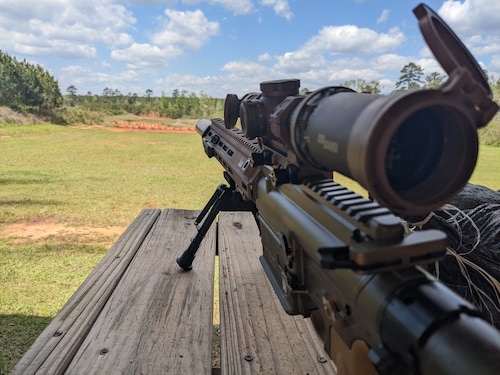
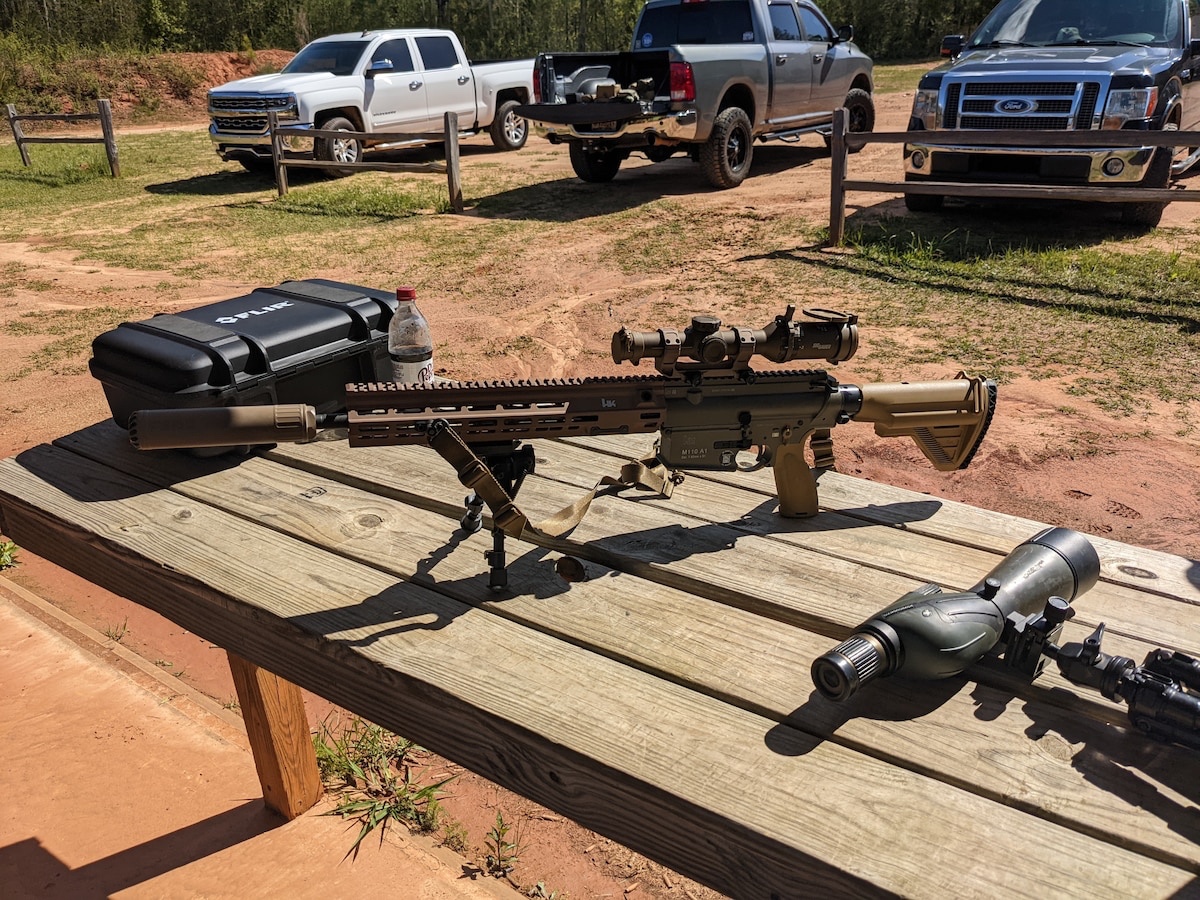
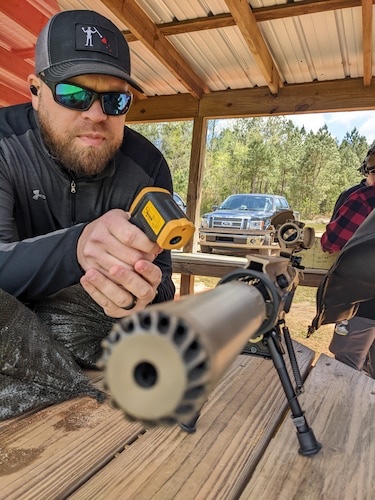
The Air Force Life Cycle Management Center’s Small Arms Program Office is in the final phase of delivering the Squad Designated Marksmanship Rifle, or SDMR, to units across the Air Force.

The Air Force purchased approximately 1,464 SDMRs that will be distributed across the service based on approved allowances.

The SDMR is a semi-automatic, 7.62x51mm caliber rifle designed by Heckler & Koch for missions requiring combat over-watch with precision-fire capability to accurately engage targets up to 600 meters.

The SDMR was fielded to Air Force units this year. It is a multi-role asset, set to meet multiple missions taking place around the world.

It will replace legacy M24 Sniper Weapon Systems for security forces defenders performing base defense operations in-garrison and in contingency support.

The SDMR is lighter weight in comparison to other 7.62 platforms and will also replace the M110 Semi-Automatic Sniper Systems rifle for pararescuemen and Guardian Angels, saving them 5 pounds in gear while out on missions.

Finally, the SDMR’s precision-fire capability will be wielded by Air Force Explosive Ordnance Disposal technicians to eliminate small munitions in their standoff munition disruption activities.

“We’re excited to field this incredible weapon system,” said Matthew Hamer, Small Arms Program Office lead. “Being able to field one solution that can effectively achieve multiple missions epitomizes Air Force acquisition strategies and shows Airmen ability to adapt to any situation.”

Story by Brian Brackens, Air Force Life Cycle Management Center Public Affairs

Photos by Shaun Ferguson

UT System, U.S. Army Futures Command Announce Partnership to Accelerate Innovation in Trauma Care

Wednesday, April 20th, 2022

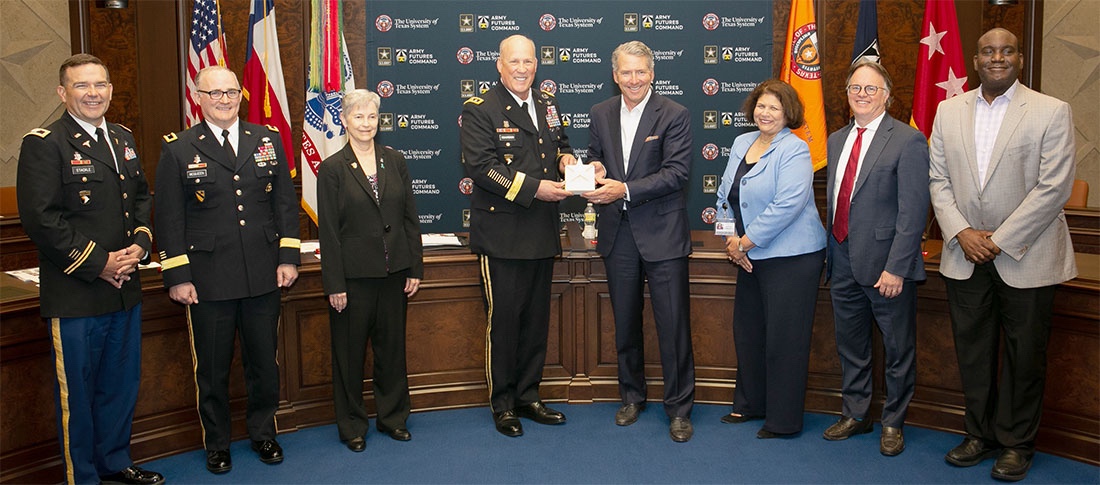
The University of Texas System and the United States Army Futures Command (AFC) have formed an official educational and cooperative research partnership to advance medical science and technology to save lives both on and off the battlefield.

Since last year, leaders from the UT System, AFC, U.S. Army Medical Research Command and U.S. Army Institute of Surgical Research (USAISR) have been exploring how to work together to solve some of the most critical issues affecting soldiers injured in combat.

Today, they formally signed two agreements to streamline collaboration between the military and UT institutions: an Educational Partnership Agreement and a Cooperative Research and Development Agreement.

The agreements will allow a continuous flow of resources, research and scientific expertise, focusing specifically on medical science and technological innovations.

“I can not emphasize how groundbreaking this will be,” said Lt. Gen. James Richardson, AFC acting commanding general. “This will allow opportunities for furthering research and expand capabilities for improving our work in the critical area of trauma care, which will extend to our future soldiers and also have impacts in our communities.”

The partnership will leverage the scale and expertise of the both the UT System and the Army, UT System Chancellor James B. Milliken said.

“The military brings to the table a substantial health research infrastructure, unrivaled experience in battlefield trauma, and the capacity to test innovations in the field,” Milliken said. “UT institutions offer an extensive basic and applied science infrastructure, a world-class system for conducting clinical trials, and some of the world’s most brilliant and innovative minds.”

During a Summit last year, researchers and military health specialists from AFC and the UT System emphasized the need to turn the “Golden Hour” into the “Golden Day,” referring to the timeframe following a battlefield wound when proper medical treatment is crucial to survival. Following the Summit, several UT institutions and USAISR developed collaborating research proposals to address the underlying causes of tissue damage and novel treatment options following trauma.

The UT System and Army Futures Command anticipate that the new partnership will have long-lasting impacts on both soldiers as well as civilians who suffer traumatic injuries that land them in the emergency room.

The partnership also builds on numerous existing collaborations between the Army and UT institutions.

The UT System Board of Regents allocated $50 million to UT Austin to establish facilities to develop and test robotic systems and artificial intelligence through the new Robotics Center of Excellence. Researchers at UT Arlington are studying the human dynamics of decision-making, and UT Dallas is creating chemically powered artificial muscles that could power robotic mules to serve as alternative Army vehicles. UT San Antonio and UT El Paso are working with the Army to advance cybersecurity.

In addition, the UT System currently has several research projects with the Department of Defense to create more technologically advanced cybersecurity systems and to support the use of robotics in combat. The collaboration aims to deliver breakthroughs in the science of combat casualty care, such as delivering oxygen to tissue, shock management, wound progression and infection, as well as physical pain or PTSD.  

DEVCOM Soldier Center’s Director of Research and Technology Integration Inducted into Senior Executive Service

Tuesday, April 19th, 2022

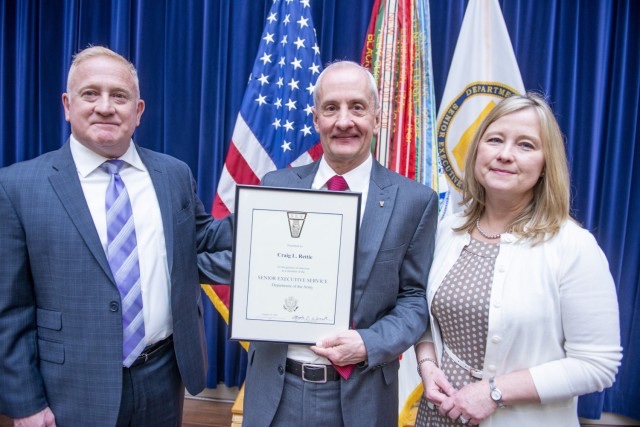
NATICK, Mass. – Craig L. Rettie, director of Research and Technology Integration for the U.S. Army Combat Capabilities Development Command Soldier Center, or DEVCOM SC, has been inducted into the Senior Executive Service, or SES.

In his position at DEVCOM SC, Rettie is responsible for the planning, programming, coordination and external integration of DEVCOM SC’s science and technology program to ensure America’s warfighters are optimized, protected, and lethal.

During the March 31 SES induction ceremony, Douglas Tamilio – director of DEVCOM SC and an SES Level II – hosted the ceremony and administered the oath of office to Rettie. The ceremony took place in Hunter Auditorium at the Natick Soldiers Systems Center, or NSSC.

By becoming an SES, Rettie joins an elite group of men and women chosen for their leadership qualifications and tasked with leading the ongoing transformation of the government.

Tamilio said that Rettie has the right skill set, as well as a wide depth of experience coupled with demonstrated leadership.

“He epitomizes the Army Values of loyalty, duty, respect, selfless service, honor, integrity, and personal courage,” said Tamilio.

Rettie credited the many people who have led, mentored, and supported him over the years.

“Being selected for the Senior Executive Service is an honor that words are incapable of truly describing,” said Rettie. “I certainly never set out almost 40 years ago with the intention of winding up here, in this position. I have been blessed over those years to have the strongest leaders, insightful mentors, and strong supporters. Any credit for my successes belongs to them and the great people I have worked with on this journey. I look forward to continuing to serve the Army and Soldiers, with this great workforce, for years to come.”

By Jane Benson, DEVCOM SC Public Affairs

Visit Photonis Defense at TTPOA

Monday, April 18th, 2022

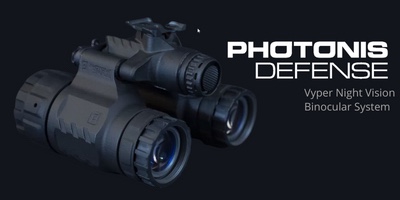
Photonis Defense – Night Vision is proud to support the Texas Tactical Police Officers Association TTPOA Raffle with a donation of our NEW Vyper Series Night Vision Binocular Device. Photonis Defense is committed to providing smaller, lighter, and faster auto gating night vision systems. From law enforcement professionals to our military forces we provide superior defense support for those who take up the cause to protect us. Our specialists custom build to fit your most demanding operations.

When you attend this year’s conference in Round Rock, TX please stop by the Photonis Defense booth and check out the Night Vision Series that allow you to see what others cannot.

photonisdefense.com

www.ttpoa.org/page/2022-conference-home

Nightforce Optics Adds Dark Earth Color Option

Monday, April 18th, 2022

Nightforce is excited to announce that select ATACR and NX8 riflescopes are now available in Dark Earth color options.

Also available is the Nightforce UltraMount in many commercial configurations: Dark Earth or Black anodizing, 1.54in or 1.93in height, and 0MOA or 20MOA bias options.

For more information on all of our new Dark Earth riflescopes and Nightforce UltraMounts, please visit our website or contact your local Nightforce dealer.

Carry Compact this Medical Monday

Monday, April 18th, 2022

SWANSBORO, N.C. – April 18, 2022 – High Speed Gear® would like to take a moment to remind its customers what matters most.

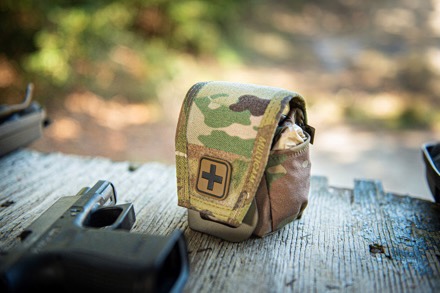
Throughout the tactical community, there are many assets to defending your life. However, some of the most important items are the ones that can save a life. High Speed Gear® offers many options for carrying medical equipment on your person. Some of the more low-profile options would be the ReViveTM Medical Pouch and the Bleeder/Blowout PouchTM.

Both the ReViveTM Medical Pouch and the Bleeder/Blowout PouchTM offer an individual a quick access pouch to release life-saving medical equipment. The pouch can fit all necessary medical equipment (not included) to treat a small-arms gunshot wound.

“The design of these pouches, was to make sure users had one handed, quick access to the most important supplies while being extremely compact to save space.” Said HSGI® Senior Designer, Daniel Chaney.

The benefits of these pouches are considered greatly within the tactical industry. Both the ReViveTM Medical Pouch and the Bleeder/Blowout PouchTM were awarded gold status by the National Tactical Officers Association (NTOA). These compact medical kits are not only space savers, but also money savers with the retail cost of the ReViveTM being $76 and the Bleeder at only $44.

For more information for the ReViveTM Medical Pouch, visit: ReViveTM Medical Pouch

If you would like to see more about the Bleeder/Blowout PouchTM, please see the link here: Bleeder/Blowout Pouch

U.S. Army Aviation and Missile Command’s Advance Planning Briefings to Industry Offers Corporate Partners ‘Predictability, Situational Understanding’

Monday, April 18th, 2022

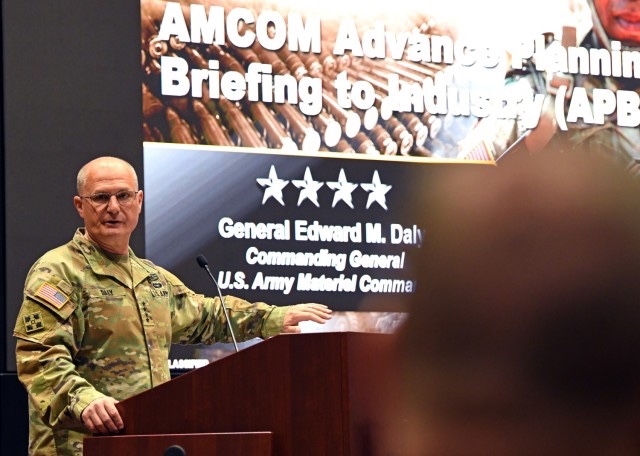
REDSTONE ARSENAL, Ala. — The U.S. Army Aviation and Missile Command hosted the Redstone Arsenal Center of Excellence — Advance Planning Briefings to Industry March 22-24 at Redstone Arsenal, Alabama.

The annual event offered transparency in acquisition strategies by providing long-range technology and capability development objectives to members of industry. It also showcased potential business opportunities available with various Team Redstone organizations.

Due to COVID-19 conditions, the event was held virtually again. Although the auditorium was nearly empty, approximately 1,000 participants tuned into the three-day forum, which was packed with presentations from senior leaders throughout the federal government, as well as civic leaders, such as Alabama Senator Tommy Tuberville, Huntsville Mayor Tommy Battle, Madison Mayor Paul Finley and Madison County Commissioner Dale Strong.

Army Materiel Command Commanding General Gen. Edward Daly was the keynote speaker and described the APBI as critical and beneficial, as it provides predictability and situational understanding to the corporate sector.

Daly outlined the four Redstone Arsenal core competencies of logistics services; space operations and missile defense; research, development, test and evaluation; and intelligence and homeland defense.

“Those are what we are focused on during APBI,” he said. “Making sure the industry partners have predictability and situational understanding on where we are going depending on what they do in support of those areas.”

He said the theme of this year’s event, “government-industry partnership to support large-scale combat operations,” is more important than ever due to the real-world events occurring in Europe.

Daly said his priorities are aligned to those of the Secretary and Chief of Staff of the Army and noted that industry partners could assist in those areas, such as modernization and identifying vulnerabilities in the supply chain — not just shortfalls and gaps, but also quality and cyber threats. His final message to the virtual audience was a reminder that when it comes to industry, the size of the company does not matter.

“This is not just about large industry partners; this is also about small businesses,” Daly said. “We have balanced this approach very carefully so that so we can simultaneously take care of small business efforts, as well as our corporate partners. We have a common bottom line, and that’s the support of the warfighter — that’s our single, common bond — our ability in those partnerships to take the right actions to support the warfighter.”

More than half of the 73 tenants that call Redstone Arsenal home spoke at the 2022 APBI, and event organizer, AMCOM Ombudsman Eric Lampkin said the event has steadily grown each year. With that growth, he said the virtual option, while necessitated for the last two events due to the COVID-19 pandemic, will remain as an option, even when APBI returns to in-person attendees.

“Next year we anticipate doing a hybrid of both virtual and in-person,” Lampkin said. “The virtual option allows attendees to dial-in when it is relevant to their needs and as their time allows. However, nothing beats the ability to shake hands, meet face-to-face and network in-person, especially when it comes to the industry matchmaking event.”

The second day of APBI traditionally features a matchmaking forum, which allows small businesses to meet with large corporations, federal contractors and government organizations. Lampkin said hosting the matchmaking event virtually was challenging because you do not get those personal connections, so he looks forward to the crowds returning to the Bob Jones Auditorium next year.

Rodney Pennywell, who assisted Lampkin by coordinating the civic leadership involvement, attended the event as a small business owner. He said when he started attending APBI six years ago, the structure and focus were different; they did not address the needs of small businesses or provide opportunities for how industry could assist Redstone organizations.

He said, “Over the years, the presenters have dramatically tailored their message to the industrial base, particularly to small businesses, ensuring that they better understand RSA missions and related business opportunities. These presentations now truly address industry needs by giving advance notice of where the federal government requires industry assistance with developing innovative technologies and solutions to achieve long-term goals and objectives.”

Former AMCOM commander Jim Rogers works for a large defense industry partner and while he was not able to attend APBI this year, as the vice president of Army programs for his company, he encouraged employees from all over the U.S. to register and tune into the virtual event.

Rogers concurs with Pennywell. He said APBI is much more robust than it was when he served at Redstone 2010 through 2012.

“Our business areas are from the west coast to the east coast, and it’s not only the people who have interest in doing business with Redstone, but also our supplier diversity, which is the folks who are looking for small businesses who want to do business with us. So you have the whole gamut of people on the line listening about what is going on at Redstone Arsenal.”

The next APBI will be held in spring 2023 and Lampkin said the planning will begin about eight months prior to the kickoff. He said he hopes to be in person next year, with a virtual option for attendees, but regardless of the forum, the intent of the event will not change, which is securing partnerships between the Department of Defense and the private sector.

“It’s important that we communicate with industry so they know where to direct their energy and resources,” Lampkin said. “It’s value added to them and it’s also value added to us on the government side, because we can communicate the technology we are looking for, what we are trying to do, where we see ourselves in five years and where we need industry to help us get these things done.”

Lampkin added, “We have to have industry continuously engaged in the organic industrial base, continuously engaged in the defense department and continuously delivering technology so we can remain ahead of our near-peer competitors.”

By Michelle Gordon

SCUBAPRO Sunday – HMS Conqueror

Sunday, April 17th, 2022

HMS Conqueror was a nuclear-powered attack submarine and one of the Royal Navy’s most powerful ships in the 1980s. As part of the Falkland Islands Re-taken operation, she sank the Argentine Navy light cruiser ARA General Belgrano. It was only the second submarine torpedo sinking since WWII.

After returning to the U.K., the Conqueror would be tasked to steal a secret sonar array from a Soviet Navy ship. It was code-named Operation Barmaid, and the nuclear-powered sub would be fitted with a special pair of remote-controlled heavy steel cutting blades and television cameras, so they could sneak up on a Russian spy trawler towing a sonar array and just cut it off and then float away.




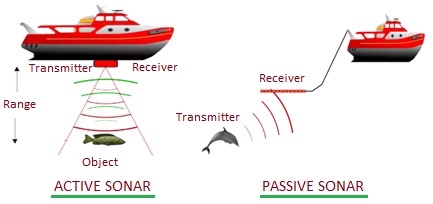
During the Cold war, the U.S. and the U.K. had a significant advantage over the Soviets regarding submarine warfare. We had two different types of SONAR, Active and passive. Active sonar sends out pings, which travel through the ocean before returning to the ship that sent them. Active sonar pings and machinery noise are detected by passive sonar. Passive sonar is challenging to use effectively due to the ship’s noise, particularly the propeller noise. A mile or more behind a boat, passive sonars are used. The easiest way to put it active SONAR is to put pings out and wait to hear if it bounces off anything. Passive is when you drag a cable behind you that has a bunch of microphones(hydrophones) on it, and you listen.

They noticed that Russian submarines were becoming quieter and faster in the late 1970s and feared that they were not making enough progress in naval technology. Because the array itself made no noise, learning about it required sitting in front of one and dismantling it. So, the U.S. and U.K. decided to steal one to see if the one the Soviets had was anything like the one they used. The plan was to sneak up behind the towed ship, a Polish intelligence vessel, and use the pincers to free the array.

It was a complicated plan. First, the Conqueror, led by Captain Christopher Wreford-Brown, had to intercept a Soviet intelligence ship in international waters. Detected would have meant immediate, lethal retribution to cut through a three-inch-thick steel cable.

Second, the sub had to operate while both ships were moving. Third, the submarine had to avoid the passive SONAR array and remove it from the trawler without being seen.

The submarine was ordered to steal a two-mile string of hydrophones from a Polish-flagged spy trawler near Russian waters. Known as AGIs (Auxiliary General Intelligence), these trawlers were common during the Cold War, often disguised as fishing trawlers. But most had no fishing nets.

They used American-made pincers to make it look like it had snagged and been torn off accidentally; it would make a lot of small compression-type cuts and not just one straight throw cut again so it would look like it was ripped off and not cut. The Conqueror had to enter the ship’s blind spot and cut the cable just yards from the vessel and its propeller.

It was on station for a while during the cutting phase, all nonessential equipment was turned off, and all hands were not allowed to move from their assigned stations. Once the cable was cut, the sub started to sink from the extra weight of the cable, and the crew had to allow this to happen until they could get away from the trawler. Once they were far enough away, the Conqueror crew sent out divers to retrieve the cable after being sent to the U.S. for analysis.

According to Stuart Prebble’s book Secrets of the Conqueror, one minor miscalculation could have spelled disaster for the entire operation.

‘The control room was tense,’ said one crew member. We expected to be discovered at any time and were prepared to flee.’

The Conqueror had twice attempted to cut the cable from the boat before succeeding in August 1982. It did not take the U.S. long to realize that the cable was made to the specification as the ones used by the U.S. and U.K. It is believed that John Walker, who spied on the U.S. for the Russians from 1967-1985, was the person that gave them the information.