OKINAWA, Japan —
High-risk emergencies can happen anytime and require the attention of a specific group known as the Special Reaction Team, or commonly referred to as SRT.
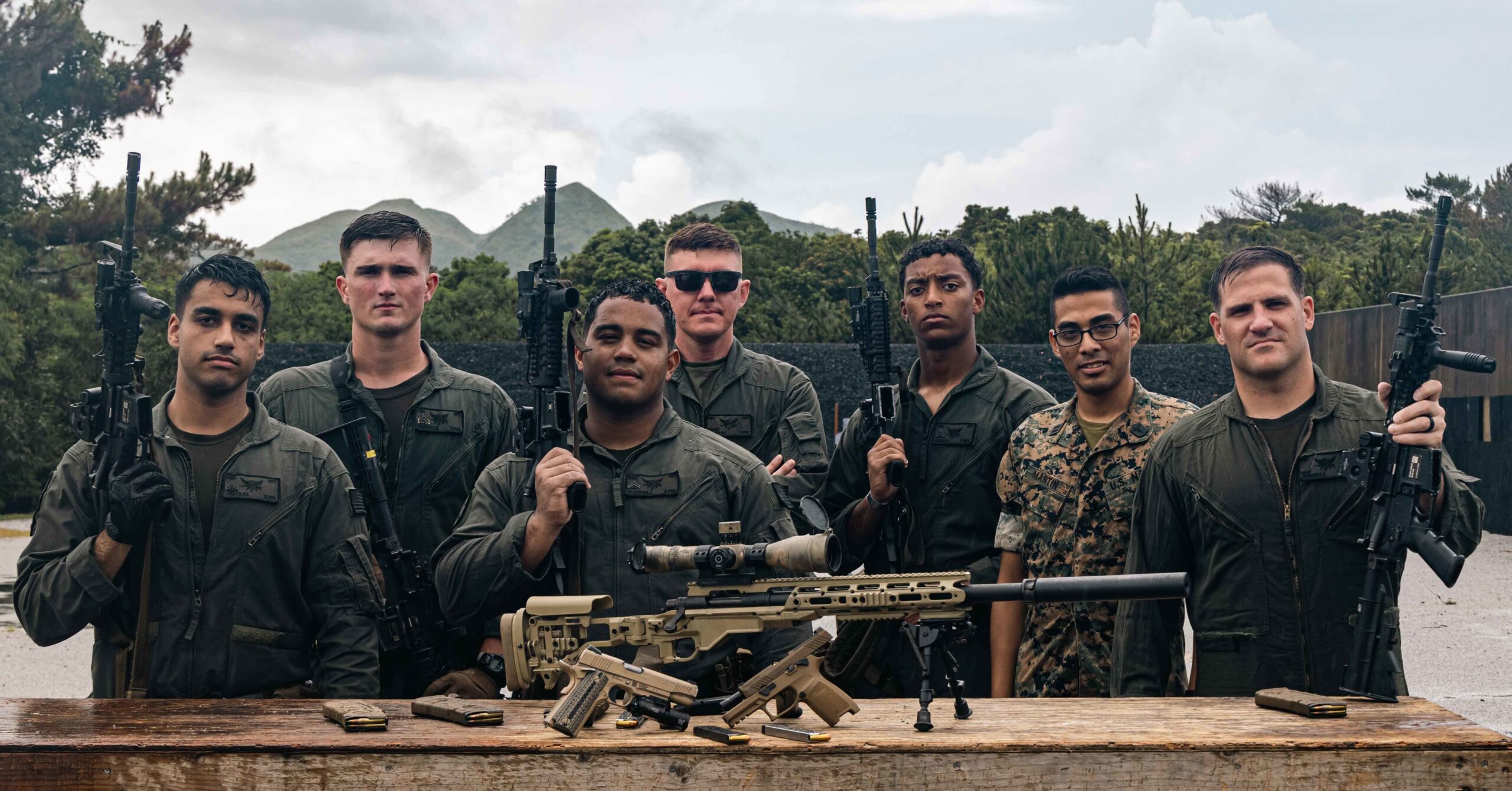
The members of SRT are attached to the Provost Marshal’s Office and are always on standby to respond to situations such as an active shooter, hostage situations, and barricaded subjects.
“Today, we shot from a tower structure to simulate engaging a hostile target from a sniper position. Afterward, we moved to a short range to practice static fire, multiple hostel engagements, and team movement drills,” said Gunnery Sgt. Russell Harned, team commander with SRT, Headquarters and Support Battalion, Marine Corps Installations Pacific. “We conducted a familiarization course of fire with an M40A6 rifle, Colt M45A1 Close Quarter Battle Pistol, P320-M18 pistol, and M4A1 Carbines.”
To remain proficient, SRT practices marksmanship weekly by conducting range firing and team tactics. As they continue to train, the team members have adapted to work not only with a dynamic approach but also with a psychological one.
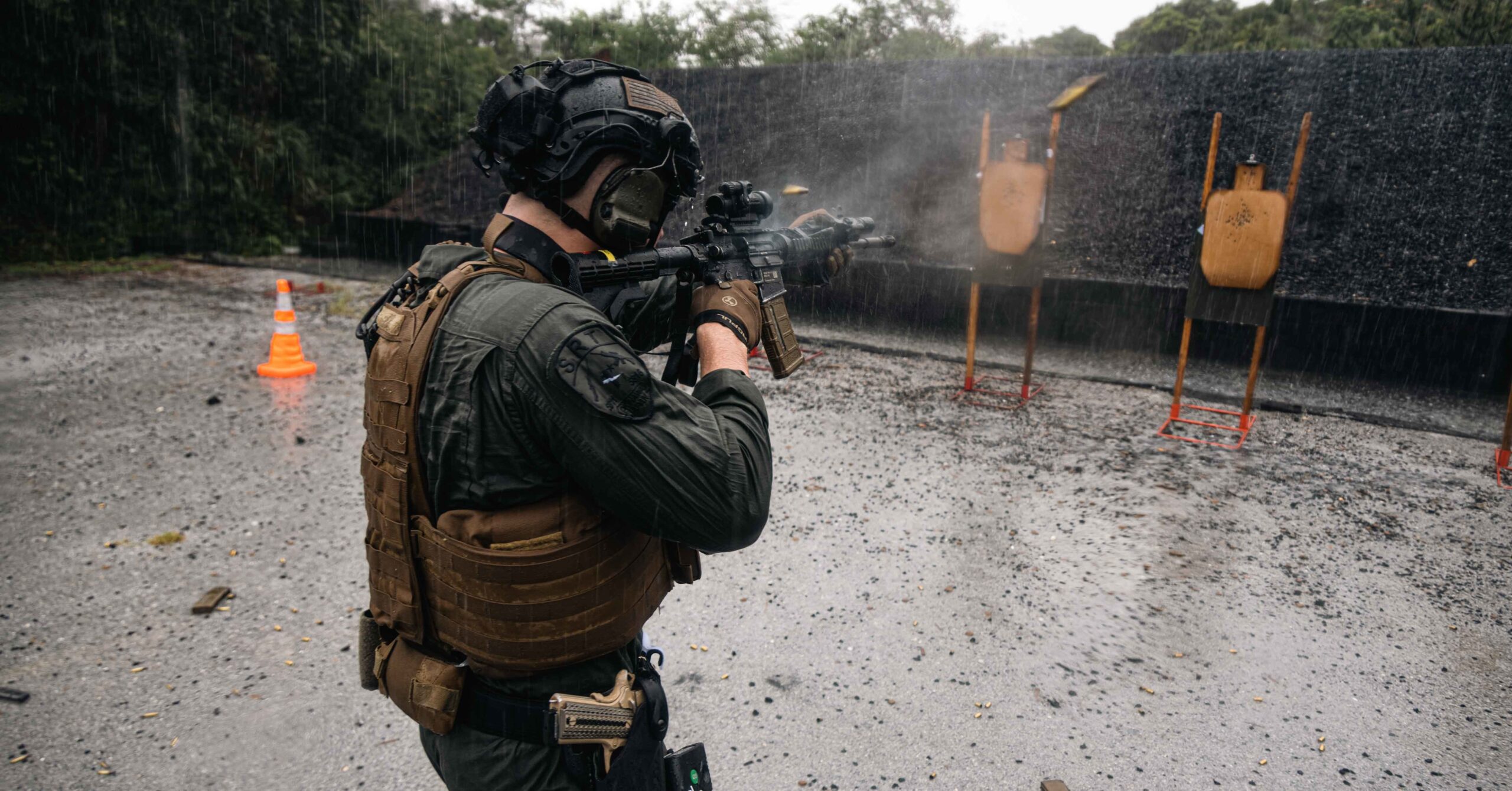
“The way we execute the mission at hand has drastically changed,” said Harned, “We still enter structures in a dynamic style, referring to kicking down doors, but we now take into account a psychological approach, to understand what the individual inside is thinking and what we can do to help them.”
SRT works on an emergency basis. When a threat is deemed too high risk for a patrolman, SRT receives a call to neutralize the subject. Their main goal is to contain, control, and dominate a threat psychologically or physically.
“My job is to protect and save lives,” said Cpl. Dylan Diamond, a team leader with SRT, H&S Battalion, MCIPAC. “Our job as a team is to protect all service members, Status of Forces Agreement Personnel, and local nationals on base. When we arrive at a site, we resolve the situation promptly, with minimal property damage.”
Diamond explained that he sees SRT continuing to move positively by adapting to the new situations and developing new tactics to protect bases across Okinawa further. Diamond explained that they will continue to grow and work as a team, furthering their goal to contain, control, and dominate a threat psychologically or physically.
By LCpl Jonathan Beauchamp, Marine Corps Installations Pacific
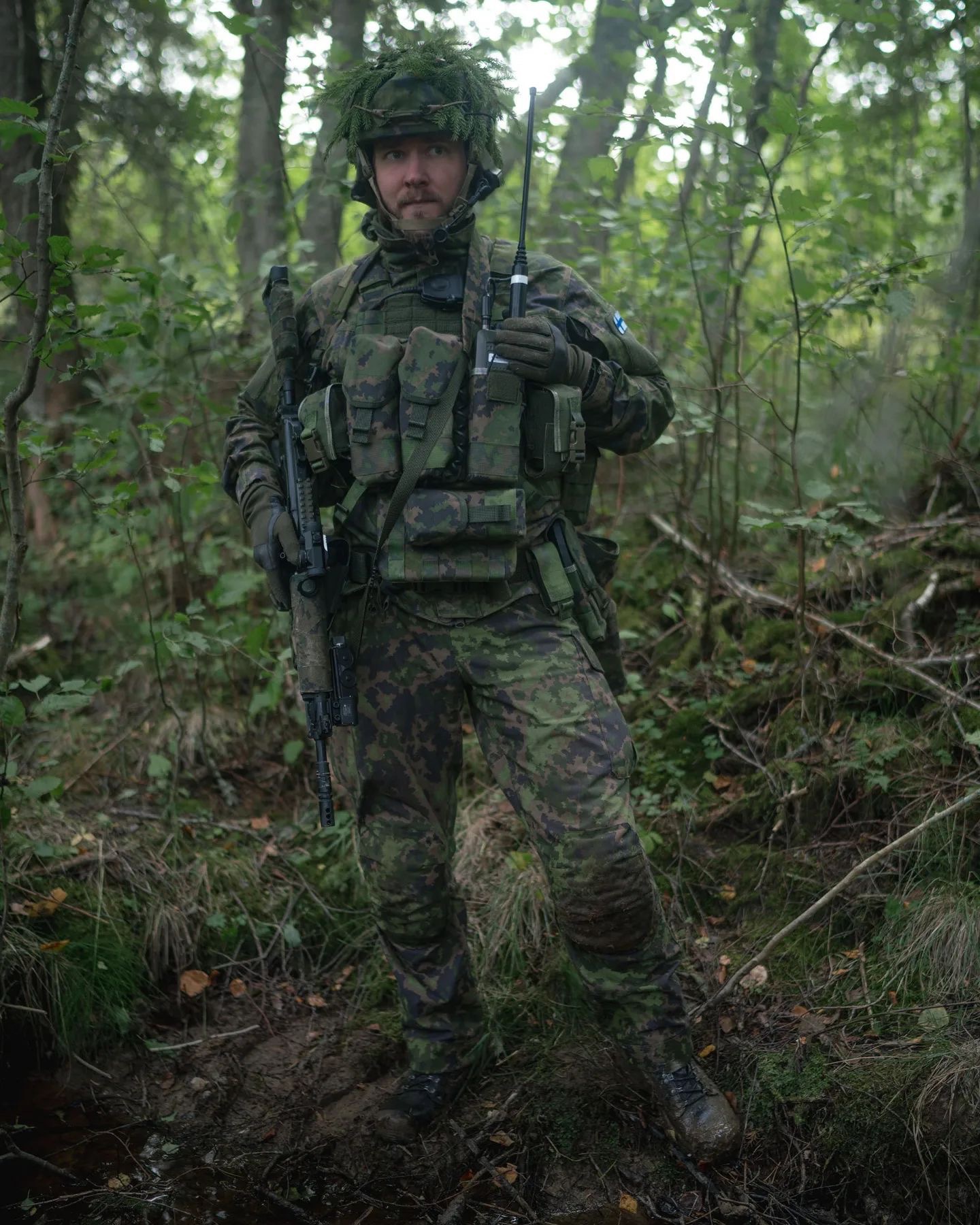
We have received a purchase order from the Finnish Defence Forces worth approx. 13 million eur for new M23 belt and pouch sets. We will also be manufacturing the textile parts for a 7 million eur procurement of M17 body armour. The body armour systems will be supplied to the FDF by Finnish body armour specialists C.P.E. Production Oy, for whom we have worked as subcontractors in the earlier procurements of the M17 system.
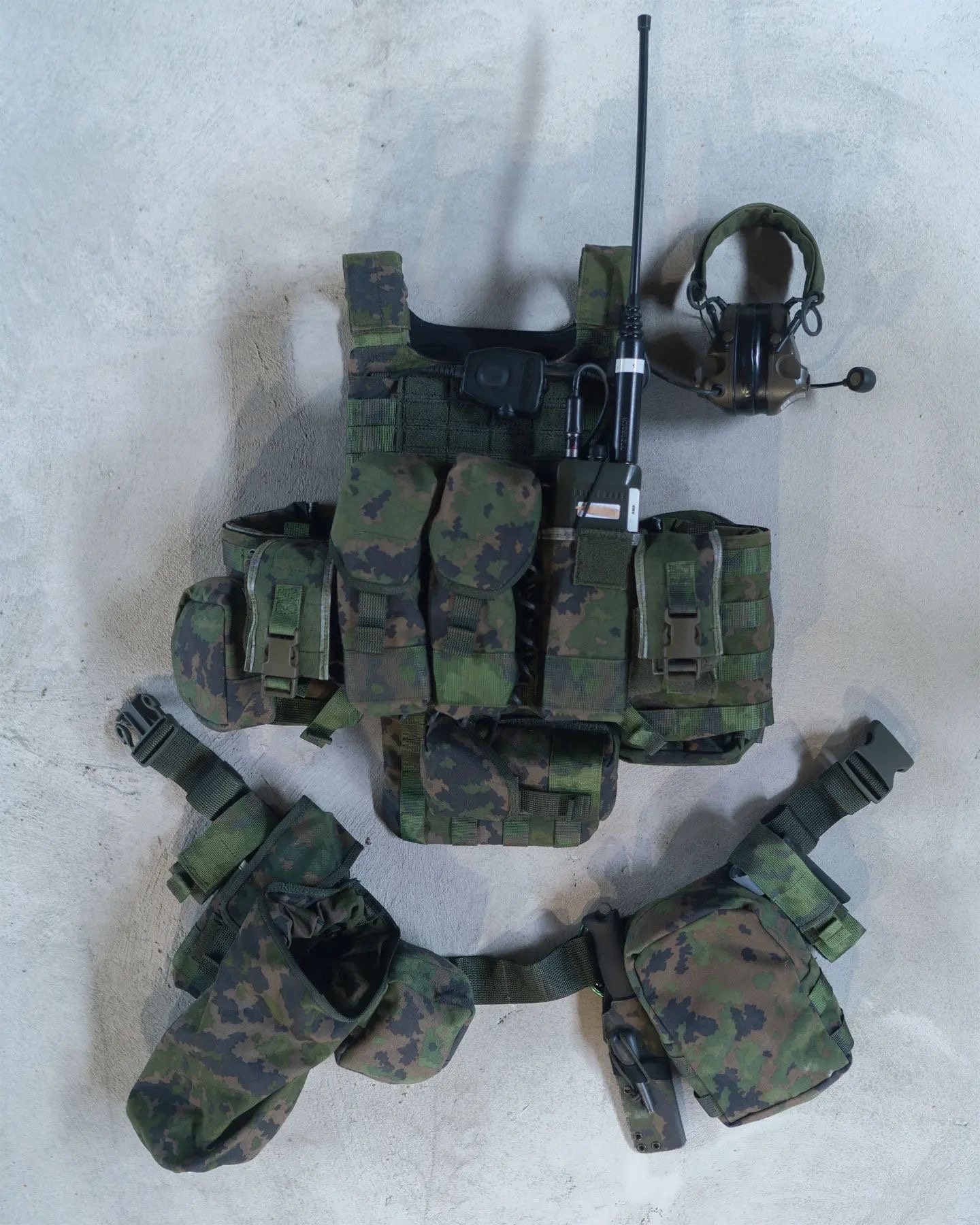
These projects will keep a considerable portion of our resources busy for a few years and may temporarily affect the availability of our commercial products. We are already working on expanding our production capacity to keep up with the growing demand.
The M23 belt and pouch set is designed for soldiers using M17 body armour and other PALS compatible load carrying equipment. The set includes a PALS compatible belt, two double magazine pouches, one single magazine pouch, four utility pouches, an empty magazine dump pouch and two hand grenade pouches. All pouches are made in Finnish M05 woodland camouflage and feature both PALS and belt attachment systems.
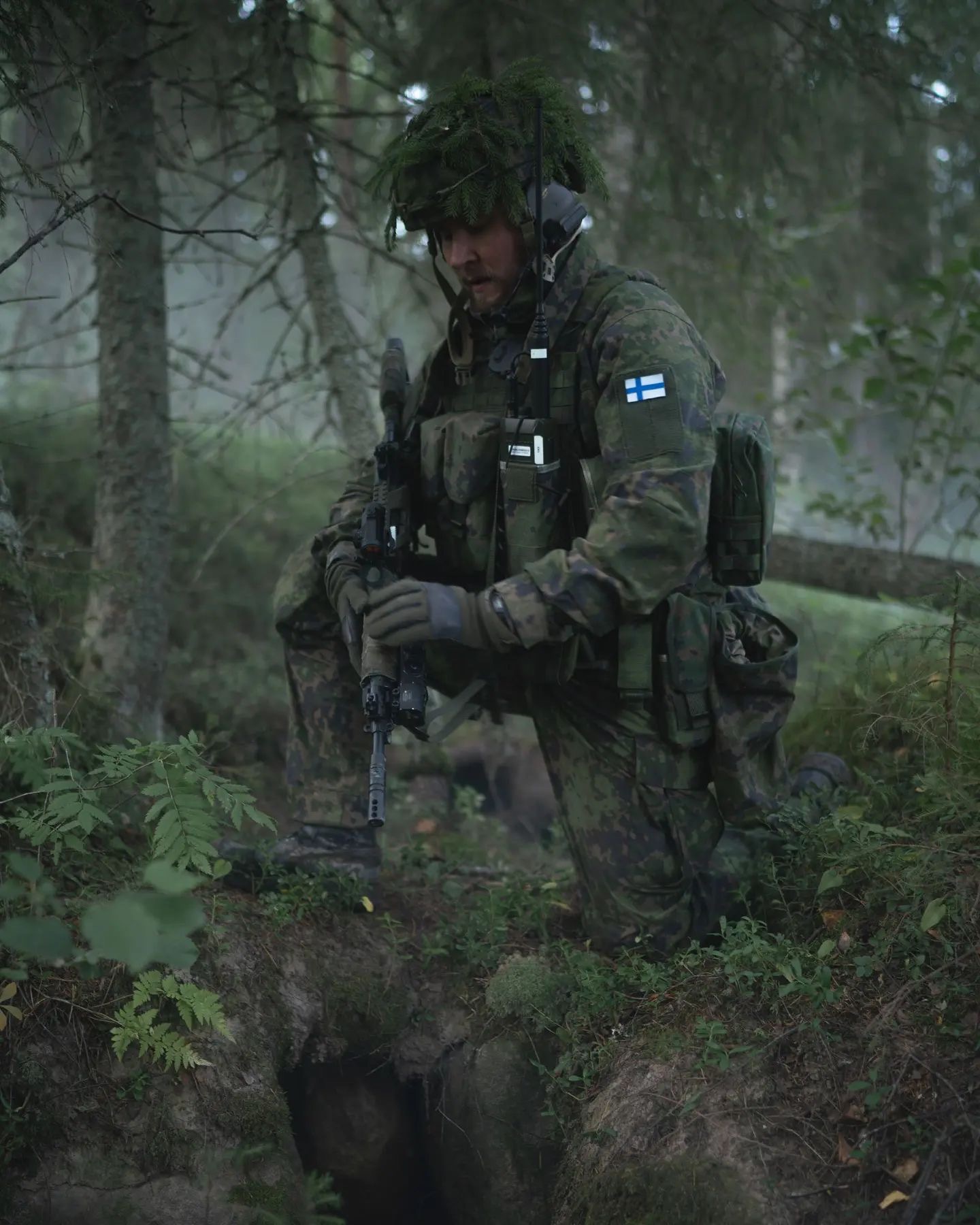
This project will have a domestic employment impact of ca. 50 person-years, with manufacturing being done at our facilities in Finland and Estonia. The main materials used, 500D and 1000D Cordura fabrics, webbing and buckles are made in the EU, with the majority of the webbing and a few other materials used being Finnish made. These are the same high-quality materials we use in the production of our commercial products.
This project is another natural step in our decades long commitment to the Finnish Defence Forces, for whom we have since the 1960’s designed and made, tents, backpacks, the M85 and M05 series of load carrying equipment and various other equipment. It should be noted that for us the Finnish Defence Forces have always been more than just a customer. In the end we design and manufacture gear for use by our friends, family and ourselves.
JOINT BASE SAN ANTONIO-RANDOLPH, Texas —
Historically, recruiting Airmen for Special Warfare career fields has been as tough as the Airmen who fill its ranks. So when Air Force Recruiting Service entered fiscal 2022, it organized a team in its Operations division here to inspire, engage and recruit future SW Airmen.
That team, called the SW branch, is reporting some progress despite headwinds that have characterized one of the toughest recruiting years in Air Force history for all career fields.
The selection process and relatively small size of the Air Force Special Warfare community compared to other career fields make members an elite class of warriors. So AFSPECWAR is lesser known compared to its counterparts in the Army, Navy and Marine Corps.
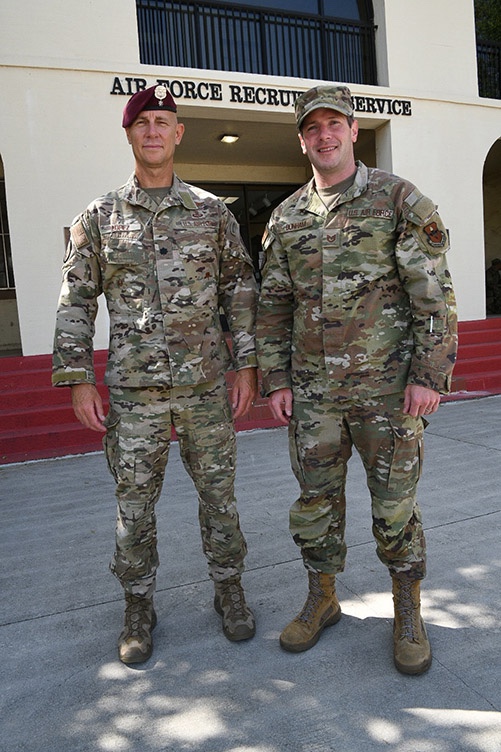
“We needed to share the story of our community, its feats of heroism and no longer be ‘quiet professionals’,” said Lt. Col. Joe Lopez, SW branch chief. The former Army Ranger and current Air Force combat rescue officer by trade, designed the 2022 plan to recruit aspiring Airmen for AFSPECWAR from within the Air Force as well as non-prior service future Airmen.
Unlike most branches at the AFRS headquarters, SW branch members visited universities and military installations where they met with all demographics while local Air Force recruiters focused on traditional recruiting methods. Overall, SW branch is searching for people with grit and determination who have the aptitude, mentality and physicality to endure the requirements of entering the SW career fields.
Those career opportunities include Combat Rescue, Special Tactics, and Tactical Air Control Party officer career fields as well as Pararescue, Combat Control, Special Reconnaissance, and Tactical Air Control Party enlisted career fields. In addition, the branch also supports recruitment for enabler Air Force Specialty Codes such as Survival, Evasion, Resistance, and Escape, along with Explosive Ordnance Disposal enlisted career fields.
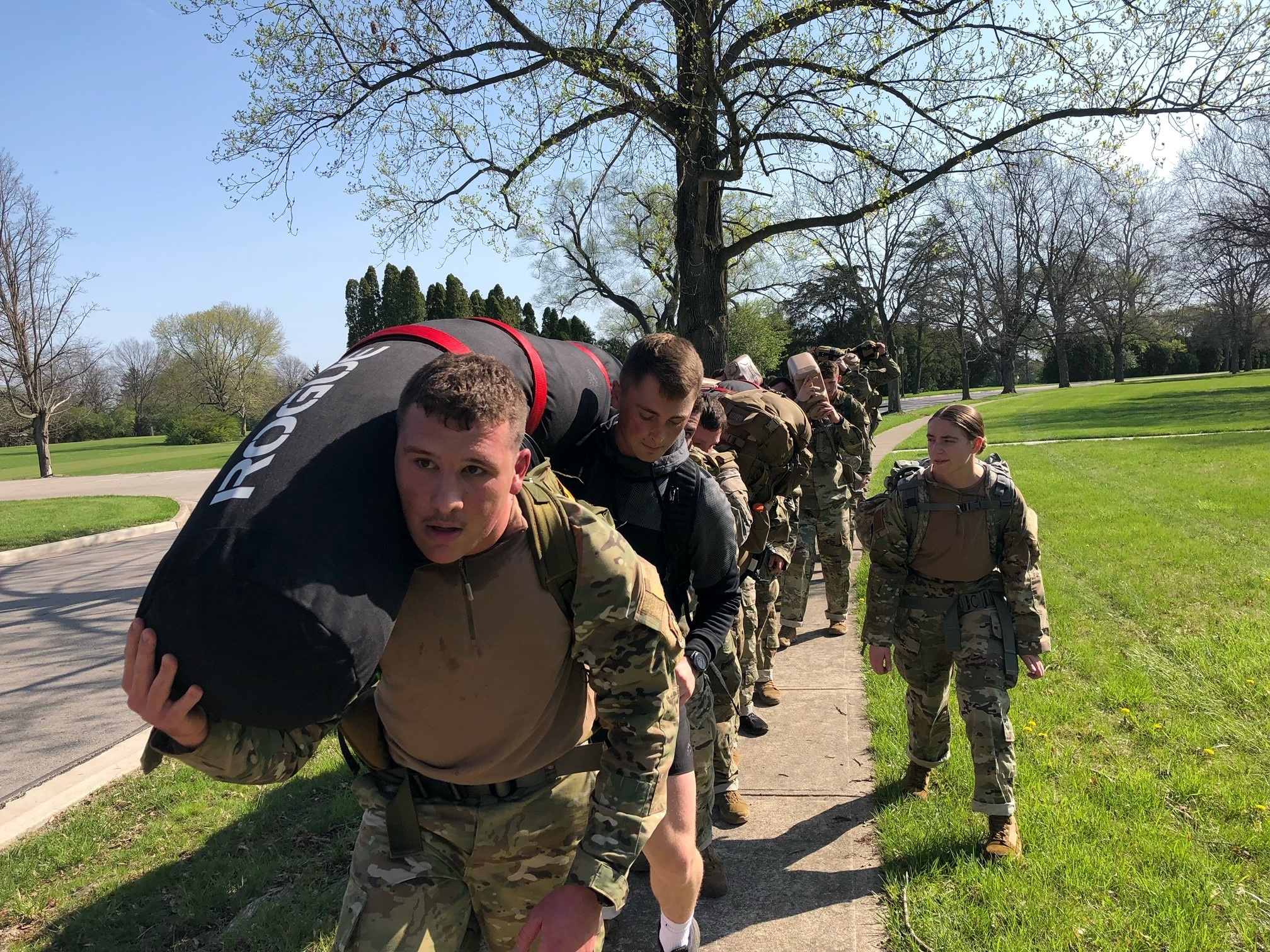
Specific to enlisted career fields, qualified applicants will enter the Special Warfare Operator Enlistment vectoring program designed in 2020 to streamline the enlistment process. This begins in the pre-accession phase where recruiting development teams identify potential SW candidates and begin the process to prepare them for the rigors of the Special Warfare training pipeline and later, their designated career field.
AFRS and the AFSPECWAR community aim to create a competitive model in the SWOE “Development Pool” where interested civilians strive to be sufficiently mentally and physically fit so they can be the next AFSPECWAR operators.
Part of the need and desire to move out more aggressively than before is because the Air Force has struggled to meet its goal for enlisted and officer ranks in AFSPECWAR.
“The intent of these outreach efforts is to establish rapport with interested applicants, give them insight on how to train smartly, and expose them with introductions to some of the physical challenges that they may experience while being screened and assessed so they’re better prepared mentally to overcome adversity during those trying times,” Lopez said. “All too often, we hear ‘I didn’t know the Air Force had this capability,’ so we are working to inspire, connect, develop and recruit future candidates into AFSPECWAR before they ship to Basic Military Training.”
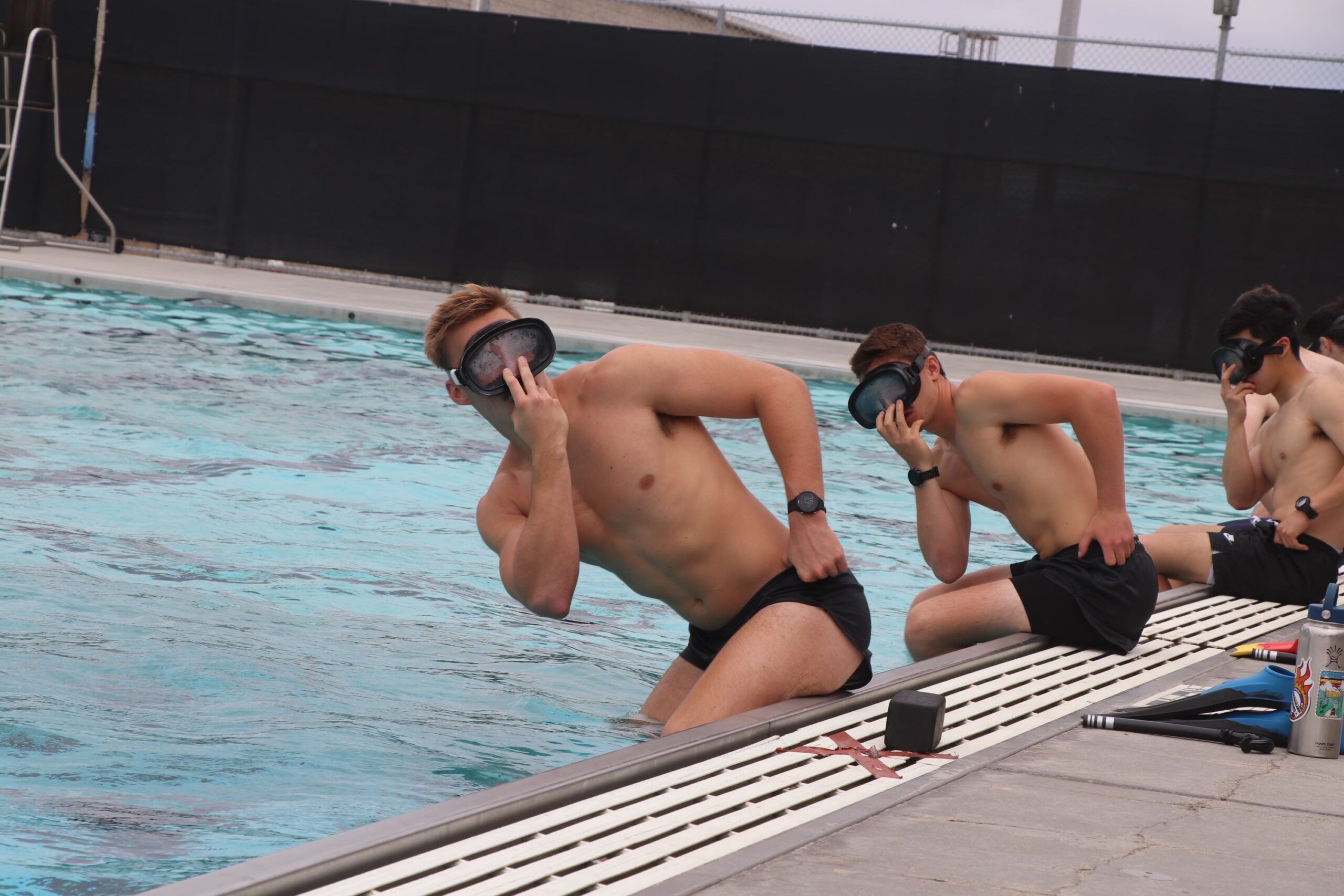
Lopez’s team includes veteran recruiters who are familiar with the challenges of recruiting SW Airmen. “Recruiting special warfare Airmen for the Air Force is very difficult, because most civilians have only heard about Navy SEALs and Green Berets,” said Master Sgt. Kenneth Babb, SW branch superintendent and former SW recruiting flight chief. “Few have ever heard about this very small community of elite warriors inside the Air Force. We know that there are people out there who want to serve in the military as a ground combatant and we need them to know that there are opportunities for them in the Air Force.”
Circumstances dictated the need for a new, innovative approach and plan that synchronized the worldwide effort to recruit SW Airmen.
“This is the very reason AFRS stood SW branch up and we hit the ground running,” Lopez said. “In our first year alone, we engaged with almost 1,300 cadets in 42 different Air Force ROTC detachments to recruit potential special warfare officers,”
The SW branch also visited 10 different Air Force bases and met with more than 200 Airmen to conduct in-service recruiting for enlisted Airmen and officers.
Simultaneously, Lopez and his team supported initiatives to elevate public awareness and engage new enlistees. The SW branch helped AFSPECWAR obtain trademark approval for a new logo and was involved in the Air Force’s decision-making process to increase SW initial enlistment bonuses from $15,000 to $50,000.
“Our main goal is to streamline the process from recruiting America’s highly talented applicants to enter the Air Force and begin their journey, in the hopes of becoming an AFSPECWAR Airman,” Lopez said. “We truly believe that if we can improve AFSPECWAR’s brand awareness and promote the opportunities special warfare careers offer, then recruiting will be much easier.”
SW branch members said that, overall, AFSPECWAR’s most difficult challenge is recruiting SW Open Enlistment candidates. SW recruiters are spread throughout the U.S. where they need to bring in roughly 1,000 non-prior service recruits each year.
“I was blown away by the effort a recruiter puts into shipping a SWOE candidate,” said Master Sgt. Matthew Voss, a SERE specialist assigned to the SW branch. Before Voss was assigned to AFRS, he served as a flight chief for the SERE Specialist Orientation Course at Joint Base San Antonio-Lackland’s Chapman Annex. He is the first SERE specialist assigned to AFRS.
“The Airmen of AFSPECWAR are absolutely critical when a conflict kicks off and we need to ensure that we have sufficient Airmen ready for the next conflict,” Voss said. “That all starts with recruiting.”
By Air Force Recruiting Service Public Affairs, Air Force Recruiting Service
6 September 2022 – San Antonio Texas – SOLGW is pleased to announce that registration is filling for the 2022 SOLGW Carbine Series to be held at The Ranch TX on 12/13 November 2022. With 12 challenging stages competitors will shoot from 0-600 yards. All prizes are on location for distribution upon completion of the event. Match director is Jeremy Reid and runs under the USSL-URL-EMG Match.
Sign up is open now at Practiscore practiscore.com/the-sons-of-liberty-gun-works-carbine-series-2022/register
Media / Sponsor inquires – carlo@sonsoflibertygw.com
In this episode, Michael Baccellieri discusses how to properly setup a LPVO.
Michael “Buck” Baccellieri grew up in the Pacific Northwest where he started his military career at age 17. He joined the Army National Guard while still in high school, attending basic and AIT, and spent three years as an infantry rifleman. Upon completing a deployment to the Middle East, he cross-decked to the Marine Corps, where he spent four years as an infantryman, assault climber, CWSS swimmer, and Scout in an STA platoon. Baccellieri later returned to the Army National Guard, taking up a slot in a sniper section and, after completing sniper school, moving on to the role of sniper team leader. He finished his career as an instructor at the Fort Chaffee sniper schoolhouse in Fort Smith, Arkansas.
Baccellieri now works for Leupold & Stevens, Inc., as the lead optics and firearms instructor for all military/LE training. He fills his time between classes by performing military business development for the Oregon-based company.
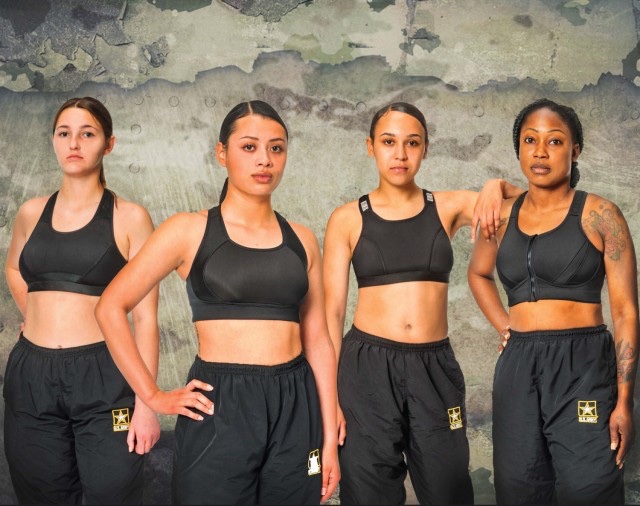
NATICK, Mass. — The U.S. Army Combat Capabilities Development Command Soldier Center, or DEVCOM SC, has designed Army Tactical Bras (including four concept bras) to meet the needs of female Soldiers who perform physically demanding tasks in a wide variety of environments.
“It’s important to recognize that Soldiers are the ultimate athletes, and they need something very specific,” said Annette LaFleur, team leader for the Design, Pattern & Prototype Team, part of the Soldier Protection Directorate at DEVCOM SC.
LaFleur explained that as ultimate athletes female Soldiers often endure arduous physical conditions that are much more intense than “say a female running a weekend road race or playing in a soccer game for a few hours.”
“Consider a design that may be worn days on end, in the cold, jungle or desert, layered under her uniform, body armor, ruck sack and while different threats may come her way,” said LaFleur.
Ashley Cushon is a clothing designer on the Design, Pattern & Prototype Team. As project officer and lead designer for the Army Tactical Brassiere Program, Cushon has led the design development and the test strategizing for the ATB concepts since the start of the program. She noted the importance of equipment that fits well and meets the needs of female Soldiers.
“The last thing the Soldiers need is to lose focus due to the discomfort of a next-to-skin garment that is meant to support them and not distract them,” said Cushon.
“As with all uniform and individual protection items we develop and evaluate, our goal is for the Soldier to not think about what they are wearing and be focused on their job,” said LaFleur.
Based on feedback from survey and focus group efforts, DEVCOM SC designers learned about capability gaps presented by the sports bras currently worn by Soldiers as well as Soldier preferences.
“We considered how to improve the comfort levels of a military appropriate performance sports bra, incorporating features that Soldiers prefer while making sure, on a design level, to keep functionality and support a priority throughout design development,” said Cushon. “The goal is to not only accommodate Soldiers that are doing field training exercises, but also those operating in combat environments where there could be potential exposure to different threats.”
The design of the Army Tactical Bras was driven by Soldier feedback and takes into consideration a variety of factors.
“It is the combination of materials, design, construction (seams/stitches) and fit which create the importance of the item — not just one feature alone,” said LaFleur. “Ashley and a team of other technical experts have been working with female Soldiers so that we can take their feedback into the design process from the start.”
The designers are working to provide female Soldiers with a few different bra options to accommodate individual preferences, match their activity level, and meet the needs of specific tasks.
“As Army clothing designers, our considerations expand beyond the general look or style of the garment, though that is definitely a factor,” said Cushon. “We aimed to provide the Soldiers with a variety of options inclusive of features that they identified work well for their activity level. One thing to keep in mind is that there is no ‘One Size Fits All’ solution out there.”
Cushon said that other very important considerations include the Soldiers’ familiarity and experimentation with the variety of styles (which varies) and a certain allegiance that they may have towards a particular type of bra.
“We had to look at this from two different perspectives; first as women, understanding a sports bra is very preference dependent and personal,” said Cushon. “Second, as designers, we interpret feedback and incorporate these points as functional elements within a design. This way, we are able to understand and reach more individuals within our target users.”
The DEVCOM SC team worked to include a wide variety of features, ranging from customizable fit to flame resistance.
“We added various features that allow Soldiers to customize the fit of the ATB concepts to their desired compression or support level,” said Cushon. “We also wanted to offer concepts that have less fasteners and hardware without forfeiting functionality, for Soldiers who prefer simplicity. Of course, a key feature is the Flame Resistant, or FR, protection, which we were able to integrate seamlessly into the designs. Whether it is the addition of a closure, the finish on a joining seam, the moisture management of the materials, the size and location of hardware or thread weight, every detail was meticulously considered to ensure we provided adequate variation for these first iterations.”
“Fit, Form and Functionality” shape the approach to products that are designed by the Design, Pattern and Prototype Team. Given that incorrectly fit bras can cause pain, and skin irritation, these three elements were particularly important in the design of the Army Tactical Bras.
“In this instance, where Army sports bras could almost be considered a niche-use case, these three elements take on a whole new level of importance,” said Cushon. “Females in general have become all too familiar with experiencing adverse effects related to the continued wear of an ill-fitting bra. Skin damage related to abrasion, or pain in the breast, shoulders and back relative to the lack of breast support are some common examples. For the ATB Concepts, we are utilizing a combination of size, style and military appropriate design elements for the individual Soldier’s body type and activity level that can help to mitigate distractions related to ill-fit or discomfort that could compromise their focus — ultimately enhancing their readiness level while active.”
The Army Tactical Bras are an important part of DEVCOM SC’s ongoing efforts to meet the needs of female warfighters.
“We see this as one of many great opportunities to provide female Soldiers items that are developed with input from their unique experiences guiding the development and evaluation,” said Cushon.
“Here at DEVCOM Soldier Center we have a strong multi-disciplined team — including military designers, anthropologists and textile technologists to name a few — that use science and technology in developing optimized solutions to keep our warfighters, in this case female, protected and focused on their mission,” said LaFleur. “The bra is an essential component to the female Soldier’s system of clothing.”
LaFleur explained that “ATB technologies developed at the Soldier Center will serve to inform the Army of potential functional product specification and material options which optimize bra performance for combat at training environments. These technologies and research findings will also provide insights as to how specific performance requirements can be defined for these and other Soldier worn garments.”
By Jane Benson, DEVCOM Soldier Center Public Affairs
HURLBURT FIELD, Fla. —
Air Force Special Operations Command (AFSOC) continues to innovate the way Air Commandos train and execute joint special operations missions in this century’s complex and competitive battlespace.
Among these recent innovative changes include the further development of multi-functional Airmen and their integration into a new Special Operations Task Unit (SOTU), known as a Mission Sustainment Team (MST).
“As the Air Force continues to operationalize and codify its approaches to Agile Combat Employment (ACE), a key effort is establishing how we’ll bring together the complementary capabilities of our fighter, bomber, mobility, and special operations forces,” said Dr. Sandeep Mulgund, Senior Advisor to the Air Force’s deputy chief of staff for operations. “Doing so will be key to creating, maintaining, and fighting from positions of advantage, which the CSAF has emphasized in recent remarks about ACE. By integrating MSTs into SOF capabilities, we’ll provide more options for our joint force and coalition commanders on how to generate and employ airpower.”
For nearly a year, the 1st Special Operations Wing, has developed its MST as a proof of concept to ensure multi-capable Airmen within AFSOC are able to meet the needs of combatant commanders against any potential adversary in the future. Its role will be to act as the connective tissue that bridges the Air Force’s ACE capability with current AFSOF capabilities in a joint environment.
“Our MST allows us to provide force support, civil engineering, communications, logistics, security forces, medical, airfield management and contracting capabilities,” said Col. Daniel Magruder, 1 SOW vice commander. “We now can take what are normally base support functions and operationalize them to support combat missions. Ultimately, without the total package of aviation, maintenance, and support provided by our multi-capable Airmen, the mission will not get done.”
In order to accomplish this capability, MSTs are designed to train 58 Air Commandos from 22 different Air Force AFSCs with seamlessly blending their operations and becoming proficient in several competencies in order to receive, prepare and redeploy aircraft expeditiously.
“It’s a huge asset to the MST for our Airmen to have the adaptability and confidence in varying skills to better meet the challenges of the changing threat environment and determine best practices for mission support within the ACE construct moving forward,” said Capt. Melissa Cecil, 1st Special Operations Mission Support Group Detachment 1 commander. “Our goal is to empower our Air Commandos to problem solve and think critically while also giving them the tools they need to operate and make decisions at dispersed locations. In some of these locations, they will be relied upon as the subject matter expert for all things mission support.”
Utilizing multi-capable Airmen was at the forefront of AFSOC leaders’ mind when they developed the MST.
“Our MSTs are empowered to adapt to assigned missions,” said Magruder. “As an Air Force, it is important to empower units at the lowest level to achieve their assigned missions.”
“Each of the military services are developing approaches to operations that recognize the need for agility and maneuver in the future threat environment,” added Mulgund. “They each have their unique focus areas and nuances, but common to all is this idea of being light on your feet to shift forces and effort where and when required. Joint approaches to agility will pull all these together to meet the needs of our combatant commanders worldwide. MSTs are part of that joint solution. Our Air Commandos now can enable and support austere operations by other special operations forces as well as allied forces when required.”
The 1 SOW’s MST recently tested their ability to help generate and integrate into air operations components during its recent participation in two exercises with drastically different theaters of operation.
“MSTs provide flexibility to the force because they can establish, sustain and retrograde forward operating locations for AFSOF mission generation,” said Magruder. “The team has been aggressively rehearsing this training in exercises like Agile Flag or INDOPACOM’s Rim of the Pacific (RIMPAC) exercise.”
As part of Air Combat Command’s Agile Flag, an exercise in a simulated rural deployed setting, the MST assisted in enabling scripted joint force air component ACE missions.
“Multi-capable Airmen is what gives the MST the capabilities it has,” said Capt. Patrick Sutton-Buscavage, 1 SOMSG Det 1 director of operations. “During Agile Flag we were able to rapidly support and sustain operations for Aircrew, maintenance and forward arming and refueling point (FARP) teams in two separate locations at the same time. Without multi-capable Airmen on our team, this doesn’t happen.”
Although Agile Flag is aimed at testing several different units’ mission generation, command and control, and base operating support-integrator elements, the MST’s inclusion provided an avenue to test the newly implemented special operations sustainment task unit in a realistic and controlled setting. It also allowed those who will be deploying in the newer, more predictable, deployment structure to develop the continuity of processes and team building needed to effectively operate in austere conditions or in support of a Theater Special Operations Command.
“The intent of MST is to align directly with the SOFORGEN cycle and integrate into a SOTU construct downrange,” Cecil said. “Although the MST is still in its infancy, we are working to build relationships and seek out further training and utilization opportunities to demonstrate how we can best be integrated across multiple areas of operation.”
In addition to Agile Flag, the MST also supported INDOPACOM’ recent RIMPAC exercise, which is the world’s largest international maritime warfare exercise. The MST’s involvement in the exercise directly influenced the ability for commanders to employ not just American special forces but also from India, Germany and the Republic of Korea.
“Large exercises, like RIMPAC, allow our team to showcase our force generation capabilities to the joint and international forces while also looking for ways to collaborate,” Magruder said. “The benefits of the MST concept is that it allows our commanders to employ multiple teams across a large AOR in order to form a more theater level power projection platform.”
“Whatever the challenge, we’ll need small multi-disciplinary teams like MSTs to support mission generation in a wide variety of operating environments,” Mulgund added.
The MST continues to prove that the development of multi-capable Airmen is pivotal to the future of how AFSOC generates forces.
“Multi-capable Airmen are the building blocks for developing small capable special operations teams required to adapt to any combat environment,” said Magruder. “Their incorporation into the MST is the first step in the wing’s campaign to improve the way we process and provide sustained logistical support against any potential adversaries.”
By TSgt Michael Charles, 1st Special Operations Wing