SIG SAUER - Never Settle

Archive for the ‘Guest Post’ Category

Defense Logistics Agency Designated DOD’s Printing Services Provider

Monday, March 28th, 2022

FORT BELVOIR, Va. (AFNS) —  

The Defense Logistics Agency is now the Defense Department’s primary provider of printing services, office print devices and electronic conversion services according to a DOD instruction signed by the Under Secretary of Defense for Acquisition and Sustainment.

All DOD components except DOD intelligence agencies, National Guard and Reserve organizations, tactical activities, and the U.S. Army Print and Media Distribution Center must now purchase such services through DLA Document Services. The change is expected to save tens of millions of dollars each year.

DLA Document Services offers numerous printing services ranging from brochures and training manuals to banners and aircraft decals. Custom and specialty options like vinyl, foam board and magnets are available, and the team can also produce large-scale items like museum displays.

“We can assist customers throughout every step of their project from planning to production,” said Nick Janik, DLA Document Services director of production operations. “Our print production employees work hard to make the customer’s vision a reality while being as efficient and timely as possible.”

DOD customers turning paper documents into electronic format can use scanning and conversion services available at DLA print facilities or with help of on-site technicians who can convert documents of all sizes. Digital conversion preserves documents and makes them searchable. Shredding services are available too.

The updated instruction also charges DLA Document Services with the procurement, delivery and sustainment of office devices including office, desktop and stand-alone printers as well as copiers, fax machines, scanners and multi-function devices – the latter of which is the main focus of the office device program. The process of procuring office devices includes an assessment of customer needs and existing equipment to ensure new devices are streamlined and compatible.

“Our office assessments help to eliminate unnecessary equipment and shift customers from a single-function or stand-alone environment to a business model of shared resources with MFDs,” said Terra Nguyen, division director for DLA’s office device program.

More information and help placing orders is available through local customer relations specialists or the DLA Document Services Customer Support Center at 866-736-7010 or j67dcsc@dla.mil.

Defense Logistics Agency Information Operations

SCUBAPRO Sunday – The First Frogman Ship Attack

Sunday, March 27th, 2022

During the summer of 1918, as World War One ended, the Austrian Navy suffered a series of defeats at the hands of the Royal Italian Navy, which was based in Genoa. The most powerful ships of the Austrian Navy withdrew to the Adriatic Sea port of Pola to avoid capture. Enemy ships could not enter the harbor because of floating booms and barricades designed to encircle and destroy their targets. The Italian Navy attempted several attacks on the Austrian fleet at Pola. Still, it could not penetrate the sophisticated harbor defenses in any of them.

Raffaele Paolucci was an Italian Naval surgeon who devised a plan to infiltrate the harbor at Pola and destroy the largest ships of the Austrian fleet. He was killed during the operation. Even though the sheltered enemy fleet appeared impenetrable to conventional attack, Lieutenant Paolucci had the idea that he might be able to reach the Austrian ships by simply swimming to them with explosives in his possession.

“If I could be dropped off near the entrance to the harbor, a swim of three kilometers would enable me to reach my destination,” Paolucci concluded after consulting charts depicting the Pola estuary.”

Paolucci began training to swim alone into the harbor at Pola while keeping his plans a secret from his friends and family. Evenings and weekends were spent swimming in the lagoons of Venice, building up his endurance to the point where he could comfortably swim five miles without stopping. To simulate the weight of an explosive charge he planned to carry with him to destroy the enemy ships, Paolucci began dragging a 300-pound barrel of water behind him as his stamina grew.

Paolucci presented his plan to his commanding officers in May, confident in his ability to carry out his vision for the military. He was informed of the apparent dangers associated with such a venture. Still, he was instructed to continue with his training.

Paolucci was introduced to Major Raffaele Rossetti in July, who impressed him. In his investigation, Paolucci discovered that Rossetti had designed and built an entirely new type of aquatic weapon. This manned torpedo was ideal for the mission for which he had been preparing himself.

An unexploded German torpedo shell that had washed up on the Italian coast had inspired Rossetti to design and build a sleek submersible craft that could be pulled through the water like a horse, using the long, slender shell as a frame. Rossetti’s rebuilt torpedo was about 20 feet long, weighed one and a half tons, and could propel a pair of riders through the water at a top speed of two miles per hour. It was filled with compressed air that drove two small, silent propellers, powered by compressed air. Located at the front end of the apparatus were two detachable watertight canisters with a capacity of 400 pounds of TNT, each of which could be detached and transported separately. The craft’s position in the water could be changed by adjusting a series of control valves that Rossetti had devised.

Swimming and guiding the torpedo were practiced in the Italian naval shipyard in Venice, where Rossetti and Paolucci worked. Paolucci later wrote, “We had to be in the water clinging to the machine, which moved slowly; we had to steer it with our bodies, and in some cases were forced to drag the apparatus ourselves…we habituated ourselves to remaining in the water for six or seven hours at a stretch with our clothes on, and to passing unnoticed beneath the eyes of the sentries posted along Venice dockyard’s perimeter.”

An Italian navy motorboat brought the two men and their hybrid watercraft to within a few miles of the entrance to the harbor at Pola on the night of 31 October 1918. Rossetti and Paolucci slipped into the water, mounted their torpedoes, and set out to sabotage the Austrian fleet, which was utterly unaware of what they were getting themselves into.

Rossetti and Paolucci submerged the torpedo by riding the incoming tide until only their heads were visible above the water’s surface. They left for Pola at 10:13 p.m. on a Friday. Assuming everything went according to plan, Rossetti estimated that it would take no more than five hours to deliver the explosives to the Austrian ships and return to the waiting Italian motorboat, which was safely anchored away from the sight of Austrian patrol boats.

Rossetti turned off the air valve driving the torpedo’s twin propellers on their way into the harbor, preventing them from being sucked into it. The torpedo was carefully guided up to the first of the barriers that guarded the outer harbor by the two men who had guided it up. The enemy’s searchlights swept across the water, threatening to reveal them to the public. The searchlights passed over them despite their repeated appearances without disclosing their location.

When Rossetti and Paolucci arrived at the outermost barricade at 10:30 a.m., they discovered that it was constructed of “numerous empty metal cylinders, each approximately three yards in length, between which were suspended heavy steel cables.” “….. In the meantime, the two men lifted and pushed their boat over the obstacle, fearful that the sound of metal scraping against metal would alert Austrian guards on the other side of the water. Their efforts went largely unnoticed. “After a great deal of effort,” Paolucci wrote, “we were able to get past the obstruction when I felt myself being seized by the arm.” After a moment’s thought, I realized Rossetti was pointing to a dark shape that appeared to be moving toward us.” They were completely unaware of the presence of an Austrian U-boat, which was gliding past them and out into the Adriatic Sea without using its lights and with only its conning tower above the water.

The two men steered the torpedo slowly toward the seawall that protected Pola’s inner harbor after restarting the torpedo’s motor. While Rossetti waited in the shadow of the seawall, Paolucci swam ahead to find the quickest way into the port. Rossetti was a little late. Instead, he encountered another stumbling block in the form of a gate constructed of heavy timbers studded with long steel spikes.

Paolucci returned to Rossetti’s boat and informed him of his discovery. Rossetti decided to proceed with the mission. It was now against the tide, and the two men had to fight against it to drag the massive torpedo up to the submerged gate. As the tide receded, Rossetti and Paolucci struggled to make their way past the nets and into the harbor where the anchored Austrian battleships were anchored. Paolucci wrote, “our endeavors proved successful.” It was 3:00 a.m. now, and the sun was shining brightly.

The dreadnought SMS Viribus Unitis, the largest ship in the fleet, was chosen as the primary target because it was closest to the shore. Rossetti and Paolucci were swimming through sleet and hail when they noticed the sky beginning to brighten with dawn. Just as they were about to reach the side of the Viribus Unitis, the torpedo began to sink unpredictably.

While Paolucci was frantically trying to keep the torpedo afloat, Rossetti discovered an intake valve that had been accidentally opened, allowing air to escape from the cylinder and sinking the ship. After closing the valve, the two men took a few moments to relax in the shadow of the Austrian flagship. According to Paolucci, “this was unquestionably the worst of all our trying moments.”

They reached the Viribus Unitis at 4:45 a.m. after making their way down a long line of Austrian battleships that stretched for miles. Rossetti detaches one of the TNT canisters from the front of the torpedo and attaches it to the hull of the Viribus Unitis, which was then launched. Rossetti set a timer for 6:30 p.m. when he planned to detonate the 400-pound charge of TNT.

As Rossetti and Paolucci pushed off from the side of the Viribus Unitis, a sentry on the flagship noticed them and alerted the authorities.

The Italians attempted to navigate towards the shore, hoping to find refuge. A boat from the Viribus Unitis was dispatched to capture them as soon as they were discovered. After quickly arming the second canister of explosives, Paolucci set it free in the ebbing tide of the river. As a result of flooding the torpedo’s air cylinder, the ship sank to the bottom.

A group of sailors from the Viribus Unitis apprehended the Italian officers and transported them back to the ship. They were shocked to discover that the Austrian fleet had mutinied during the previous night and that the Austrian admiral had transferred command of the Viribus Unitis to a Yugoslavian captain named Ianko Vukovic. Having been ordered ashore, all German and Austrian crew members were escorted off the ship, leaving the fleet in the care of neutral Yugoslav sailors.

It was 6:00 a.m. at the time. Because Rossetti was aware that the TNT would detonate in half an hour, he informed Captain Vukovic that his ship was in “serious and imminent danger.” “Save your men,” says the captain. Captain Vukovic demanded an explanation calmly. “I’m not going to tell you when, but the ship will be blown up in a short time,” Rossetti said.

Vukovic didn’t waste any time, yelling in German, “Men of the Viribus Unitis, save yourselves and everyone else you can!” “The Italians have smuggled bombs aboard the vessel!” When the Yugoslavian crew members learned of this, they panicked and abandoned the ship. As Paolucci described it, “we heard doors open and shut quickly, we saw half-naked men rushing about madly and clambering up the steps of our batteries, and we heard the noise of bodies splashing into the sea.”

Rossetti took advantage of the sudden panic and inquired of Captain Vukovic about the possibility of saving themselves. Vukovic agreed with me. Rossetti and Paolucci dashed to the side of the ship and jumped overboard. They were captured. They were quickly apprehended by a group of enraged Yugoslavian sailors in a small boat, who took them back to the Viribus Unitis, where they were imprisoned. “We were under the impression that they intended for us to perish on the doomed ship,” Paolucci wrote. The time was 6:20 p.m.

Once again, Rossetti and Paolucci found themselves surrounded by a threatening mob of sailors when they returned to the ship’s deck for the second time. They were yelling at us, claiming that we had deceived them, and others demanded to know where the bombs were hidden. Rossetti rose to his feet and demanded that he and Paolucci be treated relatively as prisoners of war, which was granted. Vukovic ordered his men not to harm the Italians, and they followed his orders.

There was no explosion at 6:30 p.m. when the time came. Neither Rossetti nor Paolucci said anything to one another, as if they were wondering what had gone wrong. Captain Vukovic was still attempting to restore order on the ship’s deck when a storm hit the ship. Crewmen who had abandoned the Viribus Unitis rowed in lifeboats all around the ship, unsure whether to flee to safety or return to the ship as the ship sank.

The TNT charge exploded at 6:44 p.m. local time. When the delayed explosion occurred, Rossetti and Paolucci were taken aback by how quiet it was, describing it as “a dull noise…a deep roaring, not loud or terrible, but rather light.” Instantaneously, however, a massive column of water rose into the air at the ship’s bow and splashed down on the ship’s forward deck. In the aftermath of the explosion, Rossetti and Paolucci requested permission to abandon the ship once more out of shock. Captain Vukovic shook their hands and pointed to a rope they could use to escape into the water, motioning for one of the lifeboats to come and pick them up from the water.

When Rossetti and Paolucci were dragged onto the small boat, they turned to watch the Viribus Unitis sinking into the water. In his book, “The Viribus Unitis,” Paolucci describes how the ship began to heel over more and more until the water reached the level of the deck and the ship capsized utterly. I noticed that the massive turret guns were being tossed around like toys. Towards the keel, I noticed a man crawling until he reached the top of the ship. It was Captain Vukovic who made the announcement. He died a short time later after being struck in the head by a wooden beam while attempting to save his life by swimming to shore after having extricated himself from the whirlpool of water.” Rossetti and Paolucci were transported as prisoners of war to an Austrian hospital ship for their recovery. There, they discovered that the second canister of explosives, which had been set free by Paolucci just before they were apprehended, had exploded against the hull of an Austrian ship named Wien, causing it to capsize and sink.

Italy and Austria signed a peace treaty three days later, on 4 November 1918, bringing the war to an end. The following day, the Italian fleet seized control of Pola, allowing Rossetti and Paolucci to be released from captivity. The two gentlemen were presented with gold medals in recognition of their bravery. Rossetti received a reward from the Italian government of 650,000 lire as compensation for his services. “A war adversary who, in dying, left me with an ineradicable example of generous humanity,” he said of Captain Vukovic’s widow when he presented the reward. Widows and mothers of other war victims received the funds used to establish a trust fund for them.

croatian-treasure.com/viribus

$20 Million in APS-2 Materiel Delivered to Armored Brigade in Grafenwoehr

Saturday, March 26th, 2022

MANNHEIM, Germany – What’s easily apparent are the tanks and armored vehicles being prepared, loaded, transported, offloaded, staged and issued. But what’s less obvious are all the supply items, tools and repair parts needed to keep those vehicles and the 1st Armored Brigade Combat Team, 3rd Infantry Division, up and running.

And that’s another area where Army Field Support Battalion-Mannheim has once again excelled.

More than 4,700 lines of materiel — some containing over a thousand items per line — were recently accounted, reported, shipped and issued to 1st ABCT, 3rd ID, by a team of about 30 personnel under the command and control of AFSBn-Mannheim and the watchful eye of the 405th Army Field Support Brigade.

Valued at nearly $20 million, tens of thousands of Army Prepositioned Stocks-2 individual repair parts, supply items and tools in more than 40 containers were shipped from Coleman worksite in Mannheim, Germany, to Grafenwoehr Training Area, Germany, and issued to the U.S.-based armored brigade combat team deployed there from Fort Stewart, Georgia.

Army Sgt. 1st Class Georgie Rodriguez said the mission was a total team effort. Broken down into mostly 2-person teams, logistics supply specialists and contractors assigned to AFSBn-Mannheim, 405th AFSB and 1st ABCT, 3rd ID, completed the mission in just five days.

“It’s a very tedious process,” said Rodriguez, who serves as the Supply Support Activity noncommissioned officer at Support Operations, 405th AFSB. “They have to check everything – every single item – and then re-check and check again. And then they have to post all this information into the Global Combat Systems Support-Army.”

The Global Combat Systems Support-Army, or GCSS-Army, is a web-based automated logistics system that tracks and maintains accountability of repair parts and supply items. It’s capable of managing large volumes of transactions, and it provides current item location updates as well as expected times of arrival. It also interfaces with the General Funds Enterprise Business System, or GFEBS, for financial data tracking and feedback.

Rodriguez said two key individuals who helped lead the process and ensure the mission was a success were Phillip Bosco from AFSBn-Mannheim, who was the accountable officer for the more than 4,700 lines or materiel, and Nixon Pierre-Louis from 405th AFSB Support Operations, who was the materiel manager, planner and operations officer for the mission.

“I commend them and the entire team of Soldiers, Army civilians and contractors – to include Sgt. 1st Class Rodriguez, Mr. Bosco and Mr. Pierre-Louis – for ensuring the process was finished in record time with 100 percent accuracy,” said Lt. Col. Brian Astwood, AFSBn-Mannheim commander. “Thanks for all your hard work.”

Rodriguez said his main responsibility was providing updates on the process to the Support Operations director, who in turn updated the 405th AFSB commander.

“Watching the representatives from the various organizations come together and react so quickly – it was outstanding,” said Rodriguez. “They executed the mission flawlessly – on time and on point.”

The 405th AFSB is assigned to U.S. Army Sustainment Command and under the operational control of the 21st Theater Sustainment Command, U.S. Army Europe and Africa. The brigade is headquartered in Kaiserslautern, Germany, and provides materiel enterprise support to U.S. Forces throughout Europe and Africa – providing theater sustainment logistics; synchronizing acquisition, logistics and technology; and leveraging U.S. Army Materiel Command’s materiel enterprise to support joint forces. For more information on the 405th AFSB, visit the official website and the official Facebook site.

Story by Cameron Porter, 405th AFSB Public Affairs Officer

Photos by SFC Georgie Rodriguez

SureFire Field Notes Ep. 68: How to Draw a Handgun with Robert Vogel

Friday, March 25th, 2022

SureFire Field Notes is a multi-segment informational video series with tips and techniques from subject matter experts of all backgrounds. In this episode, Robert Vogel of Vogel Dynamics discusses how to properly draw a handgun. This video references a previous video on grip: youtu.be/688tyvWxaYg

Robert Vogel is a professional marksman, competition shooter, and National/World champion. He is the only Law Enforcement Officer ever to win World and National Championships in the Practical Pistol Disciplines of IPSC, IDPA and USPSA.

www.vogeldynamics.com

www.surefire.com

FirstSpear Friday Focus: Operator Glove

Friday, March 25th, 2022

This Friday we are focusing on an FS classic the Operator Glove. When maximum manipulation and tactility are required while protecting your digits consider the Operator Glove (OG) first!

• Patent pending design creates a “no glove” feel
• Touch screen friendly thumb and index finger
• Super high dexterity leather palm (FS-HDLTM)
• Ultra lightweight and breathable
• No Melt No Drip construction
• 100% USA Berry Compliant materials with Core-Spun USA Merino Wool

When maximum manipulation and tactility are required while protecting your digits consider the Operator Glove (OG) first! Comprised of the most technologically advanced materials and modern construction details no corner is cut in this design. The trigger finger of the OG has an advanced patent pending design that will still give excellent transmission of trigger feel, magazine release and other key weapons functions.

The OG can work as a stand-alone capability or when higher durability and toughness is required it can be utilized in conjunction with the Operator Outer Glove (OOG). In order to achieve this amazing level of peak performance, the OG utilizes extremely light, thin materials which by their very nature will not stand up to extremely long periods of hard abuse but will perform through several mission-focused cycles.

Available in commando, sand, and manatee in small through 2XL sizes.

For more information check out www.first-spear.com/operator-glove

SecAF Kendall Details ‘Seven Operational Imperatives’ & How They Forge the Future Force

Thursday, March 24th, 2022

ORLANDO, Fla. (AFNS) —  

Secretary of the Air Force Frank Kendall outlined his increasingly urgent roadmap March 3 for successfully bringing about the new technologies, thinking, and cultures the Air and Space Forces must have to deter and, if necessary, defeat modern day adversaries.

The particulars of Kendall’s 30-minute keynote to Air Force Association’s Warfare Symposium weren’t necessarily new since they echoed main themes he’s voiced since becoming the Department’s highest ranking civilian leader. But the circumstances surrounding his appearance before an influential crowd of Airmen, Guardians, and industry officials were dramatically different, coming days after Russia invaded Ukraine.

Kendall used the invasion to buttress his larger assertion that the Air and Space Forces must modernize to meet new and emerging threats and challenges. The path to achieving those goals are embodied in what Kendall has dubbed the Department of the Air Force’s “seven operational imperatives.”

“My highest personal goal as Secretary has been to instill a sense of urgency about our efforts to modernize and to ensure that we improve our operational posture relative to our pacing challenge; China, China, China,” he said. “The most important thing we owe our Airmen and Guardians are the resources they need, and the systems and equipment they need, to perform their missions.”

“To achieve this goal, I’ve commissioned work on seven operational imperatives. These imperatives are just that; if we don’t get them right, we will have unacceptable operational risk,” he said.

Kendall spent the balance of his address discussing each of the seven imperatives. But he also noted that, given recent events, the threats are not abstract.

“In my view President Putin made a very, very, serious miscalculation. He severely underestimated the global reaction the invasion of Ukraine would provoke, he severely underestimated the will and courage of the Ukrainian people, and he overestimated the capability of his own military,” Kendall said.

“Perhaps most of all, he severely underestimated the reaction from both the U.S. and from our friends and allies,” he said.

The world’s mostly united response to Ukraine should not divert attention from the distance the Air and Space Forces must cover to adequately upgrade and change to face current threats.

“We’re stretched thin as we meet Combatant Commanders’ needs around the globe,” Kendall said, repeating a frequent refrain. “We have an aging and costly-to-maintain capital structure with average aircraft ages of approximately 30 years and operational availability rates that are lower than we desire.”

Kendall added, “While I applaud the assistance the Congress has provided this year, we are still limited in our ability to shift resources away from legacy platforms we need to retire to free up funds for modernization. … We have a Space Force that inherited a set of systems designed for an era when we could operate in space with impunity.”

Those realities, he said, triggered establishing the Department’s seven operational imperatives. They are:

1. Defining Resilient and Effective Space Order of Battle and Architectures;
2. Achieving Operationally Optimized Advanced Battle Management Systems (ABMS) / Air Force Joint All-Domain Command & Control (AF JADC2);

3. Defining the Next Generation Air Dominance (NGAD) System-of-Systems;
4. Achieving Moving Target Engagement at Scale in a Challenging Operational Environment;
5. Defining optimized resilient basing, sustainment, and communications in a contested environment;
6. Defining the B-21 Long Range Strike Family-of-Systems;
7. Readiness of the Department of the Air Force to transition to a wartime posture against a peer competitor.

The first imperative, he said, is aimed at ensuring capabilities in space. “Of all the imperatives, this is perhaps the broadest and the one with the most potential impact,” he said.

“The simple fact is that the U.S. cannot project power successfully unless our space-based services are resilient enough to endure while under attack,” he said. “Equally true, our terrestrial forces, Joint and Combined, cannot survive and perform their missions if our adversary’s space-based operational support systems, especially targeting systems, are allowed to operate with impunity.”

The second of Kendall’s seven imperatives is to modernize command and control, speed decision-making and linking seamlessly multi-domain forces. In short he wants continued development of defense-wide effort known as Joint All-Domain Command and Control (JADC2) and the Air Force component of that effort known as ABMS or Advanced Battle Management System.


“This imperative is the Department of the Air Force component of Joint All Domain Command and Control. It is intended to better define and focus DAF efforts to improve how we collect, analyze, and share information and make operational decisions more effectively than our potential adversaries,” Kendall said.




At the same time, that effort demands discipline. In this regard, Kendall was blunt, saying “we can’t invest in everything and we shouldn’t invest in improvements that don’t have clear operational benefit. We must be more focused on specific improvements with measurable value and operational impact.”

Another imperative is Defining the Next Generation Air Dominance (or NGAD) System of Systems. 

“NGAD must be more than just the next crewed fighter jet. It’s a program that will include a crewed platform teamed with much less expensive autonomous un-crewed combat aircraft, employing a distributed, tailorable mix of sensors, weapons, and other mission equipment operating as a team or formation,” he said.

Kendall’s next imperative is “Achieving Moving Target Engagement at Scale in a Challenging Operational Environment.”

The effort, he said, has direct connection to the JADC2/ABMS initiatives but tightens the focus.

“What enables our aforementioned ABMS investments to be successful starts with the ability to acquire targets using sensors and systems in a way that allows targeting data to be passed to an operator for engagement,” he said, adding, “for the scenarios of interest it all starts with these sensors. They must be both effective against the targets of interest and survivable.”

The next imperative is a pragmatic throwback to a concept that has long been important – defining optimized resilient basing, sustainment, and communications in a contested environment.

But as in other efforts, Kendall says the concept needs new thinking. In addition to relying on large, fixed bases as the Air Force has done for generations, Kendall said there needs to be a new “hub-and-spoke” arrangement that includes smaller, more mobile bases. That concept is known as Agile Combat Employment (ACE).

“It’s the idea that you don’t just operate from that one fixed base. You have satellite bases dispersed in a hub-and-spoke concept, where you can operate from numerous locations and make your forces less easily targetable because of their disbursement,” he said.

The sixth imperative has a heavy focus on hardware. The effort will define the B-21 Long Range Strike “family of systems,” he said.

As in other imperatives, this one has echoes to others in the list. “This initiative, similar to NGAD, identifies all of the components of the B-21 family of systems, including the potential use of more affordable un-crewed autonomous combat aircraft,” he said.

“The technologies are there now to introduce un-crewed platforms in this system-of-systems context, but the most cost effective approach and the operational concepts for this complement to crewed global strike capabilities have to be analyzed and defined.”

As a former senior weapons buyer for the Department of Defense, Kendall has a keen understanding of the tension between equipment and cost. That understanding explains, in part, this imperative.

“We’re looking for systems that cost nominally on the order of at least half as much as the manned systems that we’re talking about for both NGAD and for B-21” while adding capability, he said. “ … They could deliver a range of sensors, other mission payloads, and weapons, or other mission equipment and they can also be attritable or even sacrificed if doing so conferred a major operational advantage – something we would never do with a crewed platform.”

The seventh and final imperative is both ageless and essential – readiness.

“To go from a standstill to mobilizing forces, moving them into theater, and then supporting them takes the collective success of a large number of information systems and supporting logistical and industrial infrastructure. We have never had to mobilize forces against the cyber, or even the kinetic, threats we might face in a conflict with a modern peer competitor,” he said.

While achieving the imperatives is challenging, Kendall said he’s optimistic.

Kendall said industry, with its “intellectual capital” will have a critical role in finding solutions and compressing the often decades-long development time. So will allies and, of course, Airmen and Guardians.

“I’ve gotten to meet a lot of Airmen and Guardians. Nothing is more inspiring to me than to have informal conversations with the men and women who wear the Air or Space Force uniform. The dedication, commitment, professionalism, and passion these people bring to their service and to the nation is simply awesome,” he said.

“As I’ve traveled to places like Alaska, Montana, North Dakota, and Thule, Greenland, the positive attitudes, drive, and commitment our men and women serving far from home, and in sometimes challenging circumstances, is just exceptional.”

By Charles Pope, Secretary of the Air Force Public Affairs

Secretary Approves Implementation of Revised Army Combat Fitness Test

Wednesday, March 23rd, 2022

WASHINGTON – Secretary of the Army Christine E. Wormuth issued an Army Directive today outlining a time-phased implementation of a revised ACFT as the Army’s general physical fitness test.

Changes made to the ACFT incorporate feedback from Soldiers and independent analysis of test performance.

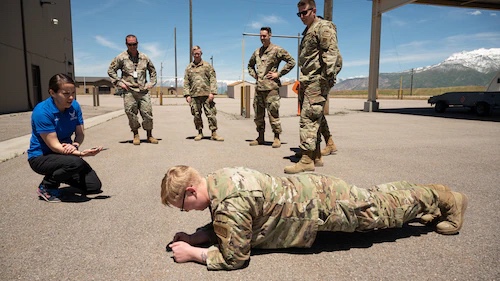
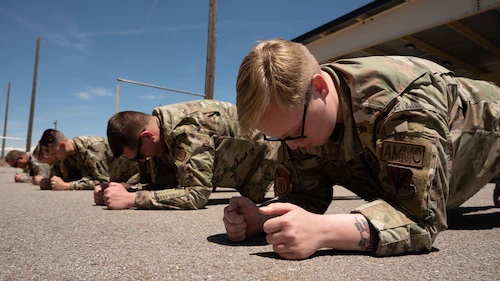
Among the key changes announced by the Army are new age-and-gender-performance normed scoring scales; the replacement of the leg tuck with the plank for the core-strength assessment; and the addition of the 2.5-mile walk as an alternate aerobic event.

“The ACFT is an essential part of maintaining the readiness of the Army as we transform into the Army of 2030,” Wormuth said.

“The revisions to the ACFT are based on data and analysis, including an independent assessment required by Congress. We will continue to assess our implementation of the test to ensure it is fair and achieves our goal of strengthening the Army’s fitness culture.”

A common concern identified by the Army’s independent analysis and the RAND study was that a gender-neutral test might not accurately measure all Soldiers’ general physical fitness levels. One example was using the leg tuck as the assessment of core strength.

RAND concluded that Soldiers might have the core strength that is not accurately measured if they lack the upper body strength required to perform a leg tuck. Now, the plank will be the sole exercise to assess core strength, using recognized standards from sister services as a baseline, and modifying the scales based on Army requirements.

The revised ACFT will utilize scoring scales that are age and gender normed, similar to the APFT. The Army designed the new scoring scales from nearly 630,000 ACFT performance scores, historical performance rates from the APFT, and scoring scales used by other military services.

The Army will continue to assess performance data and has established an ACFT governance body to provide oversight of the full implementation of the new test. This structure will assess ACFT scores, pass rates, injuries and environmental considerations, and report those findings along with any recommended changes to Army Senior Leaders. The first comprehensive assessment will be in April 2023.

Unlike the APFT, which went largely unchanged for 40 years, Army leaders believe the ACFT must be adaptable.

“Since 2018 we’ve said this test would evolve, and it has,” said Sgt. Maj. of the Army Michael Grinston.

Grinston noted the governance structure will continue to advance the ACFT to maximize the physical fitness of the force.

The six-event ACFT now provides commanders and Soldiers an accurate assessment of a Soldier’s physical fitness level and sustains the Army’s efforts to maintain a physically fit force capable of a wide range of missions.

Implementing the ACFT

Beginning April 1, units will start diagnostic testing under the new structure. Record testing begins for Regular Army and Active Guard Reserve Soldiers on October 1, 2022, to allow Soldiers six-months to train. Also on October 1, a passing ACFT score will be used for retention, graduation of initial military training, professional military education, and evaluation reports for Regular Army and Active Guard Reserve Soldiers. Implementation of separation actions may begin in April 2023 for Regular Army and Active Guard Reserve Soldiers.

The Army also approved similar, but longer, timelines for Army Reserve and Army National Guard Soldiers, with April 2023 marking the start point for most personnel policies, and the implementation of separation actions beginning in April 2024.

“During this transition, we want to make sure all Soldiers have the proper time to succeed,” Grinston explained. “Put the test on the calendar and make sure your Soldiers have a solid training plan.”

Grinston said while Regular Army Soldiers can be flagged beginning October 1, 2022 for failing the ACFT, no Regular Army Soldier will be separated solely for ACFT failure until April 2023.

The policy also directed a change to extend retesting periods from 90 days under the APFT to 180 days for Regular Army and Active Guard Reserve Soldiers, and 240 days for Reserve Soldiers for the ACFT. Grinston noted that the extended reconditioning timelines will guarantee that Soldiers who are willing to put in the time and training are provided an opportunity to pass the test.

Chain Teach throughout the Force

To help inform the force of all the policies and procedures of the test, the Sergeant Major of the Army is initiating a chain teach throughout the force – and personally gave Army Command, Army Service Component Command, and direct reporting unit command sergeants major a class on changes to the ACFT.

“They will turn around and give that class to the NCOs who report to them as well as the [command sergeants major] for their subordinate units,” Grinston said.

The chain teach will continue throughout the Army to ensure all noncommissioned officers and Soldiers are directly informed of the policy.

“This is an opportunity for leaders to get engaged and understand their Soldiers’ questions and concerns about the test,” Grinston said. “Know where they are struggling and develop a plan to help them succeed. Leaders need to address more than just physical training and focus on the Soldier’s overall fitness.”


To ensure Soldiers throughout the Total Army have comparable training opportunities, the Army procured and distributed more than 40,000 sets of equipment, 60% of which were designated for Soldiers in the Army Reserve and National Guard.

Grinston encouraged Leaders to use their equipment for physical readiness training, including on drill weekends for the Reserve Component, to help Soldiers familiarize themselves with the events before testing.

There are also a number of resources available on the ACFT website to help Soldiers train, including workout program examples and videos of exercises – many of which require no equipment.

Holistic Approach

Army leaders expect units to incorporate principles of all the Holistic Health and Fitness (H2F) System domains into their training. In addition to the physical domain, Leaders should include proper nutrition, sleep, and spiritual and mental fitness to improve overall Soldier readiness. Unit master fitness trainers are the subject-matter experts and are trained to advise in all domains of fitness.

“H2F is an incredible system that looks at training in ways the Army has never done before,” said Brig. Gen. John Kline, commanding general of the Center for Initial Military Training – the Army’s lead proponent for the H2F system.

“Incorporating things like mindfulness training, proper nutrition counseling, and better sleep techniques are proven methods to improve mental and physical readiness,” Kline said.

“If you really want to improve your ACFT score,” Grinston agreed, “start with those other four domains of fitness.”

For the full details on the implementation of the ACFT, visit www.army.mil/acft.

By SFC Will Reinier

DEVCOM Tests Airdrop System for Rapid Deployment in the Field

Wednesday, March 23rd, 2022

YUMA PROVING GROUND, Ariz. — For U.S. Army Soldiers on the move, getting a vehicle in the field increases their survivability and mobility. Safely airdropping the vehicle and quickly de-rigging it is important to reduce Soldiers’ exposure to threats. As a measure to increase operational readiness, the Army recently tested the ATAX land airdrop system, an off-the shelf prototype.

The Foreign Technology Assessment Support program provided funding that enabled the U.S. Army Combat Capabilities Development Command, or DEVCOM, Soldier Center to test the ATAX system, manufactured by United Kingdom-based IrvinGQ. The system was originally designed for British and NATO standards, which are similar to the U.S. but not identical.

The funding enabled the DEVCOM team to ensure it meets U.S. airdrop and air transportation specifications and to address any issues gathered during the testing. A follow-on Foreign Comparative Testing program, sponsored by the Office of the Secretary of Defense Comparative Technology Office, enabled detailed integration, prototype fabrication and additional airdrop flight testing.

The U.S. Army Yuma Test Center conducted four live airdrop tests between November 2020 and May 2021. The team used ballast weight for the first three airdrop tests and a High-Mobility Multipurpose Wheeled Vehicle for the fourth and last airdrop test, which they drove off the ATAX platform at the conclusion of the test.

“Overall, the project was a success. At the final demonstration, we derigged the HMMWV and drove it off the platform without any issues,” said Sean Wellman, DEVCOM SC engineer and ATAX project lead.

The ATAX airdrop system is modular and consists of eight-foot platforms connected by hinges. It can be adapted to different lengths, typically between 8 and 32 feet, and it is surrounded by a self-contained structure where the parachutes are mounted and attached. The vehicle is loaded onto the ATAX platform with an under-mounted airbag system. In a typical low altitude airdrop, it takes between two to three minutes for the vehicle to drop from a height of 1,500-2,000 feet. Airdrop systems can weigh up to 42,000 pounds including the payload and airdrop equipment.

The ATAX airdrop system has significant advantages over traditional systems because it uses reusable airbags to soften the impact when the vehicle lands. Traditional airdrop systems use multiple layers of stacked paper honeycomb that is three inches thick to soften the landing. The paper honeycomb, which is crushed by the impact, is left in the field and can take up to an hour or more for Soldiers to free the vehicle from the paper honeycomb. One of the goals of the project is to reduce de-rigging time by 75 to 80 percent, which will reduce the amount of time that Soldiers are in the drop zone.

“Airbags minimize or avoid the need for paper honeycomb, saving time during preparation and recovery. The risk of becoming stuck in a stack of honeycomb is eliminated when airbags are used. Basically, when the vehicle is dropped, everything comes off, and the vehicle is ready to execute the mission,” Wellman said.

DEVCOM SC teamed with Product Manager Force Sustainment Systems on the FTAS and FCT project. PM FSS is executing the Rapid Rigging and Derigging Airdrop System Program of Record, which will enable wheeled vehicles to drive on and off the aerial delivery platform, decreasing the amount of time Soldiers are in the drop zone. Funding provided by the FCT program enabled the Army to maintain competition that would otherwise have not been possible. The FCT program provides funding to acquire, test and evaluate mature products from foreign industry that might fill a capability gap or satisfy an urgent need.

DEVCOM SC established a Cooperative Research and Development Agreement with IrvinGQ in 2018, to share information about the ATAX system and other aerial delivery technology. DEVCOM is leveraging the CRADA for other projects that support its mission. According to IrvinGQ, numerous European forces are using the ATAX system.

“Ultimately, the ATAX system was not selected for further development but it was a key enabler for modernization efforts in aerial delivery. The ATAX is still available as a test bed for future science and technology projects, if needed,” said Andrew Meloni, lead of the DEVCOM SC Airdrop Research, Capabilities & Systems team.

By Argie Sarantinos, DEVCOM Public Affairs