Phantom Lights

Archive for the ‘Guest Post’ Category

Airmen Interested in Learning Aviation Fundamentals, Becoming a Rated Officer Can Apply for Rated Prep Program Until Dec 2

Monday, November 15th, 2021

JOINT BASE SAN ANTONIO-RANDOLPH, Texas (AFNS) —  

Active duty Air Force officers and enlisted personnel interested in becoming rated officers have until Dec. 2 to apply for the Spring 2022 Air Force Rated Preparatory Program (RPP), scheduled for March 20-25, 2022, and March 27-April 1, 2022 in Denton.

U.S. Air Force rated career fields consist of pilots, combat systems officers, air battle managers and remotely piloted aircraft pilots.

RPP provides qualified Airmen interested in cross-training to an Air Force rated career field the opportunity to gain and strengthen basic aviation skills.

“The Rated Preparatory Program provides a unique opportunity for officers and enlisted personnel to become rated officers,” said Brig. Gen. Brenda P. Cartier, Air Education and Training Command director of operations and communications. “Through RPP, qualified Airmen gain skills they may have not had the opportunity or resources to gain before entering the Air Force. We want to provide our Airmen the tools to pursue their lifelong dream of flying in the Air Force — a dream they may have never thought possible.”

Program participants will receive self-paced ground training, about eight flight hours in a Civil Air Patrol Cessna 182 Skylane, and additional training in Federal Aviation Administration-certified simulators — helping them become more competitive for rated selection boards.

“RPP has proven successful in improving students’ Air Force Officer Qualifying Test and Test of Basic Aviation Skills scores, which are considered at rated selection boards, by about 40%,” said Kathryn Gifford, AETC rated diversity improvement program analyst. “Of the 93 RPP students trained in fiscal years 19 and 20, 70 applied to the undergraduate flying training board, with 55 (78%) of applicants selected for a rated position.”

Airmen who can meet the requirements below are encouraged to apply.

Officer requirements:

Be of high moral character.

Obtain group commander (or higher) approval and endorsement (on application).

Take the AFOQT and TBAS to receive Pilot Candidate Selection Method initial scoring results prior to RPP. Then, retake the AFOQT and TBAS two-four weeks after completion of RPP. Note: The AFOQT and TBAS cannot be attempted more than three times total. RPP officials will provide an exception to policy for RPP graduates who require a waiver for retest intervals, and for those who have tested twice already.

Have less than five hours of total civilian flight time. Note: Applicants with greater than five hours of flight time will be considered on a space-available basis.

Prior to attending RPP, obtain the appropriate Air Force flight physical specific to the rated carrier field. For example, Initial Flying Class 1 for pilots.

Meet UFT board requirements post RPP in accordance with Air Force Manual 36-2100.

Review Civil Air Patrol-assigned study material prior to class start date.

Enlisted personnel requirements:

Must be under 33 years of age on March 20, 2022.

Prior to attending RPP, have or obtain a bachelor’s degree from an accredited university with at least a 2.5 GPA.

After completion of RPP, apply to an Air Force officer commissioning source at the next available opportunity.

Airmen interested in applying to the program can find additional information via the call for nominations on MyPers here (Common Access Card required).

For any questions, email AF.Rated.PrepProgramWorkflow@us.af.mil with “Attn: Rated Prep Program” as the subject line.

The Air Force RPP is led by Air Education and Training Command’s Rated Diversity Improvement Team, headquartered at Joint Base San Antonio-Randolph and supported by Civil Air Patrol.

RPP is not a commissioning program, nor does it guarantee participants will be selected for an Air Force rated position.

By Capt Kenya Pettway, Air Education and Training Command Public Affairs

UF PRO Presents – Firearms Instructor Series: E1 Shooter Deficiencies

Sunday, November 14th, 2021

Please join former LE/SWAT team member Mike Levy as he goes over shooter deficiencies in episode 1 of UF PRO’s new Firearms Instructor Series.

SCUBAPRO Sunday – Adding Pockets

Sunday, November 14th, 2021

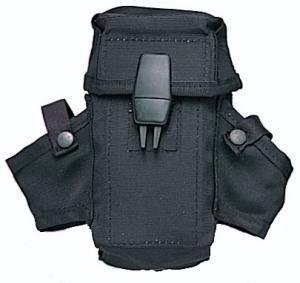
Typically, when you are diving, you want to stay as streamlined as possible. It will help keep you on time and help you use less air. But sometimes you have more things to carry so you might need to add more storage. The major problem with pockets on your thighs or hips is the drag it will create. When these pockets are full, they add about two to four inches to your profile. You can wear your BDU’s, and that will add pockets to your legs and arms. If you chose to wear a uniform, I would recommend the Patagonia Jungle uniform. It is super light and dries fast. You can also add pouches onto your gear belt, or you can put one or two onto your rebreather straps. An old school M16 pouch is great for a spare mask or extra fin straps. You can cut the grenade pouches off of the sides to reduce the drag. Here are a few after-market pockets options that can help you streamline your profile without sacrificing your gear needs or altering your existing gear in any way.

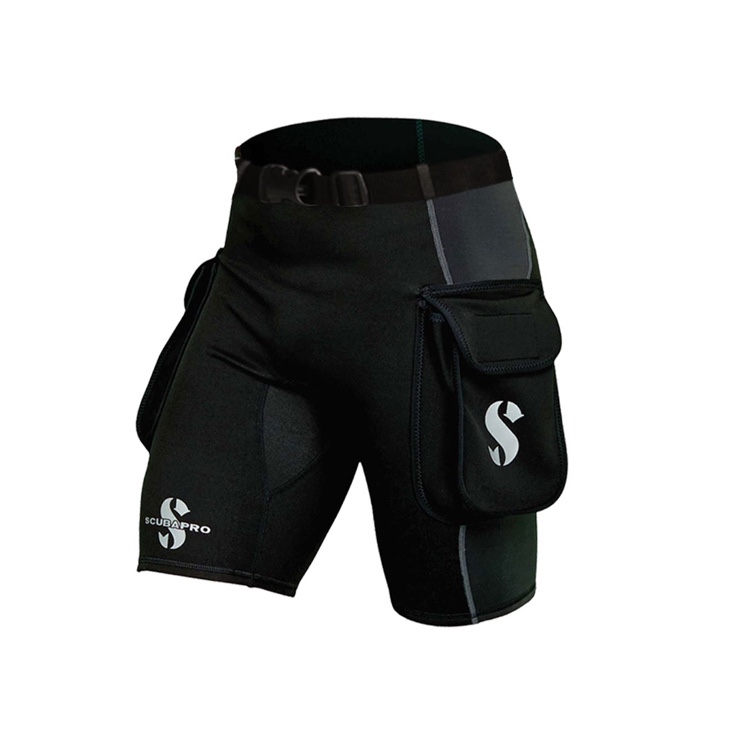
SCUBAPRO HYBRID CARGO SHORTS form-fit to your body like you were born wearing a pair. On the underside of the nylon panels, a micro-plush interior makes the shorts warm and cozy. This fleece fabric absorbs less water, which keeps heat against the body, increasing overall warmth. They also dry quickly. They can be worn by themselves, over a wetsuit, or if you need a little more warmth, they are great for over dive skins in warm water. They are also useful for items that need to be at the ready or if you need to tuck something away while diving.

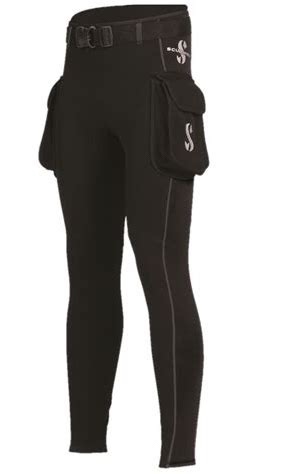
The SCUBAPRO Hybrid Cargo Pants are made from 1mm X-Foam neoprene for warmth and durable nylon for stretch and comfort. They have an adjustable waist belt that includes an easy-to-use male/female squeeze buckle closure. Abrasion-resistant fabric on the seat panel provides additional protection. Highly versatile they are great for water jump, over the beach operations or combat swimmer where you don’t need a think wetsuit, but you want all the protection a wetsuit would provide.

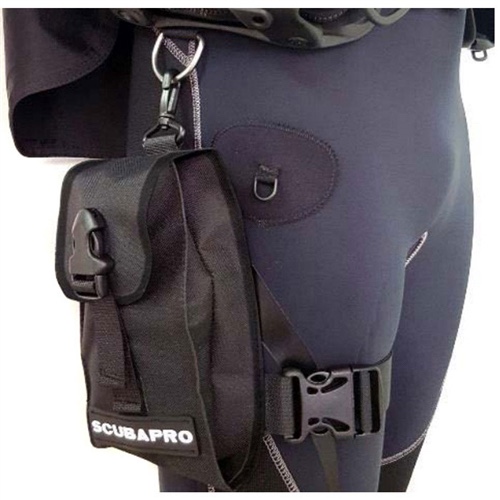
The SCUBAPRO Hydros Pro Cargo Thigh Pocket (full pocket with clips and straps) can provide the same storage as the Cargo shorts that capacity. Ideal for storing swimmer slates, lights, marker buoys, spare masks, compact cameras. Quick attachment via clips & thigh strap. The pocket has a large flap with a squeeze-style” side-release buckle closure. Bellow pocket design and large flap make access to stowed items easy and secure. The most significant feature is if you don’t need additional storage capacity, you can just remove the pocket for a more streamlined profile.

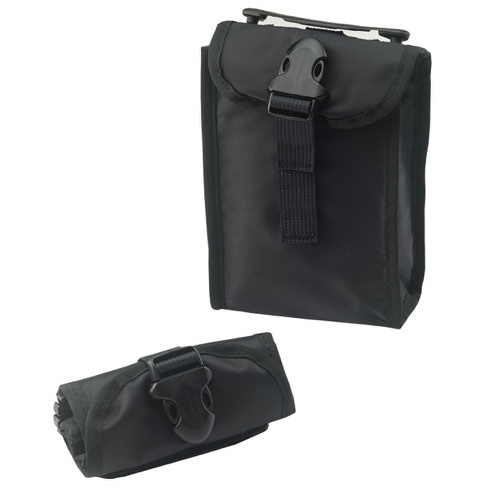
The SCUBAPRO Hydros Pro BCD Ninja Pocket is ideal for storing swimmer slates, lights, marker buoys, spare masks, compact cameras. Quick deploy when needed, roll-up when not. Pocket has a large flap with squeeze-style” side-release buckle closure. Bellow pocket design and large flap make access to stowed items easy and secure. All of the SCUBAPRO pockets are made from durable nylon fabric for strength and durability.

Another option is to glue pockets onto your wetsuit/ drysuit. This is way more permit, so make sure you get it right. You can do it yourself, but unless you have done things like this before, I would recommend having someone that has done it before showing you how to do it or have them do it. There are a lot of YouTube videos out there and articles about how to do this. There are pockets you can buy just for this purpose.

Click here to see a bunch of DIY instruction for gluing pockets to your suit.

SCUBAPRO Sunday is a weekly feature focusing on maritime equipment, operations and history.

Guard Soldier First Woman to Graduate Army Sniper Course

Saturday, November 13th, 2021

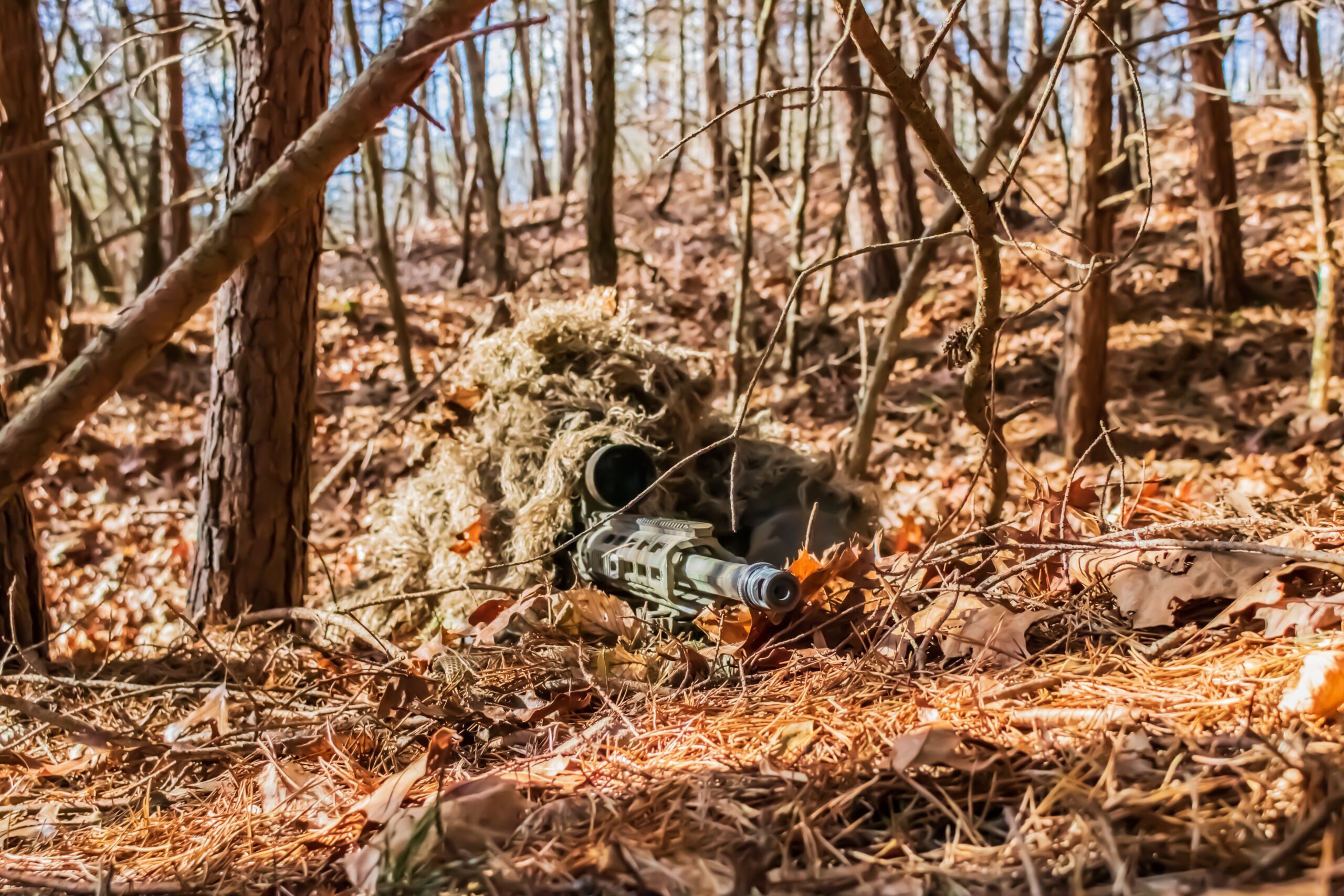
HELENA, Mont. — A Montana Army National Guard Soldier became the first woman to complete the U.S. Army Sniper Course at Fort Benning, Georgia, Nov. 5.

At this time, the military is not identifying this Soldier by name.

“We are extremely proud of this Soldier’s achievement and recognize that this is a milestone for not only Montana, but the entire National Guard and Army,” said Maj. Gen. J. Peter Hronek, the adjutant general for Montana. “This Soldier had to volunteer several times to reach this goal, which is a demonstration of her dedication and commitment to service.”

The Soldier enlisted in the Montana Army National Guard in December 2020. She was then sent to Fort Benning to complete Infantry One Station Unit Training (OSUT), a 22-week course that combines Army basic training with advanced individual training in infantry skills.

While attending OSUT, her training staff and chain of command recommended she attend the sniper course due to her superior performance, which included qualifying as an expert shooter.

“We’re all incredibly proud of her,” said Capt. Joshua O’Neill, OSUT company commander. “She epitomizes what it means to be an infantry Soldier, and there wasn’t a doubt in our minds that she would succeed in the U.S. Army Sniper Course.”

The Soldier began the course in September 2021. This intensive seven-week course trains selected individuals assigned to sniper positions in the skills necessary to deliver long-range precision fire and the collection of battlefield information.

“The Soldier met every standard required to graduate the United States Army Sniper Course,” said Capt. David Wright, battalion commander, U.S. Army Sniper School. “She arrived prepared for training and physically conditioned to succeed. We are proud of the results of her efforts and the quality training provided by the sniper course cadre. We wish her luck as she heads back to her unit as a U.S. Army Sniper Course-qualified sniper.”

On hand for the sniper course graduation ceremony were Command Sgt. Maj. John Sampa, command sergeant major of the Army National Guard, and Command Sgt. Maj. Claudena Brady, state command sergeant major for the Montana Army National Guard.

With the completion of training, the Soldier will join her unit.

Story by MAJ Ryan Finnegan, Montana National Guard

Photo by SPC John Bright

FirstSpear Friday Focus: Top Gear List from our Team of Veterans

Friday, November 12th, 2021

Whether you’re a grunt warring through the suck or a weekend warrior training at the range, the gear that you train with needs to be on point.

In honor of Veteran’s Day, we asked our team of FirstSpear veterans for their favorites— here’s their top seven picks.

1 Woobie Quarter Zip— super warm and not bulky; staying warm in the field is crucial. These woobies are lightweight, moisture-wicking and are designed to keep you from hating life while standing post on cold nights. Whether you’re on the range or hitting the stand for hunting season, the ACM wool lineup is a must have for cold climate.

2 MultiMag Rapid Adjust Pocket— Mission requirements evolve, the rapid-adjust pocket holds everything the mission requires… from magazines to beer cans.

3 Boot Super Sock— Grunts know that blisters and wet feet suck, these merino wool socks keep your feet in the fight.

4 Padded Plate Backer— Wearing armor is never comfortable, these plate backers improve comfort and provide channels for more airflow.

5 Operator Glove— All hail the OG, there is always a trade off when wearing gloves, you lose dexterity and the ability to manipulate equipment and gear. The OG glove offers great dexterity, works with touch screens, and the merino wool is useable in both hot and cold conditions. 

6   Wind Cheater— This iconic all American-made jacket offers great protection from weather elements, looks sharp and is crucial during cold weather. The pit zips keep you cool if you’re out rucking.

7 Hoodlum Hoodie— This is the most comfortable hoodie I’ve owned. It always seems to be the right amount of warmth, be it an early morning garage workout or hike in the spring.

For more information about FirstSpear, check out www.first-spear.com

DARPA’s Gremlins Program Demonstrates Airborne Recovery

Friday, November 12th, 2021

Successful Fourth Deployment Results in Airborne Recovery of Gremlins Air Vehicle to C-130

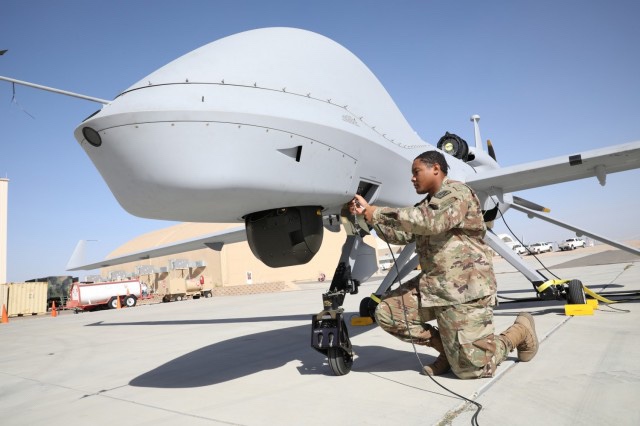
An unmanned air vehicle demonstrated successful airborne recovery during the DARPA Gremlins program’s latest flight test deployment last month. During the deployment, two X-61 Gremlin Air Vehicles (GAV) successfully validated all autonomous formation flying positions and safety features before one GAV ultimately demonstrated airborne recovery to a C-130.

“This recovery was the culmination of years of hard work and demonstrates the feasibility of safe, reliable airborne recovery,” said Lt. Col. Paul Calhoun, program manager for Gremlins in DARPA’s Tactical Technology Office. “Such a capability will likely prove to be critical for future distributed air operations.”

During the final experiment, the team refurbished an X-61 vehicle and conducted a second flight within 24 working-hours. In addition, many hours of data were collected over four flights including air vehicle performance, aerodynamic interactions between the recovery bullet and GAV, and contact dynamics for airborne retrieval. Unfortunately, one GAV was destroyed during the flight tests.

“Airborne recovery is complex,” said Calhoun. “We will take some time to enjoy the success of this deployment, then get back to work further analyzing the data and determining next steps for the Gremlins technology.”

Safe, effective, and reliable air recoveries promise to dramatically expand the range and potential uses of unmanned air vehicles in conflict situations. The GAVs can be equipped with a variety of sensors and other mission-specific payloads. They can also be launched from various types of military aircraft, keeping manned platforms safely beyond the range of adversary defenses. After air retrieval, the GAVs can be refurbished by ground crews to prepare them for another mission within 24 hours.

Dynetics, a wholly owned subsidiary of Leidos, is developing the Gremlin vehicles.

– DARPA

Improving the Service Member’s Human Performance

Thursday, November 11th, 2021

Every year thousands of Reserve and National Guard service members from across all forces of Department of Defense (DoD), come to Fort Bliss before deploying. While service members are at Fort Bliss, they execute different levels of training based on individual and unit proficiency, naturally a unit does not execute URM training if they have not qualified with the individual weapon; we, at Task Force Stallion, under 5th AR BDE, see qualification as a pre-requisite for any advanced training. Observer-Coach/Trainers play a crucial role in the units training, as we observe first, then coach and train to give them honest feedback through After-Action Reviews. One of the training events that service members go through at Fort Bliss is the Gunfighter Gymnasium (GfG).
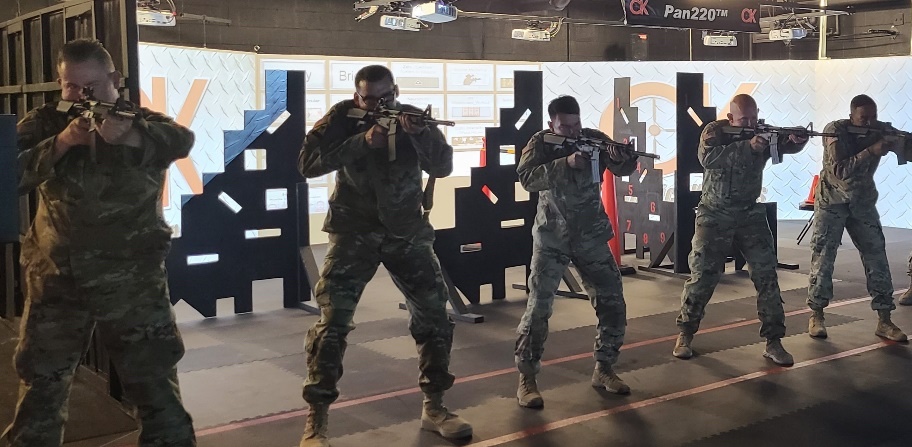

5th AR BDE GfG, OC-Ts, Instructor Trainer Course, Nov 2020: (left to right) SSG Pleinis, SGT Barton, SSG Gomez, SSG Ziegler, SSG Beavers.

5th Brigade has made an Investment in the Service Member and the effect is Revolutionizing Readiness across the Brigade through what is being called the Gunfighter Gym (GfG).  This investment is not a material solution, but rather a wholistic Soldier investment in eyes, mind, central nervous system, and body.  The gym’s focus is to rapidly guide service members to reach their Peak Human Potential (PHP) in a very short time.  By, investing in the service members cognitive decision making under stress, while fighting in a 360-degree environment, we are witnessing, measuring, and analyzing data across multiple units, as our great men and women, are going from Zeroing their rifle in Basic Rifle Marksmanship (BRM), into Urban Rifle Marksmanship (URM) in the GfG, culminating out at the live-fire range; and reaching new personal bests across all qualifications.  Thus, creating and confirming a more lethal, faster thinking and reacting service member. The same effect is happening in pistol and automatic weapons training.
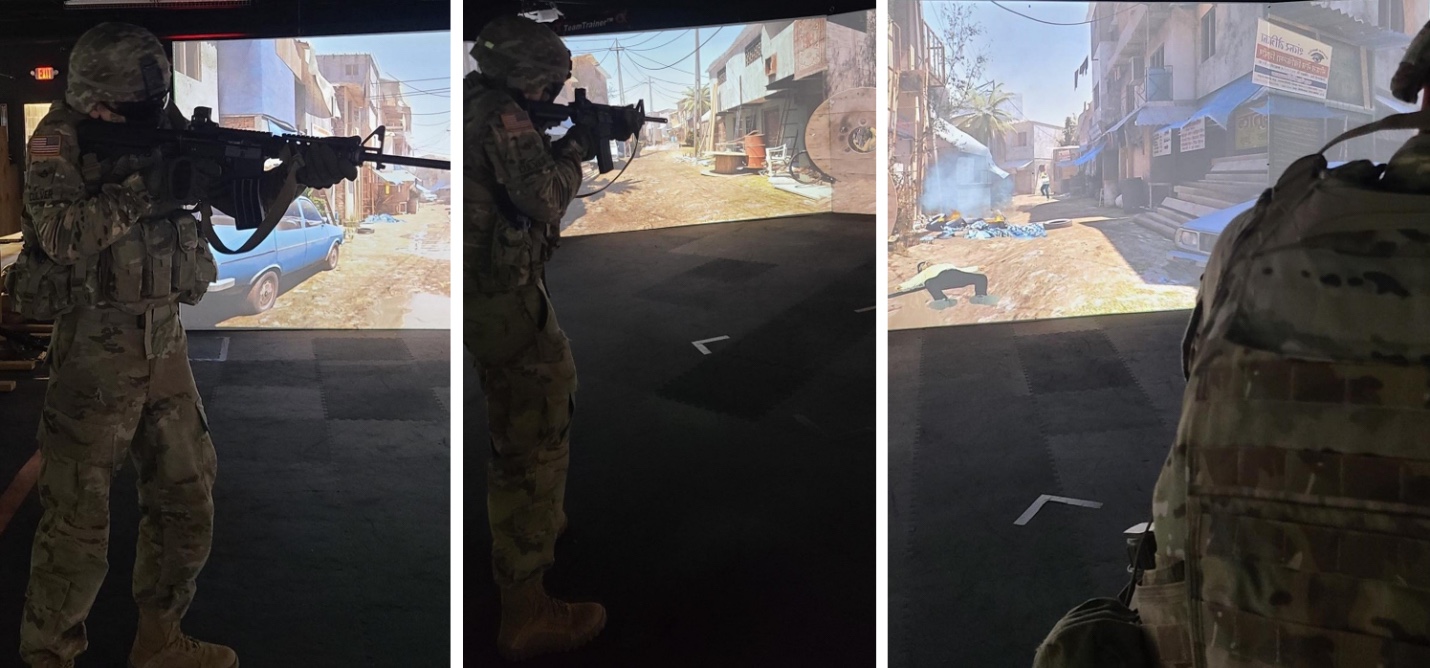

The GfG provides service members with opportunities that they rarely see at home station training. Some examples are the new Army Weapons Qualification for the M4 carbine, where service members complete their virtual marksmanship qualification tables (Table II), as outlined in TC 3-20.40, “I attempted this qualification standard once and got 18 or so 3 times, this time, at the range I got 35 out of 40, first time and it seemed so much easier” (SSG, 864th Theater Support Group, Feb 2021). Others are the execution of training packages which include Urban Rifle Marksmanship (URM), Close Quarters Battle (CQB), Team/Squad Battle Drills (with their assigned weapon or Conflict Kinetics Synthetic Weapons) and this Gym can easily add support by fire, call for fire and crew served weapons. The ability to change the environment in the GfG is limitless, which has allowed us to truly focus on the servicemembers needs based on their area of deployment.

During the first 6 months of throughput in the GfG, while under COVID restrictions, exceeded 1 million shots fired, over 3.5 million decisions made, and over 4108 Servicemembers from U.S. Army, Air Force, and Navy having been trained and mobilized.  Our gym is being run 24/7 and there have been zero down training hours/days due to equipment malfunctions. The GfG is leveraging video-based roll players, with further capabilities to bring VR/MR and shoot-back capabilities for full mission profiles. They are capturing big data on cognitive, emotional, and physical performance for the life of the service member, that further down the road, we could leverage in the unfortunate event of a TBI or MTBI incident.  The ability that the GfG gives us, knowing what a service members PHP was prior to suffering the trauma, can more rapidly map them back to full operational capacity.  It is great for the service member and great for the United States of America.

The GfG provides much more realistic training and scenarios, than a live-fire range ever could. In one day, service members can fire over ten times the number of rounds than they would at a live-fire range. Not only that, but they can also switch up scenarios in a matter of minutes and train in different situations and environments. Using the Conflict Kinetics (CK) training methodology is less costly, gives service members more time to sharpen their marksmanship skills, lets them have more repetitions, gives service members more time training because they do not have to worry about how much ammo they are allotted, or how much time they have left on the range based on scheduling or daylight. As stated by a member of the 864th Theater Support Group, “Being scheduled for the gym on the training calendar, allowed us to focus on only this task for the first time in years” (1LT, 864th Theater Support Group, Feb 2021).

After going through the Instructor Training Course provided by CK, having served over 18 years of service to my country and the Army, I improved my lethality, cognitive skills, speed, and accuracy in 5 days of training. With my years of experience, I have not seen a better system, that truly helps the individual service member and units collective training that CK provides through Human Performance. There are over 3200 drills that Soldiers can train on, so the ability to game the system is impossible. With varying scenario’s, Soldiers are trained to react to threats rapidly and in a more lethal manner. All drills have lethality zones built into the target, which takes the shooters actions into account as well as the drills actions, and provide a lethality score per shooter. Another unique advantage to this system that I have seen, is the ability to create a Unit Identifier (UID) that can follow the service member anywhere there is a GfG. This is an area I have not seen before with simulators. My personal UID, if I were to PCS to the 173rd in Italy, as an example, I could see the site tech at the 173rd, give him/her my UID, and in no more than 1 week time frame, my profile and everything I have shot will be in the system at my new duty station. Potentially, if this system were across the Army, we could track a Soldiers shooting career from Basic Training until they exit the Army, what I could have done with that data as a 1SG, would have been limitless! PVT X goes to shoot in the GfG, he is a lethal shooter but that day shoots horribly, this lets me know his mind is somewhere else, and provide focused attention to care for the Soldier through his leaders.
The GfG has been certified to Army Doctrine standard by DOTD, Maneuver Center of Excellence and has created a training path called the “Principal Path” that has been proven to be more efficient and effective than taking the troops to the live fire range. In a recently published Marine Corps MCOTEA study the GfG was shown to be a “viable substitute for live fire.” As we see it here at 5th Brigade, if we continue to invest in the wholistic training of the service member, how they see, think, react and more, we are delivering highly trained, problem solving, lethal service members in the shortest amount of time for Combatant Commanders within their Theaters of Operation.  

By MSG James S. Sharp, TF Stallion 3-362 IN, 5th AR BDE

MSG James S. Sharp is an Infantryman and has served for 18 years. He joined the Army in 2003 and has been on 7 combat tours, 3 to Iraq and 4 to Afghanistan. He has served most of his time at Fort Drum, but was also in Alaska at Fort Richardson, and was a Drill Sergeant at Fort Benning. MSG Sharp is currently at Fort Bliss were he serves as a Senior OC/T for 3-362 IN, TF Stallion 5th AR BDE. He has been an Master Trainer for the Gun Fighter Gym system for over a year. He is 44 years old and has a wife and two sons.

The views of MSG Sharp are his own personal opinions and do not reflect official DoD policy or endorsement.


Yuma Proving Ground Supports Cutting-Edge Technology Testing During PC 21

Thursday, November 11th, 2021

YUMA PROVING GROUND, Ariz. — Project Convergence, the Army’s campaign of learning, has returned to U.S. Army Yuma Proving Ground (YPG) to test a vast and astonishing array of new technology.

For the first time ever, every branch of the United States’ armed forces are testing their sensor-to-sensor capabilities in tandem.

In addition to representation from all branches of the military, this year’s iteration features all eight of the Army Futures Command’s cross-functional teams (CFTs). There is also a dramatically larger Soldier presence.

Among these CFTs is Future Vertical Lift (FVL), which is aggressively testing virtually every facet of the Army’s Future Attack Reconnaissance Aircraft (FARA) and FVL, as well as advancing knowledge on electronic warfare. Unmanned aircraft, air-to-ground missiles, rotary cannons, and all manner of ancillary technologies to expand communications capabilities and Soldier survivability are all being tested simultaneously here.

“There is a lot of learning going on out here over these several weeks,” said Jim Thomson, Acting Deputy Director of the Future Vertical Lift CFT. “Yuma Proving Ground is really a unique place to enable us to do this.”

YPG’s vast size includes nearly 2,000 square miles of restricted airspace. The proving ground’s clear, stable air and extremely dry climate combined with an ability to control a large swath of the radio frequency spectrum makes it a desired location for this type of testing.

YPG’s vast institutional UAS and counter-UAS testing knowledge is an added bonus, as is the presence of a wealth of other infrastructure meant for other sectors of YPG’s broad test mission that can be leveraged to support aviation evaluations. YPG is home to things like technical and tactical targets, as well as generator and combined maintenance shops.

“YPG in particular has been an outstanding host,” said Lt. Col. Tanner Spry, FVL CFT experimentation planner. “It’s a great area based on the distances that exist here to challenge our platforms.”


The breadth of equipment tested here over the course of the six-week demonstration is astonishing, and boasts multiple firsts. Testers say this year’s demonstration increased their ability to integrate into the joint force and improved the command and control network to extend the range Army aviators can operate in. This was shown multiple time in realistic scenarios in which Soldiers from the Army’s 82nd Airborne conducted simulated air assaults across YPG’s vast ranges.

“We’ll take a use case and run through multiple iterations to stress and challenge the technologies to make sure they are resilient,” said Spry.

One of the more exciting technologies used was Air Launched Effects (ALEs), drones attached to a helicopter or other vehicle that can be an aviator’s eyes in an area of interest. These remarkable and low-cost surveillance UAS can also be launched off of light ground vehicles, but integrating them into aviation platforms is much more complex.


“They’ve done a tremendous amount of work to get the ‘air launched’ into the name air launched effect,” said Thomson. “But there are a lot of other options, too.”

As for the FARA and FVL themselves, multiple other facets are being tested here. A new Gatling-style 20mm machine gun that could serve as one of the platforms’ rotary cannon was integrated into a UH-60 Black Hawk serving as a surrogate and fired in flight for the first time here.

“It shoots fast, it shoots well, and it shoots accurately,” said Lt. Col. Cameron Keogh, Chief of Flight Test for U.S. Army Combat Capabilities Development Command. “As a previous attack and recon pilot, I like it.”

With things like the Gatling-style gun, artificial intelligence-aided threat targeting and detection systems, and even the ability to fly autonomously, developers are using a modular systems approach that would enable these things to be used on a variety of aircraft as needed. During PC 21, the testers demonstrated flying a legacy UH-60 completely autonomously.

“We have to be able to demonstrate autonomy in any environment,” said Stuart Young, Defense Advanced Research Projects Agency program manager. “Yuma is a great location to be able to bring all of these different pieces together. We have a lot of flexibility that we don’t have in other locations: we have large safety margins and here we have the space we need to conduct all of these firsts safely.”

All of these technologies are being refined to prepare for the potential of warfare with a near-peer adversary. As such, the participation of hundreds of Soldiers in PC 21 was useful for testers: Engineers had the opportunity to gain input about systems under test from Soldiers who have operated earlier iterations of the platforms in theater overseas.

“We are leveraging technology to reduce Soldier workload,” said Spry. “Sometimes moving yourself out of chaos by being able to operate at greater distances and ranges can give us a strategic advantage.”

By Mark Schauer