Phantom Lights

Archive for the ‘Guest Post’ Category

Ft Bragg Airborne Troops Support R&D to Prevent Soldier Head Injuries

Monday, September 13th, 2021

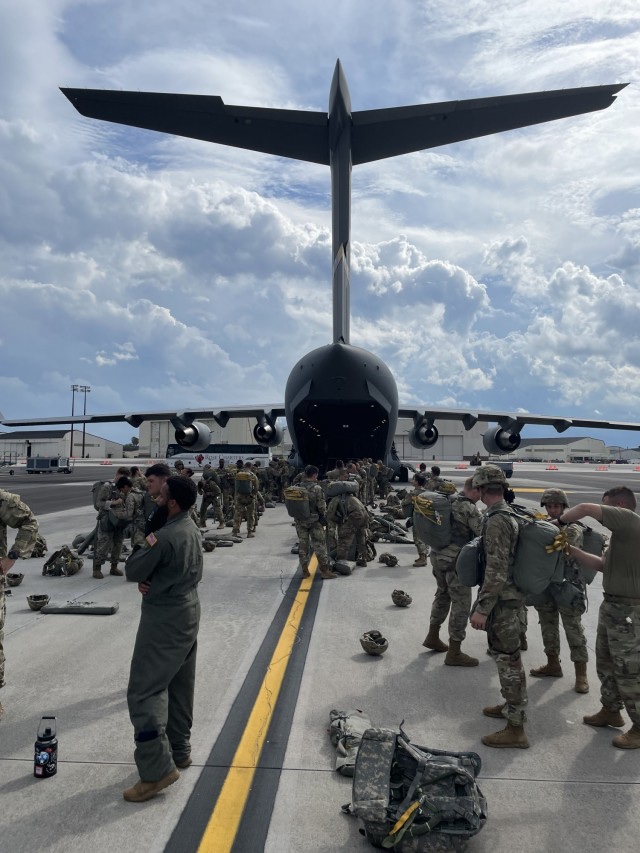
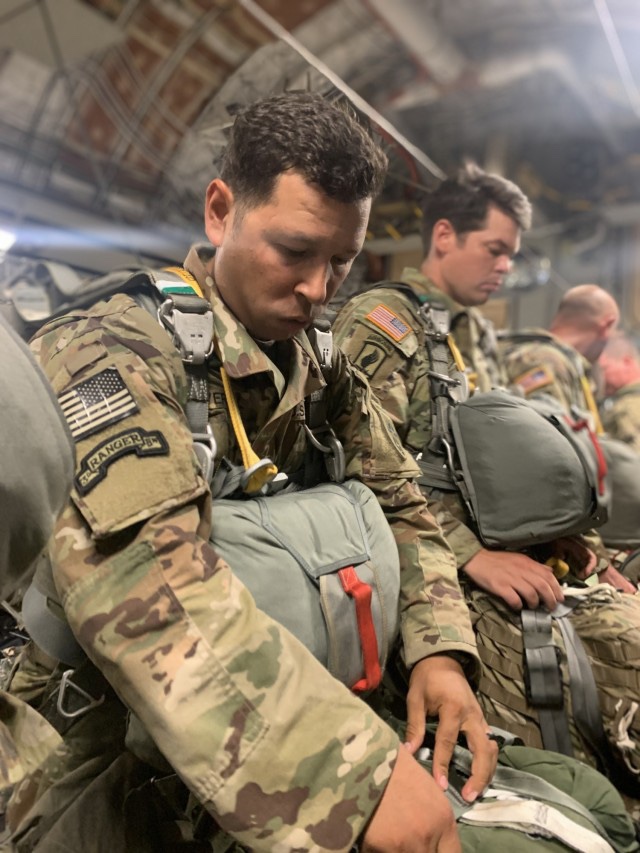
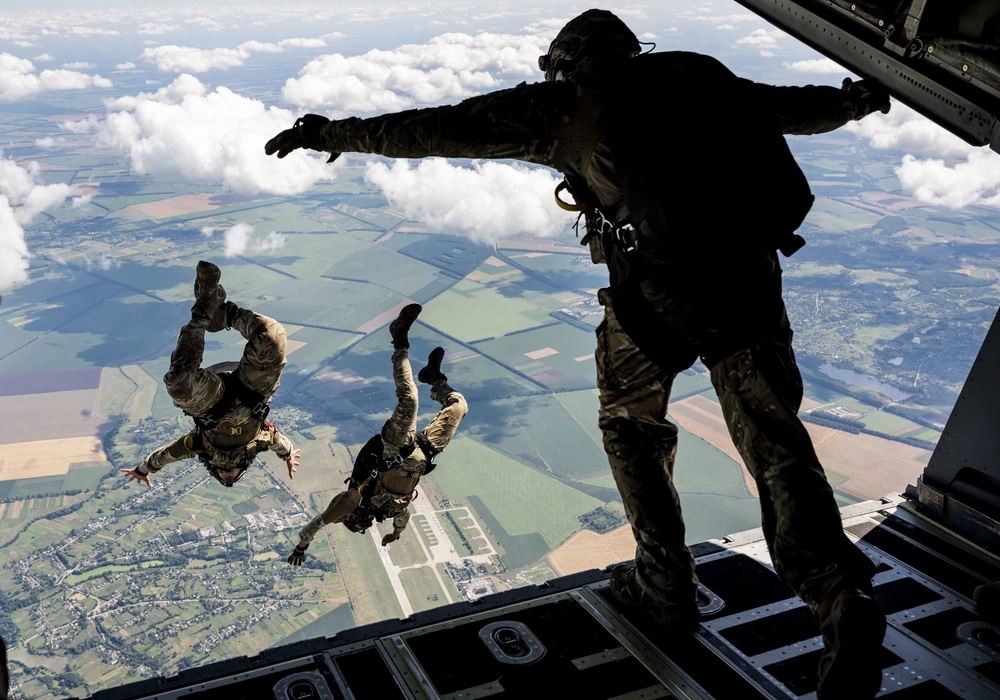
FORT BRAGG, North Carolina – Airborne Soldiers here recently tested combat helmet sensors looking to help the Army lessen repetitive traumatic injuries to the head and neck while jumping from aircraft.

The 2nd Brigade, 82nd Airborne Division and the Airborne and Special Operations Test Directorate teamed up to do testing for the Army Research Laboratory’s (ARL) newest Head Impact Monitoring Sensors.

Ongoing research supported by the ARL over the last 10 years has developed improved monitoring devices and the implementation of many new protective gear developments.

“Ultimately our goal for the Rate Activated Tether (RAT) helmet suspension is to increase the blunt impact protection in all combat helmets for all Soldiers,” said Thomas Plaisted, the ARL Materials Engineer Research Lead.

He said whether Airborne or ground-based operations Soldiers, the goal is to achieve a comfortable and stable helmet fit with minimal added weight.

“The Impact Monitoring Mouthguard (IMM) is a ‘Check Engine’ sensor that provides understandable and objective head impact and blunt force data to line leaders regarding the readiness of their Service members,” said Dr. Adam Bartsch, Chief Science Officer for Prevent Biometrics.

For the past year, the IMM Team has been collaborating with the ARL to evaluate the RAT impact absorption system fitted into the Army Combat Helmet.

Testing of the IMM and RAT began mid-July with a day of ground training and familiarization, followed by combat-equipped jumps on Fort Bragg’s Holland Drop Zone.

“The findings from this test are vital in understanding the physical demands Soldiers encounter while conducting airborne operations,” said Capt. Tyler Miller, ABNSOTD Operations Officer.

“With this data, leaders and researchers can develop equipment and processes to better protect paratroopers.”

Ground training consisted of experts from ARL and Prevent Biometrics conducting training on proper wear and fitting of the RAT and IMM.

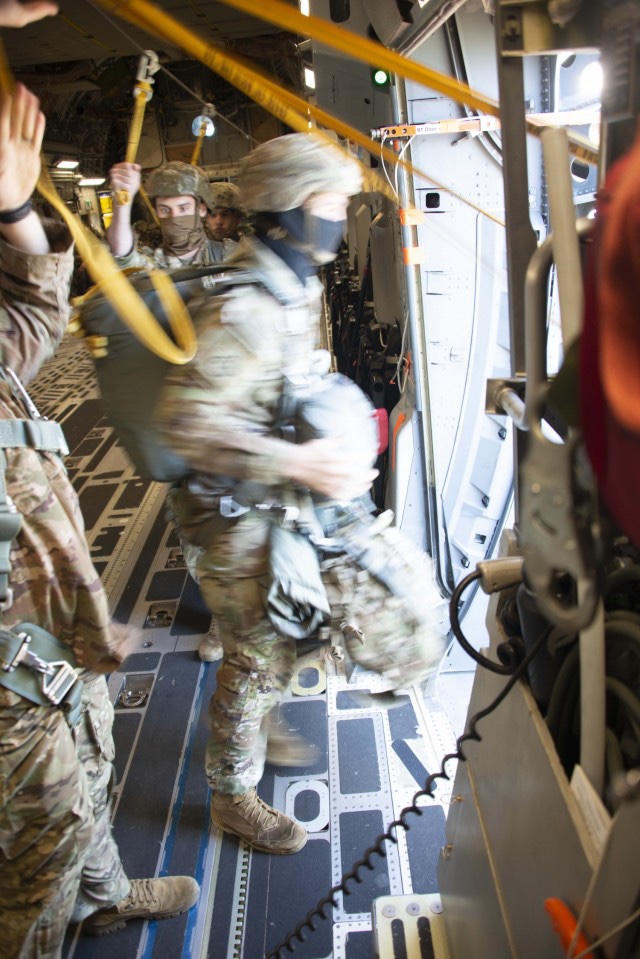
The test jumpers then tested the equipment on the ground with Sustained Airborne Training, Parachute Landing Falls on various surfaces, and then practicing jump commands and aircraft exits out of a mock door trainer.

That was followed by combat-equipped training jumps on Fort Bragg’s Holland Drop Zone from U.S. Air Force C-17 Aircraft, along with Paratroopers from 2nd Brigade, 82nd Airborne Division, who were already jumping for training for mass tactical airfield seizure insertions.

“The ability to test and put these new and emerging technologies directly into the hands of our Soldiers goes far too rapidly evolve technology for the future of the Army,” said Miller.

Data collected from post jump surveys and the head impact sensors will lead to further development of protective equipment for Paratroopers.

Soldiers from the 2nd Brigade, 82nd Airborne Division plan to assist medical researchers, by utilizing the IMM for further head impact data collection during training events over the coming months.

The data these Soldiers will gather will assist researchers in further development of protective equipment and techniques to prevent future mild traumatic brain injuries from combat and everyday training events.

By CPT Christopher Weber, Airborne and Special Operations Test Directorate, U.S. Army Operational Test Command

SCUBAPRO Sunday – Veterans Suicide

Sunday, September 12th, 2021

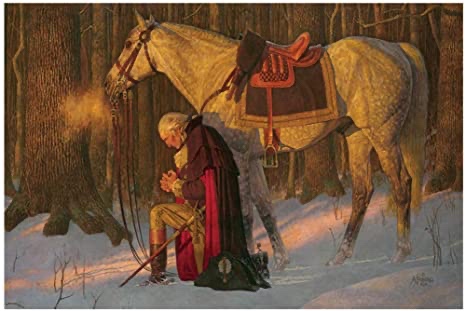
“The willingness with which our young people are likely to serve in any war, no matter how justified, shall be directly proportional to how they perceive the Veterans of earlier wars were treated and appreciated by their nation.” — President George Washington

With today being the day after the 20th anniversary of 9/11 and September being suicide awareness month, I wanted to write about something close to me. I have lost some very good friends to suicide — people you never thought in a thousand years would take their own lives. They were among the best dads you could ever meet, truly the people you think of when you imagine great fathers. As colleagues, when it came to being a team guy, a teammate, or friend, you couldn’t find better ones. Since the war on terror started, we have lost a lot of brothers and sisters to war, but we are losing four times as many veterans to the effects of war than to the war itself.

Most of the time, suicide is only discussed when it is or affects someone close to you. I think it is very misunderstood, specifically when it concerns what causes people to do it or even to think that it’s the only way out. I believe there is a lot of speculation and misdiagnosis, but I also think no one really wants to talk about it. Many veterans are suffering from a host of different things that can be both physical and/or mental. Depending on what report you read, up to 22 veterans commit suicide every day. Some reports are higher and some lower, but they are not that far apart. Regardless of the daily number, Veterans have the highest suicide rate amongst ANY group.  It is not just the vets from the War on Terror, either. This number represents all the wars and conflicts from which we still have survivors.  And it’s not only a U.S. problem, as many of our allies are dealing with the same issues.  If you know someone or you might be having problems, PLEASE talk to someone, anyone.  The Veterans Crisis Line is 1-800-273-8255 and press 1.

I have lost some very close friends to suicide, and I never want it to happen to anyone. Please look out for the signs and symptoms; sometimes they are easy to see, while other times you have no clue, and it will happen to someone close to you.  But if you are thinking of hurting yourself, please talk to someone. If you believe the world is better with you not in it, it is not. The people you leave behind will always have to deal with what happened and still have to think they could have done more. I know I do, but I also know I did all I could have done to help. But there will always be that .01% that thinks “I could have done more to help my brother”.  People, especially military people, are good at hiding things and it’s not always easy to see. Please keep an eye on your brothers and sisters. I look at the military as a family.

www.mayoclinic.org/diseases-conditions/suicide/symptoms-causes/syc-20378048

FirstSpear Friday Focus: 9/11

Friday, September 10th, 2021

With the conclusion of DoD & State Department evacuations from Afghanistan the formal end of Operation Freedom’s Sentinel is now upon us. Persistent threats to America will continue. On this solemn anniversary FS wishes to recognize that U.S. military, government and law enforcement personnel have been continuously deployed domestically and globally, since Operation Noble Eagle on 14 September, 2001.

As the 20th anniversary of 9/11 approaches, the FirstSpear team would like to extend our profound gratitude to all those who, for the last two decades, fought valiantly to bring retribution to the enemies of freedom and by doing so have given America unchallenged safety. Your service wasn’t in vain. Freedom isn’t free. We will never forget.

In the words of the late Major Douglas A. Zembiec USMC,

“Never forget those that were killed. And never let rest those that killed them.”

ACC Innovates with Air Force CyberWorx

Friday, September 10th, 2021

JOINT BASE LANGLEY-EUSTIS, Va. (AFNS) —

When there is a problem that arises within cyberspace or the operational world, Airmen may have ideas to create a better process for the United States Air Force to “accelerate change” in their mission.

Air Force CyberWorx is a Department of Defense cyber mission-focused, operational problem-solving organization that gives Airmen the tools to support Air Force operational problems by collaborating with government, industry and academic experts through structured, human-centered design activities.

“AF CyberWorx can give Airmen the ability to reach industry with unique acquisition methods, building a tidal wave of innovators,” said Lt. Col. Mike Helgeson, CyberWorx acting director. “We are focused on three lines of effort to support the warfighter: operational problem-solving, industry engagement with emerging technology sectors and our innovation education component.”

According to Helgeson, what makes CyberWorx different from other innovation cells in the DoD, is that they help the Airmen and the end user find what is really the problem.

“Every time we start a project, we are laser-focused on the end user, and how they will use this new technology or solution in their environment,” Helgeson said. “Our team then will design around the tactical outcome the user is looking for at the end.”

A couple projects the AF CyberWorx is currently working on include the Cyber Risk Ecosystem and Project Holodeck. The Cyber Risk Ecosystem project started out with a discussion of what operational commanders need to know about cyberspace, as well as how other units use cyber mission enablers. The Cyber Risk Ecosystem develops a commander’s dashboard by utilizing artificial intelligence to ingest applicable information such as flying, medical and cross-domain data points. The AI will utilize this data to aid a fighter wing and squadron commander with system effect analysis, allowing them to change flying availability faster.

The second, Project Holodeck, is a platform to use innovation intelligence by identifying best practices for solutions in development through analyzing performance data and ensuring money is applied to achieve the best portfolio outcome. Holodeck accelerates decision-making by guiding Airmen through development phases more efficiently. The customized innovation program guides experimental activities, generates status reports and makes funding recommendations along the way.

The project develops problem-solvers by moving Airmen to quickly develop and test ideas based on Air Force priorities, leveraging innovation best practices, guiding Airmen with the right process and recommending the right team for each project.

Project Holodeck stretches taxpayer dollars with transparency and enterprise-wide visibility to ensure money and resources are applied to the most promising ideas that have sustainable support.

According to Helgeson, an advantage of CyberWorx being at the U.S. Air Force Academy is that it allows the Air Force to bring operational problems into the education process. The team then takes those problems and aligns them to cadet capstone projects and other engagements letting cadets see both how industry innovates and how to apply those innovations to operational mission needs.

“This program allows cadets to understand the operational Air Force, so they are prepped when they hit the ground after graduation,” Helgeson said. “We want them to go out into the force and have the tools, knowledge and capabilities so we won’t need innovation organizations to innovate; we have developed a culture of innovation in the Air Force for the future.”

The future operating location for CyberWorx is under construction with a ground-breaking ceremony held Aug. 6 at the academy.

The new, 33,000 square-foot facility, will feature cyber-tech classrooms, labs, and a research and design space. Funding for the project was provided by 420 donors who committed $30 million to the project, with $30 million provided by military funding.

By TSgt Carlin Leslie, Air Combat Command Public Affairs

352d Special Operations Wing Deploys to Ukraine

Thursday, September 9th, 2021

VINNYTSIA, Ukraine – Members of the 352d Special Operations Wing and 24th Special Operations Wing deployed to Ukraine for the month of August to demonstrate commitment to the Black Sea region and strengthen relationships and combined capability.

The wing deployed two U.S. Air Force MC-130J Commando II aircraft to conduct bilateral training with Ukrainian Special Operations Forces and Ukrainian Air Force members.

“We focused on interoperability with our Ukrainian partners through a multitude of training events during the month of August,” said U.S. Air Force 352 SOW mission commander. “We were able to exchange (best) practices during many training events to include mission planning, low-level flight operations, personnel airdrops, field medical practices, aircraft maintenance and physical security.”

Training as partner forces increases lethality and enhances interoperability, allowing U.S. and Ukrainian forces to counter regional strategic competition and coercion. The 352 SOW worked closely with Ukrainian military leaders, ensuring both militaries were given the opportunity to hone their skills and increase readiness.

“No nation can confront today’s challenges alone. We value the close cooperation with European allies and partners to enhance deterrence and counter a range of regional threats,” said Maj. Gen. David Tabor, Special Operations Command Europe commanding general. “Conducting multinational operations in the Black Sea Region ensures stability throughout the region.”

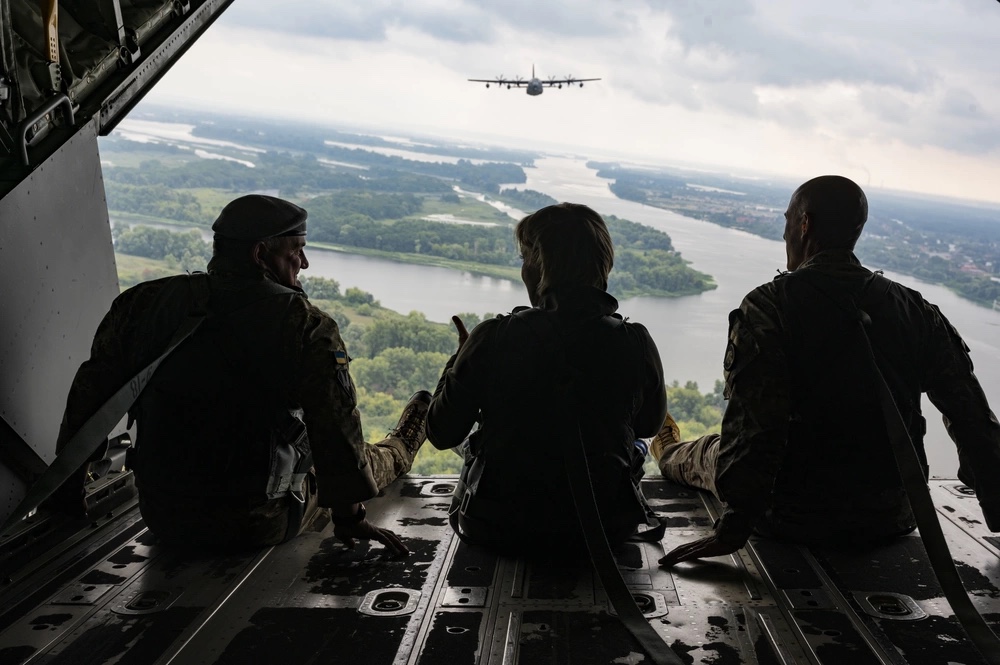
During the training exercise, Tabor, Ukrainian Maj. Gen. Hryhoriy Halahan, Commander of the Special Operations Forces of the Armed Forces of Ukraine, Iryna Vereshchuk, Ukrainian Member of Parliament, members of the U.S. Embassy Kyiv and many other U.S. and Ukrainian military members participated in a low-level flight over Kyiv, Ukraine in a MC-130J.

“We were very happy to be in Ukraine again and during the celebration of Ukrainian Independence,” continued U.S. Air Force 352 SOW Mission Commander. “The 352 SOW recognizes and celebrates a strong history and relationship with our Ukrainian partners that is a critical part of these continued engagements and strengthened partnerships.”

Over the past few years, the 352 SOW has participated in multiple exercises with Ukraine in the Black Sea region, to include Seabreeze and Fiction Urchin.

Story by SSgt Izabella Workman, 352nd Special Operations Wing Public Affairs

20 years Later: Search and Rescue Soldiers Reflect on 9/11

Wednesday, September 8th, 2021

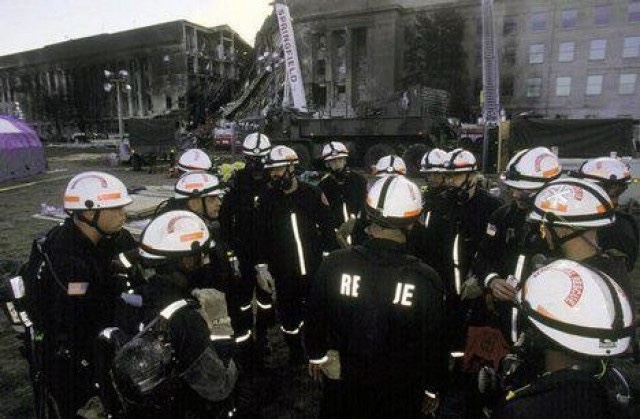
FORT BELVOIR, Va. — Two decades ago as the nation reeled from the terrorist attacks on Sept. 11, 2001, a unique team of search and rescue Soldiers put their training to work at the Pentagon when they were needed the most.

The effects of that Tuesday morning left a lasting legacy on the Army’s Military District of Washington Engineer Company. Years later, the unit was renamed the 911th Technical Rescue Engineer Company for its efforts that day.

As flames and black smoke billowed from the Pentagon, the team rushed to the disaster site without waiting on orders and spent 10 days engaged in search and rescue operations.

Soldiers from the 911th TREC come from a variety of backgrounds — combat engineers, firefighters, horizontal and vertical construction engineers and various support specialties — who receive training and certification as rescue technicians and mine rescuers.

The 911th TREC is the only technical rescue company in the Department of Defense and its Soldiers train for “the nation’s darkest day daily,” said Capt. Joseph Thomson, its commander.

That September morning

On Interstate 395, a congested spur route connecting Virginia to Washington, D.C., Dewey Snavely was on terminal leave and adjusting to civilian life. The sergeant took a job at Sunbelt Rentals, a construction equipment rental company in Springfield, Virginia.
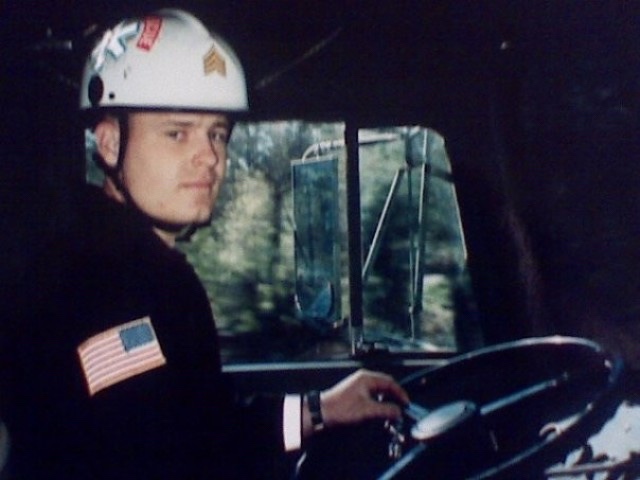
That morning he had already made a delivery to a nearby construction site and was heading to the next place on their schedule.

While driving, he listened to the radio as the situation unfolded in New York City, where a plane had struck the north tower of the World Trade Center. At first, many speculated the ways it could have been an accident.

But Snavely said he began to think the worst. His gut feeling was all but confirmed shortly after when a second jetliner struck the south tower.
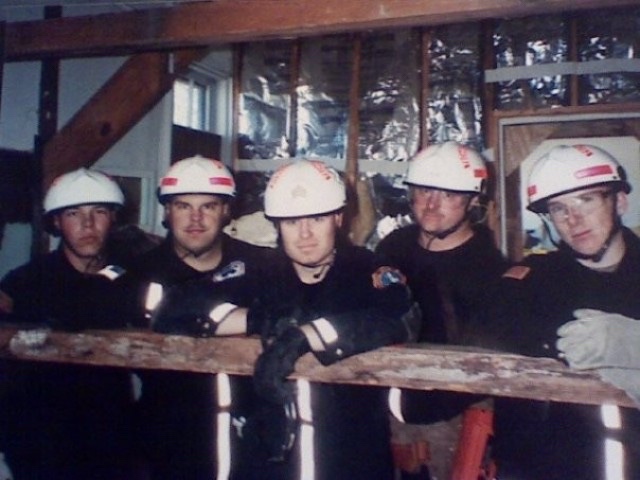
Snavely asked his coworker, Dan, if driving into Washington, D.C., was the best idea, he said. Since the incident seemed limited to New York, his coworker believed it would be OK, so the pair continued their schedule.

Their next stop was on Shirlington Road in Arlington, roughly 3 miles from the Pentagon. That’s where they heard a low-flying plane soar overhead, Snavely said. Although hearing takeoffs and landings near the Reagan National Airport was common, it was never this loud.

Unbeknownst to Snavely, he heard American Airlines Flight 77 as the hijacked jetliner headed toward the Pentagon.

“We looked up, then kind of looked at each other,” he said. “[I thought,] ‘what the hell is that [pilot] doing?’ I’ll never forget the sound of the engines throttling back when they’re decelerating.”

Less than a minute later, Snavely heard AA 77 explode into the Pentagon’s western wall, killing everyone on board and 125 in the building. Black smoke filled the sky.

Snavely knew his terminal leave was over, and even if it wasn’t, he had a job to do.

Weeks before, Snavely had turned in all his Army gear, but he knew once the Pentagon was under attack it was time to turn around, head to Fort Belvoir and do what he was trained for, he said.

‘A quick response’

Around this time at Fort Belvoir, the rescue unit’s Soldiers were well into another training day.

“We [already] did all of our in-house training, from rope rescue to confined space to collapse structure, to shoring anything in that nature,” said Fred Brown, then a senior noncommissioned officer, who now works as a Fairfax County Government project manager.

It was just before 9 a.m. and Brown was preparing for his next training class when the news coverage from New York caught his eye.

A group of his Soldiers was on their way to a funeral service less than an hour away at Quantico. Brown called back the Soldiers, but with the incident occurring in New York his leadership insisted they continue.

That changed at 9:37 a.m. when five men affiliated with al-Qaeda deliberately flew AA 77 into the Pentagon, matching the tactic in New York. The unit would be tested for the first time.

Brown quickly called the squad back from Quantico and “got everything together,” he said. “We were prepared to move within an hour.”
America under attack

An initial team flew by helicopter with a sling load of basic search and rescue equipment, but was asked to land because the last hijacked plane was still in the sky, Brown said.

So, the team pre-staged at Fort McNair in Washington, D.C. At Fort Belvoir, roughly 30 minutes south, more Soldiers loaded equipment into Humvees intended to rescue lives, said Snavely, who met with Brown on the ground.

Brown and Snavely left Fort Belvoir by Humvee before the main body to access the George Washington Parkway and met with the advanced team at Fort McNair.

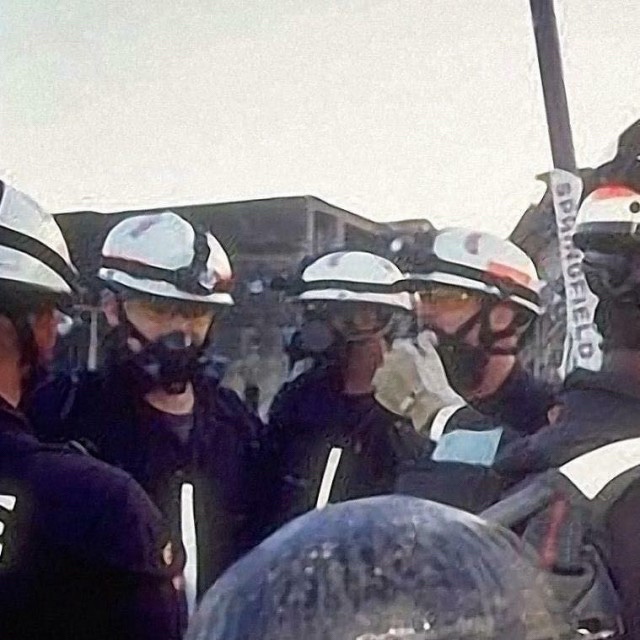
When the unit arrived at the Pentagon, “there was a bit of chaos,” Brown said, adding that the incident commander expected them. The bulk of their unit arrived shortly after and they were joined by local, state and federal responders.

“While waiting on the main body [of the unit] to show up, we took the first squad into the building to do an initial search and rescue,” Brown said. “This was after everybody that was going to come out, could come out.”

As the fires blazed, it was still unclear how bad things were inside the building. But according to Brown, that was when their training kicked in. The untested unit was ready for the challenge.

“I didn’t think of anything except making sure that my guys were suited up correctly,” he said. “We were supplied with air apparatuses, and we went in and did the search.”

As horrific as the scene was, it was personal for Brown on another level.

“My mother-in-law was in the building somewhere,” he said. But “I didn’t know exactly where she was in relationship to the plane or where the plane went in.”

Cellphone technology was relatively new, Brown said, and even today the Pentagon’s thick walls hinder most personal phones. As more information became available, the situation for Brown’s family became grimmer.

“Sgt. Brown and I looked at where the plane hit, and relatively knowing where she worked,” Snavely said. “Nobody [had] heard from her, but her car was still in the parking lot.

“The plane hit and went right through her office. She was in the Army’s Budget Analyst’s Office. I got ahold of my father-in-law and he told me what room she was in. I had to notify him that if he hadn’t heard from her, she probably wasn’t alive anymore.”

Later, it was confirmed that Brown’s mother-in-law was killed. He would eventually locate her, although only “90% sure it was her,” he said, after his team spotted her personal effects, like her purse and government identification card.

The darkest day

“It was a living hell,” Snavely said. “When we first went in, there had been water sprayed on the building for so long, there was so much water in between the corridors, walkways had filled up with water.”

The water had nowhere to drain. Debris was everywhere, including parts of the plane, building and victims.

“Whenever we found human remains, we informed the [Federal Bureau of Investigation] because, by now, it is a known terrorist attack,” Snavely said, adding the FBI required them to mark where they spotted causalities to help identify them.

Snavely vividly remembers finding three Army officers, all face down, in an inner corridor. All three were intact, but appeared to have died instantly. He checked their wallets to identify them, then notified the FBI, he said. It would be the largest investigation in the bureau’s history.

From “the best that I can remember, everybody that we found died in the impact,” Snavely said. Although news footage would replay images of personnel running out of the building, they were all out by the time the Soldiers entered the building.
The recovery site was not like the others the unit trained for, such as responding to a natural disaster.

The heavy loss of life weighed on the Soldiers, who “were feeling a lot of disappointment,” Brown said, especially given how hard they trained to save lives. The Soldiers faced the realization they probably would not find anybody alive.

This was stressful for a unit that trains to rescue, Brown said. As the body count rose, it became more and more challenging to stay motivated.

“[We’re] search and recovery, but we switched into recovery mode only,” Brown said. “We just dealt with it. Many of the young Soldiers were recovering unrecognizable bodies, often unable to decipher burnt insulation from the flesh.

“It was hard on them,” he added. “I made them understand I appreciate what they’re doing, the country appreciates what they’re doing and to let me know if there are any issues they’re having.”
Always on call

However difficult the following days would be, one silver lining that always stuck with Snavely and Brown was how well trained the unit was, they said.

“We had a mission to do, we had a job to do and we went forward and we executed that job,” he said. Even though “I was on terminal leave, I couldn’t imagine not being there.”

According to Brown, the unit’s challenging, realistic training is why nobody from their team was hurt during the dangerous response effort.
“Everyone functioned as they should have,” Brown said, and “a lot of them continued in the military.”

Heading into the Pentagon mission, “we were an untested unit,” he added. “This unit was never in this situation before. Nobody knew exactly what we would face.”

In all, nearly 3,000 people died that morning in New York, Arlington and Pennsylvania. Decades later, the unit still maintains a high level of training and stands ready to be called on again.

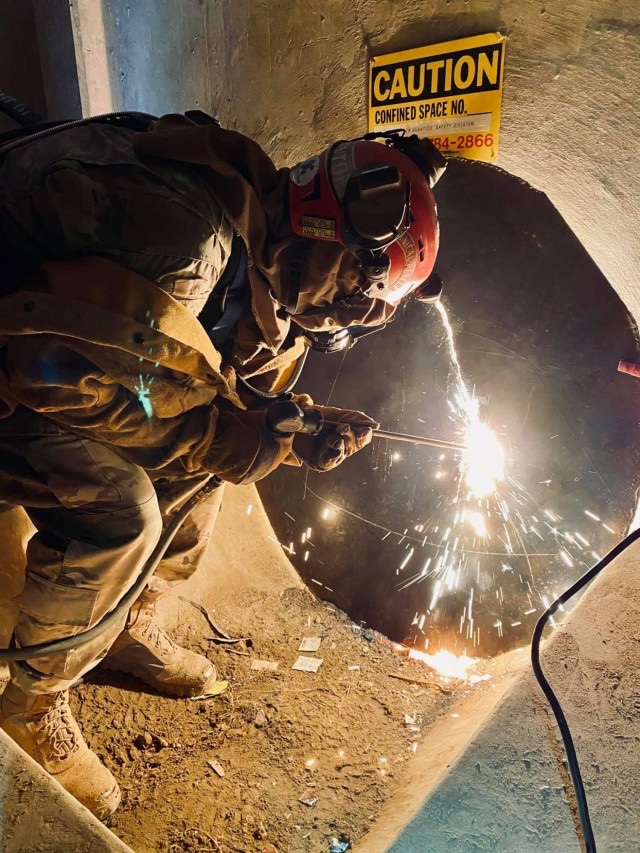
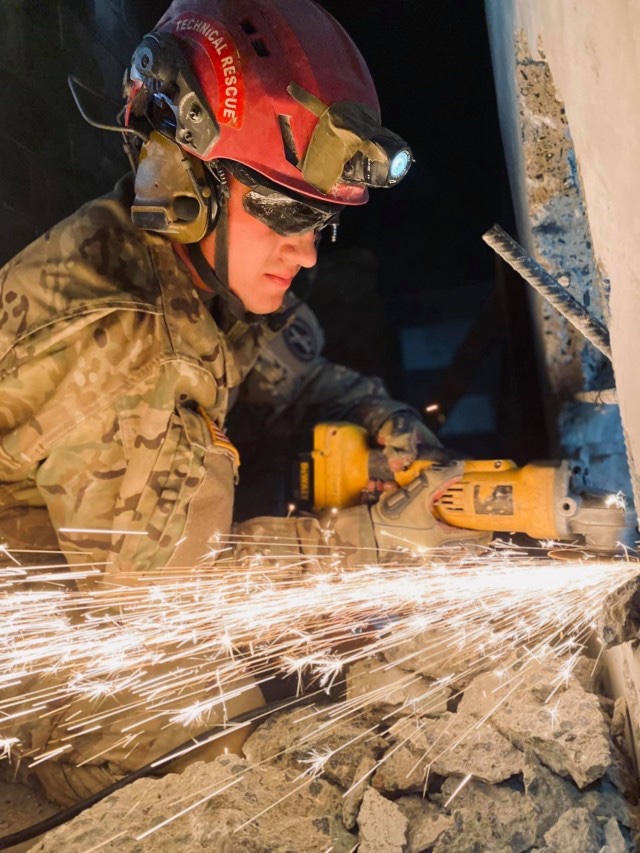
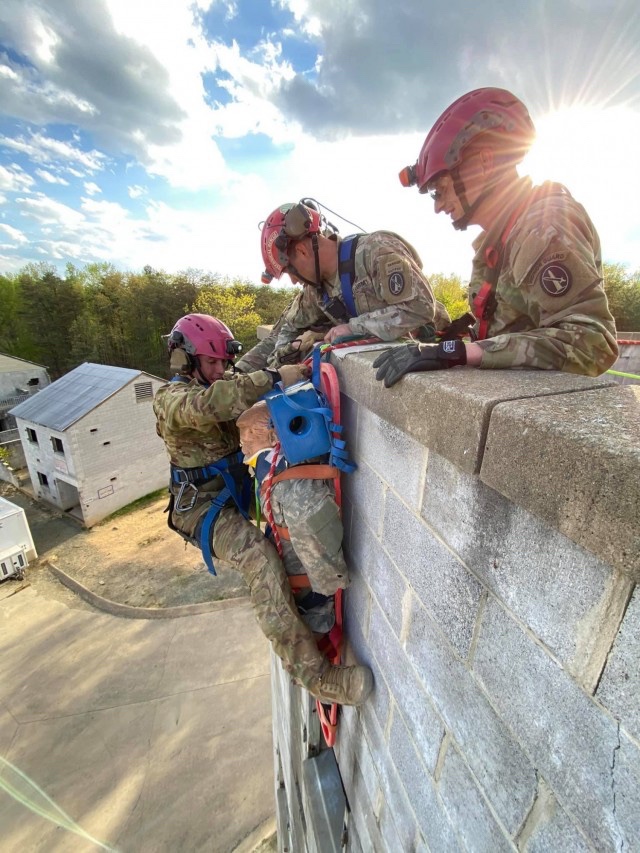
“Soldiers train on five technical rescue disciplines,” Thomson said. “Those include rope rescue, confined space rescue, structural collapse, mine or tunnel rescue, and trench rescue.”
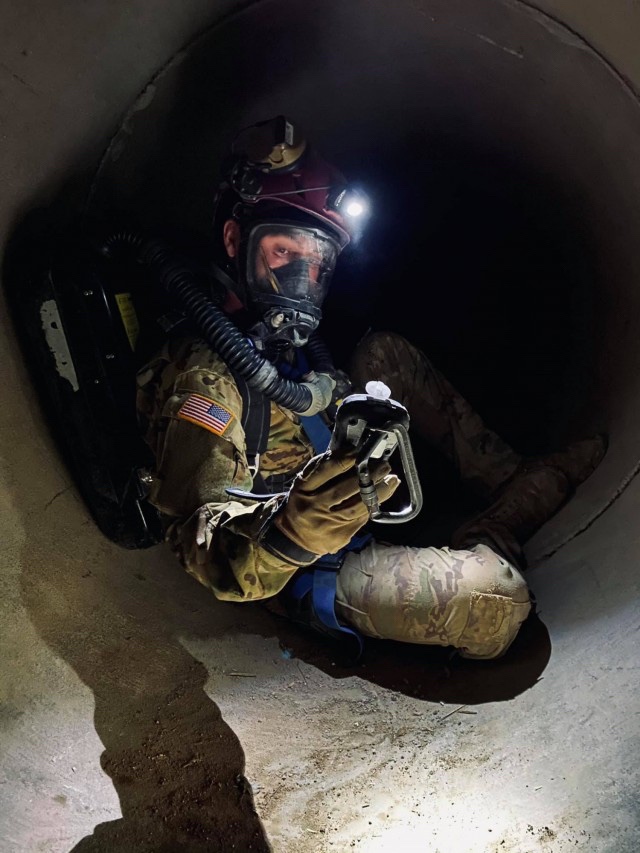
Today’s search and rescue Soldiers maintain readiness by aligning their training needs around their technical rescue disciplines, the captain added.

“It’s an honor to serve as the commander of the 911th, especially on the 20th anniversary of Sept. 11, 2001,” Thomson said. “This organization has deep roots and traditions that we always look to honor and uphold.”

In 2006, the unit was redesignated as the 911th to commemorate their recovery efforts at the Pentagon.

Since the attack, “the unit has grown by leaps and bounds,” Brown said. “They’ve gained equipment that we only dreamed of. It’s amazing to see how far they’ve come.”

Those leaps and bounds are a direct reflection of how they performed, he said.

“The biggest thing that I’m proud of is how well our training paid off,” Brown said, regarding the Pentagon mission. “The Soldiers that went in there performed their duty, and they did it well.”

By Thomas Brading, Army News Service

US Army Eyes Commonality with Tactical Wheeled Vehicle Refresh Effort

Tuesday, September 7th, 2021

DETROIT ARSENAL, Mich. — With a nod from the Army Futures Command, the Program Executive Office for Combat Support & Combat Service Support will explore the potential use of modified commercial off-the-shelf solutions for a new, common Tactical Wheeled Vehicle, or TWV Fleet.

The Army Requirements Oversight Council on July 30 approved the Common Tactical Truck (CTT) Abbreviated Capabilities Development Document, or A-CDD, which allows the PEO to begin a rapid prototyping effort to provide Army Transporters modernized capabilities while incorporating as much commonality with the commercial trucking industry as possible.

Alvin Bing, the Army’s product manager, Heavy Tactical Vehicles, PEO CS&CSS, explained that dovetailing the CTT program’s desired capabilities with commercial trucking industry research and development projects is a winning proposition.

“Aligning CTT with industry R&D efforts enables rapid and continuous integration of future technologies that can significantly reduce obsolescence issues,” Bing said. “With CTT, the Army wants as much industry involvement as possible so we can increase competition while at the same time, leveraging momentum gained through industry’s rapidly advancing fields of driver safety systems, cybersecurity, artificial intelligence, machine learning, autonomy, improved fuel economy and vehicle electrification, off-road mobility, and predictive maintenance. This will allow the Army to modernize at the pace of industry by integrating new technologies with minimal cost.”

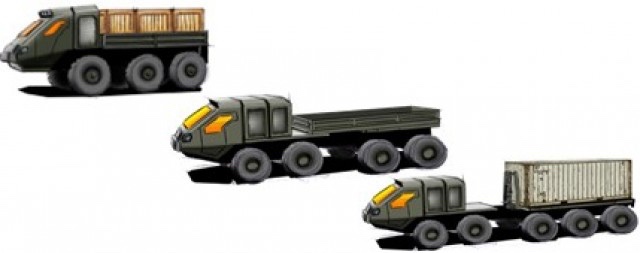
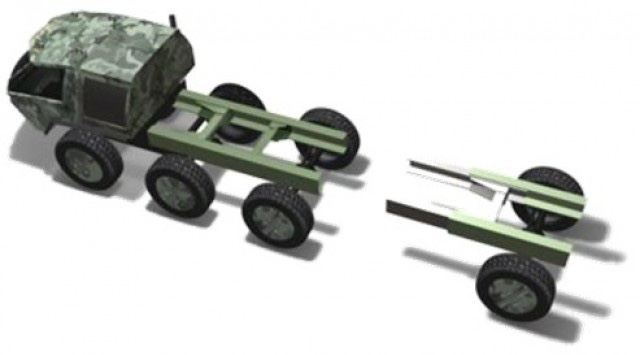
Within the Army’s TWV Fleet, the CTT falls between the Family of Medium Tactical Vehicles and the Heavy Equipment Transporter. CTT seeks to bolster TWV mission roles currently performed by vehicles in the Army’s heavy fleet.

“As the Army’s CTT acquisition lead, our intent is to procure a HTV Family of Vehicles to replace the M915/M1088 Tractors, Heavy Expanded Mobility Tactical Truck, and Palletized Load System with a commercial-based CTT designed with a modular truck platform,” Bing continued. “This will mitigate future obsolescence, leverage best commercial practices, lower procurement costs through commercial economies of scale, and take advantage of interchangeable repair parts across the fleet — resulting in streamlined supply chains and reduced total lifecycle costs.”

According to Don Overton of the Army Futures Command Sustainment Capabilities Integration Directorate’s Requirements Division, ultimately, this effort will inform a future CTT Capability Development Document, which will outline the final, approved operational requirements for a common system that will deliver capability meeting overall operational performance criteria.

“In terms of capability gaps in this portion of the TWV fleet in support of Multi-Domain Operations, we’ve reached design maturity, and without a holistic overhaul, we can’t overcome design limitations and will simultaneously drive operations and sustainment costs to untenable levels. Commercial technologies and economies of scale exist that will help the Army close those gaps and address the increasing age of the current HTV fleet. Now is the right time to modernize with a Common Tactical Truck in support of MDO,” he emphasized.

CTT’s desired characteristics include:
Drive by wire and active safety
Mission roles
Commonality with industry
Digitization (autonomy, prognostics)
Demand reduction
Force protection
Survivability
Sustainment

Industry representatives who are interested in possibly participating in CTT should be on the lookout for announcements and requests for information on SAM.gov in the coming months, Bing said. His acquisition team anticipates holding industry one-on-one meetings tentatively slated for mid-to-late Fiscal Year 2022.

Bing’s team plans to award Other Transaction Authority-based contracts in Fiscal Year 2023 to three vendors to produce multiple prototypes each. OTAs are designed to help the government speed capability to the field vs. traditional contracting methods.

Soldier Touch Points will be leveraged throughout the competitive prototyping phase. These assessments are important ways to incorporate valuable Warfighter feedback into the acquisition program, thereby providing Army Transporters the optimal CTT solution. Currently, the notional plan is for prototype runoff testing to beginning in late Fiscal Year 2023, followed by a down select to a Federal Acquisition Regulation-based production contract in Fiscal Year 2025.

CTT fielding is projected to begin in Fiscal Year 2028.

By Rae Higgins, Program Executive Office, Combat Support & Combat Service Support

NEXCOM Participates in Virtual Textile and Clothing Technology Workshop

Monday, September 6th, 2021

The Navy Exchange Service Command (NEXCOM), its business line Navy Clothing and Textile Research Facility (NCTRF) and its parent command, Naval Supply Systems Command (NAVSUP) executed its first virtual webinar from Aug. 25-26, highlighting textile and uniform technology area. The workshop encompassed over 100 participants within industry and academia.

A number of NEXCOM leaders participated in a variety of information sessions and a panel discussion titled, ‘Demystify doing Business with Clothing and Textiles for NAVSUP, NEXCOM and NCTRF.’ NEXCOM leadership who participated in the two-day webinar included Laurra Winters, Director, NCTRF; Navy Cdr. Terri Gabriel, Deputy Commander Uniform Programs; Rich Honiball, Executive Vice President, Global Merchandising and Marketing Officer; and serving as keynote speaker, retired Navy Rear Adm. Robert J. Bianchi, CEO, NEXCOM.

Serving for nearly 30 years in uniform as a Navy Supply Corps Officer, Bianchi shared with the group his sentiment and the importance of a safe, comfortable and functional uniform. “One can say that the readiness of our Navy warfighters intrinsically starts with the uniform that’s on their back and the gear they carry,” stated Bianchi. “There is plenty of ongoing research and development being accomplished in the areas of seamless knitting, cold weather gear experimentation and NWU Type III design refinement—just to name a few. But make no mistake, all of the advancements in uniforms and protective gear has at its foundation a strong partnership with industry, in particular the clothing and textile industrial base.”

The two-day webinar featured discussions on new and emerging technologies, as well as concepts and the importance of the textile industrial base to military uniforms and gear. The workshop was hosted by the Naval-X Northeast Tech Bridge, 401 Tech Bridge, the Rhode Island Textile Innovation Network and the North Carolina Military Business Center. The group discussed opportunities for small business development, to address current capability gaps in textiles for uniform and protective clothing, and collaboration areas with industry and academia. NEXCOM’s participating leadership emphasized their commitment to establishing and maintaining close relationships with industry leaders and explained that such forums can help accelerate the connection.

Bianchi described two recent examples of successes where industry and NCTRF partnered to improve the safety and function of uniform and organizational components for the Navy fleet— the steam suit for submariners resulting in a new design and materials currently transitioning and the I Boot-5 for Navy warfighters which will meet the requirements to be worn in a variety of Navy environments.

“Events like this collaborative workshop serve an important role in highlighting the importance of building military/industry partnerships,” explained Bianchi. “I am optimistic about the future of clothing and textiles…whether research, design, testing, commercial manufacturing, or academia, all play a very important role to ensure our Navy warfighters never enter a fair fight—we always want the advantage, and are truly the world’s best Naval fighting force because of everyone’s contributions!”

Quick Facts

The Navy Exchange Service Command (NEXCOM), its business line Navy Clothing and Textile Research Facility (NCTRF) and its parent command, Naval Supply Systems Command (NAVSUP) executed its first virtual webinar from Aug. 25-26, highlighting textile and uniform technology area. The workshop encompassed over 100 participants within industry and academia.