Let us talk about talent management. The Army’s Office of Economic and Manpower Analysis (OEMA) defines talent as “…the unique intersection of skills, knowledge and behaviors in every person. Talent represents far more than the training, education and experiences provided by the Army. The fullness of each person’s life experience…and a myriad number of other factors [that] better suit them to some development or employment opportunities than others.” OEMA goes on to say that talent management is the: “…systematic planning for the right number and type of people to meet the Army’s needs at all levels and at all times so that the majority of them are employed optimally. Talent management begins with entry-level employees and aligns their talents against the demand for them during their entire careers, to include positions at the very top of the Army.” More simply, I would say developing a system that enables and ensures people are being, “employed optimally” is the key to effective talent management – both from the individual’s and the Army’s perspective. That certainly articulates a worthy vision, but we are not quite there yet.
“Out of every one hundred men, ten shouldn’t even be there, eighty are just targets, nine are the real fighters, and we are lucky to have them, for they make the battle. Ah, but the one, one is a warrior, and he will bring the others back.”
– Heraclitus
I am not claiming to be that one warrior, but I always aspired to be that guy. I did have a long, colorful, and very unusual, career in the U.S. Army. During the course of 36 years, I learned a few things about the workings of the existing Personnel Management system. For the last few years, as many of you know, that term “talent management” has come into vogue. Sadly, based on what I have seen and experienced – and despite optimistic talk – the institutional Army remains largely locked in manning mechanisms and procedures that have not changed much since WWII. Even the transition from a draft back to an all-volunteer force only changed how people come in the door. Once in, officers and NCOs are still locked in rigid career tracks that require specific “branch qualifying” duty position blocks to be checked within certain narrow time in service windows in order to be promoted. The system actively resists individuals even briefly daring to step off the prescribed path and timeline; and – in the worst case – the result of such a transgression is damaging if not career ending delay or denial of a promotion. That is not effective talent management and never will be.
I am going to be using my own career to illustrate how “the system” worked – or failed to work – for me. I thought about discussing this subject in more generic terms rather than making it about myself. Not that I am ashamed of any of the events that I am going to describe; rather, because my career was so anomalous, I worried that many of the specifics would not be applicable or of value to any readers in service today. Still, I concluded it was best to write about what I personally saw and know. Besides, I wanted to get this personal history recorded eventually; so, I convinced myself that others would find some utility in my experiences. We will see. I admit I am the hero in this story. That does not mean that there are also stereotypical villains in this tale. Many of the characters I will introduce actually helped get the system to work for me. Others may have tried to block my preferences, but most thought they were doing what the system demanded and acted in good faith – even if not in my favor. But, yes, a couple of these people were dicks and I took a certain satisfaction in besting them and the system when I could.
I have written twice before about my experiences in Germany, 1975-78. The “rehabilitative” transfer to the Divisional Pathfinder Detachment made a huge difference in my professional life. There I found a handpicked group of troopers who were all sharp and combat focused. We had the esprit that comes from having a specialized mission and I loved it. I left that team after 2+ years as a Sergeant (E-5) seriously thinking in terms of making the Army a career. Indeed, shortly after PCSing to Fort Lewis, Washington (with less than 5 months left on my original enlistment), I reenlisted for another 3 years. Up to that point, I was still blissfully ignorant about how the Army personnel management system worked. I just got on with my professional and personal life. With 12 months on station at Fort Lewis I received orders to PCS to Hawaii. Just a couple of weeks earlier, my girlfriend of almost a year, who was a Supply Specialist in an Aviation unit, had gotten orders for Korea. Faced with almost immediate separation, we did the only thing we could think to do. We got married.
To this day, I have no idea if starting a marriage as a long distance relationship before skype, email, or cell phones were invented would have worked. Fortunately, we never had to find out. I went to my PAC before the ink had dried on the marriage license to codify our union with the Army. We were thinking that after a year in Korea, the Army would allow my new wife to join me in Hawaii. We did not think we had any other choices. After all, orders were orders – or so we neophytes thought. I told the SFC PAC NCOIC our plan as I was filling out the paperwork. He looked at me as if I had a you-know-what growing out of my forehead and said, “Wait here.” A couple of minutes later he came back and hustled me into the Battalion Commander’s office. I told my story to the BC and he told me to sit down. His comment to me was, “we can do better than that.” It turns out before taking command he had just completed an assignment at Infantry Branch in the HQ we now call PERSCOM, in Alexandria, Virginia. He did not call some General or even another Lieutenant Colonel. He did not seek anyone’s approval or concurrence. Instead, he called one of the “little old ladies in tennis shoes” that actually run the Army’s personnel management system. He told her the problem and gave her mine and my wife’s names and social security numbers. In no time, she had arranged to rescind both our sets of orders, stabilize us at Lewis for an additional 6 months, and cut new orders so that we would both PCS together to Hawaii. The phone call took about 30 minutes.
I strongly suspect that call saved my nascent marriage if not my career. That was 1979. All I know is that on November 30th of this year I will be celebrating my 40th Anniversary with that same woman. From that experience, I learned that the system is made up of people, orders can be changed or amended, and policies can be waived or even disregarded on a case-by-case basis. There are always options. Skip ahead 5 years and I am a promotable Staff Sergeant in the 82nd Airborne Division just accepted into Officer Candidate School (OCS). Even that did not happen without a minor complication. When my OCS Class date came down I was not at Fort Bragg, but was TDY at Infantry ANCOC at Fort Benning. In fact, I had to voluntarily withdraw in writing from that course because it overlapped the start of my OCS Class. ANCOC became the only school I ever started that I did not complete. The cadre at ANCOC actually asked me to finish the course and take the next OCS Class. I could not. At the time, the Army would not commission anyone with more than 10 years of service. If I took even the next class, my graduation / commissioning date would be 2 months too late. Therefore, I had no choice but to rush back to Bragg, out-process, and PCS back to Fort Benning just 2 weeks later.
I do not regret any of that, but the fact that I waited to literally the last minute to seek a commission would have a significant ripple effect throughout the rest of my career. As most SSD readers already know, the Army gets almost all of its officers through West Point, ROTC, or OCS. The first two are generally 4-year programs and the cadets in those schools earn a degree while simultaneously meeting the prerequisites for a commission. OCS is the smallest program, and at the time, was 14 weeks long (today 12 weeks). What many people do not realize – I did not before I got there – is historically, 75% of OCS Candidates are what are called “College Options.” That is, people who already have college degrees that enlist specifically to go to OCS. They complete Basic and then go straight on to an OCS training company. Less than a dozen people in my class of ~150 had more than 4 years of service. Those of us without a degree were required to attend “Degree Completion” sometime after commissioning. That administrative requirement would also have an unanticipated impact on my career 4 years later.
I graduated OCS and was commissioned in Infantry on 22 February 1985. My wife was assigned to an Aviation unit at Bragg and had remained there while I was in school. My intent was to go directly back to the 82nd. In this case, I had a better than average chance to get what I wanted since I was already Jumpmaster qualified and Senior Rated. However, after OCS I still had some more schooling to complete. First up was the Basic Infantry Course and that was almost 6 months. Normally, after the Basic Course, most – but not all – Infantry Lieutenants would go to Airborne and Ranger School. I had already checked that first block so all I had to do was Ranger School. By the time I was half way through the Basic Course, I had tentative orders assigning me to the 3rd Brigade, 82nd Airborne, in hand. It was all coming together. However, there was another factor looming over the Schoolhouse that potentially was going to upset my plans.
The Army had just stood up the 7th Infantry Division (Light), at Fort Ord, California. It was the Army Chief of Staff’s highest priority. Almost all of my peers that summer were already on orders to go there. Likewise, they had priority to Ranger School and that meant that I would be waiting at least a couple of months after the Basic Course before I could even get into the school. To make matters worse, the rumor was that filling the 7th was considered so important that orders for anywhere else were soon going to be rescinded. I was not going to take that chance. So, the day before graduation from the Basic Course, I called up the S1 for 3rd Brigade and asked him if I could come on up and return back to Ranger School later on a Division slot? He put me on hold and asked the Brigade XO if that would be ok. The XO agreed. I suspected – and later confirmed – that the 82nd was struggling with no longer being the highest priority fill for the Army. That summer, the 82nd and 101st had serious shortfalls in company grade infantry officers because they were all being diverted to Ord. I had the answer I wanted. I waved my orders around, signed out of the schoolhouse within 48 hours, and drove faster than the law allowed north and home to Fort Bragg.
That is why I ended up going to Ranger School about 18 months later. Including that 2-month sabbatical, I spent just over three years at 2nd Battalion, 505th PIR. During that time, I was a Rifle Platoon Leader, Mortar Platoon Leader, Tow Platoon Leader, Company XO, and finally the Battalion S3 Air. In other words, I had checked all the infantry lieutenant career blocks that I needed to. However, the Army personnel management system had negatively affected my wife’s career during this period. About a year after I got back she received orders to Germany for 3 years. That was not going to work, so she refused those orders and left the service after 8 years. I also had to start looking forward to the next phase of my career. I would have to go back to Benning for 6 months at the Infantry Advanced Course (now Captain’s Career Course). In addition, because I still had to do Degree Completion, I would be spending 18 more months going to a civilian college nearby in Columbus, Georgia. Infantry Branch also had a Heavy / Light policy, so since I had been on the light side initially, I could expect a mechanized infantry assignment next. I was not enthusiastic about the likelihood of that.
Something else happened in 1987 that helped me make a fateful decision about my future. Special Forces (SF) became a separate Branch. I had been serving with SF qualified officers and NCOs for my entire career. The majority of SF had come from the infantry ranks for decades. In fact, my last Battalion Commander and XO in 2/505 were both SF qualified. I had thought about SF before and had intentions to go over as a Captain after Rifle Company command. That had been the common practice for several years since SF Warrants had replaced Lieutenants on ODAs after 1983. SF had been a school, a skill identifier, and just a temporary assignment for Officers and NCOs of other Branches prior to that timeframe. Now, Lieutenants like me had only a single window to submit a packet to be considered for accession to SF. 1987 was my year group’s one and only window. With the full encouragement and support of my BC and XO, I submitted my packet with high hopes of being selected. Several months passed before I received a response from SF Branch. They had rejected me.
When I initially outlined this subject, I quickly realized that it naturally divided into three blocks of time. My infantry career up to 1988, my SF time from then to 2001, and finally the period from 2001-11, a.k.a. my GWOT years. As I began to write, it dawned on me that my relationship with the Army’s Personnel Management System changed significantly during each block of time. In Part 1, that you have just read, I worked with and within the system. Sure, occasionally I had to nudge the system with the help of others. Still, I was generally moving in the direction that the Army and Infantry Branch wanted me to take so there was very little friction. In Part 2, as you will see, I eventually found myself at odds with what SF Branch wanted to do with me. Therefore, at times, I had to aggressively work in opposition to the system and there was a great deal of friction. In Part 3, I was obliged to operate almost exclusively outside the system and, therefore, avoided friction almost entirely.
The “take aways” from this first article is that the Army has essentially an industrial age, conveyor belt, assembly line, MANNING system vice a flexible management system. And, from what I have seen, the other Services are not appreciably better. The system has a great deal of difficulty dealing with individuals as individuals as is required for genuine talent management. Indeed, the system is easily flummoxed by anyone who is different in any way. In 1979, dual-service couples were unusual, but the problems my wife and I encountered decades ago still apparently persist, unabated, for similar couples today. Almost inevitably, one of the two must eventually sacrifice their career to keep the marriage intact – or dissolve the marriage. It is not effective talent management if we habitually advantage one soldier’s career at the direct expense of another. Moreover, some aspects of the system are counterintuitive and counterproductive to any semblance of talent management. Time in service rules for example. One might assume that more enlisted experience would be considered a valuable asset for an officer and not a liability. That would be incorrect. As I pointed out earlier, it is rare that people are commissioned with more than 4 years of enlisted service. The system does not deal well with “rare.” Spoiler alert, I was initially rejected by SF Branch because of my abnormal amount of time in service.
Nevertheless, I am not writing this because I am disgruntled. Clearly, the system was good to me and I acknowledge that up front. But, that system is not going to be good enough as we move deeper into the ever-higher tech 21st Century. We need more and more talent in a postindustrial age, not just mass numbers of warm bodies. The Services have to find that talent and retain those people once we have them. It will have to be a radical departure from what we have previously experienced. However, I will sound one cautionary note. Military service cannot ever become entirely about self-actualization of the individual. Duty, honor, and selfless service – not to mention teamwork and unit cohesion – are always going to matter and must NOT ever be sacrificed in the name of individuality. The needs of the Service must be addressed and balanced as well as the needs of the individual. There will always be a number of less desirable and even thankless jobs that need to get done. That burden simply has to be perceived to be shared equitably under any system.
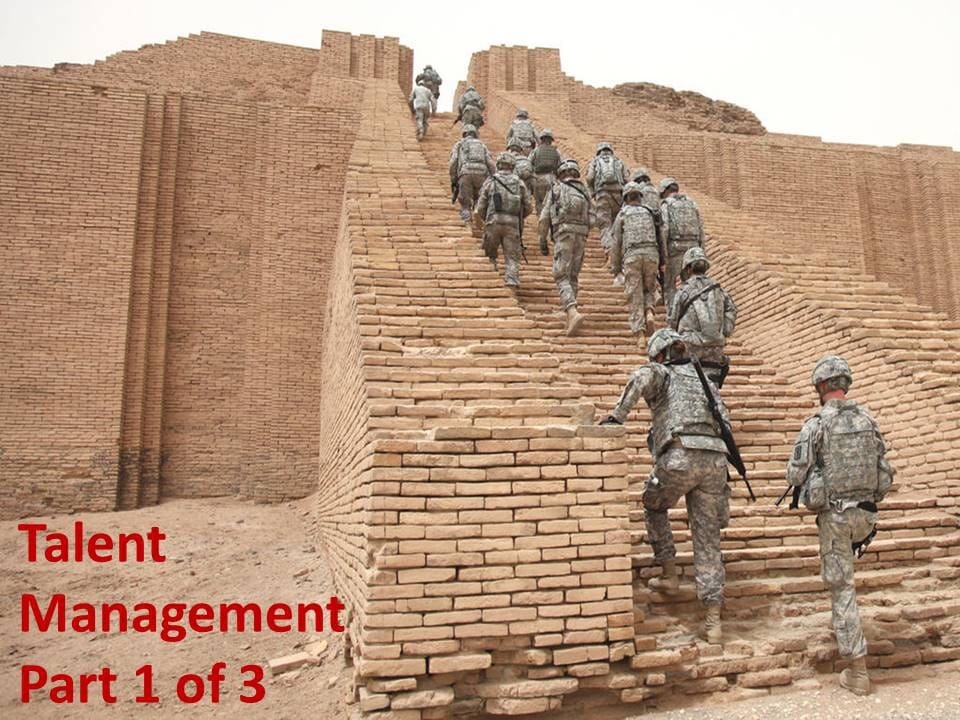
The attached picture shows soldiers climbing the ruins of the Ziggurat of Ur near Nasiriya, Iraq. It is a good metaphor of our current system. It provides a solid, if crumbling, path to the top, i.e. professional success – as long as you do not deviate from that prescribed path. Moreover, the path is wide enough that – at least in some cases – a few can move faster under their own power toward the top without disadvantaging others. Most people can accept that as long as the opportunity is perceived to be fairly administered and truly talent based. However, no one appreciates looking to the left or right and seeing that an escalator has been put in place for a privileged few. We have probably all seen this individual. His boss thinks he walks on water and wants to fast track him; his peers know him as a Spotlight Ranger and do not trust him as far as they can throw him, and his subordinates consider him an unmitigated piece of crap. An effective talent management system would have to have some methodology to collect and reconcile those disparate evaluations of everyone’s performance to differentiate true talent from the posers. Finally, if anyone has more recent experiences, or has knowledge of new(er) changes to the system – that have made it better or worse – I would love to hear it.
De Oppresso Liber!
LTC Terry Baldwin, US Army (Ret) served on active duty from 1975-2011 in various Infantry and Special Forces assignments. SSD is blessed to have him as both reader and contributor.