Archive for the ‘Guest Post’ Category
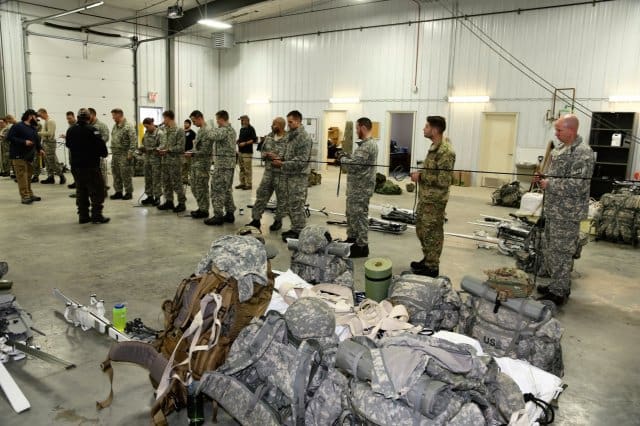
83rd ERQS Pararescuemen Conduct Weapons Training in Afghanistan
Tuesday, February 27th, 201882nd Airborne Division tests new wheeled cargo delivery system to support Global Response Force
Sunday, February 25th, 2018FORT BRAGG, North Carolina — 82nd Airborne Division troopers here are wrapping up testing of the Caster Assisted A-Series Delivery System (CAADS), which involves delivering mission essential supplies and munitions to ground troops.
Soldiers from Company A, 2nd Battalion, 325th Airborne Infantry Regiment, 2nd Brigade Combat Team teamed up with subject matter experts from the United States Army Advanced Airborne School (USAAS).

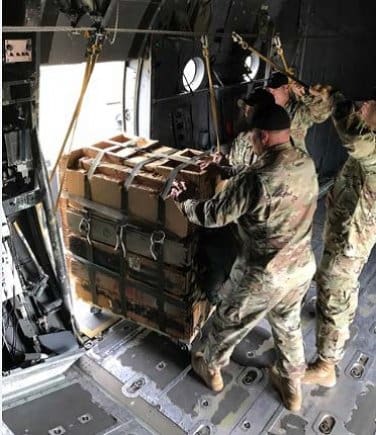
Paratroopers from the U.S. Army Advanced Airborne School develop Techniques Tactic and Procedures prior to testing with the U.S. Army Operational Test Command’s Airborne and Special Operations Test Directorate. (Photo Credit: Mr. Michael A. Zigmond, Airborne and Special Operations Test Directorate, U.S. Army Operational Test Command Public Affairs.)
With the Fort Bragg-based U.S. Army Operational Test Command’s (USAOTC) Airborne and Special Operations Test Directorate (ABNSOTD), they successfully rigged, dropped, and recovered the CAADS door bundles during operational testing on Sicily Drop Zone.
The 82nd Airborne Division is part of the XVIII Airborne Corps, and is the Army’s most strategically mobile division.

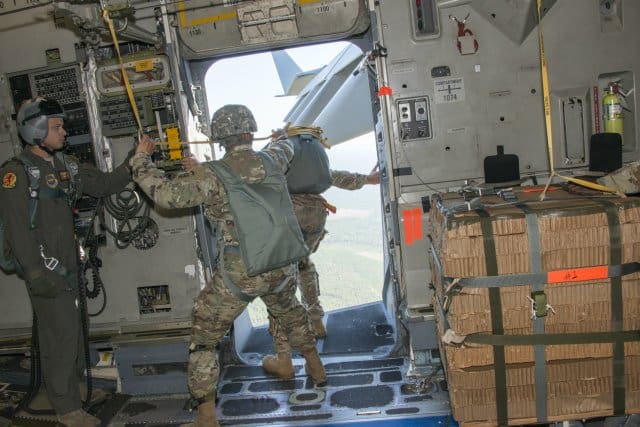
Capt. Matthew P. Carstensen, (right) Commander, Headquarters & Headquarters Co. 2nd Battalion, 505th Parachute Infantry Regiment, 3rd Brigade Combat Team, conducts a door check prior to exiting the first Caster Assisted A-Series Delivery System from a U.S. Air Force C-17 aircraft. (Photo Credit: Mr. Michael A. Zigmond, Airborne and Special Operations Test Directorate, U.S. Army Operational Test Command Public Affairs.)
82nd Airborne Division Commander, Maj. Gen. Erik Kurilla, said, “The 82nd Airborne Division is the elite Airborne infantry division of the United States Army, specializing in parachute assault operations into denied areas.”
Kurilla wants to be able to deploy three CAADS door bundles per paratroop door. Bundles can weigh up to 500 pounds of cargo and be airdropped from a variety of Department of Defense (DoD) transport aircraft to support the Global Response Force.

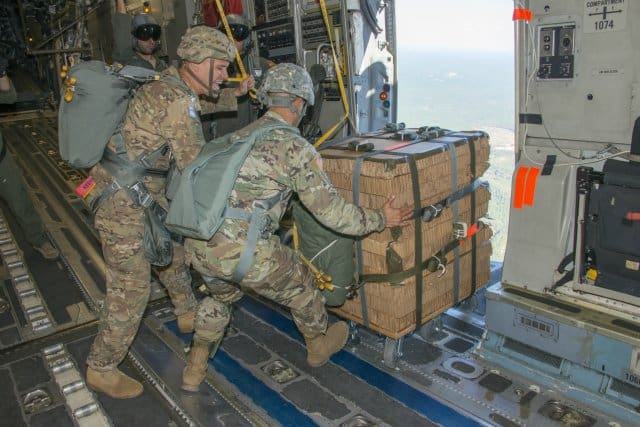
Sgt. 1st Class Miguel A. Amadis of Company A, 2nd Battalion, 325th Airborne Infantry Regiment, 2nd Brigade Combat Team, positions the Caster Assisted A-Series Delivery System in the door of a U.S. Air Force C-17 aircraft before deployment onto Sicily Drop Zone. (Photo Credit: Mr. Michael A. Zigmond, Airborne and Special Operations Test Directorate, U.S. Army Operational Test Command Public Affairs.)
The current door bundle limit without CAADS is two bundles per door per pass.
Currently, there is no standardized aerial delivery system in the Department of Defense (DoD) inventory that employs the dolly-assisted method, but other countries like France employ a similar system.
CAADS is a platform built of plywood, a brake, and six caster wheels which allow the door bundle to roll across the aircraft floor, speeding airdrop deployment.
Testing demonstrated safe deployment of door bundles using CAADS to improve the ability of Soldiers deploying the bundles while reducing exit time. The increased speed allows for additional bundles per pass.
The efficiency of the CAADS concept provides the capability of exiting more door bundles per pass, per aircraft — all increasing the amount of supplies on the ground to the paratroopers during their critical 12 hour initial entry phase.
Sgt. 1st Class Miguel A. Amadis of Company A, 2nd Battalion, 325th Airborne Infantry Regiment, 2nd Brigade Combat Team said, “I like the CAADS a lot. It was easy to push, easy to set up at the door, and it will be very useful for the upcoming missions.”
One Airborne unit commander said he liked CAADS’ simplistic design and concept, which can seriously lessen the physical wear and tear on the average paratrooper.
“The castor’s one free axle made the rotation into the door easy, but still kept two axles locked, which maintained control as the container exited the door and entered the slip stream,” said Capt. Matthew P. Carstensen, Commander, Headquarters and Headquarters Company, 2nd Battalion, 505th Parachute Infantry Regiment, 3rd Brigade Combat Team.
“I felt that the concern of jarring the container in the doorway was safely mitigated by those locked axles,” he added. “Looking at future application, a container of this size and capacity can significantly increase the combat power and lethality delivered onto a hostile drop zone on the first pass.”
According to Sgt. 1st Class Martin L. Ross, ABNSOTD Test NCO, operational testing is OTC’s opportunity to contribute to Army readiness.
“Anything less compromises the Army’s ability to provide the forces that fight and win the Nation’s wars,” he said.
“Operational testing is about Soldiers,” said Col. Bradley F. Mock, Director of the ABNSOTD. “It is about making sure that the systems developed are effective in a Soldier’s hands and suitable for the environments in which Soldiers train and fight. Operational testing is OTCs opportunity to contribute to readiness; anything less compromises the Army’s ability to provide the forces that fight and win the Nation’s wars.”
The ABNSOTD Test Division chief explained how test units incorporate systems under test into their actual missions and training requirements.
“Leaders of units involved in testing have the first look at new systems, which may also drive changes to operations and doctrine,” said Lt. Col. Gregory Oquendo. “Tests are unit-led, which translates into coordinated control under realistic operational environment scenarios.”
Other tests underway at ABNSOTD include the Advanced Medium Mobile Power Sources (AMMPS) 30K generator which will replace the relatively short-lived TQG (Tactical Quiet Generator) program and airdrop certification of the Light Armored Vehicle (LAV-25A2) Mobile Protective Firepower (MPF). Highly-instrumented test drops by Airborne and Special Operations Test Directorate (ABNSOTD) will help test overall airdrop survivability of the vehicles.
By Mr. James (J.C.) Cochran, Military Test Plans Analyst, Airborne and Special Operations Test Directorate, U.S. Army Operational Test Command Public Affairs.
Gunfighter Moment – John “Chappy” Chapman
Saturday, February 24th, 2018We’ve all seen the endless talk on social media this week about the issues spinning off the cowardly scumbag’s rampage in Florida. We seem to be spending a lot of time yelling at people who agree with us, on everything from gun control, mental heath and anti-depressants, Trump’s waffling on the 2nd Amendment, to former Deputy Scot Peterson’s refusal to close with and destroy the enemy. While the vomiting of emotion is certainly understandable, especially given that our culture now seems to encourage our belief that others should care what we think, it doesn’t accomplish a damn thing.
The only thing you can control is you. The way we solve this problem, other than letting it burn itself out or waiting for the next big problem to divert our controversy-addicted brains, is for each of us to get our own house in order. I’d suggest, as a starting point, taking two simple steps: get your mind right, and improve your skills.
These are two steps you can take right now, today, that you have complete control over. Not only that, but these are the two areas that directly effect your ability to protect yourself and / or fulfill your oath, and no one else can do them for you.
If you’re not already doing so, take some of that social media time and invest it in dry fire, flow drills, range or shoothouse time, or talking to your wife about what to do if you’re killed. Maybe a little time understanding your own weaknesses, whether physical, mental or emotional, and dealing with them head on, would be in order.
Let the politicians argue, the internet trolls participate in meme on meme violence, and the weak complain that others should be “doing something”. Now is not the time for weakness or navel-gazing. Now is the time to get ready for your turn at bat.
You’re the only one in control of you, so focus on that. We may all be counting on you some day.
Stout Hearts
Chappy
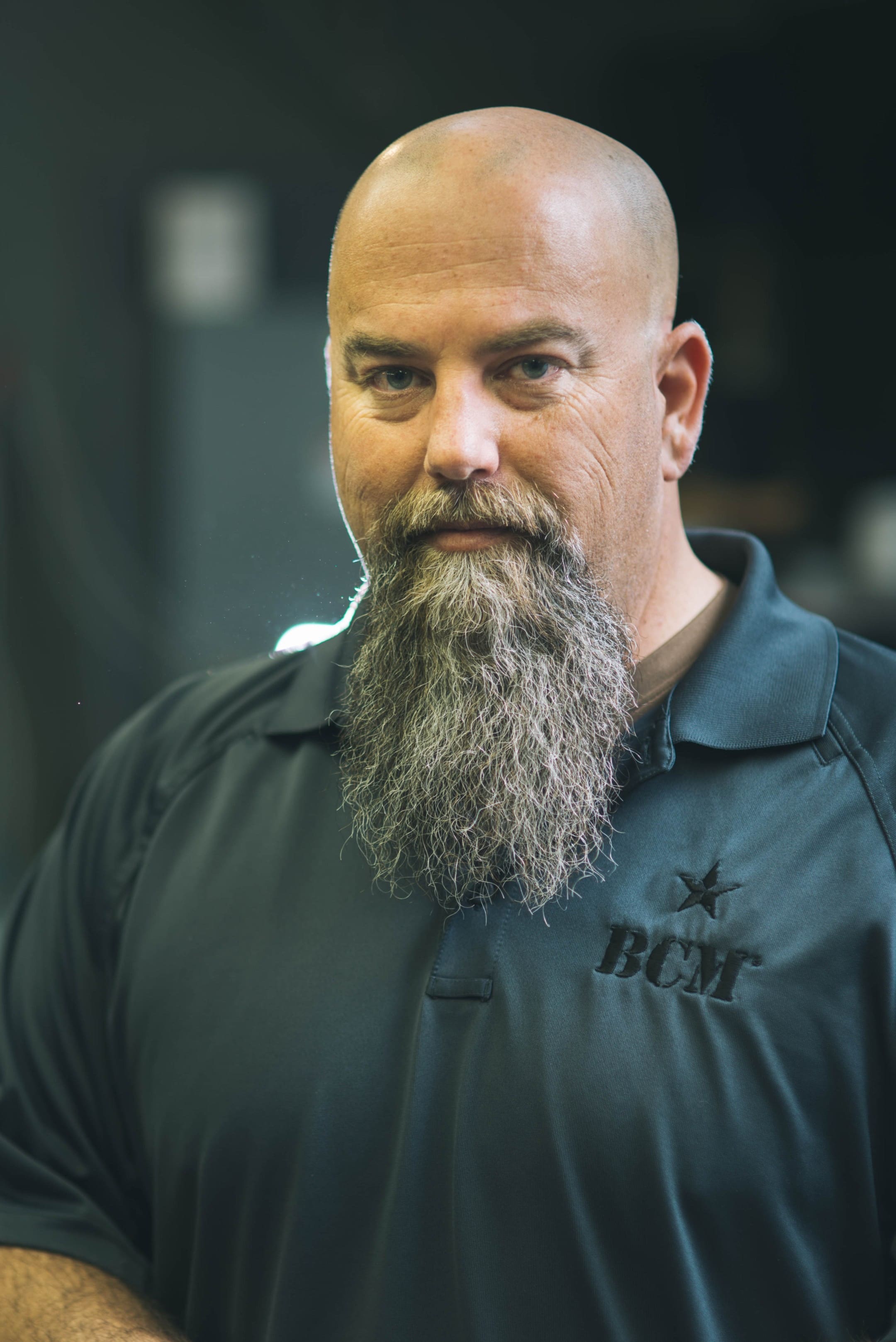
John Chapman is a founding partner of Forge Tactical, a full service training firm that focuses on procedural training for law enforcement and responsibly armed citizens. An instructor at EAG Tactical under the mentorship of BCM Gunfighter Pat Rogers for many years, John has been teaching firearms and tactics since 1994.
In the past, John has worked as a private security contractor, servicing training and physical security contracts in the public and private sector, both domestically and internationally. Mr Chapman is also a former police Lieutenant, and a currently serves as a team leader on a SWAT team in the Midwest.
Gunfighter Moment is a feature brought to you by Bravo Company USA. Bravo Company is home of the Gunfighters, and they bring us a different trainer to offer some words of wisdom.
Greyhive Snapshot – Drew Estell
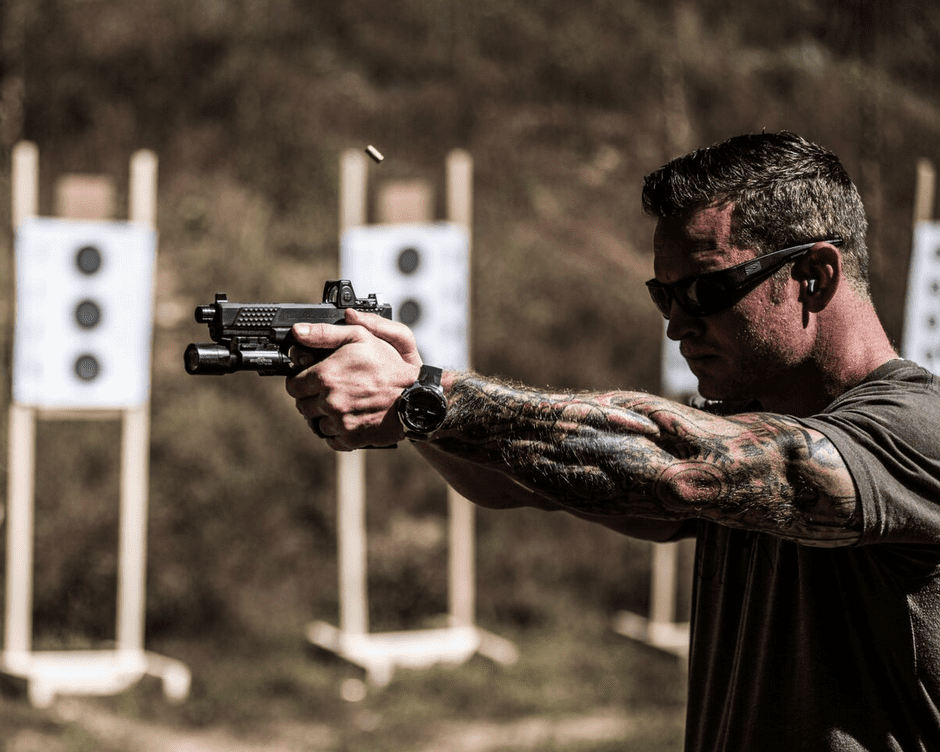
Saturday, February 24th, 2018How do we properly scan? We’ve all the seen people on the range that keep their eyes in their sights and move their weapon from left to right as a habit. While it looks good and they are checking the block on performing this critical task, sometimes those people aren’t actually identifying anything and are setting themselves up for failure.
If you keep your eyes in your sight while scanning, you are limiting yourself to what is within that toilet paper tube sized housing. With some sights, this is even smaller. As much as we train to go into broad target focus with the sight in line with our eyes, having it there will inevitably pull you back into what’s only visible from that housing. On top of this, red dot is already on your target.
We put our sights on target thousands of times and pull the trigger. Do you think anything will be different when you have to discriminate between a threat and a non-threat? Your brain has been wired to see a red dot or sights on target and pull the trigger. How about when other good guys have a weapon like a police officer responding to a call? Give yourself the time and space necessary to properly identify those around you in an actual situation. By lowering the weapon slightly so that the sights are not immediately visible and on your target, you are creating the amount of time and space necessary for your brain to identify the target, and potentially tell your firing hand not to pull the trigger if needed. I would want that split second extra to determine if what was in the suspect’s hand was a cell phone, an unidentified person holding a badge, or the shape in the middle of the night was actually my wife who accidently tripped over my gym bag while she was checking on the kiddo. There’s a lot of situations that this could be important, I’m sure you can think of several and add it to the comments below.
A good rule of thumb with a rifle is to be able to turn your chin over your buttstock. With a pistol, lower the gun down to your upper chest or break it back enough to be able to see the torso area of those around you. Hands aren’t always above the shoulder line to determine if they have a gun, and badges aren’t always high on the chest to easily see. When you have your weapon pressed out in your line of sight, you are effectively cutting off the majority or the torso that gives us the ability to identify what we need, get a snapshot of the person, and proceed into our “snapshot… hands, aim, shoot” process of target identification.
Scan with your eyes and actually identify the targets to your left and right of your area. ID target, engage until target begins to go down, gun down, eyes lead gun, and snap onto next target if required. Use your eyes to gather information and determine whether or not you will give commands or engage depending on your situation. You can only shoot as fast as you can see, and you can only make decision as fast as you can process information. Don’t limit yourself on either, or set yourself up for failure.
Drew Estell is the owner of BAER Solutions, and served for a decade in Special Operations. He has been fortunate enough to serve with soldiers and instructors who were invested in his success, and as such have benefited from the years of experience that each of them had. During the course of his multiple combat deployments and experiences, he has learned that no shooter is the same.
In addition to weapons training classes, BAER Solutions offers leadership and team building consultations. BAER Solutions also works with police departments to take lessons learned from SOF deployments and apply them to the specific needs of the local governance and populace. By combining SOF tenets of Village Stability Operations and the concept of Community Policing, they deliver a consulting and training package called Unconventional Policing.
For more information this topic, create your free account at Greyhive and subscribe to our YouTube channel to watch the pistol ready position videos demonstrating this.
Snapshot is a bi-weekly series from Greyhive featuring content written by our Experts. It is our goal to deliver information that prompts you to examine your preparedness from all angles, not just how quickly and accurately you shoot.
Soldiers confidently prepared for winter warfare after cold weather course
Thursday, February 22nd, 2018FORT MCCOY, Wis. — Twenty-five Soldiers came to Fort McCoy to learn how to survive and operate in a winter environment as students in a cold weather operations class during the first two weeks of January.

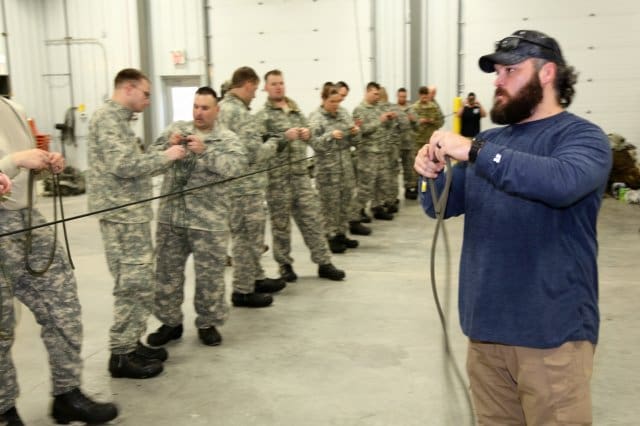
Soldiers who are students in the Fort McCoy Cold-Weather Operations Course learn about specialized knot-tying as part of course training Jan. 10, 2018, at Fort McCoy, Wis. (Photo Credit: U.S. Army photo by Scott Sturkol)
“This course gave me confidence,” said Staff Sgt. Joseph Chrysler with the 339th Psychological Operations Company of Arden Hills, Minnestoa, after completing Cold-Weather Operations Course Class 18-02. “It gave me confidence in my cold-weather clothing and gear and helped me (rebuild) skills that are not used every day in today’s Army … Also, some of the best parts of this course were learning to build a thermal shelter and (bivouacking) overnight in the elements.”
The course, also known as CWOC, is modeled on the Cold-Weather Leader Course taught by the Army Northern Warfare Training Center at Black Rapids, Alaska, said course instructor Bill Hamilton.
Hamilton said the course is designed to challenge students. “Our program of instruction includes overnight operations in the field,” he said. “We teach them a finite set of individual, leader, and small-unit collective tasks within a structured ‘crawl, walk, and run’ methodology.”

Instructor Hunter Heard with the Fort McCoy Cold-Weather Operations Course teaches Soldiers who are course students about specialized knot-tying as part of course training Jan. 10, 2018, at Fort McCoy, Wis. (Photo Credit: U.S. Army photo by Scott Sturkol)
Tasks taught include cold-weather injury identification and treatment, proper ways to wear cold weather clothing, cold weather risk management, snowshoeing and skiing, and adverse effects of cold weather on military equipment, Hamilton said.
Training also includes developing winter fighting positions in the field, camouflage and concealment, building improvised shelters, and numerous other areas that are important to know in order to survive and operate in a cold weather environment.
“We start off with classroom training for a few days and then it’s training in the field every day until we’re done,” Hamilton said. “In the field, the students spend time ruck marching for dozens of miles, skiing, snowshoeing, building tents and shelters, and more.”
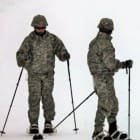
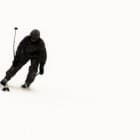
Soldiers who are students in the Fort McCoy Cold-Weather Operations Course learn to ski and about skiing techniques Jan. 11, 2018, at Whitetail Ridge Ski Area at Fort McCoy, Wis. (Photo Credit: U.S. Army photo by Scott Sturkol)
After being exposed to the cold weather in the field, many students said understanding the Army Extreme Cold-Weather Clothing System, or ECWCS, was most helpful. The system, which is issued through the Fort McCoy Central Issue Facility, includes a lightweight undershirt and underwear, midweight shirt and underwear, fleece jacket, wind jacket, soft shell jacket and trousers, extreme cold/wet weather jacket and trousers, and extreme cold weather parka and trousers.
“You have to have confidence in your gear … It’s how you stay alive in extreme conditions,” said Staff Sgt. Anthony Steinhoff, who with the Wisconsin National Guard in Richland Center, Wisconsin. “In this course, they teach you how to properly dress for the cold.”
“Practical, hands-on application of using equipment seems to be one of the best ways for students to get familiar with the equipment needed to survive in cold weather,” Hamilton said.
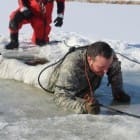
Toward the end of the course, all students participated in cold water immersion training. Joe Ernst, also a CWOC instructor, said cold water immersion is critical to the ability to survive and operate in a cold weather environment.
“The experience of a service member being introduced to water in an extreme cold environment is a crucial task for waterborne operations and confidence building,” Ernst said. “For a person to fall into water in that environment, the onset of panic generally introduces itself quickly. For our service members who will be operating in an extreme cold environment, it is a task that, if not trained for, can produce unnecessary casualties.”
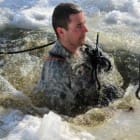
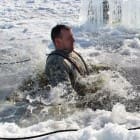
A Soldier participates in cold water immersion training at an ice-covered Big Sandy Lake as part of training for the Cold-Weather Operations Course 18-02 on Jan. 17, 2018, at Fort McCoy, Wis. (Photo Credit: U.S. Army photo by Scott Sturkol)
“The best parts of this course was learning to build an improvised shelter and the cold water immersion,” said Sgt. Hunter Carlson with the Wisconsin National Guard’s 1158th Transportation Company at Beloit, Wisconsin. “I didn’t enjoy doing either of them, but I realize how important learning those skills are and being able to use them.”
Army ROTC Cadet Molly Brown with the University of Wisconsin-La Crosse said she appreciated all of the training.
“Everything you need to know to succeed in (cold weather) is taught in this course,” Brown said. “This course significantly prepared me and taught me the skills needed to (operate) and survive in a cold weather environment.”
By Scott Sturkol and originally published at Army.mil.
The Baldwin Articles – Fort Benning Trip Report
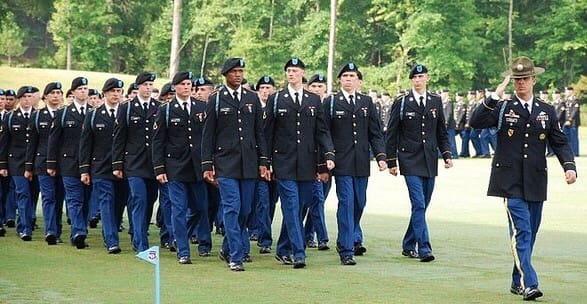
Sunday, February 11th, 2018I had the opportunity to spend a few days this last week at Fort Benning, Georgia. It is now the U.S. Army’s Maneuver Center but has been known as “The Home of the Infantry” even longer. I went ostensibly because of my Nephew’s graduation from Infantry One Station Unit Training (OSUT). However, I traveled early specifically because I had additional objectives in mind. It was a perfect excuse for me to at least briefly observe training first hand and engage some of the training cadre. My time was short so my impressions below are admittedly not scientific or comprehensive. Still, I spent a great part of my professional career quickly assessing the capabilities and status of individuals and units. Therefore, I have reasonably strong confidence in the accuracy of these snapshot assessments. While there, I met with OSUT Drill Sergeants, Officer Candidate School (OCS) Tactical Officers (TACs) and even members of the 1st SFAB.

I will start by enthusiastically and shamelessly plugging the National Infantry Museum (NIM) that is located just outside one of the Post’s gates just off Victory Drive. I actually visited the NIM twice. The first time by myself and the second time with my Nephew and his family. It is an impressive and ultra-modern historical facility and is open and free to the public. There is everything one would expect from a museum focused on the Infantry. Like small arms and support weapons displays – including never fielded experimental items – broken down by era. Likewise, uniforms and field gear. Touch screens accompany many displays and provide background and context on the history of the individual exhibits. For those that appreciate the art of scale modeling, as I do, there are a number of examples displayed throughout the museum including several impressive professionally built dioramas of battle scenes. If I had more time, I would have gone through a couple more times. The NIM alone is worth the side trip if you happen to be in the area.
On my second visit to the NIM, I had one of my better Forrest Gump moments. That is I was in the right place at the right time. By sheer coincidence, it happened that the 1st SFAB had their official activation ceremony on the parade field behind the museum mid-day on Thursday. I cannot tell you who was in the reviewing stand on the far side of the field or who spoke at the ceremony. I observed the event from the second level observation windows of the NIM. I had a great view – but no sound! Two things stuck out immediately about the unit formation. First, as to be expected, it is much smaller than a standard modern maneuver Brigade. Second, it is a combined arms and multifunctional organization. There were infantry, artillery, engineer, combat support and combat service support company guidons on display.
SSD has already reported on their revised beret color. In person, it is dark brown as the pic he posted most recently showed. No mistaking it for the SF green or Ranger tan berets. Likewise, the revised patch is more distinct than the earlier version. I talked in passing to a handful of the younger SFAB NCOs after the ceremony. They were all combat vets – as were most of the NCOs and Officers I saw from the unit. Not to say there were not some without combat patches, but they were few in number compared to those with combat experience. To a man, they were eager to get on with their upcoming deployment. In short, they seemed sharp, disciplined, motivated and ready to take on their mission. As I have said on this site before, I have concerns about meeting their long-term personnel sustainment needs or if the Army can find enough talent to stand up six SFABs total. However, I do believe the mission is valid and, based on everything I have seen and read, I am convinced this first unit is well prepared to tackle this critical assignment.
I had hoped to spend some quality time with the Black Hats at Airborne School but had only limited success. I observed training for the students in ground week for a couple of hours. Specifically the aircraft exit drills on the 34’ Towers. Not much has changed in this phase of the school since WWII or when I went through decades ago. No surprise, the mechanics of jumping out of a fixed wing aircraft in flight or the physics of how a parachute canopy functions have not really needed to evolve much over the years. Consequently, although the students were wearing ACHs rather than steel pots or camouflaged ACUs rather than OD green fatigues, the drills looked exactly the same. The tempo of the drills and the student to instructor ratio was such that I did not get to talk with the Black Hats there. They were simply too busy for me to feel comfortable interrupting their rhythm. I had intended to go out to Fryar Drop Zone on Wednesday. The Cadre Drop Zone Safeties usually have down time between aircraft sorties and I knew that was my best opportunity. However, it drizzled rain all that day and I unfortunately did not have the option of rescheduling.
I did get to spend two early mornings with the TACs at OCS during their 0545 PT sessions. It was my first formal exposure to some of the newer PT techniques that the Army is transitioning towards. For old timers, the most obvious difference is that PT is a lot quieter than it used to be. Not any “in cadence…exercise” involved in the new system. There were still traditional pushups as well as a number of variations, pullups, dips, fireman’s carries and tire rolls. In short, it was not as exotic or unfamiliar as I might have expected. In fact, it just looked a lot more like the small team / individualized PT I had seen and practiced for years in SF units. Of course that means it was quite different from the centralized and regimented system I had experienced in line infantry units way back when. I do not know if this system will ultimately result in better overall physical conditioning. I do suspect that it will generate fewer long-term joint issues than the old system routinely produced. In any case, by the end of those hour plus drills I observed, it seemed obvious that the OCS Candidates were getting a good workout.
I, of course, spoke to my Nephew quite a bit about his experiences in OSUT. I also talked to a number of his compadres. They were all sharp, disciplined, respectful, and showed appropriate pride in their uniforms – as one would expect of newly minted infantrymen. It would be fair to say that they seemed a hell of a lot more professional than my peers and I were at the same point in 1975. However, since the new guys did not have any real frame of reference, it was the Drill Sergeants that I was most interested in surveying. During the week, I spoke one on one with four different Drills, one from E Co, and three from C Co, 54th Infantry (OSUT). As one would expect, they were an impressive bunch of leaders and trainers. All had CIBs, some with multiple tours, all were airborne and one had his Ranger Tab. They certainly compared favorably with the Vietnam veteran Drill Sergeants that trained me.
I will summarize what we discussed beyond exchanging war stories. They were generally comfortable with the product that they were putting out to the force. They emphasized to me that they had already incorporated portions of the 2016, TC 3-22.9: Rifle and Carbine, during the Basic Rifle Marksmanship (BRM) portion of OSUT. In fact, Drill Sergeants were required to rotate through a formal marksmanship program on post specifically to learn how to train what was in the TC. They saw that as a significant positive and thought as a result that BRM was much improved from just a couple of years ago. Still, we all agreed that the new guys did not really know their ass from a hole in the ground yet – but they had proven to be trainable. However, we also agreed that they were no more clueless than we had all been at their age and level of training.
A generation in the Army is about six years. You can tell because every six years or so some young promotable Sergeant, Staff Sergeant or First Lieutenant will write a letter to the Army Times bemoaning the supposed FACT that today’s entry level soldiers are no longer as well trained, disciplined, patriotic or professional as they were when he or she came in. Of course, the “grizzled veteran” is oblivious to the fact that someone said exactly the same thing about him when he was a cherry soldier. After observing this cycle a few times, it becomes predictable and humorous. Often the alarm is raised because someone saw a ragbag or two at some airport. And, of course, that in turns means all new soldiers are ragbags. If you think an occasional disheveled soldier is a new phenomenon you must not have passed through an airport in the 70s, 80s, 90s or 2000s.
But, the alarmist will say, the standards have obviously been lowered! Standards change all the time. True, not all changes produce the intended results. In that case, standards will be readjusted yet again. Rigidly adhering to the old techniques because that “is how it has always been done” is even more counterproductive and ultimately dysfunctional than experimenting with change. The new PT routine I mentioned above is one example that may or may not be perfectly successful but will likely at least reduce rates of injury over time. But, but…the minimum standards are too low. This argument is entirely subjective so it is a little harder to refute. Most professional soldiers believe in demanding and achieving the highest practical standards – individually and collectively. I do. But do not fall into this trap. You will notice that the guy who can run fast always thinks the minimum run times should be shortened. If he is less confident about his upper body strength, he will argue just as energetically against raising the pushup standards.
Likewise, the guy who readily shoots expert thinks “marksman” is too low a standard. Alternatively, the guy who is already bilingual or learns languages easily always thinks 2/2 should be the minimum entry-level score for SF soldiers. I for one would not have gotten into SF if that had been the minimum standard. Each and every one of us have probably been in a situation where we were eternally grateful that the minimum passing standard was no higher than it was. My observations at Fort Benning led me to conclude that the minimum standards are being strictly enforced and that those new infantrymen, soldiers seeking those silver wings and candidates reaching for a commission are, in fact, doing far better than the minimums.
Let us talk about symbols. Are hats or beret colors important to you? Probably not. Ask any Green Beret and he will tell you that it is not the hat that makes the man and therefore the beret is not that important. He will be sincere when he says that, but just try to take that piece of felt away from him and suddenly it is important. Symbols in the military are significant and powerful. They are magic. But they only have as much magic power as we infuse them with – sometimes even including baptism with the blood of heroes. I thought of that magic as I pinned my Nephew’s infantry blue cord on his ASUs on Thursday morning. Symbols like that cord, or jump wings and jump boots, or tabs, or combat patches can simultaneously mean nothing…and everything.
I personally appreciate the passion that symbols evoke – often manifested in the comments on this site. I was in when GEN(R) Rogers took away the Airborne maroon beret and GEN(R) “Sly” Meyers gave it back a few years later. Paratroopers had complained about the beret until it was no longer authorized – then they wanted it back. Now it would be all but impossible to take it away from them again. GEN(R) Shinseki wanted to harness that symbolic power when he made the decision about issuing the black beret. I respect him and think he was well intentioned. Unfortunately, it has not worked. The Army has never managed to infuse the black beret with any magic. If it went away tomorrow, it is not likely that there would be much of a fight to keep it. However, those kids at OSUT did not know all of that history or drama and seemed genuinely proud to be wearing their berets. As a side note, I admit that I had not noticed before that the generic blue Army flash is a good match in color to that infantry blue cord.
Everyone I observed and talked to at Fort Benning gave me confidence in the future. These young people and their instructors are ably carrying on the traditions of selfless service the American people expect. The Army is sound and the Republic is not in any jeopardy with them – ever vigilant – on the parapets. They are at least as capable and motivated as those that served in my formative years and on par with every generation of soldiers I have served with since. Bottom line, they ARE as well trained, disciplined, patriotic and professional as we “old timers” like to think we were. My Nephew starts Jump School on Monday.
LTC Terry Baldwin, US Army (Ret) served on active duty from 1975-2011 in various Infantry and Special Forces assignments. SSD is blessed to have him as both reader and contributor.
Army Developing Expeditionary Cyber-Electromagnetic Teams to Support Tactical Commanders
Sunday, February 11th, 2018FORT IRWIN, Calif. — U.S. Army Cyber Command is deploying Expeditionary Cyber-Electromagnetic Activities Teams to support tactical commanders at National Training Center rotations, and the CEMA operations have tried to replicate real-world operations support through the cyberspace domain.
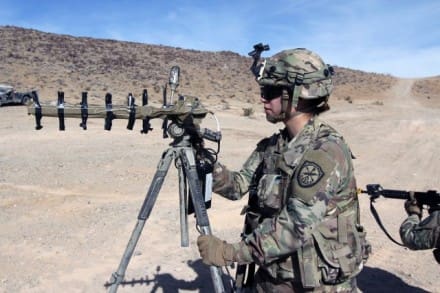
Sgt. Camille Coffey, a cyber operations specialist from the Expeditionary Cyber Support Detachment, 782nd Military Intelligence Battalion (Cyber), from Fort Gordon, Ga., provided offensive cyber operations as part of the Cyber-Electromagnetic Activities (CEMA) Support to Corps and Below (CSCB) program during the 1st Stryker Brigade Combat Team, 4th Infantry Division, National Training Center Rotation 18-03, Jan. 18 – 24, 2018. (Photo Credit: U.S. Army photo by Mr. Steven P Stover (INSCOM))
CEMA is an Army initiative designed to provide tactical commanders with integrated cyberspace operations, Department of Defense Information Network operations, Electronic Attack, Electronic Protection, Electronic Warfare Support, Spectrum Management Operations, Intelligence, and Information Operations support/effects.
According to Maj. Wayne Sanders, the ARCYBER CEMA Support to Corps and Below chief, success for the brigade combat team in the cyberspace domain begins at the D-180 planning conference — 180 days before the unit’s NTC rotation.
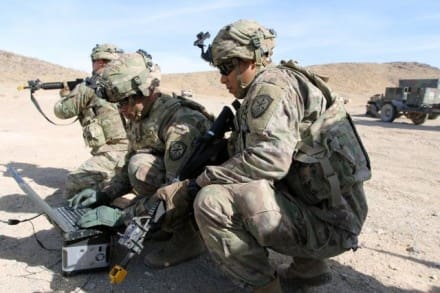
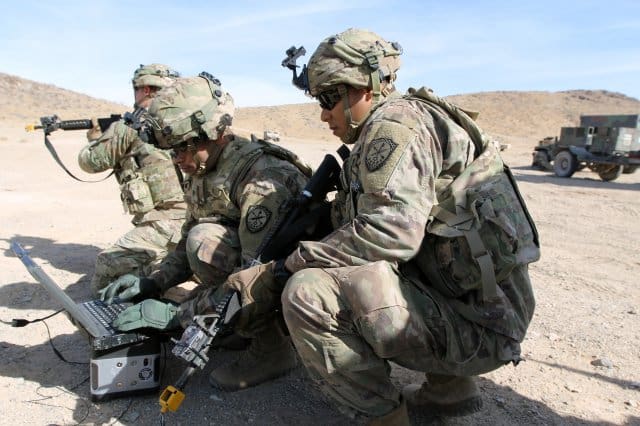
Spc. Victorious Fuqua (at the computer), and Staff Sgt. Isaias Laureano, both cyber operations specialists from the Expeditionary Cyber Support Detachment, 782nd Military Intelligence Battalion (Cyber), from Fort Gordon, Ga., provided offensive cyber operations, while Spc. Mark Osterholt pulled security, during the 1st Stryker Brigade Combat Team, 4th Infantry Division, National Training Center Rotation 18-03, Jan. 18 – 24, 2018. (Photo Credit: U.S. Army photo by Mr. Steven P Stover (INSCOM))
“The biggest thing for the D-180 are the key leader engagements,” said Sanders. “[At those conferences] we can inform the brigade commander about what types of CEMA support we can provide to help him shape conditions for his battle to be able to close with and destroy the enemy.”
Sanders said while he doesn’t foresee BCTs executing their own cyberspace operations organically, he does expect the commander and the staff to have an initial understanding of the CEMA environment and to provide their higher headquarters with a cyber effects request form. He said that if the brigade plans for an expeditionary CEMA capability to be brought out to support their operations correctly “then we can provide that for them.”
“If you’re looking at this from a real-world perspective, if they identify that they are going somewhere in the world — somewhere they would need additional capacity that they may not have coverage for — they can submit that through a CERF, as a request for forces,” said Sanders. “And the beauty of the Expeditionary CEMA Teams is their scalability and reach back.”
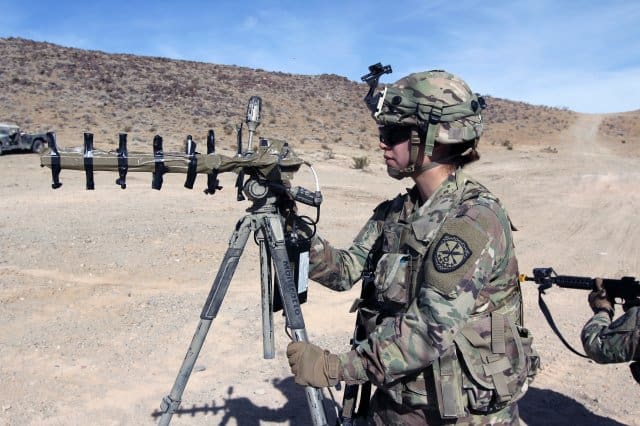
Sgt. Camille Coffey (at the antenna), and Spc. Victorious Fuqua, both cyber operations specialists from the Expeditionary Cyber Support Detachment, 782nd Military Intelligence Battalion (Cyber), from Fort Gordon, Ga., provided offensive cyber operations as part of the Cyber-Electromagnetic Activities (CEMA) Support to Corps and Below (CSCB) program during the 1st Stryker Brigade Combat Team, 4th Infantry Division, National Training Center Rotation 18-03, Jan. 18 – 24, 2018. (Photo Credit: U.S. Army photo by Mr. Steven P Stover (INSCOM))
Sanders explained the ECT concept originated from the Chief of Staff of the Army, who directed the Cyber Support to Corps and Below Pilot in 2015. The pilot tasked ARCYBER to assess the best package of equipment, capability, authorities and personnel to support a BCT.
“That’s why, out of the DOTMLPF-P (Doctrine, Organization, Training, Materiel, Leadership and Education, Personnel, Facilities and Policy) came the need for a force that provides the authorities, the senior and master level expeditionary cyber operators, and a quick turn cyber development capability, that doesn’t exist right now in the Army,” said Sanders. “It provides infrastructure support personnel that can provide the same thing as having people on the ground.”
Sgt. Maj. Jesse Potter, the operations sergeant major for the 780th Military Intelligence Brigade (Cyber), said that although this is the ninth rotation since 2015, it has been an iterative process to best replicate real-world operations, and more is being learned each time a rotation is conducted.
“We’ve learned that we were a very large logistical burden to the rotational training units. We learned our lessons about the CEMA capability that we can provide to a rotational training unit, and at the same time we were reducing the logistical requirement to provide that capability,” said Potter.
“Eventually, we concluded that an expeditionary mindset, based on the commander’s request for cyber effects, is best fitted with a plug and play capability,” he continued. “Meaning, we need to identify the personnel that fit those requirements, ensure the teams are self-sufficient with a reach back capability to reduce the logistical footprint, in both a flyaway kit, light capability, to a more robust sustained operation, whether in a peer or near-peer environment, permissive or non-permissive environment.”
Potter also said another area ARCYBER is looking at was CEMA support at the division and corps levels. “What’s missing, what’s next, are the division and corps level exercises,” he said. “Enabling the education of the commanders [is] through the institutional arm of the Army, which is primarily the mission of the Cyber Center of Excellence. That is what the CCoE is working toward –incorporating CEMA into all aspects of the PME (Professional Military Education).”
“And then for the higher level exercises, just like we’ve done for the NTC rotations, how does the staff enable cyber based effects that supports the commander’s objectives, and what can they gain from having the cyberspace capability that they currently don’t have?” Potter continued. “Because at the same time, that education will benefit the brigade combat teams.”
Furthermore, ARCYBER is not just looking at the development of the ECT structure and incorporating that support at the division and corps levels — the command is also determining the organizational structure to command and control those ECTs.
“Regarding the ECT structure…you have individuals, put together as a team, predominantly from four separate organizations across three MACOMs (Major Commands) — ARCYBER, Intelligence and Security Command, and the Cyber Center of Excellence,” said Potter. “Moving to an organizational structure whereby the ECTs are part of a larger unit as the force structure solution means we no longer have an organization that’s made up of a hodgepodge of people, further exasperating the issues that we have with the rotational training unit.”
Potter and Sanders said that’s where they are now. Organic ECTs, all assigned to the same unit, and subordinate to ARCYBER will provide the Army with an expeditionary CEMA capability.
ARCYBER used the lessons learned from the past nine NTC rotations to determine the optimized force structure they are proposing to the Army to stand up an organization with all those separate elements that were under different commands, to fall under one command with CEMA capabilities tailored to meet the tactical commander’s objectives.
By Mr. Steven P Stover (INSCOM)

Greyhive Snapshot – Ian Strimbeck
Saturday, February 10th, 2018We all have that one friend, or have encountered that one individual, who lacks the intellectual capacity to understand that pressing the trigger is just one tiny aspect of owning a gun. When it comes to handguns, how often do most of us drive the gun out to extension every time we go to the range? How many of us think about how often we’re in close quarters with multiple individuals on a day to day basis? The length of extension of our pistol correlates directly to the proximity of the threat we’re dealing with. To solidify the idea in our head that we’ll always have enough distance between our pistol and the threat is not only foolish but reckless as well.
Criminals don’t care about how you train or your range safety protocols. All they care about is completing their mission, whether that be taking your wallet or your life for that matter. Most criminal assaults occur after an ambush and the victim ends up “locking up” in a standing entanglement with the assailant. But the victim can just go for his gun now right? Wrong. That would be a recipe for failure. But why? Can’t I just shove the guy with my off hand and pull my gun out like Wyatt Earp? This is what I commonly see being thought of as a quality method for retention based shooting. Usually it’s because of the misinformation out there from social media entertainers. A rubber dummy or cardboard target doesn’t fight back. It doesn’t give pressure back. It doesn’t have limbs that will attempt to strip your gun away. And it definitely doesn’t have a will to continue the fight after you’ve already given up on yourself.
At the end of the day, think realistically as to how to approach the way you train. Steer clear of attempting to copy uncontextualized methods of entangled handgun employment. Get to a quality class that utilizes pressure based training to truly test the skills. It will be anything but easy, but to truly grow your skillset you must constantly put yourself in places of conflict.
Ian Strimbeck is a United States Marine Corps veteran and founder of Runenation LLC. Runenation is a consulting and education company specializing in the constant growth of the multidisciplinary tactician. Too often in the “gun world,” you see individuals who are drawn to a singular tool in lieu of looking at the bigger picture. It isn’t solely about the gun, blade, grappling, striking, medical, fitness, or verbal acuity. It’s a constantly evolving skillset that you put a varying amount of effort into throughout your life. Like the rings on a tree trunk , it will grow as long as you put in the necessary effort.
Snapshot is a bi-weekly series from Greyhive featuring content written by our Experts. It is our goal to deliver information that prompts you to examine your preparedness from all angles, not just how quickly and accurately you shoot.