TYR Tactical

Archive for the ‘Guest Post’ Category

Dunnagan Global Armor Strategies, LLC Is Open For Business

Friday, March 20th, 2026

Dunnagan Global Armor Strategies, LLC is proud to announce its official launch.

We are a defense-market advisory firm focused on the global commercialization of advanced armor and personal protection technologies. Our work centers on helping innovators expand into international defense markets through targeted sales strategy, market development, and competitive positioning across allied nations.
We partner with manufacturers, integrators, and technology developers to ensure their protection solutions reach the programs, procurement channels, and end-users where they can make the greatest impact.

For inquiries, collaboration opportunities, or support entering new defense markets, we welcome you to connect with us.

Email Todd@dunnaganglobal.com.

From Silk to Systems — How a 19th Century Textile Mill Became a Global Leader in Modern Protection

Friday, March 20th, 2026

What do silk threads and next-generation combat helmets have in common?

The answer starts in 1894, inside a small Pennsylvania silk mill that would eventually become one of the most influential protective equipment manufacturers in the world.

Gentex Corporation began as the Klots Throwing Company, producing silk fibers for different use cases. After a devastating factory fire, the company relocated to Carbondale, Pennsylvania — a move that set the stage for more than a century of reinvention.

During World War I, then operating as General Silk, the company became one of the world’s largest processors of silk, manufacturing cartridge bags for the U.S. military. In World War II, it pivoted again, producing cargo parachutes and protective containers, and experimenting with early composite materials that would shape its future.

In 1948, leveraging those materials innovations, the company produced its first hard-shell pilot helmet for the U.S. Navy. That moment marked a defining shift from textiles to protection systems. By 1958, the company adopted the name Gentex and began building what would become a global portfolio of advanced helmet systems.

Over the decades, Gentex has helped transform the helmet from simple head protection into an integrated platform for situational awareness, combining communications, vision systems, respiratory protection, acoustics, optics, and advanced materials into mission-critical equipment used by military forces, emergency responders, and industrial professionals worldwide.

Today, the company’s products support global defense forces and aerospace programs, including advanced aircrew helmet systems and integrated soldier protection platforms, all engineered from the same Pennsylvania roots.

Why this story matters now

At a time when supply chains, domestic manufacturing, and defense innovation are under renewed scrutiny, Gentex represents a rare example of continuous American manufacturing evolution, a company that has reinvented itself across two world wars, the jet age, the space era, and today’s multi-domain battlefield.

From silk fibers to next-generation protective systems, it’s a 130-year story of material science, military partnership, and industrial resilience.

Learn more at Gentexcorp.com

FirstSpear Friday Focus: General Purpose Pockets: Small, Medium, & Large

Friday, March 20th, 2026

FirstSpear’s SMALL, MEDIUM, & LARGE GENERAL PURPOSE POCKETS deliver durable, mission-ready storage designed to organize essential equipment without adding unnecessary bulk. Available in three sizes, these pouches provide scalable capacity to support a wide range of operational requirements. Each pocket integrates seamlessly using FirstSpear’s 6/9 and 6/12 attachment technologies for secure mounting on plate carriers, chest rigs, and packs. Built from rugged materials and manufactured in the USA, our General Purpose Pockets are engineered for demanding military and law enforcement environments.

The GENERAL PURPOSE POCKET, SMALL offers a compact storage solution ideal for items such as cell phones, GPS units, or other small mission-essential tools. Its streamlined footprint maintains a low profile while providing rapid access through a durable dual-zipper closure.

The GENERAL PURPOSE POCKET, MEDIUM increases carrying capacity while maintaining a flat, efficient design. Internal elastic retention and loop-lined pockets allow users to organize gear and keep critical items secure and accessible. A dual-zipper closure with an integrated G-Hook provides additional retention when required.

The GENERAL PURPOSE POCKET, LARGE provides maximum storage in the series and is built to manage larger equipment or multiple items. Internal organization, including a zippered mesh compartment, improves visibility and equipment management in the field. Dual-zipper access and a G-Hook closure ensure gear stays secure during movement.

Choose the size that fits your mission and upgrade your kit with reliable, purpose-built storage today at First-Spear.com.

To request an estimate click image above or visit First-Spear.com/Request-For-Estimate. FirstSpear is the premier source for cutting-edge tactical gear for military, law enforcement and those who train. For more information visit First-Spear.com.

Senior Special Warfare Leaders Highlight Community’s Capabilities, Define Its Challenges

Friday, March 20th, 2026

The principal civilian advisor to the U.S. secretary of war for all matters related to special operations forces and the most senior military SOF leader provided testimony at a House Armed Services Committee hearing on Capitol Hill today on the SOF community’s capabilities and challenges it faces ahead.

During the hearing, Derrick M. Anderson, assistant secretary of war for special operations and low-intensity conflict, and Navy Adm. Frank M. Bradley, head of U.S. Special Operations Command, explained how special operations forces are successfully countering U.S. adversaries overseas while comprising just 3% of the joint force and 2% of the War Department’s budget.  

“Today’s environment rewards forces that can operate persistently and decisively, often below the threshold of armed conflict, generating irregular effects by, through and with our allies and partners in order to produce a whole effect that is much greater than the sum of its parts — your special operations forces provide that capability,” Bradley explained during his remarks. 

As an example of this, Anderson pointed out that every major U.S. military operation has a SOF component to it. 

“From the Western Hemisphere, across the Indo-Pacific, to the Middle East, Africa, Europe and beyond, SOF has been decisive in defending the homeland, deterring China and enabling our partners and allies,” Anderson said. 

Bradley concurred with that statement, adding that the mission is not accomplished by technology and equipment alone. 

“[Rather,] it is executed by the most decisive advantage that we have: our people,” he said. 

Bradley added that the SOF community is strong and getting stronger, empowered by a culture of meritocracy and supported by programs committed to the preservation of SOF personnel and their families.  

During testimony, both leaders explained how building strong partnerships — both between the SOF community and the branches of the joint force and partners and allies around the world — are key to SOF success. 

“When we talk about the military department-to-department relationships, Adm. Bradley and I are 100% working with the other departments not only to give our lessons learned to the Army, the Navy [and] the Air Force, so that their acquisition processes get better, but to learn where [SOF] can get better,” Anderson told committee members. 

Bradley said there are presently 6,500 U.S. SOF operators and enablers deployed in about 80 different countries working to build, maintain and sustain generational partnerships and relationships.

He further explained that such relationships are key to countering influence operations that our adversaries are conducting to prey upon our allies and partners with malign behavior designed to gain unwarned access and leverage over them. 

“Our ability to illuminate that malign behavior, and then to pass it and make our partners aware of it — many times through diplomatic channels, but sometimes directly, mil[itary]-to-mil[itary], security service-to-security service — is a critical way to be able to help undermine our adversaries’ actions [overseas],” Bradley said. 

When asked about the top three challenges Socom currently faces this fiscal year, Bradley said that the ability to project force into increasingly contested environment, where our adversaries pose threats to the U.S., is at the top of the list. 

“Our first priority is always to maintain readiness for the current threats that are out there. Crisis response is that top priority for us being able to respond agilely to wherever [the crisis] might present,” Bradley said, adding that demands for SOF crisis response have increased 300% over the last five years. 

The second challenge, he said, is to take advantage of the cyber and virtual domain, which he said are critical maneuver spaces. 

“Another aspect of the rapidly evolving, changing character of warfare is the emergence of abundant, lethal autonomy. And yes, that is a threat that we will have to contend with, but it’s also one we can leverage,” Bradley said. 

“And finally … our people must continue to be our foundation, ensuring they are trained, ready, supported and educated for the future,” he said of the third challenge Socom is most focused on this year. 

Looking ahead, Anderson and Bradley said that SOF’s transformation and modernization are key to future success. 

“SOF needs sustained partnership, predictable resourcing and continued modernization,” Anderson told the committee, adding that congressional support of the SOF community is greatly appreciated. 

“SOF was purpose built for this era of competition, and we can provide an instant, indispensable asymmetric advantage for the joint force and the nation,” Bradley told the committee.

“And with your continued support, we will meet today’s missions while transforming to ensure that we are ready for the challenges of tomorrow,” he added.  

Watch the video of the testimony here.

By Matthew Olay, Pentagon News

A Legacy Cemented: 91st Civil Affairs’ Fox Company Stands Down

Thursday, March 19th, 2026

FORT BRAGG, N.C. – With a final roll in front of family, friends and alumni, the guidon of Fox Company, 91st Civil Affairs Battalion, 3rd Special Forces Group (Airborne), was cased on March 6. This marked the formal inactivation of a unit whose work was pivotal to U.S. Army missions across Africa, the Middle East and the Indo-Pacific.

The ceremony, steeped in military tradition, symbolized the end of the company’s mission as part of a broader transformation within U.S. Army Special Operations.

The strategic realignment is designed to maximize adaptability to the complex and evolving security environments across Africa, the Indo-Pacific and the Middle East, where Fox Company’s Soldiers have been continuously deployed for the past 15 years.

While the unit’s guidon will no longer fly, the missions it supported are ongoing. The inactivation is not an end, but a transformation, with the company’s operational lineage and its Soldiers being integrated into Special Operations restructure.

“From day one, the mission was clear and the tempo was high. Fox Company didn’t just meet the standard; it set the standard. By 2012 its Soldiers were spread across a vast expense of Trans-Sahara, from Somalia to Nigeria,” said U.S. Army Maj. Kristopher Levy, the 91st Civil Affairs Battalion executive officer and former Fox company commander, as he reflected on the unit’s history. “The following year they were in the mountains of Afghanistan.”

Operating in environments where trust is the ultimate currency, Civil Affairs Soldiers from Fox Company served as the essential link between military commanders and the civilian populations around them. Their primary role was simple; understand and engage the human terrain. This included advising local and national leaders on governance, facilitating humanitarian assistance, and coordinating with non-governmental organizations to support regional stability.

“To the Soldiers of the 91st, this is a moment not just to remember Fox Company’s history, but the immense responsibility entrusted to all of us as you witness constant change in the world and challenges on the horizon. We are reminded of a stark truth that we do not choose the time or place of the next call,” said U.S. Army Lt. Col. Micheal Veglucci, commander of the 91st Civil Affairs Battalion, as he addressed the Soldiers and alumni of Fox Company. “It is for this reason that we must remain ready, professional, prepared, and deeply committed to the mission.”

These Soldiers worked alongside U.S. forces, partner forces, allies, and local leaders, often in remote and austere locations. Civil Affairs Soldiers help villages secure a clean water source, advise local officials on public services, or simply building rapport with community elders. Their efforts were critical to mitigating conflict and fostering long-term security. This work behind the scenes was fundamental to creating the conditions necessary for broader mission success, helping to counter malign influence and deny sanctuary to extremist organizations.

For the Soldiers attending the ceremony, it was a moment of reflection.

“It’s true, Fox Company was established in October 2010, however the official history fails to mention how the company was initially a collection of freshly minted Civil Affairs NCOs and officers straight out of the qualification course mixed with groups from other organizations,” said Retired Command Sgt. Maj. Angelo Gutierrez.

Although their company is now part of history, the skills of the Soldiers of Fox Company remain in high demand. The Fox Company Soldiers will be reassigned, bringing their invaluable experience and regional expertise to other Special Operations units supporting U.S. Africa Command, U.S. Pacific Command and U.S. Central Command.

As the guidon is cased, it marks the conclusion of a long chapter of Civil Affairs history. Yet, the legacy of Fox Company remains etched in the strengthened partnerships and stabilized communities it left behind, a testament to the quiet professionals who lived up to their commander’s charge.

Fox Company’s guidon may be rolled up and stored away, but to those who served under it, one thing remains, the essence of the 91st Civil Affairs Battalion and its never-ending legacy.

Story by SGT Lee Heaton 

3rd Special Forces Group (Airborne)

Soldiers Assist Air Force Squadron With Drone Warfare Training

Wednesday, March 18th, 2026

More than 200 airmen training with the Air Force’s 368th Training Squadron spent Feb. 27 at Fort Leonard Wood, Missouri, learning about unmanned aerial systems during an exercise designed to cultivate Air Force airmindedness and the warrior ethos.

The training squadron, based at Fort Leonard Wood, provides initial skills and advanced level training in the areas of ground transportation, engineering, emergency management and pavements and construction equipment.

According to Air Force Tech. Sgt. Christopher Moss, a specialty code instructor assigned to the training squadron, airmen at various specialty schools on base usually train separately, but this day was unique because it brought them all together.

“It allows them to integrate with our other schoolhouses, bringing them together as one force instead of each person learning just their craft,” Moss said. “Producing more well-rounded airmen for the force.”

Air Force Capt. Nathan Elking, 368th Training Squadron director of operations, said the unique training event is called Bracer Forge and is an operational readiness exercise.

“It is a continuation of the training airmen receive at basic training,” Elking said. “Both exercise initiatives are designed to instill airmindedness and warrior ethos in our airmen.”

The squadron’s exercise topics vary, but the current unmanned aerial system focus was driven by the unit’s specialty codes, which according to Elking play a key role in airfield damage assessment and rapid airfield damage recovery.

“Before each iteration of Bracer Forge, we provide the participating airmen with an operation order for the day and reporting instructions with a training scenario to recover a damaged airfield,” he said.

Squadron instructors prepared four stations for the airmen to rotate through.

At the airfield damage assessment challenge, Elking said teams conducted an assessment on a simulated airfield and relayed the information to their teammates in an emergency operations center.

“The airmen in the EOC were tasked with creating a map of the airfield using the details their counterparts called in over the radio,” he said.

While at the UAS reporting challenge, teams established defensive fighting positions and reported UAS activity to their teammates in the EOC by consolidating the information into a report to send up.

The other two stations were a high intensity physical fitness event and a UAS capabilities overview. Soldiers assigned to the Maneuver Support Center of Excellence Combat Training Company gave the UAS portion of the training.

“We are not subject matter experts on counter-UAS and UAS employment. Being able to leverage our Army partners at [center of excellence] played a significant role in the exercise’s success,” Elking said.

According to Army Sgt. 1st Class Austin Priebe, Combat Training Company UAS chief, his mission was to introduce small UAS threats, and teach the basics of identifying, reacting to and reporting small UAS threats.

Priebe said most trainees he instructs have watched or controlled a simulated UAS in video games, but being able to experience a UAS in person, see and hear a drone up close, is “essential to prepare service members for what they will see in current and future conflicts.”

“We conducted practical exercises on scanning for [small] UAS, completing a report and showed the airmen what they look like from an elevated viewpoint,” Priebe said.

This was the training company’s first time facilitating interservice UAS training.

“I’ve largely been focused on enabling training and instruction to the Army units here on Fort Leonard Wood since the inception of our UAS program this past fall,” Priebe said.

As the battlefield changes rapidly, so does our training requirements. If our organization can provide more realistic and in-depth training to our brothers and sisters in other branches, we only stand to benefit as a military.”

Priebe said his team is looking forward to conducting more interservice training events in the future.

At the end of the day, the exercise was a catalyst for innovation, Elking said.

“By exposing airmen to the dual nature of UASs — both as a threat to counter and a tool to master — we challenge them to rethink their mission sets and pioneer new solutions for the modern battlefield,” he said.

By Melissa Buckley, Fort Leonard Wood Public Affairs

Army Forges Partnership with Pennsylvania Companies to Create Next Generation Small Arms Gun Barrel

Tuesday, March 17th, 2026

PICATINNY ARSENAL, N.J. – Army armament engineers here partnered with a pair of Pennsylvania companies, one with alloy expertise and the other with forging metals, to deliver a capable barrel for the Army’s next generation of small arms.

Carpenter Technology developed the alloy and Geissele Automatics (also known as GWYNEDD) developed the production techniques for the barrels, while the U.S. Army Combat Capabilities Development Command (DEVCOM) Armaments Center provided the expertise in gun technology to deliver an innovation that is key to meeting the required capability.

This novel barrel design, created as part of two separate CRADAs (Cooperative Research and Development Agreements) between the Armaments Center, Geissele and Carpenter, relies on the alloy, GNB 200, which provides Army small caliber next generation weapons with higher tensile strength and, with it, better wear resistance.

This advancement came after several projects focusing specifically on barrel technology over the past decade.

According to general engineer Daniel Cler, the design’s principal investigator, DEVCOM had tested several “high alloy barrel materials” over the decade, seeking to help alleviate pressure buildup, corrosion and mechanical wear as next-generation weapons maintain significantly higher-pressure than their legacy counterparts, this could in turn worsen barrel wear.

In the past several years, the U.S. Army has attempted to shift away from using hazardous heavy metals such as hexavalent chromium coatings, which is still renowned for its longevity, but is known to cause significant health problems in production when hexavalent chromium is in solution.

Seeking to replace hexavelant chrome coatings with barrel materials that provide good wear and corrosion performance without coatings, the Army has performed research into a plethora of different metals. However, many of these materials were too hard to cold hammer forge, a method that is the current manufacturing technology for most military small arms. Because of this, the Armaments Center was refocusing on hammer forging and materials that were compatible with the process when it signed both CRADAs in 2022.

GNB 200 is, per Carpenter Technology’s website, a “premium remelted alloy steel specially formulated for high temperature wear resistance.” According to Cler, GNB 200 is near the upper limit of what can reliably be cold-hammer forged.

Carpenter Technology was already highly familiar with GNB 200, and as such provided samples for testing, along with several other materials. The Armaments Center gave guidance, processed information, provided support for analysis and result documentation and carried out accelerated wear testing for proposed alloys.

Work with Geissele focused on manufacturability and feasibility. Geissele cold hammer forged the barrels themselves, provided input and direction for coating alternatives and specifications, performed testing on barrels, and processed parameters on manufacturability. In this stage, the Armaments Center gave its expertise on barrel technologies, provided ammunition for testing and performed project oversight.

The parties involved tested the barrels in an M240L machine guns over the project’s third and final year, which ended in spring 2025. The material showed much better performance than the standard M240L barrel and now informs future Army next generation weapons.

GNB 200 continues to inform the next generation of Army small caliber weapons.Though the CRADA with Carpenter Technology has expired, DEVCOM renewed its CRADA with Geissele for another three years to continue development of barrel coatings.

A CRADA is a written agreement between one or more federal laboratories and one or more non-federal parties to work together on research or development.

The GNB 200 hammer forged barrel is not the only project made in collaboration with Geissele. The pair also collaborated on developing a new rifle profile which has been shown to further reduce wear and improve dispersion. This profile received United States Patent 12,203,716 B2 on Jan. 21, 2025.

Cler said he was most proud of seeing a project he worked on informed next generation systems. He also noted how important it is to have some influence upon the industry in the correct direction, though he lamented not being able to get involved earlier.

“CRADA’s are a good way to influence industry so that as systems are developed to meet Army requirements, industry is ready to jump in with better solutions that are more aligned with the Army,” he said.

By Tyler Barth

Modernizing Air Force TACP Ground Evaluations

Tuesday, March 17th, 2026

FORT CAMPBELL, Ky. — Air Force tactical air control party (TACP) operators from the 19th Air Support Operations Squadron underwent a comprehensive mission evaluation in January, utilizing advanced electronic warfare and autonomous drone technology to validate new ground combat standards.

The evaluation, which became a requirement for Air Force Special Warfare TACP units roughly two years ago, ensures operators maintain combat mission readiness through a full mission profile. The rigorous assessment covers every phase of a deployment, including preparation, infiltration, action on objectives, exfiltration, and a final mission debrief. Special Operations Warfare Ground Evaluations are conducted every 24 months to validate the unit’s combat mission readiness and ability to operate in in contested environments.

The evaluation began in a classroom setting where the team received a warning order detailing the mission. Lt. Col. Craig Lowrey, the 19th ASOS director of operations, served as the team leader during the exercise. He said the initial phase required the team to analyze the overarching mission set and discuss the scheme of maneuver while identifying the expectations for both friendly and enemy forces.

Once the planning phase concluded and a written portion was completed, the team moved to the field for a target acquisition mission. Evaluators provided only a rough area of interest, forcing the team to rely on specialized equipment to pinpoint an enemy location on an airfield.

The insertion took place in total darkness, requiring every operator to utilize night vision goggles. 1st Lt. Michael Morin, a ground evaluator assigned to the 19th ASOS, said the lack of ambient light made the mission particularly difficult.

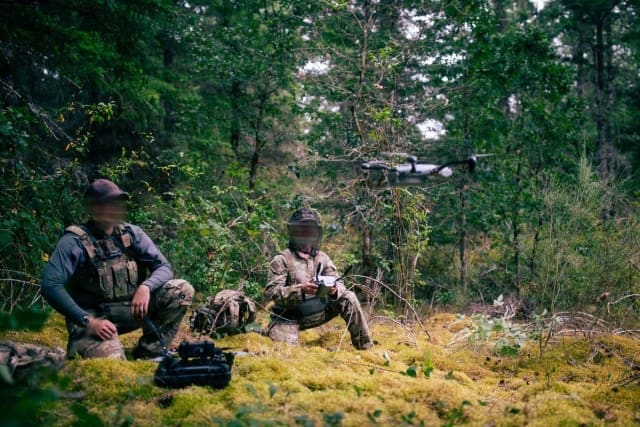
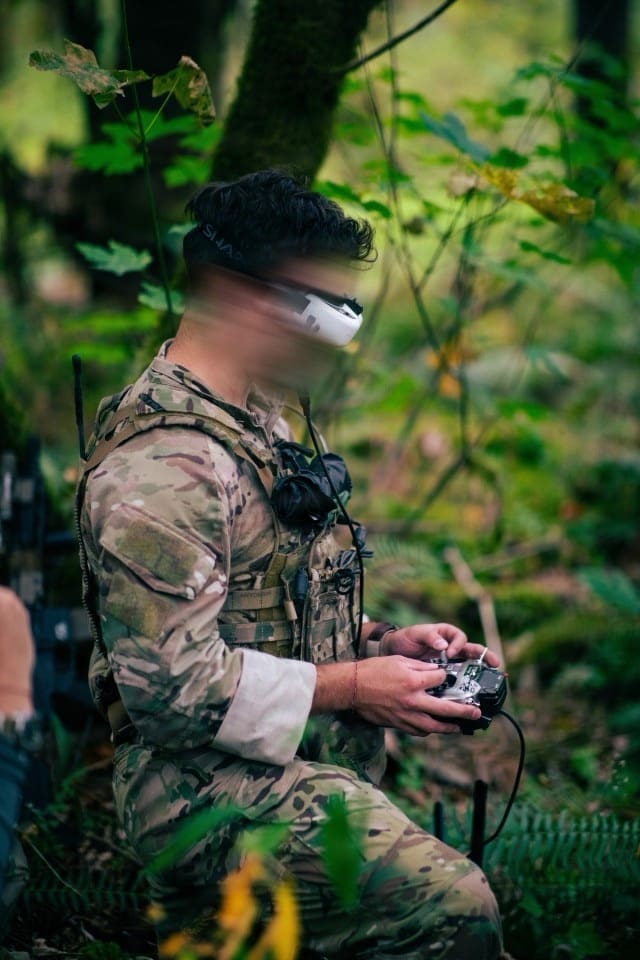
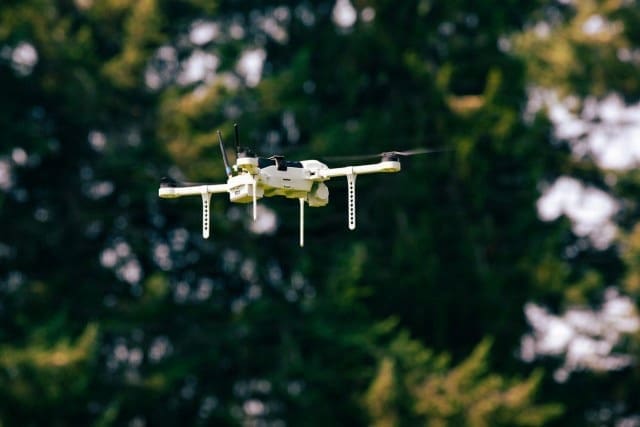
Upon reaching the vicinity of the objective rally point, the team secured the area. While the assistant team leader maintained security, the team launched a small Unmanned Aircraft Systems (sUAS) Skydio X2D drone. The sUAS was flown several hundred meters from the target area, obscured by the tree line, to get eyes on the objective.

The sUAS, which features 3D mapping and collision avoidance, allowed the team to navigate the forest and locate targets in a large open area. This provided the commander with a live video feed to refine the targeting data.

Simultaneously, the team utilized Electromagnetic Spectrum Operations (EMSO) using the Beast+ platform. This handheld device identifies and tracks adversary signals, such as radio or cellular communications.

“It can hear what kind of frequencies are being used,” Morin said. “It can help us pinpoint where radio traffic is coming from.”

By combining the signal data from the Beast+ with the visual data from the drone, the commander was able to determine the exact direction and location of the enemy.

Lowrey said the team made its way through multiple checkpoints before reaching the objective area. By using the technology to refine their targeting, they were able to send reconnaissance and surveillance teams forward to pinpoint high-priority targets. This allowed the team to successfully coordinate simulated airstrikes and artillery strikes.

The introduction of these ground evaluations reflects a shift in how the Air Force tests its special warfare operators. Morin noted that because these evaluations are relatively new, units are still refining the process to ensure operators are tested to the highest of their abilities.

The integration of low-profile, high-power technology like the Beast+ and Suas autonomous drones are essential for the TACP community as it prepares for near-peer conflicts where the electromagnetic spectrum is a primary battlefield.

By Jedhel Somera