Celebrate 20 years of the TLR-1

Archive for the ‘Helmets’ Category

Ops-Core RAILINK Partner Spotlight: Princeton Tec

Wednesday, July 30th, 2025

In the latest contribution to our series on the Ops-Core RAILINK ecosystem we discuss Princeton Tec and their Switch MPLS. This isn’t the first time these two trusted companies have worked together. In fact, the Switch MPLS (Modular Personal Lighting System) uses technology developed for use with the ARC RAIL but now optimized for seamless integration with RAILINK.

The Switch MPLS provides a lightweight, mission-adaptable lighting solution fully integrated into the Ops-Core RAILINK system, emphasizing ease-of-use, modularity, and battlefield reliability.

Integrated into a streamlined helmet system with RAILINK, the light remains powered, secure, and always ready, reducing the risk of gear failure during long shifts. That common power means lighter weight and every ounce on the head matters.

The Railink Switch MPLS is a low light/IR easy to operate directional lighting solution that works with the Gentex Railink powered rail system. Weighing in at only 13 grams with its easy-to-operate glove friendly buttons gives the end user a fail-safe lighting solution for all their low light and IR lighting needs.

It provides 6 lumens of Red and IR light for up close illumination which won’t give the operator away at long distances. The directional beam allows users to perform map reading or equipment checks without compromising their position with a broad flood of light thanks to the flexible boom which puts the light where you want it.

Glove friendly buttons allow you to control it with ease, even in cold and wet conditions. Speaking of wet conditions, with an IPX7 rating, the light is protected from the effects of temporary immersion in water.

The advantages are many. Operators can switch between Red and IR output depending on visibility requirements while maintaining stealth, all without needing to remove gloves or fumble with cables.

Features:

Integrated Power: Switch MPLS draws power directly from the Ops-Core RAILINK system, eliminating the need for onboard batteries.

Dual Spectrum Output: Equipped with Red and IR LEDs, this light meets the demands of both visible and covert operations, supporting mission flexibility without equipment changes.

Directional Illumination: Precisely aim light to where it’s needed, ideal for administrative tasks, reading maps, checking gear, or maintaining light discipline in tactical environments.

Lightweight Design: At only 13 grams, the light delivers essential capability with minimal burden on the helmet system, supporting long-wear comfort and operational mobility.

Ambidextrous Mounting Options: Can be configured on either side of the helmet, ensuring compatibility with other RAILINK-enabled accessories and user-specific setups.

To learn more about the Ops-Core RAILINK System, visit shop.gentexcorp.com/railink

Ops-Core RAILINK Partner Spotlight: SureFire  

Wednesday, July 16th, 2025

In the third installment of Soldier Systems Daily’s look at the Ops-Core RAILINK ecosystem we present a spotlight on partner brand SureFire.

One of the first companies to integrate with RAILINK, SureFire’s HL2-A Light was developed via direct end-user feedback.

The SureFire HL2-A Light is a compact, high-performance lighting solution engineered for seamless integration with the RAILINK system. With dual output capabilities (white light and infrared) the HL2-A offers flexible illumination options for varied operational environments the HL2-A offers flexible illumination options for varied operational environments in a sleek, low-profile footprint. Designed with mobility, adaptability, and ease of use in mind, this tactical light is ideal for professionals requiring lightweight gear with reliable functionality.

The HL2-A features dual output modes with simple switching between white light and infrared (IR) illumination. Additionally, two output levels (high/low) are available for both white and IR modes, allowing users to adapt to mission-specific lighting needs such as administrative applications, with the high intensity for when you really need to push the light out there. The intuitive button design ensures quick, reliable activation between functions, even while wearing gloves.

The swivel head design rotates 115° (90° upward, 25° downward) for precise light placement without shifting body position. Rotating the head straight up allows for “umbrella” lighting, bouncing the light off ceilings or parachute canopy. This is useful in both white light and with IR conditions while using NVGs.

You can also angle the head forward for more traditional use to aid navigation/searching even while mounted on bikes.

The HL2-A’s slim profile and mounting design pair effortlessly with the RAILINK system for streamlined use with seamless integration, offering plug and play with instant power. Weighing just 20 grams (0.7 ounces) the light has minimal impact on headborne loadout with amazing illumination possibilities.

To learn more about the Ops-Core RAILINK System, visit shop.gentexcorp.com/railink.

Galvion Receives Further Follow-on Batlskin Caiman Order of 5000 Helmets, for the Canadian Dismounted Infantry Capability Enhancement (DICE) Programme

Tuesday, July 15th, 2025

Galvion, a world leader in innovative head protection systems and power and data management solutions, has received a second follow-on order from the Department of National Defence (DND) Canada for its flagship Batlskin Caiman® ballistic helmet systems. This latest order for an additional 5000 helmets with two (2) helmet covers each, is expected to deliver in early 2026.

The original Canadian Dismounted Infantry Capability Enhancement (DICE) programme contract was awarded in February 2023 for 2,100 helmets and 4,200 helmet covers. In July 2024, year two of a five-year framework contract, the DND exercised an option to order an additional 8,400 helmets and 16,800 helmet covers taking the total Canadian DICE order to 10,500 helmets and 21,000 covers, all successfully delivered. With this latest follow-on order, the DICE totals now total over 15,000 helmets and 30,000 covers, all ordered within three years of the five-year framework.

Developed over a number of years with extensive SOF community collaboration and feedback and now fielded in the hundreds of thousands across multiple NATO countries, Galvion’s Caiman® helmet system delivers unmatched levels of weight and comfort, and is expressly designed to incorporate electronics, communications headsets, and other critical equipment needs, now and into the future. The helmet is equipped with Galvion’s premiere APEX lining system, an intuitively adjustable design that enables a customized fit for users.

The helmet systems assessed for DICE were trialled by members of the Canadian Light Infantry Battalion at the end of 2022. Conducted under operational conditions, the trials included the integration of equipment such as eyewear, night vision goggles, gas masks, hearing protection, and cold-weather gear. The Caiman helmet received the highest rating by a significant margin and was selected after a phased bid process.

Todd Stirtzinger, CEO at Galvion said: “We are exceedingly proud to receive another significant order from the Canadian DND for their DICE programme. Repeat orders like this demonstrate partner confidence and end-user satisfaction, both of which are core drivers for everything that we do at Galvion.” He added: “We are seeing significant increases in demand across all of our head system platforms, with the Caiman helmet seeing far and wide adoption beyond the SOF community, as evidenced by this DICE contract but also the continued receipt of orders from NATO countries through our NATO Support and Procurement Agency (NSPA) framework contract. We have more good news on that side to be announced soon. This activity, alongside other notable successes, has triggered some major investment and expansion activity, which is best showcased by our recent European Production Hub opening ceremony, in Poland.”

MARADMIN 237/25 – Marine Corps Policy on the Wear and Purchase of Body Armor and Personal Protective Equipment (PPE)

Monday, July 14th, 2025

Published in late May, the US Marine Corps guidance for the wear of PPE, restricting it to only issued items which have undergone testing and are on approved use lists. This ends the use of private purchase and commercial off the shelf items unless on the approved lists detailed in the message.

Below is the message followed by a video explaining the policy. We have redacted the email addresses and phone numbers of the POCs but they are easily found via Google search for this message.

R 201307Z MAY 25
MARADMIN 237/25
MSGID/GENADMIN/CMC PPO POF WASHINGTON DC/FOO2//
SUBJ/MARINE CORPS POLICY ON THE WEAR AND PURCHASE OF BODY ARMOR AND PERSONAL PROTECTIVE EQUIPMENT (PPE)//
REF/A/MSGID: MSG/CMC WASHINGTON DC PPO/YMD: 20070417//
REF/B/MSGID: GENADMIN/CMC WASHINGTON DC PPO: 20090416//
REF/C/MSGID: GENADMIN/CMC WASHINGTON DC PPO: 20090710//
REF/D/MSGID: GENADMIN/CMC WASHINGTON DC PPO: 20170327//
REF/E/MSGID: GENADMIN/CMC WASHINGTON DC PPO: 20181127//
REF/F/MSGID: GENADMIN/COMMMARCORSYSCOM: 20240509//
REF/G/MSGID: GENADMIN/COMMMARCORSYSCOM: 20240807//
REF/H/MCO 6260.3A SD: 20160926//
NARR/REF A IS MARADMIN 262/07, Marine Corps Policy on the Wear  and Purchase of Body Armor and Personal Protective Equipment 
(PPE). Ref b is MARADMIN 254/09, Marine Corps Policy on the  Wear of Personal Protective Equipment (PPE).  Ref c is MARADMIN 415/09, Establishment of Body Armor Protection Levels. 
Ref d is MARADMIN 151/17, change 1 to Marine Corps Policy on the Wear and Purchase of Body Armor and Personal Protective Equipment (PPE). Ref e is MARADMIN 667/18 Marine Corps Policy on the Wear and Purchase of Body Armor and Personal Protective Equipment (PPE). Ref f is the Safety of Use Message for the Enhanced Combat Helmet and High Cut Enhanced Combat Helmet Suspension Systems. Ref g is the Safety of Use Message for the Enhanced Combat Helmet with Hearing Enhancement Device. Ref h is the Marine Corps Hearing and Conservation Program.//
POC/E.T. Clark/COL/PPO POF/Branch Head/
POC/E.A. Benson/CIV/PPO POF/Dep Branch Head/
GENTEXT/REMARKS/1. The Commandant of the Marine Corps directs the following policy for Marines and Sailors assigned to USMC and joint commands, on the wear and purchase of body armor and PPE. This MARADMIN supersedes references (a, b, c, d, and e). PPE refers to Marine Corps approved body armor, helmets, goggles, gloves, clothing, and other gear designed to protect the wearer’s body from battlefield injuries. The equipment and
training information for service-approved PPE systems can be found at https://app.mcboss.usmc.mil searching via program office: PMM-154.3 and via Marine Net course # mcsppe0306 – Proper use of Personal Protective Equipment
2.  Individual Marines/Sailors may not use commercial PPE in lieu of government tested, approved, and issued PPE as outlined in the product information sheets referenced in paragraph 1.
Commanders are not authorized to utilize unit funds to purchase commercial PPE items that have not been approved for use by Marine Corps Systems Command.
3.  Ballistic spectacles and goggles authorized for use are listed on the authorized protective eyewear list (APEL) and are compatible with the universal prescription lens carrier. While the Marine Corps will continue to issue a single spectacle and a single goggle, units may purchase other authorized ballistic eyewear on the APEL through the defense logistics agency or the post-exchange. The latest APEL can be found at:
https://www.peosoldier.army.mil/equipment/
approved-eyewear-qpl/

4.  All forms of hearing protection devices are considered PPE, and the Marine Corps issues Hearing Enhancement Devices (HED) (TAMCN C01142F) and High Noise Hearing Enhancement Devices (HN-HED) (TAMCN C00142F). Commanders must ensure Marines comply with ref (f) or ref (g) for helmet configuration and ref (h) guidelines to select appropriate hearing protection devices.
HEDS shall be evaluated at least twice per year for appropriate use and to replace any worn/deteriorated seals per ref (h).
Commanders will consult navy medicine occupational audiologists or industrial hygienists to determine from sound pressure measurements appropriate hearing protective devices for their operational needs, ensuring Marines have the correct single or dual hearing protection when necessary. Per ref (h), the safety objective is to protect Marines’ exposure to any steady-state noise having an 8-hour time-weighted average noise level greater than or equal to 85 decibels: or a single exposure to impulse and/or impact noise of 140 decibels peak or greater, regardless of duration.

5.  Marine Corps Body Armor Protection Levels (APLS).
5.a.  A service-level policy defining specific armor protection levels has been established with the intent of standardizing APLS, enabling commanders to tailor armor protection based on their estimate of the situation or based on guidance from service/joint/theater combatant commanders. Higher APLS provide increased ballistic protection through the addition of modular armor components, increasing the areas of coverage and/or ballistic protection. Higher APLS correspond to greater weight, increased thermal loading, and reduced mobility, thus degrading individual and unit performance over extended periods of time.

5.b.  The following APLS are established and apply to all Marine Corps-issued armor systems. Read in two columns:
APL             Description 
Level 0         No body armor worn 
Level 1         Marine Corps-issued plate carrier with soft armor only (defeats handgun and fragmentation threats)
Level 2         Marine Corps-issued plate carrier with soft armor, and front and back hard armor plates (defeats rifle and fragmentation threats)
Level 3         Marine Corps-issued plate carrier with soft armor, front and back hard armor plates, and side hard armor plates (defeats rifle and fragmentation threats).
Removal of the soft armor from the plate carrier compromises the ballistic protection of the issued armor systems. Soft armor must be worn in conjunction with ballistic plates in the issued plate carrier – failure to do so may result in severe bodily injury or death. There are currently two variants of ballistic plates fielded to the Fleet Marine Force: the Enhanced Small Arms Plate Insert (ESAPI) (TAMCN C30202E) and the Lightweight Plate (LWP) (TAMCN C01342F). Commanders may choose to utilize either variant based on the threat.
5.c.  The Marine Corps-issued helmets authorized for operations include the Enhanced Combat Vehicle Crewman Helmet (ECVCH) (TAMCN C49942F), Enhanced Combat Helmet (ECH) (TAMCN C01202E), High Cut Enhanced Combat Helmet (HC ECH) (TAMCN C02222F), and the Integrated Helmet System (IHS) (TAMCN C02222F) which were designed to provide both ballistic and blunt impact protection across the full spectrum of operational environments. The helmets consist of a shell, a suspension system (pads), a retention system (chinstrap), and include other accessories such as a night vision device mounting bracket and rail systems.
The ballistic protection of these systems is provided by the construction and materials of the shell. The blunt impact protection is provided by the construction, materials, and configuration of the suspension system. The suspension system must have pads in an approved configuration. In accordance with ref (f) or ref (g) the issued suspension system cannot be replaced with commercial pads. The screws in the helmet support the ballistic integrity and shall not be replaced with commercial screws. Unit leaders will ensure initial training is conducted for Marines upon issue of the helmet. Commanders shall ensure approved helmets are worn in an approved configuration.



5.d. Diving life preserver and buoyancy compensator listed in the authorized for navy use (ANU) are not authorized for ballistic protection until the configuration has been certified and approved by Marine Corps Systems Command. Commanders interested in requesting diving life preserver and buoyancy compensator for certification must follow the universal needs
process. Information can be found at: https://www.cdi.marines.mil/units/cdd/universal-needs-process/
5.e. Protective attachments may be worn with
Marine Corps-issued body armor. It is impractical to establish APLS that incorporate every possible configuration in which these attachments may be worn. Commanders will designate the wear of Marine Corps approved helmets; ballistic eyewear; and groin, neck, and throat protection as required by their units’ mission, the threat, and local environmental considerations.
5.f. The lightweight helmet (TAMCN C32152E) and the small arms protective body armor (stocklist-3 item of TAMCN C35012E) are only authorized for use by training command.
5.g. Ballistic protection vendor samples are not authorized for use without Marine Corps Systems Command oversight and approved safety releases for limited user evaluations.
6. Authority
6.a. Operating force commanders at the Lieutenant Colonel (O-5) level or higher are authorized to determine the required level of PPE (or APL when established) for wear by assigned personnel within the Marine Corps Systems Command approved systems. This determination will be made based on mission(including during training), unit type, threat, and environmental factors.
6.b.  Combatant, Joint Task Force (JTF), and service component commanders retain the authority to prescribe the level of protection worn by all assigned personnel. In cases where combatant, JTF, and/ or service component commanders have established a required level of PPE that is more restrictive than that set by Marine Unit Commanders, Marines will adhere to the highest level. In cases where the APL is not designated, the Marine Corps service policy places the authority to designate the APL on commanders, Lieutenant Colonel (O-5) and higher.
6.c.  Based on their unique mission requirements, Marine Special Operations Command (MARSOC) personnel may, within published MARSOC policies and subject to their commanders’ approval, wear special operations command-approved special purpose body armor.
6.d.  Installation commanders are authorized to use government funds to purchase commercial off-the-shelf (COTS) body armor and PPE only for use by Military Police performing law enforcement duties aboard Marine Corps installations. COTS body armor must, at a minimum, meet National Institute of Justice (NIJ)-certified level RF2 as listed on the NIJ website.
https://www.nij.gov/topics/technology/body-armor/pages/compliant-ballistic-armor.aspx. COTS body armor purchased for installation law enforcement duty will not be worn by Marines as a substitute for Marine Corps approved body armor and PPE in a combat zone or theater of operation.

7.  Marine Corps organizations that do not receive class II PPE materiel support from the Logistics Command should direct all materiel requirements to DC, IL, IP.
8.  Release authorized by MajGen J. L. Morris, Assistant Deputy Commandant for Plans, Policies, and Operations.//

NEXTORCH UT61 Tactical Helmet Light with Smart Link Technology

Saturday, July 12th, 2025

Cleveland, TN – (July 8th, 2025) – NEXTORCH North America, the primary U.S. distributor of global manufacturer NEXTORCH Industries, is proud to announce the UT61 Tactical Helmet Lightutilizing Smart-Link™ encrypted communication where multiple devices can be interconnected to synchronize color and strobe pattern for coordinated operations.

The NEXTORCH UT61 helmet light is equipped with five color light sources red, blue, green, white and infrared (IR). It also offers various strobe and constant-on modes, along with a red-blue flashing signal mode. The UT61 is ideal for tactical operations, patrol, search & rescue etc. and more. This incredible helmet light provides 3600 visibility and a range of up to 1,093 yards. With an eye-catching translucent frosted shell, the UT61 has 8 multi-light source LED’s and three independent switches providing precise one-handed operation, even with gloves on.

Designed and engineered for extreme use, the UT61 is robust with an IP67 dustproof and a IPX7 waterproof rating this durable helmet light can withstand a drop impact of 6.5 ft. Its three independent switches provide tactile and auditory confirmation for precise one-hand operation, even with gloves on, in the darkness. The UT61 Helmet light offers flexible mounting options: Velcro for optimized helmet attaching and a detachable clip allowing for various mounting applications.Equipped with a USB-C rechargeable 16340 Li-ion battery, the tactical helmet light provides up to 74 hours of runtime. It’s also compatible with CR123A batteries. There is a battery status indicator for the 16340 batteries only. The UT61 is backed by a 10-year warranty.

Technical Specifications:

– Construction: Polycarbonate

– Runtime: Up to 74 hrs.

– Dimensions: 2.7” x 12.4” x .78”  

– Weight: 1.5 oz.

MSRP: $69.99

To learn more about the complete product offerings from NEXTORCH, please visit www.nextorch.com and follow them on Facebook, TikTok and Instagram.

Galvion CORTEX Offers Headborne Integration

Monday, July 7th, 2025

Galvion CEO Todd Stirtzinger looked at me and said, “We are not only going to transform how helmets are made, but how they are used.” That was how he opened our meeting during last month’s SOF Week in Tampa, Florida and it certainly got my attention.

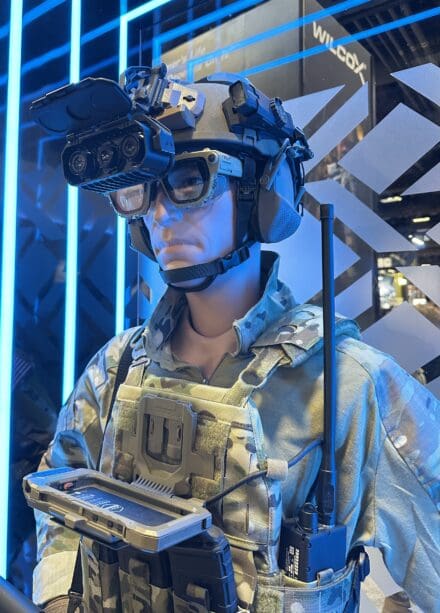
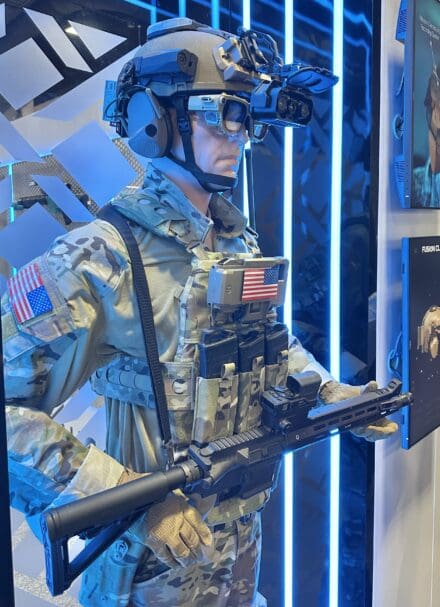
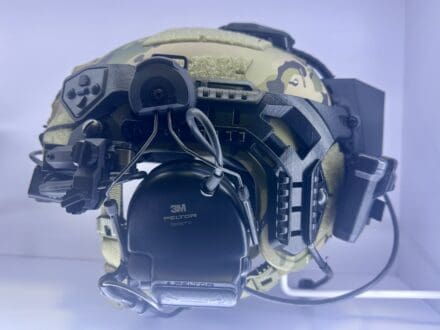
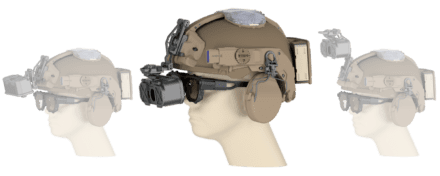
He led me to a helmet with multiple enablers and began to explain Galvion’s digitally enabled smart helmet, CORTEX.

The project stemmed from development for the UK’s Defence Science and Technology Laboratory Future Integrated Dismounted Soldier Vision (FIDSV) program. Further work has been accomplished on behalf of US Special Operations Forces. Integration is an ongoing process.

What’s amazing about CORTEX is that a Soldier can dump out his bag of kit and Galvion can integrate it, digitally. Enablers like smart watches, biometric sensors, strobes, laser detection systems, night vision, and thermal optics are no problem. They’ve encountered it all. The system is hardware agnostic and relies upon software, cables, and connectors to act as bridgeware so that everything comes together as a system, no matter who manufactured it. It is both modular and scalable and offers both data and power management.

Using the helmet as a platform, edge processing is accomplished with a module featuring an internal battery and purpose-built android-based operating system which is compatible with Tactical Awareness Kit, the de facto command and control interface for the Dismounted Soldier. This increases Soldier acceptance and facilitates faster integration of new systems.

CORTEX is powerful. It will automatically detect whether a visual augmentation system is compatible with Augmented Reality inputs. This places key data in the VAS field of view, in the direction it is found in real life. Key ATAK functions can be accessed with a quick button press via the built-in 4-key controller at the temple, eliminating the need to open the EUD. This moves the data from the usual torso mount and puts it in front of the eye so the Soldier can concentrate on the battlespace.

Everything is streamlined to make the data more digestible. There’s nothing worse than being overwhelmed with extraneous data and icons cluttering the field of view. Consequently, the AlertCentr plugin for ATAK is configurable by the Soldier who can setup multiple profiles for different phases of a mission. Navigation waypoints, target data, blue as well as red force information, and drone feeds can all be toggled data on and off based on what is needed for the task at hand.

With multiple system communication protocol options (USB, ISW, Bluetooth, Wi-Fi) and onboard battery, CORTEX is designed to fit Galvion’s Caiman and Hellbender helmets, although it has also been integrated unto select helmets from other manufacturers, based on customer needs.

With a combination of cabling running under rails (VAS connector, 4-key controller, Laser Sensor) as well as some exposed connection cabling, Galvion informs me that in the not-too-distant future, cables won’t be visible.  They’ll be incorporated inside. As Mr Stirtzinger alluded to in his opening statement to me, Galvion is going to change the way helmets are made. The result will be a more elegant way to integrate power and data into the helmet.

The system is already fielded in limited numbers with interest growing. Integration with new peripherals continues, along with functionality as more customers adopt the CORTEX ecosphere.

www.galvion.com

Ops-Core RAILINK Partner Spotlight: CORE Survival

Wednesday, July 2nd, 2025

We recently reintroduced you to Ops-Core’s RAILINK with a promise to begin offering in-depth coverage of the multiple enablers which work with this headborne integrated power and data system.

CORE SURVIVAL was one of the first companies to partner with Ops-Core on this project, developing the HEL-STAR Rail Strobe specifically to integrate with the RAILINK system.

The HEL-STAR Rail Strobe miniaturizes the high performance expected from a CORE Survival product. Powered by the RAILINK’s centralized Battery Pack+, the HEL-STAR Rail Strobe features dual compact, lightweight lights.

Features:

Small Footprint with Four Settings – High and low visibility in both White and IR. Built with CORE Survival’s patented technology for maximum performance in a low-profile, snag-resistant package.

Tactile Operation – Switches are designed for positive operation by a gloved hand while the helmet is donned. Patented double-switch blocks inadvertent switching between visible and IR functions.

Left & Right-Hand Installation – Strobe modules attach to both the left and right side of the helmet-mounted rails. Communication to synchronize function between the strobes is achieved via the RAILINK system’s data capability.

Familiar Sliding Button Operation – Settings for Off, Dim and Bright operation for both the Visible and IR functions.

You might think that a strobe light wouldn’t leverage RAILINK’s data capabilities, but the HEL-STAR Rail Strobe uses it to coordinate device communication at the physical layer—transmitting raw data signals between devices without interpretation. This allows the strobes to blink in unison, synchronize between visible and IR modes, and adjust light intensity in real time.


Aside from using the RAILINK’s common power distribution, the strobe is optimized for low power consumption, ensuring seamless integration with other low-power devices without placing a significant power burden on the overall platform.

To learn more about the Ops-Core RAILINK Power and Data ARC Rails System, visit shop.gentexcorp.com/railink

Gentex Corporation Launches the Next Generation Ops-Core FAST SF Helmet System with Factory-Installed RAILINK Power and Data ARC Rails

Tuesday, July 1st, 2025

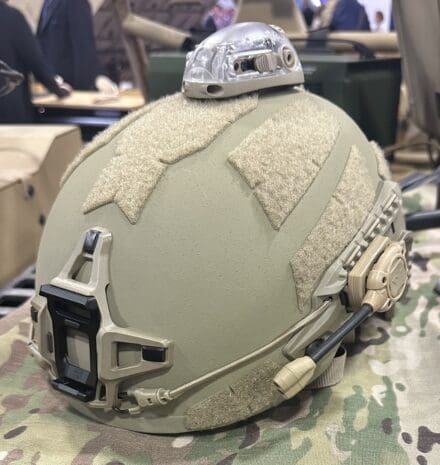
CARBONDALE, PA, June 30, 2025 – Gentex Corporation is proud to announce the launch of its next-generation Ops-Core® FAST® SF Helmet System, now available with the innovative RAILINK® Power and Data ARC Rails factory installed. This new configuration streamlines setup and allows users the flexibility to add compatible accessories separately based on their mission needs.

As a global leader in personal protection and situational awareness solutions for defense forces, emergency responders and industrial personnel, Gentex Corporation now offers a streamlined way to purchase the FAST SF Helmet with factory-installed RAILINK Power and Data ARC Rails and Hotshoe.Trusted by elite Special Operations Forces, this setup delivers seamless integration out of the box while giving users the flexibility to choose the battery pack and mission-specific accessories separately. With optimal fit, proven reliability and reduced prep time, it’s a mission-ready solution built for the demands of the world’s most elite operators.

“Factory installation of the RAILINK Power and Data ARCRails represents a significant advancement in streamlining and speeding up field deployment of this cutting-edge capability,” said Rafe Bennett, Vice President of Product and Marketing at Gentex Corporation. “Providing a fully integrated, ready-to-use system right out of the box not only minimizes setup time, but also boosts operator confidence with a solution that’s been factory installed and proven in the most demanding operational environments.”

Users can expand the capabilities of the RAILINK Power and Data system with a growing lineup of compatible accessories available separately. These include the CORE Survival® HEL-STAR Rail Strobe®, which offers synchronized visible (white) and IR marking; the Princeton Tec™ Switch® MPLS for low-light and IR illumination; and the SureFire® HL2-A Light, delivering powerful white light or infrared output. Each of these accessories integrates seamlessly with the RAILINK Power and Data system to increase operational flexibility and situational awareness. In addition, Gentex Corporation has established development partnerships with MOHOC, Inc., Advanced Materials and Devices (AMAD) and NanoAi Technologies, along with seven other companies who have signed royalty-free license agreements to create new accessories. These partnerships are accelerating the expansion of the RAILINK ecosystem and enabling a broader range of capabilities for end users.

To learn more about the next-generation FAST SF Helmet System with factory-installed RAILINK Power and Data System, click here.