Check out the entire 2011 lineup from Ops-Core. The only thing is, they are always busy developing new products so this is really more of a snapshot in time than a definitive look at their products.


Check out the entire 2011 lineup from Ops-Core. The only thing is, they are always busy developing new products so this is really more of a snapshot in time than a definitive look at their products.
Princeton Tec continues to develop the MPLS line and informed us that the NVG adapter plates developed jointly with Ops-Core are now ready for action. This only increases the versatility of the Remix Pro and EOS which can also be worn using the standard elastic headstrap or PALS adapter.

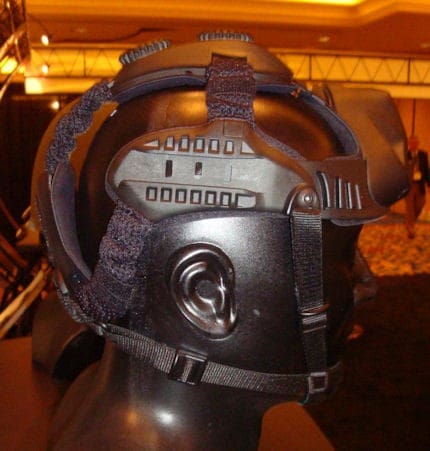
Not only did Ops-Core have their new Sentry ACH helmet on display but they also debuted the Skull Crusher. All I can say is, where the heck was this thing 25 years ago? While it adopts the name of its OEM forebearer, it is anything but. Wearing NODs can cause headaches in and of themselves, let alone when you are wearing an issue headset. Ops-Core has taken the pain out of the harness. Not only does it offer three points of adjustment to the head portion, it also features Ops-Core’s excellent chinstrap system with another four points of adjustment. And let’s not forget, it was actually designed by folks who know something about how the human head interacts with loads and what’s more, how to make them more comfortable and stable.
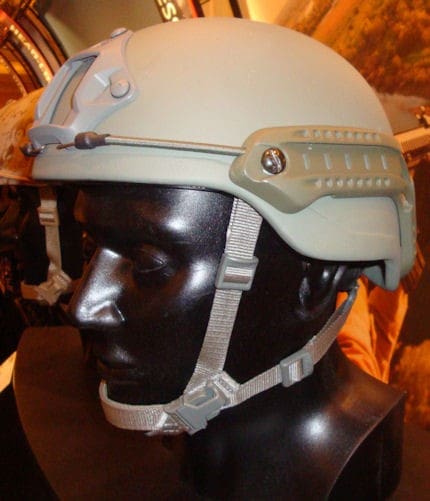
The Sentry ACH is truly the next generation of protection. The Gallet-designed MICH (ACH) originally incorporated a more traditional cradle-style suspension system. When pads were incorporated sizing tariffs were skewed in order to ensure proper fits for the troops. Ops-Core developed an entirely new shape to accommodate their new high impact suspension system.
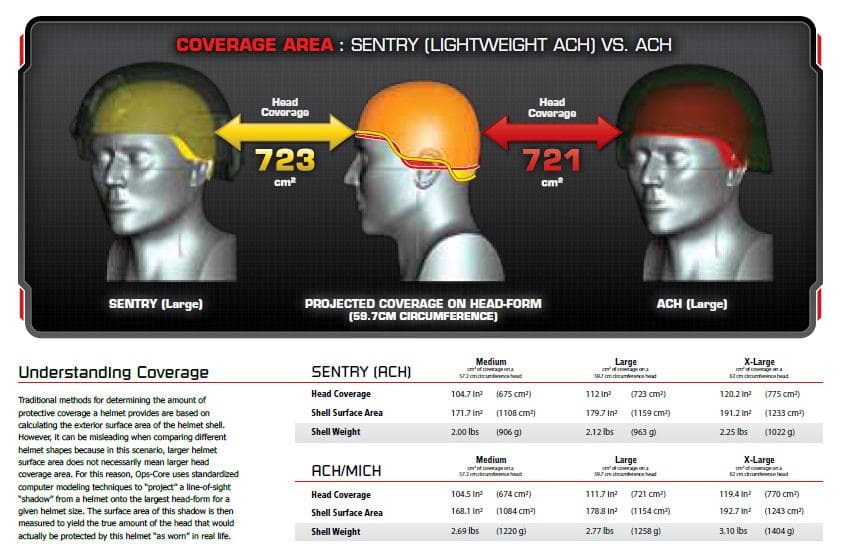
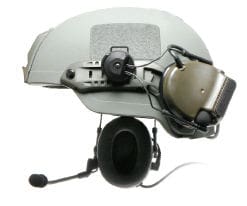
Additionally, it actually provides more coverage than an ACH, is lighter weight, and allows the use of the rail mounted ARC Peltor Headset as they will tuck up underneath the sides of the helmet. Traditional headband-style earphones can also be worn.
Ops-Core will be releasing a new helmet called the Sentry ACH. Based on the popular FAST ballistic helmet, the shape is a little different and designed to improve hearing attenuation. And, while it provides the same level of protection and coverage as an ACH, it is a full half pound lighter due to its composite construction. Visit them in booth #8111 which is adjacent to Crye Precision to learn more.
When DuPont contacted us and told use that they were set to unveil a new armor technology that could result in a 20% reduction of weight while retaining the same level of protection we practically did cheetah flips. Based on work on the Enhanced Combat Helmet program, the new Kevlar® XP™ for Hard Armor combines DuPont’s latest Kevlar® KM2 Plus fiber technology and a new advanced thermoplastic resin to create a protection system providing 20 percent higher performance. The most obvious application was helmets.
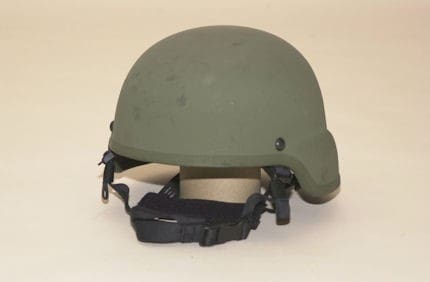
The story behind the new product is fascinating. Two years of focused research on 100% aramid reduced weight helmets at DuPont’s Armor Technology Center in Wilmington, Delaware resulted in development of XPH170. The goal was weight reduction rather than performance. Combining Kevlar® into thermo plastic technology, DuPont worked to meet current ACH requirements, and the result is a helmet with a 20% reduction in weight forming what is essentially a Lightweight ACH. To put matters into further perspective, the ACH is 8% lighter than its predecessor, the PASGT. Even better, since the new material requires fewer plies, the helmet is thinner and there is more stand off room between helmet and head lowering the risk of blunt force trauma. Additionally, the new material is stronger so there is less back face deformation.
Once the engineers at DuPont realized what they were on to, it took about nine months to workable prototypes. They have continued collaborating with several helmet producers to integrate the technology into their lines. Since it is based on work to develop the ECH, most manufacturers already invested in the infrastructure.
“Our goal is to provide the U.S. military with products that have a meaningful impact on how soldiers accomplish their mission,†said William F. Weber, vice president – DuPont Protection Technologies, North America. “The launch of Kevlar® XPâ„¢ for Hard Armor demonstrates our proactive approach to innovation in order to shape what will become the next generation of required materials for the military.â€
Not only is it a perfect fit for Tactical helmets, but it can also be used for armor plates and Police helmets. DuPont continues to develop new products under the Kevlar® XP™ platform to provide lower weight solutions and better protection for warfighters.
Kevlar® XP™ for Hard Armor will be produced using materials from the new DuPont™ Kevlar® facility being built near Charleston, S.C. Dupont has made a major investment of $500 million to expand Kevlar® production capacity. The facility is expected to be fully operational by the beginning of 2012. It also will produce other Kevlar® fiber technologies specifically for military applications, law enforcement and industrial applications, and will increase worldwide production of Kevlar®, including Kevlar® XP™ for Hard Armor, by 25 percent.
Be sure to visit DuPont at AUSA and check out this new technology.
Wilcox Industries displayed their new purpose built arm for the ANVIS family (AN/AVS-9(V) (F4949) and AN/PVS-23 (F5050) Aviator’s Night-Vision Imaging System) of night vision devices at Modern Day Marine. Previously, mounts designed for use with flight helmets have been adapted with varying degrees of success to bump and ballistic helmets. Now, there is an arm that fits the standard one-hole NVG mount found on many helmets.
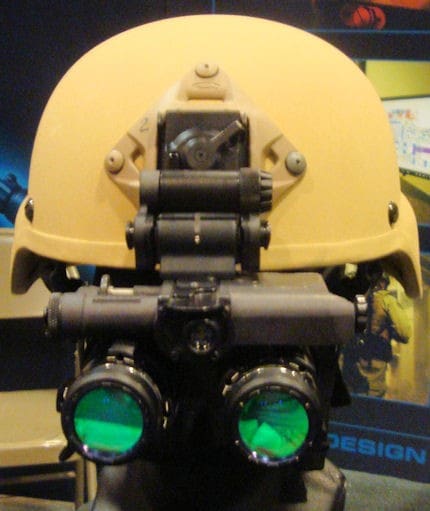
Additionally, a battery compartment has been integrated into the design so that the battery box does not need to be attached to the back of the helmet. You can see it in the photo above located just below the adjustment lever. A single DL123 battery will provide up to 32 hours of operation. Elimination of the battery box decreases both cost and weight and eliminates the cable that usually runs along the side of the helmet and can catch when in confined spaces. Although, that same box can still be used for those that use it as a counterweight.
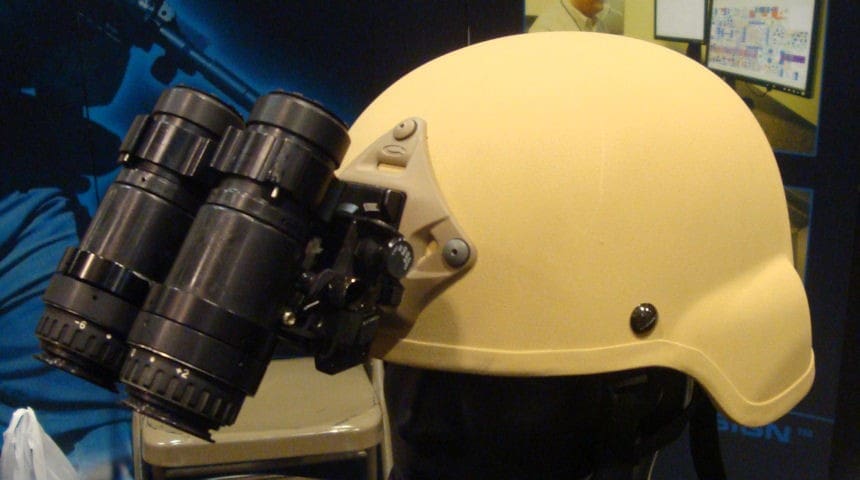
Unlike aviation use mounts and arms, the new Wilcox item is machined from Aluminum and while the NVG will pop out from its ball and detent as designed, it won’t do it accidentally. You have to depress both sides simultaneously to get it out.
Lots of you are running a variety of ballistic and bump helmets and this product is designed to keep your goggles attached to your helmet. The original Goggle Grip was introduced in 2001 for the PWC (Jet Ski) Racing Market. With sales of over 7000 units worldwide of that design, they recently introduced the Mini Grip “Mili-G†model specifically for tactical applications.
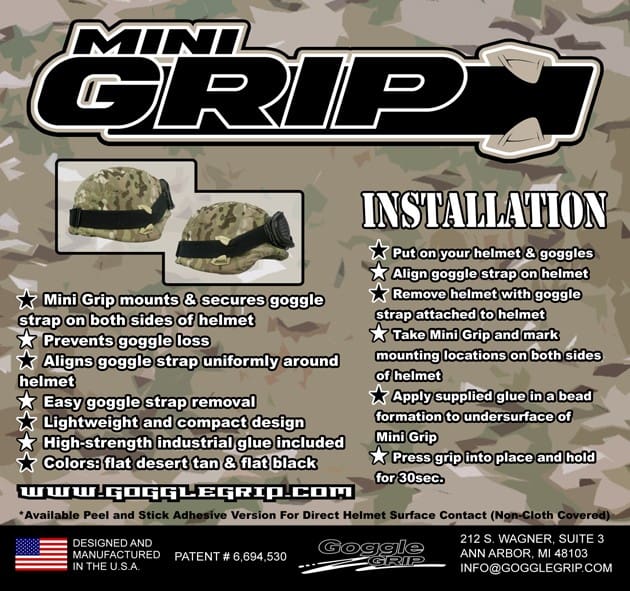
This patented product secures the goggle strap inside a slotted cavity design, allowing the strap to move freely horizontally but securing the strap from moving up or down. The Mini Grip “Mili-G” version features a compact design made out of durable polycarbonate plastic and coated with a matte finish to eliminate glare (Black and Tan). They offer a peel and stick application version for hard surface mounting and another version for cloth covered surface mounting applications which includes tested industrial strength bonding agent. Manufactured and assembled in the U.S.A.
Unfortunately, it looks like the deal for Revision to purchase Pacific Safety Products’ headborne system and helmet liner assets for $1,275,000 has been terminated by Revision. Under a Memorandum of Understanding, Revision had the right to terminate if the sale was not completed by July 15, 2010. However, all is not lost. PSP and Revision are continuing talks for a partial sale of PSP’s Headborne System.