Aquaterro

Archive for the ‘Materials’ Category

Duro Introduces Two New MultiCam Print Fabrics

Saturday, January 22nd, 2011

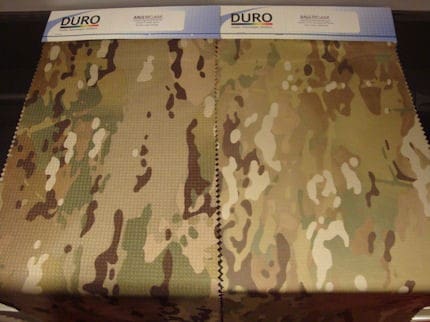
Duro Textiles, the exclusive distributor of MultiCam introduced two new fabrics at SHOT Show. The first, seen on the left below is LiteLok a 100% nylon, double layer fabric. It is 35% lighter than 500D Cordura and has been used in solid colors for many years for concealment cut armor vests. The ripstop weave gives it a very techie look and it boasts high abrasion and tear resistance.

The second fabric on the right of the photo is called Epsilon. It is a 40D x 70D nylon ripstop fabric with Nanosphere treatment. This gives it water and resistant properties.

For more information visit Duro online.

The U.S.-South Korea trade pact puts a bullet in DuPont’s ballistic fabrics business

Sunday, January 2nd, 2011

Fortune magazine did an excellent article on the US-Korea Free Trade Agreement. It seems that our number one textile export; Kevlar which is an aramid will be at a disadvantage to Korean produced fabrics. What’s worse, DuPont has been embroiled in lawsuits with one Korean producer for several years due to alleged theft of intellectual property.

Unfortunately, despite that fact that our country is at war and we rely heavily on aramids, it looks like our trade negotiators sold the industrial base out on this one.

Ahhh…Now It All Makes Sense

Thursday, December 30th, 2010

So we’ve been sitting around the office for weeks trying to figure out Hypersealth came up with SMARTCAMOâ„¢, that color changing camo material they recently teased us with.

Then, we find out that Dr. Joseph Resnick, Lt. Col. Timothy R. O’Neill, Ph.D (U.S. Army, Ret.) and Guy Cramer (of Hyperstealth fame) have owned mineral rights for 95% of the side of the moon that faces Earth, the polar regions and 50% of the far side of the Moon since 2007. And that isn’t to mention their mineral rights on Mars!


So this has got to be it, they have found some rare mineral on the Moon that makes SMARTCAMOâ„¢ work. Now the question is, how did they get it back to Earth?

Marines Purchase Additional Extreme Cold Weather Gear Using PrimaLoft Insulation

Friday, December 17th, 2010

PrimaLoft® Insulation Technologyâ„¢, the research and development leader in high performance insulations used to enhance combat conditions for soldiers, has announced that the United States Marine Corps (USMC) has purchased 6,000 additional sets of the USMC Extreme Cold Weather Parkas, Trousers and Booties insulated with PrimaLoft® to equip U.S. Marines stationed in the coldest areas of Afghanistan and across the globe. This new buy brings the total number of system sets currently fielded to Marines to 50,000. Known to Marines as the “Happy Suit” the garments are manufactured by Wild Things Tactical.


Developed in partnership with the U.S. Marine Corps, PrimaLoft® insulation provides Marines with critical tactical advantages over the enemy during the most challenging extreme cold weather conditions. The Extreme Cold Weather Parka, Trouser and Booties insulated with PrimaLoft® are packable, lightweight, weather resistant, and very warm for extreme combat conditions. Notably, this technology works in conjunction with the USMC sleeping bag system also outfitted with PrimaLoft® insulation and allows Marines to carry a less bulky sleep system, while increasing protection under diverse environmental conditions.

“PrimaLoft® takes great pride in our work to provide the best possible insulation technology to meet U.S. Marine Corps mission readiness needs,” said PrimaLoft® Vice-President and General Manager Joe Rumiesz. “We began working with the DoD 25 years ago, and we continue to advance our unique technology to address the specialized gear needs of our men and women in uniform.”

The U.S. Army originally commissioned Albany International Corp. to develop a water resistant synthetic alternative to down. Today, PrimaLoft® is the premier supplier of insulation to the United States Army, Marine Corps and Special Operations Forces providing them with a tactical advantage over the enemy under exceptionally wet and cold conditions in temperatures as low as -40 degrees Fahrenheit.

ACW Introduces “FIRELOC” Heat Resistant Hardware

Sunday, December 5th, 2010

ACW has introduced “Fireloc” a line of heat resistant plastic buckles, slides, and hook products. Primarily designed for high-heat applications, the Fireloc two inch side release has been tested and approved by Underwriters Laboratories for use in the United States and Canada.

For those of you unfamiliar with ACW, they manufacturer plastic and metal fasteners, hook and loop, as well as elastic and non-elastic narrow textile webbing and cord products. They also manufacturer a line of webbing products using specialty yarns, including Kevlar®, Nomex®, PBI®, and Dyneema® that complement the Fireloc product line offering their customers a “total solution“ product selection.

“Our mission at ACW is to continually develop new products that meet the demands of the marketplace. We are proud to provide our customers with a heat-resistant, hardware product line that has met the stringent safety standards of Underwriters Laboratories for use in the US and Canada.” explained, Mark Krauss, president of ACW.

Revitalize Your DWR

Tuesday, November 16th, 2010

We originally published this article in February of this year but seeing as the weather is getting cold and times are tough we thought this one deserved republishing. You pay a lot for your clothing and equipment and it is just as important to maintain it as it is your firearm.

It looks like it’s going to be a LONG winter. During a recent shooting class I attended it started raining day one and by the middle of the second day it looked like a blizzard. Most of my fellow shooters were wearing waterproof breathable outerwear and several began to feel clammy and then damp the longer each day progressed. A couple of guys were wearing issue Gen I ECWCS parkas. Probably not the best garment available as Gore long ago decided that the basic design could not meet their “Guaranteed to Keep You Dry” standards. Of course these jackets were old. More than anything, they needed some maintenance.

The key to any modern outerwear is its Durable Water Repellent (DWR). There are quite a few treatments available and different manufacturers have their favorites but they are usually are based on flouropolymers. These are PTFE molecules that are applied to the surface and cured at high heat to make them adhere better and increase performance and have a fluorine atom at one end which is highly hydrophobic. Heat causes them to align themselves with their flourines exposed. Water tries to move away from the flourines resulting in beading. This allows the water to roll off without wetting the fabric. Interestingly, Quarpel (Quartermaster Repellent) was one of the first DWRs and used to treat field jackets and other military clothing items.

Since most of us can’t run out and purchase a new jacket every time this happens I thought it would be a good idea to share a few tips with you that will not only revitalize your garment’s DWR treatment but also extend the life of your clothing.

DWR treatments work best when they are clean. I realize this seems counter to what you think is right since a DWR generally lasts about 25 washings and tactical garments get quite a beating in the field, but you need to wash your clothing. The first thing is to avoid using liquid detergents as well as fabric softeners. Additionally, avoid optical brighteners as they are not good for DWR or IR treatments. There are wash in treatments you can purchase as well as spray on options to help renew your clothing’s DWR. However, wash in treatments may affect the breathability of your membrane. One of the best spray solutions available is Revivex from McNett and it is what I have used in the past. It also serves as a stain repellent. Revivex can also be applied to garments that never had DWR in the first place so if you have hunting or field clothing that you find yourself wearing in inclement weather regularly you may want to give it a once over. If you use a spray treatment be sure to evenly coat your garment while it is still damp after washing and to pay special attention to any seams.

There are two additional ways you can put some life back into your DWR. One is to put the garment in a conventional dryer on warm and the other is to iron it on low heat. If water fails to bead up on the surface of your garment you will need to retreat.

No matter which method you choose, proper maintenance of your foul weather clothing’s DWR will help keep you warm and dry and extend the life of your equipment.

Hyde Definition Announces Next Production Run of PenCott Multi-terrain Camo

Friday, November 5th, 2010

Hyde Definition’s next production run of their PenCottâ„¢ multi-terrain camouflage is scheduled for early 2011, featuring a new uniform design and mil-spec-level clothing and equipment fabrics. PenCott-GreenZoneâ„¢ pattern rapidly established a reputation of being “probably the best verdant terrain camouflage pattern in the world” (to paraphrase the famous beer adverts). PenCott-Badlandsâ„¢ and PenCott-Sandstormâ„¢ have been specifically created for semi-arid and arid environments respectively.

Currently, they anticipate offering IR-treated 50/50 NyCo ripstop for uniforms and 725-Denier nylon for equipment. As for pattern colorways, they are leaving that up to the customer. They are hosting a questionnaire to solicit your opinion.

The registration page now live on www.hydedefinition.com

Anatomy of a Shell Garment – Parts 5 & 6

Thursday, November 4th, 2010

BFE Labs once again hosts the final two installments of Unleashed Tactical Equipment’s “Anatomy of a Shell Garment” which when used as a whole, is an excellent primer for those who want to learn about shell garments, their construction, and what they are made from.


Part 5: Garment Construction

Part 6: Bringing it all Together