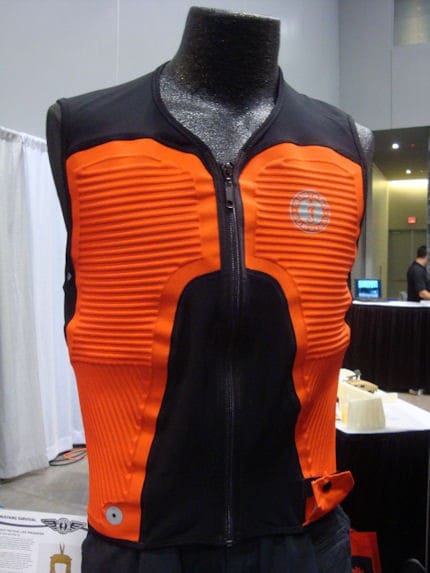
Mustang Survival, manufacturer of survival and dry suits has introduced the ECV-100, a new evaporative cooling vest. Currently under evaluation by US Navy’s NAVAIR for use by maintenance crews, the vest was on display at the NAVEXFOR expo in Virgina Beach held earlier this month. The vest is manufactured from a WL Gore fabric that allows water contained in a continuous tube formed in the fabric to slowly evaporate through the material. It attaches to a standard hydration bladder for a water supply. It really works, as soon as I felt the vest my hand immediately cooled. In a hot dry environment it would feel great. Additionally, it was very lightweight weighing a scant 25 ounces when full.
The display sample was a combination of orange and black but the government test article is all black. However, any color(s) can be produced and it can be worn under or over outer clothing so it could very well serve as a safety item or tactical equipment. Mustang Survival
In a recent interview with PEO Soldier’s COL William Cole and LTC Mike Sloane they detailed efforts to field complete ensembles of clothing and equipment in MultiCam required for combat patrols in Afghanistan. This first article will discuss what is being issued.
In addition to four FR ACUs and Army Combat Shirts in the new pattern each Soldier will receive an accessory kit consisting of name tags, rank, and shoulder sleeve insignia. The Army Institute of Heraldry still has to weigh in on the colorway and designs of individual SSIs. Other uniform components include Generation III Extreme Cold Weather Clothing System. PEO-Soldier is also hard at work getting Patrol Caps, Sun Hats, Knee and Elbow Pads as well as entire MOLLE sets into production. These will include Individual First Aid Kits in addition to the new Tactical Assault Panel seen in the accompanying photo supplied by the program office. IOTV covers and Helmet Covers as well as Nape Pads will also be produced in MultiCam. Every detail is being seen to in order to meet their fielding goals of mid-summer.
In order to meet this deadline a new contract will soon be let by PEO-Soldier for FR ACUs. Rather than relying on the current sustainment contract managed by Defense Supply Center Philadelphia for FR ACUs in UCP, this will allow the numerous improvements to the ACU design we wrote about last year to be cut in early to this new purchase along with the change to MultiCam.
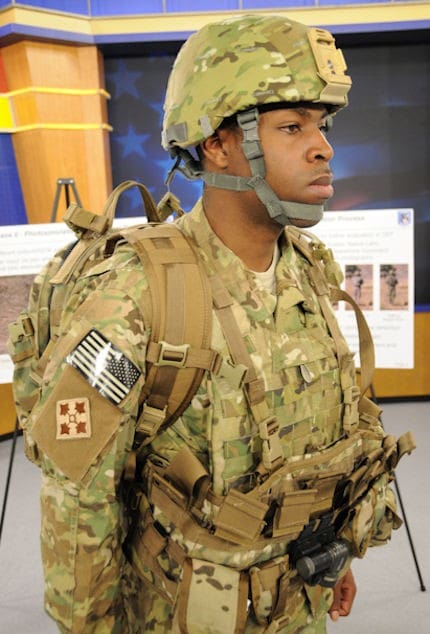
Photo: Alexandra Hemmerly-Brown
What you won’t get are MultiCam ACUs. Lots of guys are already running out and purchasing several sets in the hopes that one day they will be able to wear them. However, this isn’t the case. Although specific wear policy hasn’t yet been released for troops in Afghanistan, this has the potential for being a dream scenario for uniform nazis. If you thought it was hard to sneak into the chow hall after a patrol in your Army Combat Shirt, don’t even think about wearing your ACUs in MultiCam. Current in-theater policy requires Soldiers to protect themselves by wearing FR ACUs, whether UCP or MultiCam. If you are in the wrong uniform you will stick out like the proverbial sore thumb.
Certain organizations on the other hand have fielded standard 50/50 NYCO (50% nylon/50% ripstop cotton blend) uniforms for some time. However, these do not provide the same level of Fire Resistant protection afforded uniforms manufactured from Tencate’s Defender-M like the issue FR ACU. Already industry is hard at work producing clothing and equipment on MultiCam that are designed specifically for use in Afghanistan. This includes FR products. Over the next several weeks Soldier Systems Daily will begin to unveil these products to you.

According to an article in New Scientist, a team at the California Institute of Technology in Pasadena has developed a flexible solar cell made from an array of microwires encased in a clear flexible polymer. It uses just 1 per cent of the expensive silicon needed by a regular solar cell with the same output, and is just 5 per cent of the size. The flexible nature of the solar cells mean that they could be incorporated into shelters, packs, or even clothing. Even more important is that with this new technology, the cell only reflects half the light of a regular cell. This means less chance of reflection.
Posted in Materials | Comments Off on Flexible Solar Cells
Recently, my friends at Protect The Force told me that they wanted to show me an extraordinary technology that was initially designed to protect women from sexual assaults but that could be used for a variety of personal protection tasks. I must admit that in my mind’s eye I formed a picture of some sort of chastity belt-like contraption. Fortunately, my imagination run wild was nowhere near the truth of the matter. Instead, I was shown the video below and it brought everything into focus.
I immediately “got it” and began running scenarios in my head where I could apply the technology. I mean who couldn’t see the potential here? It’s phenomenal. No-Contact’s technology was developed by Adam Whiton, a researcher at Massachusetts Institute of Technology and Yolita Nugent, an apparel designer. Named Conducted Energy Clothing, the concept is simple; bad guy grabs you, much to his chagrin he gets shocked, he unhands you, you fight or flight.
Now I can imagine that some of you are skeptical but they’ve been working on this for awhile. No, it won’t shock you. The wearer is insulated from the effects of the charged outer layer. Additionally, the garment features a Teflon coated waterproof layer to protect the wearer in the rain. Concerned about power requirements? Currently, the system is powered by a single 9v battery.



Remember, the system was initially designed to protect women from sexual assault. It had to be simple to use, so you wear it. Unlike firearms or blade weapons, it requires no training. Once armed, the system is passive. In fact, they are working on a variant that will allow security personnel to remotely activate someone’s CEC in the event they are unable to themselves. This would be great for VIPs and others who risk kidnapping or assault. Even in its current configuration the CEC technology is well suited for Law Enforcement, Corrections, and Security officers.
Some statistics to consider:
“Close-quarters assault from aggressors using fists and hands account for more than 80% of all total assaults faced by law enforcement officers.” Federal Bureau of Investigation 2008 Uniform Crime Report
“No Weapons were used in 74% of all violent crime incidents on civilian victims, just fists and hands. In addition offenders used a weapon in only 1% of all rapes/sexual assaults. Most often fists and hands are used to overpower and restrain the victim.” U.S. Department of Justice – Bureau of Justice Statistics, 2008
“Get in on this.” If I could only say one thing about this material that would be it. The so-called gecko tape is amazing. Made from hard microfibers, and act similar to the hairs on tips of a Gecko’s toes called satae. In fact, they act on weak forces of attraction called van der Waals forces. While the electric charges are minuscule when joined in the millions the two items stay attached, even when wet.
I saw some gloves with the fingers and palm covered in this material at the 2008 SHOT Show. The manufacturer had placed corresponding tape on a knife handle and a pistol grip. When I picked the items up they stayed fast yet I could handle items without tape normally. He wouldn’t tell me what it was and I didn’t figure out until I started researching this article but in my limited interaction, it works.
Much of the work is pie-in-the-sky work hoping to create a real-life Spider Man. But I see more practical things on the horizon. While still in the developmental stage, this technology may one day lead to such items as the pouchless magazine pouch or those gloves I tried out.
There has been a lot of conjecture as to whether or not 500D Cordura is up to the task for use on individual equipment, particularly armor carriers. When I spoke with Mayflower Research and Consulting about this issue, they were able to provide me with these images of an Low-Profile Assault Armor Carrier, an early modded UW GEN I Chest Rig, and Assaulter Back Panel worn in Iraq for the past six months by an Assaulter. If that isn’t a rough environment, I don’t know what is. As you can see, the kit is stained with weapon oil but overall is none the worse for wear. The vest only came back for the addition of the new ITW Quick Attach Surface Mount buckles as well as new custom shoulder pads.
My opinion? You are going to get a you money’s worth out of kit manufactured from 500D. It might just be a bit less expensive than 1000D and will certainly be lighterweight. The purveyor of Mayflower once asked me if I had ever had any kit wear out before you replaced it for a newer design. I answered that since we switched to Cordura from the old ALICE days I have not. And I think that answer says volumes on the subject.
It looks like it’s going to be a LONG winter. During a recent shooting class I attended it started raining day one and by the middle of the second day it looked like a blizzard. Most of my fellow shooters were wearing waterproof breathable outerwear and several began to feel clammy and then damp the longer each day progressed. A couple of guys were wearing issue Gen I ECWCS parkas. Probably not the best garment available as Gore long ago decided that the basic design could not meet their “Guaranteed to Keep You Dry” standards. Of course these jackets were old. More than anything, they needed some maintenance.
The key to any modern outerwear is its Durable Water Repellent (DWR). There are quite a few treatments available and different manufacturers have their favorites but they are usually are based on flouropolymers. These are PTFE molecules that are applied to the surface and cured at high heat to make them adhere better and increase performance and have a fluorine atom at one end which is highly hydrophobic. Heat causes them to align themselves with their flourines exposed. Water tries to move away from the flourines resulting in beading. This allows the water to roll off without wetting the fabric. Interestingly, Quarpel (Quartermaster Repellent) was one of the first DWRs and used to treat field jackets and other military clothing items.
Since most of us can’t run out and purchase a new jacket every time this happens I thought it would be a good idea to share a few tips with you that will not only revitalize your garment’s DWR treatment but also extend the life of your clothing.
DWR treatments work best when they are clean. I realize this seems counter to what you think is right since a DWR generally lasts about 25 washings and tactical garments get quite a beating in the field but you need to wash your clothing. The first thing is to avoid using liquid detergents as well as fabric softeners. Additionally, avoid optical brighteners as they are not good for DWR or IR treatments. There are wash in treatments you can purchase as well as spray on options to help renew your clothing’s DWR. However, wash in treatments may affect the breathability of your membrane. One of the best spray solutions available is Revivex from McNett and it is what I have used in the past. It also serves as a stain repellent. Revivex can also be applied to garments that never had DWR in the first place so if you have hunting or field clothing that you find yourself wearing in inclement weather regularly you may want to give it a once over. If you use a spray treatment be sure to evenly coat your garment while it is still damp after washing and to pay special attention to any seams.
There are two additional ways you can put some life back into your DWR. One is to put the garment in a conventional dryer on warm and the other is to iron it on low heat. If water fails to bead up on the surface of your garment you will need to retreat.
No matter which method you choose, proper maintenance of your foul weather clothing’s DWR will help keep you warm and dry and extend the life of your equipment.
Posted in Materials | Comments Off on Revitalize Your DWR
Researchers at UC Berkely have created energy-scavenging nanofibers from organic polyvinylidene fluoride, or PVDF, which makes them flexible and relatively easy and cheap to manufacture. They work by harvesting energy from ordinary body movements. These nano-sized generators have “piezoelectric” properties that allow them to convert the energy created through mechanical stress, stretches and twists into electricity and who twist and stretches more than a Soldier in the field? The nanogenerators have diameters as small as 500 nanometers, or about 100 times thinner than a human hair and one-tenth the width of common cloth fibers. Additionallym the researchers repeatedly tugged and tweaked the nanofibers, generating electrical outputs ranging from 5 to 30 millivolts and 0.5 to 3 nanoamps. Such performance would make them well suited for use in a combat uniform.
We continue to see the development of these piezoelectric technologies that harness energy from common tasks. Some are integrated directly into the clothing and footwear and others are appliques designed to be added and removed from equipment as needed. Currently, the nanofibers features in this article are averaging about 12/5 percent efficiency but one day much of power a Soldier needs for his equipment may come from energy harvested as he conducts common tasks. Oh the possibilities.
Posted in Materials | Comments Off on Electric Clothing You Say?