Germany’s Federal Office of Bundeswehr Equipment, Information Technology and In-Service Support (BAAINBw) has contracted with Rheinmetall for the conversion of modular medical equipment (MSE).
Worth a figure in the mid-single-digit million-euro range, the order will be complete by December 2023.
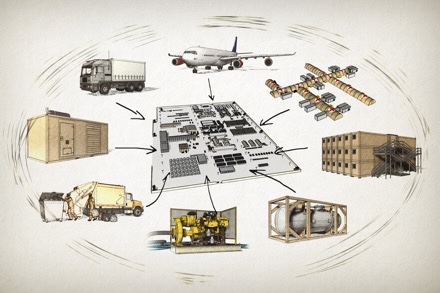
MSE containers comprise a family of modular ambulance facilities manufactured by Zeppelin Mobile Systeme. In the 1970s, various user states procured rescue station, rescue centre light, rescue centre and emergency hospital variants, which are now undergoing a comprehensive overhaul.
MSE rescue centres and field hospitals are used in Bundeswehr areas of operation. Individual systems are designed for special tasks such as the generation and supply of medical gases in the equipment supply container, or GVC. In deployed operations, the technical and medical equipment of the GVC supports the adjacent operating theatre. The container systems are CSC-classified, stackable and thus suitable for transport on container ships. The systems and their equipment are adapted in terms of scope and functionality.
Responsible for mobile deployable mission solutions, Rheinmetall Project Solutions GmbH has been pooling resources and capabilities for mission support since 2019. Rheinmetall AG created the company to handle services and projects for mission support. It provides customers with long-term mission support via specific services.
Dr. Deniz Akitürk, managing director of Rheinmetall Project Solutions GmbH, is proud of the new project: “Rheinmetall Project Solutions GmbH, in association with Rheinmetall Zeppelin Mobile Systeme, delivers comprehensive mission support. In addition to the construction and operation of forward operating bases, we also bundle protection and surveillance capabilities as well as medical expertise for our customers. As a system provider, we are pleased to be supporting the regeneration of medical equipment. In future, we could be modernizing a further 350 accommodation containers.”
The order underlines Rheinmetall’s high level of competence in mission support for the German Bundeswehr in the medical domain.
Noble’s multi-spectral shielding and antimicrobial technology supports modern era of warfare
SCRANTON, PA. (January 10, 2023) — Noble Biomaterials, creator of conductive energy textiles and advanced antimicrobial systems, announces today that its Noble Dfense™ technology is expanding into European countries as the war in Ukraine continues and combat troop demands become increasingly technical.
Noble Biomaterials has been a major supply partner to the United States military for over two decades. Noble’s Dfense™ technology has recently been adopted by government agencies in Israel, Asia, The United Kingdom, and now the product portfolio is expanding to Eastern European countries as the conflict in Ukraine continues.
“Noble Dfense™ has proven highly effective in mission-critical military and aerospace applications,” said Joel Furey, Founder and Chief Commercial Officer at Noble Biomaterials. “Noble Biomaterials has spent years developing multi-spectral energy management systems for security and protection. Whether the objective is to transfer energy, shield energy, or add antimicrobial technology, our portfolio of products embeds capabilities that provide a measurable combat advantage for U.S. forces and our allies.”
Noble Dfense™ products include fiber, fabric, and foam textiles used in soft or hard surfaces for fixed and mobile applications. Commercial products include apparel fabrics, tents, shelters, tapes, wallpapers, and medical devices. Noble Dfense™ was originally developed to permanently mitigate bacteria build-up. The silver technology quickly transitioned into solutions in EMI/RFI shielding, thermal and electrical conductivity, IR signature, biometric monitoring, and static control.
Noble Biomaterials is a registered FDA medical device facility, an essential sole-source technology supplier of medical components to the US military, and a US EPA–registered antimicrobial manufacturer. Noble products are EPA, FIFRA, BPR, and CE conforming.
The silver technology used in Noble Dfense™ provide a mechanical antimicrobial benefit that removes bacteria on fabric. The technology is permanent and never washes out of the fabric. Noble Dfense™ uses passive and active mitigation systems with the ability to counter directed energy attacks in fixed and mobile locations. The technology utilizes proprietary material technology that scatters and shields energy waves by reducing the power of the wave up to 100dB. This level of protection, deployable within soft and hard surface applications, is far above industry commercial standards and is currently utilized by the U.S. Department of Defense and Department of State.
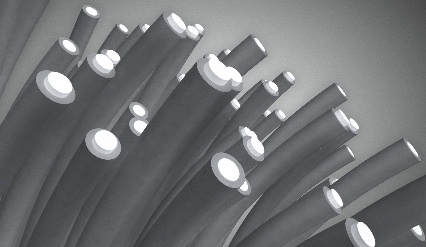
Noble Dfense™Conductive Material from Noble Biomaterials
For more information on Noble Biomaterials and to view their full range of fabric applications, please visit www.noblebiomaterials.com.
Posted in International, Materials, Medical, Press Release | Comments Off on Noble Biomaterials Expands It’s Noble Defense Technology to Military Applications in Eastern Europe
Solution Based Innovation & Creative Tent International Partner to Offer Expeditionary Medical Capabilities
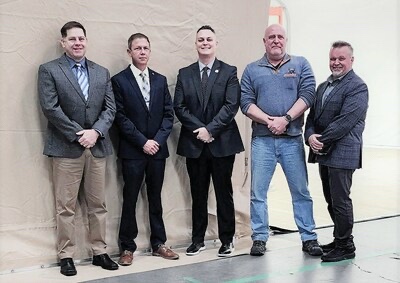
LAS VEGAS and VIRGINIA BEACH, Va. , Jan. 18, 2023 — Solution Based Innovation and Creative Tent International announced today a partnership to produce the most advanced, fully-integrated mobile hospital solution on the market that supports Department of Defense and Department of State missions.
CTI-SBI Team L-R: Micah Butler, CTI Project Mgr.; Paul Wilcox, CTI VP of Sales; Jacob Furbee, CTI CEO; Brad Stewart SBI CEO; Dr. Tim Coakley, SBI CSO
“We’re excited to integrate our expeditionary medical capabilities with Creative Tent International,” said Brad Stewart, CEO of Solution Based Innovation, LLC. “Our expeditionary medical solutions create a capability within the deployable medical space that currently doesn’t exist. With CTI and SBI working collaboratively, we can design, develop, integrate, deliver, and train personnel how to use a true turnkey solution.”
“CTI is excited to welcome SBI as our partner to deliver expeditionary medical capabilities to our customers. This partnership complements our current product portfolio and will enable us to better serve our large, diverse customer base, aligning with our purpose as an organization to provide shelter to the world,” said Jacob Furbee, CEO of Creative Tent International.
For the last two decades, CTI has led the engineered fabric structure industry in providing the warfighter with rapidly deployable, modularly configured shelters that deliver safe, reliable turnkey solutions for every mission including billeting and storage to sunshades and hangars for aircraft, from the MH6M up to the C-5 Super Galaxy. With SBI’s experience deploying UN Level 2 mobile hospitals, the companies will partner to provide engineered, proven structures and shelters systems for use in extreme, austere environments to the defense, aerospace, humanitarian, and healthcare markets. The SBI-CTI partnership adds the capability to integrate customized container systems, like the MeDConeX; expands its LAMS offerings; and creates a larger U.S.-based manufacturing footprint enabling both companies to better serve its customers.
Posted in Medical, Press Release | Comments Off on Mobile Hospital Solutions Support Dept of Defense & Dept of State Initiatives
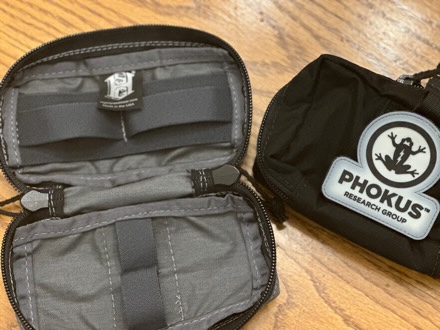
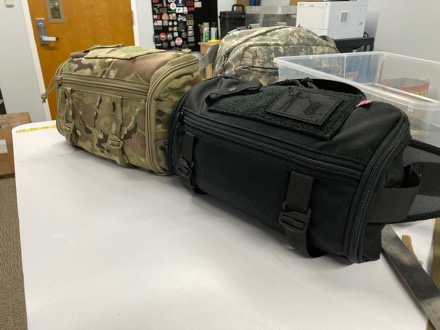
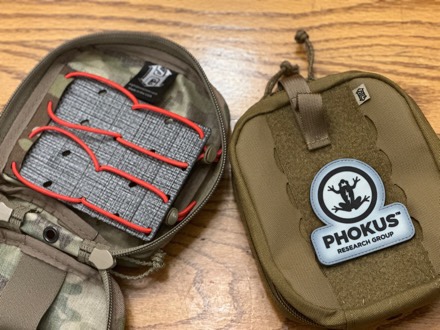
Phokus Research Group and High-Speed Gear® are collaborating in 2023 to bring you a bespoke solution to an age-old problem. Launching their joint Cordura medical line, Phokus and HSGI® have put a spin on Micro Trauma Kits, Individual First Aid Kits, and Combat Lifesaver Bags. With HSGI’s technical ability and industry leading designers, along with Phokus’ medical subject matter experts and years of tactical medical expertise, they have combined their knowledge and created some of the best new pouches in the industry. This brand partnership brings the newest, feature-rich medical kits to those who rely on it most. HSGI and Phokus products are Berry Compliant and 100% USA made.
The bags are lighter, more compact, and more user friendly, but have maximized space and working area to get the most for your tactical medical real estate. These kits have also been updated with the most relevant tactical medical items on the market, making them innovative and a true, lifesaving piece of equipment. We can’t wait for you to see them at Shot Show 2023! HSGI and Phokus welcome you to swing by the High Speed Gear booth to get your hands on the new kits (#75707).
For more information, please reach out to Christopher Bush, Phokus Research Group, chris@phokusresearch.com.
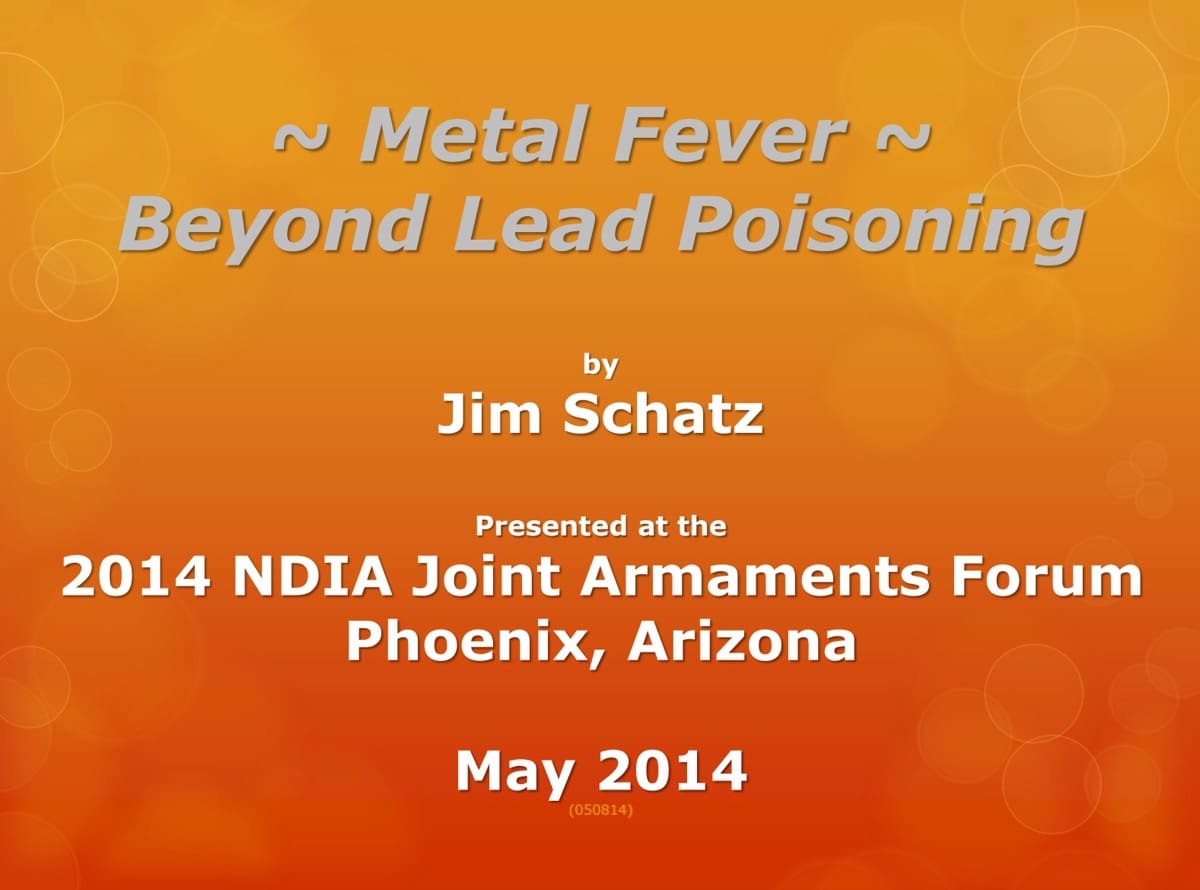
A horrible scourge is stealing the health from many of my friends, and taking the lives of still others. Heavy metal poisoning is an affliction we are just beginning to comprehend. It almost sounds like some quaint illness from the 19th century but its effects are manifesting themselves in members of the profession of arms. So far, the SOF community has been at the forefront of identifying it but as this briefing by Jim Schatz shows, so many more have been exposed to heavy metals.
Jim Schatz left us with a great deal of information on small arms, but this briefing on the effects of heavy metal poisoning, presented to the NDIA Joint Armaments Forum in 2014, is one we should all review. Just take a look at the symptoms. They are easy to rationalize as another illness, or “just getting old”. As you’ll learn in this briefing, exposure is much simpler than spending lots of time in a shoothouse. I’ll go one step further than this briefing and remind those who’ve deployed that exposure to industrial waste is more likely in locales that lack effective means of disposal.
Please, take a few minutes to go over this briefing. Many of our breathren are suffering from the effects of heavy metal poisoning. One of them could be you.
The support of the head and neck complex is critical in all activities including sport, powersports, safety and the military. Attempts to support the neck have failed due to restriction in functional range of motion and comfort. Kapsul Tech is proud to announce its release of the Atlas Shirt. The Atlas shirt provides unparalleled, unrestricted protection and performance enhancement to the Head/Neck complex. Unparalleled, since Kapsul Technology is the only Dynamic Neck Stabilization Technology (DNST) product on the market, in the field, on the field, in the snow or wherever sport or activity happens. Kapsul’s patented solution helps protect the neck (and brain) through the dissipation of force. These forces can include Concussive Force, Repetitive Sub-Concussive Trauma, Posture and Vibration. The technology uses proprietary medical-grade, rate absorptive, viscoelastic foams against the skin and across joints to reduce joint acceleration, under stress and/or strain. The dissipation of force increases joint stability through reducing the load on active (muscles) and passive (ligaments, joint surfaces, etc.) support systems. It also mitigates the risk of injury, pain, strain, and fatigue to empower athletes and service members to do what they love, at their highest level, for as long as possible. All this in a form where the user barely feels it is there, until support is required.
Kapsul Tech was formed in 2015, built around the idea of empowering athletes and service members to do what they love longer through the provision of enhanced support to critical areas of the body. Kapsul is supported by leading edge research facilities and a consortium of Orthopaedic Surgeons, who are responsible for the Worlds leading athletes, including the NFL, CFL, NHL, MLB, NBA, Rugby and World Cup Skiing. The Kapsul Atlas was designed to seamlessly integrate into existing equipment under a variety of conditions and environments.
Why the Neck? To this point there is no solution that supports the neck that does not hinder the neck’s ability to move with an unrestricted range of motion. On the field or battlefield, this range of motion is crucial to optimal performance. Joint mobility comes at a cost. The more mobile the joint, the less stable those joints are. Your neck is especially vulnerable when you perform activities that tire the muscles and challenge ligaments and soft tissues that are the joints’ natural support system. This weakening of your neck’s natural support system and destabilization of its joints render you more susceptible to serious injury and pain from sudden impacts, low-force impacts, repetitive motion, and prolonged postural positions. The neck also controls the motion of the head and the brain housed within it. Acceleration/Deceleration of the neck create a relative acceleration of the brain inside the skull. Support and control of these motions in the head may protect the brain, particularly in conditions that don’t involve blunt force trauma directly to the head.
How does this relate to service members? Members of the military are athletes in their own right. Asked to perform tasks under duress and while carrying heavy loads. Body armor, helmets, night vision and weapon systems all place extreme load on the body. Additionally, the tasks we ask service members to complete, parachute insertion, mobility operations and general combat operations, while wearing kit, produce countless injuries and long-term disability. Kapsul understands this problem and its transition to military products was the clear next step. Actually, the product was born, designed and tested with the military athlete in mind. No single sporting category has the physical demands of the military athlete and injury statistics clearly demonstrate this. Kapsul Tactical will provide stand-alone solutions such as the Atlas shirt, and they are currently working with elements of USSOCOM and CANSOFCOM to develop the next generation of Kapsul protections. These innovations will include the complete integration of the Kapsul collar with existing Programs of Record, including combat shirts, flight suits, dry suits and tactical vests.
While the neck was its first choice, given the number 1 and 2 injuries sustained by US Forces were TBI and Neck Injury, Kapsul is also working to develop integrated support systems for other areas of the body, like the lower back and knees. Lots more to come from Kapsul!
More info on Kapsul and the Atlas Shirt can be found at www.kapsultech.com.
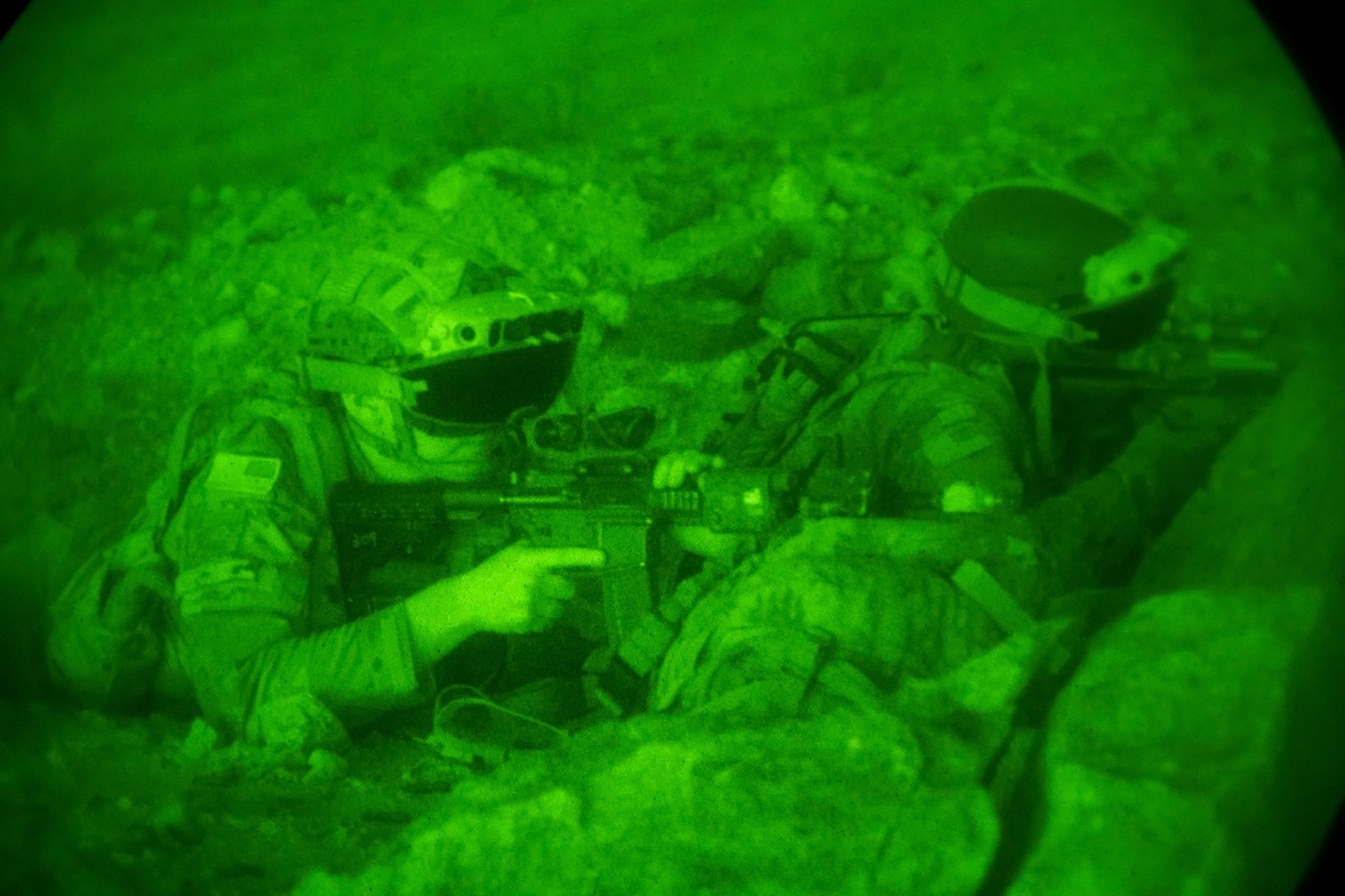
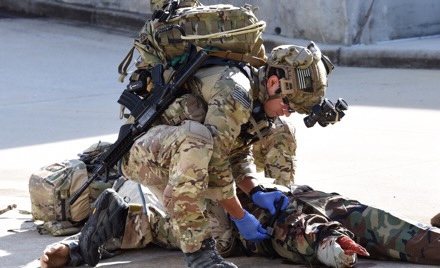
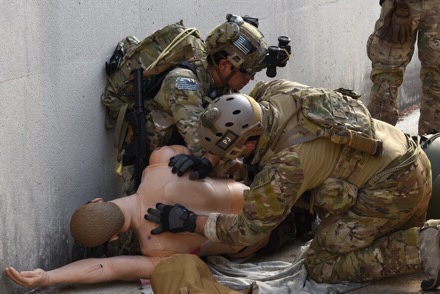
U.S. Air Force Pararescuemen executed the Fall 2022 Special Operations Center for Medical Integration and Development culminating field training exercise in Birmingham, Alabama, Nov. 17, 2022.
Training provided the pararescuemen various controlled scenarios to enhance medical readiness, whether in day-to-day operations or in austere, resource-limited locations.
The culminating FTX was the capstone to a two-week-long certification course where students applied skills learned in civilian hospital care to tactical scenarios.
SOCMID is embedded with the University of Alabama at Birmingham Hospital. Their vision is to establish the premier trauma skills, sustainment and recertification platform for pararescuemen and Special Operations Independent Duty Medical Technicians.
The partnership with UAB Hospital is beneficial to students as it is a level one trauma center, allowing them to conduct clinical rotations in operating and emergency rooms.
“The civilian-military partnerships are important to our sustainment program,” said U.S. Air Force Col. Clayton Rabens, 24th Special Operations Wing command surgeon. “Some of these skills are perishable, so having partnerships like we do with UAB allows us to replicate scenarios and solve problems hands-on, then apply them to tactical scenarios for students to practice.”
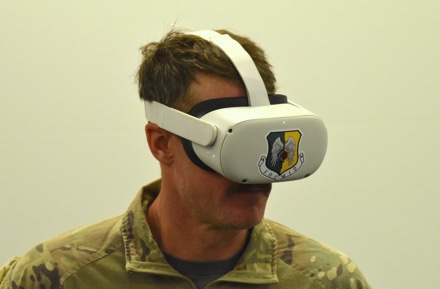
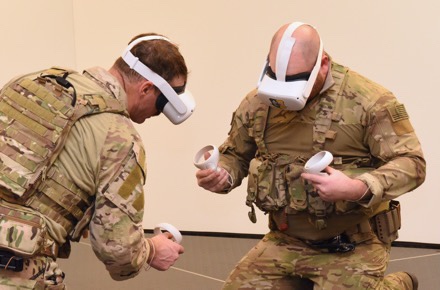
Some of the other training was completed with virtual reality headsets. Specific VR training helps students refine cognitive skills in approaching medical problem sets.
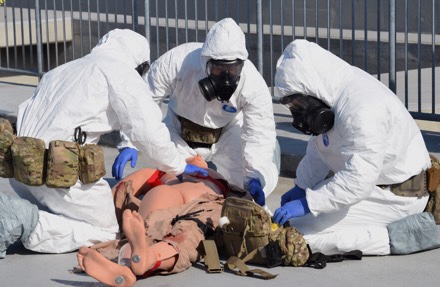
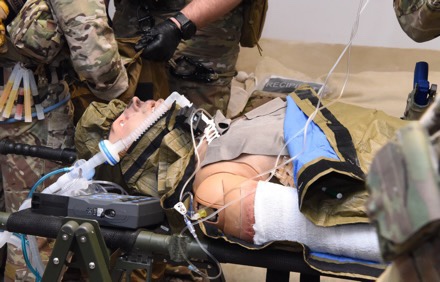
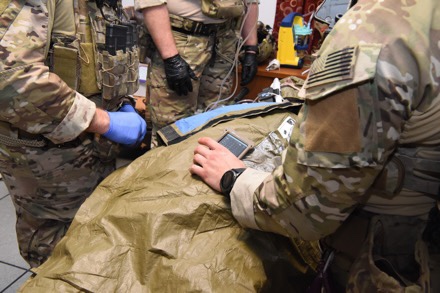
Additionally, prolonged casualty care scenarios allowed pararescue teams to work through casualty care with new skillsets learned while attending SOCMID real-time with wounded mannequins.
“We want to ensure they’re prepared to meet real-world missions,” added Rabens. “The high stress environment they encounter during the FTX ensures we are able to meet that goal.”
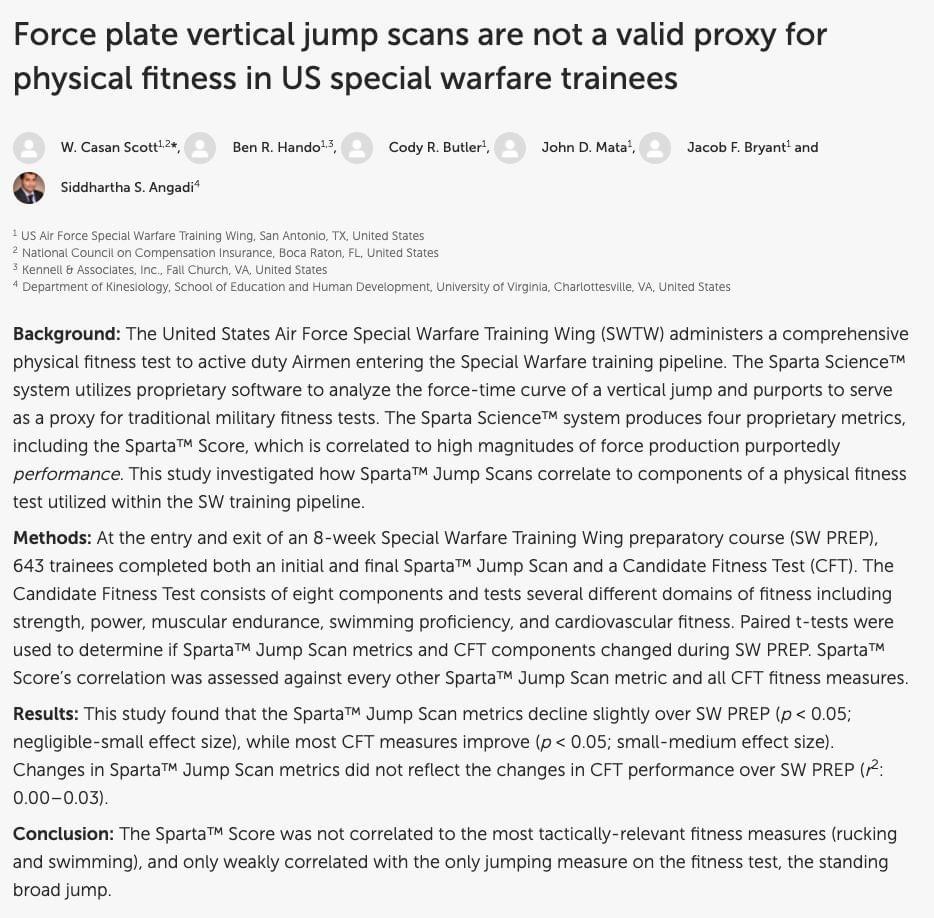
Members of the Air Force Special Warfare Human Performance Support Group’s Research Flight recently published an article in a peer-reviewed journal, “Force plate vertical jump scans are not a valid proxy for physical fitness in US special warfare trainees.”
The Research Flight is the only embedded research team in the DoD, tasked with supporting the Special Warfare Training Wing with data driven decisions to identify trends, maximize the effectiveness and reduce injuries within the pipeline.