TYR Tactical

Archive for the ‘Optics’ Category

BROWE Introduces .300 Blackout Reticle

Tuesday, August 28th, 2012

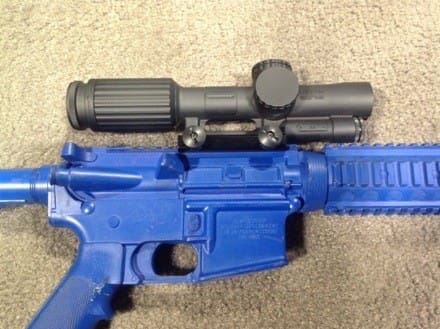
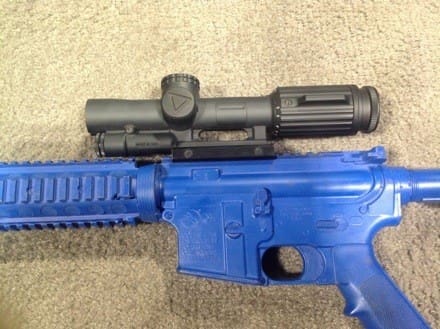
BROWE Optics has released their new reticle pattern for the 4×32 BROWE Combat Optic (BCO) consisting of horseshoe and dot for the .300 Blackout cartridge.

The 4×32 BCO .300 Blackout reticle is based on the popular horseshoe and dot style reticle and provides a bullet drop compensated (BDC) reticle for both the subsonic and supersonic ammunition. The 7 MOA horseshoe has a 5 MOA inner dimension and provides an illuminated 2 MOA wide ring for quick target acquisition. The center 1 MOA dot gives the operator that precision shot and was designed to be zeroed at 100m with the supersonic round or 25m with the subsonic round. For long range precision, the 4×32 BCO .300 Blackout reticle features a BDC reticle that ranges out to 900m for the supersonic and out to 400m for the subsonic. The horizontal stadia lines represent 19” at the indicated ranges. The reticle also offers a horizontal mil scale that has an overall length of 30 mils, with indicators every 5 mil.

The reticle is available in four color options including amber, blue, green, or red with illumination controlled automatically with the BCO Target Light Sensor Technology which adjusts the intensity of the reticle based on the amount of light reflected by the target.

www.browe-inc.com

LAV Talks Aimpoint

Tuesday, August 28th, 2012

LAV explains the various attributes of Aimpoint sights.

Pivothead Introduces Recon Model for Tactical Market

Wednesday, August 22nd, 2012

Awhile back SSD introduced you to Pivothead, manufacturers of eyewear embedded with cameras. Now, they’ve introduced a new version of the Recon model designed specifically for the tactical market.

20120821-155316.jpg

Featuring full 1080P HD video collection, the Pivothead Recon comes with three sets of interchangeable lenses: shooting yellow, clear and grey. Prescription lens services and ANSI 87.1 rated lenses will be available this Fall. Additionally, they’re working on live, wireless streaming technology, which should be released in a few months, so keep an eye out for that as well.

The Recon is currently available in a matte black color with a universal camo pattern being launched later this month. Pivothead eyewear retails for $349.

www.pivothead.com

Sneak Peek – LBX Transporter

Friday, August 10th, 2012

20120810-110652.jpg

The upcoming Transporter from LBX is a licensed Medal of Honor – Warfighter product. It is designed to transport your gaming console in style and features the Honor Camo pattern developed exclusively for the game.

lbxtactical.com

Free Digital Reticle Book – Updated

Monday, August 6th, 2012

Gun Digest is giving away a free digital copy of the “Handbook of Standard Reticle Patterns by Manufacturer”, Compiled by D. Andrew Kopas. It’s a recently expanded reference containing 100-pages of diagrams of tactical reticles from all the major optics manufacturers. All you have to do is register on their site. It’s a pretty handy reference considering how many different reticles are on the market.

www.gundigest.com/reticlebook

Canipe Correspondence – The Next Step in Handgun Sighting

Sunday, August 5th, 2012

Since the invention of the handgun in the 15th century mankind has been steadily improving the concept to what we are familiar with today.  It is quite possible that we are at a point where the notch-and-post sight configuration has reached it maximum potential, and red-dot sights for the handgun are becoming more mainstream.  This is a great trend for shooters for a number of reasons, but it also has a number of drawbacks that should be understood to ensure you have the capability you need when you need it.
 
Red dots on handguns might be more prevalent now than ever before, and that is certainly the case for tactical use.  However, it’s nothing new, and competition shooters have been aware of the benefits of the red dot for speed and accuracy for decades.  As far back as the 1960’s, bullseye shooters experimented with the Burris Bullseye Pistol Scope, and in 1975 Swedish manufacturer Aimpoint released the “Aimpoint Electronic”.  Following these in the late 80’s was the wildly popular Tasco ProPoint and C-More, both of which are still available today.  One does not have to look too hard to find any number of Aimpoint or C-More optics in the hands of  thousands of competitive shooters around the world.  These systems are remarkably effective for their purposes, but due to their size and durability were not practical for duty use.
 
For military/law enforcement/concealed carry use, the trend has just started to gain popularity over the last few years.  The Glock and Smith and Wesson M&P series lend themselves to being modified for direct acceptance of small red-dots. Additionally, dovetail adapters for many platforms are available that do not require costly permanent modification to the pistol.  David Bowie of Bowie  Tactical Concepts was an early adopter of small red-dot sights for duty use, as well as a pioneer in the machining of handgun slides to directly mount the sights.  Due to the fragile nature of some older sights, adoption by Military and Law Enforcement users was slow-paced for a few years.  Recently, with the release of viable optics by industry leaders, their use has skyrocketed and resulted in a huge growth in the development of mounting systems and support products.
 
The mini-red dot has a lot going for it.  It works the same as the Aimpoint or EoTech most people are familiar with on their rifles:  Put dot on target, apply fundamentals.  You can maintain focus on your target instead of the sight, which is something many shooters struggle with.  It removes the variable of aligning the rear notch and front post precisely on target, although it certainly does not make up for poor shooting ability and in no way acts as a substitute for solid shooting technique.  In fact, the new user will likely experience a period of growing pains where the dot is difficult to initially acquire, possibly gets lost in recoil, and is generally slower than when shooting irons until they become familiar with it.  Once the average shooter is familiar with using the new system they are likely to see improvement all around, although skills of high-level competitive shooters are at a level where they are so fast and accurate with iron sights the advantages of the dots might be less useful or even nonexistent.  People who suffer from visual impairments such as astigmatism or “old eyes” can really benefit from the dot, and may be able to regain a level of former accuracy that would have otherwise been impossible due to declining vision.  For military users, the ability to shoot through NVGs to preserve light discipline has been proven on the battlefield with the desired results.  The red-dot also offers a tremendous improvement in the ability to aim while moving, track moving targets, and shoot from unstable or asymmetric positions.  The cost is significant, generally more than the gun it’s going on, and you are tying yourself to a battery powered optic and hoping the electronics hold up to the violent forces of reciprocating on a handgun.  We are not out of the woods on that yet, but the popular modern optics that are suitable for duty use have a pretty admirable track record thus far.  Of note, open-type sights like the RMR, Docter, J-Point and MRDS have a diode that is easily occluded by dirt, precipitation, lint, etc. and can block the projection of the dot onto the lens.  Care must be taken to ensure that his doesn’t happen, on the tubular style sights (such as Aimpoints) the functional parts of the sight are sealed and this isn’t an issue.
 
Among the most popular sights for modern defensive handguns are the Aimpoint Micro T1, Trijicon RMR series, Leupold Deltapoint, and Insight MRDS.  All of these manufacturers are top-tier manufacturers with decades of experience in making electronics or optics for the tactical market.  There are pros and cons to each of them that the user will have to weigh and decide.  Direct mounting capability can be provided by Mark Housel at L&M Precision Gunworks, David Bowie at Bowie Tactical Concepts, and Doug Holloway at ATEI.  Coupled with suppressor height iron sights from Ameriglo, you can have a fast, accurate electronic sighting system with the reliable backup of traditional irons.  L&M also provides the ATOM system from Unity Tactical, which represents the current state-of-the-art mounting system for  handguns.  The ATOM gives the flexibility to use any of the popular red dots mentioned as well as traditional iron sights through the use of interchangeable mounting bases.  This allows the user to forego dedicating a slide to one specific sight only to have it rendered obsolete in the future.  With the ATOM, you simply get a new plate with the new sight’s footprint and you’re set.  This is a huge asset as small electronic sights are likely to evolve and improve in the near future.  Any of these setups can be concealable with the proper base gun and holster setup.  Support gear is available from Raven Concealment and Safariland among other smaller boutique kydex makers.  Safariland developed the excellent 6354DO holsters in conjunction with elite military units to accommodate the Docter, Insight, and Trijicon miniature red-dot sights and is unequaled for a duty rig with your dot.
 
Years ago, many rifle shooters were skeptical about the adoption of dot sighting systems, their reliance on batteries, failure of their circuitry, and other concerns.  Yet today, the battery powered red dot sight is an overwhelming success for duty use on rifles.  The same trend is possibly on the horizon for handguns, certainly the technology is at a point where users with a need for their capability would be wise to start looking into trying a red dot sight for themselves.

For more info, check out the following:

Unity Tactical

L&M Precision Gunworks

ATEI, Inc.

Bowie Tactical Concepts

Jon Canipe served on Active Duty with the US Army as a Special Forces Weapons Sergeant at 5th SFG(A) and was a Senior Instructor at the JFKSWCS, training SFQC students in planning, unconventional warfare, small unit tactics, CQB, and advanced marksmanship. He is a veteran of multiple combat tours, and still serves in the Army National Guard’s 20th SFG(A) in addition to working as an industry consultant and small arms instructor.

Down Range Gear NOD Retention Lanyard

Thursday, August 2nd, 2012

These absolutely work and they are absolutely on sale so if you are looking for an inexpensive leash system for your NVGs then the NOD Retention Lanyard from Down Range Gear is the one for you. It’s a simple mod to install. You just place the lanyard between the helmet and mount.

There are a couple of places that carry DRG products but I know that OP Tactical currently has them on sale.

www.optactical.com/doragenodrel

Special Deal on 3X MIL-Spec AFocal Lens Assemblies from Adams Industries

Wednesday, July 25th, 2012

20120724-210744.jpg

Adams Industries is offering a great deal on 3X MIL-Spec AFocal Lens Assemblies. For those unfamiliar they attach to the front of a night vision system and provide 3 power magnification. Notice they are mil-spec and were built for a contract. Normally, these will run you over $400 but Adams Industries is selling them at $300 until they are gone.

www.adamsindustries.com/Various/Night-Vision/3X-MIL-SPEC-AFOCAL-LENS-ASSEMBLY