TYR Tactical

Archive for the ‘Robotics’ Category

Irregular Warfare Technical Support Directorate Awards Oak Grove Technologies Special Operations Robotics Capability Course Contract

Wednesday, June 5th, 2024

According to a statement by Oak Grove Technologies (OGT), they were recently awarded the Special Operations Robotics Capability Course (SORCC) contract from the Irregular Warfare Technical Support Directorate (IWTSD), under the Assistant Secretary of Defense for Special Operations/Low-Intensity Conflict (ASD SO/LIC), to train on customization and adaptability in Small Uncrewed System Operations.

This is very exciting news as Special Operations Forces (SOF) are at the forefront of small unit unmanned systems across the air, ground and maritime domains.

SOF requires the ability to swiftly redesign, manufacture, build, test, and operate customized small uncrewed systems (sUXS). Please note that the X is used to describe unmanned systems write large while A is used for aerial, G is used for ground and U is used for undersea.

It is also important to note that this effort will build upon the US Army’s John F. Kennedy Special Warfare Center and School’s six week program called Robotics and Unmanned Systems Integration Course (RUSIC) as well as IWTSD Human Performance and Training Subgroup’s Organically Designed and Built Small UAS (ODB sUAS) Course.

Operating often alongside partner forces, SOF leverages readily available equipment to enhance its capabilities. “SOF activities demand agile and adaptable solutions,” said Eli Monroe, Director of Uncrewed Systems at OGT. “By emphasizing customization and leveraging existing resources, we enhance our effectiveness while ensuring compatibility within diverse operational environments.”

Efforts are underway to address these training gaps, focusing on efficiently incorporating methodologies for sourcing, procuring, and manufacturing tailored systems using commercially available components. This initiative aims to empower SOF operators with the knowledge and skills necessary to optimize the utilization of small uncrewed systems in their missions.

Milrem Robotics Expands Its Production Capability Fivefold

Friday, May 24th, 2024

Tallinn, Estonia – 23 May 2024: Milrem Robotics, the world’s leading robotics and autonomous systems developer, has expanded its production capability fivefold by opening a new facility that allows the company to satisfy the growing need for intelligent robotics solutions by end-users.

The new facility next to Milrem Robotics’ headquarters in Tallinn, Estonia, allows the company to manufacture 500 units of its operationally proven, multi-mission THeMIS Unmanned Ground Vehicle yearly.

The THeMIS is already part of robotics programs in 18 different countries internationally, eight of which are members of NATO, including Estonia, France, Germany, the Netherlands, Norway, Spain, the UK, and the US. THeMIS UGVs are also assisting Ukrainian soldiers in the war with Russia.

“Many end-users, satisfied with the results of testing the robotic vehicles, are preparing to launch high-quantity procurements. With the opening of our new facility, we are better prepared to answer these calls,” explained Kuldar Väärsi, CEO of Milrem Robotics. “Also, the growing use of UGVs in Ukraine shows a clear focus and importance of unmanned ground systems,” he added.

In addition to production, Milrem Robotics will also expand its prototyping facilities to speed up the development of new products in the company’s growing portfolio. An extra 1000 square meters of office space has also been added.

“Unlike other technology companies who announced layoffs during 2023, Milrem Robotics is continuing to grow this year and hiring 100 new employees, mostly in Europe,” Väärsi added.

Additionally, the expansion is estimated to indirectly generate further positions with high-technology partners and suppliers, contributing to developing the local talent pool and economy.

“The expansion of the Estonian defence industry is beneficial from both a security and economic perspective,” said Kusti Salm, permanent secretary of the Ministry of Defence of Estonia.

“For many years, Estonia’s defence industry policy has aimed to develop a high-tech defence industry that can be competitive in export markets. Milrem Robotics is a good example of how a defence industry start-up has grown in 10 years into a large and innovative industrial company, in Estonian terms, with a wide international customer base that can include a wide range of Estonian subcontractors, engineers and specialists in its network. The creation of such companies – and others that have been established in recent years – is a sign of the maturity of the Estonian defence industry and the potential to contribute more to national defence and economic development,” Salm said.

Milrem Robotics is the world’s leading robotics and autonomous systems developer and systems integrator, with offices in Estonia, Finland, Sweden, the Netherlands, and the US. The company is known for its THeMIS and Multiscope UGVs, the Type-X Robotic Combat Vehicle, and MIFIK.

The company is also renowned for successfully completing the European Defence Industrial Development Programme (EDIDP) project iMUGS, which focused on developing a modular and scalable architecture for hybrid manned-unmanned systems.

AimLock: Leading the Charge in Semi-Autonomous Weapons Tech

Wednesday, May 22nd, 2024

Denver, CO – AimLock, a pivotal innovator in the defense industry, continues to redefine precision targeting and engagement capabilities with its state-of-the-art semi-autonomous weapon systems.

Since its inception in 2009 and incorporation in 2013, AimLock has been at the forefront of integrating cutting-edge technologies such as artificial intelligence, sensor management, and computer vision into advanced weapons systems, enhancing targeting accuracy and operational efficiency in combat scenarios.

AimLock’s dedication to enhancing the capabilities of warfighters while ensuring their safety through advanced technologies is unwavering,” said Bryan Bockmon, CEO of AimLock. “Our systems are designed to increase the speed, accuracy, and safety of military engagements, making them indispensable in modern warfare.

Revolutionizing Military Engagements with Core Targeting Module

Central to AimLock’s technology suite is the Core Targeting Module (CTM), a robust computing solution that drives precision in fire control and platform management across air, ground, and unmanned systems. The compact, IP67-rated CTM brings unprecedented processing power to various military applications, from unmanned mission computing to guided weapons launch control.

Seamless Integration with Legacy Systems

AimLock excels at marrying new technologies with existing military hardware. Integrating the Core Targeting Module into legacy systems enhances their efficacy without necessitating complete overhauls, bridging the gap between traditional and modern warfare technologies.

Innovative Semi-Autonomous Weapon Systems

AimLock’s portfolio includes the I-M1 and R-M1 systems, which significantly enhance the capabilities of medium-range rifles and machine guns by introducing autonomous targeting features that improve accuracy and reduce response times in dynamic combat environments.

The R-S1 system, part of AimLock’s R-S Series, offers versatile applications, ranging from sniper overwatch to precision strike capabilities. It is designed to function effectively in both ground and aerial engagements.

Remote Operated Launch System (ROLS)

The Remote Operated Launch System further underscores AimLock’s innovation in semi-autonomous weaponry. Integrating the Core Targeting Module with a single launch tube for APKWS, ROLS extends the reach and precision of this established weapon system across various new platforms.

Leading the Future of Defense Technology

As AimLock continues pushing the boundaries of military technology, it invites defense departments and industry stakeholders to experience the transformative effects of its semi-autonomous systems. With a steadfast commitment to enhancing combat effectiveness and warfighter safety, AimLock remains a player in the evolution of modern military operations.

For more information on AimLock’s innovative solutions or to schedule a demonstration, please contact us.

SOF Week 24 – DefendTex Banshee

Tuesday, May 7th, 2024

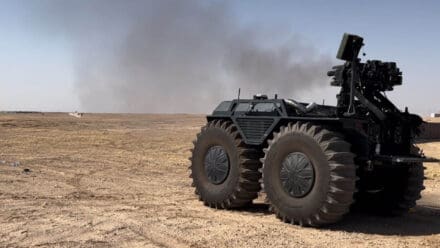
During the 2022 Land Forces conference in Australia we have you a sneak preview of the Banshee Land Autonomous Munitions Platform. At this year’s SOF Week, manufacturer DefendTex has unveiled the production version.

The Banshee is an Autonomous Unmanned Ground Vehicle which serves a a platform for ISR, anti-tank and Anti-Access Area-Denial (A2/AD) missions. It offers a top speed 100 km/h top speed with a 30km range.

Although it’s not as sleek as the prototype, it is certainly a rigged, functional design which will accept a variety of mission payloads.

Milrem Robotics Awarded Contract to Deliver THeMIS UGVs to Japan

Wednesday, April 17th, 2024

Milrem Robotics, Europe’s leading robotics and autonomous systems developer, has been awarded a contract to supply the Japanese Ground Self-Defense Forces with THeMIS unmanned ground vehicles.

The company will supply Japan with three THeMIS UGVs configured for various tasks, including supply transportation and intelligence gathering. The vehicles are equipped with Milrem’s Intelligent Functions Kit (MIFIK), enabling them to execute on- and off-road operations independently. MIFIK allows UGV operators to plan missions using waypoint navigation and set en-route vehicle behaviours.

MIFIK is used strictly for vehicle mobility.

“The goal of the Ground Self-Defense Forces is to fundamentally strengthen its defence capabilities with unmanned assets in order to gain asymmetric superiority while limiting human losses. A task to which UGVs are uniquely qualified,” said Kuldar Väärsi, CEO of Milrem Robotics.

“We are honoured that the Japanese Ground Self-Defense Forces has selected us to support them in increasing thecombat effectiveness of their ground forces through advanced robotics and achieving their capability goals,” he added.

THeMIS UGVs were selected by the Japan Ministry of Defense as a target of the newly introduced Rapid Acquisition Program. Milrem Robotics will provide maximum support for Japan to be equipped as soon as possible.

In addition, THeMIS UGVs were chosen because they utilise cutting-edge technology and have already been adopted in 16 countries, including eight NATO countries: Estonia, France, Germany, the Netherlands, Norway, Spain, the UK, and the US. THeMIS UGVs are also assisting Ukrainian soldiers in the war with Russia.

It is expected that THeMIS UGVs will provide new ways to keep more soldiers safe and make operations more efficient for the Japan Self-Defense Forces.

Rheinmetall to Supply Japan with its First Fleet of Autonomous Vehicles

Monday, April 8th, 2024

Rheinmetall paves the way for autonomous Unmanned Ground Vehicles (UGVs) in Japan after being awarded a multimillion-dollar contract on behalf of the Japanese Ministry of Defence. 
The Rheinmetall Mission Master SP UGVs are expected to be delivered early next year for testing. These compact, low-signature electric UGVs will each be equipped with different payload modules, including cargo, surveillance and a remote-controlled weapon station. The contract also includes a long-term support and training program, as well as spare parts.  

Rheinmetall will deliver the UGVs in collaboration with the prime contractor Marubeni Aerospace, a major Japanese business conglomerate that will be trained by Rheinmetall to offer local support to the Japan Ground Self-Defense Force. 

Rheinmetall Mission Master SP

The Rheinmetall Mission Master SP is a fully electric, compact UGV that is designed to autonomously carry out missions such as forward and last mile resupply missions, silent watch operations, and carriages of light payloads, including section sensors and weapon systems. The vehicle can be towed or deployed by parachute to carry out missions in hard-to-reach terrain, and fitted with tracks to enhance mobility in deep snow and mud—an ideal feature for countries with extreme climates like Japan.

The Mission Master SP was the first UGV to be developed by Rheinmetall Canada in 2017 and has since been deployed during multiple live military exercises by land forces, including the German, USA, Royal Dutch, and Polish armies. Various NATO partners, such as the UK and the USA have also acquired this UGV.

Autonomous solutions for the modern battlefield

Like other platforms in the Rheinmetall Mission Master family, the SP vehicle is driven by Rheinmetall PATH: an AI-powered navigation system that can be installed on any vehicle. This agnostic suite of advanced sensors and perception algorithms enables the Mission Master vehicles to navigate autonomously through challenging environments.

“As international tensions continue to rise, more and more countries are seeking autonomous solutions to maintain a competitive advantage and prepare for the modern battlefield. Our Mission Master vehicles equipped with our PATH A-kit have performed well in numerous international trials in recent years. These experiences have allowed us to refine our technology and become an internationally renowned centre of excellence for UGVs” recounts Pietro Mazzei, President and CEO at Rheinmetall Canada.

To find out more about the Rheinmetall Mission Master family of UGVs, visit rheinmetall.com

Transforming DOD: PC-C4 Prepares for the Future Battlefield

Thursday, March 28th, 2024

FORT IRWIN, Calif. — On the beaches, oceans, air and deserts of the U.S. West Coast, more than 4,000 members of the joint force, civilians, contractors, and militaries from the United Kingdom, Australia, Canada, New Zealand, France and Japan experimented with more than 200 technologies in the Army’s largest experiment in the dirt, Project Convergence Capstone 4.

Two phases, primarily conducted in California at Camp Pendleton and the National Training Center, allowed experimenters to work in arduous conditions and experiment with cutting-edge technology in as close to a real-world environment as possible. Distant locations also supported the experiment up and down the West Coast and the Pacific region to experiment through time, distance and complexity.

Technology getting to PC-C4 itself takes time and goes through a review process designed to save PC-C4 time and money by ensuring only the most promising technologies make their way to the capstone experiment. All technology at PC-C4 could fill a potential gap or provide a capability designated as necessary by senior leaders. Nascent technologies go through the Science Technology and Review Board before spending time at a myriad of other experiments and lab-based risk reduction activities, all before they ever make their way to NTC or Camp Pendleton.

“There are plenty of technologies we find out aren’t mature enough or don’t fill a gap or capability the way we thought, so they get withdrawn way before Capstone 4 takes place,” said Mindy Gabbert, experiment division chief at the U.S. Army Combat Capabilities Development Command.

Not only does this scrutiny save money and time once the experiment begins at PC-C4, but it also ensures that all players involved in putting on PC-C4 already have working relationships.

“It’s not just a yes or no process. It’s going through those prior risk reduction activities that allows the broader community to see those technologies and just to be familiar with them before they get here so that they can properly fit them into the exercise, so that they can make sure that we are aligning them with the right use cases and the other right opportunities out here,” Gabbert said. “So, in addition to the technical aspects of those technologies, it’s just building that knowledge base within the community of what’s out there and bridges that community by building the whole body of knowledge we’re all working on.”

Since 2020, Project Convergence (PC) has grown exponentially in scale and scope. PC-C4 was the largest PC experiment yet, with participation from the United States Army, Navy, Marine Corps, Air Force and multinational partners.

“The first PC was conducted in 2020. It was Army only and focused on a specific time between the identification of a target and an effector shooting on that target,” said Lt. Gen. Ross Coffman, United States Army Futures Command deputy commanding general. “And from there, we decided the Army will never fight alone, so let’s get the entire joint force focused on this problem set.”

“This year, we have increased the threat envelope to 10 times what we did last year. With the entire joint force and our U.K. and Australian teammates and allies, we were able to effectively move data for the first time in an Indo-Pacific scenario at a magnitude we’ve never seen before,” Coffman said.

PC-C4 informed combined, joint all-domain situational awareness, command and control, integrated offensive and defensive fires, defeat large target array, human machine integration and how to sustain the force over large-scale combat operations, dubbed contested logistics.

One of the significant successes of PC-C4 was the integration of sensors and fires to ensure that the force is best able to stop incoming missiles without depleting munitions unnecessarily. Coffman explained that they used offensive and defensive fires to tackle the problem and ensure that sensors have interoperability between the branches to ensure the right sensors pick up the threat and the right shooter takes it out, so the military does not waste munitions.

“It’s not our job to go fill up the magazines to the level we’d like them to be, but it is our job to ensure that we can connect my sensors to his fires and his sensors to my fires because I might have the most available weapon where he’s got the most survivable sensor and vice versa,” said Vice Adm. Michael Boyle, Third Fleet commander. “And that’s really what this is about; it’s enabling us to pick from whatever magazine we need.”

Another major win for PC-C4 was the increased ability to push data through a fully networked command, control and communications system. This allowed for more significant amounts of data to be pushed to the Joint and Allied forces.

“When you put stress on untested equipment, you’re going to learn things,” Coffman said. “One of the interesting things is that as we increase the pipe on this cross, it worked magnificently. It could pass a large amount of data that we had not seen before we tested it last year, and we could see it was nascent. We were able to pass data successfully.”

Great strides in contested logistics experiments also took place across both phases. Experiments involving beach landings, drones and printing technology were showcased, and for the first time, a repair part for an Army system was printed out at sea on a Navy vessel.

“Envision the printer was on the vessel,” said Col. Shane Upton, director of the Contested Logistics Cross-Functional Team. “They printed the part, we put it on an unmarried unmanned aerial system, a drone, and flew it onto the beach to the point of need. In a contested environment where you don’t have a permissive flow of sustainment, you’ve got to use some of these exquisite technologies. That’s why we’re experimenting with them.”

Now that PC-C4 has wrapped up after several weeks of experimentation, the data collected will be analyzed to inform future acquisition and force structure decisions and aggressively advance and integrate Army contributions to the Joint and Combined fight.

“It’s worth every penny,” Coffman said of the experiment. “The readiness of the joint force and the partnership with our allies is invaluable. When called upon, the women and men of this nation and the women and men of other nations will fight side by side to preserve liberty, and that cost is worth every penny.”

By Matthew Murch, Futures and Concepts Center

American Rheinmetall Vehicles Conducts Live-Fire Demo and Continues to Deliver Autonomous Ground Vehicles to the U.S. Marine Corps for Testing, Training, and Deployment

Friday, March 15th, 2024

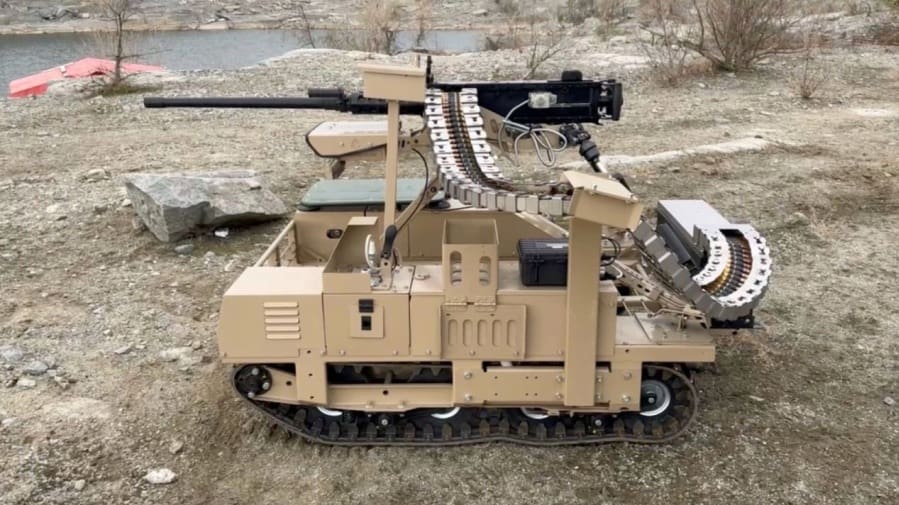
American Rheinmetall Vehicles (Sterling Heights, MI) and Rheinmetall Canada have successfully conducted a live-fire capability demonstration for the U.S. Marine Corps (USMC) in Fort Clinton, Ohio to highlight the unique capabilities of the Rheinmetall Mission Master SP autonomous, unmanned ground vehicle (A-UGV) paired with the Fieldranger Remotely Controlled Weapon Station (RCWS). This armed variant of the Rheinmetall Mission Master SP provides Marines a variety of remote operated capabilities including armed reconnaisance, sentry over watch, fire support, flank security, screening capability, and more. Having completed numerous test and evaluation events with the Mission Master SP, American Rheinmetall Vehicles continues to deliver ground-breaking advancements in A-UGV systems to the USMC. It first made deliveries to the USMC in early 2023, and several follow-on orders for A-UGVs are proceeding in 2024. The platforms have the potential to substantially enhance the way Marines fight. 


Mission Master SPs furnished by American Rheinmetall Vehicles were also extensively tested by the USMC during the Talisman Sabre Exercise (TS23) in Queensland, Australia, in summer 2023 and as part of the Apollo Shield exercise at Marine Corps Base, Twentynine Palms, California, in fall 2023, both in support of Marine Corps Warfighting Lab (MCWL) evaluations. The Mission Master SPs’ participation supported MCWL’s one year, crawl-walk-run, bilateral effort to test equipment capabilities and evaluate tactics, techniques, and procedures of Infantry squads equipped with A-UGVs. Tasks the Mission Master SP A-UGVs took on during the exercises included casualty evacuations (CASEVAC), resupply missions, fully autonomous road marches reaching ranges up to 50 kilometers, and operating in Military Operations in Urban Terrain (MOUT) environments. Feedback from the Marines and their Commanders drove A-UGV design modifications and solidified the benefits of A-UGVs among Marines.

In December 2023, American Rheinmetall Vehicles received an order to manufacture and deliver six Mission Master SPs which are slated for delivery to III Marine Expeditionary Force (MEF) to support further training and evaluation. Four of the Mission Master SPs will support 3rd Battalion, 4th Marines, who will be the first unit to conduct pre-deployment work-ups and deploy with the A-UGVs.


“Bringing the capabilities of the Mission Master SP A-UGV to today‘s Marines gives me great pride in knowing that lives will be saved and Marines will be better prepared for battle,“ said Mike Brooks, Gunner (CW05) USMC Ret., and Director of Business Development for American Rheinmetall Vehicles. 

“MCWL’s experimentation with state-of-the-art autonomous systems exemplifies our commitment to harnessing innovative technologies that enhance our tactical capabilities, ensuring our Marines are better equipped, more agile, and always a step ahead on the battlefield,” stated Maj Steven Atkinson, Robotics & Autonomy and Artificial Intelligence Branch Head for the Science and Technology Division of the Marine Corps Warfighting Laboratory. 

Rheinmetall PATH A-kit: A platform-agnostic, next-generation system that brings autonomous mobility to any vehicle 

Each of Rheinmetall’s Mission Master SP A-UGVs uses the Rheinmetall PATH autonomy kit (A-kit), a navigation system developed by Rheinmetall Canada that enables fully autonomous movement and mission planning for vehicles. It can be rapidly added onto existing legacy vehicles or integrated into the latest next-generation platforms. It is a core element of Rheinmetall’s exceptional Mission Master family of autonomous vehicles and combines advanced sensors, technology leading algorithms, and real-time data analysis to allow vehicle platforms to maneuver autonomously in a wide range of operating environments. Fielded and tested on this family of vehicles, but also a wide array of other platforms, the PATH A-kit is a mature, proven technology that stands out from the competition providing a high degree of autonomous mobility. 

American Rheinmetall Vehicles is leveraging the PATH A-kit technology to supply program specific vehicle solutions for the U.S. Army’s Common Tactical Truck program and XM30 program. 
?

www.rheinmetall.com/arv 

Unmanned and Unmatched.