FirstSpear TV

Archive for the ‘Robotics’ Category

Rheinmetall and Escribano Demonstrate New Modules for the Mission Master SP A-UGV

Tuesday, August 10th, 2021

Rheinmetall and Escribano Mechanical & Engineering (EM&E) have collaborated in recent months in order to demonstrate two new Rheinmetall Mission Master SP modules carrying EM&E sensors and weapons systems. A series of demonstrations took place at EM&E’s new facilities in San Juan del Viso in the presence of Spanish government officials, including the Army chief of staff and international delegations. A demonstration for His Majesty King Felipe VI was also held at Viator in the Province Almería in southern Spain.

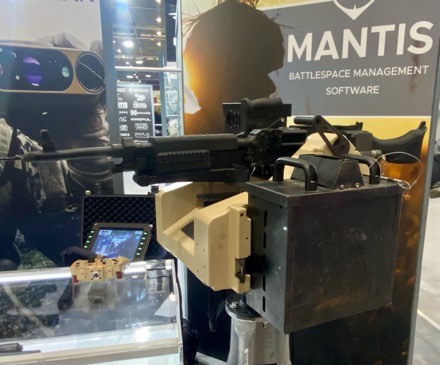
The demonstrations involved two Mission Master SP Autonomous Unmanned Ground Vehicles (A-UGVs). For these activities, a Mission Master SP – Fire Support was equipped with the Escribano Guardian 2.0 Remote Weapon Station (RWS), while a Mission Master SP – Surveillance carried the Escribano OTEOS sensor package. Thanks to the mast-mounted OTEOS, the Mission Master SP – Surveillance successfully detected a threat and automatically shared its location with the Mission Master SP – Fire support, triggering a slew-to-cue. Various Mission Master control modes were showcased, including follow-me, autonomous navigation, and convoy modes.

Live firing with the Mission Master SP – Fire Support equipped with the Escribano Guardian 2.0 RWS in the Dillon Aero M134D configuration was conducted using UGV/RWS portable controllers integrated with a safety board architecture, allowing safe wireless firing. As with all Mission Master operations, targets are never engaged automatically. A human in the loop is always required for all kinetic decisions.

For Rheinmetall Canada, this series of demonstrations in Spain marks the first integration of an EM&E payload on its Mission Master SP A-UGV and its first collaboration with a Spanish company. This success underscores Rheinmetall’s mastery of system integration and the growing capabilities of its Mission Master family.

Warrior East 21 – Tomahawk Robotics

Thursday, August 5th, 2021

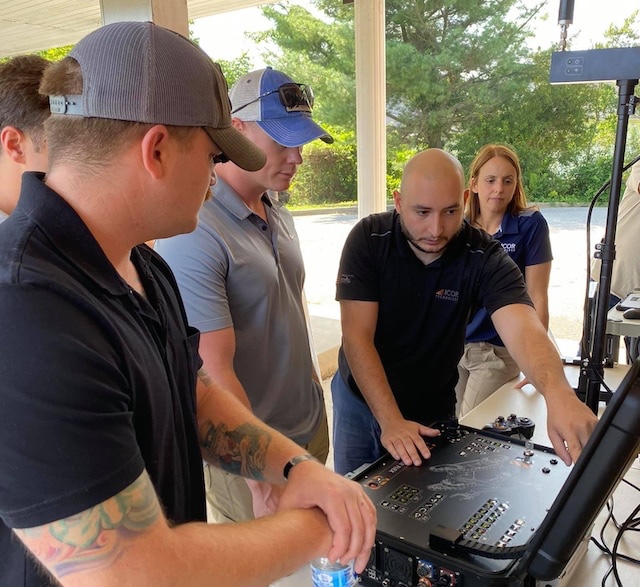
Tomahawk Robotics displayed several technologies at Warrior East but the one that caught my eye is the Grip S20 Controller. It is based around the Samsung Galaxy S20 End User Device and offers controls for unmanned systems. This protective case also incorporates an integral USB hub.

Another item is the Mimic Spatial Controller which is a tactile trigger-style device many in EOD prefer to use. It is Intra Soldier Wireless compatible and provides haptic feedback of payload control.

Additionally, Tomahawk Robotics offers the MXC Family of Micro Datalinks which can be had as a stand-alone battery powered model or a more streamlined version which uses radio battery juice. With this datalink, the user can not only receive ISR feeds but also retransmit them to others in their network.

Units and agencies can procure Tomahawk Robotics products shown during Warrior East by contacting Atlantic Diving Supply.

Army’s GVSC, Picatinny Arsenal Test Robotic Combat Vehicle Prototype at Fort Dix

Thursday, August 5th, 2021

JOINT BASE MCGUIRE-DIX-LAKEHURST, New Jersey– Members of the U.S. Army Combat Capabilities Development Command (DEVCOM) Armaments Center at Picatinny Arsenal, New Jersey, and Ground Vehicle Systems Center (GVSC) located in Detroit Arsenal, Michigan, joined together on a range at Fort Dix June 30 to perform a live-fire test of a Robotic Combat Vehicle-Medium (RCV-M), an experimental prototype under the Next Generation Combat Vehicle Cross-Functional Team (NGCV CFT).

The tests focused on firing the RCV-M’s XM813 main gun, as well as its M240 machine gun, from an unmanned and wirelessly-operated weapon station.

“We want to look at the integration of a turret, which was provided as government furnished equipment to the effort, onto the platform,” said Mike Mera, an engineer in the Remote Weapons Branch at Picatinny Arsenal.

The RCV-M program is a joint collaboration among the NGCV CFT, Product Manager Maneuver Combat Systems (PM MCS), Product Manager Soldier Lethality (PM SL), and Combat Capabilities Development Command. The RCV-M platform includes products from Textron, Howe and Howe Technologies, FLIR, and Kongsberg Defence & Aerospace (KDA).

“We’re using high speed cameras to look at the platform, cannon, and turret dynamics,” Mera said. “We’ve got data collection systems downrange to collect the dispersion information, and we’ll evaluate both the performance and quality of the overall integration to make sure expectations are being met.”

The verification exercise ensured the stringent requirements for the turret and host platform were not only met by design, but also in reality.

“Here, we’re evaluating the armaments integration, but the overall expectation is to get these into the Soldiers’ hands and perform some experimentation as part of a regular training regimen down at Fort Hood, Texas, next summer,” Mera said.

Although this system has been in the works for approximately 18 months, this was its first live-fire test.


A Robotic Combat Vehicle-Medium fires a around at a target during the vehicle’s live fire testing at Fort Dix, N.J., June 30, 2021. The testing prepares the vehicle’s systems and the engineers who design and operate it the opportunity to exercise its capabilities before the 2022 Soldier Operational Experiment at Fort Hood, Texas. (U.S. Army photo by Angelique N. Smythe/Released)

“To date, there hasn’t been any testing other than in the lab,” Mera said.

The RCV-M armament system’s control station was housed in a Mission Enabling Technologies Demonstrator (MET-D). From there, crewmembers were able to move, shoot and communicate through a mixture of touchscreen panels and physical controls.

“We’ve got personnel from the Armaments Center – both government employees as well as employees of Booz Allen Hamilton,” Mera said. “The Booz Allen folks perform the energetic operations. They’re our gunners and loaders. The government personnel serve in the capacity of the officer in charge of the range – that’s myself, and the range safety officer, as well as other support. We’ve also got folks from the Ground Vehicle Systems Center. They’re supporting the platform, monitoring the overall test, providing a lot of logistic support.”

Several GVSC and Armaments Center officials also visited the range to observe the demonstration, such as Michael Cadieux, director of GVSC, and Mark Ford, Director of the DEVCOM Armaments Center Weapon Systems and Technology Directorate, among others.

Cristian Bara, a GVSC test engineer for the RCV-M and MET-D, said he also came from Michigan to observe how the guns performed from the test plan perspective and to ensure the quality of the systems were where they needed to be.

“These are all prototypes,” Bara said. “This is the first system that we’ve developed where we have a gun of this caliber mounted on the robot, a completely unmanned robot, and that is also controlled from a different location or within the manned combat vehicle; it’s certainly unique.”

The functional check ensures the MET-D and RCV systems communicate properly, messages and data are received on both ends, and the hardware and software also perform as intended.

“The overall goal is to ensure that the systems, technologies and capabilities work as we design them and are being used as intended,” Bara said. “We want to make sure we deliver a solid product to Soldiers because we’re trying to save lives.”

Another observer from Detroit Arsenal, Col. Jeffrey Jurand, Project Manager, Maneuver Combat Systems at PEO Ground Combat Systems, said a robotic platform allows the ability to fight wars without risking the lives of Soldiers.


Engineers and program officers from the U.S. Army DEVCOM Ground Vehicle Systems Center and DEVCOM Armaments Center operate a robotic vehicle crew station from inside a Mission Enabling Technologies-Demonstrator vehicle at Fort Dix, N.J., June 30, 2021. The crew station allows Soldiers to provide waypoints or remotely operate Robotic Combat Vehicles from a distance. (U.S. Army Photo by Angelique N. Smythe/Released)

“We’re taking humans out of harm’s way,” he said. “Although it’s something we’d want to avoid, if the vehicle were to be lost, we’re not losing Soldiers. We can build new vehicles.”

The RCV-M live-fire demonstration took place at Fort Dix on ranges formerly used to train Abrams and Bradley crews in gunnery from manned combat vehicles.

“It is fitting this range is now being used to test and develop the robots that will one day fight alongside them,” said Mera.

“We wanted to do it at Camp Grayling [Michigan] because it’s closer to home, but there are a lot of active units training out there,” Bara said. “Fort Dix was available, and also Picatinny is close. Picatinny is our partner in weapons integration.”


Fort Dix is the common name for the Army Support Activity located at Joint Base McGuire-Dix-Lakehurst. It is located less than two hours south of Picatinny Arsenal. The partnership between the two installations allowed for flexibility in scheduling the range for testing of experimental systems in relevant environmental and training conditions.

By Angelique N. Smythe, Picatinny Arsenal Public Affairs

Rheinmetall’s Optionally Manned Fighting Vehicle Concept Down-selected for U.S. Army’s program – Team of Industry-leading Experts to Digitally Design Advanced OMFV

Monday, July 26th, 2021

The U.S. Army has awarded American Rheinmetall Vehicles – a Sterling Heights, MI, U.S. subsidiary of leading defense industry giant Rheinmetall – a develop¬mental contract for the Phase 2 Digital Design of the Optionally Manned Fighting Vehicle (OMFV) program. American Rheinmetall Vehicles will execute Phase 2 with its teammates, a group of unsurpassed defense industry companies, including Raytheon Technologies, L3Harris Technologies, Textron Systems and Allison Transmission.

The U.S. Army’s OMFV program is a ground-modernization effort to replace nearly 3,800 Bradley Fighting Vehicles among the U.S. Army’s Armored Brigade Combat Teams.

“This is a great win for American Rhein¬metall Vehicles and Team Lynx as a whole,” said Matt Warnick, Managing Director of American Rheinmetall Vehicles. “With this contract award, we take another important step forward in bringing the kind of next-generation technology solution, partnership and industrial capability the U.S. Army deserves and that Team Lynx is so well prepared to deliver for the OMFV program.”

Team Lynx will work with the U.S. Army on the digitally engineered design and development of the team’s OMFV concept using Rheinmetall’s proven Lynx KF41 Infantry Fighting Vehicle (IFV) as the point of departure for the design. The team’s solution will provide the U.S. Army with a next-generation infantry fighting vehicle featuring a game-changing platform with a modular open systems architecture. This will enable rapid insertion of new capabilities as they become available, guaranteeing overmatch today and overmatch tomorrow.

Variants of American Rheinmetall Vehicle’s Lynx KF41 IFV are advancing in multiple countries around the world. The Hungarian Army became the launch customer in 2020 with an order for 218 locally produced vehicles. In Australia, for the Land 400 Phase 3 program, Rheinmetall was down selected along with one other combat vehicle manufacturer for a risk reduction test phase that involves extensive vehicle testing comprised of field trials, survivability and mobility testing. The KF41 performed to a high standard.

The Digital Design Phase kicks off the OMFV program and continues through early 2023, laying the foundation for future development and production phases. Team Lynx is developing industrialization plans to fully deliver the OMFV as a Made in the USA, next-generation vehicle. The team will grow U.S. Defense manufacturing capacity and introduce advanced manufacturing capabilities. Competition for Phase 3 (Detailed Design) is anticipated to start in 2023, followed by Phase 4 (Prototype Build and Test), which results in government testing in early 2026.

“We are incredibly proud at American Rheinmetall of the commitment we are making to the US Army, to Soldiers and to advanced American technology, design and production,” said Stephen Hedger, CEO at American Rheinmetall Defense, the U.S. parent headquarters for Rheinmetall.

U.S. Army Live-Fire Exercise at Fort Benning Demonstrates Future Lethality of Kongsberg Remote Weapon Systems

Friday, July 16th, 2021

Kongsberg systems still superior in accuracy, reliability and network capabilities

JOHNSTOWN, PENN., July 15, 2021 – During a multi-day demonstration at Fort Benning, Georgia, KONGSBERG Defence and Aerospace used four different remote weapon systems to demonstrate future lethality and cutting-edge capabilities which can be leveraged by the more than 17,000 systems already fielded in the U.S. military’s current inventory. This also was the first ever demonstration where multiple targets were engaged using multiple unmanned platforms simultaneously.

The ground-breaking demonstration was held at the U.S. Army Maneuver Center for Excellence and spanned July 14-15, 2021. Two light combat vehicles and two unmanned ground vehicles were each equipped with different configurations of the KONGSBERG CROWS-Javelin (CROWS-J) and Protector RS6 Remote Weapon Station (RWS), all while networked to one another through the Common Protector Interface (CPI), the standard in remote lethality architecture for U.S. Army and U.S. Marine Corps remote weapon systems.

“KONGSBERG remote weapon systems are powerful force multipliers, especially with the addition of Multi-User, Multi Station (MUMS) capabilities and network advancements that bring incredible value to the U.S. military and allied forces as we continue to earn and prove our position as the remote weapon system of choice for deployment across a broad range of platforms,” said Scott Burk, vice president of Business Development at KONGSBERG Defence and Aerospace. “Our continued investments in the architecture and platforms overall maximize the U.S. military’s current inventory, training and provisioning while providing groundbreaking advancements in capability. We wanted to demonstrate new capabilities – rather than competencies we’ve long ago qualified for the Department of Defense – and we are pleased the engagements were flawless.”

QinetiQ North America’s Robotic Combat Vehicle-Light (RCV-L) unmanned vehicle was among the platforms used, demonstrating advanced network lethality capabilities and innovations that meet the needs of the Army and other customers well beyond the next decade. The CROWS systems also simultaneously demonstrated Tech Refresh’s backwards compatibility with legacy CROWS systems.

Further, KONGSBERG continued to showcase its PROTECTOR RS6 platform by successfully firing XM914 (30x113mm) from a lightweight, Flyer Defense Ground Mobility Vehicle (GMV). The RS6 RWS is the system selected by the U.S. Marine Corps for the Marine Air Defense Integrated System (MADIS) program. This firing followed immediately after the successful firing of Javelin anti-tank missiles from the same systems for the US Army at Redstone Arsenal in Alabama in May. This further validates the inherent flexibility of the RS6 design, which allows users to address a broad range of threats and operational needs – C-UAS, SHORAD, ATGM, Maneuver Support, Manned / Unmanned Teaming (MUM-T) – from a single system.

With more than 20,000 systems delivered worldwide and 14 years of CROWS experience, KONGSBERG will continue to support the soldiers with new systems, capabilities and features meeting tomorrow’s requirements while maintaining, supporting and keeping up to date a wide range of CROWS variants and support equipment. All CROWS and RWS systems are produced in the KONGSBERG Johnstown, PA facility. Continuing the execution of this contract secures 3,000+ jobs, both directly and through the KONGSBERG U.S. supply chain. With systems sold to 26 nations, KONGSBERG is the world-leading provider of remote weapon stations.

Warrior West 21 – HDT Hunter WOLF

Thursday, July 1st, 2021

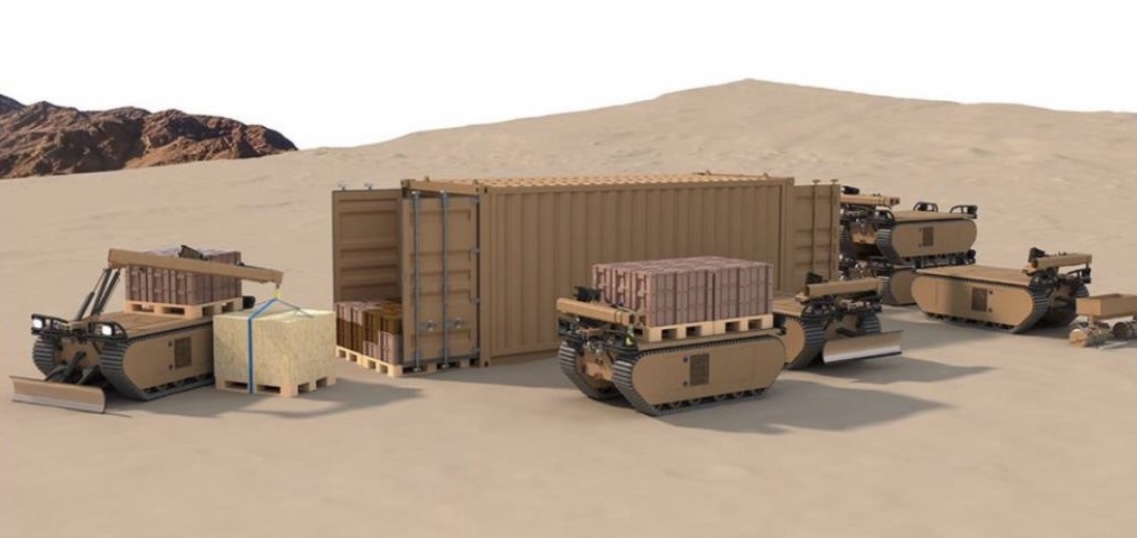
One of the first things you see upon entering Warrior West is HDT’s Hunter Wheeled Offload Logistics Follower (WOLF), a 6×6 load-carrier for dismounted infantry.

Capable of carrying 1,000 kg (2,200 pounds) off-road for more than 300 km (200 miles) at up to 12 mph, and 120 hour endurance with its onboard fuel tank, the JP-8 / electric hybrid powertrain provides both a “silent drive” and “silent watch” capability. It will also produce five kilowatts of power.

This particular model spent quite a bit of time with the 10th Mountain Division, including a JRTC rotation, where the Army learned about how to use a small robotic vehicle in direct support of the squad.

What interests me about the Hunter WOLF is the modular architecture which allows the quick reconfiguration of multiple mission payloads.

At Warrior West, it is fitted with the MPR060 Water Purification System which produces 60GPH (227 LPH) maximum flow rate on freshwater sources and 30GPH (113.6 LPH) maximum flow rate on saltwater sources.

HDT products are available for unit and agency orders from ADS, Inc.

Milrem Robotics and InnoVfoam Present the Multiscope Rescue Hydra UGV at Sofins

Thursday, July 1st, 2021

The European leading robotics and autonomous systems developer and system integrator Milrem Robotics and InnoVfoam, the specialist in foam extinguishing technology present the Multiscope Rescue Hydra unmanned ground vehicle (UGV) at the Sofins exhibition held in France from June 29 until July 1st.

The jointly developed firefighting solution combines Milrem Robotics’ unmanned ground vehicle (UGV) Multiscope Rescue and InnoVfoam’s Hydra fire monitor and foam proportioning system.

The firefighting robot can be remotely operated by firefighters who remain at a safe distance while receiving a complete overview of the operation area via various cameras, i.e. thermal and infrared, and sensors onboard the robot that can additionally detect gas or chemical leaks.

The fire monitors can be operated independently from the UGV thanks to separate cameras on the UGV and the monitors allowing the vehicle to change position while maintaining a perfect overview of the fire. The system can also be complemented with additional preventive and repressive systems and autonomous functions.

”The Multiscope Rescue Hydra developed together with InnoVfoam can alleviate dangers firefighters face and help contain fires faster,” said Kuldar Väärsi, CEO of Milrem Robotics. “This is also an ideal tool for military rescue services that face the same challenges as other firefighters,” he added.

The Multiscope Rescue has a maximum payload capacity of 1200 kg and pull force of 15 000 N allowing it to be equipped with a variety of firefighting specific payloads including foam or water tanks, but also tethered drones for better situational awareness.

Robot firefighters can also deliver heavy firehoses to reach areas and enter structures that are inaccessible with bigger vehicles or may collapse on top of firefighters. They also help firefighters conserve energy and time. In case of forest or landscape fires, the robot firefighters can be airdropped to start limiting the spread of fires.

InnoVfoam’s fire monitors can dispense water and foam from 2000 up to 20 000 liters per minute.

KONGSBERG with Javelin Joint Venture Demonstrate Future Lethality During Flawless Live Fire Exercise

Monday, June 28th, 2021

JOHNSTOWN, PENN., June 25, 2021 – In collaboration with the U.S. Army, KONGSBERG Defence and Aerospace and the Javelin Joint Venture (JJV) conducted a four-shot, multi-platform Javelin demonstration at the U.S. Army Redstone Test Center in Alabama on May 25, 2021. Three different vehicles were each equipped with different configurations of the KONGSBERG Common Remotely Operated Weapon Station-Javelin (CROWS-J) and Protector RS6 Remote Weapon Station (RWS).

“KONGSBERG has solidified its position as the remote weapon station of choice for Javelin deployment across a broad range of platforms. Our remote weapon stations are powerful force multipliers, especially given that we’re delivering a Multi-User Multi-Station (MUMS) capability to facilitate advanced target sharing and cooperative engagement,” said Jason Toepfer, director for Army Business Development (US) at KONGSBERG Defence and Aerospace. “Our continued investments in the architecture and platforms overall maximize the U.S. military’s current inventory, training and provisioning while providing groundbreaking advancements in capability.”

During the demonstration, three different KONGSBERG remote weapon station configurations on three unique ground platforms fired Javelin, successfully engaging targets each time. Using QinetiQ North America’s Robotic Combat Vehicle-Light (RCV-L), KONGSBERG executed a fully remote firing of Javelin using CROWS Tech Refresh control components. This was a first for the Army’s official RCV-L platform and demonstrated Tech Refresh’s backwards compatibility with legacy CROWS systems.

Another firing demonstrated KONGSBERG’s capability to fire Javelin on a 4×4 (JLTV) platform from a previously qualified and fielded system within the inventory on an 8×8 platform – the same KONGSBERG RWS that is currently fielded with Stryker brigades in Germany.

Finally, KONGSBERG continued to showcase its PROTECTOR RS6 (30x113mm) platform by successfully firing javelin from a lightweight, Ground Mobility Vehicle (GMV). The RS6 RWS is the system selected by the U.S. Marine Corps for the Marine Air Defense Integrated System (MADIS) program. This Javelin firing is one of several conducted from this station and further demonstrates the inherent flexibility of the RS6 design, allowing users to address a broad range of threats and operational needs – C-UAS, SHORAD, ATGM, Maneuver Support, Manned / Unmanned Teaming (MUM-T) – from a single system.

With more than 20,000 systems delivered worldwide and 14 years of CROWS experience, KONGSBERG will continue to support the soldiers with new systems, capabilities and features meeting tomorrow’s requirements while maintaining, supporting and keeping up to date a wide range of CROWS variants and support equipment. All CROWS and RWS systems are produced in the KONGSBERG Johnstown, PA facility. Continuing the execution of this contract secures 3,000+ jobs, both directly and through the KONGSBERG U.S. supply chain. With systems sold to 26 nations, KONGSBERG is the world-leading provider of remote weapon stations.