Phantom Lights

Archive for the ‘Robotics’ Category

Next-Generation Drone Pilots Face Off at Comp

Wednesday, December 24th, 2025

Army’s newest drone and robotics talent went head-to-head at Victoria Barracks last month in the finals of Rise of the Drones and War of the Machines.

The culmination of months of training, designing and testing at Battle Lab’s MakerSpace sites across the country had finals competitors assembling, configuring, flying and repairing first-person-view (FPV) drones and robotic ground systems. 

The event represents a step forward in building Army’s uncrewed systems capability, with 161 new FPV drone pilots and 98 uncrewed ground vehicle operators trained through the MakerSpace program.

Commander Battle Lab Colonel Pete Allan said the competitions played an important role in supporting Army’s future capability needs.

“We’re clearly seeing that robotics and automated systems are reshaping how militaries fight, so activities like Rise of the Drones and War of the Machines are part of how Army rapidly adapts at the forward edge,” Colonel Allan said.

The Battle Lab MakerSpace training model, originally conducted over six weeks, was condensed to four weeks to demonstrate the ability to accelerate capability when required. 

‘There are lessons to be learned from Ukraine and the Middle East. Innovating in the FPV space is critical.’

Participants received instruction and mentorship as they progressed from assembly to simulation to live flights. Some completed the initial training in less than three days.

Competitor Captain Jesse Wood, of Headquarters 7th Brigade, said the training was highly relevant to contemporary warfare.

“There are lessons to be learned from Ukraine and the Middle East. Innovating in the FPV space is critical,” Captain Wood said.

“The course stepped us through UAV fundamentals, flight characteristics, basic controls and customising the software and settings. We also spent time in simulation before our first flight.”

Private Dan Leeks, a competitor from the 8th/9th Battalion, Royal Australian Regiment, said the program armed him with the skills and confidence to employ FPV drones.

“We learned how to solder the boards and motors, program the drones and test-fly them. I started with no experience, but now I’d be confident employing them in my job,” Private Leeks said.

By Captain Andrew Lee, ADF
Quantum Systems Acquires FERNRIDE

Friday, December 19th, 2025

As part of its expansion into a multi-domain provider, Quantum Systems acquires FERNRIDE and integrates solutions for ground autonomy.

Gilching, 17 December 2025: Quantum Systems, Europe’s market leader in AI-powered unmanned systems, today announced the acquisition of FERNRIDE. With the acquisition of FERNRIDE, Quantum Systems is expanding its leadership position from air and software intelligence to autonomous ground mobility, creating a connected, cross-domain offering for intelligent unmanned systems.

FERNRIDE offers an industry-proven software platform for ground autonomy in the areas of container terminals, defence logistics, yard operations and autonomous driving. The technology is already in use by well-known customers. In 2025, FERNRIDE became the first company to obtain TÜV approval for autonomous trucks in Europe, has already used them in initial tests with the German Armed Forces and expanded its portfolio to include defence logistics.

‘FERNRIDE has developed one of the most advanced and scalable autonomous ground platforms,’ said Martin Karkour, Chief Revenue Officer of Quantum Systems. ‘By integrating their technology into MOSAIC UXS, we are consistently implementing our vision of creating a connected ecosystem in which unmanned systems think, move and act as a single entity across different dimensions.’

‘Europe urgently needs sovereign autonomy solutions. By joining forces with Quantum Systems, we can take our technology to a new level,’ said Hendrik Kramer, CEO and co-founder of FERNRIDE. ‘Together with Quantum Systems, we are accelerating the deployment of our platform in the European defence sector, which is currently the most urgent environment globally for scaling autonomous ground systems. In the future, this experience will also be transferred back to civilian logistics applications,m making our society safer and more resilient.’

Quantum Systems’ operational experience in Ukraine has demonstrated the relevance of the interaction between air and ground robotics. The integration of FERNRIDE solutions into MOSAIC UXS, Quantum Systems’ autonomous mission software, is intended to enable multi-domain operations that improve situational awareness and decision-making. Quantum Systems’ operational experience in Ukraine has demonstrated the relevance of the interaction between air and ground robotics. The integration of FERNRIDE solutions into MOSAIC UXS, Quantum Systems’ autonomous mission software, is intended to enable multi-domain operations that improve situational awareness and decision-making.

No details regarding the financial aspects of the acquisition will be disclosed.

First European RIPSAW M3 Robotic Ground Vehicle Sold To Sweden

Friday, December 5th, 2025

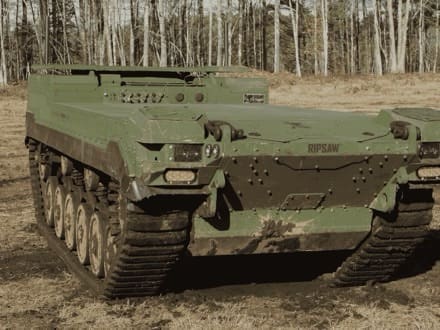
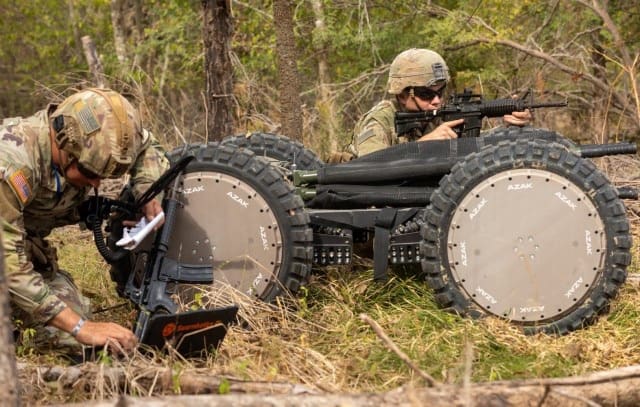
HUNT VALLEY, Md., Dec. 2, 2025 – Textron Systems Corporation, a Textron Inc. (NYSE:TXT) company, and its subsidiary Howe & Howe, announced today a sale of the RIPSAW® M3 robotic ground vehicle to the government of Sweden, the product’s first European customer. The M3 is part of Textron Systems’ RIPSAW family of vehicles, designed as a rugged and reliable robotic ground vehicle that leverages a Modular Open System Approach (MOSA) to simplify integration of new payloads, controllers and autonomy suites.

Building on its reputation as a global leader in uncrewed, robotic and autonomous vehicles for land, air and sea, Textron Systems continues to invest in the design and maturation of a highly scalable, configurable family of robotic ground vehicles that deliver exceptional transportability, mission flexibility and battlefield agility. The RIPSAW M3 provides confidence to the warfighter with a powerful hybrid-electric powertrain, high ground clearance, and composite rubber track system, providing unmatched mobility in offroad, operationally relevant environments, with over 180 miles of range.

“The RIPSAW M3 is ideally suited for operations in the region because of its high performance in challenging climates and terrains,” said Vice President of Programs, Sara Willett. “Textron Systems is excited to be a trusted partner to European customers and remains focused on investing in trusted robotic platforms that enhance user safety and mission success.”

Backed by decades of proven performance and more than three million operational hours of uncrewed experience across air, land and maritime domains, Textron Systems continues to leverage its expertise to meet the demands of modern warfare.

Milipol 25 – Rhode & Schwarz x ARX Robotics

Friday, November 28th, 2025

Rhode & Schwarz has long been the gold standard in Electronic Warfare. They offer systems which operate across almost the entire electromagnetic spectrum. If a frequency can carry a message, they can collect against it.

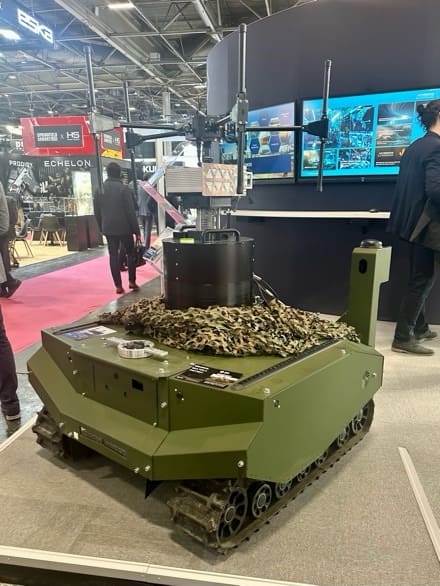
Seen here is one of their Direction Finding arrays mounted on an ARX Robotics Gereon Remote Control System. Already being used in Ukraine this robot enjoys a 100% European supply chain and has been adopted by seven countries.

This is an excellent use case for robots, to place sensors into areas which would be hazardous to humans. Dispersion of DF front ends across the battlespace allow deeper and more accurate fixes of enemy emitters.

European Consortium Launches iMUGS2 to Advance Interoperable Unmanned Ground Systems

Sunday, November 23rd, 2025

A European consortium uniting leading defence, research, and technology organisations from across the Union has launched the iMUGS2 project to develop the next generation of interoperable unmanned ground systems, following its successful proposal to the European Commission under its European Defence Fund (EDF) programme. The project is coordinated by Milrem Robotics.

Building on the achievements of the first iMUGS project, iMUGS2 aims to enhance Europe’s autonomy and robotics capabilities by developing a scalable, interoperable, and secure system-of-systems architecture for both unmanned and manned platforms. The project reinforces Europe’s technological sovereignty in key defence areas, including AI-driven autonomy, systems integration, communications, and command and control.

“With iMUGS2, Europe takes another significant step towards developing truly interoperable and scalable robotic forces that enhance the continent’s defence capabilities,” said Raul Rikk, Capability Development Director at Milrem Robotics. “The project promotes innovation and cooperation among European nations, ensuring that future AI-based autonomous systems can operate seamlessly together on the battlefield.”

iMUGS2 begins immediately with extensive conceptual, operational, and technical development across multiple domains. Partners will design and refine operational concepts, system architectures, and technological solutions that advance manned–unmanned teaming, autonomous functions, secure communications, and electronic protection.

In parallel, the project focuses on system integration, lifecycle efficiency, and interoperability, laying the groundwork for upcoming demonstrations and capability deployment across Europe’s defence landscape. These developments will ensure resilient, cost-effective, and future-ready unmanned systems.

About iMUGS2

With a total value of approximately €55 million and nearly €50 million in EDF funding, iMUGS2 pursues three strategic objectives: to develop and demonstrate combat-ready unmanned ground systems that support dismounted troops; to define operational concepts showing how unmanned ground and aerial systems can improve infantry battalion operations and cross-domain cooperation; and to advance modular, open architectures and lifecycle management frameworks that ensure interoperability across both legacy and future platforms.

About the Consortium:

The iMUGS2 Consortium comprises 29 partners from 15 European Union member states. The group includes large corporations, mid-sized businesses, SMEs, and research organisations. Each partner provides leading expertise in their respective fields, supporting a comprehensive vision throughout the project’s lifecycle. This diversity allows the consortium to tackle potential challenges and deliver strategic, effective solutions.

The iMUGS2 Consortium includes the following entities: AVL List, Bittium Wireless, Bureau Veritas, Czech Technical University in Prague, Cybernetica, Delft Dynamics, Diehl Defence, dotOcean, Elettronica, Escribano Mechanical and Engineering, FN Herstal, GMV, Huta Stalowa Wola, Insta Advance,  Integrated Systems Development, John Cockerill Defense, Kepla, KNDS France, KNDS Germany, Kongsberg Defence & Aerospace, Latvijas Mobilais Telefons, ?ukasiewicz – PIAP, Milrem Robotics (project coordinator),  Nortal (Talgen Cybersecurity), Norwegian Defence Research Establishment, the Royal Military Academy of Belgium, Safran Electronics & Defense, Svensk Konstruktionstjänst and TNO.

For more information, please visit imugs.eu.

Milipol 25 – MP-SEC & Ghost Robotics

Thursday, November 20th, 2025

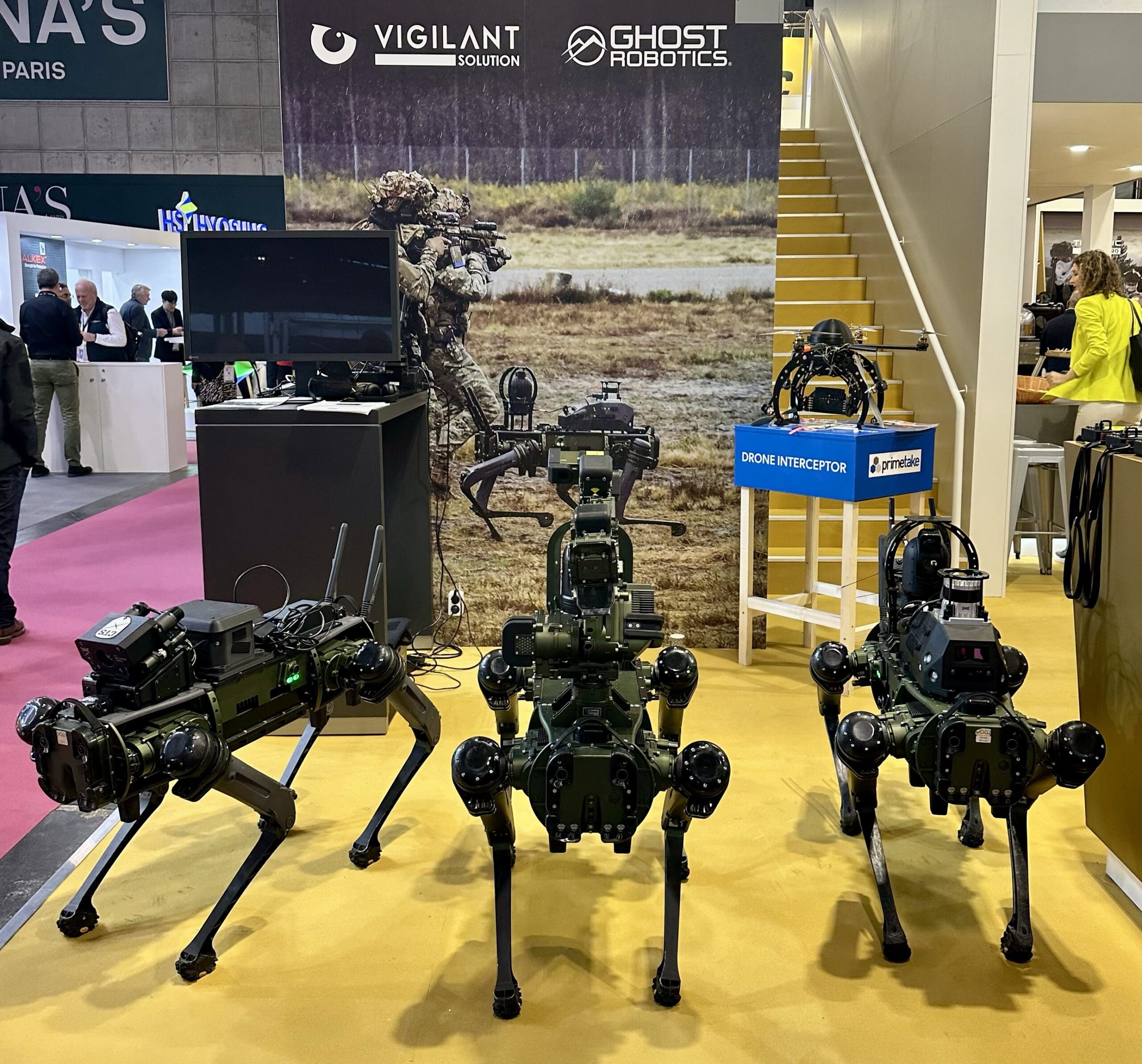
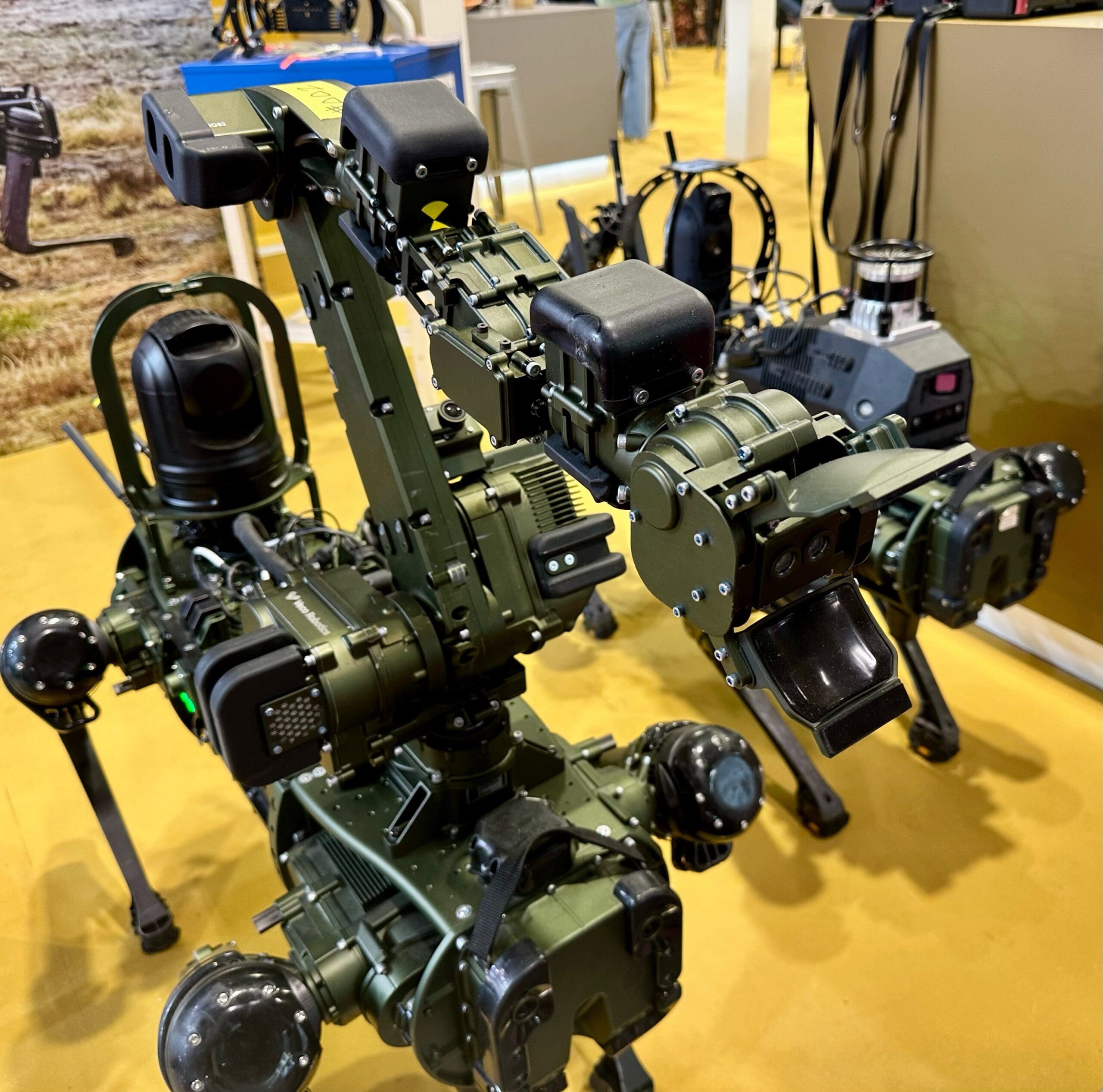
Ghost Robotics has a tight relationship with MP-SEC in France. Not only does MP-SEC represent the Vision 60 Quadraped Unmanned Ground System and accessories, they also work with clients to outfit the Vision 60 to fill their requirements.

Often referred to colloquially as a “Robot Dog” the Vision 60 is well known to SSD readers for its ability to integrate a wide variety of lethal and sensor packages.

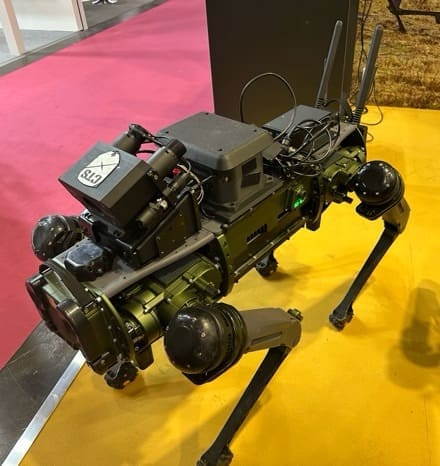
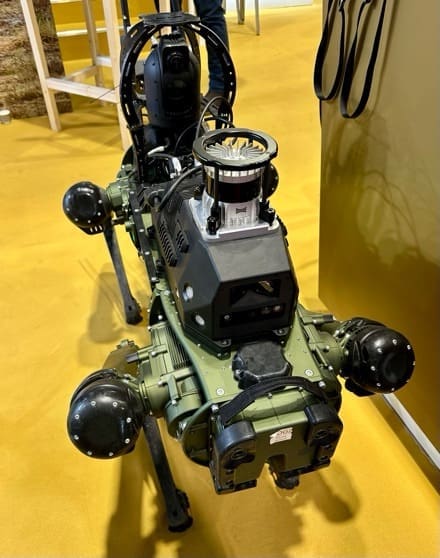
For example, seen above is Ghost Robotics’ new Manipulator Arm. Extendable up to 1 meter, the arm offers seamless integration with 6 Degrees of Freedom. The Vision 60 to the rear is outfitted with a sensor appliqué manufactured in-house at MP-SEC. Customizable for each user need, this version incorporates stereo thermal cameras and illuminator along with a LIDAR package. Manufactured from 6961 T6 aluminum, the sensor package is IP67 rated like the Vision 60 it is mounted to.

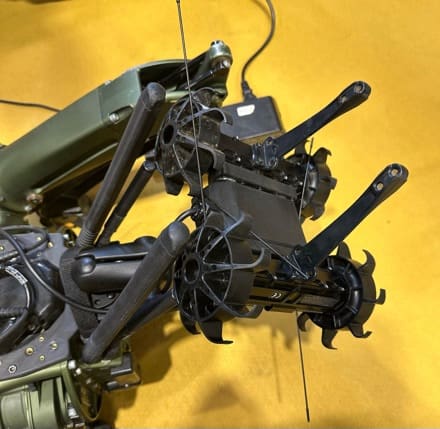
They’ve also integrated a system which allows the Vision 60 to carry and deploy two ReconRobotics Throwbots to get a look into tighter spaces.

xTechOverwatch Competition Showcases Autonomous Capabilities

Thursday, November 20th, 2025

BRYAN, Texas — U.S. Army Transformation and Training Command hosted xTechOverwatch for Unmanned Systems Oct. 27-29, 2025, at the Bush Combat Development Center – Innovation Proving Ground in Bryan, Texas, which provided industry partners and academia the ability to compete for opportunities to continue development integrated within the Army.

This invitation-only competition showcased cutting-edge autonomous unmanned system technologies from 40 selected industry teams, evaluated alongside private capital partners, as they integrate their solutions with the Army’s most lethal squads. Twenty teams were chosen to continue development with the Army.

These teams will work directly with Transformation in Contact formations from January 2026 to July 2027, providing the chance to influence the Army’s modernization strategy by accelerating autonomous capabilities.

This competitive assessment, facilitated by T2COM and key stakeholders, aimed to accelerate the adoption of autonomous systems in line with the Chief of Staff of the Army’s directive. Competitors demonstrated their air, ground, payload, and collaborative autonomy technologies on situational training lanes, providing a real-world assessment of their capabilities.

“xTechOverwatch was incredibly successful for the Army,” Lt. Col. Nick Rinaldi, competition lead, Army Applications Laboratory, said. “Having the entire ‘materiel kill chain’ as evaluators invested in the outcome was critical to the speed of decisions on which technologies were most suited to move into a TiC formation.”

Rinaldi continued, “this was a microcosm of how we have to do business. We have to engage industry on real problems we’re trying to solve, get their capabilities in a place where Soldier formations can actually use the equipment in context and in concert with other capabilities, and then make decision quickly.”

A critical component of this approach is the rapid fielding of experimental technologies to active-duty units. The competitors selected will be under contract within 60 days to work directly with the formations training cycle. This allows Soldiers to experiment with prototypes and provide crucial feedback, driving iterative improvements.

By exposing warfighters to cutting-edge advancements, the Army empowers them to adapt, anticipate challenges, and maintain relevance in the modern battlespace. Delaying this process risks forcing Soldiers to learn how to use these capabilities under the pressure of combat.

– US Army T2COM Public Affairs

New Partnership Between Milrem Robotics and Poland’s Military University of Technology Strengthens Defence Robotics R&D

Sunday, November 2nd, 2025

Milrem Robotics, the world’s leading robotics and autonomous systems developer, and Poland’s Military University of Technology (Wojskowa Akademia Techniczna—WAT) have signed a cooperation agreement to accelerate joint scientific research, innovation, and education in defence robotics.

The agreement was signed on October 29, 2025, by Brigadier General Prof. Przemys?aw Wachulak, PhD, DSc, Eng., the Commandant-Rector of the Military University of Technology, and Kuldar Väärsi, the Chief Executive Officer of Milrem Robotics.

This partnership fosters research and development synergy: together, Milrem Robotics and WAT will co-design and implement projects under European and international programmes, drive joint scientific publications and conference participation, and combine technological development with academia to accelerate innovation.

“We are delighted to collaborate with WAT to enhance Europe’s defence capabilities. This partnership reflects Milrem Robotics’ dedication to Poland’s vibrant innovation ecosystem. As a global leader in advanced technology, this agreement signifies an exciting milestone in our journey to engage with Poland’s dynamic industrial and technological landscape. Together, we will utilise agility, creativity, and innovative solutions to foster progress, demonstrating that European collaboration is essential to maintaining a competitive edge in the future,” said Kuldar Väärsi, CEO of Milrem Robotics.

“At the Military University of Technology, we understand the importance of rapidly implementing research results and delivering new technologies: military, dual-use and civilian,” said Brigadier General Professor Przemys?aw Wachulak, Commandant-Rector of WAT. “WAT’s cooperation with Milrem Robotics is another important step toward advancing unmanned ground vehicle technologies for the military, as well as new educational opportunities for the young ranks of soldiers and engineers building our future security,” he added.

“This agreement allows us to bring academia and robotics engineering closer together to create real impact,” said Marcin Sobieraj, Country Manager of Milrem Robotics Poland.

The cooperation further provides for mutual technical and scientific consulting, exchange of knowledge and experience, and coordination of research and development efforts. Educational integration is central: Milrem experts will engage in WAT’s workshops, courses, and events; students will gain from study visits, internships, and apprenticeships.

Milrem Robotics and the Military University of Technology commit to ongoing collaboration in science, education, and defence systems development, pushing advancements in unmanned systems and enhancing European resilience.