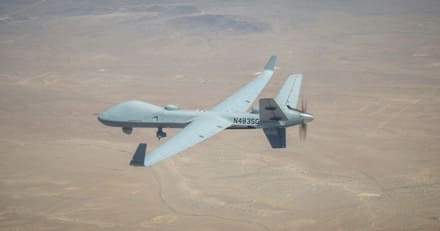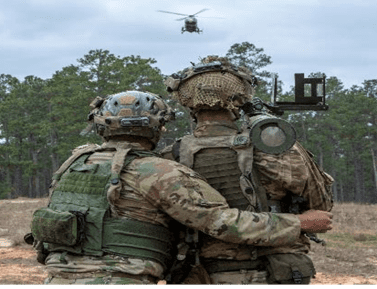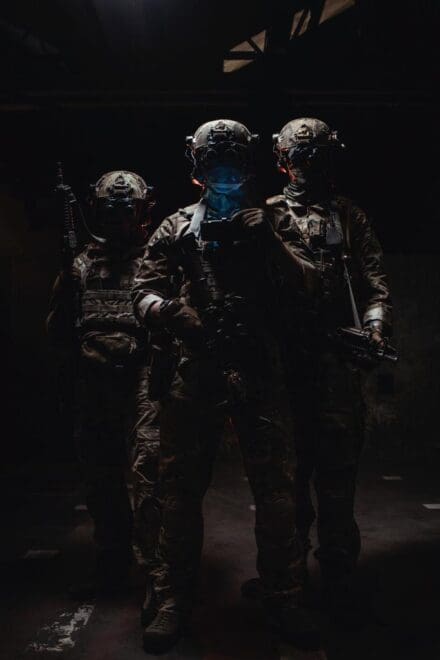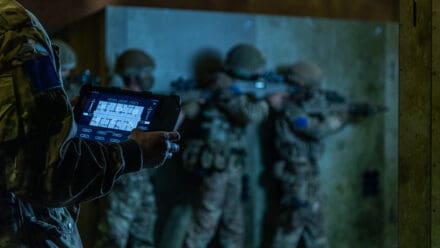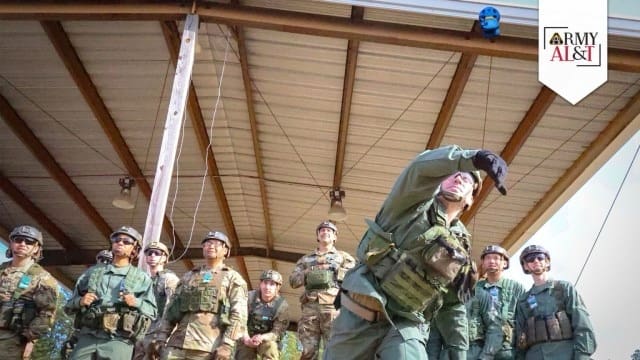
LIVE ACTION – Soldiers train with synthetic Claymore mine, mortar, grenade and Stinger weapons systems to determine if they accurately portray a live-fire weapon during an operational demonstration of the STE LTS at the Joint Readiness Training Center, Fort Johnson, Louisiana in January 2024. (Photo by Ariana Aubuchon, PEO STRI)
Haptics improvements to Army simulation training makes virtual environments feel more realistic.
Simulation doesn’t replace live training, but with enhancements to its digital programs, along with haptics improvements, the Army will soon be able to augment existing programs and replicate weapons like direct fire, counter-defilade and directed energy that, until now, couldn’t be replicated through simulation. Making interactions with virtual environments or digital devices feels more realistic and tactile.
Haptics is the use of technology to simulate the sense of touch by applying forces, vibrations or motions to the user via wearable suits or devices (i.e., gloves, vests, watches). While it is not currently used in live force-on-force training—a training method that combines live action with virtual and constructive training—it will be used going forward to bridge the gap between virtual training and real-world experiences. The result is a safer, more effective and more cost-efficient way to prepare Soldiers for various operational scenarios, and this technology is particularly valuable in effectively addressing modern military challenges—from urban warfare to cyber-defense training.
“Haptic technology in combination with immersive VR/AR [virtual reality and augmented reality] technologies and artificial intelligence [AI] form a critical architecture element within emerging Army training systems,” said Chief Technology Officer Marwane Bahbaz, Program Executive Office for Simulation, Training and Instrumentation (PEO STRI). “And simulations using virtual reality and haptic capabilities drastically increase immersion and improve retention and learning in training exercises.” This means that Soldiers can safely and effectively practice high-risk or complex scenarios like piloting a plane or handling dangerous machinery with more confidence and less risk than in real life.
He explained that haptics “increases combat realism in the collective training environment because it induces combat stress to Soldiers, ensuring that the execution of the mission, the decision-making process and the overall combined arms tasks are validated.” Inducing combat stress in the training environment mimics the emotions and fatigue Soldiers could face when engaged in combat so they are better able to anticipate these sensations in the peer threat environment.
The Synthetic Training Environment Live Training System (STE LTS), which uses virtual technology to simulate combat environments for Soldiers, is advancing haptic technology with environmental hardening (increasing resistance to stress or threats) to enhance training resilience and cost efficiency and continues to monitor and invest in evolving haptic innovations.
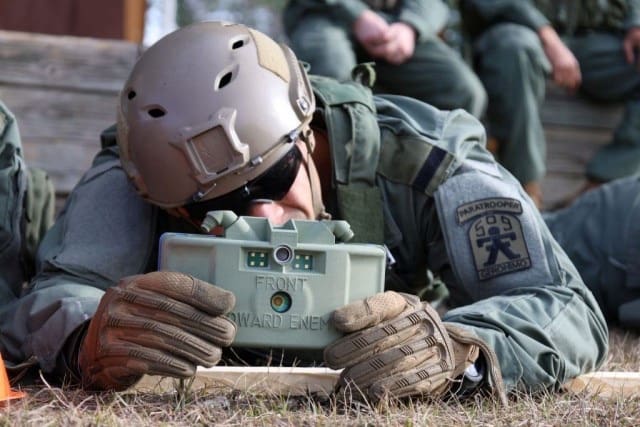
REAL-WORLD BENEFITS – A Soldier from the 1st Battalion, 509th Infantry Regiment, takes part in an operational demonstration of the Synthetic Training Environment Live Training Systems (STE LTS), designed and fielded by PEO STRI, at the Joint Readiness Training Center at Fort Johnson, Louisiana. STE LTS allows Soldiers to take part in more reps and sets than they would with live fire, while reducing training costs and improving safety. (Photo by Ariana Aubuchon, PEO STRI)
SYNTHETIC TRAINING ENVIRONMENT
In 2017, the Army began developing the Synthetic Training Environment (STE) with the goal of achieving initial operational capability by 2021 and full operational capability (a highly realistic and immersive training environment) by 2023. Some features are currently being used for training, while the full system is still under development and deployment.
The STE integrates virtual reality and augmented reality to create immersive, realistic training scenarios across multiple domains—land, sea, air, space and cyber. By enhancing training with VR and AR, Soldiers can experience complex, large-scale environments and situations that are difficult or impossible to replicate in live training, improving readiness, decision-making and coordination in a cost-effective manner.
“The vision of the Army’s Synthetic Training Environment is to revolutionize Army training by merging live, virtual, constructive [LVC] and gaming platforms into an interoperable training experience that provides real-life immersion for combat training,” said Bahbaz. The blending of these domains enables decentralized training, reduces wear on tactical equipment and provides additional tools to enhance training effectiveness. This provides significant value for brigade and company-level training, benefiting forward observers (fire support specialists, artillery observers) and mortarmen crews.
PEO STRI’s Project Manager Training Devices (PM TRADE) has developed instrumented mortars capable of engaging targets across the LVC spectrum, Bahbaz explained, including live instrumented Soldiers, the virtual Training Simulation Software (TSS) Soldier and constructive simulation-generated entities. Using an immersive VR headset, the forward observer can visualize the entire battlefield in real-time, seeing LVC entities in their exact locations. The device provides a fully virtualized view of the battlefield, using high-resolution, three-dimensional terrain models that are updated in real time—allowing the forward observer to pan and zoom the digital battlefield, provide targeting information and call in indirect fire on targets across the LVC spectrum. This capability, he said, allows for a highly realistic and dynamic training environment and can be used to supplement training when live personnel or vehicle platforms are unavailable.
These haptic technologies are currently in the prototyping phase, where the performance and effectiveness is evaluated in a live training environment through the use of Soldier touch points conducted throughout a wide range of locations, including Fort Cavazos, Fort Benning, Fort Irwin, Fort Bragg, Fort Wainwright and Fort Polk. Bahbaz noted that, as a result of the PEO STRI touch points, PM TRADE received both positive and constructive feedback from Soldiers, which was critical in informing requirements and design improvements.
Bahbaz anticipates that these capabilities will be procured in fiscal year 2025 and fielded, starting in fiscal year 2026, to the Combat Training Center sites. This will begin with the Joint Readiness Training Center at Fort Johnson, Louisiana, then the National Training Center at Fort Irwin, California, followed by the Joint Multination Readiness Center in Hohenfels, Germany.
PM TRADE will start fielding with the indirect fire mortar and artillery training systems, he said, followed by shoulder-launched munitions and others, mainly because they enhance realism by providing tactile feedback for recoil, loading and firing, which helps develop muscle memory and operational skills.
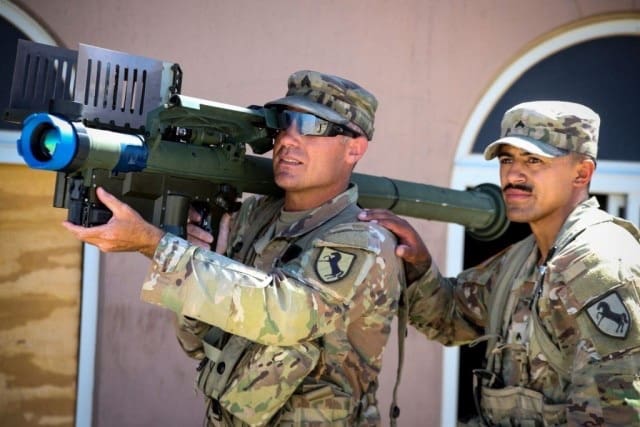
STING OPERATION – The Stinger training system, which is being developed by Program Executive Office for Simulation, Training and Instrumentation (PEO STRI) as part of the STE-Live Direct Fires program, provides realistic and immersive training for Soldiers. (Photo by Ariana Aubuchon, PEO STRI)
LIVE TRAINING
For the next generation of dismounted Tactical Engagement Simulation Systems (TESS)— designed for infantry or ground-based personnel to simulate real-world combat scenarios without live ammunition—PEO STRI is prototyping haptic alerts to the Soldiers for firing, near miss, wound assessments and suppression.
“The current Live Tactical Engagement Simulation Systems use audio alters for near miss and assessment, which also provides an alert to nearby opposing Soldiers,” said Mark Dasher, product lead for STE LTS. “Use of haptics will provide a silent alert when battlefield effects occur. Additionally, tactical haptics will introduce new training capabilities such as loading ‘training round’ into a 155 mm howitzer.”
During live force-on-force training, the integration of artificial intelligence and machine learning (AI/ML) is going to be a key focus area for live prototyping efforts at many levels, Dasher said. For this training, real Soldiers, using real equipment in physical environments, engage in simulated combat against other live participants—with the addition of synthetic computer-generated elements to enhance realism and complexity. “First, we are applying AI/ML in engagements allowing proper combat techniques [e.g., target lead and site elevation],” Dasher said. This will provide real-time, data-driven feedback, as AI creates moving targets and realistic conditions, while ML adapts training to individual skill levels, analyzing performance to refine accuracy and decision-making. “We believe that AI/ML will provide a continuous evaluation of Soldier and unit actions, enabling better unit training strategies. In the future, AI/ML will support small-unit training without the need of trainers, exercise control, OPFOR [Opposing Forces] or external enablers.”
Live training systems are utilized not just by the Army but also by other services, particularly the U.S. Marine Corps (USMC). “We work closely with PM TRASYS [Program Manager for Training Systems], our USMC counterparts in modernization efforts,” Bahbaz said. “They participate in our Soldier touch points and provide valuable feedback to our team.”
Bahbaz said PEO STRI has also forged a solid partnership with the Program Executive Office for Intelligence, Electronic Warfare and Sensors Project Linchpin, the Army’s first artificial intelligence pipeline to deliver AI and ML capabilities to sensors for faster and more accurate decision-making in collaboration with the STE cross-functional team.
“We have successfully released, jointly, a request for information that communicates AI needs for Army training. This is part of our STRI to efficiently accelerate AI adoption across the training portfolio and specifically in [the] STE program, starting with live.” Bahbaz said he received 82 responses spanning traditional (defense-focused industries) and non-traditional (commercial business with advanced commercial technologies, particularly in the digital space) with diverse experience, which will expand—even transform—the Defense Industrial Base. “This market research effort will shape the prototyping requirements of our modernization programs with respect to AI and data,” he said.
PEO STRI, Bahbaz said, is also investing in computer vision technology as a potential replacement for lasers currently used by the Instrumentable Multiple Integrated Laser Engagement System (I-MILES), a system that enables the Army to simulate combat and improve the realism of training.
“Object detection will enable us to simulate physics-based direct fire engagement, further increasing the realism in the live training environment,” Bahbaz said, adding that recent engineering touch points have yielded promising results as haptic devices attempt to draw reaction of the forces as they maneuver in the force-on-force battle space.
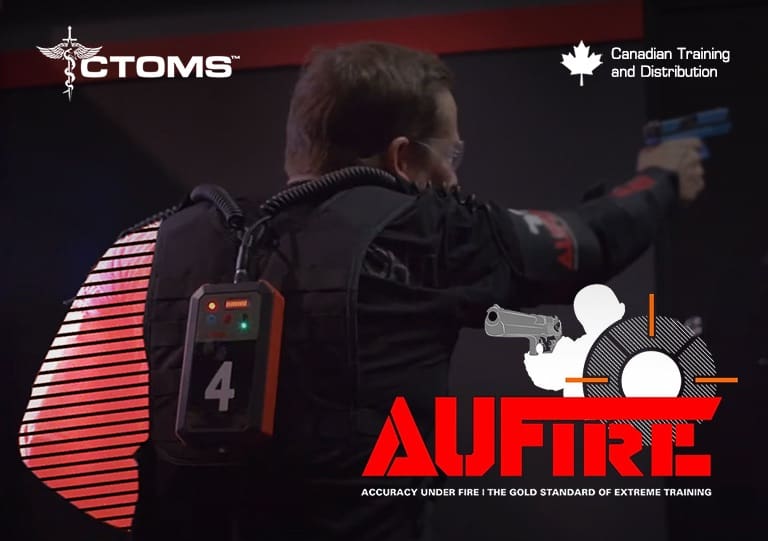
At Soldier Touch Point 10 (a testing session point of refinement), he explained that two haptic devices were tested: 1) a haptic watch that also provided an electronic MILES casualty card to process and display battle damage assessment on their training system in fidelity that allows the performance of exercise medical tasks in a combat training exercise; and 2), a haptic Small Arms Protective Insert replacement, a type of body armor that provides a tactile feedback sensation when impacted by a bullet, allowing the wearer to perceive a hit without feeling the full force.
Bahbaz said PEO STRI is experimenting with these haptic wearables to introduce the effects of explosions that are also integrated with mixed-reality devices and to increase the fidelity of interactions between live participants and synthetic entities in live exercises.
A “STAGES IN STAGES” APPROACH
Bahbaz said there are two live training modern products that will include a “stages in stages” approach, meaning phased in as technology matures and is validated. These two products are the Indirect Fire and Guide System (i.e., Stinger Trainer), with the first increment production planned to begin in fiscal year 2025 and fielding in fiscal year 2027, and the Direct Fire System with haptic and AI-enabled system, which is currently in the prototyping stage and scheduled for production in fiscal year 2027 and fielding in fiscal year 2028-29.
The Stinger Training System provides realistic and immersive training for military personnel, enabling them to effectively operate and maintain the Stinger missile system in a variety of combat scenarios and to simulate the complexities of real-world engagements. This allows users to develop the skills and confidence needed to accurately detect, track and engage enemy aircraft, while minimizing the risks and costs associated with live-fire training.
The system requires the gunner to perform all tasks involved in Stinger operation and target engagement. The life-sized Stinger trainer connects to range instrumentation, delivering realistic training without firing projectiles and can interrogate instrumented aircraft utilizing a simulated Identification Friend or Foe (IFF), replicating the dimensions, weight and firing sequence of a real Stinger weapon system.
A direct fire system with haptic and AI-enabled capabilities is a training platform designed to simulate a realistic use of the weapon in the force-on-force environment. According to Bahbaz, these systems leverage haptics to provide physical feedback, such as recoil, vibrations and resistance, replicating the sensations of real-world weapon handling. At the same time, AI introduces adaptive elements to the training or operational environment, like intelligent target behaviors, real-time performance analysis and scenario adjustments.
For example, a rifle or machine gun training simulator equipped with haptics will simulate the weapons recoil and resistance while engaging AI-controlled targets that react unpredictably to the Soldier’s kinetic actions and reinforce rapid decision-making. The system, Bahbaz said, will provide feedback on accuracy, reaction time and situational awareness, adapting the scenarios’ difficulty as the training environment changes.
These systems utilize AI to simulate lively scenarios like engaging aerial or ground threats, adapting to trainee performance and providing detailed feedback on decision-making and accuracy. Haptics enhancements also add a layer of physical realism by replicating sensations like weapon recoil, weight and control resistance, helping users develop muscle memory and familiarity with equipment. Together, these technologies ensure comprehensive preparation by addressing both the cognitive and physical aspects of weapon operation in a safe, controlled environment.
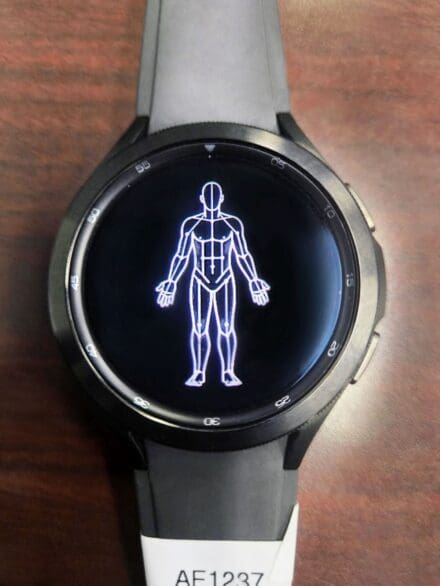
HALF PAST HAPTICS – A wrist-worn device like this watch can be worn by Soldiers to provide situational awareness, biometric data, and a real-time casualty assessment during training. These improvements in haptics will help to provide a more realistic training environment and bridge the gap between virtual training and real-world experiences. (U.S. Army photo, courtesy of PEO STRI)
GOING GLOBAL
U.S. simulation training is conducted globally to enhance interoperability with allied forces, improve mission readiness and adapt to region-specific challenges. These exercises allow multinational forces to train together using advanced technologies, fostering seamless collaboration in joint operations. Simulation training is also cost effective and safer compared to live exercises, enabling realistic practice without the logistical complexities or risks. By deploying this training worldwide, the U.S. not only prepares for diverse operational scenarios but also demonstrates leadership in cutting-edge military technology.
“PM TRADE provides training capability for home station, Combat Training Centers and for use during deployments. Where the Army is, the Army trains. As haptic-enabled TESS is deployed, the Army will use globally as needed,” Dasher said.
“These improvements can be used by our multination partners,” Bahbaz noted. “In fact, we collaborate closely with our Five Eyes [Oversight and Review Council composed of intelligence oversight, review and security entities of Australia, Canada, New Zealand, the United Kingdom and the United States] on several live training technologies. They are well informed of the core design of training capabilities and have various engagements [where] we exchange our lessons learned to ensure interoperability.”
CONCLUSION
Improving haptics within the STE offers significant benefits for enhancing the Army’s training capabilities. These advancements create a more immersive and realistic training experience by bridging the gap between virtual scenarios and visual sensations. Wearables enable real-time biometric feedback, which can improve training effectiveness by monitoring Soldier performance, stress levels and physical conditions. Enhanced haptics deliver tactile and force feedback, allowing Soldiers to experience the sensations of weapon recoil, environmental resistance and physical impacts while fostering muscle memory and situational awareness. By integrating these technologies, the STE not only better replicates real-world conditions but also reduces the logistical burden and cost of live training exercises. This comprehensive approach ensures that Soldiers are better prepared for operational challenges, leading to improved readiness, adaptability and mission success.
“A critical resource is time for units to train, especially at the lower level (e.g., squad or platoon). Through the insertion of new technology, STE LTS is creating training devices that are both easy to use and realistic,” Dasher said. “The benefit of these enhancements and new additions is allowing units to do realistic training, anywhere and at any time.”
For more information, go to www.peostri.army.mil
By Cheryl Marino for Army AL&T Magazine
CHERYL MARINO provides contract support to the U.S. Army Acquisition Support Center at Fort Belvoir, Virginia, as a writer and editor for Army AL&T magazine and TMGL, LLC. Prior to USAASC, she served as a technical report editor at the Combat Capabilities Development Command Center at Picatinny Arsenal for five years. She holds a B.A. in communications from Seton Hall University and has more than 25 years of writing and editing experience in both the government and private sectors.