Atrius Development Group

Archive for the ‘UAS’ Category

AeroVironment Introduces Next-Generation All-Electric VAPOR 55 MX Helicopter Unmanned Aircraft System, Built for Heavier Payloads and Longer Distances

Wednesday, September 14th, 2022

• Next-generation VAPOR 55 delivers more simplified, modular design with performance improvements that optimize user experience

• Redesigned for increased levels of operational efficiency with 25 percent increased endurance and 20 percent increased payload capacity

• New payload interface and tool-free quick rail mount enables quick and easy field integration of both current and future payloads for increased mission flexibility


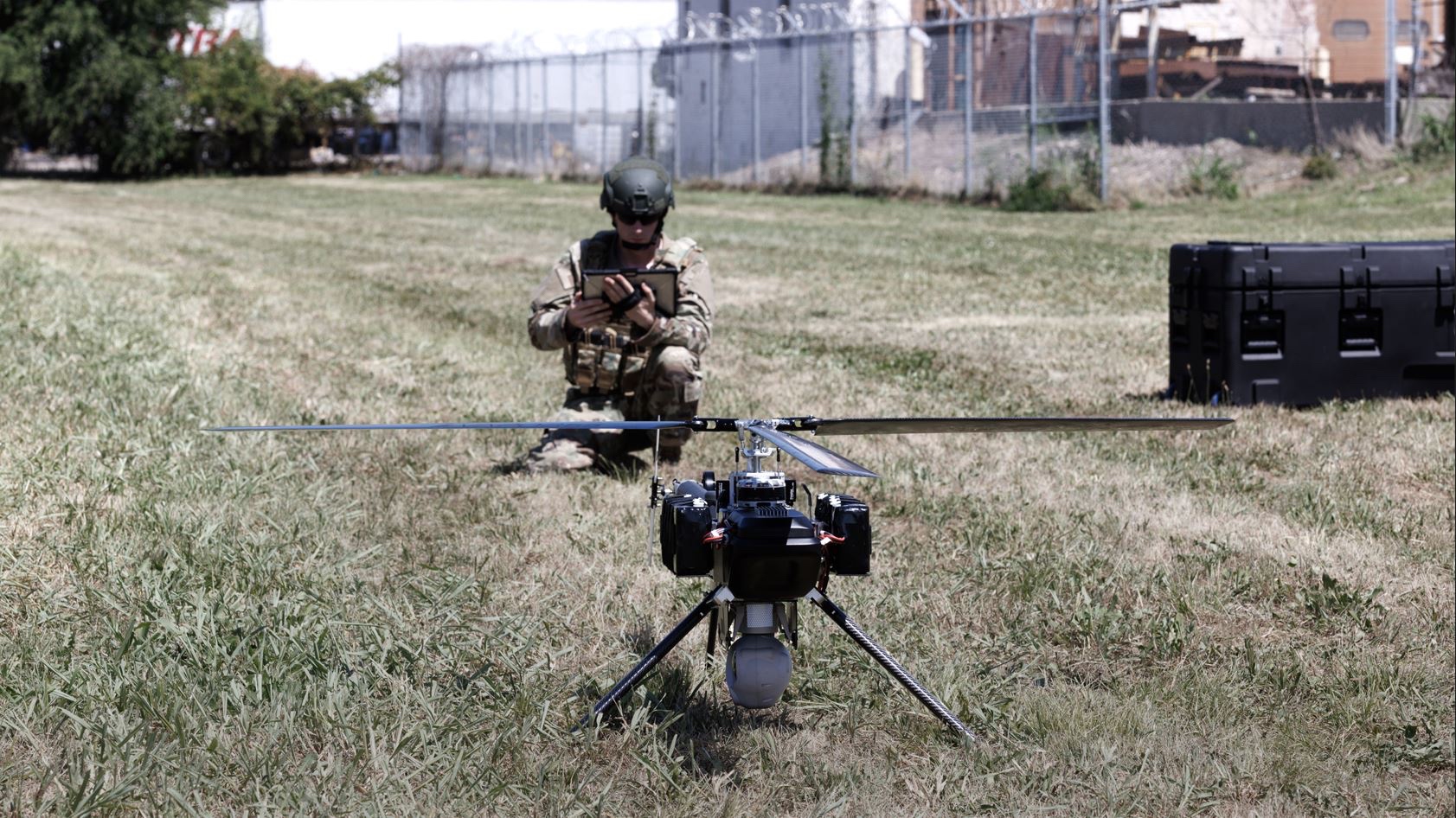
VAPOR 55 MX is more rugged and packable than its predecessor and can stay in the air longer, hover and cover more ground. (Image: AeroVironment, Inc.)

ARLINGTON, Va., Sept. 13, 2022 – AeroVironment, Inc. (NASDAQ: AVAV), a global leader in intelligent, multi-domain robotic systems, today announced the launch of the next-generation VAPOR® Helicopter unmanned aircraft system (UAS), VAPOR 55 MX. Delivering new levels of operational performance with a completely redesigned modular autonomy framework, VAPOR 55 MX enables increased endurance and expanded payload capacity to meet current and emerging needs of defense, commercial and industrial customers.

“The new VAPOR 55 MX is an easy-to-maintain system that incorporates a highly versatile modular architecture and tool-free rail system for simple, efficient integration of third-party or custom payloads, allowing users to adapt to multi-sensor, multi-mission requirements including utility inspection, aerial surveying, public safety and defense applications,” said Trace Stevenson, AeroVironment vice president and product line general manager for small UAS.

Built on the class-leading endurance and payload weight performance of its predecessor, VAPOR 55 MX features a new sleek and efficient low-profile design that enables the helicopter UAS to stay in the air 25 percent longer and operate in all weather. VAPOR 55 MX is heavy-lift capable and its increased usable payload capacity allows users to choose from single or multiple payload configurations.

This expansive modular payload bay can carry up to 12 pounds of payload with more than 70 minutes of flight endurance while still maintaining the 55-pound gross take-off weight (GTOW) restricted by the Federal Aviation Administration (FAA) for commercial customers.  For military customers that require more take-off weight, VAPOR 55 MX is capable of a 65-pound GTOW and can carry up to 22 pounds of usable payloads with a reduced endurance trade-off, nearing the edge of Group 3 weight class.

To learn more about the all-electric VAPOR 55 MX Helicopter UAS, visit www.avinc.com/uas/vapor.

Airman Accelerates Change Through Persistence, Develops Tool for RPAs

Tuesday, September 13th, 2022

CANNON AIR FORCE BASE, N.M. (AFNS) —
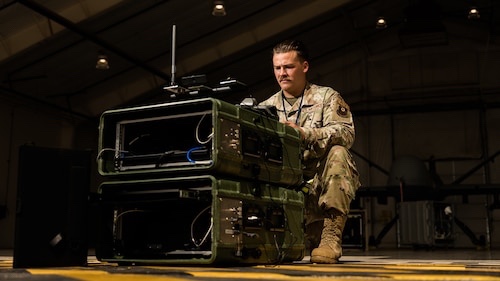
In 2015, the 3rd Aircraft Maintenance Unit was tasked with reducing cargo taken on an MQ-1 Predator alert package with the goal to decrease the need for two C-17 Globemaster IIIs to only one. Then Tech. Sgt. Bridget Carroll had an idea to help achieve this goal with the creation of a “bird-in-a-box” later known as the Digital Aircraft Link Emulator, or DALE.

Though Carroll created the solution, she was not met with instant success. Her journey took seven years.

Spring 2015 – Need was discovered.

July 2015 – First MQ-1 DALE prototype created.

September 2015 – Airman Powered by Innovation submitted.

Spring 2016 – Space Dynamics Lab at the University of Utah created two DALE MQ-9 Reaper prototypes.

August 2018 – Air Force Special Operations Command 2019 Spark Tank competition submitted.

October 2018 – API disapproval

October 2018 – Notified that MQ-9 DALE had won AFSOC Spark Tank Top 5.

February 2019 – DALE presented at Air Force Association Spark Tank.

Present – DALE Jr. developed and employed.

“If we could mobilize our capability without an actual aircraft then we could get down range and get operational faster,” Carroll said. “I had the idea to put the minimum amount of aircraft parts in a box to still do line-of-sight checks with our control stations after we set up a field site.”

During her planning phase of DALE, the Air Force was retiring the MQ-1, which resulted in a lower risk if the aircraft parts were damaged during the project’s initial stages.
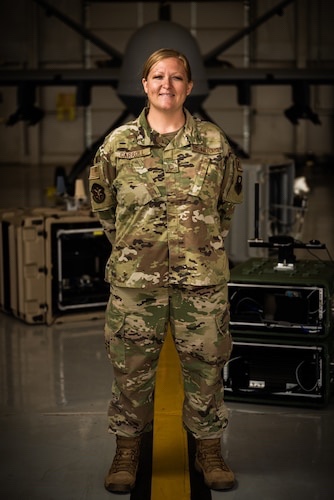
“Once all the parts came in, I took the MQ-1 computer, gutted an electronics case that was awaiting DRMO, spliced cables, drilled mounting brackets, and pieced together the first “bird-in-a-box” prototype,” she said.

Before the existence of DALE, this process would require more than 10 Airmen to accompany the package, set it up and tow the remotely piloted aircraft around the airfield to ensure link connections were made.

Today, the DALE can be unloaded and ready for use with two Airmen in less than an hour. It is used to establish line of sight connections on a remote airfield and can be unloaded, set up and prepared for link checks in a more efficient manner.

Carroll’s idea and her creation of DALE serve as an inspiration for all Airmen to lean into innovation to accelerate change.

“Spark Tank is a chance to celebrate our Air Force risk-takers, idea makers and entrepreneurs who refuse to accept the status quo and have determined their own fate by developing solutions that make it easier for us to bring our very best to the fight,” said Lauren Knausenberger, Spark Tank director.

Innovation competitions like Spark Tank create an avenue for Airmen to think outside of the box and in Carroll’s case, put her idea in a box.

“Don’t give up,” she said. “There’s always people and other avenues out there that will help you.”

Staff Sgt. Chase Ward, 727th Special Operations Aircraft Maintenance Squadron avionics craftsman, began working alongside Carroll and the DALE jr. prototype last year and has witnessed the impact of her innovation. He said that the final version of DALE is in the process of being manufactured and sent out Air Force wide.

“I appreciate being able to watch this process go full circle,” Ward said. “It is awesome to know that our ideas do matter.”

Carroll’s journey and level of success is a testimony to hard work, dedication and the impact of empowering Airmen with a culture of innovation. She did not allow a hurdle such as not winning a competition prevent her from accomplishing her goals.

Story by TSgt Kaylee Clark

Photos by SSgt Candin Muniz

27th Special Operations Wing Public Affairs

AeroVironment’s New Mantis i23 D Multi-Sensor Imaging Payload Delivers Superior Daytime Surveillance Performance

Thursday, September 1st, 2022

• Mantis i23 D is a compact, high-performance daytime imaging payload system for intelligence, surveillance and reconnaissance (ISR) operations at an extended range

• Features 24X digital zoom video for extended ISR without compromising image quality

• Payload provides 50 percent wider HFOV and more than four times the target detection capability over the current Mantis i23 for improved situational awareness


The Mantis i23 D daytime imaging payload system allows operators to capture ISR at a greater aircraft standoff distance without compromising image quality. (Photo: AeroVironment, Inc.)

ARLINGTON, Va., Aug. 30, 2022 –AeroVironment, Inc. (NASDAQ: AVAV), a global leader in intelligent, multi-domain robotic systems, today introduced Mantis™ i23 D, a multi-sensor daytime imaging payload compatible with the Raven® B small unmanned aircraft systems (SUAS). An enhanced daylight variant of its predecessor, the Mantis i23, Mantis i23 D maintains its ruggedized design and utilizes the same modular interface to allow for quick and simple swapping between payloads with no software updates required to the avionics or ground control systems.

At 13.4 ounces (380 grams), the ultralight imaging system features dual 18 MP electro-optical sensors and class-leading 24X digital zoom, providing four times improved target detection over the current Mantis i23 payload during daytime missions. Through its advanced suite of sensors, extended zoom capability, onboard processing and digital imaging stabilization, the Mantis i23 D payload allows operators to increase aircraft standoff distance without compromising image quality.

“With the introduction of the next-generation Mantis payload, we have expanded the capabilities and adoption of the combat-proven Raven SUAS,” said Charles Dean, AeroVironment vice president of global business development, sales and marketing. “Customers can now operate their Raven systems at a greater standoff distance than before, enabling eyes-on-target from several kilometers away and reducing the risk of the target detecting or hearing the SUAS overhead.”

To learn more about Mantis i23 D and AeroVironment’s expansive Mantis product line of micro-gimbals, visit: www.avinc.com/uas/payloads.

DroneShield Releases DroneSentry-C2 Command-and-Control System Update

Wednesday, August 24th, 2022

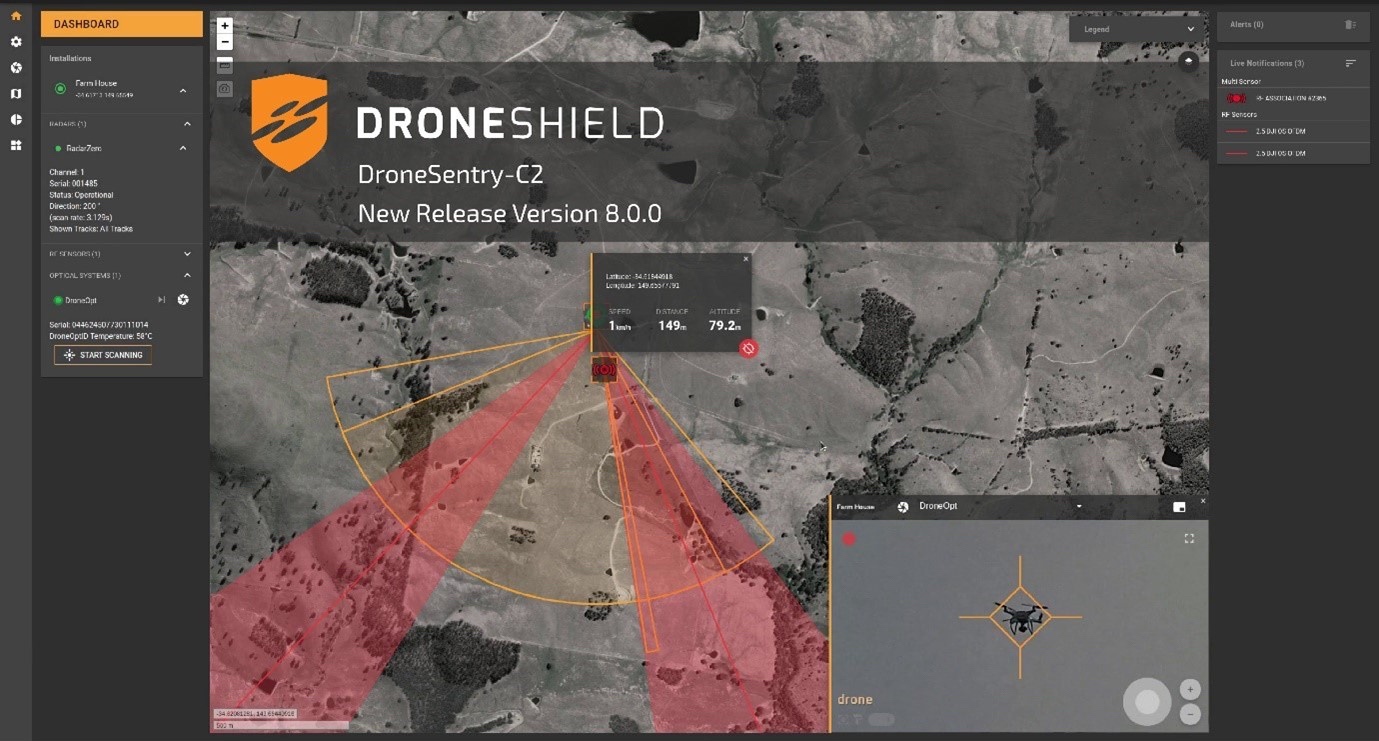
DroneShield is pleased to announce it has released the latest v8.0.0 version of its DroneSentry-C2 Command-and-Control System. Both secure cloud-hosted and on-premises editions of the DroneSentry-C2 software receive quarterly software updates, which include upgrades to DroneShield’s edge computing server (SmartHub), computer vision AI engine (DroneOptID) and sensor fusion (ComputeNode) components of the system.  

This major update of DroneSentry-C2 includes security improvements including patches for zero-day vulnerabilities, bug fixes and performance improvements.  

Major upgrades include:  

Integration of additional FLIR Thermal Cameras: Adding to the suite of cameras integrated into the DroneSentry-C2, the FLIR Ranger HDC MS 1200 and Ranger HDC MR Electro-Optical (EO) and Infra-red (IR) capable cameras have been integrated as plug and play options. Optical DroneOptID computer vision models have been refined for thermal cameras.  

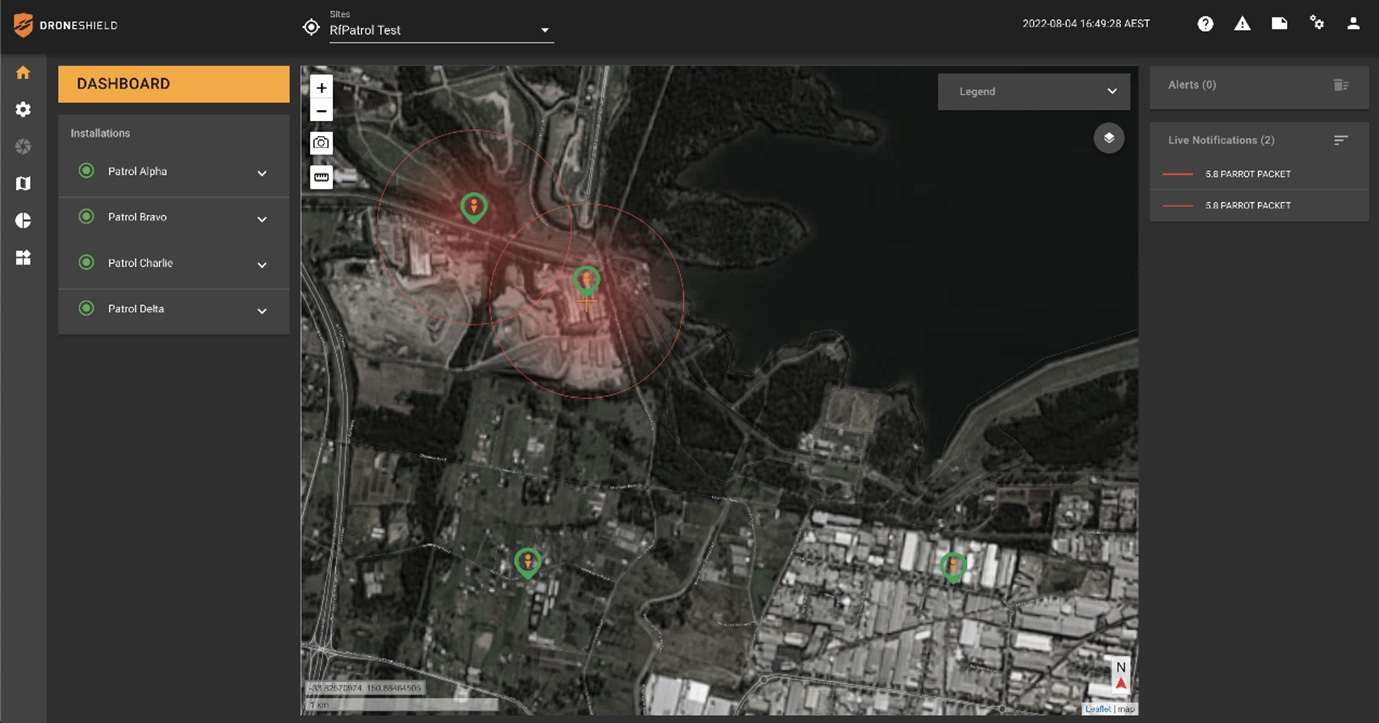
Integration of the RfPatrol: When paired with compatible MANET-radios the wearable RfPatrol drone detector can now  provide near real-time drone detection alerts and sensor location data fully integrated into the common operating picture of the DroneSentry-C2 user interface. This provides situational awareness across multiple RfPatrol devices in the field from a single map view. 

 Image: RfPatrol wearable drone detection sensors tracked on DroneSentry-C2

Usability improvements: User feedback has been incorporated to improve the usability of settings such as radar masking, RF filtering, flexible sensor setup and drone detection display. These improvements greatly reduces average setup time, cognitive burden, and time needed for training.  

Video Labelling: Video recordings can now be labelled for the purposes of feedback to DroneShield for DroneOptID AI Model training. 

Streamlined Analytics: Historical data is now intelligently filtered and low-value data is deleted. This reduces the amount of storage required for on-premises users and reduces cognitive burden on operators viewing analytics.  

Video tracking and optical model improvements: DroneOptID enhancements  include improved optical drone tracking and identification. 

Angus Bean, DroneShield’s Chief Technology Officer, commented, “This major software update, incorporates a substantial amount of end-user feedback, which enhances all facets of the DroneSentry-C2 system including user experience, performance, security, and the number of integrated sensors and effectors. DroneShield is uniquely positioned as a bleeding edge technology manufacturer of individual sensors, as well as a systems integrator, enabling our team to optimise the ecosystem experience for our end users.”

Nordic Unmanned Opens North American Office

Monday, August 22nd, 2022

22.08.2022, Sandnes, Norway – Nordic Unmanned opens a North American office headed by a seasoned industry veteran to expand its business in the world’s largest and fastest-growing drone market.

The office will be located in Baltimore County, Maryland, close to strategic partners, potential governmental and commercial clients and aviation authorities. The focus will be on offering Nordic Unmanned’s existing products and services portfolio, as well as operational experience with performing long-range, complex beyond visual line of sight (BVLOS) operations, in pursuit of the North American defense, government, and commercial markets.

North America is the largest drone market in the world, with the highest expected growth rate, both within the defense and enterprise market. The U.S. 2023 defense budget request consists of 20 programs fully dedicated to the procurement of drones, totaling $2.6 billion. The enterprise market adds to this, with its expected CAGR of 15.8 percent from 2021 to 2030.

“Expanding into accessible markets is a key part of our growth strategy. The US is a very appealing market for Nordic Unmanned, allowing us to build upon our leading role in the European drone industry and leverage our EASA-approved Light UAS Operator Certificate (LUC) and experience within complex BVLOS drone operations. This provides a solid foundation for capturing the enormous opportunities identified through the development of drone regulations in North America. Europe and North America have a long and positive history of collaboration on aviation rules, safety, regulations and operational licenses, for all aspects of the aviation industry, including drones. Nordic Unmanned has the ambition to become the first company with a fully approved BVLOS operating certificate, for multiple complex drone systems, in both Europe and the U.S,” says Knut Roar Wiig, CEO of Nordic Unmanned.

The North American market will be led by the seasoned multi-mode aviation, defense, rail, and transit executive Timothy “T3” Tenne. Mr. Tenne joins Nordic Unmanned from the position of Chief Operations Officer at Easy Aerial Inc, where he has led their operations, production, regulatory, and other areas within the defense, enterprise, government, and rail drone solutions. Tim has also held senior leadership positions with, amongst others, the Federal Aviation Administration (FAA), Amtrak, Maryland Transit Administration and U.S. Air Force. Mr. Tenne is a local of Baltimore County and Maryland, where he attended the U.S. Naval Academy and went on to become a pilot and leader, and eventually retired after many years of service.  

“I’m excited by this opportunity, and I look forward to making the new entity the leader in this market and applying my many years of executive aviation and aerospace experience to deliver cutting-edge solutions to existing and new customers in multiple verticals,” says Timothy Tenne.

“Opening the office in Baltimore County was a carefully planned and strategic decision. Maryland is an attractive state for this business, with proximity to partners, potential customers, test and operations areas, a growing pool of technical and engineering talent, and proximity to the Federal Aviation Administration (FAA). These are major benefits, while at the same ensuring closeness to Norway with only a six-hour time difference. This is crucial for us to ensure synergies and to harvest the substantial operational experience from our colleagues in Norway,” Mr. Tenne says.

“As the leading operator and provider of drone solutions, it is a natural next step for us to enter the largest and fastest growing market in the world. We expect to turn the current North America opportunity pipeline into revenue within the next six months,” concludes CEO Knut Roar Wiig.

www.nordicunmanned.com

DISCLOSURE REGULATION This information is subject to the disclosure requirements pursuant to section 5-12 of the Norwegian Securities Trading Act.

U.S. Army Selects AeroVironment JUMP 20 Medium Unmanned Aircraft System for Future Tactical Unmanned Aircraft System (FTUAS) Increment 1

Monday, August 22nd, 2022

• FTUAS to replace RQ-7B Shadow UAS currently fielded in selected Brigade Combat Teams

• Increment 1 entails testing and fielding JUMP 20 medium unmanned aircraft on an accelerated schedule as it competes to become the U.S. Army’s FTUAS of choice  

• The JUMP 20 vertical takeoff and landing (VTOL), runway independent medium unmanned aircraft system provides intelligence, surveillance and reconnaissance (ISR) services with increased maneuverability, and improved command and control


Specialist. Christopher McCoy assigned to 1st Engineer Battalion, 1st Infantry Division, conducts an engine start on the JUMP 20 prior to a launch during the FTUAS capabilities assessment at Fort Riley, Kansas. (Photo: Courtesy asset of the U.S. Department of Defense [DoD]) Disclaimer: The appearance of U.S. DoD visual information does not imply or constitute DoD endorsement.

ARLINGTON, Va., Aug. 19, 2022 –AeroVironment, Inc. (NASDAQ: AVAV), a global leader in intelligent, multi-domain robotic systems, today announced it received an Other Transaction Agreement award by the United States Army on Aug. 18, 2022 for Increment 1 of the Future Tactical Unmanned Aircraft System (FTUAS) program. The contract encompasses the purchase, testing and delivery of one JUMP® 20 medium unmanned aircraft system (MUAS) to a selected Army Brigade Combat Team (BCT) and associated services, training and support.

“With Increment 1 of the FTUAS program, the Army will be testing and fielding the JUMP 20 on an accelerated schedule as they seek a replacement for the RQ-7B Shadow UAS currently fielded in Brigade Combat Teams,” said Gorik Hossepian, AeroVironment vice president and product line general manager for MUAS. “The combat-proven JUMP 20 is a rapidly deployable, runway independent, vertical takeoff and landing solution for the Army. Its ability to be deployed, operated and sustained from anywhere is a game-changer in theater and in situations where the enemy has invaded or destroyed infrastructure.”

The AeroVironment JUMP 20 is the first fixed-wing unmanned aircraft system capable of vertical takeoff and landing (VTOL) to be deployed extensively in support of U.S. military forces. Ideal for multi-mission operations, JUMP 20 delivers 14+ hours of endurance, a standard operational range of 115 miles (185 kilometers) and is runway independent. The system can be set up and operational in less than 60 minutes without the need for launch or recovery equipment and has a useable payload capacity of up to 30 pounds (13.6 kilograms). The JUMP 20 also features a common autopilot and ground control system architecture providing a highly customizable, modular platform that can be custom configured to meet operational or customer requirements.

GA-ASI Tests PT6 E-series Engine from Pratt & Whitney on MQ-9B RPA

Sunday, August 21st, 2022

SAN DIEGO – 16 August 2022 – On July 29, 2022, General Atomics Aeronautical Systems, Inc. (GA-ASI) tested a PT6 E-Series model turboprop engine from Pratt & Whitney Canada on GA-ASI’s MQ-9B Remotely Piloted Aircraft (RPA). Multiple full-power engine tests were performed at GA-ASI’s Desert Horizon flight operations facility in El Mirage, Calif.

“We’ve enjoyed a long-term relationship with Pratt & Whitney,” said GA-ASI President David R. Alexander. “Integrating their PT6 E-Series engine onto our MQ-9B SkyGuardian® aircraft offers an alternate option for future customers that includes a 33 percent increase in power, dual channel electronic propeller and engine control system, as well as all the benefits of the PT6 engine family.”

The PT6 E-Series is a reliable and versatile turboprop engine family that will deliver the performance characteristics required as GA-ASI continues its development of MQ-9B capabilities.

“Our PT6 E-series is the ideal engine for this mission and we look forward to working with General Atomics on this important program,” said Jill Albertelli, president of Pratt & Whitney Military Engines.

MQ-9B represents the next generation of RPA system having demonstrated airborne endurance of more than 40 hours in certain configurations, automatic takeoffs and landings under SATCOM-only control, as well as a GA-ASI developed Detect and Avoid system. Its development is the result of a company-funded effort to deliver an RPA that can meet the stringent airworthiness certification requirements of various military and civil authorities.

GA-ASI has enjoyed a long-term collaboration with Pratt & Whitney for over a decade with their turbofan engine for GA-ASI’s MQ-20 Avenger RPA.

Schiebel Camcopter S-100 Delivers UAS Capability As Part Of Bristow’s New Search And Rescue Contract With UK’s Maritime And Coastguard Agency

Thursday, August 18th, 2022

Vienna, 12 August 2022 – Bristow, the global leader in vertical flight, has been awarded a 10-year contract by the UK Maritime Coastguard Agency (MCA) to deliver the Second-Generation Search and Rescue (UKSAR2G) programme. The contract includes the operational deployment of Schiebel’s CAMCOPTER® S-100 Unmanned Air System (UAS).

The new contract expands and builds on the existing capabilities Bristow has delivered to the MCA since 2015, most notably the life-saving search and rescue helicopter service (SAR) for HM Coastguard.

In January 2019, Bristow received the delivery of its first Schiebel CAMCOPTER® S-100 system, consisting of two aircraft, a Ground Control Station and engineering and logistic support as a Proof of Concept capability. Its aim was to prove the utility of combining unmanned with manned aviation in the SAR role to ensure greater efficiency and effectiveness. In 2022, Bristow took delivery of a second system, stationed on the south coast of England supporting the MCA and HM Coastguard operations in the English Channel. Recently, Bristow trained additional pilots and engineers to maintain its fleet of S-100 in the UK.

The CAMCOPTER® S-100 Vertical Takeoff and Landing (VTOL) UAS needs no prepared area or supporting launch or recovery equipment. It operates day and night, under adverse weather conditions with a range of payloads, out to 200 km, both on land and at sea.

Hans Georg Schiebel, Chairman of the Schiebel Group, said: “We are immensely proud that the S-100 is the UAS of choice to support SAR activities in the UK. The unrivalled maritime experience of the S-100 and the countless operations all over the world make the Schiebel UAS ideally suited for the UKSAR2G programme.”