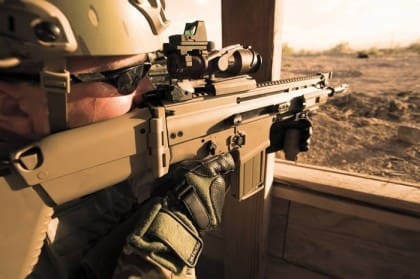
So you’re asking yourself, what is this “Milestone C”? Programs of record are structured with several milestones that they must reach in order to progress from good idea to fielded piece of equipment. In the case of milestone C, it is the decision to “authorize” full production and fielding. And in this case in particular, it is intriguing choice of words. SOCOM and Crane have remained mum on this decision but have been talking in general terms about a forthcoming milestone C decision for years. Below is the press release from FNH, manufacturers of the SCAR for SOCOM that is the only known announcement of the move.
FNH USA, LLC received notification from the USSOCOM Program Executive Office—SOF Warrior (PEO—SW) that the SCAR Acquisition Decision Memorandum (ADM) was approved and signed on April 14, 2010, moving this FN Herstal (FN) program into the Milestone C phase. This decision authorizes the production and deployment of the Special Operations Forces (SOF) Combat Assault Rifle (SCAR) MK 16 and MK 17, as well as the Enhanced Grenade Launcher Module (EGLM) MK 13.
Following a worldwide solicitation to the military firearms industry, nine vendors submitted a dozen different designs for a new modular, multi-caliber weapons system. The FN SCAR submission was the only weapons system to pass all of the Go/No-Go criteria and was unanimously chosen in November 2004 by the selection board composed of senior operators from every SOF component. The SCAR is the first new assault rifle procured by the U.S. Military through a full and open competition since the M16 trials were held in the mid-1960s. Tests in reliability, accuracy, safety and ergonomics were administered from August 2005 to September 2008 and were conducted in a variety of environments including urban, maritime, jungle and winter/mountain operational test scenarios. The SCAR weapons system successfully endured more than two million rounds of ammunition during these trials, therein making it one of the most heavily tested weapons in the history of small arms.
“The SCAR is one of the most tested small arms in our military’s history and is currently being employed in the fight to defend freedom,†said United States Senator Lindsey Graham (R-SC), member of the Senate Armed Services Committee. “Products of excellence, like the SCAR, represent the continuation of a long and proud tradition of defense manufacturing in South Carolina. I look forward to the continued use of this weapons system.â€
The FN SCAR system consists of two highly adaptable modular rifle platforms and a grenade launcher. Type-designated as the MK 16 MOD 0 5.56mm Special Operations Forces Combat Assault Rifle and the MK 17 MOD 0 7.62mm Special Operations Forces Combat Assault Rifle, both weapons are available with three different barrel lengths optimized for conducting operations in close-quarters combat, standard infantry and longer-range precision fire roles. All SCAR barrels can be easily interchanged by the operator in just minutes to instantly meet the requirements of virtually any mission. The MK 13 MOD 0 40mm Enhanced Grenade Launcher Module (EGLM) quickly mounts under the barrel of either SCAR platform, providing additional capability to the individual warfighter’s firepower, and can be easily configured for use as a stand-alone weapon as well. Because of the SCAR system’s modular design, ergonomic commonality (100%) and parts commonality (greater than 80%), it represents a significant reduction in training costs and life-cycle support. The weapon system’s open architecture is designed to support future advancements in operational requirements including ammunition, aiming devices, sighting systems and other mission critical equipment.
“The SCAR weapons system is a major USSOCOM program whose success is a direct result of the effort, commitment and teamwork provided by FN and the U.S. Government. We are extremely pleased to have had the opportunity to work with such a strong team in achieving the Milestone C decision,†said Mark Cherpes, Vice President of Military Operations for FNH USA. “This milestone signifies that our products are operationally effective and suitable for mass fielding. We believe that the SCAR is the most flexible, reliable and cost-effective small arms weapons system ever offered to America’s servicemen and women, and that it will give them a significant operational advantage in both present and future conflicts.â€
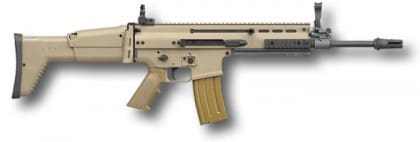
Now take a look at the two dates associated with this release. SOCOM approved the milestone C decision on April 14, 2010 yet the weapon was down selected in November, 2004. So it took five-and-a-half years for SOCOM to work the bugs out of the weapon to the point where they could authorize production. Based on feedback we have received from the field, it has been a long road and the weapon continues to have its fleas. But a few examples of issues that continue to plague the weapon are the reciprocating charging handle, ergonomics issues, pencil barrel to meet weight standards, and a butt stock that can be unlocked with a simple tap in the right place. Additionally, both variants of the SCAR are said to be battering the SOPMOD II accessories during firing despite a requirement that the SCAR is compatible with them.
Another issue is that due to the low numbers, the guns are still being manufactured in Belgium and assembled here. FNH has still not set up a US line. However, in a stroke of engineering genius, FN has developed the common receiver which essentially makes the Mk 16 and Mk 17 the single, modular weapon envisioned in the original requirements document. With the advent of this common receiver, essentially every rifle has a Mk 17 receiver, and with the addition of a new barrel and receiver insert, the rifle can be converted to a Mk 16. This may be one of the main sticking points on how many weapons and type are actually fielded.
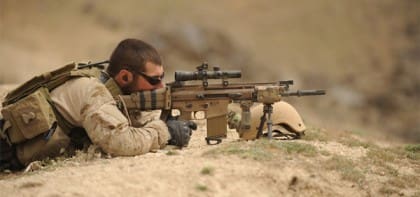
Sources claim that originally, the program was supposed to procure 4 Mk 16 SCAR-Lights for every Mk 17 SCAR-Heavy. However, once the weapons hit the field, few operators were willing to replace their M4 SOPMODs with the Mk 16 and demand turned this basis of issue on its head flip-flopping the numbers. In fact, the few photos that have been released by DoD show troops carrying Mk 17s rather than the 5.56 Mk 16. And why might you ask is this the case? Quite simply because SOCOM lacks a 7.62 battle rifle. And what is even more interesting is how the Mk 17 was even fielded in the first place. The simple fact of the matter is that the Mk 17 never participated in a small arms down select. It was selected simply because SOCOM added a requirement for a 7.62 big brother for the 5.56 SCAR-light. The Mk 17 did not participate in the initial source selection and at the command level, SOCOM has never competed the SCAR-Heavy against any other rifles. Furthermore, with the various issues surrounding the weapon, it will be interesting the see how the Mk 16 SCAR-Light will fair if it is entered in next year’s Army Improved Carbine program.
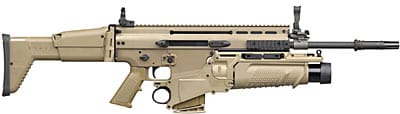
While the troops are happy with the enhanced capability of the Mk 17, it too has some special problems in addition to those already common with the Mk 16. For example, the current magazine is a modified FN FAL 20 round magazine which falls short of SOCOM’s desired 25 rounds. Additionally, with the Mk 13 EGLM fitted to the Mk 16, the current mag is completely enclosed in the weapon and can get stuck if it doesn’t fall free. The issue of the Mk 13 also makes it all but impossible to develop a polymer magazine for the Mk 17 without major engineering changes.
We cannot lay blame for this dilemma at the feet of FNH nor can we throw Crane under the bus either. After all, FNH is just building to the requirements and Crane has an excellent history, overseeing the development of the SOPMOD program. Both are very successful entities in their own right. It’s really more a case of acquisition run amok. It is just difficult to stop a program once it is going, even one gone wrong. Add to this SOCOM’s MFP-11 service-like acquisition authority and you have a situation where they can’t afford to drop the ball on something as simple as a battle rifle when the services wait for their chance to gobble up the funding line.
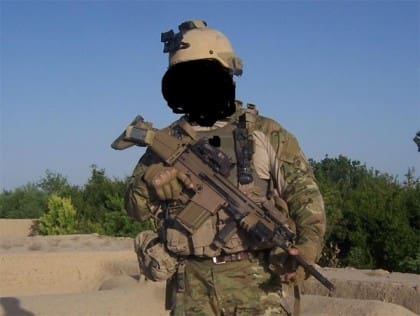
We will watch to see if the word “authorize” in the press release means that the program is just administratively on track and the things that need to happen are happening for bureaucracy’s sake, or that SOCOM will procure the full or an amended Basis of Issue and field them to its components. Even more telling will be if those weapons are actually being used.



 One of the coolest things I saw at last week’s