From frontline operators under fire to law enforcement officers on the street, comfortable, reliable and rugged personal protective equipment (PPE) is vital to get the mission accomplished. Operators must be confident that what they’re wearing equips them to perform effectively and safely against a continuously increasing range of threats, every time, without failure.
The dangers posed by aggressors constantly change. Recent images from around the world have not only shown troops facing higher energy ballistic threats in military engagements in the Middle East and Southwest Asia but also ferocious assaults on Special Weapons and Tactics (SWAT) teams. Police in Portland were frequently confronted by hails of rocks and concrete during disturbances in the summer of 2020 and a fire extinguisher was notoriously hurled at a group of officers during the US Capitol riots in January this year.
In response to these and other unpredictable military and law enforcement scenarios in-theatre, impact protection specialist D3O has applied its world-class material and product engineering capabilities to develop a new addition to its head protection range to better protect both military and law enforcement operators.
As this article goes on to explain, D3O’s latest innovation meets and exceeds blunt impact performance requirements at multiple impact velocities.
As a result, D3O offers head protection for the frontline warfighter who may be wearing a helmet for 15 hours uninterrupted as well as for the law enforcement officer facing a different type of threat on a short-duration mission.
Responding to evolving threats
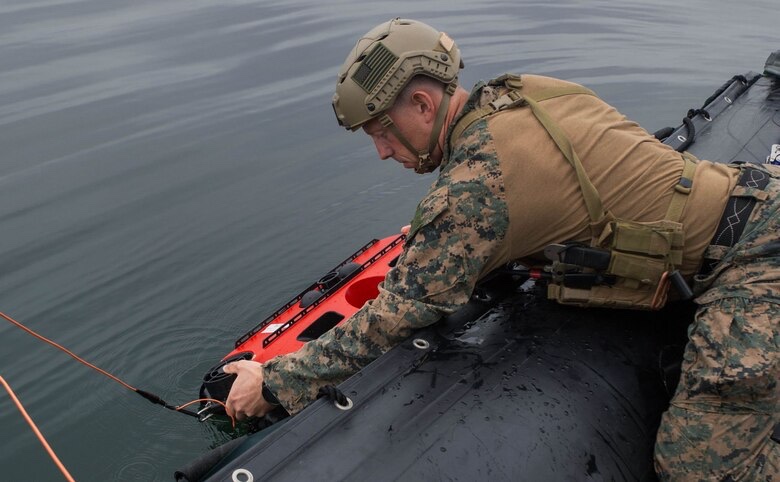
An integral component of an operator’s PPE kit is the helmet, which offers critical protection against threats including ballistic impact from arms fire and explosive devices, blunt impact from falls or contact with solid objects, and blast overpressure from explosive devices.
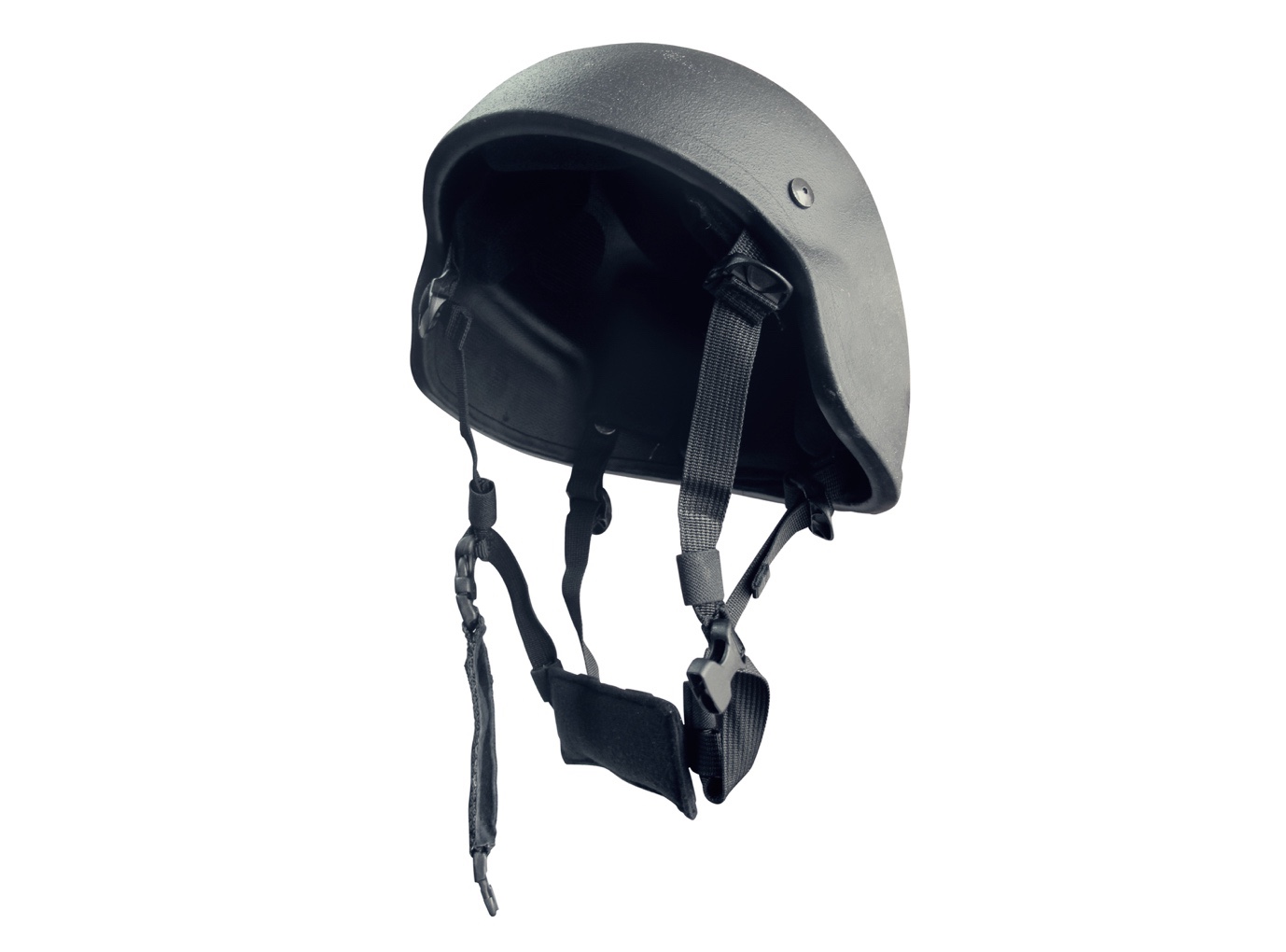
The helmet’s core components include an external hard shell, an internal liner and suspension system to achieve a customized fit and minimize acceleration and deceleration of the head while providing comfort, and a retention device such as a chin strap to secure the system to the wearer’s head.
These components work together to reduce the risk of injury by preventing penetration from a ballistic impact and absorbing energy from a blunt impact or blast event – any of which can lead to traumatic brain injury (TBI), where the brain’s normal function is disturbed.
Furthermore, the geometry and mass of additional accessories such as mandible protection, communications equipment or a ballistic visor cannot compromise the level of blunt impact protection or the overall balanced effectiveness of the helmet’s functioning parts.
All operators are aware of the adage, ‘Ounces equal pounds and pounds equal pain’. The average U.S. military warfighter carries at least 60 lbs of gear, with that figure often doubling for an extended patrol. Every component and accessory increases the total weight, which is particularly felt when added to the helmet. Operators must execute their mission without being distracted by their comfort level or fatigue. As a result, helmet system designers constantly face the challenge of increasing performance while ideally reducing weight.
The U.S. Army’s Integrated Helmet Protection System (IHPS) is one of three subsystems of the cutting-edge Soldier Protection System (SPS) – a platform designed to defeat current threats at a reduced weight while supporting the operator’s agility, maneuverability and survivability. SPS provides multiple levels of protection that can be tailored to a broad range of missions. The IHPS can also be configured and optimized to a specific task.
To help counter ever more unconventional projectiles, PPE specifications also evolve to provide enhanced levels of protection for operators. The IHPS product specification has a new requirement for a helmet that can perform at an impact velocity of 14 feet per second (fps) while not compromising performance at the traditional impact velocity of 10 fps, based on the Advanced Combat Helmet (ACH) standard (AR/PD 10-02). Protection at an impact velocity of 14 fps delivers a higher performance capability against the increasing energy exposure posed by many modern-day threats.
Applying cross-sector expertise
In 2015, D3O created the D3O® TRUST Stealth™ helmet pad system by leveraging its expertise from developing market-leading impact protection across the industrial, sports, motorcycle, electronics and defense markets. This system exceeds the required level of protection at 10 fps by 45 percent and maintains consistent performance on second impact. The seven-pad system fits most ground combat helmets and provides comfort during extended periods of wear.
TRUST Stealth™ was followed by TRUST Nimbus™, which delivers a 30 percent weight reduction and also exceeds the required level of protection at 10 fps by 50 percent in polyethylene (PE) shells and 39 percent in aramid shells. A seven- or nine-pad system that can be incorporated within most ground combat helmets, Nimbus™ offers state-of-the-art comfort, significantly easing the wearer burden.
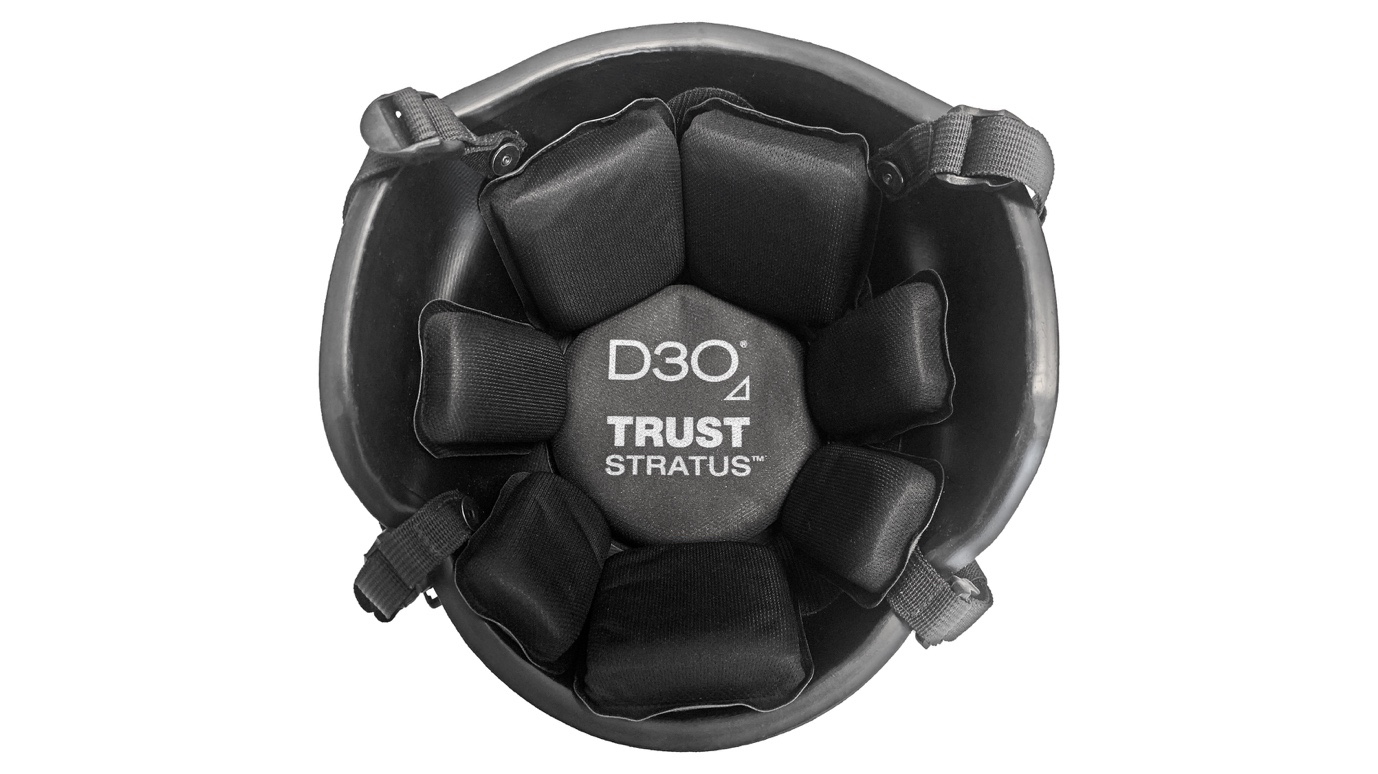
D3O® TRUST Stratus™ is the latest innovation in D3O’s Defense head protection range. Testing shows that Stratus™ is the only commercially available system to exceed the impact performance requirements of the ACH standard simultaneously at 10 and 14 fps in both PE and aramid shells.
An integrated comfort liner in each pad, head-side fabrics offering antimicrobial protection and superior moisture-wicking properties, plus a ventilated moisture barrier to prevent pressure points at high altitude, also help to keep the operator’s focus on the task rather than their PPE.
TRUST Stratus™ meets SPS hook and loop adhesion requirements and can be integrated as an eight- or 10-pad system within most infantry combat helmets. This opens up a range of commercial possibilities for law enforcement and military tenders.
Optimizing for protection and comfort
For Oliver Sunnucks, D3O’s Senior Product Design Engineer, D3O® TRUST Stratus™ is “a natural evolution of the work we’ve been doing on the D3O® TRUST range over the last six or seven years. Throughout our development of the D3O Defense head protection range, we have continually fine-tuned the balance between applications, materials and standards.
“Ballistic performance is delivered primarily by the shell, whereas blunt impact performance comes from the synergy of the shell and the system inside. However, where the shells are specifically designed to meet a ballistic requirement, the internal pad systems are required to work effectively with a range of varying helmet shell designs. From a design engineering perspective, we must also consider the effect of geometric variables such as shell size and profile, material property variables such as temperature and strain rate (that is, the different impact speed requirements) and how the system response is changed through multiple impacts (due to damage).
“Our expertise is in understanding how these things play off against each other and knowing how to optimize the variables in order to deliver maximum protection and comfort at the lightest weight.”
Kevin Fleer, D3O’s Head of Product, explains that the requirement for impact resistance at a speed of 14 fps is “based on real-life impacts that modern-day operators encounter. It’s no longer a niche solution but a mass market one.
“Also, it doesn’t equate that a helmet system capable of passing a 14 fps standard will automatically pass at 10 fps. In almost all cases, the materials in a system tuned to 14 fps will be too rigid at the lower impact velocity.
“D3O® materials are extremely rate sensitive, meaning they react instantly to different velocities and energies. Therefore, it is possible to meet both the 10 and 14 fps standards using materials that remain soft enough for the 10 fps test and hard enough for the 14. This is only achievable with so much rate sensitivity from your chosen materials, a performance advantage that is unique to D3O®.”
The D3O Defense head protection range draws on the company’s world-class material and product engineering capabilities in order to create technology that serves those who need it most.
Furthermore, the ability to scale up US production capacity to handle the demands of the SPS IHPS program means the company is ideally positioned to serve both military and law enforcement needs for head protection.
By offering these solutions off the shelf, D3O is pushing the boundaries of head protection for a variety of users and providing a range of options for specifiers looking to increase protection for their teams.
by Bill VanMullekom, D3O